Version published:
February 25, 2026 - 8:54pm
February 25, 2026 - 8:54pm
February 25, 2026 - 8:53pm
February 25, 2026 - 8:53pm
February 25, 2026 - 8:52pm
February 25, 2026 - 8:51pm
January 13, 2026 - 7:16pm
January 13, 2026 - 7:16pm
January 13, 2026 - 7:15pm
January 13, 2026 - 6:21pm
January 13, 2026 - 6:20pm
January 7, 2026 - 11:16pm
January 7, 2026 - 11:08pm
January 7, 2026 - 11:08pm
January 7, 2026 - 11:07pm
January 7, 2026 - 11:03pm
January 7, 2026 - 11:03pm
January 7, 2026 - 10:59pm
January 7, 2026 - 10:58pm
January 7, 2026 - 10:58pm
Species Selection, Cultivation and Harvesting
Species Selection
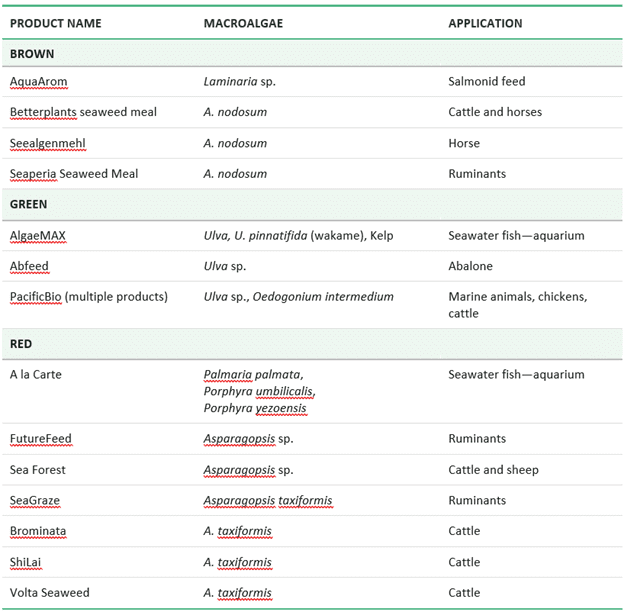
Seaweeds species used for animal feed are selected for their yield and nutritional profile; for example, Ulva species are favored for poultry feed while Asparagopsis taxiformis is preferred for cattle due to its co-benefits in methane reduction (Ozogul et al., 2024; Stedt et al., 2022).
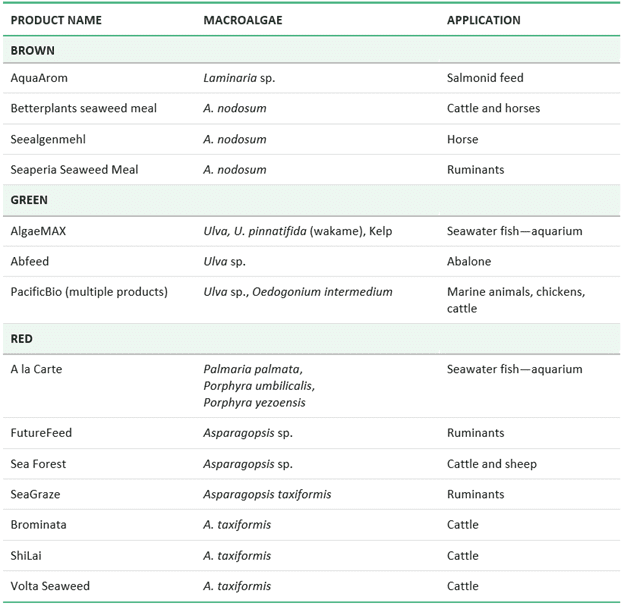
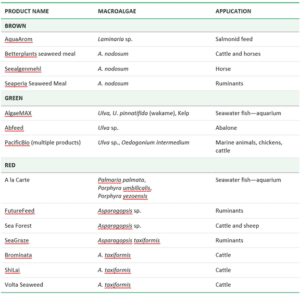
Table 1. Common species of seaweed that are cultivated for human food and animal feed products.
Nursery
See roadmap section “Cultivation and Drying Considerations” for more information.
Cultivation
See roadmap section “Cultivation and Drying Considerations” for more information.
Harvesting
See roadmap section “Cultivation and Drying Considerations” for more information.
Pre-processing
Seaweed must be dried prior to processing to quantify the dry weight yield, making it one of the most energy-intensive steps of the conversion workstream Drying methods through air drying on drying net frames, or freeze or heated drying in temperature-controlled rooms remove before quantifying the dry weight yield (Garcia-Vaquero & Hayes, 2016; Jönsson et al., 2020).
Heavy metal content, which must remain under a set concentration level for food and feed regulatory bodies, is reduced through blanching, washing and boiling before processing workstreams; this process can also remove the high salt content as appropriate (e.g., Hanaoka et al., 2001; Stévant et al., 2018; Ownsworth et al., 2019; Blikra et al., 2021).
Processing
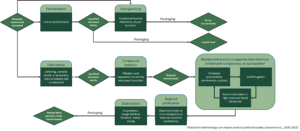
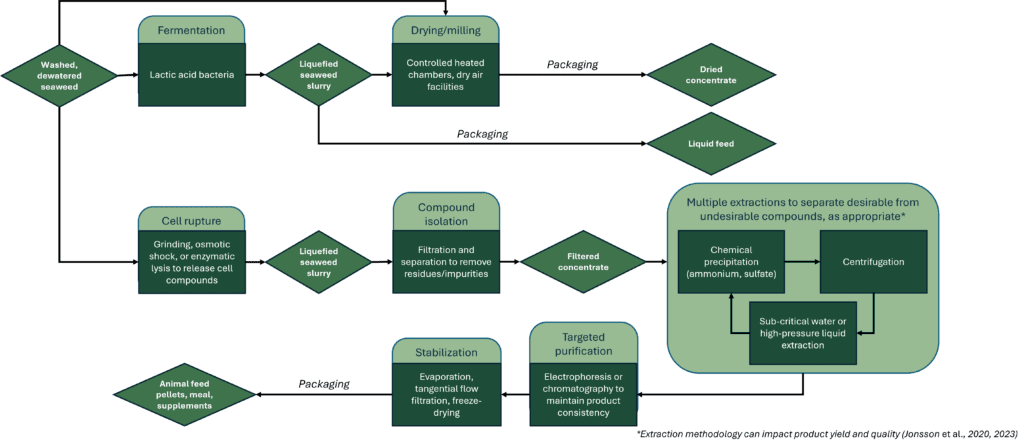
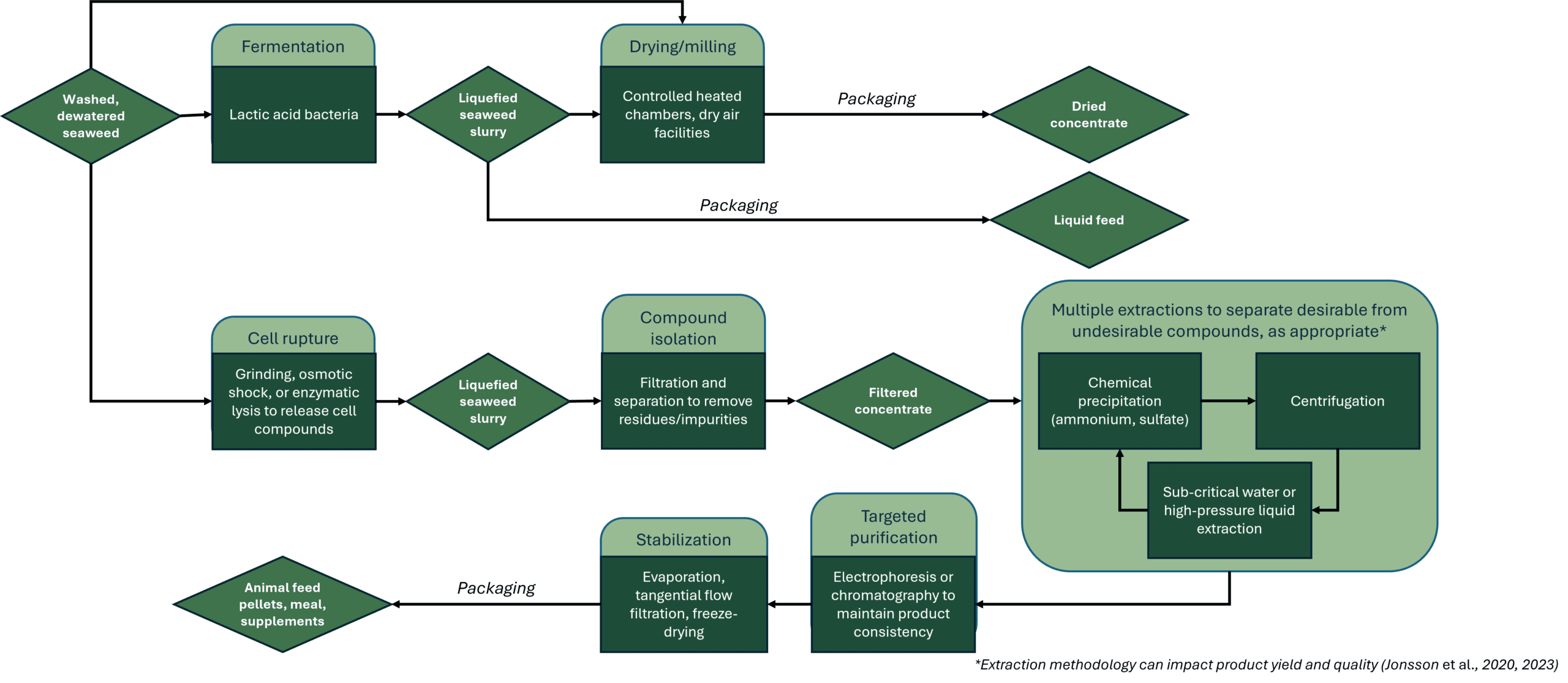
Animal feed extraction method can range from simple to complex, ranging from general processing into meal, pellets, or liquid extracts while complex processing isolates and concentrates key compounds of interest (O’Connor et al., 2020). Simple methods like fermentation and drying use microbes to enhance digestibility and shelf life before drying and milling, producing 2–7.5% of the original wet weight as dried meal or liquid extract (Stévant and Rebours, 2021; Ozogul et al., 2024). Complex methods involve protein extraction and purification through mechanical or enzymatic cell rupture, centrifugation, and advanced separation techniques (e.g., chromatography, electrophoresis), followed by post-processing (e.g., filtration, freeze-drying) to stabilize and concentrate proteins for consistent, high-quality products (Figure 2).
Post-processing
Animal feed may be packaged as pellets, likely to match the consistency and palatability needs of the livestock (e.g., Certified Organic Irish Seaweed Meal). Like with pet food, it can be packaged as a topper or a supplement in wet and dry forms.
Species Selection, Cultivation and Harvesting
Species Selection
Seaweeds species used for animal feed are selected for their yield and nutritional profile; for example,
Ulva species are favored for poultry feed while
Asparagopsis taxiformis is preferred for cattle due to its co-benefits in methane reduction (
Ozogul et al., 2024;
Stedt et al., 2022).
Table 1. Common species of seaweed that are cultivated for human food and animal feed products.
Nursery
See roadmap section “
Cultivation and Drying Considerations” for more information.
Cultivation
See roadmap section “
Cultivation and Drying Considerations” for more information.
Harvesting
See roadmap section “
Cultivation and Drying Considerations” for more information.
Pre-processing
Seaweed must be dried prior to processing to quantify the dry weight yield, making it one of the most energy-intensive steps of the conversion workstream Drying methods through air drying on drying net frames, or freeze or heated drying in temperature-controlled rooms remove before quantifying the dry weight yield (
Garcia-Vaquero & Hayes, 2016;
Jönsson et al., 2020).
Heavy metal content, which must remain under a set concentration level for food and feed regulatory bodies, is reduced through blanching, washing and boiling before processing workstreams; this process can also remove the high salt content as appropriate (e.g.,
Hanaoka et al., 2001;
Stévant et al., 2018;
Ownsworth et al., 2019;
Blikra et al., 2021).
Processing
Animal feed extraction method can range from simple to complex, ranging from general processing into meal, pellets, or liquid extracts while complex processing isolates and concentrates key compounds of interest (
O’Connor et al., 2020). Simple methods like fermentation and drying use microbes to enhance digestibility and shelf life before drying and milling, producing 2–7.5% of the original wet weight as dried meal or liquid extract (
Stévant and Rebours, 2021;
Ozogul et al., 2024). Complex methods involve protein extraction and purification through mechanical or enzymatic cell rupture, centrifugation, and advanced separation techniques (e.g., chromatography, electrophoresis), followed by post-processing (e.g., filtration, freeze-drying) to stabilize and concentrate proteins for consistent, high-quality products (Figure 2).
Post-processing
Animal feed may be packaged as pellets, likely to match the consistency and palatability needs of the livestock (e.g.,
Certified Organic Irish Seaweed Meal). Like with pet food, it can be packaged as a
topper or a supplement in wet and dry forms.
Species Selection, Cultivation and Harvesting
Species Selection
Seaweeds species used for animal feed are selected for their yield and nutritional profile; for example,
Ulva species are favored for poultry feed while
Asparagopsis taxiformis is preferred for cattle due to its co-benefits in methane reduction (
Ozogul et al., 2024;
Stedt et al., 2022).
Table 1. Common species of seaweed that are cultivated for human food and animal feed products.
Nursery
See roadmap section “
Cultivation and Drying Considerations” for more information.
Cultivation
See roadmap section “
Cultivation and Drying Considerations” for more information.
Harvesting
See roadmap section “
Cultivation and Drying Considerations” for more information.
Pre-processing
Seaweed must be dried prior to processing to quantify the dry weight yield, making it one of the most energy-intensive steps of the conversion workstream Drying methods through air drying on drying net frames, or freeze or heated drying in temperature-controlled rooms remove before quantifying the dry weight yield (
Garcia-Vaquero & Hayes, 2016;
Jönsson et al., 2020).
Heavy metal content, which must remain under a set concentration level for food and feed regulatory bodies, is reduced through blanching, washing and boiling before processing workstreams; this process can also remove the high salt content as appropriate (e.g.,
Hanaoka et al., 2001;
Stévant et al., 2018;
Ownsworth et al., 2019;
Blikra et al., 2021).
Processing
Animal feed extraction method can range from simple to complex, ranging from general processing into meal, pellets, or liquid extracts while complex processing isolates and concentrates key compounds of interest (
O’Connor et al., 2020). Simple methods like fermentation and drying use microbes to enhance digestibility and shelf life before drying and milling, producing 2–7.5% of the original wet weight as dried meal or liquid extract (
Stévant and Rebours, 2021;
Ozogul et al., 2024). Complex methods involve protein extraction and purification through mechanical or enzymatic cell rupture, centrifugation, and advanced separation techniques (e.g., chromatography, electrophoresis), followed by post-processing (e.g., filtration, freeze-drying) to stabilize and concentrate proteins for consistent, high-quality products (Figure 2).
Post-processing
Animal feed may be packaged as pellets, likely to match the consistency and palatability needs of the livestock (e.g.,
Certified Organic Irish Seaweed Meal). Like with pet food, it can be packaged as a
topper or a supplement in wet and dry forms.
Species Selection, Cultivation and Harvesting
Species Selection
Seaweeds species used for animal feed are selected for their yield and nutritional profile; for example,
Ulva species are favored for poultry feed while
Asparagopsis taxiformis is preferred for cattle due to its co-benefits in methane reduction (
Ozogul et al., 2024;
Stedt et al., 2022).
Table 1. Common species of seaweed that are cultivated for human food and animal feed products.
Nursery
See roadmap section “
Cultivation and Drying Considerations” for more information.
Cultivation
See roadmap section “
Cultivation and Drying Considerations” for more information.
Harvesting
See roadmap section “
Cultivation and Drying Considerations” for more information.
Pre-processing
Seaweed must be dried prior to processing to quantify the dry weight yield, making it one of the most energy-intensive steps of the conversion workstream Drying methods through air drying on drying net frames, or freeze or heated drying in temperature-controlled rooms remove before quantifying the dry weight yield (
Garcia-Vaquero & Hayes, 2016;
Jönsson et al., 2020).
Heavy metal content, which must remain under a set concentration level for food and feed regulatory bodies, is reduced through blanching, washing and boiling before processing workstreams; this process can also remove the high salt content as appropriate (e.g.,
Hanaoka et al., 2001;
Stévant et al., 2018;
Ownsworth et al., 2019;
Blikra et al., 2021).
Processing
Animal feed extraction method can range from simple to complex, ranging from general processing into meal, pellets, or liquid extracts while complex processing isolates and concentrates key compounds of interest (
O’Connor et al., 2020). Simple methods like fermentation and drying use microbes to enhance digestibility and shelf life before drying and milling, producing 2–7.5% of the original wet weight as dried meal or liquid extract (
Stévant and Rebours, 2021;
Ozogul et al., 2024). Complex methods involve protein extraction and purification through mechanical or enzymatic cell rupture, centrifugation, and advanced separation techniques (e.g., chromatography, electrophoresis), followed by post-processing (e.g., filtration, freeze-drying) to stabilize and concentrate proteins for consistent, high-quality products (Figure 2).
Post-processing
Animal feed may be packaged as pellets, likely to match the consistency and palatability needs of the livestock (e.g.,
Certified Organic Irish Seaweed Meal). Like with pet food, it can be packaged as a
topper or a supplement in wet and dry forms.
Species Selection, Cultivation and Harvesting
Species Selection
Seaweeds species used for animal feed are selected for their yield and nutritional profile; for example,
Ulva species are favored for poultry feed while
Asparagopsis taxiformis is preferred for cattle due to its co-benefits in methane reduction (
Ozogul et al., 2024;
Stedt et al., 2022).
Table 1. Common species of seaweed that are cultivated for human food and animal feed products.
Nursery
See roadmap section “
Cultivation and Drying Considerations” for more information.
Cultivation
See roadmap section “
Cultivation and Drying Considerations” for more information.
Harvesting
See roadmap section “
Cultivation and Drying Considerations” for more information.
Pre-processing
Seaweed must be dried prior to processing to quantify the dry weight yield, making it one of the most energy-intensive steps of the conversion workstream Drying methods through air drying on drying net frames, or freeze or heated drying in temperature-controlled rooms remove before quantifying the dry weight yield (
Garcia-Vaquero & Hayes, 2016;
Jönsson et al., 2020).
Heavy metal content, which must remain under a set concentration level for food and feed regulatory bodies, is reduced through blanching, washing and boiling before processing workstreams; this process can also remove the high salt content as appropriate (e.g.,
Hanaoka et al., 2001;
Stévant et al., 2018;
Ownsworth et al., 2019;
Blikra et al., 2021).
Processing
Animal feed extraction method can range from simple to complex, ranging from general processing into meal, pellets, or liquid extracts while complex processing isolates and concentrates key compounds of interest (
O’Connor et al., 2020). Simple methods like fermentation and drying use microbes to enhance digestibility and shelf life before drying and milling, producing 2–7.5% of the original wet weight as dried meal or liquid extract (
Stévant and Rebours, 2021;
Ozogul et al., 2024). Complex methods involve protein extraction and purification through mechanical or enzymatic cell rupture, centrifugation, and advanced separation techniques (e.g., chromatography, electrophoresis), followed by post-processing (e.g., filtration, freeze-drying) to stabilize and concentrate proteins for consistent, high-quality products (Figure 2).
Post-processing
Animal feed may be packaged as pellets, likely to match the consistency and palatability needs of the livestock (e.g.,
Certified Organic Irish Seaweed Meal). Like with pet food, it can be packaged as a
topper or a supplement in wet and dry forms.
Species Selection, Cultivation and Harvesting
Species Selection
Seaweeds species used for animal feed are selected for their yield and nutritional profile; for example,
Ulva species are favored for poultry feed while
Asparagopsis taxiformis is preferred for cattle due to its co-benefits in methane reduction (
Ozogul et al., 2024;
Stedt et al., 2022).
Table 1. Common species of seaweed that are cultivated for human food and animal feed products.
Nursery
See roadmap section “
Cultivation and Drying Considerations” for more information.
Cultivation
See roadmap section “
Cultivation and Drying Considerations” for more information.
Harvesting
See roadmap section “
Cultivation and Drying Considerations” for more information.
Pre-processing
Seaweed must be dried prior to processing to quantify the dry weight yield, making it one of the most energy-intensive steps of the conversion workstream Drying methods through air drying on drying net frames, or freeze or heated drying in temperature-controlled rooms remove before quantifying the dry weight yield (
Garcia-Vaquero & Hayes, 2016;
Jönsson et al., 2020).
Heavy metal content, which must remain under a set concentration level for food and feed regulatory bodies, is reduced through blanching, washing and boiling before processing workstreams; this process can also remove the high salt content as appropriate (e.g.,
Hanaoka et al., 2001;
Stévant et al., 2018;
Ownsworth et al., 2019;
Blikra et al., 2021).
Processing
Animal feed extraction method can range from simple to complex, ranging from general processing into meal, pellets, or liquid extracts while complex processing isolates and concentrates key compounds of interest (
O’Connor et al., 2020). Simple methods like fermentation and drying use microbes to enhance digestibility and shelf life before drying and milling, producing 2–7.5% of the original wet weight as dried meal or liquid extract (
Stévant and Rebours, 2021;
Ozogul et al., 2024). Complex methods involve protein extraction and purification through mechanical or enzymatic cell rupture, centrifugation, and advanced separation techniques (e.g., chromatography, electrophoresis), followed by post-processing (e.g., filtration, freeze-drying) to stabilize and concentrate proteins for consistent, high-quality products (Figure 2).
Post-processing
Animal feed may be packaged as pellets, likely to match the consistency and palatability needs of the livestock (e.g.,
Certified Organic Irish Seaweed Meal). Like with pet food, it can be packaged as a
topper or a supplement in wet and dry forms.
Species Selection, Cultivation and Harvesting
Species Selection
Seaweeds species used for animal feed are selected for their yield and nutritional profile; for example,
Ulva species are favored for poultry feed while
Asparagopsis taxiformis is preferred for cattle due to its co-benefits in methane reduction (
Ozogul et al., 2024;
Stedt et al., 2022).
Table 1. Common species of seaweed that are cultivated for human food and animal feed products.
Nursery
See roadmap section “
Cultivation and Drying Considerations” for more information.
Cultivation
See roadmap section “
Cultivation and Drying Considerations” for more information.
Harvesting
See roadmap section “
Cultivation and Drying Considerations” for more information.
Pre-processing
Seaweed must be dried prior to processing to quantify the dry weight yield, making it one of the most energy-intensive steps of the conversion workstream Drying methods through air drying on drying net frames, or freeze or heated drying in temperature-controlled rooms remove before quantifying the dry weight yield (
Garcia-Vaquero & Hayes, 2016;
Jönsson et al., 2020).
Heavy metal content, which must remain under a set concentration level for food and feed regulatory bodies, is reduced through blanching, washing and boiling before processing workstreams; this process can also remove the high salt content as appropriate (e.g.,
Hanaoka et al., 2001;
Stévant et al., 2018;
Ownsworth et al., 2019;
Blikra et al., 2021).
Processing
Animal feed extraction method can range from simple to complex, ranging from general processing into meal, pellets, or liquid extracts while complex processing isolates and concentrates key compounds of interest (
O’Connor et al., 2020). Simple methods like fermentation and drying use microbes to enhance digestibility and shelf life before drying and milling, producing 2–7.5% of the original wet weight as dried meal or liquid extract (
Stévant and Rebours, 2021;
Ozogul et al., 2024). Complex methods involve protein extraction and purification through mechanical or enzymatic cell rupture, centrifugation, and advanced separation techniques (e.g., chromatography, electrophoresis), followed by post-processing (e.g., filtration, freeze-drying) to stabilize and concentrate proteins for consistent, high-quality products (Figure 2).
Post-processing
Animal feed may be packaged as pellets, likely to match the consistency and palatability needs of the livestock (e.g.,
Certified Organic Irish Seaweed Meal). Like with pet food, it can be packaged as a
topper or a supplement in wet and dry forms.
Species Selection, Cultivation and Harvesting
Species Selection
Seaweeds species used for animal feed are selected for their yield and nutritional profile; for example,
Ulva species are favored for poultry feed while
Asparagopsis taxiformis is preferred for cattle due to its co-benefits in methane reduction (
Ozogul et al., 2024;
Stedt et al., 2022).
Table 1. Common species of seaweed that are cultivated for human food and animal feed products.
Nursery
See roadmap section “
Cultivation and Drying Considerations” for more information.
Cultivation
See roadmap section “
Cultivation and Drying Considerations” for more information.
Harvesting
See roadmap section “
Cultivation and Drying Considerations” for more information.
Pre-processing
Seaweed must be dried prior to processing to quantify the dry weight yield, making it one of the most energy-intensive steps of the conversion workstream Drying methods through air drying on drying net frames, or freeze or heated drying in temperature-controlled rooms remove before quantifying the dry weight yield (
Garcia-Vaquero & Hayes, 2016;
Jönsson et al., 2020).
Heavy metal content, which must remain under a set concentration level for food and feed regulatory bodies, is reduced through blanching, washing and boiling before processing workstreams; this process can also remove the high salt content as appropriate (e.g.,
Hanaoka et al., 2001;
Stévant et al., 2018;
Ownsworth et al., 2019;
Blikra et al., 2021).
Processing
Animal feed extraction method can range from simple to complex, ranging from general processing into meal, pellets, or liquid extracts while complex processing isolates and concentrates key compounds of interest (
O’Connor et al., 2020). Simple methods like fermentation and drying use microbes to enhance digestibility and shelf life before drying and milling, producing 2–7.5% of the original wet weight as dried meal or liquid extract (
Stévant and Rebours, 2021;
Ozogul et al., 2024). Complex methods involve protein extraction and purification through mechanical or enzymatic cell rupture, centrifugation, and advanced separation techniques (e.g., chromatography, electrophoresis), followed by post-processing (e.g., filtration, freeze-drying) to stabilize and concentrate proteins for consistent, high-quality products (Figure 2).
Post-processing
Animal feed may be packaged as pellets, likely to match the consistency and palatability needs of the livestock (e.g.,
Certified Organic Irish Seaweed Meal). Like with pet food, it can be packaged as a
topper or a supplement in wet and dry forms.
Species Selection, Cultivation and Harvesting
Species Selection
Seaweeds species used for animal feed are selected for their yield and nutritional profile; for example,
Ulva species are favored for poultry feed while
Asparagopsis taxiformis is preferred for cattle due to its co-benefits in methane reduction (
Ozogul et al., 2024;
Stedt et al., 2022).
Table 1. Common species of seaweed that are cultivated for human food and animal feed products.
Nursery
See roadmap section “
Cultivation and Drying Considerations” for more information.
Cultivation
See roadmap section “
Cultivation and Drying Considerations” for more information.
Harvesting
See roadmap section “
Cultivation and Drying Considerations” for more information.
Pre-processing
Seaweed must be dried prior to processing to quantify the dry weight yield, making it one of the most energy-intensive steps of the conversion workstream Drying methods through air drying on drying net frames, or freeze or heated drying in temperature-controlled rooms remove before quantifying the dry weight yield (
Garcia-Vaquero & Hayes, 2016;
Jönsson et al., 2020).
Heavy metal content, which must remain under a set concentration level for food and feed regulatory bodies, is reduced through blanching, washing and boiling before processing workstreams; this process can also remove the high salt content as appropriate (e.g.,
Hanaoka et al., 2001;
Stévant et al., 2018;
Ownsworth et al., 2019;
Blikra et al., 2021).
Processing
Animal feed extraction method can range from simple to complex, ranging from general processing into meal, pellets, or liquid extracts while complex processing isolates and concentrates key compounds of interest (
O’Connor et al., 2020). Simple methods like fermentation and drying use microbes to enhance digestibility and shelf life before drying and milling, producing 2–7.5% of the original wet weight as dried meal or liquid extract (
Stévant and Rebours, 2021;
Ozogul et al., 2024). Complex methods involve protein extraction and purification through mechanical or enzymatic cell rupture, centrifugation, and advanced separation techniques (e.g., chromatography, electrophoresis), followed by post-processing (e.g., filtration, freeze-drying) to stabilize and concentrate proteins for consistent, high-quality products (Figure 2).
Post-processing
Animal feed may be packaged as pellets, likely to match the consistency and palatability needs of the livestock (e.g.,
Certified Organic Irish Seaweed Meal). Like with pet food, it can be packaged as a
topper or a supplement in wet and dry forms.
Species Selection, Cultivation and Harvesting
Species Selection
Seaweeds species used for animal feed are selected for their yield and nutritional profile; for example,
Ulva species are favored for poultry feed while
Asparagopsis taxiformis is preferred for cattle due to its co-benefits in methane reduction (
Ozogul et al., 2024;
Stedt et al., 2022).
Table 1. Common species of seaweed that are cultivated for human food and animal feed products.
Nursery
See roadmap section “
Cultivation and Drying Considerations” for more information.
Cultivation
See roadmap section “
Cultivation and Drying Considerations” for more information.
Harvesting
See roadmap section “
Cultivation and Drying Considerations” for more information.
Pre-processing
Seaweed must be dried prior to processing to quantify the dry weight yield, making it one of the most energy-intensive steps of the conversion workstream Drying methods through air drying on drying net frames, or freeze or heated drying in temperature-controlled rooms remove before quantifying the dry weight yield (
Garcia-Vaquero & Hayes, 2016;
Jönsson et al., 2020).
Heavy metal content, which must remain under a set concentration level for food and feed regulatory bodies, is reduced through blanching, washing and boiling before processing workstreams; this process can also remove the high salt content as appropriate (e.g.,
Hanaoka et al., 2001;
Stévant et al., 2018;
Ownsworth et al., 2019;
Blikra et al., 2021).
Processing
Animal feed extraction method can range from simple to complex, ranging from general processing into meal, pellets, or liquid extracts while complex processing isolates and concentrates key compounds of interest (
O’Connor et al., 2020). Simple methods like fermentation and drying use microbes to enhance digestibility and shelf life before drying and milling, producing 2–7.5% of the original wet weight as dried meal or liquid extract (
Stévant and Rebours, 2021;
Ozogul et al., 2024). Complex methods involve protein extraction and purification through mechanical or enzymatic cell rupture, centrifugation, and advanced separation techniques (e.g., chromatography, electrophoresis), followed by post-processing (e.g., filtration, freeze-drying) to stabilize and concentrate proteins for consistent, high-quality products (Figure 2).
Post-processing
Animal feed may be packaged as pellets, likely to match the consistency and palatability needs of the livestock (e.g.,
Certified Organic Irish Seaweed Meal). Like with pet food, it can be packaged as a
topper or a supplement in wet and dry forms.
Species Selection, Cultivation and Harvesting
Species Selection
Seaweeds species used for animal feed are selected for their yield and nutritional profile; for example,
Ulva species are favored for poultry feed while
Asparagopsis taxiformis is preferred for cattle due to its co-benefits in methane reduction (
Ozogul et al., 2024;
Stedt et al., 2022).
Table 1. Common species of seaweed that are cultivated for human food and animal feed products.
Nursery
See roadmap section “
Cultivation and Drying Considerations” for more information.
Cultivation
See roadmap section “
Cultivation and Drying Considerations” for more information.
Harvesting
See roadmap section “
Cultivation and Drying Considerations” for more information.
Pre-processing
Seaweed must be dried prior to processing to quantify the dry weight yield, making it one of the most energy-intensive steps of the conversion workstream Drying methods through air drying on drying net frames, or freeze or heated drying in temperature-controlled rooms remove before quantifying the dry weight yield (
Garcia-Vaquero & Hayes, 2016;
Jönsson et al., 2020).
Heavy metal content, which must remain under a set concentration level for food and feed regulatory bodies, is reduced through blanching, washing and boiling before processing workstreams; this process can also remove the high salt content as appropriate (e.g.,
Hanaoka et al., 2001;
Stévant et al., 2018;
Ownsworth et al., 2019;
Blikra et al., 2021).
Processing
Animal feed extraction method can range from simple to complex, ranging from general processing into meal, pellets, or liquid extracts while complex processing isolates and concentrates key compounds of interest (
O’Connor et al., 2020). Simple methods like fermentation and drying use microbes to enhance digestibility and shelf life before drying and milling, producing 2–7.5% of the original wet weight as dried meal or liquid extract (
Stévant and Rebours, 2021;
Ozogul et al., 2024). Complex methods involve protein extraction and purification through mechanical or enzymatic cell rupture, centrifugation, and advanced separation techniques (e.g., chromatography, electrophoresis), followed by post-processing (e.g., filtration, freeze-drying) to stabilize and concentrate proteins for consistent, high-quality products (Figure 2).
Post-processing
Animal feed may be packaged as pellets, likely to match the consistency and palatability needs of the livestock (e.g.,
Certified Organic Irish Seaweed Meal). Like with pet food, it can be packaged as a
topper or a supplement in wet and dry forms.
Species Selection, Cultivation and Harvesting
Species Selection
Seaweeds species used for animal feed are selected for their yield and nutritional profile; for example,
Ulva species are favored for poultry feed while
Asparagopsis taxiformis is preferred for cattle due to its co-benefits in methane reduction (
Ozogul et al., 2024;
Stedt et al., 2022).
Table 1. Common species of seaweed that are cultivated for human food and animal feed products.
Nursery
See roadmap section “
Cultivation and Drying Considerations” for more information.
Cultivation
See roadmap section “
Cultivation and Drying Considerations” for more information.
Harvesting
See roadmap section “
Cultivation and Drying Considerations” for more information.
Pre-processing
Seaweed must be dried prior to processing to quantify the dry weight yield, making it one of the most energy-intensive steps of the conversion workstream Drying methods through air drying on drying net frames, or freeze or heated drying in temperature-controlled rooms remove before quantifying the dry weight yield (
Garcia-Vaquero & Hayes, 2016;
Jönsson et al., 2020).
Heavy metal content, which must remain under a set concentration level for food and feed regulatory bodies, is reduced through blanching, washing and boiling before processing workstreams; this process can also remove the high salt content as appropriate (e.g.,
Hanaoka et al., 2001;
Stévant et al., 2018;
Ownsworth et al., 2019;
Blikra et al., 2021).
Processing
Animal feed extraction method can range from simple to complex, ranging from general processing into meal, pellets, or liquid extracts while complex processing isolates and concentrates key compounds of interest (
O’Connor et al., 2020). Simple methods like fermentation and drying use microbes to enhance digestibility and shelf life before drying and milling, producing 2–7.5% of the original wet weight as dried meal or liquid extract (
Stévant and Rebours, 2021;
Ozogul et al., 2024). Complex methods involve protein extraction and purification through mechanical or enzymatic cell rupture, centrifugation, and advanced separation techniques (e.g., chromatography, electrophoresis), followed by post-processing (e.g., filtration, freeze-drying) to stabilize and concentrate proteins for consistent, high-quality products (Figure 2).
Post-processing
Animal feed may be packaged as pellets, likely to match the consistency and palatability needs of the livestock (e.g.,
Certified Organic Irish Seaweed Meal). Like with pet food, it can be packaged as a
topper or a supplement in wet and dry forms.
Species Selection, Cultivation and Harvesting
Species Selection
Seaweeds species used for animal feed are selected for their yield and nutritional profile; for example,
Ulva species are favored for poultry feed while
Asparagopsis taxiformis is preferred for cattle due to its co-benefits in methane reduction (
Ozogul et al., 2024;
Stedt et al., 2022).
Table 1. Common species of seaweed that are cultivated for human food and animal feed products.
Nursery
See roadmap section “
Cultivation and Drying Considerations” for more information.
Cultivation
See roadmap section “
Cultivation and Drying Considerations” for more information.
Harvesting
See roadmap section “
Cultivation and Drying Considerations” for more information.
Pre-processing
Seaweed must be dried prior to processing to quantify the dry weight yield, making it one of the most energy-intensive steps of the conversion workstream Drying methods through air drying on drying net frames, or freeze or heated drying in temperature-controlled rooms remove before quantifying the dry weight yield (
Garcia-Vaquero & Hayes, 2016;
Jönsson et al., 2020).
Heavy metal content, which must remain under a set concentration level for food and feed regulatory bodies, is reduced through blanching, washing and boiling before processing workstreams; this process can also remove the high salt content as appropriate (e.g.,
Hanaoka et al., 2001;
Stévant et al., 2018;
Ownsworth et al., 2019;
Blikra et al., 2021).
Processing
Animal feed extraction method can range from simple to complex, ranging from general processing into meal, pellets, or liquid extracts while complex processing isolates and concentrates key compounds of interest (
O’Connor et al., 2020). Simple methods like fermentation and drying use microbes to enhance digestibility and shelf life before drying and milling, producing 2–7.5% of the original wet weight as dried meal or liquid extract (
Stévant and Rebours, 2021;
Ozogul et al., 2024). Complex methods involve protein extraction and purification through mechanical or enzymatic cell rupture, centrifugation, and advanced separation techniques (e.g., chromatography, electrophoresis), followed by post-processing (e.g., filtration, freeze-drying) to stabilize and concentrate proteins for consistent, high-quality products (Figure 2).
Post-processing
Animal feed may be packaged as pellets, likely to match the consistency and palatability needs of the livestock (e.g.,
Certified Organic Irish Seaweed Meal). Like with pet food, it can be packaged as a
topper or a supplement in wet and dry forms.
Species Selection, Cultivation and Harvesting
Species Selection
Seaweeds species used for animal feed are selected for their yield and nutritional profile; for example,
Ulva species are favored for poultry feed while
Asparagopsis taxiformis is preferred for cattle due to its co-benefits in methane reduction (
Ozogul et al., 2024;
Stedt et al., 2022).
Table 1. Common species of seaweed that are cultivated for human food and animal feed products.
Nursery
See roadmap section “
Seaweed Cultivation” for more information.
Cultivation
See roadmap section “
Seaweed Cultivation” for more information.
Harvesting
See roadmap section “
Seaweed Cultivation” for more information.
Pre-processing
Seaweed must be dried prior to processing to quantify the dry weight yield, making it one of the most energy-intensive steps of the conversion workstream Drying methods through air drying on drying net frames, or freeze or heated drying in temperature-controlled rooms remove before quantifying the dry weight yield (
Garcia-Vaquero & Hayes, 2016;
Jönsson et al., 2020).
Heavy metal content, which must remain under a set concentration level for food and feed regulatory bodies, is reduced through blanching, washing and boiling before processing workstreams; this process can also remove the high salt content as appropriate (e.g.,
Hanaoka et al., 2001;
Stévant et al., 2018;
Ownsworth et al., 2019;
Blikra et al., 2021).
Processing
Animal feed extraction method can range from simple to complex, ranging from general processing into meal, pellets, or liquid extracts while complex processing isolates and concentrates key compounds of interest (
O’Connor et al., 2020). Simple methods like fermentation and drying use microbes to enhance digestibility and shelf life before drying and milling, producing 2–7.5% of the original wet weight as dried meal or liquid extract (
Stévant and Rebours, 2021;
Ozogul et al., 2024). Complex methods involve protein extraction and purification through mechanical or enzymatic cell rupture, centrifugation, and advanced separation techniques (e.g., chromatography, electrophoresis), followed by post-processing (e.g., filtration, freeze-drying) to stabilize and concentrate proteins for consistent, high-quality products (Figure 2).
Post-processing
Animal feed may be packaged as pellets, likely to match the consistency and palatability needs of the livestock (e.g.,
Certified Organic Irish Seaweed Meal). Like with pet food, it can be packaged as a
topper or a supplement in wet and dry forms.
Species Selection, Cultivation and Harvesting
Species Selection
Seaweeds species used for animal feed are selected for their yield and nutritional profile; for example,
Ulva species are favored for poultry feed while
Asparagopsis taxiformis is preferred for cattle due to its co-benefits in methane reduction (
Ozogul et al., 2024;
Stedt et al., 2022).
[posts_table]
Table 1. Common species of seaweed that are cultivated for human food and animal feed products.
Nursery
See roadmap section “
Seaweed Cultivation” for more information.
Cultivation
See roadmap section “
Seaweed Cultivation” for more information.
Harvesting
See roadmap section “
Seaweed Cultivation” for more information.
Pre-processing
Seaweed must be dried prior to processing to quantify the dry weight yield, making it one of the most energy-intensive steps of the conversion workstream Drying methods through air drying on drying net frames, or freeze or heated drying in temperature-controlled rooms remove before quantifying the dry weight yield (
Garcia-Vaquero & Hayes, 2016;
Jönsson et al., 2020).
Heavy metal content, which must remain under a set concentration level for food and feed regulatory bodies, is reduced through blanching, washing and boiling before processing workstreams; this process can also remove the high salt content as appropriate (e.g.,
Hanaoka et al., 2001;
Stévant et al., 2018;
Ownsworth et al., 2019;
Blikra et al., 2021).
Processing
Animal feed extraction method can range from simple to complex, ranging from general processing into meal, pellets, or liquid extracts while complex processing isolates and concentrates key compounds of interest (
O’Connor et al., 2020). Simple methods like fermentation and drying use microbes to enhance digestibility and shelf life before drying and milling, producing 2–7.5% of the original wet weight as dried meal or liquid extract (
Stévant and Rebours, 2021;
Ozogul et al., 2024). Complex methods involve protein extraction and purification through mechanical or enzymatic cell rupture, centrifugation, and advanced separation techniques (e.g., chromatography, electrophoresis), followed by post-processing (e.g., filtration, freeze-drying) to stabilize and concentrate proteins for consistent, high-quality products (Figure 2).
Post-processing
Animal feed may be packaged as pellets, likely to match the consistency and palatability needs of the livestock (e.g.,
Certified Organic Irish Seaweed Meal). Like with pet food, it can be packaged as a
topper or a supplement in wet and dry forms.
Species Selection, Cultivation and Harvesting
Species Selection
Seaweeds species used for animal feed are selected for their yield and nutritional profile; for example,
Ulva species are favored for poultry feed while
Asparagopsis taxiformis is preferred for cattle due to its co-benefits in methane reduction (
Ozogul et al., 2024;
Stedt et al., 2022).
Table 1. Common species of seaweed that are cultivated for human food and animal feed products.
Nursery
See roadmap section “
Seaweed Cultivation” for more information.
Cultivation
See roadmap section “
Seaweed Cultivation” for more information.
Harvesting
See roadmap section “
Seaweed Cultivation” for more information.
Pre-processing
Seaweed must be dried prior to processing to quantify the dry weight yield, making it one of the most energy-intensive steps of the conversion workstream Drying methods through air drying on drying net frames, or freeze or heated drying in temperature-controlled rooms remove before quantifying the dry weight yield (
Garcia-Vaquero & Hayes, 2016;
Jönsson et al., 2020).
Heavy metal content, which must remain under a set concentration level for food and feed regulatory bodies, is reduced through blanching, washing and boiling before processing workstreams; this process can also remove the high salt content as appropriate (e.g.,
Hanaoka et al., 2001;
Stévant et al., 2018;
Ownsworth et al., 2019;
Blikra et al., 2021).
Processing
Animal feed extraction method can range from simple to complex, ranging from general processing into meal, pellets, or liquid extracts while complex processing isolates and concentrates key compounds of interest (
O’Connor et al., 2020). Simple methods like fermentation and drying use microbes to enhance digestibility and shelf life before drying and milling, producing 2–7.5% of the original wet weight as dried meal or liquid extract (
Stévant and Rebours, 2021;
Ozogul et al., 2024). Complex methods involve protein extraction and purification through mechanical or enzymatic cell rupture, centrifugation, and advanced separation techniques (e.g., chromatography, electrophoresis), followed by post-processing (e.g., filtration, freeze-drying) to stabilize and concentrate proteins for consistent, high-quality products (Figure 2).
Post-processing
Animal feed may be packaged as pellets, likely to match the consistency and palatability needs of the livestock (e.g.,
Certified Organic Irish Seaweed Meal). Like with pet food, it can be packaged as a
topper or a supplement in wet and dry forms.
Species Selection, Cultivation and Harvesting
Species Selection
Seaweeds species used for animal feed are selected for their yield and nutritional profile; for example,
Ulva species are favored for poultry feed while
Asparagopsis taxiformis is preferred for cattle due to its co-benefits in methane reduction (
Ozogul et al., 2024;
Stedt et al., 2022).
Table 1. Common species of seaweed that are cultivated for human food and animal feed products.
Nursery
See roadmap section “Cross-cutting: Cultivation and Drying Considerations” for more information.
Cultivation
See roadmap section “Cross-cutting: Cultivation and Drying Considerations” for more information.
Harvesting
See roadmap section “Cross-cutting: Cultivation and Drying Considerations” for more information.
Pre-processing
Seaweed must be dried prior to processing to quantify the dry weight yield, making it one of the most energy-intensive steps of the conversion workstream Drying methods through air drying on drying net frames, or freeze or heated drying in temperature-controlled rooms remove before quantifying the dry weight yield (
Garcia-Vaquero & Hayes, 2016;
Jönsson et al., 2020).
Heavy metal content, which must remain under a set concentration level for food and feed regulatory bodies, is reduced through blanching, washing and boiling before processing workstreams; this process can also remove the high salt content as appropriate (e.g.,
Hanaoka et al., 2001;
Stévant et al., 2018;
Ownsworth et al., 2019;
Blikra et al., 2021).
Processing
Animal feed extraction method can range from simple to complex, ranging from general processing into meal, pellets, or liquid extracts while complex processing isolates and concentrates key compounds of interest (
O’Connor et al., 2020). Simple methods like fermentation and drying use microbes to enhance digestibility and shelf life before drying and milling, producing 2–7.5% of the original wet weight as dried meal or liquid extract (
Stévant and Rebours, 2021;
Ozogul et al., 2024). Complex methods involve protein extraction and purification through mechanical or enzymatic cell rupture, centrifugation, and advanced separation techniques (e.g., chromatography, electrophoresis), followed by post-processing (e.g., filtration, freeze-drying) to stabilize and concentrate proteins for consistent, high-quality products (Figure 2).
Species Selection, Cultivation and Harvesting
Species Selection
Seaweeds species used for animal feed are selected for their yield and nutritional profile; for example,
Ulva species are favored for poultry feed while
Asparagopsis taxiformis is preferred for cattle due to its co-benefits in methane reduction (
Ozogul et al., 2024;
Stedt et al., 2022).
Table 1. Common species of seaweed that are cultivated for human food and animal feed products.
Nursery
See roadmap section “Cross-cutting: Cultivation and Drying Considerations” for more information.
Cultivation
See roadmap section “Cross-cutting: Cultivation and Drying Considerations” for more information.
Harvesting
See roadmap section “Cross-cutting: Cultivation and Drying Considerations” for more information.
Pre-processing
Seaweed must be dried prior to processing to quantify the dry weight yield, making it one of the most energy-intensive steps of the conversion workstream Drying methods through air drying on drying net frames, or freeze or heated drying in temperature-controlled rooms remove before quantifying the dry weight yield (
Garcia-Vaquero & Hayes, 2016;
Jönsson et al., 2020).
Heavy metal content, which must remain under a set concentration level for food and feed regulatory bodies, is reduced through blanching, washing and boiling before processing workstreams; this process can also remove the high salt content as appropriate (e.g.,
Hanaoka et al., 2001;
Stévant et al., 2018;
Ownsworth et al., 2019;
Blikra et al., 2021).
Processing
Animal feed extraction method can range from simple to complex, ranging from general processing into meal, pellets, or liquid extracts while complex processing isolates and concentrates key compounds of interest (
O’Connor et al., 2020). Simple methods like fermentation and drying use microbes to enhance digestibility and shelf life before drying and milling, producing 2–7.5% of the original wet weight as dried meal or liquid extract (
Stévant and Rebours, 2021;
Ozogul et al., 2024). Complex methods involve protein extraction and purification through mechanical or enzymatic cell rupture, centrifugation, and advanced separation techniques (e.g., chromatography, electrophoresis), followed by post-processing (e.g., filtration, freeze-drying) to stabilize and concentrate proteins for consistent, high-quality products (Figure 2).
Species Selection, Cultivation and Harvesting
Species Selection
Seaweeds species used for animal feed are selected for their yield and nutritional profile; for example,
Ulva species are favored for poultry feed while
Asparagopsis taxiformis is preferred for cattle due to its co-benefits in methane reduction (
Ozogul et al., 2024;
Stedt et al., 2022).
Table 1. Common species of seaweed that are cultivated for human food and animal feed products.
Species Selection, Cultivation and Harvesting
Species Selection
Seaweeds species used for animal feed are selected for their yield and nutritional profile; for example,
Ulva species are favored for poultry feed while
Asparagopsis taxiformis is preferred for cattle due to its co-benefits in methane reduction (
Ozogul et al., 2024;
Stedt et al., 2022).
Species Selection, Cultivation and Harvesting
Species Selection
Seaweeds species used for animal feed are selected for their yield and nutritional profile; for example,
Ulva species are favored for poultry feed while
Asparagopsis taxiformis is preferred for cattle due to its co-benefits in methane reduction (
Ozogul et al., 2024;
Stedt et al., 2022).
Projects from Ocean CDR Community


 Click here for the high-resolution image.
  Click here for the high-resolution image.
How to submit comments:
Thanks for helping to advance these roadmaps. Here is how it works!
Or, send general feedback to info@oceanvisions.org
All submitted comments will be reviewed by the Ocean Visions team to ensure that they are true, verifiable, and additive before being added to the road maps. You can increase the likelihood that your comments will be incorporated into the road maps by providing references (where appropriate).