

State of approach
Overview
Why Explore Seaweed-based Construction Materials
The construction and operation of buildings account for approximately 40 percent of global carbon emissions, with 11 percent of global emissions coming specifically from embodied carbon emissions; defined as the greenhouse gas emissions required to extract the materials and to manufacture, transport, maintain (excluding operational energy emissions such as from heating and cooling), and dispose of building components (World Bank, 2023).
Seaweed-based construction materials are worth exploring for emissions reduction through two main pathways: Carbon Sequestration/Storage and Emissions Avoidance (Displacement).
- Carbon Sequestration and Long-Term Storage
Seaweed-based materials store carbon dioxide (CO2). This CO2 can be locked away for centuries, especially when used in material to construct long-lived products such as buildings. While the focus of this program is on reducing emissions, this is a critical component of the climate impact of seaweed-based materials.
- Emissions Avoidance (Displacement of GHG-Intensive Materials)
Seaweed products can mitigate emissions to the extent that they replace more GHG-intensive products. For example, limited studies show that alginate (a biopolymer derived from macro-algae), can be used as a stabilizing additive in unfired clay bricks or adobe materials. The unfired clay bricks were found to have a lower embodied carbon footprint than fired clay bricks with equivalent mechanical performance (Galán-Marín et al., 2015).
Construction materials also offer a possibility for more efficient use of resources; for example, by using waste seaweed left over from alginate extraction or biostimulant production in a cascading biorefinery setting as feedstock for the construction materials. Another possibility is using beach-cast seaweed-this is demonstrated commercially in Mexico, where companies use Sargassum (which cause problematic inundation events) to make building blocks (Sargablocks) and concrete (SargaCreto). Utilizing this biomass prevents the algae from returning carbon or excess nutrients to the ocean, which aligns with a circular approach intended to minimize or eliminate waste while providing social and environmental benefits.
Construction Materials Incorporating Seaweed
Seaweed’s diverse properties such as binding, fiber reinforcement, flame suppression, and thermal insulation make it a candidate across a wide range of construction applications.
| Product Type | Seaweed Component & Potential Role in Improving Performance | Climate Pathway | Key Example(s) | Sources |
| Unfired / Adobe Blocks in buildings | Dried, ground Sargassum acts as structural fiber reinforcement and partial binder, reducing the need for clay and improving hygrothermal performance | Carbon storage in long-lived structure; displaces fired clay bricks, which require kiln firing at ~1,000°C | Sargablocks — BlueGreen, Mexico | López Miranda et al., 2021 |
| Concrete / Cement Composites | Pulverized or powdered seaweed blended into cement mix; seaweed ash used as a partial replacement for conventional mineral components, reducing clinker demand | Reduces Portland cement content per unit; seaweed-powder concrete demonstrated a 21% reduction in global warming potential; displaces a sector responsible for ~1.6 Gt CO₂e/yr | SargaCreto — Grupo Dakatso, Mexico; Low-carbon concrete — University of Washington / Microsoft (research) | Lin et al., 2025 |
| Medium Density Fiberboard (MDF) / Particle Boards | Seaweed residue from alginate extraction (~40%) blended with sawdust and seaweed-derived binder; valorizes processing waste in a cascade biorefinery model. Other examples example seaweed (Ulva) as an adhesive to create a wood-seaweed composite. | Carbon storage in building panels; avoids disposal emissions from alginate processing waste; substitutes wood-based boards that require forest harvesting | BlueBlocks — Netherlands | Albright & Fujita, 2023 |
| Thermal Insulation (Nanocellulose Aerogels) | Seaweed processed into nanocellulose fibers and ice-templated into a low-density porous aerogel structure providing thermal super-insulation | AgriSea nanocellulose hydrogel — New Zealand (production facility under construction); | Berglund et al. (process description) | |
| Fire-Retardant Additives / Coatings | Seaweed biopolymers (e.g., alginate, carrageenan) incorporated into composites or surface treatments; halogen-rich compounds in seaweed tissue act as natural flame suppressants | Displaces halogenated synthetic flame retardants with high manufacturing emissions and persistent environmental toxicity; enables greater use of bio-based materials that would otherwise fail fire tests | CTV News / University of Waterloo | |
| Limestone / Cement Raw Material | Calcifying seaweeds (coralline algae) biologically mineralize calcium carbonate, which can substitute quarried limestone as a raw cement input | Carbon stored in mineral form during seaweed growth; potential to reduce emissions from conventional limestone quarrying and the energy-intensive calcination step | Bloomineral -France | Bloomineral |
| Functional Additives in Cement (Seaweed Ash / Modified Extracts) | Dried and pyrolyzed seaweed ash (1–5% addition) as a pozzolanic partial cement replacement; chemically modified seaweed polysaccharides as dispersing or retarding agents | Academic literature — multiple species tested including Cladophora sp., Kappaphycus alvarezii, Gracilaria sp. | Albright & Fujita, 2023 |
Table 1: Range of construction materials that incorporate seaweed.
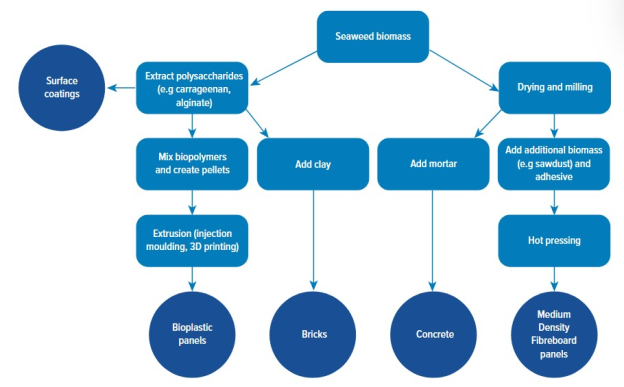
Figure 1: Example of processing flow for seaweed-based construction materials. Source: World Bank (2023)
Why Explore Seaweed-based Construction Materials
The construction and operation of buildings account for approximately 40 percent of global carbon emissions, with 11 percent of global emissions coming specifically from embodied carbon emissions; defined as the greenhouse gas emissions required to extract the materials and to manufacture, transport, maintain (excluding operational energy emissions such as from heating and cooling), and dispose of building components (World Bank, 2023). Seaweed-based construction materials are worth exploring for emissions reduction through two main pathways: Carbon Sequestration/Storage and Emissions Avoidance (Displacement).- Carbon Sequestration and Long-Term Storage
- Emissions Avoidance (Displacement of GHG-Intensive Materials)
Construction Materials Incorporating Seaweed
Seaweed's diverse properties such as binding, fiber reinforcement, flame suppression, and thermal insulation make it a candidate across a wide range of construction applications.| Product Type | Seaweed Component & Potential Role in Improving Performance | Climate Pathway | Key Example(s) | Sources |
| Unfired / Adobe Blocks in buildings | Dried, ground Sargassum acts as structural fiber reinforcement and partial binder, reducing the need for clay and improving hygrothermal performance | Carbon storage in long-lived structure; displaces fired clay bricks, which require kiln firing at ~1,000°C | Sargablocks — BlueGreen, Mexico | López Miranda et al., 2021 Albright & Fujita, 2023 |
| Concrete / Cement Composites | Pulverized or powdered seaweed blended into cement mix; seaweed ash used as a partial replacement for conventional mineral components, reducing clinker demand | Reduces Portland cement content per unit; seaweed-powder concrete demonstrated a 21% reduction in global warming potential; displaces a sector responsible for ~1.6 Gt CO₂e/yr | SargaCreto — Grupo Dakatso, Mexico; Low-carbon concrete — University of Washington / Microsoft (research) | Lin et al., 2025 Miranda et al., 2021 |
| Medium Density Fiberboard (MDF) / Particle Boards | Seaweed residue from alginate extraction (~40%) blended with sawdust and seaweed-derived binder; valorizes processing waste in a cascade biorefinery model. Other examples example seaweed (Ulva) as an adhesive to create a wood-seaweed composite. | Carbon storage in building panels; avoids disposal emissions from alginate processing waste; substitutes wood-based boards that require forest harvesting | BlueBlocks — Netherlands | Albright & Fujita, 2023 Liew et al., 2022 Grandgeorge et al., 2024 |
| Thermal Insulation (Nanocellulose Aerogels) | Seaweed processed into nanocellulose fibers and ice-templated into a low-density porous aerogel structure providing thermal super-insulation | AgriSea nanocellulose hydrogel — New Zealand (production facility under construction); | Berglund et al. (process description) Affan et al., 2023 | |
| Fire-Retardant Additives / Coatings | Seaweed biopolymers (e.g., alginate, carrageenan) incorporated into composites or surface treatments; halogen-rich compounds in seaweed tissue act as natural flame suppressants | Displaces halogenated synthetic flame retardants with high manufacturing emissions and persistent environmental toxicity; enables greater use of bio-based materials that would otherwise fail fire tests | CTV News / University of Waterloo | |
| Limestone / Cement Raw Material | Calcifying seaweeds (coralline algae) biologically mineralize calcium carbonate, which can substitute quarried limestone as a raw cement input | Carbon stored in mineral form during seaweed growth; potential to reduce emissions from conventional limestone quarrying and the energy-intensive calcination step | Bloomineral -France | Bloomineral |
| Functional Additives in Cement (Seaweed Ash / Modified Extracts) | Dried and pyrolyzed seaweed ash (1–5% addition) as a pozzolanic partial cement replacement; chemically modified seaweed polysaccharides as dispersing or retarding agents | Academic literature — multiple species tested including Cladophora sp., Kappaphycus alvarezii, Gracilaria sp. | Albright & Fujita, 2023 |
Figure 1: Example of processing flow for seaweed-based construction materials. Source: World Bank (2023) Why Explore Seaweed-based Construction Materials
The construction and operation of buildings account for approximately 40 percent of global carbon emissions, with 11 percent of global emissions coming specifically from embodied carbon emissions; defined as the greenhouse gas emissions required to extract the materials and to manufacture, transport, maintain (excluding operational energy emissions such as from heating and cooling), and dispose of building components (World Bank, 2023). Seaweed-based construction materials are worth exploring for emissions reduction through two main pathways: Carbon Sequestration/Storage and Emissions Avoidance (Displacement).- Carbon Sequestration and Long-Term Storage
- Emissions Avoidance (Displacement of GHG-Intensive Materials)
Construction Materials Incorporating Seaweed
Seaweed's diverse properties such as binding, fiber reinforcement, flame suppression, and thermal insulation make it a candidate across a wide range of construction applications.| Product Type | Seaweed Component & Potential Role in Improving Performance | Climate Pathway | Key Example(s) | Sources |
| Unfired / Adobe Blocks in buildings | Dried, ground Sargassum acts as structural fiber reinforcement and partial binder, reducing the need for clay and improving hygrothermal performance | Carbon storage in long-lived structure; displaces fired clay bricks, which require kiln firing at ~1,000°C | Sargablocks — BlueGreen, Mexico | López Miranda et al., 2021 Albright & Fujita, 2023 |
| Concrete / Cement Composites | Pulverized or powdered seaweed blended into cement mix; seaweed ash used as a partial replacement for conventional mineral components, reducing clinker demand | Reduces Portland cement content per unit; seaweed-powder concrete demonstrated a 21% reduction in global warming potential; displaces a sector responsible for ~1.6 Gt CO₂e/yr | SargaCreto — Grupo Dakatso, Mexico; Low-carbon concrete — University of Washington / Microsoft (research) | Lin et al., 2025 Miranda et al., 2021 |
| Medium Density Fiberboard (MDF) / Particle Boards | Seaweed residue from alginate extraction (~40%) blended with sawdust and seaweed-derived binder; valorizes processing waste in a cascade biorefinery model. Other examples example seaweed (Ulva) as an adhesive to create a wood-seaweed composite. | Carbon storage in building panels; avoids disposal emissions from alginate processing waste; substitutes wood-based boards that require forest harvesting | BlueBlocks — Netherlands | Albright & Fujita, 2023 Liew et al., 2022 Grandgeorge et al., 2024 |
| Thermal Insulation (Nanocellulose Aerogels) | Seaweed processed into nanocellulose fibers and ice-templated into a low-density porous aerogel structure providing thermal super-insulation | AgriSea nanocellulose hydrogel — New Zealand (production facility under construction); | Berglund et al. (process description) Affan et al., 2023 | |
| Fire-Retardant Additives / Coatings | Seaweed biopolymers (e.g., alginate, carrageenan) incorporated into composites or surface treatments; halogen-rich compounds in seaweed tissue act as natural flame suppressants | Displaces halogenated synthetic flame retardants with high manufacturing emissions and persistent environmental toxicity; enables greater use of bio-based materials that would otherwise fail fire tests | CTV News / University of Waterloo | |
| Limestone / Cement Raw Material | Calcifying seaweeds (coralline algae) biologically mineralize calcium carbonate, which can substitute quarried limestone as a raw cement input | Carbon stored in mineral form during seaweed growth; potential to reduce emissions from conventional limestone quarrying and the energy-intensive calcination step | Bloomineral -France | Bloomineral |
| Functional Additives in Cement (Seaweed Ash / Modified Extracts) | Dried and pyrolyzed seaweed ash (1–5% addition) as a pozzolanic partial cement replacement; chemically modified seaweed polysaccharides as dispersing or retarding agents | Academic literature — multiple species tested including Cladophora sp., Kappaphycus alvarezii, Gracilaria sp. | Albright & Fujita, 2023 |
Figure 1: Example of processing flow for seaweed-based construction materials. Source: World Bank (2023) Why Explore Seaweed-based Construction Materials
The construction and operation of buildings account for approximately 40 percent of global carbon emissions, with 11 percent of global emissions coming specifically from embodied carbon emissions; defined as the greenhouse gas emissions required to extract the materials and to manufacture, transport, maintain (excluding operational energy emissions such as from heating and cooling), and dispose of building components (World Bank, 2023). Seaweed-based construction materials are worth exploring for emissions reduction through two main pathways: Carbon Sequestration/Storage and Emissions Avoidance (Displacement).- Carbon Sequestration and Long-Term Storage
- Emissions Avoidance (Displacement of GHG-Intensive Materials)
Construction Materials Incorporating Seaweed
Seaweed's diverse properties such as binding, fiber reinforcement, flame suppression, and thermal insulation make it a candidate across a wide range of construction applications.| Product Type | Seaweed Component & Potential Role in Improving Performance | Climate Pathway | Key Example(s) | Sources |
| Unfired / Adobe Blocks in buildings | Dried, ground Sargassum acts as structural fiber reinforcement and partial binder, reducing the need for clay and improving hygrothermal performance | Carbon storage in long-lived structure; displaces fired clay bricks, which require kiln firing at ~1,000°C | Sargablocks — BlueGreen, Mexico | López Miranda et al., 2021 Albright & Fujita, 2023 |
| Concrete / Cement Composites | Pulverized or powdered seaweed blended into cement mix; seaweed ash used as a partial replacement for conventional mineral components, reducing clinker demand | Reduces Portland cement content per unit; seaweed-powder concrete demonstrated a 21% reduction in global warming potential; displaces a sector responsible for ~1.6 Gt CO₂e/yr | SargaCreto — Grupo Dakatso, Mexico; Low-carbon concrete — University of Washington / Microsoft (research) | Lin et al., 2025 Miranda et al., 2021 |
| Medium Density Fiberboard (MDF) / Particle Boards | Seaweed residue from alginate extraction (~40%) blended with sawdust and seaweed-derived binder; valorizes processing waste in a cascade biorefinery model. Other examples example seaweed (Ulva) as an adhesive to create a wood-seaweed composite. | Carbon storage in building panels; avoids disposal emissions from alginate processing waste; substitutes wood-based boards that require forest harvesting | BlueBlocks — Netherlands | Albright & Fujita, 2023 Liew et al., 2022 Grandgeorge et al., 2024 |
| Thermal Insulation (Nanocellulose Aerogels) | Seaweed processed into nanocellulose fibers and ice-templated into a low-density porous aerogel structure providing thermal super-insulation | AgriSea nanocellulose hydrogel — New Zealand (production facility under construction); | Berglund et al. (process description) Affan et al., 2023 | |
| Fire-Retardant Additives / Coatings | Seaweed biopolymers (e.g., alginate, carrageenan) incorporated into composites or surface treatments; halogen-rich compounds in seaweed tissue act as natural flame suppressants | Displaces halogenated synthetic flame retardants with high manufacturing emissions and persistent environmental toxicity; enables greater use of bio-based materials that would otherwise fail fire tests | CTV News / University of Waterloo | |
| Limestone / Cement Raw Material | Calcifying seaweeds (coralline algae) biologically mineralize calcium carbonate, which can substitute quarried limestone as a raw cement input | Carbon stored in mineral form during seaweed growth; potential to reduce emissions from conventional limestone quarrying and the energy-intensive calcination step | Bloomineral -France | Bloomineral |
| Functional Additives in Cement (Seaweed Ash / Modified Extracts) | Dried and pyrolyzed seaweed ash (1–5% addition) as a pozzolanic partial cement replacement; chemically modified seaweed polysaccharides as dispersing or retarding agents | Academic literature — multiple species tested including Cladophora sp., Kappaphycus alvarezii, Gracilaria sp. | Albright & Fujita, 2023 |
Figure 1: Example of processing flow for seaweed-based construction materials. Source: World Bank (2023) Why Explore Seaweed-based Construction Materials
The construction and operation of buildings account for approximately 40 percent of global carbon emissions, with 11 percent of global emissions coming specifically from embodied carbon emissions; defined as the greenhouse gas emissions required to extract the materials and to manufacture, transport, maintain (excluding operational energy emissions such as from heating and cooling), and dispose of building components (World Bank, 2023). Seaweed-based construction materials are worth exploring for emissions reduction through two main pathways: Carbon Sequestration/Storage and Emissions Avoidance (Displacement).- Carbon Sequestration and Long-Term Storage
- Emissions Avoidance (Displacement of GHG-Intensive Materials)
Construction Materials Incorporating Seaweed
Seaweed's diverse properties such as binding, fiber reinforcement, flame suppression, and thermal insulation make it a candidate across a wide range of construction applications.| Product Type | Seaweed Component & Potential Role in Improving Performance | Climate Pathway | Key Example(s) | Sources |
| Unfired / Adobe Blocks in buildings | Dried, ground Sargassum acts as structural fiber reinforcement and partial binder, reducing the need for clay and improving hygrothermal performance | Carbon storage in long-lived structure; displaces fired clay bricks, which require kiln firing at ~1,000°C | Sargablocks — BlueGreen, Mexico | López Miranda et al., 2021 Albright & Fujita, 2023 |
| Concrete / Cement Composites | Pulverized or powdered seaweed blended into cement mix; seaweed ash used as a partial replacement for conventional mineral components, reducing clinker demand | Reduces Portland cement content per unit; seaweed-powder concrete demonstrated a 21% reduction in global warming potential; displaces a sector responsible for ~1.6 Gt CO₂e/yr | SargaCreto — Grupo Dakatso, Mexico; Low-carbon concrete — University of Washington / Microsoft (research) | Lin et al., 2025 Miranda et al., 2021 |
| Medium Density Fiberboard (MDF) / Particle Boards | Seaweed residue from alginate extraction (~40%) blended with sawdust and seaweed-derived binder; valorizes processing waste in a cascade biorefinery model | Carbon storage in building panels; avoids disposal emissions from alginate processing waste; substitutes wood-based boards that require forest harvesting | BlueBlocks — Netherlands | Albright & Fujita, 2023 Liew et al., 2022 |
| Thermal Insulation (Nanocellulose Aerogels) | Seaweed processed into nanocellulose fibers and ice-templated into a low-density porous aerogel structure providing thermal super-insulation | AgriSea nanocellulose hydrogel — New Zealand (production facility under construction); | Berglund et al. (process description) Affan et al., 2023 | |
| Fire-Retardant Additives / Coatings | Seaweed biopolymers (e.g., alginate, carrageenan) incorporated into composites or surface treatments; halogen-rich compounds in seaweed tissue act as natural flame suppressants | Displaces halogenated synthetic flame retardants with high manufacturing emissions and persistent environmental toxicity; enables greater use of bio-based materials that would otherwise fail fire tests | CTV News / University of Waterloo | |
| Limestone / Cement Raw Material | Calcifying seaweeds (coralline algae) biologically mineralize calcium carbonate, which can substitute quarried limestone as a raw cement input | Carbon stored in mineral form during seaweed growth; potential to reduce emissions from conventional limestone quarrying and the energy-intensive calcination step | Bloomineral -France | Bloomineral |
| Functional Additives in Cement (Seaweed Ash / Modified Extracts) | Dried and pyrolyzed seaweed ash (1–5% addition) as a pozzolanic partial cement replacement; chemically modified seaweed polysaccharides as dispersing or retarding agents | Academic literature — multiple species tested including Cladophora sp., Kappaphycus alvarezii, Gracilaria sp. | Albright & Fujita, 2023 |
Figure 1: Example of processing flow for seaweed-based construction materials. Source: World Bank (2023) Why Explore Seaweed-based Construction Materials
The construction and operation of buildings account for approximately 40 percent of global carbon emissions, with 11 percent of global emissions coming specifically from embodied carbon emissions; defined as the greenhouse gas emissions required to extract the materials and to manufacture, transport, maintain (excluding operational energy emissions such as from heating and cooling), and dispose of building components (World Bank, 2023). Seaweed-based construction materials are worth exploring for emissions reduction through two main pathways: Carbon Sequestration/Storage and Emissions Avoidance (Displacement).- Carbon Sequestration and Long-Term Storage
- Emissions Avoidance (Displacement of GHG-Intensive Materials)
Construction Materials Incorporating Seaweed
Seaweed's diverse properties such as binding, fiber reinforcement, flame suppression, and thermal insulation make it a candidate across a wide range of construction applications.| Product Type | Seaweed Component & Potential Role in Improving Performance | Climate Pathway | Key Example(s) | Sources |
| Unfired / Adobe Blocks in buildings | Dried, ground Sargassum acts as structural fiber reinforcement and partial binder, reducing the need for clay and improving hygrothermal performance | Carbon storage in long-lived structure; displaces fired clay bricks, which require kiln firing at ~1,000°C | Sargablocks — BlueGreen, Mexico | López Miranda et al., 2021 Albright & Fujita, 2023 |
| Concrete / Cement Composites | Pulverized or powdered seaweed blended into cement mix; seaweed ash used as a partial replacement for conventional mineral components, reducing clinker demand | Reduces Portland cement content per unit; seaweed-powder concrete demonstrated a 21% reduction in global warming potential; displaces a sector responsible for ~1.6 Gt CO₂e/yr | SargaCreto — Grupo Dakatso, Mexico; Low-carbon concrete — University of Washington / Microsoft (research) | Lin et al., 2025 Miranda et al., 2021 |
| Medium Density Fiberboard (MDF) / Particle Boards | Seaweed residue from alginate extraction (~40%) blended with sawdust and seaweed-derived binder; valorizes processing waste in a cascade biorefinery model | Carbon storage in building panels; avoids disposal emissions from alginate processing waste; substitutes wood-based boards that require forest harvesting | BlueBlocks — Netherlands | Albright & Fujita, 2023 Liew et al., 2022 |
| Thermal Insulation (Nanocellulose Aerogels) | Seaweed processed into nanocellulose fibers and ice-templated into a low-density porous aerogel structure providing thermal super-insulation | AgriSea nanocellulose hydrogel — New Zealand (production facility under construction); | Berglund et al. (process description) Affan et al., 2023 | |
| Fire-Retardant Additives / Coatings | Seaweed biopolymers (e.g., alginate, carrageenan) incorporated into composites or surface treatments; halogen-rich compounds in seaweed tissue act as natural flame suppressants | Displaces halogenated synthetic flame retardants with high manufacturing emissions and persistent environmental toxicity; enables greater use of bio-based materials that would otherwise fail fire tests | CTV News / University of Waterloo | |
| Limestone / Cement Raw Material | Calcifying seaweeds (coralline algae) biologically mineralize calcium carbonate, which can substitute quarried limestone as a raw cement input | Carbon stored in mineral form during seaweed growth; potential to reduce emissions from conventional limestone quarrying and the energy-intensive calcination step | Bloomineral -France | Bloomineral |
| Functional Additives in Cement (Seaweed Ash / Modified Extracts) | Dried and pyrolyzed seaweed ash (1–5% addition) as a pozzolanic partial cement replacement; chemically modified seaweed polysaccharides as dispersing or retarding agents | Academic literature — multiple species tested including Cladophora sp., Kappaphycus alvarezii, Gracilaria sp. | Albright & Fujita, 2023 |
Figure 1: Example of processing flow for seaweed-based construction materials. Source: World Bank (2023) Why Explore Seaweed-based Construction Materials
The construction and operation of buildings account for approximately 40 percent of global carbon emissions, with 11 percent of global emissions coming specifically from embodied carbon emissions; defined as the greenhouse gas emissions required to extract the materials and to manufacture, transport, maintain (excluding operational energy emissions such as from heating and cooling), and dispose of building components (The World Bank Group, Global Seaweed New and Emerging Markets Report, 2023). Seaweed-based construction materials are worth exploring for emissions reduction through two main pathways: Carbon Sequestration/Storage and Emissions Avoidance (Displacement).- Carbon Sequestration and Long-Term Storage
- Emissions Avoidance (Displacement of GHG-Intensive Materials)
Construction Materials Incorporating Seaweed
Seaweed's diverse properties such as binding, fiber reinforcement, flame suppression, and thermal insulation make it a candidate across a wide range of construction applications.| Product Type | Seaweed Component & Potential Role in Improving Performance | Climate Pathway | Key Example(s) | Sources |
| Unfired / Adobe Blocks in buildings | Dried, ground Sargassum acts as structural fiber reinforcement and partial binder, reducing the need for clay and improving hygrothermal performance | Carbon storage in long-lived structure; displaces fired clay bricks, which require kiln firing at ~1,000°C | Sargablocks — BlueGreen, Mexico | López Miranda et al., 2021 Albright & Fujita, 2023 |
| Concrete / Cement Composites | Pulverized or powdered seaweed blended into cement mix; seaweed ash used as a partial replacement for conventional mineral components, reducing clinker demand | Reduces Portland cement content per unit; seaweed-powder concrete demonstrated a 21% reduction in global warming potential; displaces a sector responsible for ~1.6 Gt CO₂e/yr | SargaCreto — Grupo Dakatso, Mexico; Low-carbon concrete — University of Washington / Microsoft (research) | Lin et al., 2025 Miranda et al., 2021 |
| Medium Density Fiberboard (MDF) / Particle Boards | Seaweed residue from alginate extraction (~40%) blended with sawdust and seaweed-derived binder; valorizes processing waste in a cascade biorefinery model | Carbon storage in building panels; avoids disposal emissions from alginate processing waste; substitutes wood-based boards that require forest harvesting | BlueBlocks — Netherlands | Albright & Fujita, 2023 Liew et al., 2022 |
| Thermal Insulation (Nanocellulose Aerogels) | Seaweed processed into nanocellulose fibers and ice-templated into a low-density porous aerogel structure providing thermal super-insulation | AgriSea nanocellulose hydrogel — New Zealand (production facility under construction); | Berglund et al. (process description) Affan et al., 2023 | |
| Fire-Retardant Additives / Coatings | Seaweed biopolymers (e.g., alginate, carrageenan) incorporated into composites or surface treatments; halogen-rich compounds in seaweed tissue act as natural flame suppressants | Displaces halogenated synthetic flame retardants with high manufacturing emissions and persistent environmental toxicity; enables greater use of bio-based materials that would otherwise fail fire tests | CTV News / University of Waterloo | |
| Limestone / Cement Raw Material | Calcifying seaweeds (coralline algae) biologically mineralize calcium carbonate, which can substitute quarried limestone as a raw cement input | Carbon stored in mineral form during seaweed growth; potential to reduce emissions from conventional limestone quarrying and the energy-intensive calcination step | Bloomineral -France | Bloomineral |
| Functional Additives in Cement (Seaweed Ash / Modified Extracts) | Dried and pyrolyzed seaweed ash (1–5% addition) as a pozzolanic partial cement replacement; chemically modified seaweed polysaccharides as dispersing or retarding agents | Academic literature — multiple species tested including Cladophora sp., Kappaphycus alvarezii, Gracilaria sp. | Albright & Fujita, 2023 |
Figure 1: Example of processing flow for seaweed-based construction materials: The World Bank Group (2023). Why Explore Seaweed-based Construction Materials
The construction and operation of buildings account for approximately 40 percent of global carbon emissions, with 11 percent of global emissions coming specifically from embodied carbon emissions; defined as the greenhouse gas emissions required to extract the materials and to manufacture, transport, maintain (excluding operational energy emissions such as from heating and cooling), and dispose of building components (The World Bank Group, Global Seaweed New and Emerging Markets Report, 2023). Seaweed-based construction materials are worth exploring for emissions reduction through two main pathways: Carbon Sequestration/Storage and Emissions Avoidance (Displacement).- Carbon Sequestration and Long-Term Storage
- Emissions Avoidance (Displacement of GHG-Intensive Materials)
Construction Materials Incorporating Seaweed
Seaweed's diverse properties such as binding, fiber reinforcement, flame suppression, and thermal insulation make it a candidate across a wide range of construction applications.| Product Type | Seaweed Component & Potential Role in Improving Performance | Climate Pathway | Key Example(s) | Sources |
| Unfired / Adobe Blocks in buildings | Dried, ground Sargassum acts as structural fiber reinforcement and partial binder, reducing the need for clay and improving hygrothermal performance | Carbon storage in long-lived structure; displaces fired clay bricks, which require kiln firing at ~1,000°C | Sargablocks — BlueGreen, Mexico | López Miranda et al., 2021 Albright & Fujita, 2023 |
| Concrete / Cement Composites | Pulverized or powdered seaweed blended into cement mix; seaweed ash used as a partial replacement for conventional mineral components, reducing clinker demand | Reduces Portland cement content per unit; seaweed-powder concrete demonstrated a 21% reduction in global warming potential; displaces a sector responsible for ~1.6 Gt CO₂e/yr | SargaCreto — Grupo Dakatso, Mexico; Low-carbon concrete — University of Washington / Microsoft (research) | Lin et al., 2025 Miranda et al., 2021 |
| Medium Density Fiberboard (MDF) / Particle Boards | Seaweed residue from alginate extraction (~40%) blended with sawdust and seaweed-derived binder; valorizes processing waste in a cascade biorefinery model | Carbon storage in building panels; avoids disposal emissions from alginate processing waste; substitutes wood-based boards that require forest harvesting | BlueBlocks — Netherlands | Albright & Fujita, 2023 Liew et al., 2022 |
| Thermal Insulation (Nanocellulose Aerogels) | Seaweed processed into nanocellulose fibers and ice-templated into a low-density porous aerogel structure providing thermal super-insulation | AgriSea nanocellulose hydrogel — New Zealand (production facility under construction); | Berglund et al. (process description) Affan et al., 2023 | |
| Fire-Retardant Additives / Coatings | Seaweed biopolymers (e.g., alginate, carrageenan) incorporated into composites or surface treatments; halogen-rich compounds in seaweed tissue act as natural flame suppressants | Displaces halogenated synthetic flame retardants with high manufacturing emissions and persistent environmental toxicity; enables greater use of bio-based materials that would otherwise fail fire tests | CTV News / University of Waterloo | |
| Limestone / Cement Raw Material | Calcifying seaweeds (coralline algae) biologically mineralize calcium carbonate, which can substitute quarried limestone as a raw cement input | Carbon stored in mineral form during seaweed growth; potential to reduce emissions from conventional limestone quarrying and the energy-intensive calcination step | Bloomineral -France | Bloomineral |
| Functional Additives in Cement (Seaweed Ash / Modified Extracts) | Dried and pyrolyzed seaweed ash (1–5% addition) as a pozzolanic partial cement replacement; chemically modified seaweed polysaccharides as dispersing or retarding agents | Academic literature — multiple species tested including Cladophora sp., Kappaphycus alvarezii, Gracilaria sp. | Albright & Fujita, 2023 |
Figure 1: Example of processing flow for seaweed-based construction materials: The World Bank Group (2023). Why Explore Seaweed-based Construction Materials
The construction and operation of buildings account for approximately 40 percent of global carbon emissions, with 11 percent of global emissions coming specifically from embodied carbon emissions; defined as the greenhouse gas emissions required to extract the materials and to manufacture, transport, maintain (excluding operational energy emissions such as from heating and cooling), and dispose of building components (The World Bank Group, Global Seaweed New and Emerging Markets Report, 2023). Seaweed-based construction materials are worth exploring for emissions reduction through two main pathways: Carbon Sequestration/Storage and Emissions Avoidance (Displacement).- Carbon Sequestration and Long-Term Storage
- Emissions Avoidance (Displacement of GHG-Intensive Materials)
Construction Materials Incorporating Seaweed
Seaweed's diverse properties such as binding, fiber reinforcement, flame suppression, and thermal insulation make it a candidate across a wide range of construction applications.| Product Type | Seaweed Component & Potential Role in Improving Performance | Climate Pathway | Key Example(s) | Sources |
| Unfired / Adobe Blocks in buildings | Dried, ground Sargassum acts as structural fiber reinforcement and partial binder, reducing the need for clay and improving hygrothermal performance | Carbon storage in long-lived structure; displaces fired clay bricks, which require kiln firing at ~1,000°C | Sargablocks — BlueGreen, Mexico | López Miranda et al., 2021 Albright & Fujita, 2023 |
| Concrete / Cement Composites | Pulverized or powdered seaweed blended into cement mix; seaweed ash used as a partial replacement for conventional mineral components, reducing clinker demand | Reduces Portland cement content per unit; seaweed-powder concrete demonstrated a 21% reduction in global warming potential; displaces a sector responsible for ~1.6 Gt CO₂e/yr | SargaCreto — Grupo Dakatso, Mexico; Low-carbon concrete — University of Washington / Microsoft (research) | Lin et al., 2025 Miranda et al., 2021 |
| Medium Density Fiberboard (MDF) / Particle Boards | Seaweed residue from alginate extraction (~40%) blended with sawdust and seaweed-derived binder; valorizes processing waste in a cascade biorefinery model | Carbon storage in building panels; avoids disposal emissions from alginate processing waste; substitutes wood-based boards that require forest harvesting | BlueBlocks — Netherlands | Albright & Fujita, 2023 Liew et al., 2022 |
| Thermal Insulation (Nanocellulose Aerogels) | Seaweed processed into nanocellulose fibers and ice-templated into a low-density porous aerogel structure providing thermal super-insulation | AgriSea nanocellulose hydrogel — New Zealand (production facility under construction); | Berglund et al. (process description) Affan et al., 2023 | |
| Fire-Retardant Additives / Coatings | Seaweed biopolymers (e.g., alginate, carrageenan) incorporated into composites or surface treatments; halogen-rich compounds in seaweed tissue act as natural flame suppressants | Displaces halogenated synthetic flame retardants with high manufacturing emissions and persistent environmental toxicity; enables greater use of bio-based materials that would otherwise fail fire tests | CTV News / University of Waterloo | |
| Limestone / Cement Raw Material | Calcifying seaweeds (coralline algae) biologically mineralize calcium carbonate, which can substitute quarried limestone as a raw cement input | Carbon stored in mineral form during seaweed growth; potential to reduce emissions from conventional limestone quarrying and the energy-intensive calcination step | Bloomineral -France | Bloomineral |
| Functional Additives in Cement (Seaweed Ash / Modified Extracts) | Dried and pyrolyzed seaweed ash (1–5% addition) as a pozzolanic partial cement replacement; chemically modified seaweed polysaccharides as dispersing or retarding agents | Academic literature — multiple species tested including Cladophora sp., Kappaphycus alvarezii, Gracilaria sp. | Albright & Fujita, 2023 |
Figure 1: Example of processing flow for seaweed-based construction materials: The World Bank Group (2023). Why Explore Seaweed-based Construction Materials
The construction and operation of buildings account for approximately 40 percent of global carbon emissions, with 11 percent of global emissions coming specifically from embodied carbon emissions; defined as the greenhouse gas emissions required to extract the materials and to manufacture, transport, maintain (excluding operational energy emissions such as from heating and cooling), and dispose of building components (The World Bank Group, Global Seaweed New and Emerging Markets Report, 2023). Seaweed-based construction materials are worth exploring for emissions reduction through two main pathways: Carbon Sequestration/Storage and Emissions Avoidance (Displacement).- Carbon Sequestration and Long-Term Storage
- Emissions Avoidance (Displacement of GHG-Intensive Materials)
Construction Materials Incorporating Seaweed
Seaweed's diverse properties such as binding, fiber reinforcement, flame suppression, and thermal insulation make it a candidate across a wide range of construction applications.| Product Type | Seaweed Component & Potential Role in Improving Performance | Climate Pathway | Key Example(s) | Sources |
| Unfired / Adobe Blocks in buildings | Dried, ground Sargassum acts as structural fiber reinforcement and partial binder, reducing the need for clay and improving hygrothermal performance | Carbon storage in long-lived structure; displaces fired clay bricks, which require kiln firing at ~1,000°C | Sargablocks — BlueGreen, Mexico | López Miranda et al., 2021 Albright & Fujita, 2023 |
| Concrete / Cement Composites | Pulverized or powdered seaweed blended into cement mix; seaweed ash used as a partial replacement for conventional mineral components, reducing clinker demand | Reduces Portland cement content per unit; seaweed-powder concrete demonstrated a 21% reduction in global warming potential; displaces a sector responsible for ~1.6 Gt CO₂e/yr | SargaCreto — Grupo Dakatso, Mexico; Low-carbon concrete — University of Washington / Microsoft (research) | Lin et al., 2025 Miranda et al., 2021 |
| Medium Density Fiberboard (MDF) / Particle Boards | Seaweed residue from alginate extraction (~40%) blended with sawdust and seaweed-derived binder; valorizes processing waste in a cascade biorefinery model | Carbon storage in building panels; avoids disposal emissions from alginate processing waste; substitutes wood-based boards that require forest harvesting | BlueBlocks — Netherlands | Albright & Fujita, 2023 Liew et al., 2022 |
| Thermal Insulation (Nanocellulose Aerogels) | Seaweed processed into nanocellulose fibers and ice-templated into a low-density porous aerogel structure providing thermal super-insulation | AgriSea nanocellulose hydrogel — New Zealand (production facility under construction); | Berglund et al. (process description) Affan et al., 2023 | |
| Fire-Retardant Additives / Coatings | Seaweed biopolymers (e.g., alginate, carrageenan) incorporated into composites or surface treatments; halogen-rich compounds in seaweed tissue act as natural flame suppressants | Displaces halogenated synthetic flame retardants with high manufacturing emissions and persistent environmental toxicity; enables greater use of bio-based materials that would otherwise fail fire tests | CTV News / University of Waterloo | |
| Limestone / Cement Raw Material | Calcifying seaweeds (coralline algae) biologically mineralize calcium carbonate, which can substitute quarried limestone as a raw cement input | Carbon stored in mineral form during seaweed growth; potential to reduce emissions from conventional limestone quarrying and the energy-intensive calcination step | Bloomineral -France | Bloomineral |
| Functional Additives in Cement (Seaweed Ash / Modified Extracts) | Dried and pyrolyzed seaweed ash (1–5% addition) as a pozzolanic partial cement replacement; chemically modified seaweed polysaccharides as dispersing or retarding agents | Academic literature — multiple species tested including Cladophora sp., Kappaphycus alvarezii, Gracilaria sp. | Albright & Fujita, 2023 |
Figure 1: Example of processing flow for seaweed-based construction materials: The World Bank Group (2023). Why Explore Seaweed-based Construction Materials
The construction and operation of buildings account for approximately 40 percent of global carbon emissions, with 11 percent of global emissions coming specifically from embodied carbon emissions; defined as the greenhouse gas emissions required to extract the materials and to manufacture, transport, maintain (excluding operational energy emissions such as from heating and cooling), and dispose of building components (The World Bank Group, Global Seaweed New and Emerging Markets Report, 2023). Seaweed-based construction materials are worth exploring for emissions reduction through two main pathways: Carbon Sequestration/Storage and Emissions Avoidance (Displacement).- Carbon Sequestration and Long-Term Storage
- Emissions Avoidance (Displacement of GHG-Intensive Materials)
Construction Materials Incorporating Seaweed
Seaweed's diverse properties such as binding, fiber reinforcement, flame suppression, and thermal insulation make it a candidate across a wide range of construction applications.| Product Type | Seaweed Component & Potential Role in Improving Performance | Climate Pathway | Key Example(s) | Sources |
| Unfired / Adobe Blocks in buildings | Dried, ground Sargassum acts as structural fiber reinforcement and partial binder, reducing the need for clay and improving hygrothermal performance | Carbon storage in long-lived structure; displaces fired clay bricks, which require kiln firing at ~1,000°C | Sargablocks — BlueGreen, Mexico | López Miranda et al., 2021 Albright & Fujita, 2023 |
| Concrete / Cement Composites | Pulverized or powdered seaweed blended into cement mix; seaweed ash used as a partial replacement for conventional mineral components, reducing clinker demand | Reduces Portland cement content per unit; seaweed-powder concrete demonstrated a 21% reduction in global warming potential; displaces a sector responsible for ~1.6 Gt CO₂e/yr | SargaCreto — Grupo Dakatso, Mexico; Low-carbon concrete — University of Washington / Microsoft (research) | Lin et al., 2025 Miranda et al., 2021 |
| Medium Density Fiberboard (MDF) / Particle Boards | Seaweed residue from alginate extraction (~40%) blended with sawdust and seaweed-derived binder; valorizes processing waste in a cascade biorefinery model | Carbon storage in building panels; avoids disposal emissions from alginate processing waste; substitutes wood-based boards that require forest harvesting | BlueBlocks — Netherlands | Albright & Fujita, 2023 Liew et al., 2022 |
| Thermal Insulation (Nanocellulose Aerogels) | Seaweed processed into nanocellulose fibers and ice-templated into a low-density porous aerogel structure providing thermal super-insulation | AgriSea nanocellulose hydrogel — New Zealand (production facility under construction); | Berglund et al. (process description) Affan et al., 2023 | |
| Fire-Retardant Additives / Coatings | Seaweed biopolymers (e.g., alginate, carrageenan) incorporated into composites or surface treatments; halogen-rich compounds in seaweed tissue act as natural flame suppressants | Displaces halogenated synthetic flame retardants with high manufacturing emissions and persistent environmental toxicity; enables greater use of bio-based materials that would otherwise fail fire tests | CTV News / University of Waterloo | |
| Limestone / Cement Raw Material | Calcifying seaweeds (coralline algae) biologically mineralize calcium carbonate, which can substitute quarried limestone as a raw cement input | Carbon stored in mineral form during seaweed growth; potential to reduce emissions from conventional limestone quarrying and the energy-intensive calcination step | Bloomineral -France | Bloomineral |
| Functional Additives in Cement (Seaweed Ash / Modified Extracts) | Dried and pyrolyzed seaweed ash (1–5% addition) as a pozzolanic partial cement replacement; chemically modified seaweed polysaccharides as dispersing or retarding agents | Academic literature — multiple species tested including Cladophora sp., Kappaphycus alvarezii, Gracilaria sp. | Albright & Fujita, 2023 |
Figure 1: Example of processing flow for seaweed-based construction materials: The World Bank Group (2023). Why Explore Seaweed-based Construction Materials
The construction and operation of buildings account for approximately 40 percent of global carbon emissions, with 11 percent of global emissions coming specifically from embodied carbon emissions; defined as the greenhouse gas emissions required to extract the materials and to manufacture, transport, maintain (excluding operational energy emissions such as from heating and cooling), and dispose of building components (The World Bank Group, Global Seaweed New and Emerging Markets Report, 2023). Seaweed-based construction materials are worth exploring for emissions reduction through two main pathways: Carbon Sequestration/Storage and Emissions Avoidance (Displacement).- Carbon Sequestration and Long-Term Storage
- Emissions Avoidance (Displacement of GHG-Intensive Materials)
Construction Materials Incorporating Seaweed
Seaweed's diverse properties such as binding, fiber reinforcement, flame suppression, and thermal insulation make it a candidate across a wide range of construction applications.| Product Type | Seaweed Component & Potential Role in Improving Performance | Climate Pathway | Key Example(s) | Sources |
| Unfired / Adobe Blocks in buildings | Dried, ground Sargassum acts as structural fiber reinforcement and partial binder, reducing the need for clay and improving hygrothermal performance | Carbon storage in long-lived structure; displaces fired clay bricks, which require kiln firing at ~1,000°C | Sargablocks — BlueGreen, Mexico | López Miranda et al., 2021 Albright & Fujita, 2023 |
| Concrete / Cement Composites | Pulverized or powdered seaweed blended into cement mix; seaweed ash used as a partial replacement for conventional mineral components, reducing clinker demand | Reduces Portland cement content per unit; seaweed-powder concrete demonstrated a 21% reduction in global warming potential; displaces a sector responsible for ~1.6 Gt CO₂e/yr | SargaCreto — Grupo Dakatso, Mexico; Low-carbon concrete — University of Washington / Microsoft (research) | Lin et al., 2025 Miranda et al., 2021 |
| Medium Density Fiberboard (MDF) / Particle Boards | Seaweed residue from alginate extraction (~40%) blended with sawdust and seaweed-derived binder; valorizes processing waste in a cascade biorefinery model | Carbon storage in building panels; avoids disposal emissions from alginate processing waste; substitutes wood-based boards that require forest harvesting | BlueBlocks — Netherlands | Albright & Fujita, 2023 Liew et al., 2022 |
| Thermal Insulation (Nanocellulose Aerogels) | Seaweed processed into nanocellulose fibers and ice-templated into a low-density porous aerogel structure providing thermal super-insulation | AgriSea nanocellulose hydrogel — New Zealand (production facility under construction); | Berglund et al. (process description) Affan et al., 2023 | |
| Fire-Retardant Additives / Coatings | Seaweed biopolymers (e.g., alginate, carrageenan) incorporated into composites or surface treatments; halogen-rich compounds in seaweed tissue act as natural flame suppressants | Displaces halogenated synthetic flame retardants with high manufacturing emissions and persistent environmental toxicity; enables greater use of bio-based materials that would otherwise fail fire tests | CTV News / University of Waterloo | |
| Limestone / Cement Raw Material | Calcifying seaweeds (coralline algae) biologically mineralize calcium carbonate, which can substitute quarried limestone as a raw cement input | Carbon stored in mineral form during seaweed growth; potential to reduce emissions from conventional limestone quarrying and the energy-intensive calcination step | Bloomineral -France | Bloomineral |
| Functional Additives in Cement (Seaweed Ash / Modified Extracts) | Dried and pyrolyzed seaweed ash (1–5% addition) as a pozzolanic partial cement replacement; chemically modified seaweed polysaccharides as dispersing or retarding agents | Academic literature — multiple species tested including Cladophora sp., Kappaphycus alvarezii, Gracilaria sp. | Albright & Fujita, 2023 |
Figure 1: Example of processing flow for seaweed-based construction materials: The World Bank Group (2023). Why Explore Seaweed-based Construction Materials
The construction and operation of buildings account for approximately 40 percent of global carbon emissions, with 11 percent of global emissions coming specifically from embodied carbon emissions; defined as the greenhouse gas emissions required to extract the materials and to manufacture, transport, maintain (excluding operational energy emissions such as from heating and cooling), and dispose of building components (The World Bank Group, Global Seaweed New and Emerging Markets Report, 2023). Seaweed-based construction materials are worth exploring for emissions reduction through two main pathways: Carbon Sequestration/Storage and Emissions Avoidance (Displacement).- Carbon Sequestration and Long-Term Storage
- Emissions Avoidance (Displacement of GHG-Intensive Materials)
Construction Materials Incorporating Seaweed
Seaweed's diverse properties such as binding, fiber reinforcement, flame suppression, and thermal insulation make it a candidate across a wide range of construction applications.| Product Type | Seaweed Component & Potential Role in Improving Performance | Climate Pathway | Key Example(s) | Sources |
| Unfired / Adobe Blocks in buildings | Dried, ground Sargassum acts as structural fiber reinforcement and partial binder, reducing the need for clay and improving hygrothermal performance | Carbon storage in long-lived structure; displaces fired clay bricks, which require kiln firing at ~1,000°C | Sargablocks — BlueGreen, Mexico | López Miranda et al., 2021 Albright & Fujita, 2023 |
| Concrete / Cement Composites | Pulverized or powdered seaweed blended into cement mix; seaweed ash used as a partial replacement for conventional mineral components, reducing clinker demand | Reduces Portland cement content per unit; seaweed-powder concrete demonstrated a 21% reduction in global warming potential; displaces a sector responsible for ~1.6 Gt CO₂e/yr | SargaCreto — Grupo Dakatso, Mexico; Low-carbon concrete — University of Washington / Microsoft (research) | Lin et al., 2025 Miranda et al., 2021 |
| Medium Density Fiberboard (MDF) / Particle Boards | Seaweed residue from alginate extraction (~40%) blended with sawdust and seaweed-derived binder; valorizes processing waste in a cascade biorefinery model | Carbon storage in building panels; avoids disposal emissions from alginate processing waste; substitutes wood-based boards that require forest harvesting | BlueBlocks — Netherlands | Albright & Fujita, 2023 Liew et al., 2022 |
| Thermal Insulation (Nanocellulose Aerogels) | Seaweed processed into nanocellulose fibers and ice-templated into a low-density porous aerogel structure providing thermal super-insulation | AgriSea nanocellulose hydrogel — New Zealand (production facility under construction); | Berglund et al. (process description) Affan et al., 2023 | |
| Fire-Retardant Additives / Coatings | Seaweed biopolymers (e.g., alginate, carrageenan) incorporated into composites or surface treatments; halogen-rich compounds in seaweed tissue act as natural flame suppressants | Displaces halogenated synthetic flame retardants with high manufacturing emissions and persistent environmental toxicity; enables greater use of bio-based materials that would otherwise fail fire tests | CTV News / University of Waterloo | |
| Limestone / Cement Raw Material | Calcifying seaweeds (coralline algae) biologically mineralize calcium carbonate, which can substitute quarried limestone as a raw cement input | Carbon stored in mineral form during seaweed growth; potential to reduce emissions from conventional limestone quarrying and the energy-intensive calcination step | Bloomineral -France | Bloomineral |
| Functional Additives in Cement (Seaweed Ash / Modified Extracts) | Dried and pyrolyzed seaweed ash (1–5% addition) as a pozzolanic partial cement replacement; chemically modified seaweed polysaccharides as dispersing or retarding agents | Academic literature — multiple species tested including Cladophora sp., Kappaphycus alvarezii, Gracilaria sp. | Albright & Fujita, 2023 |
Figure 1: Example of processing flow for seaweed-based construction materials: The World Bank Group (2023). Why Explore Seaweed-based Construction Materials
The construction and operation of buildings account for approximately 40 percent of global carbon emissions, with 11 percent of global emissions coming specifically from embodied carbon emissions; defined as the greenhouse gas emissions required to extract the materials and to manufacture, transport, maintain (excluding operational energy emissions such as from heating and cooling), and dispose of building components (The World Bank Group, Global Seaweed New and Emerging Markets Report, 2023). Seaweed-based construction materials are worth exploring for emissions reduction through two main pathways: Carbon Sequestration/Storage and Emissions Avoidance (Displacement).- Carbon Sequestration and Long-Term Storage
- Emissions Avoidance (Displacement of GHG-Intensive Materials)
Construction Materials Incorporating Seaweed
Seaweed's diverse properties such as binding, fiber reinforcement, flame suppression, and thermal insulation make it a candidate across a wide range of construction applications.| Product Type | Seaweed Component & Potential Role in Improving Performance | Climate Pathway | Key Example(s) | Sources |
| Unfired / Adobe Blocks in buildings | Dried, ground Sargassum acts as structural fiber reinforcement and partial binder, reducing the need for clay and improving hygrothermal performance | Carbon storage in long-lived structure; displaces fired clay bricks, which require kiln firing at ~1,000°C | Sargablocks — BlueGreen, Mexico | López Miranda et al., 2021 Albright & Fujita, 2023 |
| Concrete / Cement Composites | Pulverized or powdered seaweed blended into cement mix; seaweed ash used as a partial replacement for conventional mineral components, reducing clinker demand | Reduces Portland cement content per unit; seaweed-powder concrete demonstrated a 21% reduction in global warming potential; displaces a sector responsible for ~1.6 Gt CO₂e/yr | SargaCreto — Grupo Dakatso, Mexico; Low-carbon concrete — University of Washington / Microsoft (research) | Lin et al., 2025 Miranda et al., 2021 |
| Medium Density Fiberboard (MDF) / Particle Boards | Seaweed residue from alginate extraction (~40%) blended with sawdust and seaweed-derived binder; valorizes processing waste in a cascade biorefinery model | Carbon storage in building panels; avoids disposal emissions from alginate processing waste; substitutes wood-based boards that require forest harvesting | BlueBlocks — Netherlands | Albright & Fujita, 2023 Liew et al., 2022 |
| Thermal Insulation (Nanocellulose Aerogels) | Seaweed processed into nanocellulose fibers and ice-templated into a low-density porous aerogel structure providing thermal super-insulation | AgriSea nanocellulose hydrogel — New Zealand (production facility under construction); | Berglund et al. (process description) Affan et al., 2023 | |
| Fire-Retardant Additives / Coatings | Seaweed biopolymers (e.g., alginate, carrageenan) incorporated into composites or surface treatments; halogen-rich compounds in seaweed tissue act as natural flame suppressants | Displaces halogenated synthetic flame retardants with high manufacturing emissions and persistent environmental toxicity; enables greater use of bio-based materials that would otherwise fail fire tests | CTV News / University of Waterloo | |
| Limestone / Cement Raw Material | Calcifying seaweeds (coralline algae) biologically mineralize calcium carbonate, which can substitute quarried limestone as a raw cement input | Carbon stored in mineral form during seaweed growth; potential to reduce emissions from conventional limestone quarrying and the energy-intensive calcination step | Bloomineral -France | Bloomineral |
| Functional Additives in Cement (Seaweed Ash / Modified Extracts) | Dried and pyrolyzed seaweed ash (1–5% addition) as a pozzolanic partial cement replacement; chemically modified seaweed polysaccharides as dispersing or retarding agents | Academic literature — multiple species tested including Cladophora sp., Kappaphycus alvarezii, Gracilaria sp. | Albright & Fujita, 2023 |
Figure 1: Example of processing flow for seaweed-based construction materials: The World Bank Group (2023). Why Explore Seaweed-based Construction Materials
The construction and operation of buildings account for approximately 40 percent of global carbon emissions, with 11 percent of global emissions coming specifically from embodied carbon emissions; defined as the greenhouse gas emissions required to extract the materials and to manufacture, transport, maintain (excluding operational energy emissions such as from heating and cooling), and dispose of building components (The World Bank Group, Global Seaweed New and Emerging Markets Report, 2023). Seaweed-based construction materials are worth exploring for emissions reduction through two main pathways: Carbon Sequestration/Storage and Emissions Avoidance (Displacement).- Carbon Sequestration and Long-Term Storage
- Emissions Avoidance (Displacement of GHG-Intensive Materials)
Construction Materials Incorporating Seaweed
Seaweed's diverse properties such as binding, fiber reinforcement, flame suppression, and thermal insulation make it a candidate across a wide range of construction applications.| Product Type | Seaweed Component & Potential Role in Improving Performance | Climate Pathway | Key Example(s) | Sources |
| Unfired / Adobe Blocks in buildings | Dried, ground Sargassum acts as structural fiber reinforcement and partial binder, reducing the need for clay and improving hygrothermal performance | Carbon storage in long-lived structure; displaces fired clay bricks, which require kiln firing at ~1,000°C | Sargablocks — BlueGreen, Mexico | López Miranda et al., 2021 Albright & Fujita, 2023 |
| Concrete / Cement Composites | Pulverized or powdered seaweed blended into cement mix; seaweed ash used as a partial replacement for conventional mineral components, reducing clinker demand | Reduces Portland cement content per unit; seaweed-powder concrete demonstrated a 21% reduction in global warming potential; displaces a sector responsible for ~1.6 Gt CO₂e/yr | SargaCreto — Grupo Dakatso, Mexico; Low-carbon concrete — University of Washington / Microsoft (research) | Lin et al., 2025 Miranda et al., 2021 |
| Medium Density Fiberboard (MDF) / Particle Boards | Seaweed residue from alginate extraction (~40%) blended with sawdust and seaweed-derived binder; valorizes processing waste in a cascade biorefinery model | Carbon storage in building panels; avoids disposal emissions from alginate processing waste; substitutes wood-based boards that require forest harvesting | BlueBlocks — Netherlands | Albright & Fujita, 2023 Liew et al., 2022 |
| Thermal Insulation (Nanocellulose Aerogels) | Seaweed processed into nanocellulose fibers and ice-templated into a low-density porous aerogel structure providing thermal super-insulation | AgriSea nanocellulose hydrogel — New Zealand (production facility under construction); | Berglund et al. (process description) Affan et al., 2023 | |
| Fire-Retardant Additives / Coatings | Seaweed biopolymers (e.g., alginate, carrageenan) incorporated into composites or surface treatments; halogen-rich compounds in seaweed tissue act as natural flame suppressants | Displaces halogenated synthetic flame retardants with high manufacturing emissions and persistent environmental toxicity; enables greater use of bio-based materials that would otherwise fail fire tests | CTV News / University of Waterloo | |
| Limestone / Cement Raw Material | Calcifying seaweeds (coralline algae) biologically mineralize calcium carbonate, which can substitute quarried limestone as a raw cement input | Carbon stored in mineral form during seaweed growth; potential to reduce emissions from conventional limestone quarrying and the energy-intensive calcination step | Bloomineral -France | Bloomineral |
| Functional Additives in Cement (Seaweed Ash / Modified Extracts) | Dried and pyrolyzed seaweed ash (1–5% addition) as a pozzolanic partial cement replacement; chemically modified seaweed polysaccharides as dispersing or retarding agents | Academic literature — multiple species tested including Cladophora sp., Kappaphycus alvarezii, Gracilaria sp. | Albright & Fujita, 2023 |
Figure 1: Example of processing flow for seaweed-based construction materials: The World Bank Group (2023). Why Explore Seaweed-based Construction Materials
The construction and operation of buildings account for approximately 40 percent of global carbon emissions, with 11 percent of global emissions coming specifically from embodied carbon emissions; defined as the greenhouse gas emissions required to extract the materials and to manufacture, transport, maintain (excluding operational energy emissions such as from heating and cooling), and dispose of building components (The World Bank Group, Global Seaweed New and Emerging Markets Report, 2023). Seaweed-based construction materials are worth exploring for emissions reduction through two main pathways: Carbon Sequestration/Storage and Emissions Avoidance (Displacement).- Carbon Sequestration and Long-Term Storage
- Emissions Avoidance (Displacement of GHG-Intensive Materials)
Construction Materials Incorporating Seaweed
Seaweed's diverse properties such as binding, fiber reinforcement, flame suppression, and thermal insulation make it a candidate across a wide range of construction applications.| Product Type | Seaweed Component & Potential Role in Improving Performance | Climate Pathway | Key Example(s) | Sources |
| Unfired / Adobe Blocks in buildings | Dried, ground Sargassum acts as structural fiber reinforcement and partial binder, reducing the need for clay and improving hygrothermal performance | Carbon storage in long-lived structure; displaces fired clay bricks, which require kiln firing at ~1,000°C | Sargablocks — BlueGreen, Mexico | López Miranda et al., 2021 Albright & Fujita, 2023 |
| Concrete / Cement Composites | Pulverized or powdered seaweed blended into cement mix; seaweed ash used as a partial replacement for conventional mineral components, reducing clinker demand | Reduces Portland cement content per unit; seaweed-powder concrete demonstrated a 21% reduction in global warming potential; displaces a sector responsible for ~1.6 Gt CO₂e/yr | SargaCreto — Grupo Dakatso, Mexico; Low-carbon concrete — University of Washington / Microsoft (research) | Lin et al., 2025 Miranda et al., 2021 |
| Medium Density Fiberboard (MDF) / Particle Boards | Seaweed residue from alginate extraction (~40%) blended with sawdust and seaweed-derived binder; valorizes processing waste in a cascade biorefinery model | Carbon storage in building panels; avoids disposal emissions from alginate processing waste; substitutes wood-based boards that require forest harvesting | BlueBlocks — Netherlands | Albright & Fujita, 2023 Liew et al., 2022 |
| Thermal Insulation (Nanocellulose Aerogels) | Seaweed processed into nanocellulose fibers and ice-templated into a low-density porous aerogel structure providing thermal super-insulation | AgriSea nanocellulose hydrogel — New Zealand (production facility under construction); | Berglund et al. (process description) Affan et al., 2023 | |
| Fire-Retardant Additives / Coatings | Seaweed biopolymers (e.g., alginate, carrageenan) incorporated into composites or surface treatments; halogen-rich compounds in seaweed tissue act as natural flame suppressants | Displaces halogenated synthetic flame retardants with high manufacturing emissions and persistent environmental toxicity; enables greater use of bio-based materials that would otherwise fail fire tests | CTV News / University of Waterloo | |
| Limestone / Cement Raw Material | Calcifying seaweeds (coralline algae) biologically mineralize calcium carbonate, which can substitute quarried limestone as a raw cement input | Carbon stored in mineral form during seaweed growth; potential to reduce emissions from conventional limestone quarrying and the energy-intensive calcination step | Bloomineral -France | Bloomineral |
| Functional Additives in Cement (Seaweed Ash / Modified Extracts) | Dried and pyrolyzed seaweed ash (1–5% addition) as a pozzolanic partial cement replacement; chemically modified seaweed polysaccharides as dispersing or retarding agents | Academic literature — multiple species tested including Cladophora sp., Kappaphycus alvarezii, Gracilaria sp. | Albright & Fujita, 2023 |
Why Explore Seaweed-based Construction Materials
The construction and operation of buildings account for approximately 40 percent of global carbon emissions, with 11 percent of global emissions coming specifically from embodied carbon emissions; defined as the greenhouse gas emissions required to extract the materials and to manufacture, transport, maintain (excluding operational energy emissions such as from heating and cooling), and dispose of building components (The World Bank Group, Global Seaweed New and Emerging Markets Report, 2023). Seaweed-based construction materials are worth exploring for emissions reduction through two main pathways: Carbon Sequestration/Storage and Emissions Avoidance (Displacement).- Carbon Sequestration and Long-Term Storage
- Emissions Avoidance (Displacement of GHG-Intensive Materials)
Construction Materials Incorporating Seaweed
Seaweed's diverse properties such as binding, fiber reinforcement, flame suppression, and thermal insulation make it a candidate across a wide range of construction applications.| Product Type | Seaweed Component & Potential Role in Improving Performance | Climate Pathway | Key Example(s) | Sources |
| Unfired / Adobe Blocks in buildings | Dried, ground Sargassum acts as structural fiber reinforcement and partial binder, reducing the need for clay and improving hygrothermal performance | Carbon storage in long-lived structure; displaces fired clay bricks, which require kiln firing at ~1,000°C | Sargablocks — BlueGreen, Mexico | López Miranda et al., 2021 Albright & Fujita, 2023 |
| Concrete / Cement Composites | Pulverized or powdered seaweed blended into cement mix; seaweed ash used as a partial replacement for conventional mineral components, reducing clinker demand | Reduces Portland cement content per unit; seaweed-powder concrete demonstrated a 21% reduction in global warming potential; displaces a sector responsible for ~1.6 Gt CO₂e/yr | SargaCreto — Grupo Dakatso, Mexico; Low-carbon concrete — University of Washington / Microsoft (research) | Lin et al., 2025 Miranda et al., 2021 |
| Medium Density Fiberboard (MDF) / Particle Boards | Seaweed residue from alginate extraction (~40%) blended with sawdust and seaweed-derived binder; valorizes processing waste in a cascade biorefinery model | Carbon storage in building panels; avoids disposal emissions from alginate processing waste; substitutes wood-based boards that require forest harvesting | BlueBlocks — Netherlands | Albright & Fujita, 2023 Liew et al., 2022 |
| Thermal Insulation (Nanocellulose Aerogels) | Seaweed processed into nanocellulose fibers and ice-templated into a low-density porous aerogel structure providing thermal super-insulation | AgriSea nanocellulose hydrogel — New Zealand (production facility under construction); | Berglund et al. (process description) Affan et al., 2023 | |
| Fire-Retardant Additives / Coatings | Seaweed biopolymers (e.g., alginate, carrageenan) incorporated into composites or surface treatments; halogen-rich compounds in seaweed tissue act as natural flame suppressants | Displaces halogenated synthetic flame retardants with high manufacturing emissions and persistent environmental toxicity; enables greater use of bio-based materials that would otherwise fail fire tests | CTV News / University of Waterloo | |
| Limestone / Cement Raw Material | Calcifying seaweeds (coralline algae) biologically mineralize calcium carbonate, which can substitute quarried limestone as a raw cement input | Carbon stored in mineral form during seaweed growth; potential to reduce emissions from conventional limestone quarrying and the energy-intensive calcination step | Bloomineral -France | Bloomineral |
| Functional Additives in Cement (Seaweed Ash / Modified Extracts) | Dried and pyrolyzed seaweed ash (1–5% addition) as a pozzolanic partial cement replacement; chemically modified seaweed polysaccharides as dispersing or retarding agents | Academic literature — multiple species tested including Cladophora sp., Kappaphycus alvarezii, Gracilaria sp. | Albright & Fujita, 2023 |
Why Explore Seaweed-based Construction Materials
The construction and operation of buildings account for approximately 40 percent of global carbon emissions, with 11 percent of global emissions coming specifically from embodied carbon emissions; defined as the greenhouse gas emissions required to extract the materials and to manufacture, transport, maintain (excluding operational energy emissions such as from heating and cooling), and dispose of building components (The World Bank Group, Global Seaweed New and Emerging Markets Report, 2023). Seaweed-based construction materials are worth exploring for emissions reduction through two main pathways: Carbon Sequestration/Storage and Emissions Avoidance (Displacement).- Carbon Sequestration and Long-Term Storage
- Emissions Avoidance (Displacement of GHG-Intensive Materials)
Construction Materials Incorporating Seaweed
Seaweed's diverse properties such as binding, fiber reinforcement, flame suppression, and thermal insulation make it a candidate across a wide range of construction applications.| Product Type | Seaweed Component & Potential Role in Improving Performance | Climate Pathway | Key Example(s) | Sources |
| Unfired / Adobe Blocks in buildings | Dried, ground Sargassum acts as structural fiber reinforcement and partial binder, reducing the need for clay and improving hygrothermal performance | Carbon storage in long-lived structure; displaces fired clay bricks, which require kiln firing at ~1,000°C | Sargablocks — BlueGreen, Mexico | López Miranda et al., 2021 Albright & Fujita, 2023 |
| Concrete / Cement Composites | Pulverized or powdered seaweed blended into cement mix; seaweed ash used as a partial replacement for conventional mineral components, reducing clinker demand | Reduces Portland cement content per unit; seaweed-powder concrete demonstrated a 21% reduction in global warming potential; displaces a sector responsible for ~1.6 Gt CO₂e/yr | SargaCreto — Grupo Dakatso, Mexico; Low-carbon concrete — University of Washington / Microsoft (research) | Lin et al., 2025 Miranda et al., 2021 |
| Medium Density Fiberboard (MDF) / Particle Boards | Seaweed residue from alginate extraction (~40%) blended with sawdust and seaweed-derived binder; valorizes processing waste in a cascade biorefinery model | Carbon storage in building panels; avoids disposal emissions from alginate processing waste; substitutes wood-based boards that require forest harvesting | BlueBlocks — Netherlands | Albright & Fujita, 2023 Liew et al., 2022 |
| Thermal Insulation (Nanocellulose Aerogels) | Seaweed processed into nanocellulose fibers and ice-templated into a low-density porous aerogel structure providing thermal super-insulation | AgriSea nanocellulose hydrogel — New Zealand (production facility under construction); | Berglund et al. (process description) Affan et al., 2023 | |
| Fire-Retardant Additives / Coatings | Seaweed biopolymers (e.g., alginate, carrageenan) incorporated into composites or surface treatments; halogen-rich compounds in seaweed tissue act as natural flame suppressants | Displaces halogenated synthetic flame retardants with high manufacturing emissions and persistent environmental toxicity; enables greater use of bio-based materials that would otherwise fail fire tests | CTV News / University of Waterloo | |
| Limestone / Cement Raw Material | Calcifying seaweeds (coralline algae) biologically mineralize calcium carbonate, which can substitute quarried limestone as a raw cement input | Carbon stored in mineral form during seaweed growth; potential to reduce emissions from conventional limestone quarrying and the energy-intensive calcination step | Bloomineral -France | Bloomineral |
| Functional Additives in Cement (Seaweed Ash / Modified Extracts) | Dried and pyrolyzed seaweed ash (1–5% addition) as a pozzolanic partial cement replacement; chemically modified seaweed polysaccharides as dispersing or retarding agents | Academic literature — multiple species tested including Cladophora sp., Kappaphycus alvarezii, Gracilaria sp. | Albright & Fujita, 2023 |
Why Explore Seaweed-based Construction Materials
The construction and operation of buildings account for approximately 40 percent of global carbon emissions, with 11 percent of global emissions coming specifically from embodied carbon emissions; defined as the greenhouse gas emissions required to extract the materials and to manufacture, transport, maintain (excluding operational energy emissions such as from heating and cooling), and dispose of building components (The World Bank Group, Global Seaweed New and Emerging Markets Report, 2023). Seaweed-based construction materials are worth exploring for emissions reduction through two main pathways: Carbon Sequestration/Storage and Emissions Avoidance (Displacement).- Carbon Sequestration and Long-Term Storage
- Emissions Avoidance (Displacement of GHG-Intensive Materials)
Construction Materials Incorporating Seaweed
Seaweed's diverse properties such as binding, fiber reinforcement, flame suppression, and thermal insulation make it a candidate across a wide range of construction applications.| Product Type | Seaweed Component & Potential Role in Improving Performance | Climate Pathway | Key Example(s) | Sources |
| Unfired / Adobe Blocks in buildings | Dried, ground Sargassum acts as structural fiber reinforcement and partial binder, reducing the need for clay and improving hygrothermal performance | Carbon storage in long-lived structure; displaces fired clay bricks, which require kiln firing at ~1,000°C | Sargablocks — BlueGreen, Mexico | López Miranda et al., 2021 Albright & Fujita, 2023 |
| Concrete / Cement Composites | Pulverized or powdered seaweed blended into cement mix; seaweed ash used as a partial replacement for conventional mineral components, reducing clinker demand | Reduces Portland cement content per unit; seaweed-powder concrete demonstrated a 21% reduction in global warming potential; displaces a sector responsible for ~1.6 Gt CO₂e/yr | SargaCreto — Grupo Dakatso, Mexico; Low-carbon concrete — University of Washington / Microsoft (research) | Lin et al., 2025 Miranda et al., 2021 |
| Medium Density Fiberboard (MDF) / Particle Boards | Seaweed residue from alginate extraction (~40%) blended with sawdust and seaweed-derived binder; valorizes processing waste in a cascade biorefinery model | Carbon storage in building panels; avoids disposal emissions from alginate processing waste; substitutes wood-based boards that require forest harvesting | BlueBlocks — Netherlands | Albright & Fujita, 2023 Liew et al., 2022 |
| Thermal Insulation (Nanocellulose Aerogels) | Seaweed processed into nanocellulose fibers and ice-templated into a low-density porous aerogel structure providing thermal super-insulation | AgriSea nanocellulose hydrogel — New Zealand (production facility under construction); | Berglund et al. (process description) Affan et al., 2023 | |
| Fire-Retardant Additives / Coatings | Seaweed biopolymers (e.g., alginate, carrageenan) incorporated into composites or surface treatments; halogen-rich compounds in seaweed tissue act as natural flame suppressants | Displaces halogenated synthetic flame retardants with high manufacturing emissions and persistent environmental toxicity; enables greater use of bio-based materials that would otherwise fail fire tests | CTV News / University of Waterloo | |
| Limestone / Cement Raw Material | Calcifying seaweeds (coralline algae) biologically mineralize calcium carbonate, which can substitute quarried limestone as a raw cement input | Carbon stored in mineral form during seaweed growth; potential to reduce emissions from conventional limestone quarrying and the energy-intensive calcination step | Bloomineral -France | Bloomineral |
| Functional Additives in Cement (Seaweed Ash / Modified Extracts) | Dried and pyrolyzed seaweed ash (1–5% addition) as a pozzolanic partial cement replacement; chemically modified seaweed polysaccharides as dispersing or retarding agents | Academic literature — multiple species tested including Cladophora sp., Kappaphycus alvarezii, Gracilaria sp. | Albright & Fujita, 2023 |
Why Explore Seaweed-based Construction Materials
The construction and operation of buildings account for approximately 40 percent of global carbon emissions, with 11 percent of global emissions coming specifically from embodied carbon emissions; defined as the greenhouse gas emissions required to extract the materials and to manufacture, transport, maintain (excluding operational energy emissions such as from heating and cooling), and dispose of building components (The World Bank Group, Global Seaweed New and Emerging Markets Report, 2023). Seaweed-based construction materials are worth exploring for emissions reduction through two main pathways: Carbon Sequestration/Storage and Emissions Avoidance (Displacement).- Carbon Sequestration and Long-Term Storage
- Emissions Avoidance (Displacement of GHG-Intensive Materials)
Construction Materials Incorporating Seaweed
Seaweed's diverse properties such as binding, fiber reinforcement, flame suppression, and thermal insulation make it a candidate across a wide range of construction applications.| Product Type | Seaweed Component & Potential Role in Improving Performance | Climate Pathway | Key Example(s) | Sources |
| Unfired / Adobe Blocks in buildings | Dried, ground Sargassum acts as structural fiber reinforcement and partial binder, reducing the need for clay and improving hygrothermal performance | Carbon storage in long-lived structure; displaces fired clay bricks, which require kiln firing at ~1,000°C | Sargablocks — BlueGreen, Mexico | López Miranda et al., 2021 Albright & Fujita, 2023 |
| Concrete / Cement Composites | Pulverized or powdered seaweed blended into cement mix; seaweed ash used as a partial replacement for conventional mineral components, reducing clinker demand | Reduces Portland cement content per unit; seaweed-powder concrete demonstrated a 21% reduction in global warming potential; displaces a sector responsible for ~1.6 Gt CO₂e/yr | SargaCreto — Grupo Dakatso, Mexico; Low-carbon concrete — University of Washington / Microsoft (research) | Lin et al., 2025 Miranda et al., 2021 |
| Medium Density Fiberboard (MDF) / Particle Boards | Seaweed residue from alginate extraction (~40%) blended with sawdust and seaweed-derived binder; valorizes processing waste in a cascade biorefinery model | Carbon storage in building panels; avoids disposal emissions from alginate processing waste; substitutes wood-based boards that require forest harvesting | BlueBlocks — Netherlands | Albright & Fujita, 2023 Liew et al., 2022 |
| Thermal Insulation (Nanocellulose Aerogels) | Seaweed processed into nanocellulose fibers and ice-templated into a low-density porous aerogel structure providing thermal super-insulation | AgriSea nanocellulose hydrogel — New Zealand (production facility under construction); | Berglund et al. (process description) Affan et al., 2023 | |
| Fire-Retardant Additives / Coatings | Seaweed biopolymers (e.g., alginate, carrageenan) incorporated into composites or surface treatments; halogen-rich compounds in seaweed tissue act as natural flame suppressants | Displaces halogenated synthetic flame retardants with high manufacturing emissions and persistent environmental toxicity; enables greater use of bio-based materials that would otherwise fail fire tests | CTV News / University of Waterloo | |
| Limestone / Cement Raw Material | Calcifying seaweeds (coralline algae) biologically mineralize calcium carbonate, which can substitute quarried limestone as a raw cement input | Carbon stored in mineral form during seaweed growth; potential to reduce emissions from conventional limestone quarrying and the energy-intensive calcination step | Bloomineral -France | Bloomineral |
| Functional Additives in Cement (Seaweed Ash / Modified Extracts) | Dried and pyrolyzed seaweed ash (1–5% addition) as a pozzolanic partial cement replacement; chemically modified seaweed polysaccharides as dispersing or retarding agents | Academic literature — multiple species tested including Cladophora sp., Kappaphycus alvarezii, Gracilaria sp. | Albright & Fujita, 2023 |
Science, Technology and Engineering
Species Selection
Species selection is driven by a combination of requirements for performance and local availability.
- Construction applications requiring binding or stabilizing agents, such as additives for unfired clay bricks, and often use brown seaweed for their sources of alginate (for their binding properties).
- A key focus, especially in the Caribbean and Mexico, is utilizing the excessive blooms of pelagic Sargassum (a brown seaweed) for materials.
Species like Cladophora sp. Kützing, Kappaphycus alvarezii, and Gracilaria sp. Greville have been tested as fiber, additive, or ash components in Portland cement composites (Albright & Fujita, 2023).
Cultivation
The companies currently building seaweed construction materials overwhelmingly rely on wild collected and beach-cast seaweed. Cultivated seaweeds have not been incorporated into the construction material supply chain (World Bank, 2023).
See the chapter, “Cultivation and Drying Considerations“, for details on approaches to cultivate seaweed.
Harvesting
The logistics of harvesting vary significantly based on the seaweed source. For example, in areas dealing with invasive blooms (e.g., Quintana Roo, Mexico), the Sargassum biomass washes up on beaches and is collected. Collection of wild Sargassum often uses heavy machinery, such as loaders and dump trucks, due to the massive quantities involved. Companies such as Dakatso contract with beach owners to prevent Sargassum wash-up on shore using offshore barriers.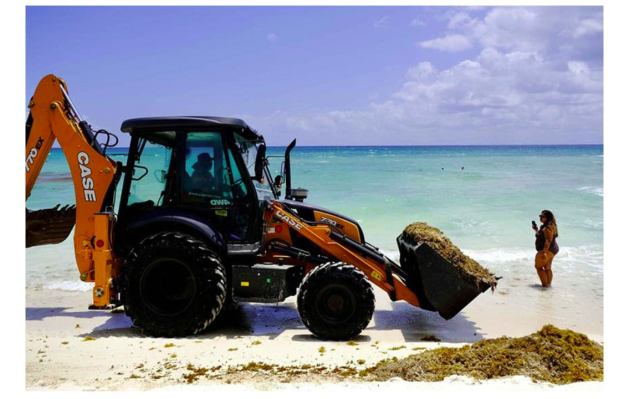
Figure 2: Collection of sargassum using a loader (Image Credit: Elizabeth Ruiz/Cuartoscuro)
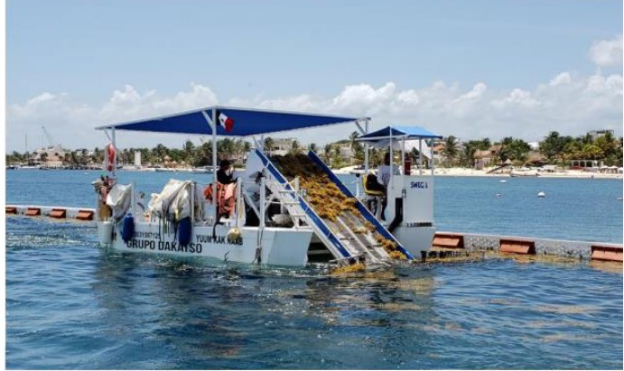
Figure 3: Dakatso Sargassum Collector Vessel (Image Credit: Dakatso)
Other wild species are collected manually on foot or by boat in case of small operations or using mechanical systems (for example, a boat equipped with a rake-like device or a rotating mechanical hook is used to cut kelp species like Laminaria hyperborea). See the chapter, “Cultivation and Drying Considerations“, for details on approaches to harvest wild and cultivated seaweed. (Note: Insert link)
Pre-processing
Most pre-processing involves some cleaning to get rid of impurities, sand and to reduce salt content. Salt content is typically reduced through repeated freshwater rinsing or soaking, followed by sun-drying. Residual chloride content must be monitored for structural applications, as levels above threshold concentrations accelerate corrosion of adjacent steel reinforcement in composite applications.
Drying: Since fresh seaweed is composed of 80–90% water, drying is crucial for economical use, as shipping wet seaweed is generally uneconomical. The most energy-efficient method is sun-drying or air-drying on beaches. Companies making Sargassum-based concrete (Dakatso) utilize ‘UV dehydration’—which appears to be sun-drying on plastic sheets (Albright and Fujita, 2023).
See the “Cultivation and Drying Considerations” chapter for details on approaches to clean and dry seaweed.
Processing
The processing requirements generally depend on the final product, but in most cases, the seaweed only needs to be shredded to the correct size and mixed with other ingredients in the right proportion, often following industry standards.
| Product type | Company/Product Name | Seaweed feedstock Type and content | Non-Seaweed inputs | Processing steps (simplified) | Processing Conditions | Key Advantages |
| Unfired blocks (Adobe bricks) | BlueGreen | Dry Sargassum (often waste biomass)-~40% by mass | Adobe soil, clay, water, proprietary material | (1) Sun Drying
(2) Grinding to powder (4) Mechanical pressing (5) Sun-drying |
Ambient conditions, no firing | Uses standard adobe brick making equipment |
| Concrete / cement composites | Grupo Dakatso (Sargacreto); | Pulverized Sargassum | Portland cement or blends, aggregates, water | (1) Sun Drying(2) Shred in an electric shredder (3) Incorporation into cement mix |
Medium (cement calcination requires heating around 1450°C) | Fully compatible with conventional concrete process to produce cinder blocks, pavers, molded concrete or poured concrete |
| Medium Density Fiberboard (MDF) Particle boards |
BlueBlocks | Seaweed residue from alginate extraction ~40% seaweed; |
Sawdust, seaweed-derived binder, adhesive (~11–12%); Particle boards use wood pulp/chips instead of sawdust | (1) Drying and grinding seaweed residue (2) Blending with fibers and binder(3) hot pressing (4) curing |
Hot pressing required (typically 150°C to 200°C) | Uses standard MDF lines or particleboard equipment |
| Seaweed-ash fillers / functional additives into cement | Academic literature | Seaweed ash, chemically modified seaweed 1-5% |
Cementitious matrices, polymers | (1) Drying → (2) combustion or chemical treatment → (3) dispersion | Medium–high (depends on treatment) | Drop-in additive |
Table 2 Processing methods for current commercial products made from seaweed. Sources: Albright and Fujita (2023), The World Bank Group (2023)
Other Approaches under Research
Seaweed Based Aerogels: Aerogels are promising candidates in thermal super-insulation applications. Cellulose nanofiber (CNF) based aerogels offer a potentially non-toxic alternative for flame-retardant insulation. Berglund et al. described a process for a seaweed-based CNF aerogel. In this process, the seaweed stipe is purified to remove pigments and impurities. This was done by bleaching in Sodium Hypochlorite in an acetate buffer and then washing until a neutral pH is achieved. After purification, the seaweed is ground with coarse Silicon carbide grinding stones to separate the cellulosic part into very fine nanofibers. The aerogel is then created through a process called ice templating, where the seaweed gel is mixed with water and then frozen in a mold. The ice-crystals grow and push aside the solid materials. This is then freeze-dried to form a porous CNF aerogel structure because ice is removed by sublimation and leaves gaps where the ice crystals used to be, Finally, this aerogel is treated with Calcium Chloride solutions in ethanol to generate a crosslinked structure, improving mechanical properties.
Seaweed Inclusion in Concrete
Several research initiatives are being undertaken to include seaweed in different form factors to improve the performance of cement and concrete. For example, seaweeds can be burnt/pyrolyzed (thermal decomposition of a material in the absence of oxygen) and the ash can be used as a partial replacement for a mineral component.
Researchers at the University of Washington and Microsoft developed low-carbon concrete by mixing dried, powdered seaweed with cement and found a 21% reduction in global warming potential (Lin et al., 2025).
Species Selection
Species selection is driven by a combination of requirements for performance and local availability.- Construction applications requiring binding or stabilizing agents, such as additives for unfired clay bricks, and often use brown seaweed for their sources of alginate (for their binding properties).
- A key focus, especially in the Caribbean and Mexico, is utilizing the excessive blooms of pelagic Sargassum (a brown seaweed) for materials.
Cultivation
The companies currently building seaweed construction materials overwhelmingly rely on wild collected and beach-cast seaweed. Cultivated seaweeds have not been incorporated into the construction material supply chain (World Bank, 2023). See the chapter, "Cultivation and Drying Considerations", for details on approaches to cultivate seaweed.Harvesting
The logistics of harvesting vary significantly based on the seaweed source. For example, in areas dealing with invasive blooms (e.g., Quintana Roo, Mexico), the Sargassum biomass washes up on beaches and is collected. Collection of wild Sargassum often uses heavy machinery, such as loaders and dump trucks, due to the massive quantities involved. Companies such as Dakatso contract with beach owners to prevent Sargassum wash-up on shore using offshore barriers.
Figure 2: Collection of sargassum using a loader (Image Credit: Elizabeth Ruiz/Cuartoscuro)
Figure 3: Dakatso Sargassum Collector Vessel (Image Credit: Dakatso)
Other wild species are collected manually on foot or by boat in case of small operations or using mechanical systems (for example, a boat equipped with a rake-like device or a rotating mechanical hook is used to cut kelp species like Laminaria hyperborea). See the chapter, "Cultivation and Drying Considerations", for details on approaches to harvest wild and cultivated seaweed. (Note: Insert link)
Pre-processing
Most pre-processing involves some cleaning to get rid of impurities, sand and to reduce salt content. Salt content is typically reduced through repeated freshwater rinsing or soaking, followed by sun-drying. Residual chloride content must be monitored for structural applications, as levels above threshold concentrations accelerate corrosion of adjacent steel reinforcement in composite applications. Drying: Since fresh seaweed is composed of 80–90% water, drying is crucial for economical use, as shipping wet seaweed is generally uneconomical. The most energy-efficient method is sun-drying or air-drying on beaches. Companies making Sargassum-based concrete (Dakatso) utilize 'UV dehydration'—which appears to be sun-drying on plastic sheets (Albright and Fujita, 2023). See the "Cultivation and Drying Considerations" chapter for details on approaches to clean and dry seaweed.Processing
The processing requirements generally depend on the final product, but in most cases, the seaweed only needs to be shredded to the correct size and mixed with other ingredients in the right proportion, often following industry standards.| Product type | Company/Product Name | Seaweed feedstock Type and content | Non-Seaweed inputs | Processing steps (simplified) | Processing Conditions | Key Advantages |
| Unfired blocks (Adobe bricks) | BlueGreen | Dry Sargassum (often waste biomass)-~40% by mass | Adobe soil, clay, water, proprietary material | (1) Sun Drying (2) Grinding to powder (4) Mechanical pressing (5) Sun-drying | Ambient conditions, no firing | Uses standard adobe brick making equipment |
| Concrete / cement composites | Grupo Dakatso (Sargacreto); | Pulverized Sargassum | Portland cement or blends, aggregates, water | (1) Sun Drying(2) Shred in an electric shredder (3) Incorporation into cement mix | Medium (cement calcination requires heating around 1450°C) | Fully compatible with conventional concrete process to produce cinder blocks, pavers, molded concrete or poured concrete |
| Medium Density Fiberboard (MDF) Particle boards | BlueBlocks | Seaweed residue from alginate extraction ~40% seaweed; | Sawdust, seaweed-derived binder, adhesive (~11–12%); Particle boards use wood pulp/chips instead of sawdust | (1) Drying and grinding seaweed residue (2) Blending with fibers and binder(3) hot pressing (4) curing | Hot pressing required (typically 150°C to 200°C) | Uses standard MDF lines or particleboard equipment |
| Seaweed-ash fillers / functional additives into cement | Academic literature | Seaweed ash, chemically modified seaweed 1-5% | Cementitious matrices, polymers | (1) Drying → (2) combustion or chemical treatment → (3) dispersion | Medium–high (depends on treatment) | Drop-in additive |
Other Approaches under Research
Seaweed Based Aerogels: Aerogels are promising candidates in thermal super-insulation applications. Cellulose nanofiber (CNF) based aerogels offer a potentially non-toxic alternative for flame-retardant insulation. Berglund et al. described a process for a seaweed-based CNF aerogel. In this process, the seaweed stipe is purified to remove pigments and impurities. This was done by bleaching in Sodium Hypochlorite in an acetate buffer and then washing until a neutral pH is achieved. After purification, the seaweed is ground with coarse Silicon carbide grinding stones to separate the cellulosic part into very fine nanofibers. The aerogel is then created through a process called ice templating, where the seaweed gel is mixed with water and then frozen in a mold. The ice-crystals grow and push aside the solid materials. This is then freeze-dried to form a porous CNF aerogel structure because ice is removed by sublimation and leaves gaps where the ice crystals used to be, Finally, this aerogel is treated with Calcium Chloride solutions in ethanol to generate a crosslinked structure, improving mechanical properties. Seaweed Inclusion in Concrete Several research initiatives are being undertaken to include seaweed in different form factors to improve the performance of cement and concrete. For example, seaweeds can be burnt/pyrolyzed (thermal decomposition of a material in the absence of oxygen) and the ash can be used as a partial replacement for a mineral component. Researchers at the University of Washington and Microsoft developed low-carbon concrete by mixing dried, powdered seaweed with cement and found a 21% reduction in global warming potential (Lin et al., 2025).Species Selection
Species selection is driven by a combination of requirements for performance and local availability.- Construction applications requiring binding or stabilizing agents, such as additives for unfired clay bricks, and often use brown seaweed for their sources of alginate (for their binding properties).
- A key focus, especially in the Caribbean and Mexico, is utilizing the excessive blooms of pelagic Sargassum (a brown seaweed) for materials.
Cultivation
The companies currently building seaweed construction materials overwhelmingly rely on wild collected and beach-cast seaweed. Cultivated seaweeds have not been incorporated into the construction material supply chain (World Bank, 2023). See the chapter, "Cultivation and Drying Considerations", for details on approaches to cultivate seaweed.Harvesting
The logistics of harvesting vary significantly based on the seaweed source. For example, in areas dealing with invasive blooms (e.g., Quintana Roo, Mexico), the Sargassum biomass washes up on beaches and is collected. Collection of wild Sargassum often uses heavy machinery, such as loaders and dump trucks, due to the massive quantities involved. Companies such as Dakatso contract with beach owners to prevent Sargassum wash-up on shore using offshore barriers.
Figure 2: Collection of sargassum using a loader (Image Credit: Elizabeth Ruiz/Cuartoscuro)
Figure 3: Dakatso Sargassum Collector Vessel (Image Credit: Dakatso)
Other wild species are collected manually on foot or by boat in case of small operations or using mechanical systems (for example, a boat equipped with a rake-like device or a rotating mechanical hook is used to cut kelp species like Laminaria hyperborea). See the chapter, "Cultivation and Drying Considerations", for details on approaches to harvest wild and cultivated seaweed. (Note: Insert link)
Pre-processing
Most pre-processing involves some cleaning to get rid of impurities, sand and to reduce salt content. Salt content is typically reduced through repeated freshwater rinsing or soaking, followed by sun-drying. Residual chloride content must be monitored for structural applications, as levels above threshold concentrations accelerate corrosion of adjacent steel reinforcement in composite applications. Drying: Since fresh seaweed is composed of 80–90% water, drying is crucial for economical use, as shipping wet seaweed is generally uneconomical. The most energy-efficient method is sun-drying or air-drying on beaches. Companies making Sargassum-based concrete (Dakatso) utilize 'UV dehydration'—which appears to be sun-drying on plastic sheets (Albright and Fujita, 2023). See the "Cultivation and Drying Considerations" chapter for details on approaches to clean and dry seaweed.Processing
The processing requirements generally depend on the final product, but in most cases, the seaweed only needs to be shredded to the correct size and mixed with other ingredients in the right proportion, often following industry standards.| Product type | Company/Product Name | Seaweed feedstock Type and content | Non-Seaweed inputs | Processing steps (simplified) | Processing Conditions | Key Advantages |
| Unfired blocks (Adobe bricks) | BlueGreen | Dry Sargassum (often waste biomass)-~40% by mass | Adobe soil, clay, water, proprietary material | (1) Sun Drying (2) Grinding to powder (4) Mechanical pressing (5) Sun-drying | Ambient conditions, no firing | Uses standard adobe brick making equipment |
| Concrete / cement composites | Grupo Dakatso (Sargacreto); | Pulverized Sargassum | Portland cement or blends, aggregates, water | (1) Sun Drying(2) Shred in an electric shredder (3) Incorporation into cement mix | Medium (cement calcination requires heating around 1450°C) | Fully compatible with conventional concrete process to produce cinder blocks, pavers, molded concrete or poured concrete |
| Medium Density Fiberboard (MDF) Particle boards | BlueBlocks | Seaweed residue from alginate extraction ~40% seaweed; | Sawdust, seaweed-derived binder, adhesive (~11–12%); Particle boards use wood pulp/chips instead of sawdust | (1) Drying and grinding seaweed residue (2) Blending with fibers and binder(3) hot pressing (4) curing | Hot pressing required (typically 150°C to 200°C) | Uses standard MDF lines or particleboard equipment |
| Seaweed-ash fillers / functional additives into cement | Academic literature | Seaweed ash, chemically modified seaweed 1-5% | Cementitious matrices, polymers | (1) Drying → (2) combustion or chemical treatment → (3) dispersion | Medium–high (depends on treatment) | Drop-in additive |
Other Approaches under Research
Seaweed Based Aerogels: Aerogels are promising candidates in thermal super-insulation applications. Cellulose nanofiber (CNF) based aerogels offer a potentially non-toxic alternative for flame-retardant insulation. Berglund et al. described a process for a seaweed-based CNF aerogel. In this process, the seaweed stipe is purified to remove pigments and impurities. This was done by bleaching in Sodium Hypochlorite in an acetate buffer and then washing until a neutral pH is achieved. After purification, the seaweed is ground with coarse Silicon carbide grinding stones to separate the cellulosic part into very fine nanofibers. The aerogel is then created through a process called ice templating, where the seaweed gel is mixed with water and then frozen in a mold. The ice-crystals grow and push aside the solid materials. This is then freeze-dried to form a porous CNF aerogel structure because ice is removed by sublimation and leaves gaps where the ice crystals used to be, Finally, this aerogel is treated with Calcium Chloride solutions in ethanol to generate a crosslinked structure, improving mechanical properties. Seaweed Inclusion in Concrete Several research initiatives are being undertaken to include seaweed in different form factors to improve the performance of cement and concrete. For example, seaweeds can be burnt/pyrolyzed (thermal decomposition of a material in the absence of oxygen) and the ash can be used as a partial replacement for a mineral component. Researchers at the University of Washington and Microsoft developed low-carbon concrete by mixing dried, powdered seaweed with cement and found a 21% reduction in global warming potential (Lin et al., 2025).Species Selection
Species selection is driven by a combination of requirements for performance and local availability.- Construction applications requiring binding or stabilizing agents, such as additives for unfired clay bricks, and often use brown seaweed for their sources of alginate (for their binding properties).
- A key focus, especially in the Caribbean and Mexico, is utilizing the excessive blooms of pelagic Sargassum (a brown seaweed) for materials.
Cultivation
The companies currently building seaweed construction materials overwhelmingly rely on wild collected and beach-cast seaweed. Cultivated seaweeds have not been incorporated into the construction material supply chain (World Bank, 2023). See the chapter, "Cultivation and Drying Considerations", for details on approaches to cultivate seaweed.Harvesting
The logistics of harvesting vary significantly based on the seaweed source. For example, in areas dealing with invasive blooms (e.g., Quintana Roo, Mexico), the Sargassum biomass washes up on beaches and is collected. Collection of wild Sargassum often uses heavy machinery, such as loaders and dump trucks, due to the massive quantities involved. Companies such as Dakatso contract with beach owners to prevent Sargassum wash-up on shore using offshore barriers.
Figure 2: Collection of sargassum using a loader (Image Credit: Elizabeth Ruiz/Cuartoscuro)
Figure 3: Dakatso Sargassum Collector Vessel (Image Credit: Dakatso)
Other wild species are collected manually on foot or by boat in case of small operations or using mechanical systems (for example, a boat equipped with a rake-like device or a rotating mechanical hook is used to cut kelp species like Laminaria hyperborea). See the chapter, "Cultivation and Drying Considerations", for details on approaches to harvest wild and cultivated seaweed. (Note: Insert link)
Pre-processing
Most pre-processing involves some cleaning to get rid of impurities, sand and to reduce salt content. Salt content is typically reduced through repeated freshwater rinsing or soaking, followed by sun-drying. Residual chloride content must be monitored for structural applications, as levels above threshold concentrations accelerate corrosion of adjacent steel reinforcement in composite applications. Drying: Since fresh seaweed is composed of 80–90% water, drying is crucial for economical use, as shipping wet seaweed is generally uneconomical. The most energy-efficient method is sun-drying or air-drying on beaches. Companies making Sargassum-based concrete (Dakatso) utilize 'UV dehydration'—which appears to be sun-drying on plastic sheets (Albright and Fujita, 2023). See the "Cultivation and Drying Considerations" chapter for details on approaches to clean and dry seaweed.Processing
The processing requirements generally depend on the final product, but in most cases, the seaweed only needs to be shredded to the correct size and mixed with other ingredients in the right proportion, often following industry standards.| Product type | Company/Product Name | Seaweed feedstock Type and content | Non-Seaweed inputs | Processing steps (simplified) | Processing Conditions | Key Advantages |
| Unfired blocks (Adobe bricks) | BlueGreen | Dry Sargassum (often waste biomass)-~40% by mass | Adobe soil, clay, water, proprietary material | (1) Sun Drying (2) Grinding to powder (4) Mechanical pressing (5) Sun-drying | Ambient conditions, no firing | Uses standard adobe brick making equipment |
| Concrete / cement composites | Grupo Dakatso (Sargacreto); | Pulverized Sargassum | Portland cement or blends, aggregates, water | (1) Sun Drying(2) Shred in an electric shredder (3) Incorporation into cement mix | Medium (cement calcination requires heating around 1450°C) | Fully compatible with conventional concrete process to produce cinder blocks, pavers, molded concrete or poured concrete |
| Medium Density Fiberboard (MDF) Particle boards | BlueBlocks | Seaweed residue from alginate extraction ~40% seaweed; | Sawdust, seaweed-derived binder, adhesive (~11–12%); Particle boards use wood pulp/chips instead of sawdust | (1) Drying and grinding seaweed residue (2) Blending with fibers and binder(3) hot pressing (4) curing | Hot pressing required (typically 150°C to 200°C) | Uses standard MDF lines or particleboard equipment |
| Seaweed-ash fillers / functional additives into cement | Academic literature | Seaweed ash, chemically modified seaweed 1-5% | Cementitious matrices, polymers | (1) Drying → (2) combustion or chemical treatment → (3) dispersion | Medium–high (depends on treatment) | Drop-in additive |
Other Approaches under Research
Seaweed Based Aerogels: Aerogels are promising candidates in thermal super-insulation applications. Cellulose nanofiber (CNF) based aerogels offer a potentially non-toxic alternative for flame-retardant insulation. Berglund et al. described a process for a seaweed-based CNF aerogel. In this process, the seaweed stipe is purified to remove pigments and impurities. This was done by bleaching in Sodium Hypochlorite in an acetate buffer and then washing until a neutral pH is achieved. After purification, the seaweed is ground with coarse Silicon carbide grinding stones to separate the cellulosic part into very fine nanofibers. The aerogel is then created through a process called ice templating, where the seaweed gel is mixed with water and then frozen in a mold. The ice-crystals grow and push aside the solid materials. This is then freeze-dried to form a porous CNF aerogel structure because ice is removed by sublimation and leaves gaps where the ice crystals used to be, Finally, this aerogel is treated with Calcium Chloride solutions in ethanol to generate a crosslinked structure, improving mechanical properties. Seaweed Inclusion in Concrete Several research initiatives are being undertaken to include seaweed in different form factors to improve the performance of cement and concrete. For example, seaweeds can be burnt/pyrolyzed (thermal decomposition of a material in the absence of oxygen) and the ash can be used as a partial replacement for a mineral component. Researchers at the University of Washington and Microsoft developed low-carbon concrete by mixing dried, powdered seaweed with cement and found a 21% reduction in global warming potential (Lin et al., 2025).Species Selection
Species selection is driven by a combination of requirements for performance and local availability.- Construction applications requiring binding or stabilizing agents, such as additives for unfired clay bricks, and often use brown seaweed for their sources of alginate (for their binding properties).
- A key focus, especially in the Caribbean and Mexico, is utilizing the excessive blooms of pelagic Sargassum (a brown seaweed) for materials.
Cultivation
The companies currently building seaweed construction materials overwhelmingly rely on wild collected and beach-cast seaweed. Cultivated seaweeds have not been incorporated into the construction material supply chain (World Bank, 2023). See the chapter, "Cultivation and Drying Considerations", for details on approaches to cultivate seaweed.Harvesting
The logistics of harvesting vary significantly based on the seaweed source. For example, in areas dealing with invasive blooms (e.g., Quintana Roo, Mexico), the Sargassum biomass washes up on beaches and is collected. Collection of wild Sargassum often uses heavy machinery, such as loaders and dump trucks, due to the massive quantities involved. Companies such as Dakatso contract with beach owners to prevent Sargassum wash-up on shore using offshore barriers.
Figure 2: Collection of sargassum using a loader (Image Credit: Elizabeth Ruiz/Cuartoscuro)
Figure 3: Dakatso Sargassum Collector Vessel (Image Credit: Dakatso)
Other wild species are collected manually on foot or by boat in case of small operations or using mechanical systems (for example, a boat equipped with a rake-like device or a rotating mechanical hook is used to cut kelp species like Laminaria hyperborea). See the chapter, "Cultivation and Drying Considerations", for details on approaches to harvest wild and cultivated seaweed. (Note: Insert link)
Pre-processing
Most pre-processing involves some cleaning to get rid of impurities, sand and to reduce salt content. Salt content is typically reduced through repeated freshwater rinsing or soaking, followed by sun-drying. Residual chloride content must be monitored for structural applications, as levels above threshold concentrations accelerate corrosion of adjacent steel reinforcement in composite applications. Drying: Since fresh seaweed is composed of 80–90% water, drying is crucial for economical use, as shipping wet seaweed is generally uneconomical. The most energy-efficient method is sun-drying or air-drying on beaches. Companies making Sargassum-based concrete (Dakatso) utilize 'UV dehydration'—which appears to be sun-drying on plastic sheets (Albright and Fujita, 2023). See the "Cultivation and Drying Considerations" chapter for details on approaches to clean and dry seaweed.Processing
The processing requirements generally depend on the final product, but in most cases, the seaweed only needs to be shredded to the correct size and mixed with other ingredients in the right proportion, often following industry standards.| Product type | Company/Product Name | Seaweed feedstock Type and content | Non-Seaweed inputs | Processing steps (simplified) | Processing Conditions | Key Advantages |
| Unfired blocks (Adobe bricks) | BlueGreen | Dry Sargassum (often waste biomass)-~40% by mass | Adobe soil, clay, water, proprietary material | (1) Sun Drying (2) Grinding to powder (4) Mechanical pressing (5) Sun-drying | Ambient conditions, no firing | Uses standard adobe brick making equipment |
| Concrete / cement composites | Grupo Dakatso (Sargacreto); | Pulverized Sargassum | Portland cement or blends, aggregates, water | (1) Sun Drying(2) Shred in an electric shredder (3) Incorporation into cement mix | Medium (cement calcination requires heating around 1450°C) | Fully compatible with conventional concrete process to produce cinder blocks, pavers, molded concrete or poured concrete |
| Medium Density Fiberboard (MDF) Particle boards | BlueBlocks | Seaweed residue from alginate extraction ~40% seaweed; | Sawdust, seaweed-derived binder, adhesive (~11–12%); Particle boards use wood pulp/chips instead of sawdust | (1) Drying and grinding seaweed residue (2) Blending with fibers and binder(3) hot pressing (4) curing | Hot pressing required (typically 150°C to 200°C) | Uses standard MDF lines or particleboard equipment |
| Seaweed-ash fillers / functional additives into cement | Academic literature | Seaweed ash, chemically modified seaweed 1-5% | Cementitious matrices, polymers | (1) Drying → (2) combustion or chemical treatment → (3) dispersion | Medium–high (depends on treatment) | Drop-in additive |
Other Approaches under Research
Seaweed Based Aerogels: Aerogels are promising candidates in thermal super-insulation applications. Cellulose nanofiber (CNF) based aerogels offer a potentially non-toxic alternative for flame-retardant insulation. Berglund et al. described a process for a seaweed-based CNF aerogel. In this process, the seaweed stipe is purified to remove pigments and impurities. This was done by bleaching in Sodium Hypochlorite in an acetate buffer and then washing until a neutral pH is achieved. After purification, the seaweed is ground with coarse Silicon carbide grinding stones to separate the cellulosic part into very fine nanofibers. The aerogel is then created through a process called ice templating, where the seaweed gel is mixed with water and then frozen in a mold. The ice-crystals grow and push aside the solid materials. This is then freeze-dried to form a porous CNF aerogel structure because ice is removed by sublimation and leaves gaps where the ice crystals used to be, Finally, this aerogel is treated with Calcium Chloride solutions in ethanol to generate a crosslinked structure, improving mechanical properties. Seaweed Inclusion in Concrete Several research initiatives are being undertaken to include seaweed in different form factors to improve the performance of cement and concrete. For example, seaweeds can be burnt/pyrolyzed (thermal decomposition of a material in the absence of oxygen) and the ash can be used as a partial replacement for a mineral component. Researchers at the University of Washington and Microsoft developed low-carbon concrete by mixing dried, powdered seaweed with cement and found a 21% reduction in global warming potential (Lin et al., 2025).Species Selection
Species selection is driven by a combination of requirements for performance and local availability.- Construction applications requiring binding or stabilizing agents, such as additives for unfired clay bricks, and often use brown seaweed for their sources of alginate (for their binding properties).
- A key focus, especially in the Caribbean and Mexico, is utilizing the excessive blooms of pelagic Sargassum (a brown seaweed) for materials.
Cultivation
The companies currently building seaweed construction materials overwhelmingly rely on wild collected and beach-cast seaweed. Cultivated seaweeds have not been incorporated into the construction material supply chain (World Bank, 2023). See the Cross Cutting: Cultivation section for details on approaches to cultivate seaweed. (Note: Insert link to the Cross Cutting: Cultivation section)Harvesting
The logistics of harvesting vary significantly based on the seaweed source. For example, in areas dealing with invasive blooms (e.g., Quintana Roo, Mexico), the Sargassum biomass washes up on beaches and is collected. Collection of wild Sargassum often uses heavy machinery, such as loaders and dump trucks, due to the massive quantities involved. Companies such as Dakatso contract with beach owners to prevent Sargassum wash-up on shore using offshore barriers.
Figure 2: Collection of sargassum using a loader (Image Credit: Elizabeth Ruiz/Cuartoscuro)
Figure 3: Dakatso Sargassum Collector Vessel (Image Credit: Dakatso)
Other wild species are collected manually on foot or by boat in case of small operations or using mechanical systems (for example, a boat equipped with a rake-like device or a rotating mechanical hook is used to cut kelp species like Laminaria hyperborea). See the chapter, "Cultivation and Drying Considerations", for details on approaches to harvest wild and cultivated seaweed. (Note: Insert link)
Pre-processing
Most pre-processing involves some cleaning to get rid of impurities, sand and to reduce salt content. Salt content is typically reduced through repeated freshwater rinsing or soaking, followed by sun-drying. Residual chloride content must be monitored for structural applications, as levels above threshold concentrations accelerate corrosion of adjacent steel reinforcement in composite applications. Drying: Since fresh seaweed is composed of 80–90% water, drying is crucial for economical use, as shipping wet seaweed is generally uneconomical. The most energy-efficient method is sun-drying or air-drying on beaches. Companies making Sargassum-based concrete (Dakatso) utilize 'UV dehydration'—which appears to be sun-drying on plastic sheets (Albright and Fujita, 2023). See the "Cultivation and Drying Considerations" chapter for details on approaches to clean and dry seaweed.Processing
The processing requirements generally depend on the final product, but in most cases, the seaweed only needs to be shredded to the correct size and mixed with other ingredients in the right proportion, often following industry standards.| Product type | Company/Product Name | Seaweed feedstock Type and content | Non-Seaweed inputs | Processing steps (simplified) | Processing Conditions | Key Advantages |
| Unfired blocks (Adobe bricks) | BlueGreen | Dry Sargassum (often waste biomass)-~40% by mass | Adobe soil, clay, water, proprietary material | (1) Sun Drying (2) Grinding to powder (4) Mechanical pressing (5) Sun-drying | Ambient conditions, no firing | Uses standard adobe brick making equipment |
| Concrete / cement composites | Grupo Dakatso (Sargacreto); | Pulverized Sargassum | Portland cement or blends, aggregates, water | (1) Sun Drying(2) Shred in an electric shredder (3) Incorporation into cement mix | Medium (cement calcination requires heating around 1450°C) | Fully compatible with conventional concrete process to produce cinder blocks, pavers, molded concrete or poured concrete |
| Medium Density Fiberboard (MDF) Particle boards | BlueBlocks | Seaweed residue from alginate extraction ~40% seaweed; | Sawdust, seaweed-derived binder, adhesive (~11–12%); Particle boards use wood pulp/chips instead of sawdust | (1) Drying and grinding seaweed residue (2) Blending with fibers and binder(3) hot pressing (4) curing | Hot pressing required (typically 150°C to 200°C) | Uses standard MDF lines or particleboard equipment |
| Seaweed-ash fillers / functional additives into cement | Academic literature | Seaweed ash, chemically modified seaweed 1-5% | Cementitious matrices, polymers | (1) Drying → (2) combustion or chemical treatment → (3) dispersion | Medium–high (depends on treatment) | Drop-in additive |
Other Approaches under Research
Seaweed Based Aerogels: Aerogels are promising candidates in thermal super-insulation applications. Cellulose nanofiber (CNF) based aerogels offer a potentially non-toxic alternative for flame-retardant insulation. Berglund et al. described a process for a seaweed-based CNF aerogel. In this process, the seaweed stipe is purified to remove pigments and impurities. This was done by bleaching in Sodium Hypochlorite in an acetate buffer and then washing until a neutral pH is achieved. After purification, the seaweed is ground with coarse Silicon carbide grinding stones to separate the cellulosic part into very fine nanofibers. The aerogel is then created through a process called ice templating, where the seaweed gel is mixed with water and then frozen in a mold. The ice-crystals grow and push aside the solid materials. This is then freeze-dried to form a porous CNF aerogel structure because ice is removed by sublimation and leaves gaps where the ice crystals used to be, Finally, this aerogel is treated with Calcium Chloride solutions in ethanol to generate a crosslinked structure, improving mechanical properties. Seaweed Inclusion in Concrete Several research initiatives are being undertaken to include seaweed in different form factors to improve the performance of cement and concrete. For example, seaweeds can be burnt/pyrolyzed (thermal decomposition of a material in the absence of oxygen) and the ash can be used as a partial replacement for a mineral component. Researchers at the University of Washington and Microsoft developed low-carbon concrete by mixing dried, powdered seaweed with cement and found a 21% reduction in global warming potential (Lin et al., 2025).Species Selection
Species selection is driven by a combination of requirements for performance and local availability.- Construction applications requiring binding or stabilizing agents, such as additives for unfired clay bricks, and often use brown seaweed for their sources of alginate (for their binding properties).
- A key focus, especially in the Caribbean and Mexico, is utilizing the excessive blooms of pelagic Sargassum (a brown seaweed) for materials.
Cultivation
The companies currently building seaweed construction materials overwhelmingly rely on wild collected and beach-cast seaweed. Cultivated seaweeds have not been incorporated into the construction material supply chain (World Bank, 2023). See the Cross Cutting: Cultivation section for details on approaches to cultivate seaweed. (Note: Insert link to the Cross Cutting: Cultivation section)Harvesting
The logistics of harvesting vary significantly based on the seaweed source. For example, in areas dealing with invasive blooms (e.g., Quintana Roo, Mexico), the Sargassum biomass washes up on beaches and is collected. Collection of wild Sargassum often uses heavy machinery, such as loaders and dump trucks, due to the massive quantities involved. Companies such as Dakatso contract with beach owners to prevent Sargassum wash-up on shore using offshore barriers.
Figure 3: Collection of sargassum using a loader (Image Credit: Elizabeth Ruiz/Cuartoscuro)
Figure 3: Dakatso Sargassum Collector Vessel (Image Credit: Dakatso)
Other wild species are collected manually on foot or by boat in case of small operations or using mechanical systems (for example, a boat equipped with a rake-like device or a rotating mechanical hook is used to cut kelp species like Laminaria hyperborea). See the chapter, "Cultivation and Drying Considerations", for details on approaches to harvest wild and cultivated seaweed. (Note: Insert link)
Pre-processing
Most pre-processing involves some cleaning to get rid of impurities, sand and to reduce salt content. Salt content is typically reduced through repeated freshwater rinsing or soaking, followed by sun-drying. Residual chloride content must be monitored for structural applications, as levels above threshold concentrations accelerate corrosion of adjacent steel reinforcement in composite applications. Drying: Since fresh seaweed is composed of 80–90% water, drying is crucial for economical use, as shipping wet seaweed is generally uneconomical. The most energy-efficient method is sun-drying or air-drying on beaches. Companies making Sargassum-based concrete (Dakatso) utilize 'UV dehydration'—which appears to be sun-drying on plastic sheets (Albright and Fujita, 2023). See the "Cultivation and Drying Considerations" chapter for details on approaches to clean and dry seaweed.Processing
The processing requirements generally depend on the final product, but in most cases, the seaweed only needs to be shredded to the correct size and mixed with other ingredients in the right proportion, often following industry standards.| Product type | Company/Product Name | Seaweed feedstock Type and content | Non-Seaweed inputs | Processing steps (simplified) | Processing Conditions | Key Advantages |
| Unfired blocks (Adobe bricks) | BlueGreen | Dry Sargassum (often waste biomass)-~40% by mass | Adobe soil, clay, water, proprietary material | (1) Sun Drying (2) Grinding to powder (4) Mechanical pressing (5) Sun-drying | Ambient conditions, no firing | Uses standard adobe brick making equipment |
| Concrete / cement composites | Grupo Dakatso (Sargacreto); | Pulverized Sargassum | Portland cement or blends, aggregates, water | (1) Sun Drying(2) Shred in an electric shredder (3) Incorporation into cement mix | Medium (cement calcination requires heating around 1450°C) | Fully compatible with conventional concrete process to produce cinder blocks, pavers, molded concrete or poured concrete |
| Medium Density Fiberboard (MDF) Particle boards | BlueBlocks | Seaweed residue from alginate extraction ~40% seaweed; | Sawdust, seaweed-derived binder, adhesive (~11–12%); Particle boards use wood pulp/chips instead of sawdust | (1) Drying and grinding seaweed residue (2) Blending with fibers and binder(3) hot pressing (4) curing | Hot pressing required (typically 150°C to 200°C) | Uses standard MDF lines or particleboard equipment |
| Seaweed-ash fillers / functional additives into cement | Academic literature | Seaweed ash, chemically modified seaweed 1-5% | Cementitious matrices, polymers | (1) Drying → (2) combustion or chemical treatment → (3) dispersion | Medium–high (depends on treatment) | Drop-in additive |
Other Approaches under Research
Seaweed Based Aerogels: Aerogels are promising candidates in thermal super-insulation applications. Cellulose nanofiber (CNF) based aerogels offer a potentially non-toxic alternative for flame-retardant insulation. Berglund et al. described a process for a seaweed-based CNF aerogel. In this process, the seaweed stipe is purified to remove pigments and impurities. This was done by bleaching in Sodium Hypochlorite in an acetate buffer and then washing until a neutral pH is achieved. After purification, the seaweed is ground with coarse Silicon carbide grinding stones to separate the cellulosic part into very fine nanofibers. The aerogel is then created through a process called ice templating, where the seaweed gel is mixed with water and then frozen in a mold. The ice-crystals grow and push aside the solid materials. This is then freeze-dried to form a porous CNF aerogel structure because ice is removed by sublimation and leaves gaps where the ice crystals used to be, Finally, this aerogel is treated with Calcium Chloride solutions in ethanol to generate a crosslinked structure, improving mechanical properties. Seaweed Inclusion in Concrete Several research initiatives are being undertaken to include seaweed in different form factors to improve the performance of cement and concrete. For example, seaweeds can be burnt/pyrolyzed (thermal decomposition of a material in the absence of oxygen) and the ash can be used as a partial replacement for a mineral component. Researchers at the University of Washington and Microsoft developed low-carbon concrete by mixing dried, powdered seaweed with cement and found a 21% reduction in global warming potential (Lin et al., 2025).Species Selection
Species selection is driven by a combination of requirements for performance and local availability.- Construction applications requiring binding or stabilizing agents, such as additives for unfired clay bricks, and often use brown seaweed for their sources of alginate (for their binding properties).
- A key focus, especially in the Caribbean and Mexico, is utilizing the excessive blooms of pelagic Sargassum (a brown seaweed) for materials.
Cultivation
The companies currently building seaweed construction materials overwhelmingly rely on wild collected and beach-cast seaweed. Cultivated seaweeds have not been incorporated into the construction material supply chain. (The World Bank Group, Global Seaweed New and Emerging Markets Report, 2023). See the Cross Cutting: Cultivation section for details on approaches to cultivate seaweed. (Note: Insert link to the Cross Cutting: Cultivation section)Harvesting
The logistics of harvesting vary significantly based on the seaweed source: For example, in areas dealing with invasive blooms (e.g., Quintana Roo, Mexico), the Sargassum biomass washes up on beaches and is collected. Collection of wild Sargassum often uses heavy machinery, such as loaders and dump trucks, due to the massive quantities involved. Companies such as Dakatso contract with beach owners to prevent Sargassum wash-up on shore using offshore barriers.
Figure 3: Collection of sargassum using a loader (Image Credit: Elizabeth Ruiz/Cuartoscuro)
Figure 3: Dakatso Sargassum Collector Vessel (Image Credit: Dakatso)
Other wild species are collected manually on foot or by boat in case of small operations or using mechanical systems (for example, a boat equipped with a rake-like device or a rotating mechanical hook is used to cut kelp species like Laminaria hyperborea).
See the Cross Cutting: Cultivation section for details on approaches to harvest wild and cultivated seaweed. (Note: Insert link)
Pre-processing
Most pre-processing involves some cleaning to get rid of impurities, sand and to reduce salt content. Salt content is typically reduced through repeated freshwater rinsing or soaking, followed by sun-drying. Residual chloride content must be monitored for structural applications, as levels above threshold concentrations accelerate corrosion of adjacent steel reinforcement in composite applications. Drying: Since fresh seaweed is composed of 80–90% water, drying is crucial for economical use, as shipping wet seaweed is generally uneconomical. The most energy-efficient method is sun-drying or air-drying on beaches. Companies making Sargassum-based concrete (Dakatso) utilize 'UV dehydration'—which appears to be sun-drying on plastic sheets. (Albright and Fujita, 2023). See the Cross Cutting: Cultivation section for details on approaches to clean and dry seaweed. (Note: Insert link)Processing
The processing requirements generally depend on the final product, but in most cases, the seaweed only needs to be shredded to the correct size and mixed with other ingredients in the right proportion, often following industry standards.| Product type | Company/Product Name | Seaweed feedstock Type and content | Non-Seaweed inputs | Processing steps (simplified) | Processing Conditions | Key Advantages |
| Unfired blocks (Adobe bricks) | BlueGreen | Dry Sargassum (often waste biomass)-~40% by mass | Adobe soil, clay, water, proprietary material | (1) Sun Drying (2) Grinding to powder (4) Mechanical pressing (5) Sun-drying | Ambient conditions, no firing | Uses standard adobe brick making equipment |
| Concrete / cement composites | Grupo Dakatso (Sargacreto); | Pulverized Sargassum | Portland cement or blends, aggregates, water | (1) Sun Drying(2) Shred in an electric shredder (3) Incorporation into cement mix | Medium (cement calcination requires heating around 1450°C) | Fully compatible with conventional concrete process to produce cinder blocks, pavers, molded concrete or poured concrete |
| Medium Density Fiberboard (MDF) Particle boards | BlueBlocks | Seaweed residue from alginate extraction ~40% seaweed; | Sawdust, seaweed-derived binder, adhesive (~11–12%); Particle boards use wood pulp/chips instead of sawdust | (1) Drying and grinding seaweed residue (2) Blending with fibers and binder(3) hot pressing (4) curing | Hot pressing required (typically 150°C to 200°C) | Uses standard MDF lines or particleboard equipment |
| Seaweed-ash fillers / functional additives into cement | Academic literature | Seaweed ash, chemically modified seaweed 1-5% | Cementitious matrices, polymers | (1) Drying → (2) combustion or chemical treatment → (3) dispersion | Medium–high (depends on treatment) | Drop-in additive |
Species Selection
Species selection is driven by a combination of requirements for performance and local availability.- Construction applications requiring binding or stabilizing agents, such as additives for unfired clay bricks, and often use brown seaweed for their sources of alginate (for their binding properties).
- A key focus, especially in the Caribbean and Mexico, is utilizing the excessive blooms of pelagic Sargassum (a brown seaweed) for materials.
Cultivation
The companies currently building seaweed construction materials overwhelmingly rely on wild collected and beach-cast seaweed. Cultivated seaweeds have not been incorporated into the construction material supply chain. (The World Bank Group, Global Seaweed New and Emerging Markets Report, 2023). See the Cross Cutting: Cultivation section for details on approaches to cultivate seaweed. (Note: Insert link to the Cross Cutting: Cultivation section)Harvesting
The logistics of harvesting vary significantly based on the seaweed source: For example, in areas dealing with invasive blooms (e.g., Quintana Roo, Mexico), the Sargassum biomass washes up on beaches and is collected. Collection of wild Sargassum often uses heavy machinery, such as loaders and dump trucks, due to the massive quantities involved. Companies such as Dakatso contract with beach owners to prevent Sargassum wash-up on shore using offshore barriers.
Figure 3: Collection of sargassum using a loader (Image Credit: Elizabeth Ruiz/Cuartoscuro)
Figure 3: Dakatso Sargassum Collector Vessel (Image Credit: Dakatso)
Other wild species are collected manually on foot or by boat in case of small operations or using mechanical systems (for example, a boat equipped with a rake-like device or a rotating mechanical hook is used to cut kelp species like Laminaria hyperborea).
See the Cross Cutting: Cultivation section for details on approaches to harvest wild and cultivated seaweed. (Note: Insert link)
Pre-processing
Most pre-processing involves some cleaning to get rid of impurities, sand and to reduce salt content. Salt content is typically reduced through repeated freshwater rinsing or soaking, followed by sun-drying. Residual chloride content must be monitored for structural applications, as levels above threshold concentrations accelerate corrosion of adjacent steel reinforcement in composite applications. Drying: Since fresh seaweed is composed of 80–90% water, drying is crucial for economical use, as shipping wet seaweed is generally uneconomical. The most energy-efficient method is sun-drying or air-drying on beaches. Companies making Sargassum-based concrete (Dakatso) utilize 'UV dehydration'—which appears to be sun-drying on plastic sheets. (Albright and Fujita, 2023). See the Cross Cutting: Cultivation section for details on approaches to clean and dry seaweed. (Note: Insert link)Processing
The processing requirements generally depend on the final product, but in most cases, the seaweed only needs to be shredded to the correct size and mixed with other ingredients in the right proportion, often following industry standards.| Product type | Company/Product Name | Seaweed feedstock Type and content | Non-Seaweed inputs | Processing steps (simplified) | Processing Conditions | Key Advantages |
| Unfired blocks (Adobe bricks) | BlueGreen | Dry Sargassum (often waste biomass)-~40% by mass | Adobe soil, clay, water, proprietary material | (1) Sun Drying (2) Grinding to powder (4) Mechanical pressing (5) Sun-drying | Ambient conditions, no firing | Uses standard adobe brick making equipment |
| Concrete / cement composites | Grupo Dakatso (Sargacreto); | Pulverized Sargassum | Portland cement or blends, aggregates, water | (1) Sun Drying(2) Shred in an electric shredder (3) Incorporation into cement mix | Medium (cement calcination requires heating around 1450°C) | Fully compatible with conventional concrete process to produce cinder blocks, pavers, molded concrete or poured concrete |
| Medium Density Fiberboard (MDF) Particle boards | BlueBlocks | Seaweed residue from alginate extraction ~40% seaweed; | Sawdust, seaweed-derived binder, adhesive (~11–12%); Particle boards use wood pulp/chips instead of sawdust | (1) Drying and grinding seaweed residue (2) Blending with fibers and binder (3) hot pressing (4) curing | Hot pressing required (typically 150°C to 200°C) | Uses standard MDF lines or particleboard equipment |
| Seaweed-ash fillers / functional additives into cement | Academic literature | Seaweed ash, chemically modified seaweed 1-5% | Cementitious matrices, polymers | (1) Drying → (2) combustion or chemical treatment → (3) dispersion | Medium–high (depends on treatment) | Drop-in additive |
Technology Readiness Level
The Technology Readiness Level (TRL) or Development Stage for seaweed-based construction products varies widely, ranging from niche but commercial products that utilize waste biomass to materials that are still in the early research and development phase. Construction materials are generally categorized as a long-term emerging market opportunity projected to reach a potential market value of $1.4 billion by 2030 (World Bank, 2023).
| Product Type | Company | Development Stage / TRL Context | TRL |
| Adobe Bricks (Sargablocks) | BlueGreen (Mexico) | Small-scale commercial This is the most commercially active product in this category but it’s still at relatively small scale | 8-9 |
| Concrete Blocks (SargaCreto) | Grupo Dakatso de México (Dakatso) | Small-scale commercial. This product is commercially available in Cancun. Sargassum-based concrete is considered the most commercially active product type in this category. | 8-9 |
| Medium Density Fiberboard (MDF) | BlueBlocks | Research and development / pilot. The company currently sells non-load bearing panels to small-scale projects and is establishing its pricing strategy. | 5-6 |
| Nanocellulose (for insulation/hydrogels) | AgriSea | Research and development / pilot. The technology for producing the nanocellulose hydrogel was licensed to AgriSea, and the company is currently building a facility for mass production. | 5-6 |
| Limestone mineralized from macroalgae as cement raw material | Bloomineral | Research and development | 4-5 |
Table 3: Technology Readiness Level for Seaweed-based Construction Products
| Product Type | Company | Development Stage / TRL Context | TRL |
| Adobe Bricks (Sargablocks) | BlueGreen (Mexico) | Small-scale commercial This is the most commercially active product in this category but it’s still at relatively small scale | 8-9 |
| Concrete Blocks (SargaCreto) | Grupo Dakatso de México (Dakatso) | Small-scale commercial. This product is commercially available in Cancun. Sargassum-based concrete is considered the most commercially active product type in this category. | 8-9 |
| Medium Density Fiberboard (MDF) | BlueBlocks | Research and development / pilot. The company currently sells non-load bearing panels to small-scale projects and is establishing its pricing strategy. | 5-6 |
| Nanocellulose (for insulation/hydrogels) | AgriSea | Research and development / pilot. The technology for producing the nanocellulose hydrogel was licensed to AgriSea, and the company is currently building a facility for mass production. | 5-6 |
| Limestone mineralized from macroalgae as cement raw material | Bloomineral | Research and development | 4-5 |
| Product Type | Company | Development Stage / TRL Context | TRL |
| Adobe Bricks (Sargablocks) | BlueGreen (Mexico) | Small-scale commercial This is the most commercially active product in this category but it’s still at relatively small scale | 8-9 |
| Concrete Blocks (SargaCreto) | Grupo Dakatso de México (Dakatso) | Small-scale commercial. This product is commercially available in Cancun. Sargassum-based concrete is considered the most commercially active product type in this category. | 8-9 |
| Medium Density Fiberboard (MDF) | BlueBlocks | Research and development / pilot. The company currently sells non-load bearing panels to small-scale projects and is establishing its pricing strategy. | 5-6 |
| Nanocellulose (for insulation/hydrogels) | AgriSea | Research and development / pilot. The technology for producing the nanocellulose hydrogel was licensed to AgriSea, and the company is currently building a facility for mass production. | 5-6 |
| Limestone mineralized from macroalgae as cement raw material | Bloomineral | Research and development | 4-5 |
Mitigation Potential
Context
Cement manufacturing accounted for 1.6 gigatons CO2e in 2022 so addressing these emissions have significant impact. Comprehensive Life Cycle Analyses (LCAs) do not yet exist for many seaweed construction products, making it difficult to quantify the long-term benefits and environmental impact of the processing operations required. Lin et al. (2025) performed a closed loop optimization driven by machine learning with feedback from real-time experiments on Ulva sp. inclusion in cement to reduce global warming potential (GWP) while reaching a target compression strength. The result of the analysis was a 21% drop in GWP while achieving the target compression strength. A 21% reduction in emissions from cement manufacturing would equal about 330 million tons CO2e per year. If real-world cement manufacturing processes can achieve these results, there’s a potential for meaningful emissions reductions (even at 5% adoption).
Evidence Base
Chaurasiya et al. (2026) reviewed approximately sixty published LCA studies across diverse seaweed product categories which included construction materials. Here’s a summary of the hotspots where emissions are largest and their relevance to seaweed construction products, with a focus on the current commercial case of using Sargassum blooms in materials such as Sargablocks.
| Hotspot | Share of GWP (indicative) | Relevance to seaweed construction products |
| Drying | 50–70% of total GWP across seaweed products | Construction applications using sun-dried or air-dried Sargassum (e.g., Sargablocks in Mexico) avoid this burden almost entirely. |
| Energy-intensive extraction or crosslinking | Up to 40% of GWP in products requiring chemical processing | Seaweed powders used as cement additives require relatively minimal processing (drying + grinding) compared to alginate or cellulose extraction. |
| Solvent and chemical use | Varies; dominated by conventional organic solvents in complex extractions | Less relevant for ground seaweed powder in cement; more relevant for alginate-based binders and adhesives used in MDF and composite panels. |
| Transport | Typically 5–15% of GWP for coastal-to-industrial logistics | Wet seaweed is heavy and perishable. Sargassum collection in Mexico avoids long-distance transport. Cultivated seaweed from offshore farms faces logistics costs that would need to be included in any commercial LCA. |
Table 4: Hotspots in the seaweed-based product development lifecycle and relevance to seaweed-based construction products
The current processing of sargassum for Sargablocks , avoiding the major hotspots suggest products may already have a better emissions profile than the academic LCA literature implies for seaweed products generally, though without published LCAs this cannot be confirmed. The key question for scalable climate impact would be if the inclusion of seaweed in cement can result in reduced emissions (as promised from the modeling and experimental study performed by Lin et al. (2025)) when a cradle to grave LCA is performed in real-world settings
Context
Cement manufacturing accounted for 1.6 gigatons CO2e in 2022 so addressing these emissions have significant impact. Comprehensive Life Cycle Analyses (LCAs) do not yet exist for many seaweed construction products, making it difficult to quantify the long-term benefits and environmental impact of the processing operations required. Lin et al. (2025) performed a closed loop optimization driven by machine learning with feedback from real-time experiments on Ulva sp. inclusion in cement to reduce global warming potential (GWP) while reaching a target compression strength. The result of the analysis was a 21% drop in GWP while achieving the target compression strength. A 21% reduction in emissions from cement manufacturing would equal about 330 million tons CO2e per year. If real-world cement manufacturing processes can achieve these results, there's a potential for meaningful emissions reductions (even at 5% adoption).Evidence Base
Chaurasiya et al. (2026) reviewed approximately sixty published LCA studies across diverse seaweed product categories which included construction materials. Here's a summary of the hotspots where emissions are largest and their relevance to seaweed construction products, with a focus on the current commercial case of using Sargassum blooms in materials such as Sargablocks.| Hotspot | Share of GWP (indicative) | Relevance to seaweed construction products |
| Drying | 50–70% of total GWP across seaweed products | Construction applications using sun-dried or air-dried Sargassum (e.g., Sargablocks in Mexico) avoid this burden almost entirely. |
| Energy-intensive extraction or crosslinking | Up to 40% of GWP in products requiring chemical processing | Seaweed powders used as cement additives require relatively minimal processing (drying + grinding) compared to alginate or cellulose extraction. |
| Solvent and chemical use | Varies; dominated by conventional organic solvents in complex extractions | Less relevant for ground seaweed powder in cement; more relevant for alginate-based binders and adhesives used in MDF and composite panels. |
| Transport | Typically 5–15% of GWP for coastal-to-industrial logistics | Wet seaweed is heavy and perishable. Sargassum collection in Mexico avoids long-distance transport. Cultivated seaweed from offshore farms faces logistics costs that would need to be included in any commercial LCA. |
Context
Cement manufacturing accounted for 1.6 gigatons CO2e in 2022 so addressing these emissions have significant impact. Comprehensive Life Cycle Analyses (LCAs) do not yet exist for many seaweed construction products, making it difficult to quantify the long-term benefits and environmental impact of the processing operations required. Lin et al. (2025) performed a closed loop optimization driven by machine learning with feedback from real-time experiments on Ulva sp. inclusion in cement to reduce global warming potential (GWP) while reaching a target compression strength. The result of the analysis was a 21% drop in GWP while achieving the target compression strength. A 21% reduction would result in a reduction in emissions of about 330 million tons CO2e per year. If real-world products can be developed with this technology, even with limited adoption, there's a potential for meaningful emissions reductions.Evidence Base
Chaurasiya et al. (2026) reviewed approximately sixty published LCA studies across diverse seaweed product categories which included construction materials. Here's a summary of the hotspots where emissions are largest and their relevance to seaweed construction products, with a focus on the current commercial case of using Sargassum blooms in materials such as Sargablocks.| Hotspot | Share of GWP (indicative) | Relevance to seaweed construction products |
| Drying | 50–70% of total GWP across seaweed products | Construction applications using sun-dried or air-dried Sargassum (e.g., Sargablocks in Mexico) avoid this burden almost entirely. |
| Energy-intensive extraction or crosslinking | Up to 40% of GWP in products requiring chemical processing | Seaweed powders used as cement additives require relatively minimal processing (drying + grinding) compared to alginate or cellulose extraction. |
| Solvent and chemical use | Varies; dominated by conventional organic solvents in complex extractions | Less relevant for ground seaweed powder in cement; more relevant for alginate-based binders and adhesives used in MDF and composite panels. |
| Transport | Typically 5–15% of GWP for coastal-to-industrial logistics | Wet seaweed is heavy and perishable. Sargassum collection in Mexico avoids long-distance transport. Cultivated seaweed from offshore farms faces logistics costs that would need to be included in any commercial LCA. |
Context
Cement manufacturing accounted for 1.6 gigatons CO2e in 2022 so addressing these emissions have significant impact. Comprehensive Life Cycle Analyses (LCAs) do not yet exist for many seaweed construction products, making it difficult to quantify the long-term benefits and environmental impact of the processing operations required. Lin et al. (2025) performed a closed loop optimization driven by machine learning with feedback from real-time experiments on Ulva sp. inclusion in cement to reduce global warming potential (GWP) while reaching a target compression strength. The result of the analysis was a 21% drop in GWP while achieving the target compression strength. A 21% reduction would result in a reduction in emissions of about 330 million tons CO2e per year.Evidence Base
Chaurasiya et al. (2026) reviewed approximately sixty published LCA studies across diverse seaweed product categories which included construction materials. Here's a summary of the hotspots where emissions are largest and their relevance to seaweed construction products, with a focus on the current commercial case of using Sargassum blooms in materials such as Sargablocks.| Hotspot | Share of GWP (indicative) | Relevance to seaweed construction products |
| Drying | 50–70% of total GWP across seaweed products | Construction applications using sun-dried or air-dried Sargassum (e.g., Sargablocks in Mexico) avoid this burden almost entirely. |
| Energy-intensive extraction or crosslinking | Up to 40% of GWP in products requiring chemical processing | Seaweed powders used as cement additives require relatively minimal processing (drying + grinding) compared to alginate or cellulose extraction. |
| Solvent and chemical use | Varies; dominated by conventional organic solvents in complex extractions | Less relevant for ground seaweed powder in cement; more relevant for alginate-based binders and adhesives used in MDF and composite panels. |
| Transport | Typically 5–15% of GWP for coastal-to-industrial logistics | Wet seaweed is heavy and perishable. Sargassum collection in Mexico avoids long-distance transport. Cultivated seaweed from offshore farms faces logistics costs that would need to be included in any commercial LCA. |
Product Performance
While Sargablocks meet Mexican federal regulations for construction and MDF boards meet international standards, limited real-world long-term performance data exists for most seaweed-based construction materials, restricting widespread adoption. For example, there are no detailed studies on the properties of the blocks made out of Sargacreto (Miranda et al., 2021).
| Performance Metric | Sargassum-based adobe blocks | MDF Boards (Seaweed-Fiber Composites) |
| Mechanical Strength (Load-Bearing) | Sargablocks: Up to 120-year durability. Meets Mexican federal regulations. (López Miranda et al., 2021). |
50% sawdust + 50% K. alvarezii + 12% adhesive meets JIS A 5905:2003. (Albright & Fujita, 2023) 40 wt% Ulva- wood composite resulted in an increase in elastic modulus and flexural strength over pure wood. (Grandgeorge et al., 2024) |
| Hygrothermal performance/Water resistance | Increasing sargassum fiber content in earthen materials is shown to increase water vapor permeability (material’s ability to let water vapor pass through it) reducing surface water condensation and mildew formation (Affan et al., 2023).
Incorporation of whole seaweeds can cause degradation in humid environments, so it is best for interior use without additional treatments. (The World Bank Group, Global Seaweed New and Emerging Markets Report, 2023).
|
Seaweed- based particle boards absorbed more water than wood plastic composites and starch-based particleboards. This increased absorption could adversely impact mechanical strength. (Liew et al., 2022).
|
Table 5: Performance metrics for seaweed-based construction products
In addition, companies are exploring products that use the fire-retardant properties of biopolymers in seaweed. Seaweed inclusion can also reduce thermal conductivity, making its use attractive in insulation for homes (Affan et al., 2023).
| Performance Metric | Sargassum-based adobe blocks | MDF Boards (Seaweed-Fiber Composites) |
| Mechanical Strength (Load-Bearing) | Sargablocks: Up to 120-year durability. Meets Mexican federal regulations. (López Miranda et al., 2021). | 50% sawdust + 50% K. alvarezii + 12% adhesive meets JIS A 5905:2003. (Albright & Fujita, 2023) 40 wt% Ulva- wood composite resulted in an increase in elastic modulus and flexural strength over pure wood. (Grandgeorge et al., 2024) |
| Hygrothermal performance/Water resistance | Increasing sargassum fiber content in earthen materials is shown to increase water vapor permeability (material’s ability to let water vapor pass through it) reducing surface water condensation and mildew formation (Affan et al., 2023). Incorporation of whole seaweeds can cause degradation in humid environments, so it is best for interior use without additional treatments. (The World Bank Group, Global Seaweed New and Emerging Markets Report, 2023). | Seaweed- based particle boards absorbed more water than wood plastic composites and starch-based particleboards. This increased absorption could adversely impact mechanical strength. (Liew et al., 2022). |
| Performance Metric | Sargassum-based adobe blocks | MDF Boards (Seaweed-Fiber Composites) |
| Mechanical Strength (Load-Bearing) | Sargablocks: Up to 120-year durability. Meets Mexican federal regulations. (López Miranda et al., 2021). | 50% sawdust + 50% K. alvarezii + 12% adhesive meets JIS A 5905:2003. (Albright & Fujita, 2023) |
| Hygrothermal performance/Water resistance | Increasing sargassum fiber content in earthen materials is shown to increase water vapor permeability (material’s ability to let water vapor pass through it) reducing surface water condensation and mildew formation (Affan et al., 2023). Incorporation of whole seaweeds can cause degradation in humid environments, so it is best for interior use without additional treatments. (The World Bank Group, Global Seaweed New and Emerging Markets Report, 2023). | Seaweed- based particle boards absorbed more water than wood plastic composites and starch-based particleboards. This increased absorption could adversely impact mechanical strength. (Liew et al., 2022). |
| Performance Metric | Sargassum-based adobe blocks | MDF Boards (Seaweed-Fiber Composites) |
| Mechanical Strength (Load-Bearing) | Sargablocks: Up to 120-year durability. Meets Mexican federal regulations. (López Miranda et al., 2021). | 50% sawdust + 50% K. alvarezii + 12% adhesive meets JIS A 5905:2003. (Albright & Fujita, 2023) |
| Hygrothermal performance/Water resistance | Increasing sargassum fiber content in earthen materials is shown to increase water vapor permeability (material’s ability to let water vapor pass through it) reducing surface water condensation and mildew formation (Affan et al., 2023). Incorporation of whole seaweeds can cause degradation in humid environments, so it is best for interior use without additional treatments. (The World Bank Group, Global Seaweed New and Emerging Markets Report, 2023). | Seaweed- based particle boards absorbed more water than wood plastic composites and starch-based particleboards. This increased absorption could adversely impact mechanical strength. (Liew et al., 2022). |
| Performance Metric | Sargassum-based adobe blocks | MDF Boards (Seaweed-Fiber Composites) |
| Mechanical Strength (Load-Bearing) | Sargablocks: Up to 120-year durability. Meets Mexican federal regulations. (López Miranda et al., 2021). | 50% sawdust + 50% K. alvarezii + 12% adhesive meets JIS A 5905:2003. (Albright & Fujita, 2023) |
| Hygrothermal performance/Water resistance | Increasing sargassum fiber content in earthen materials is shown to increase water vapor permeability (material’s ability to let water vapor pass through it) reducing surface water condensation and mildew formation (Affan et al., 2023). Incorporation of whole seaweeds can cause degradation in humid environments, so it is best for interior use without additional treatments. (The World Bank Group, Global Seaweed New and Emerging Markets Report, 2023). | Seaweed- based particle boards absorbed more water than wood plastic composites and starch-based particleboards. This increased absorption could adversely impact mechanical strength. (Liew et al., 2022). |
| Performance Metric | Sargassum-based adobe blocks | MDF Boards (Seaweed-Fiber Composites) |
| Mechanical Strength (Load-Bearing) | Sargablocks: Up to 120-year durability. Meets Mexican federal regulations. (López Miranda et al., 2021). | 50% sawdust + 50% K. alvarezii + 12% adhesive meets JIS A 5905:2003. (Albright & Fujita, 2023) |
| Hygrothermal performance/Water resistance | Increasing sargassum fiber content in earthen materials is shown to increase water vapor permeability (material’s ability to let water vapor pass through it) reducing surface water condensation and mildew formation (Affan et al., 2023). Incorporation of whole seaweeds can cause degradation in humid environments, so it is best for interior use without additional treatments. (The World Bank Group, Global Seaweed New and Emerging Markets Report, 2023). | Seaweed- based particle boards absorbed more water than wood plastic composites and starch-based particleboards. This increased absorption could adversely impact mechanical strength. (Liew et al., 2022). |
Cost/Market Adoption
The demand for green construction materials is a potential impetus for the use of seaweed in construction. This demand is driven by policy, but also by increasing interest from consumers, architecture firms and construction companies in the concept of environmentally friendly construction and the use of bio-based materials. In the Caribbean, hotels and governments have been adversely impacted by Sargassum blooms, prompting their collection and use in construction.
Costs
Currently, cultivated seaweed is too expensive to be processed into materials to replace or even be incorporated in traditional bulk- commodity materials such as wood, cement, bricks and blocks. The use of Sargassum in adobe blocks in Mexico is however currently viable. See the costs below in Table 5 for comparison.
Algae bioplastic panels are being adopted in more luxury settings where they are cost-competitive with incumbent materials. These tend to be materials used mainly as artistic elements.
| Category | Material / Product | Price | Unit |
| Beach-Cast Seaweed Product | Sargablocks (wild seaweed bricks) | $0.42–$0.51 | per block |
| Traditional Brick Alternative | Adobe bricks (Mexico) | $0.84–$1.02 | per block |
Table 6 Cost comparison between seaweed-based construction products and their incumbent alternatives. Source: World Bank (2023)
As a result of challenges to adoption (see section “Knowledge and Development Gaps”), the seaweed-based construction material market is expected to remain relatively small (approximately 0.2% of the $670B market) by 2030.
| Product | 2022 market (USD) | Potential Estimated market in 2030 (USD) | CAGR (2022-20230) |
| Global green construction materials | 312.5 billion | 670 billion | 10% |
| Seaweed-based construction materials | – | 1.4 billion | – |
Table 7: Projected market size of seaweed-based construction materials. Source: World Bank (2023)
Costs
Currently, cultivated seaweed is too expensive to be processed into materials to replace or even be incorporated in traditional bulk- commodity materials such as wood, cement, bricks and blocks. The use of Sargassum in adobe blocks in Mexico is however currently viable. See the costs below in Table 5 for comparison. Algae bioplastic panels are being adopted in more luxury settings where they are cost-competitive with incumbent materials. These tend to be materials used mainly as artistic elements.| Category | Material / Product | Price | Unit |
| Beach-Cast Seaweed Product | Sargablocks (wild seaweed bricks) | $0.42–$0.51 | per block |
| Traditional Brick Alternative | Adobe bricks (Mexico) | $0.84–$1.02 | per block |
| Product | 2022 market (USD) | Potential Estimated market in 2030 (USD) | CAGR (2022-20230) |
| Global green construction materials | 312.5 billion | 670 billion | 10% |
| Seaweed-based construction materials | - | 1.4 billion | - |
Costs
Currently, cultivated seaweed is too expensive to be processed into materials to replace or even be incorporated in traditional bulk- commodity materials such as wood, cement, bricks and blocks. The use of Sargassum in adobe blocks in Mexico is however currently viable. See the costs below in Table 5 for comparison. Algae bioplastic panels are being adopted in more luxury settings where they are cost-competitive with incumbent materials. These tend to be materials used mainly as artistic elements.| Category | Material / Product | Price | Unit |
| Beach-Cast Seaweed Product | Sargablocks (wild seaweed bricks) | $0.42–$0.51 | per block |
| Traditional Brick Alternative | Adobe bricks (Mexico) | $0.84–$1.02 | per block |
| Product | 2022 market (USD) | Potential Estimated market in 2030 (USD) | CAGR (2022-20230) |
| Global green construction materials | 312.5 billion | 670 billion | 10% |
| Seaweed-based construction materials | - | 1.4 billion | - |
Costs
Currently, cultivated seaweed is too expensive to be processed into materials to replace or even be incorporated in traditional bulk- commodity materials such as wood, cement, bricks and blocks. The use of Sargassum in adobe blocks in Mexico is however currently viable. See the costs below in Table 5 for comparison. Algae bioplastic panels are being adopted in more luxury settings where they are cost-competitive with incumbent materials. These tend to be materials used mainly as artistic elements.| Category | Material / Product | Price | Unit |
| Beach-Cast Seaweed Product | Sargablocks (wild seaweed bricks) | $0.42–$0.51 | per block |
| Traditional Brick Alternative | Adobe bricks (Mexico) | $0.84–$1.02 | per block |
| Product | 2022 market (USD) | Potential Estimated market in 2030 (USD) | CAGR (2022-20230) |
| Global green construction materials | 312.5 billion | 670 billion | 10% |
| Seaweed-based construction materials | - | 1.4 billion | - |
Costs
Currently, cultivated seaweed is too expensive to be processed into materials to replace or even be incorporated in traditional bulk- commodity materials such as wood, cement, bricks and blocks. The use of Sargassum in adobe blocks in Mexico is however currently viable. See the costs below in Table 5 for comparison. Algae bioplastic panels are being adopted in more luxury settings where they are cost-competitive with incumbent materials. These tend to be materials used mainly as artistic elements.| Category | Material / Product | Price | Unit | Notes |
| Beach-Cast Seaweed Product | Sargablocks (wild seaweed bricks) | $0.42–$0.51 | per block | |
| Traditional Brick Alternative | Adobe bricks (Mexico) | $0.84–$1.02 | per block |
| Product | 2022 market (USD) | Potential Estimated market in 2030 (USD) | CAGR (2022-20230) |
| Global green construction materials | 312.5 billion | 670 billion | 10% |
| Seaweed-based construction materials | - | 1.4 billion | - |
Costs
Currently, cultivated seaweed is too expensive to be processed into materials to replace or even be incorporated in traditional bulk- commodity materials such as wood, cement, bricks and blocks. The use of Sargassum in adobe blocks in Mexico is however currently viable. See the costs below in Table 5 for comparison. Algae bioplastic panels are being adopted in more luxury settings where they are cost-competitive with incumbent materials. These tend to be materials used mainly as artistic elements.| Category | Material / Product | Price | Unit | Notes |
| Beach-Cast Seaweed Product | Sargablocks (wild seaweed bricks) | $0.42–$0.51 | per block | |
| Traditional Brick Alternative | Adobe bricks (Mexico) | $0.84–$1.02 | per block |
| Product | 2022 market (USD) | Potential Estimated market in 2030 (USD) | CAGR (2022-20230) |
| Global green construction materials | 312.5 billion | 670 billion | 10% |
| Seaweed-based construction materials | - | 1.4 billion | - |
Environmental Co-benefits and Risks
Co-benefits
- The deployment of macroalgae in construction provides a method for valorizing waste seaweed. Utilizing massive, expanding volumes of stranded algae, such as the Sargassum drifting over to the Caribbean, converts a severe ecological threat into a viable economic asset by eliminating substantial cleanup costs and reduces the life cycle emissions relative to cultivated products. (Amador-Castro, 2021) Similarly, producers can use waste seaweed leftover from alginate extraction or biostimulant production as a low-cost feedstock.
- Materials like earth masonry and seaweed-based materials are easier to recycle than fired bricks or concrete. If Sargablocks break, they can be ground up and re-used to make new ones, supporting a circular approach.
Risks
Co-benefits
- The deployment of macroalgae in construction provides a method for valorizing waste seaweed. Utilizing massive, expanding volumes of stranded algae, such as the Sargassum drifting over to the Caribbean, converts a severe ecological threat into a viable economic asset by eliminating substantial cleanup costs and reduces the life cycle emissions relative to cultivated products. (Amador-Castro, 2021) Similarly, producers can use waste seaweed leftover from alginate extraction or biostimulant production as a low-cost feedstock.
- Materials like earth masonry and seaweed-based materials are easier to recycle than fired bricks or concrete. If Sargablocks break, they can be ground up and re-used to make new ones, supporting a circular approach.
Risks
Co-benefits
- The deployment of macroalgae in construction provides a method for valorizing waste seaweed. Utilizing massive, expanding volumes of stranded algae, such as the Sargassum drifting over to the Caribbean, converts a severe ecological threat into a viable economic asset by eliminating substantial cleanup costs and reduces the life cycle emissions relative to cultivated products. Similarly, producers can use waste seaweed leftover from alginate extraction or biostimulant production as a low-cost feedstock.
- Materials like earth masonry and seaweed-based materials are easier to recycle than fired bricks or concrete. If Sargablocks break, they can be ground up and re-used to make new ones, supporting a circular approach.
Risks
Co-benefits
- Waste Valorization and Remediation: The deployment of macroalgae in construction provides a method for valorizing waste seaweed. Utilizing massive, expanding volumes of stranded algae, such as the Sargassum drifting over to the Caribbean, converts a severe ecological threat into a viable economic asset by eliminating substantial cleanup costs and reduces the life cycle emissions relative to cultivated products. Similarly, producers can use waste seaweed leftover from alginate extraction or biostimulant production as a low-cost feedstock.
- Recyclability and Circularity: Materials like earth masonry and seaweed-based materials are easier to recycle than fired bricks or concrete. If Sargablocks break, they can be ground up and re-used to make new ones, supporting a circular approach.
Risks
Co-Benefits
- Waste Valorization and Remediation: The deployment of macroalgae in construction provides a method for valorizing waste seaweed. Utilizing massive, expanding volumes of stranded algae, such as the Sargassum drifting over to the Caribbean, converts a severe ecological threat into a viable economic asset by eliminating substantial cleanup costs and reduces the life cycle emissions relative to cultivated products. Similarly, producers can use waste seaweed leftover from alginate extraction or biostimulant production as a low-cost feedstock.
- Recyclability and Circularity: Materials like earth masonry and seaweed-based materials are easier to recycle than fired bricks or concrete. If Sargablocks break, they can be ground up and re-used to make new ones, supporting a circular approach.
Risks
Policy and Regulation
The limited current adoption of seaweed-based construction products is primarily driven by mandates and targets related to environmental performance and the reduction of conventional materials, particularly in Europe, as well as economic necessity in regions dealing with invasive seaweed blooms.
| Jurisdiction | Policy / Regulation | Driver Summary |
| Canada | Buy Clean Policies through the Greening Government Program | Requirements for government procurements to reduce embodied carbon, increasing demand for lower-emissions construction materials like concrete. |
| Denmark | Mandatory LCAs + CO₂e Cap
|
Caps average CO₂e limit for building stock with increasingly strict requirements through 2029 making the use of low embodied energy materials more compelling. |
| European Union | Construction Products Regulation (2011) | Harmonized assessment methods of environmental performance enable easier acceptance of bio-based materials. |
| France | Public Newbuild Bio-based Mandate | Requires 25% bio-based content by 2025, 50% by 2030. |
| Mexico | Sargassum formally included as a fishery resource in the National Fisheries Charter. The state government of Quintana Roo gives tax benefits to companies focused on Sargassum | The amended Fisheries Charter creates a legal basis for harvesting. |
Table 8: Policy Drivers that support the adoption of seaweed-based construction materials
| Jurisdiction | Policy / Regulation | Driver Summary |
| Canada | Buy Clean Policies through the Greening Government Program | Requirements for government procurements to reduce embodied carbon, increasing demand for lower-emissions construction materials like concrete. |
| Denmark | Mandatory LCAs + CO₂e Cap | Caps average CO₂e limit for building stock with increasingly strict requirements through 2029 making the use of low embodied energy materials more compelling. |
| European Union | Construction Products Regulation (2011) | Harmonized assessment methods of environmental performance enable easier acceptance of bio-based materials. |
| France | Public Newbuild Bio-based Mandate | Requires 25% bio-based content by 2025, 50% by 2030. |
| Mexico | Sargassum formally included as a fishery resource in the National Fisheries Charter. The state government of Quintana Roo gives tax benefits to companies focused on Sargassum | The amended Fisheries Charter creates a legal basis for harvesting. |
| Jurisdiction | Policy / Regulation | Driver Summary |
| European Union | Construction Products Regulation (2011) | Harmonized assessment methods of environmental performance enable easier acceptance of bio-based materials. |
| France | Public Newbuild Bio-based Mandate | Requires 25% bio-based content by 2025, 50% by 2030. |
| Denmark | Mandatory LCAs + CO₂e Cap | Caps average CO₂e limit for building stock with increasingly strict requirements through 2029 making the use of low embodied energy materials more compelling. |
| Mexico | Sargassum formally included as a fishery resource in the National Fisheries Charter. The state government of Quintana Roo gives tax benefits to companies focused on Sargassum | The amended Fisheries Charter creates a legal basis for harvesting. |
| Jurisdiction | Policy / Regulation | Driver Summary |
| European Union | Construction Products Regulation (2011) | Harmonized assessment methods of environmental performance enable easier acceptance of bio-based materials. |
| France | Public Newbuild Bio-based Mandate | Requires 25% bio-based content by 2025, 50% by 2030. |
| Denmark | Mandatory LCAs + CO₂e Cap | Caps average CO₂e limit for building stock with increasingly strict requirements through 2029 making the use of low embodied energy materials more compelling. |
| Mexico | Sargassum formally included as a fishery resource in the National Fisheries Charter. The state government of Quintana Roo gives tax benefits to companies focused on Sargassum | The amended Fisheries Charter creates a legal basis for harvesting. |
| Jurisdiction | Policy / Regulation | Driver Summary |
| EU | Construction Products Regulation (2011) | Harmonized assessment methods of environmental performance enable easier acceptance of bio-based materials. |
| France | Public Newbuild Bio-based Mandate | Requires 25% bio-based content by 2025, 50% by 2030. |
| Denmark | Mandatory LCAs + CO₂e Cap | Caps average CO₂e limit for building stock with increasingly strict requirements through 2029 making the use of low embodied energy materials more compelling. |
| Mexico | Sargassum formally included as a fishery resource in the National Fisheries Charter. The state government of Quintana Roo gives tax benefits to companies focused on Sargassum | The amended Fisheries Charter creates a legal basis for harvesting. |
| Jurisdiction | Policy / Regulation | Driver Summary |
| EU | Construction Products Regulation (2011) | Harmonized assessment methods of environmental performance enable easier acceptance of bio-based materials. |
| France | Public Newbuild Bio-based Mandate | Requires 25% bio-based content by 2025, 50% by 2030. |
| Denmark | Mandatory LCAs + CO₂e Cap | Caps average CO₂e limit for building stock with increasingly strict requirements through 2029 making the use of low embodied energy materials more compelling. |
| Mexico | Sargassum formally included as a fishery resource in the National Fisheries Charter. The state government of Quintana Roo gives tax benefits to companies focused on Sargassum | The amended Fisheries Charter creates a legal basis for harvesting. |
| Jurisdiction | Policy / Regulation | Driver Summary |
| EU | Construction Products Regulation (2011) | Harmonized assessment methods of environmental performance enable easier acceptance of bio-based materials. |
| France | Public Newbuild Bio-based Mandate | Requires 25% bio-based content by 2025, 50% by 2030. |
| Denmark | Mandatory LCAs + CO₂e Cap | Caps average CO₂e limit for building stock with increasingly strict requirements through 2029 making the use of low embodied energy materials more compelling. |
| Mexico | Sargassum formally included as a fishery resource in the National Fisheries Charter. The state government of Quintana Roo gives tax benefits to companies focused on Sargassum | The amended Fisheries Charter creates a legal basis for harvesting. |
How to submit comments:
Thanks for helping to advance these roadmaps. Here is how it works!
Or, send general feedback to info@oceanvisions.org
All submitted comments will be reviewed by the Ocean Visions team to ensure that they are true, verifiable, and additive before being added to the road maps. You can increase the likelihood that your comments will be incorporated into the road maps by providing references (where appropriate).