Low-Carbon Seaweed-Based Product Road Maps

State of approach

Overview

Food production needs to grow to meet the needs of a growing human population, which is expected to reach 9 billion by 2050. With more terrestrial and aquatic livestock production comes more greenhouse gas emissions from the production of feed like soy, maize (corn), and fish oil/meal (World Bank, 2023). As of 2020, the agriculture sector is responsible for roughly 2.5 gigatons of CO2e per year, in addition to 64 million tons CO2e per year emitted by the aquaculture sector (Cao et al., 2026; Zhang et al., 2026). Including seaweed in animal feed for both terrestrial and aquatic livestock production could reduce the carbon footprint of food systems and the associated pressure on land and water use (Balasse et al., 2019; Cottrell et al., 2020; DeAngelo et al., 2023; Morais et al., 2020; Michalak et al., 2022). Seaweed in feed can also improve livestock health and growth, decreasing overreliance on chemical antibiotics; Figure 1 summarizes the benefits for different types of livestock (Gabrielsen & Austreng, 1998; Morais et al., 2020; M. G. Mustafa & Nakagawa, 1995; Wassef et al., 2013).

Figure 1. Infographic of seaweed-based animal feed impacts on livestock product quality. Image credits: cow by Enes Gozcu, pig by Freepik, chicken by dDara, salmon by surang, tuna by monkik.

Elements of seaweed-based animal feed production

This section presents an overview of the workstreams involved in producing seaweed-based animal feed for livestock consumption. After cultivation and harvest, seaweed biomass is pre-processed to stabilize it and remove undesirable components (e.g., impurities, excess salts, heavy metals, and some polysaccharides) so the material meets quality, safety, and shelf-life requirements under regional standards (Ozogul et al., 2024; Hofmann et al., 2025). This can occur with or without dewatering/drying. The biomass is then processed to refine it and release, isolate, or purify the compounds needed for animal-feed performance, ranging from minimal handling (e.g., using semi-fresh seaweed, Hansen et al., 2003) to more intensive extraction approaches (Øverland et al., 2019). Post-processing further stabilizes and concentrates the resulting biomaterial (often emphasizing the liquid fraction) and prepares it for distribution. Finally, the product is packaged into market-ready formats such as pellets or meal for use as a feed ingredient (e.g., Certified Organic Irish Seaweed Meal), or as a dry or liquid feed additive to supplement existing feed (e.g., Olmix MFeed+).

Food production needs to grow to meet the needs of a growing human population, which is expected to reach 9 billion by 2050. With more terrestrial and aquatic livestock production comes more greenhouse gas emissions from the production of feed like soy, maize (corn), and fish oil/meal (World Bank, 2023). As of 2020, the agriculture sector is responsible for roughly 2.5 gigatons of CO2e per year, in addition to 64 million tons CO2e per year emitted by the aquaculture sector (Cao et al., 2026; Zhang et al., 2026). Including seaweed in animal feed for both terrestrial and aquatic livestock production could reduce the carbon footprint of food systems and the associated pressure on land and water use (Balasse et al., 2019; Cottrell et al., 2020; DeAngelo et al., 2023; Morais et al., 2020; Michalak et al., 2022). Seaweed in feed can also improve livestock health and growth, decreasing overreliance on chemical antibiotics; Figure 1 summarizes the benefits for different types of livestock (Gabrielsen & Austreng, 1998; Morais et al., 2020; M. G. Mustafa & Nakagawa, 1995; Wassef et al., 2013). [caption id="attachment_12814" align="aligncenter" width="952"] Figure 1. Infographic of seaweed-based animal feed impacts on livestock product quality. Image credits: cow by Enes Gozcu, pig by Freepik, chicken by dDara, salmon by surang, tuna by monkik.[/caption]

Elements of seaweed-based animal feed production

This section presents an overview of the workstreams involved in producing seaweed-based animal feed for livestock consumption. After cultivation and harvest, seaweed biomass is pre-processed to stabilize it and remove undesirable components (e.g., impurities, excess salts, heavy metals, and some polysaccharides) so the material meets quality, safety, and shelf-life requirements under regional standards (Ozogul et al., 2024; Hofmann et al., 2025). This can occur with or without dewatering/drying. The biomass is then processed to refine it and release, isolate, or purify the compounds needed for animal-feed performance, ranging from minimal handling (e.g., using semi-fresh seaweed, Hansen et al., 2003) to more intensive extraction approaches (Øverland et al., 2019). Post-processing further stabilizes and concentrates the resulting biomaterial (often emphasizing the liquid fraction) and prepares it for distribution. Finally, the product is packaged into market-ready formats such as pellets or meal for use as a feed ingredient (e.g., Certified Organic Irish Seaweed Meal), or as a dry or liquid feed additive to supplement existing feed (e.g., Olmix MFeed+).

Why Explore Seaweed-based Animal Feed Products?

The global population is expected to reach 9 billion by 2050, and food production needs to grow to meet the demand, bringing with it the risk of higher greenhouse gas emissions (World Bank, 2023). In 2015 alone food systems produced on average 18 gigatons CO2e, more than a third of that year’s global anthropogenic emissions and stemming predominantly from land use and land use change (Crippa et al., 2021). To meet the demand for food without increasing its carbon footprint requires sustainable farm practices that reduce the terrestrial agricultural carbon footprint. Seaweed could mitigate emissions as a low-carbon food/nutrition source for animals, whether it is as alternate plant-based protein or dietary supplements to improve the rate at which animals consume feed to grow to desired sizes (i.e., lower feed conversion ratios) and meet recommended health requirements.

Seaweed as animal feed

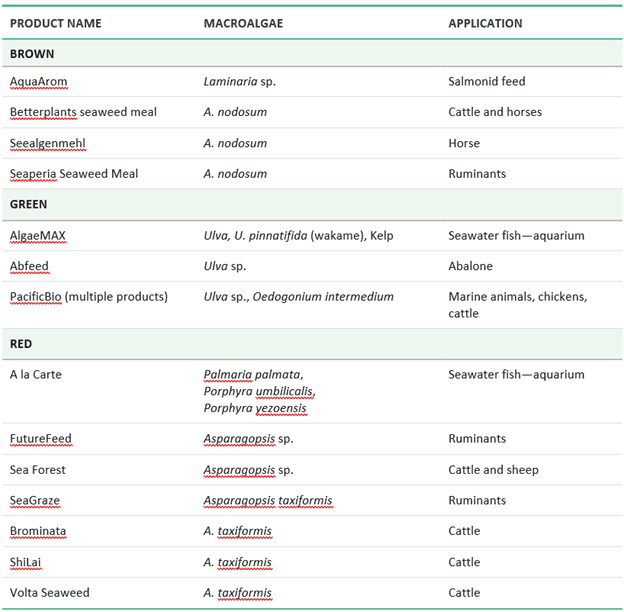
Seaweed has been used in animal feed for centuries, and the high protein content of seaweeds makes them attractive as a low-carbon and land-free alternative to feed from terrestrial protein sources like soy (Balasse et al., 2019; DeAngelo et al., 2023a; Morais et al., 2020). [caption id="attachment_11740" align="aligncenter" width="624"] Table 1. Examples of seaweed products, their species in production, and livestock that they have been used on.[/caption]

Click here for the table in high-resolution.

Why Explore Seaweed-based Animal Feed Products?

The global population is expected to reach 9 billion by 2050, and food production needs to grow to meet the demand, bringing with it the risk of higher greenhouse gas emissions (World Bank, 2023). In 2015 alone food systems produced on average 18 gigatons CO2e, more than a third of that year’s global anthropogenic emissions and stemming predominantly from land use and land use change (Crippa et al., 2021). To meet the demand for food without increasing its carbon footprint requires sustainable farm practices that reduce the terrestrial agricultural carbon footprint. Seaweed could mitigate emissions as a low-carbon food/nutrition source for animals, whether it is as alternate plant-based protein or dietary supplements to improve the rate at which animals consume feed to grow to desired sizes (i.e., lower feed conversion ratios) and meet recommended health requirements.

Seaweed as animal feed

Seaweed has been used in animal feed for centuries, and the high protein content of seaweeds makes them attractive as a low-carbon and land-free alternative to feed from terrestrial protein sources like soy (Balasse et al., 2019; DeAngelo et al., 2023a; Morais et al., 2020). [caption id="attachment_11740" align="alignnone" width="624"] Table 1. Examples of seaweed products, their species in production, and livestock that they have been used on.[/caption] Click here for the table in high-resolution.

Why Explore Seaweed-based Animal Feed Products?

The global population is expected to reach 9 billion by 2050, and food production needs to grow to meet the demand, bringing with it the risk of higher greenhouse gas emissions (World Bank, 2023). In 2015 alone food systems produced on average 18 gigatons CO2e, more than a third of that year’s global anthropogenic emissions and stemming predominantly from land use and land use change (Crippa et al., 2021). To meet the demand for food without increasing its carbon footprint requires sustainable farm practices that reduce the terrestrial agricultural carbon footprint. Seaweed could mitigate emissions as a low-carbon food/nutrition source for animals, whether it is as alternate plant-based protein or dietary supplements to improve the rate at which animals consume feed to grow to desired sizes (i.e., lower feed conversion ratios) and meet recommended health requirements.

Seaweed as animal feed

Seaweed has been used in animal feed for centuries, and the high protein content of seaweeds makes them attractive as a low-carbon and land-free alternative to feed from terrestrial protein sources like soy (Balasse et al., 2019; DeAngelo et al., 2023a; Morais et al., 2020). [caption id="attachment_11740" align="alignnone" width="624"] Table 1. Examples of seaweed products, their species in production, and livestock that they have been used on.[/caption] Click here to see the table in high-resolution.

Why Explore Seaweed-based Animal Feed Products?

The global population is expected to reach 9 billion by 2050, and food production needs to grow to meet the demand, bringing with it the risk of higher greenhouse gas emissions (World Bank, 2023). In 2015 alone food systems produced on average 18 gigatons CO2e, more than a third of that year’s global anthropogenic emissions and stemming predominantly from land use and land use change (Crippa et al., 2021). To meet the demand for food without increasing its carbon footprint requires sustainable farm practices that reduce the terrestrial agricultural carbon footprint. Seaweed could mitigate emissions as a low-carbon food/nutrition source for animals, whether it is as alternate plant-based protein or dietary supplements to improve the rate at which animals consume feed to grow to desired sizes (i.e., lower feed conversion ratios) and meet recommended health requirements.

Seaweed as animal feed

Seaweed has been used in animal feed for centuries, and the high protein content of seaweeds makes them attractive as a low-carbon and land-free alternative to feed from terrestrial protein sources like soy (Balasse et al., 2019; DeAngelo et al., 2023a; Morais et al., 2020). [caption id="attachment_11740" align="alignnone" width="624"] Table 1. Examples of seaweed products, their species in production, and livestock that they have been used on.[/caption] Click here for the high-resolution image.

Why Explore Seaweed-based Animal Feed Products?

The global population is expected to reach 9 billion by 2050, and food production needs to grow to meet the demand, bringing with it the risk of higher greenhouse gas emissions (World Bank, 2023). In 2015 alone food systems produced on average 18 gigatons CO2e, more than a third of that year’s global anthropogenic emissions and stemming predominantly from land use and land use change (Crippa et al., 2021). To meet the demand for food without increasing its carbon footprint requires sustainable farm practices that reduce the terrestrial agricultural carbon footprint. Seaweed could mitigate emissions as a low-carbon food/nutrition source for animals, whether it is as alternate plant-based protein or dietary supplements to improve the rate at which animals consume feed to grow to desired sizes (i.e., lower feed conversion ratios) and meet recommended health requirements.

Seaweed as animal feed

Seaweed has been used in animal feed for centuries, and the high protein content of seaweeds makes them attractive as a low-carbon and land-free alternative to feed from terrestrial protein sources like soy (Balasse et al., 2019; DeAngelo et al., 2023a; Morais et al., 2020). [caption id="attachment_11740" align="alignnone" width="624"] Table 1. Examples of seaweed products, their species in production, and livestock that they have been used on.[/caption] Click here for the high-resolution image.

Why Explore Seaweed-based Animal Feed Products?

The global population is expected to reach 9 billion by 2050, and food production needs to grow to meet the demand, bringing with it the risk of higher greenhouse gas emissions (World Bank, 2023). In 2015 alone food systems produced on average 18 gigatons CO2e, more than a third of that year’s global anthropogenic emissions and stemming predominantly from land use and land use change (Crippa et al., 2021). To meet the demand for food without increasing its carbon footprint requires sustainable farm practices that reduce the terrestrial agricultural carbon footprint. Seaweed could mitigate emissions as a low-carbon food/nutrition source for animals, whether it is as alternate plant-based protein or dietary supplements to improve the rate at which animals consume feed to grow to desired sizes (i.e., lower feed conversion ratios) and meet recommended health requirements.

Seaweed as animal feed

Seaweed has been used in animal feed for centuries, and the high protein content of seaweeds makes them attractive as a low-carbon and land-free alternative to feed from terrestrial protein sources like soy (Balasse et al., 2019; DeAngelo et al., 2023a; Morais et al., 2020). Click here for the high-resolution image.

Why Explore Seaweed-based Animal Feed Products?

The global population is expected to reach 9 billion by 2050, and food production needs to grow to meet the demand, bringing with it the risk of higher greenhouse gas emissions (World Bank, 2023). In 2015 alone food systems produced on average 18 gigatons CO2e, more than a third of that year’s global anthropogenic emissions and stemming predominantly from land use and land use change (Crippa et al., 2021). To meet the demand for food without increasing its carbon footprint requires sustainable farm practices that reduce the terrestrial agricultural carbon footprint. Seaweed could mitigate emissions as a low-carbon food/nutrition source for animals, whether it is as alternate plant-based protein or dietary supplements to improve the rate at which animals consume feed to grow to desired sizes (i.e., lower feed conversion ratios) and meet recommended health requirements.

Seaweed as animal feed

Seaweed has been used in animal feed for centuries, and the high protein content of seaweeds makes them attractive as a low-carbon and land-free alternative to feed from terrestrial protein sources like soy (Balasse et al., 2019; DeAngelo et al., 2023a; Morais et al., 2020). Click here for the high-resolution image.

Why Explore Seaweed-based Animal Feed Products?

The global population is expected to reach 9 billion by 2050, and food production needs to grow to meet the demand, bringing with it the risk of higher greenhouse gas emissions (World Bank, 2023). In 2015 alone food systems produced on average 18 gigatons CO2e, more than a third of that year’s global anthropogenic emissions and stemming predominantly from land use and land use change (Crippa et al., 2021). To meet the demand for food without increasing its carbon footprint requires sustainable farm practices that reduce the terrestrial agricultural carbon footprint. Seaweed could mitigate emissions as a low-carbon food/nutrition source for animals, whether it is as alternate plant-based protein or dietary supplements to improve the rate at which animals consume feed to grow to desired sizes (i.e., lower feed conversion ratios) and meet recommended health requirements.

Seaweed as animal feed

Seaweed has been used in animal feed for centuries, and the high protein content of seaweeds makes them attractive as a low-carbon and land-free alternative to feed from terrestrial protein sources like soy (Balasse et al., 2019; DeAngelo et al., 2023a; Morais et al., 2020). seaweed_products_bycolor_coastal_minimal

Why Explore Seaweed-based Animal Feed Products?

The global population is expected to reach 9 billion by 2050, and food production needs to grow to meet the demand, bringing with it the risk of higher greenhouse gas emissions (World Bank, 2023). In 2015 alone food systems produced on average 18 gigatons CO2e, more than a third of that year’s global anthropogenic emissions and stemming predominantly from land use and land use change (Crippa et al., 2021). To meet the demand for food without increasing its carbon footprint requires sustainable farm practices that reduce the terrestrial agricultural carbon footprint. Seaweed could mitigate emissions as a low-carbon food/nutrition source for animals, whether it is as alternate plant-based protein or dietary supplements to improve the rate at which animals consume feed to grow to desired sizes (i.e., lower feed conversion ratios) and meet recommended health requirements.

Seaweed as animal feed

Seaweed has been used in animal feed for centuries, and the high protein content of seaweeds makes them attractive as a low-carbon and land-free alternative to feed from terrestrial protein sources like soy (Balasse et al., 2019; DeAngelo et al., 2023a; Morais et al., 2020). [test file should be below here]  

Why Explore Seaweed-based Animal Feed Products?

The global population is expected to reach 9 billion by 2050, and food production needs to grow to meet the demand, bringing with it the risk of higher greenhouse gas emissions (World Bank, 2023). In 2015 alone food systems produced on average 18 gigatons CO2e, more than a third of that year’s global anthropogenic emissions and stemming predominantly from land use and land use change (Crippa et al., 2021). To meet the demand for food without increasing its carbon footprint requires sustainable farm practices that reduce the terrestrial agricultural carbon footprint. Seaweed could mitigate emissions as a low-carbon food/nutrition source for animals, whether it is as alternate plant-based protein or dietary supplements to improve the rate at which animals consume feed to grow to desired sizes (i.e., lower feed conversion ratios) and meet recommended health requirements.

Seaweed as animal feed

Seaweed has been used in animal feed for centuries, and the high protein content of seaweeds makes them attractive as a low-carbon and land-free alternative to feed from terrestrial protein sources like soy (Balasse et al., 2019; DeAngelo et al., 2023a; Morais et al., 2020). [test file should be below here] test image

Why Explore Seaweed-based Animal Feed Products?

The global population is expected to reach 9 billion by 2050, and food production needs to grow to meet the demand, bringing with it the risk of higher greenhouse gas emissions (World Bank, 2023). In 2015 alone food systems produced on average 18 gigatons CO2e, more than a third of that year’s global anthropogenic emissions and stemming predominantly from land use and land use change (Crippa et al., 2021). To meet the demand for food without increasing its carbon footprint requires sustainable farm practices that reduce the terrestrial agricultural carbon footprint. Seaweed could mitigate emissions as a low-carbon food/nutrition source for animals, whether it is as alternate plant-based protein or dietary supplements to improve the rate at which animals consume feed to grow to desired sizes (i.e., lower feed conversion ratios) and meet recommended health requirements.

Seaweed as animal feed

Seaweed has been used in animal feed for centuries, and the high protein content of seaweeds makes them attractive as a low-carbon and land-free alternative to feed from terrestrial protein sources like soy (Balasse et al., 2019; DeAngelo et al., 2023a; Morais et al., 2020). [test file should be below here]  

Why Explore Seaweed-based Animal Feed Products?

The global population is expected to reach 9 billion by 2050, and food production needs to grow to meet the demand, bringing with it the risk of higher greenhouse gas emissions (World Bank, 2023). In 2015 alone food systems produced on average 18 gigatons CO2e, more than a third of that year’s global anthropogenic emissions and stemming predominantly from land use and land use change (Crippa et al., 2021). To meet the demand for food without increasing its carbon footprint requires sustainable farm practices that reduce the terrestrial agricultural carbon footprint. Seaweed could mitigate emissions as a low-carbon food/nutrition source for animals, whether it is as alternate plant-based protein or dietary supplements to improve the rate at which animals consume feed to grow to desired sizes (i.e., lower feed conversion ratios) and meet recommended health requirements.

Seaweed as animal feed

Seaweed has been used in animal feed for centuries, and the high protein content of seaweeds makes them attractive as a low-carbon and land-free alternative to feed from terrestrial protein sources like soy (Balasse et al., 2019; DeAngelo et al., 2023a; Morais et al., 2020).

Why Explore Seaweed-based Animal Feed Products?

The global population is expected to reach 9 billion by 2050, and food production needs to grow to meet the demand, bringing with it the risk of higher greenhouse gas emissions (World Bank, 2023). In 2015 alone food systems produced on average 18 gigatons CO2e, more than a third of that year’s global anthropogenic emissions and stemming predominantly from land use and land use change (Crippa et al., 2021). To meet the demand for food without increasing its carbon footprint requires sustainable farm practices that reduce the terrestrial agricultural carbon footprint. Seaweed could mitigate emissions as a low-carbon food/nutrition source for animals, whether it is as alternate plant-based protein or dietary supplements to improve the rate at which animals consume feed to grow to desired sizes (i.e., lower feed conversion ratios) and meet recommended health requirements.

Seaweed as animal feed

Seaweed has been used in animal feed for centuries, and the high protein content of seaweeds makes them attractive as a low-carbon and land-free alternative to feed from terrestrial protein sources like soy. (Balasse et al., 2019; DeAngelo et al., 2023a; Morais et al., 2020).

Why Explore Seaweed-based Animal Feed Products?

The global population is expected to reach 9 billion by 2050, and food production needs to grow to meet the demand, bringing with it the risk of higher greenhouse gas emissions (World Bank, 2023). In 2015 alone food systems produced on average 18 gigatons CO2e, more than a third of that year’s global anthropogenic emissions and stemming predominantly from land use and land use change (Crippa et al., 2021). To meet the demand for food without increasing its carbon footprint requires sustainable farm practices that reduce the terrestrial agricultural carbon footprint. Seaweed could mitigate emissions as a low-carbon food/nutrition source for animals, whether it is as alternate plant-based protein or dietary supplements to improve the rate at which animals consume feed to grow to desired sizes (i.e., lower feed conversion ratios) and meet recommended health requirements.

Seaweed as animal feed

Seaweed has been used in animal feed for centuries, and the high protein content of seaweeds makes them attractive as a low-carbon and land-free alternative to feed from terrestrial protein sources like soy. (Balasse et al., 2019; DeAngelo et al., 2023a; Morais et al., 2020).

Why Explore Seaweed-based Animal Feed Products?

The global population is expected to reach 9 billion by 2050, and food production needs to grow to meet the demand, bringing with it the risk of higher greenhouse gas emissions (World Bank, 2023). In 2015 alone food systems produced on average 18 gigatons CO2e, more than a third of that year’s global anthropogenic emissions and stemming predominantly from land use and land use change (Crippa et al., 2021). To meet the demand for food without increasing its carbon footprint requires sustainable farm practices that reduce the terrestrial agricultural carbon footprint. Seaweed could mitigate emissions as a low-carbon food/nutrition source for animals, whether it is as alternate plant-based protein or dietary supplements to improve the rate at which animals consume feed to grow to desired sizes (i.e., lower feed conversion ratios) and meet recommended health requirements.

Why Explore Seaweed-based Animal Feed Products?

The global population is expected to reach 9 billion by 2050, and food production needs to grow to meet the demand, bringing with it the risk of higher greenhouse gas emissions (World Bank, 2023). In 2015 alone food systems produced on average 18 gigatons CO2e, more than a third of that year’s global anthropogenic emissions and stemming predominantly from land use and land use change (Crippa et al., 2021). To meet the demand for food without increasing its carbon footprint requires sustainable farm practices that reduce the terrestrial agricultural carbon footprint. Seaweed could mitigate emissions as a low-carbon food/nutrition source for animals, whether it is as alternate plant-based protein or dietary supplements to improve the rate at which animals consume feed to grow to desired sizes (i.e., lower feed conversion ratios) and meet recommended health requirements.

Projects from Ocean CDR Community

Science, Technology and Engineering

Species Selection

There are over 10,000 species of seaweed whose nutritional profiles vary with lifecycle, seasonality, and processing approach. Animal feed product producers select species based on their nutritional profile, target livestock, and existing regional seaweed supply; they use either individual species or species blends (Ozogul et al., 2024; Stedt et al., 2022). Table 1 summarizes seaweed groups’ nutritional composition, limitations, and how they are used.

Color group Key nutrients & compounds Notable limitations Common uses Example species Commercial producer/product
BROWN Carbohydrates (alginates, fucoidans, laminarins)
More digestible than red or green seaweeds
Less protein than red or green algae
Higher risk of heavy metals and biotoxins (e.g., arsenic)
Feed additive Laminaria sp.

Ascophyllum nodosum

Ocean Harvest Technology/OceanFeed Bovine (blend)

Ocean Harvest Technology/OceanFeed Swine (blend)

Tasco/Acadian

GREEN High levels of minerals, protein, vitamins dietary fibers Difficult to digest and access nutrients for monogastric livestock (e.g., pigs, poultry) Feed ingredient Ulva sp.

Ulva pinnatifida

Oedogonium intermedium

Ocean Harvest Technology/OceanFeed Bovine (blend)

Ocean Harvest Technology/OceanFeed Swine (blend)

RED Highest protein content of the three groups
Has essential nutrients for aquatic livestock (e.g., iodine)
No major limitations identified relative to other groups Enteric methane-reduction products Palmaria palmata / Porphyra sp.

Asparagopsis sp.
Lithothamnium calcareum

Ocean Harvest Technology/OceanFeed Bovine (blend)

Ocean Harvest Technology/OceanFeed Swine (blend)

Celtic Sea Minerals/CeltiCal

Table 1. Examples of seaweed groups’ nutritional composition for animal feed, limitations, and example species and products. Sources: Cian et al. (2015), Valente et al. (2015), Garcia-Vaquero and Hayes (2016), Øverland et al. (2019), Morais et al. (2020), Schleder et al. (2020), Costa et al. (2021)

Wild harvest and cultivation practices

Harvesting wild seaweed for animal feed occurs in nations such as Norway, but this industry needs large volumes of biomass so leading companies achieve this by sourcing raw material from large-scale cultivated seaweed producing economies such as Indonesia (World Bank, 2023). While cultivation can occur in a range of locations (onshore vs offshore) and scale of farms, the approach of choice will vary according to end-product specifications and the level of inclusion in livestock diet (Costa et al., 2021). For cross-cutting information about seaweed cultivation and harvest, refer to the “Cultivation and Dewatering/Drying” chapter.

Dewatering/drying

Animal feed must be dewatered/dried before further processing. Commercial-scale drying methods include air drying on net frames, or freeze or heated drying in temperature-controlled rooms (Garcia-Vaquero & Hayes, 2016; Jönsson et al., 2020; Grabež et al., 2023). Conventional methods can degrade heat-sensitive target compounds (e.g., polyphenols, antioxidants), meriting R&D on how to dry seaweed without jeopardizing downstream product quality (Costa et al., 2021). See the “Cultivation and Dewatering/Drying” chapter for more information.

Preprocessing

Seaweed polysaccharides (e.g., cellulose, alginate, carrageenan, ulvan) and heavy metals interfere with adequate nutrient absorption in most livestock diets (e.g., Terry et al., 2023; Sumana et al., 2026). To address this, conventional pre-processing methods include blanching, washing and boiling biomass (e.g., Hanaoka et al., 2001; Stévant et al., 2018; Ownsworth et al., 2019; Blikra et al., 2021; Hofmann et al., 2025). Pre-treating seaweed biomass with microbial fermentation and ensiling is being studied as one innovative solution to improve digestibility, with observed co-benefits like increased antioxidant potential and immune system health (Usmani et al., 2020; Yen et al., 2024; Khan et al., 2025). Enzymatic hydrolysis pre-treatment is also being explored, as it breaks down polysaccharides into oligosaccharides, improving nutrient absorption and feed efficiency (Kulshreshtha et al., 2020; Mota et al., 2023; Bikker et al., 2016). In addition to increasing digestibility, simple fermentation methods (e.g., salt brine) are being tested to extend the seaweed’s shelf life (Stévant and Rebours, 2021; Ozogul et al., 2024; Sumana et al., 2026).

Processing

Conventional methods to extract proteins and other valuable compounds use high temperatures, water, acid, and/or salt solutions over time to break down seaweeds’ cell walls to reach desirable compounds (Dobrinčić et al., 2020). Methods include mechanical or enzymatic cell rupture, centrifugation, and advanced separation techniques (e.g., chromatography, electrophoresis; reviewed in Kumar and Sharma, 2017, Jönsson et al., 2020). The result of each method is a solid and liquid fraction of seaweed biomaterial, the latter of which contains desirable soluble protein and other compounds used in feed production. Novel extraction methods are being developed to cut down on extraction time, solvent usage, and energy needs and to maximize protein extraction while maintaining their functional and nutritional properties (reviewed in Naseem et al., 2024). Pre-processing and processing is summarized in Figure 2 while Table 2 summarizes the novel techniques, the benefits of their use in producing seaweed-based animal feed, and technological readiness.

Figure 2. Flowchart summarizing animal feed pre-/processing.
Innovation Process Claimed benefits
Fermentation Fermentation with acid (e.g., lactic acid) or fungus (Aspergillus ibericus) Improved digestibility
Reduced heavy metals
Improved antioxidant profile
Enzymatic hydrolysis Soaking in enzymatic solutions under controlled heat Improved digestibility
Improved extraction yield
Microwave-assisted extraction (MAE) Uses microwaves to break cell walls and release compounds in solvent Improved extraction yield
Fewer solvents required
Can use fresh biomass
Ultrasound-assisted extraction (UAE) High-frequency sound waves increase cell porosity, allowing solvent penetration Improved extraction yield
Preserves heat-sensitive compounds
Can use fresh biomass
Reduced biotoxins
Enzyme-assisted extraction (EAE) Hydrolytic enzymes (e.g., cellulase) break down cell walls, releasing contents Lower environmental impact
Improved extraction yield
Aqueous/Enzyme-assisted aqueous extraction process (AEP/EAEP) Fractionation of several matrices into protein-, oil-, and fiber-rich fractions using water as a solvent Lower environmental impact
Enables rapid release of compounds
Sub-critical water extraction (SWE) Sub-critical temperature (100–374°C) and pressure (0.1–2.0 MPa) is used to alter water properties and encourage extractability Improved extraction yield
Sub-critical fluid extraction (SFE) Sub-critical temperature (>31.1°C) and pressure (>72.8 bar) is used to alter fluid (CO2) properties and encourage extractability Improved extraction yield
Improved targeted extraction

Table 2. Emerging pre-/processing techniques and claimed benefits. Sources: de Moura et al. (2008), Yuan and Macquarrie (2015), Zollmann et al. (2019), Bordoloi and Goosen (2020), Dobrinčić et al. (2020), Naseri et al. (2020), Matos et al. (2021), Sharma and Zalpouri (2022), Lewandowska et al. (2023), Choulot et al. (2025), Gaiero et al. (2025), Sumana et al. (2025)

Species Selection

There are over 10,000 species of seaweed whose nutritional profiles vary with lifecycle, seasonality, and processing approach. Animal feed product producers select species based on their nutritional profile, target livestock, and existing regional seaweed supply; they use either individual species or species blends (Ozogul et al., 2024; Stedt et al., 2022). Table 1 summarizes seaweed groups’ nutritional composition, limitations, and how they are used.
Color group Key nutrients & compounds Notable limitations Common uses Example species Commercial producer/product
BROWN Carbohydrates (alginates, fucoidans, laminarins) More digestible than red or green seaweeds Less protein than red or green algae Higher risk of heavy metals and biotoxins (e.g., arsenic) Feed additive Laminaria sp. Ascophyllum nodosum Ocean Harvest Technology/OceanFeed Bovine (blend) Ocean Harvest Technology/OceanFeed Swine (blend) Tasco/Acadian
GREEN High levels of minerals, protein, vitamins dietary fibers Difficult to digest and access nutrients for monogastric livestock (e.g., pigs, poultry) Feed ingredient Ulva sp. Ulva pinnatifida Oedogonium intermedium Ocean Harvest Technology/OceanFeed Bovine (blend) Ocean Harvest Technology/OceanFeed Swine (blend)
RED Highest protein content of the three groups Has essential nutrients for aquatic livestock (e.g., iodine) No major limitations identified relative to other groups Enteric methane-reduction products Palmaria palmata / Porphyra sp. Asparagopsis sp. Lithothamnium calcareum Ocean Harvest Technology/OceanFeed Bovine (blend) Ocean Harvest Technology/OceanFeed Swine (blend) Celtic Sea Minerals/CeltiCal
Table 1. Examples of seaweed groups’ nutritional composition for animal feed, limitations, and example species and products. Sources: Cian et al. (2015), Valente et al. (2015), Garcia-Vaquero and Hayes (2016), Øverland et al. (2019), Morais et al. (2020), Schleder et al. (2020), Costa et al. (2021)

Wild harvest and cultivation practices

Harvesting wild seaweed for animal feed occurs in nations such as Norway, but this industry needs large volumes of biomass so leading companies achieve this by sourcing raw material from large-scale cultivated seaweed producing economies such as Indonesia (World Bank, 2023). While cultivation can occur in a range of locations (onshore vs offshore) and scale of farms, the approach of choice will vary according to end-product specifications and the level of inclusion in livestock diet (Costa et al., 2021). For cross-cutting information about seaweed cultivation and harvest, refer to the “Cultivation and Dewatering/Drying” chapter.

Dewatering/drying

Animal feed must be dewatered/dried before further processing. Commercial-scale drying methods include air drying on net frames, or freeze or heated drying in temperature-controlled rooms (Garcia-Vaquero & Hayes, 2016; Jönsson et al., 2020; Grabež et al., 2023). Conventional methods can degrade heat-sensitive target compounds (e.g., polyphenols, antioxidants), meriting R&D on how to dry seaweed without jeopardizing downstream product quality (Costa et al., 2021). See the “Cultivation and Dewatering/Drying” chapter for more information.

Preprocessing

Seaweed polysaccharides (e.g., cellulose, alginate, carrageenan, ulvan) and heavy metals interfere with adequate nutrient absorption in most livestock diets (e.g., Terry et al., 2023; Sumana et al., 2026). To address this, conventional pre-processing methods include blanching, washing and boiling biomass (e.g., Hanaoka et al., 2001; Stévant et al., 2018; Ownsworth et al., 2019; Blikra et al., 2021; Hofmann et al., 2025). Pre-treating seaweed biomass with microbial fermentation and ensiling is being studied as one innovative solution to improve digestibility, with observed co-benefits like increased antioxidant potential and immune system health (Usmani et al., 2020; Yen et al., 2024; Khan et al., 2025). Enzymatic hydrolysis pre-treatment is also being explored, as it breaks down polysaccharides into oligosaccharides, improving nutrient absorption and feed efficiency (Kulshreshtha et al., 2020; Mota et al., 2023; Bikker et al., 2016). In addition to increasing digestibility, simple fermentation methods (e.g., salt brine) are being tested to extend the seaweed’s shelf life (Stévant and Rebours, 2021; Ozogul et al., 2024; Sumana et al., 2026).

Processing

Conventional methods to extract proteins and other valuable compounds use high temperatures, water, acid, and/or salt solutions over time to break down seaweeds’ cell walls to reach desirable compounds (Dobrinčić et al., 2020). Methods include mechanical or enzymatic cell rupture, centrifugation, and advanced separation techniques (e.g., chromatography, electrophoresis; reviewed in Kumar and Sharma, 2017, Jönsson et al., 2020). The result of each method is a solid and liquid fraction of seaweed biomaterial, the latter of which contains desirable soluble protein and other compounds used in feed production. Novel extraction methods are being developed to cut down on extraction time, solvent usage, and energy needs and to maximize protein extraction while maintaining their functional and nutritional properties (reviewed in Naseem et al., 2024). Pre-processing and processing is summarized in Figure 2 while Table 2 summarizes the novel techniques, the benefits of their use in producing seaweed-based animal feed, and technological readiness. [caption id="attachment_12816" align="aligncenter" width="2560"] Figure 2. Flowchart summarizing animal feed pre-/processing.[/caption]
Innovation Process Claimed benefits
Fermentation Fermentation with acid (e.g., lactic acid) or fungus (Aspergillus ibericus) Improved digestibility Reduced heavy metals Improved antioxidant profile
Enzymatic hydrolysis Soaking in enzymatic solutions under controlled heat Improved digestibility Improved extraction yield
Microwave-assisted extraction (MAE) Uses microwaves to break cell walls and release compounds in solvent Improved extraction yield Fewer solvents required Can use fresh biomass
Ultrasound-assisted extraction (UAE) High-frequency sound waves increase cell porosity, allowing solvent penetration Improved extraction yield Preserves heat-sensitive compounds Can use fresh biomass Reduced biotoxins
Enzyme-assisted extraction (EAE) Hydrolytic enzymes (e.g., cellulase) break down cell walls, releasing contents Lower environmental impact Improved extraction yield
Aqueous/Enzyme-assisted aqueous extraction process (AEP/EAEP) Fractionation of several matrices into protein-, oil-, and fiber-rich fractions using water as a solvent Lower environmental impact Enables rapid release of compounds
Sub-critical water extraction (SWE) Sub-critical temperature (100–374°C) and pressure (0.1–2.0 MPa) is used to alter water properties and encourage extractability Improved extraction yield
Sub-critical fluid extraction (SFE) Sub-critical temperature (>31.1°C) and pressure (>72.8 bar) is used to alter fluid (CO2) properties and encourage extractability Improved extraction yield Improved targeted extraction
Table 2. Emerging pre-/processing techniques and claimed benefits. Sources: de Moura et al. (2008), Yuan and Macquarrie (2015), Zollmann et al. (2019), Bordoloi and Goosen (2020), Dobrinčić et al. (2020), Naseri et al. (2020), Matos et al. (2021), Sharma and Zalpouri (2022), Lewandowska et al. (2023), Choulot et al. (2025), Gaiero et al. (2025), Sumana et al. (2025)

Species Selection

There are over 10,000 species of seaweed whose nutritional profiles vary with lifecycle, seasonality, and processing approach. Animal feed product producers select species based on their nutritional profile, target livestock, and existing regional seaweed supply; they use either individual species or species blends (Ozogul et al., 2024; Stedt et al., 2022). Table 1 summarizes seaweed groups’ nutritional composition, limitations, and how they are used.
Color group Key nutrients & compounds Notable limitations Common uses Example species Commercial producer/product
BROWN Carbohydrates (alginates, fucoidans, laminarins) More digestible than red or green seaweeds Less protein than red or green algae Higher risk of heavy metals and biotoxins (e.g., arsenic) Feed additive Laminaria sp. Ascophyllum nodosum Ocean Harvest Technology/OceanFeed Bovine (blend) Ocean Harvest Technology/OceanFeed Swine (blend) Tasco/Acadian
GREEN High levels of minerals, protein, vitamins dietary fibers Difficult to digest and access nutrients for monogastric livestock (e.g., pigs, poultry) Feed ingredient Ulva sp. Ulva pinnatifida Oedogonium intermedium Ocean Harvest Technology/OceanFeed Bovine (blend) Ocean Harvest Technology/OceanFeed Swine (blend)
RED Highest protein content of the three groups Has essential nutrients for aquatic livestock (e.g., iodine) No major limitations identified relative to other groups Enteric methane-reduction products Palmaria palmata / Porphyra sp. Asparagopsis sp. Lithothamnium calcareum Ocean Harvest Technology/OceanFeed Bovine (blend) Ocean Harvest Technology/OceanFeed Swine (blend) Celtic Sea Minerals/CeltiCal
Table 1. Examples of seaweed groups’ nutritional composition for animal feed, limitations, and example species and products. Sources: Cian et al. (2015), Valente et al. (2015), Garcia-Vaquero and Hayes (2016), Øverland et al. (2019), Morais et al. (2020), Schleder et al. (2020), Costa et al. (2021)

Wild harvest and cultivation practices

Harvesting wild seaweed for animal feed occurs in nations such as Norway, but this industry needs large volumes of biomass so leading companies achieve this by sourcing raw material from large-scale cultivated seaweed producing economies such as Indonesia (World Bank, 2023). While cultivation can occur in a range of locations (onshore vs offshore) and scale of farms, the approach of choice will vary according to end-product specifications and the level of inclusion in livestock diet (Costa et al., 2021). For cross-cutting information about seaweed cultivation and harvest, refer to the “Cultivation and Dewatering/Drying” chapter.

Dewatering/drying

Animal feed must be dewatered/dried before further processing. Commercial-scale drying methods include air drying on net frames, or freeze or heated drying in temperature-controlled rooms (Garcia-Vaquero & Hayes, 2016; Jönsson et al., 2020). Conventional methods can degrade heat-sensitive target compounds (e.g., polyphenols, antioxidants), meriting R&D on how to dry seaweed without jeopardizing downstream product quality (Costa et al., 2021). See the “Cultivation and Dewatering/Drying” chapter for more information.

Preprocessing

Seaweed polysaccharides (e.g., cellulose, alginate, carrageenan, ulvan) and heavy metals interfere with adequate nutrient absorption in most livestock diets (e.g., Terry et al., 2023; Sumana et al., 2026). To address this, conventional pre-processing methods include blanching, washing and boiling biomass (e.g., Hanaoka et al., 2001; Stévant et al., 2018; Ownsworth et al., 2019; Blikra et al., 2021; Hofmann et al., 2025). Pre-treating seaweed biomass with microbial fermentation and ensiling is being studied as one innovative solution to improve digestibility, with observed co-benefits like increased antioxidant potential and immune system health (Usmani et al., 2020; Yen et al., 2024; Khan et al., 2025). Enzymatic hydrolysis pre-treatment is also being explored, as it breaks down polysaccharides into oligosaccharides, improving nutrient absorption and feed efficiency (Kulshreshtha et al., 2020; Mota et al., 2023; Bikker et al., 2016). In addition to increasing digestibility, simple fermentation methods (e.g., salt brine) are being tested to extend the seaweed’s shelf life (Stévant and Rebours, 2021; Ozogul et al., 2024; Sumana et al., 2026).

Processing

Conventional methods to extract proteins and other valuable compounds use high temperatures, water, acid, and/or salt solutions over time to break down seaweeds’ cell walls to reach desirable compounds (Dobrinčić et al., 2020). Methods include mechanical or enzymatic cell rupture, centrifugation, and advanced separation techniques (e.g., chromatography, electrophoresis; reviewed in Kumar and Sharma, 2017, Jönsson et al., 2020). The result of each method is a solid and liquid fraction of seaweed biomaterial, the latter of which contains desirable soluble protein and other compounds used in feed production. Novel extraction methods are being developed to cut down on extraction time, solvent usage, and energy needs and to maximize protein extraction while maintaining their functional and nutritional properties (reviewed in Naseem et al., 2024). Pre-processing and processing is summarized in Figure 2 while Table 2 summarizes the novel techniques, the benefits of their use in producing seaweed-based animal feed, and technological readiness. [caption id="attachment_12816" align="aligncenter" width="2560"] Figure 2. Flowchart summarizing animal feed pre-/processing.[/caption]
Innovation Process Claimed benefits
Fermentation Fermentation with acid (e.g., lactic acid) or fungus (Aspergillus ibericus) Improved digestibility Reduced heavy metals Improved antioxidant profile
Enzymatic hydrolysis Soaking in enzymatic solutions under controlled heat Improved digestibility Improved extraction yield
Microwave-assisted extraction (MAE) Uses microwaves to break cell walls and release compounds in solvent Improved extraction yield Fewer solvents required Can use fresh biomass
Ultrasound-assisted extraction (UAE) High-frequency sound waves increase cell porosity, allowing solvent penetration Improved extraction yield Preserves heat-sensitive compounds Can use fresh biomass Reduced biotoxins
Enzyme-assisted extraction (EAE) Hydrolytic enzymes (e.g., cellulase) break down cell walls, releasing contents Lower environmental impact Improved extraction yield
Aqueous/Enzyme-assisted aqueous extraction process (AEP/EAEP) Fractionation of several matrices into protein-, oil-, and fiber-rich fractions using water as a solvent Lower environmental impact Enables rapid release of compounds
Sub-critical water extraction (SWE) Sub-critical temperature (100–374°C) and pressure (0.1–2.0 MPa) is used to alter water properties and encourage extractability Improved extraction yield
Sub-critical fluid extraction (SFE) Sub-critical temperature (>31.1°C) and pressure (>72.8 bar) is used to alter fluid (CO2) properties and encourage extractability Improved extraction yield Improved targeted extraction
Table 2. Emerging pre-/processing techniques and claimed benefits. Sources: de Moura et al. (2008), Yuan and Macquarrie (2015), Zollmann et al. (2019), Bordoloi and Goosen (2020), Dobrinčić et al. (2020), Naseri et al. (2020), Matos et al. (2021), Sharma and Zalpouri (2022), Lewandowska et al. (2023), Choulot et al. (2025), Gaiero et al. (2025), Sumana et al. (2025)

Species Selection

There are over 10,000 species of seaweed whose nutritional profiles vary with lifecycle, seasonality, and processing approach. Animal feed product producers select species based on their nutritional profile, target livestock, and existing regional seaweed supply; they use either individual species or species blends (Ozogul et al., 2024; Stedt et al., 2022). Table 1 summarizes seaweed groups’ nutritional composition, limitations, and how they are used.
Color group Key nutrients & compounds Notable limitations Common uses Example species Commercial producer/product
BROWN Carbohydrates (alginates, fucoidans, laminarins) More digestible than red or green seaweeds Less protein than red or green algae Higher risk of heavy metals and biotoxins (e.g., arsenic) Feed additive Laminaria sp. Ascophyllum nodosum Ocean Harvest Technology/OceanFeed Bovine (blend) Ocean Harvest Technology/OceanFeed Swine (blend) Tasco/Acadian
GREEN High levels of minerals, protein, vitamins dietary fibers Difficult to digest and access nutrients for monogastric livestock (e.g., pigs, poultry) Feed ingredient Ulva sp. Ulva pinnatifida Oedogonium intermedium Ocean Harvest Technology/OceanFeed Bovine (blend) Ocean Harvest Technology/OceanFeed Swine (blend)
RED Highest protein content of the three groups Has essential nutrients for aquatic livestock (e.g., iodine) No major limitations identified relative to other groups Enteric methane-reduction products Palmaria palmata / Porphyra sp. Asparagopsis sp. Lithothamnium calcareum Ocean Harvest Technology/OceanFeed Bovine (blend) Ocean Harvest Technology/OceanFeed Swine (blend) Celtic Sea Minerals/CeltiCal
Table 1. Examples of seaweed groups’ nutritional composition for animal feed, limitations, and example species and products. Sources: Cian et al. (2015), Valente et al. (2015), Garcia-Vaquero and Hayes (2016), Øverland et al. (2019), Morais et al. (2020), Schleder et al. (2020), Costa et al. (2021)

Wild harvest and cultivation practices

Harvesting wild seaweed for animal feed occurs in nations such as Norway, but this industry needs large volumes of biomass so leading companies achieve this by sourcing raw material from large-scale cultivated seaweed producing economies such as Indonesia (World Bank, 2023). While cultivation can occur in a range of locations (onshore vs offshore) and scale of farms, the approach of choice will vary according to end-product specifications and the level of inclusion in livestock diet (Costa et al., 2021). For cross-cutting information about seaweed cultivation and harvest, refer to the “Cultivation and Dewatering/Drying” chapter.

Dewatering/drying

Animal feed must be dewatered/dried before further processing. Commercial-scale drying methods include air drying on net frames, or freeze or heated drying in temperature-controlled rooms (Garcia-Vaquero & Hayes, 2016; Jönsson et al., 2020). Conventional methods can degrade heat-sensitive target compounds (e.g., polyphenols, antioxidants), meriting R&D on how to dry seaweed without jeopardizing downstream product quality (Costa et al., 2021). See the “Cultivation and Dewatering/Drying” chapter for more information.

Preprocessing

Seaweed polysaccharides (e.g., cellulose, alginate, carrageenan, ulvan) and heavy metals interfere with adequate nutrient absorption in most livestock diets (e.g., Terry et al., 2023; Sumana et al., 2026). To address this, conventional pre-processing methods include blanching, washing and boiling biomass (e.g., Hanaoka et al., 2001; Stévant et al., 2018; Ownsworth et al., 2019; Blikra et al., 2021; Hofmann et al., 2025). Pre-treating seaweed biomass with microbial fermentation is being studied as one innovative solution, with observed co-benefits like increased antioxidant potential and immune system health (Usmani et al., 2020; Khan et al., 2025). Enzymatic hydrolysis pre-treatment is also being explored, as it breaks down polysaccharides into oligosaccharides, improving nutrient absorption and feed efficiency (Kulshreshtha et al., 2020; Mota et al., 2023; Bikker et al., 2016). In addition to increasing digestibility, simple fermentation methods (e.g., salt brine) are being tested to extend the seaweed’s shelf life (Stévant and Rebours, 2021; Ozogul et al., 2024; Sumana et al., 2026).

Processing

Conventional methods to extract proteins and other valuable compounds use high temperatures, water, acid, and/or salt solutions over time to break down seaweeds’ cell walls to reach desirable compounds (Dobrinčić et al., 2020). Methods include mechanical or enzymatic cell rupture, centrifugation, and advanced separation techniques (e.g., chromatography, electrophoresis; reviewed in Kumar and Sharma, 2017, Jönsson et al., 2020). The result of each method is a solid and liquid fraction of seaweed biomaterial, the latter of which contains desirable soluble protein and other compounds used in feed production. Novel extraction methods are being developed to cut down on extraction time, solvent usage, and energy needs and to maximize protein extraction while maintaining their functional and nutritional properties (reviewed in Naseem et al., 2024). Pre-processing and processing is summarized in Figure 2 while Table 2 summarizes the novel techniques, the benefits of their use in producing seaweed-based animal feed, and technological readiness. [caption id="attachment_12816" align="aligncenter" width="2560"] Figure 2. Flowchart summarizing animal feed pre-/processing.[/caption]
Innovation Process Claimed benefits
Fermentation Fermentation with acid (e.g., lactic acid) or fungus (Aspergillus ibericus) Improved digestibility Reduced heavy metals Improved antioxidant profile
Enzymatic hydrolysis Soaking in enzymatic solutions under controlled heat Improved digestibility Improved extraction yield
Microwave-assisted extraction (MAE) Uses microwaves to break cell walls and release compounds in solvent Improved extraction yield Fewer solvents required Can use fresh biomass
Ultrasound-assisted extraction (UAE) High-frequency sound waves increase cell porosity, allowing solvent penetration Improved extraction yield Preserves heat-sensitive compounds Can use fresh biomass Reduced biotoxins
Enzyme-assisted extraction (EAE) Hydrolytic enzymes (e.g., cellulase) break down cell walls, releasing contents Lower environmental impact Improved extraction yield
Aqueous/Enzyme-assisted aqueous extraction process (AEP/EAEP) Fractionation of several matrices into protein-, oil-, and fiber-rich fractions using water as a solvent Lower environmental impact Enables rapid release of compounds
Sub-critical water extraction (SWE) Sub-critical temperature (100–374°C) and pressure (0.1–2.0 MPa) is used to alter water properties and encourage extractability Improved extraction yield
Sub-critical fluid extraction (SFE) Sub-critical temperature (>31.1°C) and pressure (>72.8 bar) is used to alter fluid (CO2) properties and encourage extractability Improved extraction yield Improved targeted extraction
Table 2. Emerging pre-/processing techniques and claimed benefits. Sources: de Moura et al. (2008), Yuan and Macquarrie (2015), Zollmann et al. (2019), Bordoloi and Goosen (2020), Dobrinčić et al. (2020), Naseri et al. (2020), Matos et al. (2021), Sharma and Zalpouri (2022), Lewandowska et al. (2023), Choulot et al. (2025), Gaiero et al. (2025), Sumana et al. (2025)

Species Selection

There are over 10,000 species of seaweed whose nutritional profiles vary with lifecycle, seasonality, and processing approach. Animal feed product producers select species based on their nutritional profile, target livestock, and existing regional seaweed supply; they use either individual species or species blends (Ozogul et al., 2024; Stedt et al., 2022). Table 1 summarizes seaweed groups’ nutritional composition, limitations, and how they are used.
Color group Key nutrients & compounds Notable limitations Common uses Example species Commercial producer/product
BROWN Carbohydrates (alginates, fucoidans, laminarins) More digestible than red or green seaweeds Less protein than red or green algae Higher risk of heavy metals and biotoxins (e.g., arsenic) Feed additive Laminaria sp. Ascophyllum nodosum Ocean Harvest Technology/OceanFeed Bovine (blend) Ocean Harvest Technology/OceanFeed Swine (blend) Tasco/Acadian
GREEN High levels of minerals, protein, vitamins dietary fibers Difficult to digest and access nutrients for monogastric livestock (e.g., pigs, poultry) Feed ingredient Ulva sp. Ulva pinnatifida Oedogonium intermedium Ocean Harvest Technology/OceanFeed Bovine (blend) Ocean Harvest Technology/OceanFeed Swine (blend)
RED Highest protein content of the three groups Has essential nutrients for aquatic livestock (e.g., iodine) No major limitations identified relative to other groups Enteric methane-reduction products Palmaria palmata / Porphyra sp. Asparagopsis sp. Lithothamnium calcareum Ocean Harvest Technology/OceanFeed Bovine (blend) Ocean Harvest Technology/OceanFeed Swine (blend) Celtic Sea Minerals/CeltiCal
Table 1. Examples of seaweed groups’ nutritional composition for animal feed, limitations, and example species and products. Sources: Cian et al. (2015), Valente et al. (2015), Garcia-Vaquero and Hayes (2016), Øverland et al. (2019), Morais et al. (2020), Schleder et al. (2020), Costa et al. (2021)

Wild harvest and cultivation practices

Harvesting wild seaweed for animal feed occurs in nations such as Norway, but this industry needs large volumes of biomass so leading companies achieve this by sourcing raw material from large-scale cultivated seaweed producing economies such as Indonesia (World Bank, 2023). While cultivation can occur in a a range of locations (onshore vs offshore) and scale of farms, the approach of choice will vary according to end-product specifications and the level of inclusion in livestock diet (Costa et al., 2021). For cross-cutting information about seaweed cultivation and harvest, refer to the “Cultivation and Dewatering/Drying” chapter.

Dewatering/drying

Animal feed must be dewatered/dried before further processing. Commercial-scale drying methods include air drying on net frames, or freeze or heated drying in temperature-controlled rooms (Garcia-Vaquero & Hayes, 2016; Jönsson et al., 2020). Conventional methods can degrade heat-sensitive target compounds (e.g., polyphenols, antioxidants), meriting R&D on how to dry seaweed without jeopardizing downstream product quality (Costa et al., 2021). See the “Cultivation and Dewatering/Drying” chapter for more information.

Preprocessing

Seaweed polysaccharides (e.g., cellulose, alginate, carrageenan, ulvan) and heavy metals interfere with adequate nutrient absorption in most livestock diets (e.g., Terry et al., 2023; Sumana et al., 2026). To address this, conventional pre-processing methods include blanching, washing and boiling biomass (e.g., Hanaoka et al., 2001; Stévant et al., 2018; Ownsworth et al., 2019; Blikra et al., 2021; Hofmann et al., 2025). Pre-treating seaweed biomass with microbial fermentation is being studied as one innovative solution, with observed co-benefits like increased antioxidant potential and immune system health (Usmani et al., 2020; Khan et al., 2025). Enzymatic hydrolysis pre-treatment is also being explored, as it breaks down polysaccharides into oligosaccharides, improving nutrient absorption and feed efficiency (Kulshreshtha et al., 2020; Mota et al., 2023; Bikker et al., 2016). In addition to increasing digestibility, simple fermentation methods (e.g., salt brine) are being tested to extend the seaweed’s shelf life (Stévant and Rebours, 2021; Ozogul et al., 2024; Sumana et al., 2026).

Processing

Conventional methods to extract proteins and other valuable compounds use high temperatures, water, acid, and/or salt solutions over time to break down seaweeds’ cell walls to reach desirable compounds (Dobrinčić et al., 2020). Methods include mechanical or enzymatic cell rupture, centrifugation, and advanced separation techniques (e.g., chromatography, electrophoresis; reviewed in Kumar and Sharma, 2017, Jönsson et al., 2020). The result of each method is a solid and liquid fraction of seaweed biomaterial, the latter of which contains desirable soluble protein and other compounds used in feed production. Novel extraction methods are being developed to cut down on extraction time, solvent usage, and energy needs and to maximize protein extraction while maintaining their functional and nutritional properties (reviewed in Naseem et al., 2024). Pre-processing and processing is summarized in Figure 2 while Table 2 summarizes the novel techniques, the benefits of their use in producing seaweed-based animal feed, and technological readiness. [caption id="attachment_12816" align="aligncenter" width="2560"] Figure 2. Flowchart summarizing animal feed pre-/processing.[/caption]
Innovation Process Claimed benefits
Fermentation Fermentation with acid (e.g., lactic acid) or fungus (Aspergillus ibericus) Improved digestibility Reduced heavy metals Improved antioxidant profile
Enzymatic hydrolysis Soaking in enzymatic solutions under controlled heat Improved digestibility Improved extraction yield
Microwave-assisted extraction (MAE) Uses microwaves to break cell walls and release compounds in solvent Improved extraction yield Fewer solvents required Can use fresh biomass
Ultrasound-assisted extraction (UAE) High-frequency sound waves increase cell porosity, allowing solvent penetration Improved extraction yield Preserves heat-sensitive compounds Can use fresh biomass Reduced biotoxins
Enzyme-assisted extraction (EAE) Hydrolytic enzymes (e.g., cellulase) break down cell walls, releasing contents Lower environmental impact Improved extraction yield
Aqueous/Enzyme-assisted aqueous extraction process (AEP/EAEP) Fractionation of several matrices into protein-, oil-, and fiber-rich fractions using water as a solvent Lower environmental impact Enables rapid release of compounds
Sub-critical water extraction (SWE) Sub-critical temperature (100–374°C) and pressure (0.1–2.0 MPa) is used to alter water properties and encourage extractability Improved extraction yield
Sub-critical fluid extraction (SFE) Sub-critical temperature (>31.1°C) and pressure (>72.8 bar) is used to alter fluid (CO2) properties and encourage extractability Improved extraction yield Improved targeted extraction
Table 2. Emerging pre-/processing techniques and claimed benefits. Sources: de Moura et al. (2008), Yuan and Macquarrie (2015), Zollmann et al. (2019), Bordoloi and Goosen (2020), Dobrinčić et al. (2020), Naseri et al. (2020), Matos et al. (2021), Sharma and Zalpouri (2022), Lewandowska et al. (2023), Choulot et al. (2025), Gaiero et al. (2025), Sumana et al. (2025)

Species Selection

There are over 10,000 species of seaweed whose nutritional profiles vary with lifecycle, seasonality, and processing approach. Animal feed product producers select species based on their nutritional profile, target livestock, and existing regional seaweed supply; they use either individual species or species blends (Ozogul et al., 2024; Stedt et al., 2022). Table 1 summarizes seaweed groups’ nutritional composition, limitations, and how they are used.
Color group Key nutrients & compounds Notable limitations Common uses Example species Commercial producer/product
BROWN Carbohydrates (alginates, fucoidans, laminarins) More digestible than red or green seaweeds Less protein than red or green algae Higher risk of heavy metals and biotoxins (e.g., arsenic) Feed additive Laminaria sp. Ascophyllum nodosum Ocean Harvest Technology/OceanFeed Bovine (blend) Ocean Harvest Technology/OceanFeed Swine (blend) Tasco/Acadian
GREEN High levels of minerals, protein, vitamins dietary fibers Difficult to digest and access nutrients for monogastric livestock (e.g., pigs, poultry) Feed ingredient Ulva sp. Ulva pinnatifida Oedogonium intermedium Ocean Harvest Technology/OceanFeed Bovine (blend) Ocean Harvest Technology/OceanFeed Swine (blend)
RED Highest protein content of the three groups Has essential nutrients for aquatic livestock (e.g., iodine) No major limitations identified relative to other groups Enteric methane-reduction products Palmaria palmata / Porphyra sp. Asparagopsis sp. Lithothamnium calcareum Ocean Harvest Technology/OceanFeed Bovine (blend) Ocean Harvest Technology/OceanFeed Swine (blend) Celtic Sea Minerals/CeltiCal
Table 1. Examples of seaweed groups’ nutritional composition for animal feed, limitations, and example species and products. Sources: Cian et al. (2015), Valente et al. (2015), Garcia-Vaquero and Hayes (2016), Øverland et al. (2019), Morais et al. (2020), Schleder et al. (2020), Costa et al. (2021)

Wild harvest and cultivation practices

Harvesting wild seaweed for animal feed occurs in nations such as Norway, but this industry needs large volumes of biomass so leading companies achieve this by sourcing raw material from large-scale cultivated seaweed producing economies such as Indonesia (World Bank, 2023). While cultivation can occur in a a range of locations (onshore vs offshore) and scale of farms, the approach of choice will vary according to end-product specifications and the level of inclusion in livestock diet (Costa et al., 2021). For cross-cutting information about seaweed cultivation and harvest, refer to the “Cultivation and Dewatering/Drying” chapter.

Dewatering/drying

Animal feed must be dewatered/dried before further processing. Commercial-scale drying methods include air drying on net frames, or freeze or heated drying in temperature-controlled rooms (Garcia-Vaquero & Hayes, 2016; Jönsson et al., 2020). Conventional methods can degrade heat-sensitive target compounds (e.g., polyphenols, antioxidants), meriting R&D on how to dry seaweed without jeopardizing downstream product quality (Costa et al., 2021). See the “Cultivation and Dewatering/Drying” chapter for more information.

Preprocessing

Seaweed polysaccharides (e.g., cellulose, alginate, carrageenan, ulvan) and heavy metals interfere with adequate nutrient absorption in most livestock diets (e.g., Terry et al., 2023; Sumana et al., 2026). To address this, conventional pre-processing methods include blanching, washing and boiling biomass (e.g., Hanaoka et al., 2001; Stévant et al., 2018; Ownsworth et al., 2019; Blikra et al., 2021; Hofmann et al., 2025). Pre-treating seaweed biomass with microbial fermentation is being studied as one innovative solution, with observed co-benefits like increased antioxidant potential and immune system health (Usmani et al., 2020; Khan et al., 2025). Enzymatic hydrolysis pre-treatment is also being explored, as it breaks down polysaccharides into oligosaccharides, improving nutrient absorption and feed efficiency (Kulshreshtha et al., 2020; Mota et al., 2023; Bikker et al., 2016). In addition to increasing digestibility, simple fermentation methods (e.g., salt brine) are being tested to extend the seaweed’s shelf life (Stévant and Rebours, 2021; Ozogul et al., 2024; Sumana et al., 2026).

Processing

Conventional methods to extract proteins and other valuable compounds use high temperatures, water, acid, and/or salt solutions over time to break down seaweeds’ cell walls to reach desirable compounds (Dobrinčić et al., 2020). Methods include mechanical or enzymatic cell rupture, centrifugation, and advanced separation techniques (e.g., chromatography, electrophoresis; reviewed in Kumar and Sharma, 2017, Jönsson et al., 2020). The result of each method is a solid and liquid fraction of seaweed biomaterial, the latter of which contains desirable soluble protein and other compounds used in feed production. Novel extraction methods are being developed to cut down on extraction time, solvent usage, and energy needs and to maximize protein extraction while maintaining their functional and nutritional properties (reviewed in Naseem et al., 2024). Pre-processing and processing is summarized in Figure 2 while Table 2 summarizes the novel techniques, the benefits of their use in producing seaweed-based animal feed, and technological readiness. [caption id="attachment_12816" align="aligncenter" width="2560"] Figure 2. Flowchart summarizing animal feed pre-/processing.[/caption]
Innovation Process Claimed benefits
Fermentation Fermentation with acid (e.g., lactic acid) or fungus (Aspergillus ibericus) Improved digestibility Reduced heavy metals Improved antioxidant profile
Enzymatic hydrolysis Soaking in enzymatic solutions under controlled heat Improved digestibility Improved extraction yield
Microwave-assisted extraction (MAE) Uses microwaves to break cell walls and release compounds in solvent Improved extraction yield Fewer solvents required Can use fresh biomass
Ultrasound-assisted extraction (UAE) High-frequency sound waves increase cell porosity, allowing solvent penetration Improved extraction yield Preserves heat-sensitive compounds Can use fresh biomass Reduced biotoxins
Enzyme-assisted extraction (EAE) Hydrolytic enzymes (e.g., cellulase) break down cell walls, releasing contents Lower environmental impact Improved extraction yield
Aqueous/Enzyme-assisted aqueous extraction process (AEP/EAEP) Fractionation of several matrices into protein-, oil-, and fiber-rich fractions using water as a solvent Lower environmental impact Enables rapid release of compounds
Sub-critical water extraction (SWE) Sub-critical temperature (100–374°C) and pressure (0.1–2.0 MPa) is used to alter water properties and encourage extractability Improved extraction yield
Sub-critical fluid extraction (SFE) Sub-critical temperature (>31.1°C) and pressure (>72.8 bar) is used to alter fluid (CO2) properties and encourage extractability Improved extraction yield Improved targeted extraction
Table 2. Emerging pre-/processing techniques and claimed benefits. Sources: de Moura et al. (2008), Yuan and Macquarrie (2015), Zollmann et al. (2019), Bordoloi and Goosen (2020), Dobrinčić et al. (2020), Naseri et al. (2020), Matos et al. (2021), Sharma and Zalpouri (2022), Lewandowska et al. (2023), Choulot et al. (2025), Gaiero et al. (2025), Sumana et al. (2025)

Species Selection, Cultivation and Harvesting

Species Selection

Seaweeds species used for animal feed are selected for their yield and nutritional profile; for example, Ulva species are favored for poultry feed while Asparagopsis taxiformis is preferred for cattle due to its co-benefits in methane reduction (Ozogul et al., 2024; Stedt et al., 2022).
Product Seaweed species Reference
Animal feed (Cattle) Ascophyllum nodosum Costa et al., 2021
Animal feed (Swine) Laminaria spp. Costa et al., 2021
Animal feed (Poultry) Ulva spp. Costa et al., 2021
Table 1. Common species of seaweed that are cultivated for human food and animal feed products.
 

Nursery

See roadmap section “Cultivation and Drying Considerations” for more information.

Cultivation

See roadmap section “Cultivation and Drying Considerations” for more information.

Harvesting

See roadmap section “Cultivation and Drying Considerations” for more information.

Pre-processing

Seaweed must be dried prior to processing to quantify the dry weight yield, making it one of the most energy-intensive steps of the conversion workstream Drying methods through air drying on drying net frames, or freeze or heated drying in temperature-controlled rooms remove before quantifying the dry weight yield (Garcia-Vaquero & Hayes, 2016; Jönsson et al., 2020). Heavy metal content, which must remain under a set concentration level for food and feed regulatory bodies, is reduced through blanching, washing and boiling before processing workstreams; this process can also remove the high salt content as appropriate (e.g., Hanaoka et al., 2001; Stévant et al., 2018; Ownsworth et al., 2019; Blikra et al., 2021).

Processing

Animal feed extraction method can range from simple to complex, ranging from general processing into meal, pellets, or liquid extracts while complex processing isolates and concentrates key compounds of interest (O’Connor et al., 2020). Simple methods like fermentation and drying use microbes to enhance digestibility and shelf life before drying and milling, producing 2–7.5% of the original wet weight as dried meal or liquid extract (Stévant and Rebours, 2021; Ozogul et al., 2024). Complex methods involve protein extraction and purification through mechanical or enzymatic cell rupture, centrifugation, and advanced separation techniques (e.g., chromatography, electrophoresis), followed by post-processing (e.g., filtration, freeze-drying) to stabilize and concentrate proteins for consistent, high-quality products (Figure 2).  

Post-processing

Animal feed may be packaged as pellets, likely to match the consistency and palatability needs of the livestock (e.g., Certified Organic Irish Seaweed Meal). Like with pet food, it can be packaged as a topper or a supplement in wet and dry forms.

Species Selection, Cultivation and Harvesting

[test] [caption id="attachment_12147" align="alignnone" width="1304"] Table 2. Emering pre-/processing techniques, claimed benefits, and technological readiness/status. Sources: de Moura et al. (2008), Yuan and Macquarrie (2015), Zollmann et al. (2019), Bordoloi and Goosen (2020), Dobrinčić et al. (2020), Naseri et al. (2020), Matos et al. (2021), Sharma and Zalpouri (2022), Lewandowska et al. (2023), Choulot et al. (2025), Gaiero et al. (2025), Sumana et al. (2025)[/caption]

Species Selection

Seaweeds species used for animal feed are selected for their yield and nutritional profile; for example, Ulva species are favored for poultry feed while Asparagopsis taxiformis is preferred for cattle due to its co-benefits in methane reduction (Ozogul et al., 2024; Stedt et al., 2022).
Product Seaweed species Reference
Animal feed (Cattle) Ascophyllum nodosum Costa et al., 2021
Animal feed (Swine) Laminaria spp. Costa et al., 2021
Animal feed (Poultry) Ulva spp. Costa et al., 2021
Table 1. Common species of seaweed that are cultivated for human food and animal feed products.
 

Nursery

See roadmap section “Cultivation and Drying Considerations” for more information.

Cultivation

See roadmap section “Cultivation and Drying Considerations” for more information.

Harvesting

See roadmap section “Cultivation and Drying Considerations” for more information.

Pre-processing

Seaweed must be dried prior to processing to quantify the dry weight yield, making it one of the most energy-intensive steps of the conversion workstream Drying methods through air drying on drying net frames, or freeze or heated drying in temperature-controlled rooms remove before quantifying the dry weight yield (Garcia-Vaquero & Hayes, 2016; Jönsson et al., 2020). Heavy metal content, which must remain under a set concentration level for food and feed regulatory bodies, is reduced through blanching, washing and boiling before processing workstreams; this process can also remove the high salt content as appropriate (e.g., Hanaoka et al., 2001; Stévant et al., 2018; Ownsworth et al., 2019; Blikra et al., 2021).

Processing

Animal feed extraction method can range from simple to complex, ranging from general processing into meal, pellets, or liquid extracts while complex processing isolates and concentrates key compounds of interest (O’Connor et al., 2020). Simple methods like fermentation and drying use microbes to enhance digestibility and shelf life before drying and milling, producing 2–7.5% of the original wet weight as dried meal or liquid extract (Stévant and Rebours, 2021; Ozogul et al., 2024). Complex methods involve protein extraction and purification through mechanical or enzymatic cell rupture, centrifugation, and advanced separation techniques (e.g., chromatography, electrophoresis), followed by post-processing (e.g., filtration, freeze-drying) to stabilize and concentrate proteins for consistent, high-quality products (Figure 2).  

Post-processing

Animal feed may be packaged as pellets, likely to match the consistency and palatability needs of the livestock (e.g., Certified Organic Irish Seaweed Meal). Like with pet food, it can be packaged as a topper or a supplement in wet and dry forms.

Species Selection, Cultivation and Harvesting

Species Selection

Seaweeds species used for animal feed are selected for their yield and nutritional profile; for example, Ulva species are favored for poultry feed while Asparagopsis taxiformis is preferred for cattle due to its co-benefits in methane reduction (Ozogul et al., 2024; Stedt et al., 2022).
Product Seaweed species Reference
Animal feed (Cattle) Ascophyllum nodosum Costa et al., 2021
Animal feed (Swine) Laminaria spp. Costa et al., 2021
Animal feed (Poultry) Ulva spp. Costa et al., 2021
Table 1. Common species of seaweed that are cultivated for human food and animal feed products.
 

Nursery

See roadmap section “Cultivation and Drying Considerations” for more information.

Cultivation

See roadmap section “Cultivation and Drying Considerations” for more information.

Harvesting

See roadmap section “Cultivation and Drying Considerations” for more information.

Pre-processing

Seaweed must be dried prior to processing to quantify the dry weight yield, making it one of the most energy-intensive steps of the conversion workstream Drying methods through air drying on drying net frames, or freeze or heated drying in temperature-controlled rooms remove before quantifying the dry weight yield (Garcia-Vaquero & Hayes, 2016; Jönsson et al., 2020). Heavy metal content, which must remain under a set concentration level for food and feed regulatory bodies, is reduced through blanching, washing and boiling before processing workstreams; this process can also remove the high salt content as appropriate (e.g., Hanaoka et al., 2001; Stévant et al., 2018; Ownsworth et al., 2019; Blikra et al., 2021).

Processing

Animal feed extraction method can range from simple to complex, ranging from general processing into meal, pellets, or liquid extracts while complex processing isolates and concentrates key compounds of interest (O’Connor et al., 2020). Simple methods like fermentation and drying use microbes to enhance digestibility and shelf life before drying and milling, producing 2–7.5% of the original wet weight as dried meal or liquid extract (Stévant and Rebours, 2021; Ozogul et al., 2024). Complex methods involve protein extraction and purification through mechanical or enzymatic cell rupture, centrifugation, and advanced separation techniques (e.g., chromatography, electrophoresis), followed by post-processing (e.g., filtration, freeze-drying) to stabilize and concentrate proteins for consistent, high-quality products (Figure 2).  

Post-processing

Animal feed may be packaged as pellets, likely to match the consistency and palatability needs of the livestock (e.g., Certified Organic Irish Seaweed Meal). Like with pet food, it can be packaged as a topper or a supplement in wet and dry forms.

Species Selection, Cultivation and Harvesting

Species Selection

Seaweeds species used for animal feed are selected for their yield and nutritional profile; for example, Ulva species are favored for poultry feed while Asparagopsis taxiformis is preferred for cattle due to its co-benefits in methane reduction (Ozogul et al., 2024; Stedt et al., 2022).
Product Seaweed species Reference
Animal feed (Cattle) Ascophyllum nodosum Costa et al., 2021
Animal feed (Swine) Laminaria spp. Costa et al., 2021
Animal feed (Poultry) Ulva spp. Costa et al., 2021
Table 1. Common species of seaweed that are cultivated for human food and animal feed products.
 

Nursery

See roadmap section “Cultivation and Drying Considerations” for more information.

Cultivation

See roadmap section “Cultivation and Drying Considerations” for more information.

Harvesting

See roadmap section “Cultivation and Drying Considerations” for more information.

Pre-processing

Seaweed must be dried prior to processing to quantify the dry weight yield, making it one of the most energy-intensive steps of the conversion workstream Drying methods through air drying on drying net frames, or freeze or heated drying in temperature-controlled rooms remove before quantifying the dry weight yield (Garcia-Vaquero & Hayes, 2016; Jönsson et al., 2020). Heavy metal content, which must remain under a set concentration level for food and feed regulatory bodies, is reduced through blanching, washing and boiling before processing workstreams; this process can also remove the high salt content as appropriate (e.g., Hanaoka et al., 2001; Stévant et al., 2018; Ownsworth et al., 2019; Blikra et al., 2021).

Processing

Animal feed extraction method can range from simple to complex, ranging from general processing into meal, pellets, or liquid extracts while complex processing isolates and concentrates key compounds of interest (O’Connor et al., 2020). Simple methods like fermentation and drying use microbes to enhance digestibility and shelf life before drying and milling, producing 2–7.5% of the original wet weight as dried meal or liquid extract (Stévant and Rebours, 2021; Ozogul et al., 2024). Complex methods involve protein extraction and purification through mechanical or enzymatic cell rupture, centrifugation, and advanced separation techniques (e.g., chromatography, electrophoresis), followed by post-processing (e.g., filtration, freeze-drying) to stabilize and concentrate proteins for consistent, high-quality products (Figure 2).  

Post-processing

Animal feed may be packaged as pellets, likely to match the consistency and palatability needs of the livestock (e.g., Certified Organic Irish Seaweed Meal). Like with pet food, it can be packaged as a topper or a supplement in wet and dry forms.

Species Selection, Cultivation and Harvesting

Species Selection

Seaweeds species used for animal feed are selected for their yield and nutritional profile; for example, Ulva species are favored for poultry feed while Asparagopsis taxiformis is preferred for cattle due to its co-benefits in methane reduction (Ozogul et al., 2024; Stedt et al., 2022).
Product Seaweed species Reference
Animal feed (Cattle) Ascophyllum nodosum Costa et al., 2021
Animal feed (Swine) Laminaria spp. Costa et al., 2021
Animal feed (Poultry) Ulva spp. Costa et al., 2021
Table 1. Common species of seaweed that are cultivated for human food and animal feed products.
 

Nursery

See roadmap section “Cultivation and Drying Considerations” for more information.

Cultivation

See roadmap section “Cultivation and Drying Considerations” for more information.

Harvesting

See roadmap section “Cultivation and Drying Considerations” for more information.

Pre-processing

Seaweed must be dried prior to processing to quantify the dry weight yield, making it one of the most energy-intensive steps of the conversion workstream Drying methods through air drying on drying net frames, or freeze or heated drying in temperature-controlled rooms remove before quantifying the dry weight yield (Garcia-Vaquero & Hayes, 2016; Jönsson et al., 2020). Heavy metal content, which must remain under a set concentration level for food and feed regulatory bodies, is reduced through blanching, washing and boiling before processing workstreams; this process can also remove the high salt content as appropriate (e.g., Hanaoka et al., 2001; Stévant et al., 2018; Ownsworth et al., 2019; Blikra et al., 2021).

Processing

Animal feed extraction method can range from simple to complex, ranging from general processing into meal, pellets, or liquid extracts while complex processing isolates and concentrates key compounds of interest (O’Connor et al., 2020). Simple methods like fermentation and drying use microbes to enhance digestibility and shelf life before drying and milling, producing 2–7.5% of the original wet weight as dried meal or liquid extract (Stévant and Rebours, 2021; Ozogul et al., 2024). Complex methods involve protein extraction and purification through mechanical or enzymatic cell rupture, centrifugation, and advanced separation techniques (e.g., chromatography, electrophoresis), followed by post-processing (e.g., filtration, freeze-drying) to stabilize and concentrate proteins for consistent, high-quality products (Figure 2).  

Post-processing

Animal feed may be packaged as pellets, likely to match the consistency and palatability needs of the livestock (e.g., Certified Organic Irish Seaweed Meal). Like with pet food, it can be packaged as a topper or a supplement in wet and dry forms.

Species Selection, Cultivation and Harvesting

Species Selection

Seaweeds species used for animal feed are selected for their yield and nutritional profile; for example, Ulva species are favored for poultry feed while Asparagopsis taxiformis is preferred for cattle due to its co-benefits in methane reduction (Ozogul et al., 2024; Stedt et al., 2022).
Product Seaweed species Reference
Animal feed (Cattle) Ascophyllum nodosum Costa et al., 2021
Animal feed (Swine) Laminaria spp. Costa et al., 2021
Animal feed (Poultry) Ulva spp. Costa et al., 2021
Table 1. Common species of seaweed that are cultivated for human food and animal feed products.
 

Nursery

See roadmap section “Cultivation and Drying Considerations” for more information.

Cultivation

See roadmap section “Cultivation and Drying Considerations” for more information.

Harvesting

See roadmap section “Cultivation and Drying Considerations” for more information.

Pre-processing

Seaweed must be dried prior to processing to quantify the dry weight yield, making it one of the most energy-intensive steps of the conversion workstream Drying methods through air drying on drying net frames, or freeze or heated drying in temperature-controlled rooms remove before quantifying the dry weight yield (Garcia-Vaquero & Hayes, 2016; Jönsson et al., 2020). Heavy metal content, which must remain under a set concentration level for food and feed regulatory bodies, is reduced through blanching, washing and boiling before processing workstreams; this process can also remove the high salt content as appropriate (e.g., Hanaoka et al., 2001; Stévant et al., 2018; Ownsworth et al., 2019; Blikra et al., 2021).

Processing

Animal feed extraction method can range from simple to complex, ranging from general processing into meal, pellets, or liquid extracts while complex processing isolates and concentrates key compounds of interest (O’Connor et al., 2020). Simple methods like fermentation and drying use microbes to enhance digestibility and shelf life before drying and milling, producing 2–7.5% of the original wet weight as dried meal or liquid extract (Stévant and Rebours, 2021; Ozogul et al., 2024). Complex methods involve protein extraction and purification through mechanical or enzymatic cell rupture, centrifugation, and advanced separation techniques (e.g., chromatography, electrophoresis), followed by post-processing (e.g., filtration, freeze-drying) to stabilize and concentrate proteins for consistent, high-quality products (Figure 2).  

Post-processing

Animal feed may be packaged as pellets, likely to match the consistency and palatability needs of the livestock (e.g., Certified Organic Irish Seaweed Meal). Like with pet food, it can be packaged as a topper or a supplement in wet and dry forms.

Species Selection, Cultivation and Harvesting

Species Selection

Seaweeds species used for animal feed are selected for their yield and nutritional profile; for example, Ulva species are favored for poultry feed while Asparagopsis taxiformis is preferred for cattle due to its co-benefits in methane reduction (Ozogul et al., 2024; Stedt et al., 2022).
Product Seaweed species Reference
Animal feed (Cattle) Ascophyllum nodosum Costa et al., 2021
Animal feed (Swine) Laminaria spp. Costa et al., 2021
Animal feed (Poultry) Ulva spp. Costa et al., 2021
Table 1. Common species of seaweed that are cultivated for human food and animal feed products.
 

Nursery

See roadmap section “Cultivation and Drying Considerations” for more information.

Cultivation

See roadmap section “Cultivation and Drying Considerations” for more information.

Harvesting

See roadmap section “Cultivation and Drying Considerations” for more information.

Pre-processing

Seaweed must be dried prior to processing to quantify the dry weight yield, making it one of the most energy-intensive steps of the conversion workstream Drying methods through air drying on drying net frames, or freeze or heated drying in temperature-controlled rooms remove before quantifying the dry weight yield (Garcia-Vaquero & Hayes, 2016; Jönsson et al., 2020). Heavy metal content, which must remain under a set concentration level for food and feed regulatory bodies, is reduced through blanching, washing and boiling before processing workstreams; this process can also remove the high salt content as appropriate (e.g., Hanaoka et al., 2001; Stévant et al., 2018; Ownsworth et al., 2019; Blikra et al., 2021).

Processing

Animal feed extraction method can range from simple to complex, ranging from general processing into meal, pellets, or liquid extracts while complex processing isolates and concentrates key compounds of interest (O’Connor et al., 2020). Simple methods like fermentation and drying use microbes to enhance digestibility and shelf life before drying and milling, producing 2–7.5% of the original wet weight as dried meal or liquid extract (Stévant and Rebours, 2021; Ozogul et al., 2024). Complex methods involve protein extraction and purification through mechanical or enzymatic cell rupture, centrifugation, and advanced separation techniques (e.g., chromatography, electrophoresis), followed by post-processing (e.g., filtration, freeze-drying) to stabilize and concentrate proteins for consistent, high-quality products (Figure 2).  

Post-processing

Animal feed may be packaged as pellets, likely to match the consistency and palatability needs of the livestock (e.g., Certified Organic Irish Seaweed Meal). Like with pet food, it can be packaged as a topper or a supplement in wet and dry forms.

Species Selection, Cultivation and Harvesting

Species Selection

Seaweeds species used for animal feed are selected for their yield and nutritional profile; for example, Ulva species are favored for poultry feed while Asparagopsis taxiformis is preferred for cattle due to its co-benefits in methane reduction (Ozogul et al., 2024; Stedt et al., 2022).
Product Seaweed species Reference
Animal feed (Cattle) Ascophyllum nodosum Costa et al., 2021
Animal feed (Swine) Laminaria spp. Costa et al., 2021
Animal feed (Poultry) Ulva spp. Costa et al., 2021
Table 1. Common species of seaweed that are cultivated for human food and animal feed products.
 

Nursery

See roadmap section “Cultivation and Drying Considerations” for more information.

Cultivation

See roadmap section “Cultivation and Drying Considerations” for more information.

Harvesting

See roadmap section “Cultivation and Drying Considerations” for more information.

Pre-processing

Seaweed must be dried prior to processing to quantify the dry weight yield, making it one of the most energy-intensive steps of the conversion workstream Drying methods through air drying on drying net frames, or freeze or heated drying in temperature-controlled rooms remove before quantifying the dry weight yield (Garcia-Vaquero & Hayes, 2016; Jönsson et al., 2020). Heavy metal content, which must remain under a set concentration level for food and feed regulatory bodies, is reduced through blanching, washing and boiling before processing workstreams; this process can also remove the high salt content as appropriate (e.g., Hanaoka et al., 2001; Stévant et al., 2018; Ownsworth et al., 2019; Blikra et al., 2021).

Processing

Animal feed extraction method can range from simple to complex, ranging from general processing into meal, pellets, or liquid extracts while complex processing isolates and concentrates key compounds of interest (O’Connor et al., 2020). Simple methods like fermentation and drying use microbes to enhance digestibility and shelf life before drying and milling, producing 2–7.5% of the original wet weight as dried meal or liquid extract (Stévant and Rebours, 2021; Ozogul et al., 2024). Complex methods involve protein extraction and purification through mechanical or enzymatic cell rupture, centrifugation, and advanced separation techniques (e.g., chromatography, electrophoresis), followed by post-processing (e.g., filtration, freeze-drying) to stabilize and concentrate proteins for consistent, high-quality products (Figure 2).  

Post-processing

Animal feed may be packaged as pellets, likely to match the consistency and palatability needs of the livestock (e.g., Certified Organic Irish Seaweed Meal). Like with pet food, it can be packaged as a topper or a supplement in wet and dry forms.

Species Selection, Cultivation and Harvesting

Species Selection

Seaweeds species used for animal feed are selected for their yield and nutritional profile; for example, Ulva species are favored for poultry feed while Asparagopsis taxiformis is preferred for cattle due to its co-benefits in methane reduction (Ozogul et al., 2024; Stedt et al., 2022).
Product Seaweed species Reference
Animal feed (Cattle) Ascophyllum nodosum Costa et al., 2021
Animal feed (Swine) Laminaria spp. Costa et al., 2021
Animal feed (Poultry) Ulva spp. Costa et al., 2021
Table 1. Common species of seaweed that are cultivated for human food and animal feed products.
 

Nursery

See roadmap section “Cultivation and Drying Considerations” for more information.

Cultivation

See roadmap section “Cultivation and Drying Considerations” for more information.

Harvesting

See roadmap section “Cultivation and Drying Considerations” for more information.

Pre-processing

Seaweed must be dried prior to processing to quantify the dry weight yield, making it one of the most energy-intensive steps of the conversion workstream Drying methods through air drying on drying net frames, or freeze or heated drying in temperature-controlled rooms remove before quantifying the dry weight yield (Garcia-Vaquero & Hayes, 2016; Jönsson et al., 2020). Heavy metal content, which must remain under a set concentration level for food and feed regulatory bodies, is reduced through blanching, washing and boiling before processing workstreams; this process can also remove the high salt content as appropriate (e.g., Hanaoka et al., 2001; Stévant et al., 2018; Ownsworth et al., 2019; Blikra et al., 2021).

Processing

Animal feed extraction method can range from simple to complex, ranging from general processing into meal, pellets, or liquid extracts while complex processing isolates and concentrates key compounds of interest (O’Connor et al., 2020). Simple methods like fermentation and drying use microbes to enhance digestibility and shelf life before drying and milling, producing 2–7.5% of the original wet weight as dried meal or liquid extract (Stévant and Rebours, 2021; Ozogul et al., 2024). Complex methods involve protein extraction and purification through mechanical or enzymatic cell rupture, centrifugation, and advanced separation techniques (e.g., chromatography, electrophoresis), followed by post-processing (e.g., filtration, freeze-drying) to stabilize and concentrate proteins for consistent, high-quality products (Figure 2).  

Post-processing

Animal feed may be packaged as pellets, likely to match the consistency and palatability needs of the livestock (e.g., Certified Organic Irish Seaweed Meal). Like with pet food, it can be packaged as a topper or a supplement in wet and dry forms.

Species Selection, Cultivation and Harvesting

Species Selection

Seaweeds species used for animal feed are selected for their yield and nutritional profile; for example, Ulva species are favored for poultry feed while Asparagopsis taxiformis is preferred for cattle due to its co-benefits in methane reduction (Ozogul et al., 2024; Stedt et al., 2022).
Product Seaweed species Reference
Animal feed (Cattle) Ascophyllum nodosum Costa et al., 2021
Animal feed (Swine) Laminaria spp. Costa et al., 2021
Animal feed (Poultry) Ulva spp. Costa et al., 2021
Table 1. Common species of seaweed that are cultivated for human food and animal feed products.
 

Nursery

See roadmap section “Cultivation and Drying Considerations” for more information.

Cultivation

See roadmap section “Cultivation and Drying Considerations” for more information.

Harvesting

See roadmap section “Cultivation and Drying Considerations” for more information.

Pre-processing

Seaweed must be dried prior to processing to quantify the dry weight yield, making it one of the most energy-intensive steps of the conversion workstream Drying methods through air drying on drying net frames, or freeze or heated drying in temperature-controlled rooms remove before quantifying the dry weight yield (Garcia-Vaquero & Hayes, 2016; Jönsson et al., 2020). Heavy metal content, which must remain under a set concentration level for food and feed regulatory bodies, is reduced through blanching, washing and boiling before processing workstreams; this process can also remove the high salt content as appropriate (e.g., Hanaoka et al., 2001; Stévant et al., 2018; Ownsworth et al., 2019; Blikra et al., 2021).

Processing

Animal feed extraction method can range from simple to complex, ranging from general processing into meal, pellets, or liquid extracts while complex processing isolates and concentrates key compounds of interest (O’Connor et al., 2020). Simple methods like fermentation and drying use microbes to enhance digestibility and shelf life before drying and milling, producing 2–7.5% of the original wet weight as dried meal or liquid extract (Stévant and Rebours, 2021; Ozogul et al., 2024). Complex methods involve protein extraction and purification through mechanical or enzymatic cell rupture, centrifugation, and advanced separation techniques (e.g., chromatography, electrophoresis), followed by post-processing (e.g., filtration, freeze-drying) to stabilize and concentrate proteins for consistent, high-quality products (Figure 2).  

Post-processing

Animal feed may be packaged as pellets, likely to match the consistency and palatability needs of the livestock (e.g., Certified Organic Irish Seaweed Meal). Like with pet food, it can be packaged as a topper or a supplement in wet and dry forms.

Species Selection, Cultivation and Harvesting

Species Selection

Seaweeds species used for animal feed are selected for their yield and nutritional profile; for example, Ulva species are favored for poultry feed while Asparagopsis taxiformis is preferred for cattle due to its co-benefits in methane reduction (Ozogul et al., 2024; Stedt et al., 2022).
Product Seaweed species Reference
Animal feed (Cattle) Ascophyllum nodosum Costa et al., 2021
Animal feed (Swine) Laminaria spp. Costa et al., 2021
Animal feed (Poultry) Ulva spp. Costa et al., 2021
Table 1. Common species of seaweed that are cultivated for human food and animal feed products.
 

Nursery

See roadmap section “Cultivation and Drying Considerations” for more information.

Cultivation

See roadmap section “Cultivation and Drying Considerations” for more information.

Harvesting

See roadmap section “Cultivation and Drying Considerations” for more information.

Pre-processing

Seaweed must be dried prior to processing to quantify the dry weight yield, making it one of the most energy-intensive steps of the conversion workstream Drying methods through air drying on drying net frames, or freeze or heated drying in temperature-controlled rooms remove before quantifying the dry weight yield (Garcia-Vaquero & Hayes, 2016; Jönsson et al., 2020). Heavy metal content, which must remain under a set concentration level for food and feed regulatory bodies, is reduced through blanching, washing and boiling before processing workstreams; this process can also remove the high salt content as appropriate (e.g., Hanaoka et al., 2001; Stévant et al., 2018; Ownsworth et al., 2019; Blikra et al., 2021).

Processing

Animal feed extraction method can range from simple to complex, ranging from general processing into meal, pellets, or liquid extracts while complex processing isolates and concentrates key compounds of interest (O’Connor et al., 2020). Simple methods like fermentation and drying use microbes to enhance digestibility and shelf life before drying and milling, producing 2–7.5% of the original wet weight as dried meal or liquid extract (Stévant and Rebours, 2021; Ozogul et al., 2024). Complex methods involve protein extraction and purification through mechanical or enzymatic cell rupture, centrifugation, and advanced separation techniques (e.g., chromatography, electrophoresis), followed by post-processing (e.g., filtration, freeze-drying) to stabilize and concentrate proteins for consistent, high-quality products (Figure 2).  

Post-processing

Animal feed may be packaged as pellets, likely to match the consistency and palatability needs of the livestock (e.g., Certified Organic Irish Seaweed Meal). Like with pet food, it can be packaged as a topper or a supplement in wet and dry forms.

Species Selection, Cultivation and Harvesting

Species Selection

Seaweeds species used for animal feed are selected for their yield and nutritional profile; for example, Ulva species are favored for poultry feed while Asparagopsis taxiformis is preferred for cattle due to its co-benefits in methane reduction (Ozogul et al., 2024; Stedt et al., 2022).
Product Seaweed species Reference
Animal feed (Cattle) Ascophyllum nodosum Costa et al., 2021
Animal feed (Swine) Laminaria spp. Costa et al., 2021
Animal feed (Poultry) Ulva spp. Costa et al., 2021
Table 1. Common species of seaweed that are cultivated for human food and animal feed products.
 

Nursery

See roadmap section “Cultivation and Drying Considerations” for more information.

Cultivation

See roadmap section “Cultivation and Drying Considerations” for more information.

Harvesting

See roadmap section “Cultivation and Drying Considerations” for more information.

Pre-processing

Seaweed must be dried prior to processing to quantify the dry weight yield, making it one of the most energy-intensive steps of the conversion workstream Drying methods through air drying on drying net frames, or freeze or heated drying in temperature-controlled rooms remove before quantifying the dry weight yield (Garcia-Vaquero & Hayes, 2016; Jönsson et al., 2020). Heavy metal content, which must remain under a set concentration level for food and feed regulatory bodies, is reduced through blanching, washing and boiling before processing workstreams; this process can also remove the high salt content as appropriate (e.g., Hanaoka et al., 2001; Stévant et al., 2018; Ownsworth et al., 2019; Blikra et al., 2021).

Processing

Animal feed extraction method can range from simple to complex, ranging from general processing into meal, pellets, or liquid extracts while complex processing isolates and concentrates key compounds of interest (O’Connor et al., 2020). Simple methods like fermentation and drying use microbes to enhance digestibility and shelf life before drying and milling, producing 2–7.5% of the original wet weight as dried meal or liquid extract (Stévant and Rebours, 2021; Ozogul et al., 2024). Complex methods involve protein extraction and purification through mechanical or enzymatic cell rupture, centrifugation, and advanced separation techniques (e.g., chromatography, electrophoresis), followed by post-processing (e.g., filtration, freeze-drying) to stabilize and concentrate proteins for consistent, high-quality products (Figure 2).

Post-processing

Animal feed may be packaged as pellets, likely to match the consistency and palatability needs of the livestock (e.g., Certified Organic Irish Seaweed Meal). Like with pet food, it can be packaged as a topper or a supplement in wet and dry forms.

Species Selection, Cultivation and Harvesting

Species Selection

Seaweeds species used for animal feed are selected for their yield and nutritional profile; for example, Ulva species are favored for poultry feed while Asparagopsis taxiformis is preferred for cattle due to its co-benefits in methane reduction (Ozogul et al., 2024; Stedt et al., 2022).
Product Seaweed species Reference
Animal feed (Cattle) Ascophyllum nodosum Costa et al., 2021
Animal feed (Swine) Laminaria spp. Costa et al., 2021
Animal feed (Poultry) Ulva spp. Costa et al., 2021
Table 1. Common species of seaweed that are cultivated for human food and animal feed products.
 

Nursery

See roadmap section “Cultivation and Drying Considerations” for more information.

Cultivation

See roadmap section “Cultivation and Drying Considerations” for more information.

Harvesting

See roadmap section “Cultivation and Drying Considerations” for more information.

Pre-processing

Seaweed must be dried prior to processing to quantify the dry weight yield, making it one of the most energy-intensive steps of the conversion workstream Drying methods through air drying on drying net frames, or freeze or heated drying in temperature-controlled rooms remove before quantifying the dry weight yield (Garcia-Vaquero & Hayes, 2016; Jönsson et al., 2020). Heavy metal content, which must remain under a set concentration level for food and feed regulatory bodies, is reduced through blanching, washing and boiling before processing workstreams; this process can also remove the high salt content as appropriate (e.g., Hanaoka et al., 2001; Stévant et al., 2018; Ownsworth et al., 2019; Blikra et al., 2021).

Processing

Animal feed extraction method can range from simple to complex, ranging from general processing into meal, pellets, or liquid extracts while complex processing isolates and concentrates key compounds of interest (O’Connor et al., 2020). Simple methods like fermentation and drying use microbes to enhance digestibility and shelf life before drying and milling, producing 2–7.5% of the original wet weight as dried meal or liquid extract (Stévant and Rebours, 2021; Ozogul et al., 2024). Complex methods involve protein extraction and purification through mechanical or enzymatic cell rupture, centrifugation, and advanced separation techniques (e.g., chromatography, electrophoresis), followed by post-processing (e.g., filtration, freeze-drying) to stabilize and concentrate proteins for consistent, high-quality products (Figure 2).

Post-processing

Animal feed may be packaged as pellets, likely to match the consistency and palatability needs of the livestock (e.g., Certified Organic Irish Seaweed Meal). Like with pet food, it can be packaged as a topper or a supplement in wet and dry forms.

Species Selection, Cultivation and Harvesting

Species Selection

Seaweeds species used for animal feed are selected for their yield and nutritional profile; for example, Ulva species are favored for poultry feed while Asparagopsis taxiformis is preferred for cattle due to its co-benefits in methane reduction (Ozogul et al., 2024; Stedt et al., 2022).
Product Seaweed species Reference
Animal feed (Cattle) Ascophyllum nodosum Costa et al., 2021
Animal feed (Swine) Laminaria spp. Costa et al., 2021
Animal feed (Poultry) Ulva spp. Costa et al., 2021
Table 1. Common species of seaweed that are cultivated for human food and animal feed products.
 

Nursery

See roadmap section “Cultivation and Drying Considerations” for more information.

Cultivation

See roadmap section “Cultivation and Drying Considerations” for more information.

Harvesting

See roadmap section “Cultivation and Drying Considerations” for more information.

Pre-processing

Seaweed must be dried prior to processing to quantify the dry weight yield, making it one of the most energy-intensive steps of the conversion workstream Drying methods through air drying on drying net frames, or freeze or heated drying in temperature-controlled rooms remove before quantifying the dry weight yield (Garcia-Vaquero & Hayes, 2016; Jönsson et al., 2020). Heavy metal content, which must remain under a set concentration level for food and feed regulatory bodies, is reduced through blanching, washing and boiling before processing workstreams; this process can also remove the high salt content as appropriate (e.g., Hanaoka et al., 2001; Stévant et al., 2018; Ownsworth et al., 2019; Blikra et al., 2021).

Processing

Animal feed extraction method can range from simple to complex, ranging from general processing into meal, pellets, or liquid extracts while complex processing isolates and concentrates key compounds of interest (O’Connor et al., 2020). Simple methods like fermentation and drying use microbes to enhance digestibility and shelf life before drying and milling, producing 2–7.5% of the original wet weight as dried meal or liquid extract (Stévant and Rebours, 2021; Ozogul et al., 2024). Complex methods involve protein extraction and purification through mechanical or enzymatic cell rupture, centrifugation, and advanced separation techniques (e.g., chromatography, electrophoresis), followed by post-processing (e.g., filtration, freeze-drying) to stabilize and concentrate proteins for consistent, high-quality products (Figure 2).

Post-processing

Animal feed may be packaged as pellets, likely to match the consistency and palatability needs of the livestock (e.g., Certified Organic Irish Seaweed Meal). Like with pet food, it can be packaged as a topper or a supplement in wet and dry forms.

Species Selection, Cultivation and Harvesting

Species Selection

Seaweeds species used for animal feed are selected for their yield and nutritional profile; for example, Ulva species are favored for poultry feed while Asparagopsis taxiformis is preferred for cattle due to its co-benefits in methane reduction (Ozogul et al., 2024; Stedt et al., 2022).
Product Seaweed species Reference
Animal feed (Cattle) Ascophyllum nodosum Costa et al., 2021
Animal feed (Swine) Laminaria spp. Costa et al., 2021
Animal feed (Poultry) Ulva spp. Costa et al., 2021
Table 1. Common species of seaweed that are cultivated for human food and animal feed products.
 

Nursery

See roadmap section “Seaweed Cultivation” for more information.

Cultivation

See roadmap section “Seaweed Cultivation” for more information.

Harvesting

See roadmap section “Seaweed Cultivation” for more information.

Pre-processing

Seaweed must be dried prior to processing to quantify the dry weight yield, making it one of the most energy-intensive steps of the conversion workstream Drying methods through air drying on drying net frames, or freeze or heated drying in temperature-controlled rooms remove before quantifying the dry weight yield (Garcia-Vaquero & Hayes, 2016; Jönsson et al., 2020). Heavy metal content, which must remain under a set concentration level for food and feed regulatory bodies, is reduced through blanching, washing and boiling before processing workstreams; this process can also remove the high salt content as appropriate (e.g., Hanaoka et al., 2001; Stévant et al., 2018; Ownsworth et al., 2019; Blikra et al., 2021).

Processing

Animal feed extraction method can range from simple to complex, ranging from general processing into meal, pellets, or liquid extracts while complex processing isolates and concentrates key compounds of interest (O’Connor et al., 2020). Simple methods like fermentation and drying use microbes to enhance digestibility and shelf life before drying and milling, producing 2–7.5% of the original wet weight as dried meal or liquid extract (Stévant and Rebours, 2021; Ozogul et al., 2024). Complex methods involve protein extraction and purification through mechanical or enzymatic cell rupture, centrifugation, and advanced separation techniques (e.g., chromatography, electrophoresis), followed by post-processing (e.g., filtration, freeze-drying) to stabilize and concentrate proteins for consistent, high-quality products (Figure 2).

Post-processing

Animal feed may be packaged as pellets, likely to match the consistency and palatability needs of the livestock (e.g., Certified Organic Irish Seaweed Meal). Like with pet food, it can be packaged as a topper or a supplement in wet and dry forms.

Species Selection, Cultivation and Harvesting

Species Selection

Seaweeds species used for animal feed are selected for their yield and nutritional profile; for example, Ulva species are favored for poultry feed while Asparagopsis taxiformis is preferred for cattle due to its co-benefits in methane reduction (Ozogul et al., 2024; Stedt et al., 2022). [posts_table]
Product Seaweed species Reference
Animal feed (Cattle) Ascophyllum nodosum Costa et al., 2021
Animal feed (Swine) Laminaria spp. Costa et al., 2021
Animal feed (Poultry) Ulva spp. Costa et al., 2021
Table 1. Common species of seaweed that are cultivated for human food and animal feed products.
 

Nursery

See roadmap section “Seaweed Cultivation” for more information.

Cultivation

See roadmap section “Seaweed Cultivation” for more information.

Harvesting

See roadmap section “Seaweed Cultivation” for more information.

Pre-processing

Seaweed must be dried prior to processing to quantify the dry weight yield, making it one of the most energy-intensive steps of the conversion workstream Drying methods through air drying on drying net frames, or freeze or heated drying in temperature-controlled rooms remove before quantifying the dry weight yield (Garcia-Vaquero & Hayes, 2016; Jönsson et al., 2020). Heavy metal content, which must remain under a set concentration level for food and feed regulatory bodies, is reduced through blanching, washing and boiling before processing workstreams; this process can also remove the high salt content as appropriate (e.g., Hanaoka et al., 2001; Stévant et al., 2018; Ownsworth et al., 2019; Blikra et al., 2021).

Processing

Animal feed extraction method can range from simple to complex, ranging from general processing into meal, pellets, or liquid extracts while complex processing isolates and concentrates key compounds of interest (O’Connor et al., 2020). Simple methods like fermentation and drying use microbes to enhance digestibility and shelf life before drying and milling, producing 2–7.5% of the original wet weight as dried meal or liquid extract (Stévant and Rebours, 2021; Ozogul et al., 2024). Complex methods involve protein extraction and purification through mechanical or enzymatic cell rupture, centrifugation, and advanced separation techniques (e.g., chromatography, electrophoresis), followed by post-processing (e.g., filtration, freeze-drying) to stabilize and concentrate proteins for consistent, high-quality products (Figure 2).

Post-processing

Animal feed may be packaged as pellets, likely to match the consistency and palatability needs of the livestock (e.g., Certified Organic Irish Seaweed Meal). Like with pet food, it can be packaged as a topper or a supplement in wet and dry forms.

Species Selection, Cultivation and Harvesting

Species Selection

Seaweeds species used for animal feed are selected for their yield and nutritional profile; for example, Ulva species are favored for poultry feed while Asparagopsis taxiformis is preferred for cattle due to its co-benefits in methane reduction (Ozogul et al., 2024; Stedt et al., 2022).
Product Seaweed species Reference
Animal feed (Cattle) Ascophyllum nodosum Costa et al., 2021
Animal feed (Swine) Laminaria spp. Costa et al., 2021
Animal feed (Poultry) Ulva spp. Costa et al., 2021
Table 1. Common species of seaweed that are cultivated for human food and animal feed products.
 

Nursery

See roadmap section “Seaweed Cultivation” for more information.

Cultivation

See roadmap section “Seaweed Cultivation” for more information.

Harvesting

See roadmap section “Seaweed Cultivation” for more information.

Pre-processing

Seaweed must be dried prior to processing to quantify the dry weight yield, making it one of the most energy-intensive steps of the conversion workstream Drying methods through air drying on drying net frames, or freeze or heated drying in temperature-controlled rooms remove before quantifying the dry weight yield (Garcia-Vaquero & Hayes, 2016; Jönsson et al., 2020). Heavy metal content, which must remain under a set concentration level for food and feed regulatory bodies, is reduced through blanching, washing and boiling before processing workstreams; this process can also remove the high salt content as appropriate (e.g., Hanaoka et al., 2001; Stévant et al., 2018; Ownsworth et al., 2019; Blikra et al., 2021).

Processing

Animal feed extraction method can range from simple to complex, ranging from general processing into meal, pellets, or liquid extracts while complex processing isolates and concentrates key compounds of interest (O’Connor et al., 2020). Simple methods like fermentation and drying use microbes to enhance digestibility and shelf life before drying and milling, producing 2–7.5% of the original wet weight as dried meal or liquid extract (Stévant and Rebours, 2021; Ozogul et al., 2024). Complex methods involve protein extraction and purification through mechanical or enzymatic cell rupture, centrifugation, and advanced separation techniques (e.g., chromatography, electrophoresis), followed by post-processing (e.g., filtration, freeze-drying) to stabilize and concentrate proteins for consistent, high-quality products (Figure 2).

Post-processing

Animal feed may be packaged as pellets, likely to match the consistency and palatability needs of the livestock (e.g., Certified Organic Irish Seaweed Meal). Like with pet food, it can be packaged as a topper or a supplement in wet and dry forms.

Species Selection, Cultivation and Harvesting

Species Selection

Seaweeds species used for animal feed are selected for their yield and nutritional profile; for example, Ulva species are favored for poultry feed while Asparagopsis taxiformis is preferred for cattle due to its co-benefits in methane reduction (Ozogul et al., 2024; Stedt et al., 2022).
Product Seaweed species Reference
Animal feed (Cattle) Ascophyllum nodosum Costa et al., 2021
Animal feed (Swine) Laminaria spp. Costa et al., 2021
Animal feed (Poultry) Ulva spp. Costa et al., 2021
Table 1. Common species of seaweed that are cultivated for human food and animal feed products.
 

Nursery

See roadmap section “Cross-cutting: Cultivation and Drying Considerations” for more information.

Cultivation

See roadmap section “Cross-cutting: Cultivation and Drying Considerations” for more information.

Harvesting

See roadmap section “Cross-cutting: Cultivation and Drying Considerations” for more information.

Pre-processing

Seaweed must be dried prior to processing to quantify the dry weight yield, making it one of the most energy-intensive steps of the conversion workstream Drying methods through air drying on drying net frames, or freeze or heated drying in temperature-controlled rooms remove before quantifying the dry weight yield (Garcia-Vaquero & Hayes, 2016; Jönsson et al., 2020). Heavy metal content, which must remain under a set concentration level for food and feed regulatory bodies, is reduced through blanching, washing and boiling before processing workstreams; this process can also remove the high salt content as appropriate (e.g., Hanaoka et al., 2001; Stévant et al., 2018; Ownsworth et al., 2019; Blikra et al., 2021).

Processing

Animal feed extraction method can range from simple to complex, ranging from general processing into meal, pellets, or liquid extracts while complex processing isolates and concentrates key compounds of interest (O’Connor et al., 2020). Simple methods like fermentation and drying use microbes to enhance digestibility and shelf life before drying and milling, producing 2–7.5% of the original wet weight as dried meal or liquid extract (Stévant and Rebours, 2021; Ozogul et al., 2024). Complex methods involve protein extraction and purification through mechanical or enzymatic cell rupture, centrifugation, and advanced separation techniques (e.g., chromatography, electrophoresis), followed by post-processing (e.g., filtration, freeze-drying) to stabilize and concentrate proteins for consistent, high-quality products (Figure 2).

Species Selection, Cultivation and Harvesting

Species Selection

Seaweeds species used for animal feed are selected for their yield and nutritional profile; for example, Ulva species are favored for poultry feed while Asparagopsis taxiformis is preferred for cattle due to its co-benefits in methane reduction (Ozogul et al., 2024; Stedt et al., 2022).
Product Seaweed species Reference
Animal feed (Cattle) Ascophyllum nodosum Costa et al., 2021
Animal feed (Swine) Laminaria spp. Costa et al., 2021
Animal feed (Poultry) Ulva spp. Costa et al., 2021
Table 1. Common species of seaweed that are cultivated for human food and animal feed products.

Nursery

See roadmap section “Cross-cutting: Cultivation and Drying Considerations” for more information.

Cultivation

See roadmap section “Cross-cutting: Cultivation and Drying Considerations” for more information.

Harvesting

See roadmap section “Cross-cutting: Cultivation and Drying Considerations” for more information.

Pre-processing

Seaweed must be dried prior to processing to quantify the dry weight yield, making it one of the most energy-intensive steps of the conversion workstream Drying methods through air drying on drying net frames, or freeze or heated drying in temperature-controlled rooms remove before quantifying the dry weight yield (Garcia-Vaquero & Hayes, 2016; Jönsson et al., 2020). Heavy metal content, which must remain under a set concentration level for food and feed regulatory bodies, is reduced through blanching, washing and boiling before processing workstreams; this process can also remove the high salt content as appropriate (e.g., Hanaoka et al., 2001; Stévant et al., 2018; Ownsworth et al., 2019; Blikra et al., 2021).

Processing

Animal feed extraction method can range from simple to complex, ranging from general processing into meal, pellets, or liquid extracts while complex processing isolates and concentrates key compounds of interest (O’Connor et al., 2020). Simple methods like fermentation and drying use microbes to enhance digestibility and shelf life before drying and milling, producing 2–7.5% of the original wet weight as dried meal or liquid extract (Stévant and Rebours, 2021; Ozogul et al., 2024). Complex methods involve protein extraction and purification through mechanical or enzymatic cell rupture, centrifugation, and advanced separation techniques (e.g., chromatography, electrophoresis), followed by post-processing (e.g., filtration, freeze-drying) to stabilize and concentrate proteins for consistent, high-quality products (Figure 2).

Species Selection, Cultivation and Harvesting

Species Selection

Seaweeds species used for animal feed are selected for their yield and nutritional profile; for example, Ulva species are favored for poultry feed while Asparagopsis taxiformis is preferred for cattle due to its co-benefits in methane reduction (Ozogul et al., 2024; Stedt et al., 2022).
Product Seaweed species Reference
Animal feed (Cattle) Ascophyllum nodosum Costa et al., 2021
Animal feed (Swine) Laminaria spp. Costa et al., 2021
Animal feed (Poultry) Ulva spp. Costa et al., 2021
Table 1. Common species of seaweed that are cultivated for human food and animal feed products.

Species Selection, Cultivation and Harvesting

Species Selection

Seaweeds species used for animal feed are selected for their yield and nutritional profile; for example, Ulva species are favored for poultry feed while Asparagopsis taxiformis is preferred for cattle due to its co-benefits in methane reduction (Ozogul et al., 2024; Stedt et al., 2022).
Product Seaweed species Reference
Animal feed (Cattle) Ascophyllum nodosum Costa et al., 2021
Animal feed (Swine) Laminaria spp. Costa et al., 2021
Animal feed (Poultry) Ulva spp. Costa et al., 2021

Species Selection, Cultivation and Harvesting

Species Selection

Seaweeds species used for animal feed are selected for their yield and nutritional profile; for example, Ulva species are favored for poultry feed while Asparagopsis taxiformis is preferred for cattle due to its co-benefits in methane reduction (Ozogul et al., 2024; Stedt et al., 2022).
Product Seaweed species Reference
Animal feed (Cattle) Ascophyllum nodosum Costa et al., 2021
Animal feed (Swine) Laminaria spp. Costa et al., 2021
Animal feed (Poultry) Ulva spp. Costa et al., 2021

Projects from Ocean CDR Community

Technology Readiness Level

Version published: 

Technology Readiness Level 7-9

Animal feed from seaweed is already in market at commercial scale with companies having products for multiple livestock sectors.

Product Livestock sector
Ekogea (UK) Poultry

Swine

Ocean Harvest Technology (Ireland) Poultry

Swine

Olmix Group Poultry

Swine

Algea Poultry

Swine

Ruminants
Fish
Equines

SeaLac Poultry

Swine

Ruminants
Finfish

Table 3. Examples of commercial-size companies and target livestock. Table adapted from Kulshreshtha et al., 2020

Technology Readiness Level 7-9

Animal feed from seaweed is already in market at commercial scale with companies having products for multiple livestock sectors.
Product Livestock sector
Ekogea (UK) Poultry Swine
Ocean Harvest Technology (Ireland) Poultry Swine
Olmix Group Poultry Swine
Algea Poultry Swine Ruminants Fish Equines
SeaLac Poultry Swine Ruminants Finfish
Table 3. Examples of commercial-size companies and target livestock. Table adapted from Kulshreshtha et al., 2020
Technology Readiness Level 7-9: Animal feed from seaweed is already in market at commercial scale with companies having products for multiple livestock sectors.
Product Livestock sector
Ekogea (UK) Poultry Swine
Ocean Harvest Technology (Ireland) Poultry Swine
Olmix Group Poultry Swine
Algea Poultry Swine Ruminants Fish Equines
SeaLac Poultry Swine Ruminants Finfish
Table 3. Examples of commercial-size companies and target livestock. Table adapted from Kulshreshtha et al., 2020
Animal feed from seaweed is already in market at commercial scale with companies having products for multiple livestock sectors.
Product Livestock sector
Ekogea (UK) Poultry Swine
Ocean Harvest Technology (Ireland) Poultry Swine
Olmix Group Poultry Swine
Algea Poultry Swine Ruminants Fish Equines
SeaLac Poultry Swine Ruminants Finfish
Table 3. Examples of commercial-size companies and target livestock. Table adapted from Kulshreshtha et al., 2020

Projects from Ocean CDR Community

Mitigation Potential

Context

Adding seaweed to livestock feed could reduce agriculture’s carbon footprint by partially replacing conventional feed ingredients (like soy and corn) and/or improving feed conversion ratios so animals need less feed to reach market weight (Costa et al., 2021; Hofmann et al., 2025).

Studies have flagged feed conversion ratios (FCRs) as a key driver in mitigating emissions due to animal feed. The Seaweed Company has stated that their products can improve FCR by 3–10% in swine farms, reducing the carbon footprint of 100,000 pigs by up to 18,000 tons CO2e per year (as stated in World Bank, 2023). If applied worldwide in 2024, it could have mitigated approximately 191,003 tons CO2e. More studies have been done replacing soy protein with seaweed for fish feed and that will be the basis for the calculations below.  The global aquaculture sector generates approximately 64 Mt CO2e per year, with feed production — particularly soy protein concentrate — representing a dominant emissions driver. Seaweed-based protein offers a partial substitution pathway for soy in fish feed.

Key Findings and Limitations of Existing Life Cycle Assessments

Multiple life cycle assessments (LCAs) have flagged energy consumption in seaweed drying and pelletizing and resourcing wild harvest versus cultivated seaweed as climate impact drivers (e.g., Halfdanarson et al., 2019; Coelho et al., 2022; Koesling et al., 2021; Wu et al., 2025).

However, LCAs to date are incomplete in several respects. First, they do not cover the full end-to-end product lifecycle, including emissions in the cultivation process, and product end-use (Chaurasiya et al., 2026). Second, indirect land use change may not be fully incorporated: for example, when seaweed replaces soy protein, there is less pressure to clear forests to grow soybeans, thus creating an additional mitigation benefit. Third, seaweed products are increasingly marketed as alternatives to synthetic antibiotics in livestock, but the upstream emissions from antibiotic manufacture and the downstream benefits of antibiotic reduction are absent from available LCAs, making direct like-for-like comparison impossible with regards to climate impact.

Emissions Reduction Potential

Note: The mitigation potential estimates presented here are screening-level calculations to establish order-of-magnitude plausibility under specific adoption scenarios. Each estimate is derived by combining published or estimated values for current or forecasted seaweed-based product emissions performance in currently available LCAs (e.g., methane reduction per animal, GHG intensity relative to a displaced product) with assumptions about adoption rates and addressable market size.


Scenario Basis / Source Feasibility-adjusted (×0.75) Mt CO2e/yr Key condition
Base Case Koesling et al., 2021 0 (net climate increase: +28.8 kg CO2e/kg protein vs soy) Non-renewable energy
2030 Scenario — renewable energy; S. latissima to L. digitata range Seghetta et al., 2017+ WB (2023) ~0.009-0.035 Mt CO2e/yr Renewable energy is prerequisite
Theoretical  upper bound value  (Seghetta et al., 2017)) extrapolated to full cultivation area ~0.27–1.07 Mt CO2e/yr Renewable energy; Theoretical value depicting current maximum scale

Evidence Base

(Seghetta et al., 2017), working with Danish cultivation systems on a predominantly renewable grid, find that substituting soy with Saccharina latissima protein reduces emissions by 300 kg CO2e per hectare of cultivation per year; using Laminaria digitata the emissions reduction rises to 1,230 kg CO2e/ha/yr, reflecting that species’ higher protein yield.

(Koesling et al., 2021) however shows that under the scenario of a Norwegian grid with fossil inputs, S. latissima protein generates +28.8 kg CO2e per kg crude protein — a net emissions increase versus soy. The majority of global seaweed production occurs in China, Indonesia, and the Philippines where grid electricity is substantially more carbon-intensive than Norway, meaning the (Koesling et al., 2021) base case is closer to current reality for most global production than the (Seghetta et al., 2017) Danish renewable scenario.

Three systematic omissions mean current figures are conservative even when conditions are met. First, indirect land-use change (iLUC): when seaweed replaces soy, reduced demand decreases pressure on land clearing in Brazil and Southeast Asia; Brazilian soy iLUC emissions are estimated at 4–12 t CO2ee per hectare of soy displaced which is a benefit absent from current LCAs. Second, antibiotic avoidance: seaweed-based feed additives reduce synthetic antibiotic use, whose upstream production carries its own emissions footprint. Third, feed conversion ratio improvement: a 10% FCR reduction in aquaculture reduces environmental impacts by up to 24%, but this is not considered.

Calculation

Parameter Value Note
Functional unit kg CO2e per ha cultivation area / yr (Seghetta et al., 2017) Per-ha basis; though Koesling et al., 2021 uses per-kg-protein basis
Displacement factor 300–1,230 kg CO2e/ha/yr (S. latissima to L. digitata) (Seghetta et al., 2017);Danish renewable grid
Global seaweed cultivation area and production (2023) ~1.1 million ha and 36 Mtons ww DeAngelo et al. (2023)
WB (2023) market volume $1,122M ÷ $12/kg = ~93,500 t product → ~935,000 t ww (assuming product is dried seaweed meal at 10% of ww) → ~28570 ha equiv. WB (2023)
Gross mitigation (WB central; renewable) 28570 ha × 300–1,230 kg CO2e/ha = ~0.009–0.035 Mt CO2e/yr (Seghetta et al., 2017);Danish renewable grid


A theoretical long-term anchor is total cultivation area:

Calculation Value
Total global cultivation area 2023 ~1.1M ha
Potential cultivation area in 2050 9M ha
If 10% of all area is used for fish feed substitution (renewable energy; S. latissima) 0.9M × 300 = 330,000 t CO2e/yr = 0.27 Mt CO2e/yr
If all area used for fish feed substitution (renewable energy; L. digitata) 0.9M × 1,230 = 1,107,000 t CO2e/yr = 1.07 Mt CO2e/yr


Context Adding seaweed to livestock feed could reduce agriculture’s carbon footprint by partially replacing conventional feed ingredients (like soy and corn) and/or improving feed conversion ratios so animals need less feed to reach market weight (Costa et al., 2021; Hofmann et al., 2025). Studies have flagged feed conversion ratios (FCRs) as a key driver in mitigating emissions due to animal feed. The Seaweed Company has stated that their products can improve FCR by 3–10% in swine farms, reducing the carbon footprint of 100,000 pigs by up to 18,000 tons CO2e per year (as stated in World Bank, 2023). If applied worldwide in 2024, it could have mitigated approximately 191,003 tons CO2e. More studies have been done replacing soy protein with seaweed for fish feed and that will be the basis for the calculations below.  The global aquaculture sector generates approximately 64 Mt CO2e per year, with feed production — particularly soy protein concentrate — representing a dominant emissions driver. Seaweed-based protein offers a partial substitution pathway for soy in fish feed.

Key Findings and Limitations of Existing Life Cycle Assessments

Multiple life cycle assessments (LCAs) have flagged energy consumption in seaweed drying and pelletizing and resourcing wild harvest versus cultivated seaweed as climate impact drivers (e.g., Halfdanarson et al., 2019; Coelho et al., 2022; Koesling et al., 2021; Wu et al., 2025). However, LCAs to date are incomplete in several respects. First, they do not cover the full end-to-end product lifecycle, including emissions in the cultivation process, and product end-use (Chaurasiya et al., 2026). Second, indirect land use change may not be fully incorporated: for example, when seaweed replaces soy protein, there is less pressure to clear forests to grow soybeans, thus creating an additional mitigation benefit. Third, seaweed products are increasingly marketed as alternatives to synthetic antibiotics in livestock, but the upstream emissions from antibiotic manufacture and the downstream benefits of antibiotic reduction are absent from available LCAs, making direct like-for-like comparison impossible with regards to climate impact. Emissions Reduction Potential Note: The mitigation potential estimates presented here are screening-level calculations to establish order-of-magnitude plausibility under specific adoption scenarios. Each estimate is derived by combining published or estimated values for current or forecasted seaweed-based product emissions performance in currently available LCAs (e.g., methane reduction per animal, GHG intensity relative to a displaced product) with assumptions about adoption rates and addressable market size.  
Scenario Basis / Source Feasibility-adjusted (×0.75) Mt CO2e/yr Key condition
Base Case Koesling et al., 2021 0 (net climate increase: +28.8 kg CO2e/kg protein vs soy) Non-renewable energy
2030 Scenario — renewable energy; S. latissima to L. digitata range Seghetta et al., 2017+ WB (2023) ~0.009-0.035 Mt CO2e/yr Renewable energy is prerequisite
Theoretical  upper bound value  (Seghetta et al., 2017)) extrapolated to full cultivation area ~0.27–1.07 Mt CO2e/yr Renewable energy; Theoretical value depicting current maximum scale
Evidence Base (Seghetta et al., 2017), working with Danish cultivation systems on a predominantly renewable grid, find that substituting soy with Saccharina latissima protein reduces emissions by 300 kg CO2e per hectare of cultivation per year; using Laminaria digitata the emissions reduction rises to 1,230 kg CO2e/ha/yr, reflecting that species' higher protein yield. (Koesling et al., 2021) however shows that under the scenario of a Norwegian grid with fossil inputs, S. latissima protein generates +28.8 kg CO2e per kg crude protein — a net emissions increase versus soy. The majority of global seaweed production occurs in China, Indonesia, and the Philippines where grid electricity is substantially more carbon-intensive than Norway, meaning the (Koesling et al., 2021) base case is closer to current reality for most global production than the (Seghetta et al., 2017) Danish renewable scenario. Three systematic omissions mean current figures are conservative even when conditions are met. First, indirect land-use change (iLUC): when seaweed replaces soy, reduced demand decreases pressure on land clearing in Brazil and Southeast Asia; Brazilian soy iLUC emissions are estimated at 4–12 t CO2ee per hectare of soy displaced which is a benefit absent from current LCAs. Second, antibiotic avoidance: seaweed-based feed additives reduce synthetic antibiotic use, whose upstream production carries its own emissions footprint. Third, feed conversion ratio improvement: a 10% FCR reduction in aquaculture reduces environmental impacts by up to 24%, but this is not considered. Calculation
Parameter Value Note
Functional unit kg CO2e per ha cultivation area / yr (Seghetta et al., 2017) Per-ha basis; though Koesling et al., 2021 uses per-kg-protein basis
Displacement factor 300–1,230 kg CO2e/ha/yr (S. latissima to L. digitata) (Seghetta et al., 2017);Danish renewable grid
Global seaweed cultivation area and production (2023) ~1.1 million ha and 36 Mtons ww DeAngelo et al. (2023)
WB (2023) market volume $1,122M ÷ $12/kg = ~93,500 t product → ~935,000 t ww (assuming product is dried seaweed meal at 10% of ww) → ~28570 ha equiv. WB (2023)
Gross mitigation (WB central; renewable) 28570 ha × 300–1,230 kg CO2e/ha = ~0.009–0.035 Mt CO2e/yr (Seghetta et al., 2017);Danish renewable grid
  A theoretical long-term anchor is total cultivation area:
Calculation Value
Total global cultivation area 2023 ~1.1M ha
Potential cultivation area in 2050 9M ha
If 10% of all area is used for fish feed substitution (renewable energy; S. latissima) 0.9M × 300 = 330,000 t CO2e/yr = 0.27 Mt CO2e/yr
If all area used for fish feed substitution (renewable energy; L. digitata) 0.9M × 1,230 = 1,107,000 t CO2e/yr = 1.07 Mt CO2e/yr
   
Context Adding seaweed to livestock feed could reduce agriculture’s carbon footprint by partially replacing conventional feed ingredients (like soy and corn) and/or improving feed conversion ratios so animals need less feed to reach market weight (Costa et al., 2021; Hofmann et al., 2025). Studies have flagged feed conversion ratios (FCRs) as a key driver in mitigating emissions due to animal feed. The Seaweed Company has stated that their products can improve FCR by 3–10% in swine farms, reducing the carbon footprint of 100,000 pigs by up to 18,000 tons CO2e per year (as stated in World Bank, 2023). If applied worldwide in 2024, it could have mitigated approximately 191,003 tons CO2e. More studies have been done replacing soy protein with seaweed for fish feed and that will be the basis for the calculations below.  The global aquaculture sector generates approximately 64 Mt CO2e per year, with feed production — particularly soy protein concentrate — representing a dominant emissions driver. Seaweed-based protein offers a partial substitution pathway for soy in fish feed.

Key Findings and Limitations of Existing Life Cycle Assessments

Multiple life cycle assessments (LCAs) have flagged energy consumption in seaweed drying and pelletizing and resourcing wild harvest versus cultivated seaweed as climate impact drivers (e.g., Halfdanarson et al., 2019; Coelho et al., 2022; Koesling et al., 2021; Wu et al., 2025). However, LCAs to date are incomplete in several respects. First, they do not cover the full end-to-end product lifecycle, including emissions in the cultivation process, and product end-use (Chaurasiya et al., 2026). Second, indirect land use change may not be fully incorporated: for example, when seaweed replaces soy protein, there is less pressure to clear forests to grow soybeans, thus creating an additional mitigation benefit. Third, seaweed products are increasingly marketed as alternatives to synthetic antibiotics in livestock, but the upstream emissions from antibiotic manufacture and the downstream benefits of antibiotic reduction are absent from available LCAs, making direct like-for-like comparison impossible with regards to climate impact.

The estimates below are based on currently available LCAs.

Emissions Reduction Potential
Scenario Basis / Source Feasibility-adjusted (×0.75) Mt CO2e/yr Key condition
Base Case Koesling et al., 2021 0 (net climate increase: +28.8 kg CO2e/kg protein vs soy) Non-renewable energy
2030 Scenario — renewable energy; S. latissima to L. digitata range Seghetta et al., 2017+ WB (2023) ~0.009-0.035 Mt CO2e/yr Renewable energy is prerequisite
Theoretical  upper bound value  (Seghetta et al., 2017)) extrapolated to full cultivation area ~0.27–1.07 Mt CO2e/yr Renewable energy; Theoretical value depicting current maximum scale
Evidence Base (Seghetta et al., 2017), working with Danish cultivation systems on a predominantly renewable grid, find that substituting soy with Saccharina latissima protein reduces emissions by 300 kg CO2e per hectare of cultivation per year; using Laminaria digitata the emissions reduction rises to 1,230 kg CO2e/ha/yr, reflecting that species' higher protein yield. (Koesling et al., 2021) however shows that under the scenario of a Norwegian grid with fossil inputs, S. latissima protein generates +28.8 kg CO2e per kg crude protein — a net emissions increase versus soy. The majority of global seaweed production occurs in China, Indonesia, and the Philippines where grid electricity is substantially more carbon-intensive than Norway, meaning the (Koesling et al., 2021) base case is closer to current reality for most global production than the (Seghetta et al., 2017) Danish renewable scenario. Three systematic omissions mean current figures are conservative even when conditions are met. First, indirect land-use change (iLUC): when seaweed replaces soy, reduced demand decreases pressure on land clearing in Brazil and Southeast Asia; Brazilian soy iLUC emissions are estimated at 4–12 t CO2ee per hectare of soy displaced which is a benefit absent from current LCAs. Second, antibiotic avoidance: seaweed-based feed additives reduce synthetic antibiotic use, whose upstream production carries its own emissions footprint. Third, feed conversion ratio improvement: a 10% FCR reduction in aquaculture reduces environmental impacts by up to 24%, but this is not considered. Calculation
Parameter Value Note
Functional unit kg CO2e per ha cultivation area / yr (Seghetta et al., 2017) Per-ha basis; though Koesling et al., 2021 uses per-kg-protein basis
Displacement factor 300–1,230 kg CO2e/ha/yr (S. latissima to L. digitata) (Seghetta et al., 2017);Danish renewable grid
Global seaweed cultivation area and production (2023) ~1.1 million ha and 36 Mtons ww DeAngelo et al. (2023)
WB (2023) market volume $1,122M ÷ $12/kg = ~93,500 t product → ~935,000 t ww (assuming product is dried seaweed meal at 10% of ww) → ~28570 ha equiv. WB (2023)
Gross mitigation (WB central; renewable) 28570 ha × 300–1,230 kg CO2e/ha = ~0.009–0.035 Mt CO2e/yr (Seghetta et al., 2017);Danish renewable grid
  A theoretical long-term anchor is total cultivation area:
Calculation Value
Total global cultivation area 2023 ~1.1M ha
Potential cultivation area in 2050 9M ha
If 10% of all area is used for fish feed substitution (renewable energy; S. latissima) 0.9M × 300 = 330,000 t CO2e/yr = 0.27 Mt CO2e/yr
If all area used for fish feed substitution (renewable energy; L. digitata) 0.9M × 1,230 = 1,107,000 t CO2e/yr = 1.07 Mt CO2e/yr
   
Context Adding seaweed to livestock feed could reduce agriculture’s carbon footprint by partially replacing conventional feed ingredients (like soy and corn) and/or improving feed conversion ratios so animals need less feed to reach market weight (Costa et al., 2021; Hofmann et al., 2025). Studies have flagged feed conversion ratios (FCRs) as a key driver in mitigating emissions due to animal feed. The Seaweed Company has stated that their products can improve FCR by 3–10% in swine farms, reducing the carbon footprint of 100,000 pigs by up to 18,000 tons CO2e per year (as stated in World Bank, 2023). If applied worldwide in 2024, it could have mitigated approximately 191,003 tons CO2e. More studies have been done replacing soy protein with seaweed for fish feed and that will be the basis for the calculations below.  The global aquaculture sector generates approximately 64 Mt CO2e per year, with feed production — particularly soy protein concentrate — representing a dominant emissions driver. Seaweed-based protein offers a partial substitution pathway for soy in fish feed. Emissions Reduction Potential
Scenario Basis / Source Feasibility-adjusted (×0.75) Mt CO2e/yr Key condition
Base Case Koesling et al., 2021 0 (net climate increase: +28.8 kg CO2e/kg protein vs soy) Non-renewable energy
2030 Scenario — renewable energy; S. latissima to L. digitata range Seghetta et al., 2017+ WB (2023) ~0.009-0.035 Mt CO2e/yr Renewable energy is prerequisite
Theoretical  upper bound value  (Seghetta et al., 2017)) extrapolated to full cultivation area ~0.27–1.07 Mt CO2e/yr Renewable energy; Theoretical value depicting current maximum scale
Evidence Base (Seghetta et al., 2017), working with Danish cultivation systems on a predominantly renewable grid, find that substituting soy with Saccharina latissima protein reduces emissions by 300 kg CO2e per hectare of cultivation per year; using Laminaria digitata the emissions reduction rises to 1,230 kg CO2e/ha/yr, reflecting that species' higher protein yield. (Koesling et al., 2021) however shows that under the scenario of a Norwegian grid with fossil inputs, S. latissima protein generates +28.8 kg CO2e per kg crude protein — a net emissions increase versus soy. The majority of global seaweed production occurs in China, Indonesia, and the Philippines where grid electricity is substantially more carbon-intensive than Norway, meaning the (Koesling et al., 2021) base case is closer to current reality for most global production than the (Seghetta et al., 2017) Danish renewable scenario. Three systematic omissions mean current figures are conservative even when conditions are met. First, indirect land-use change (iLUC): when seaweed replaces soy, reduced demand decreases pressure on land clearing in Brazil and Southeast Asia; Brazilian soy iLUC emissions are estimated at 4–12 t CO2ee per hectare of soy displaced which is a benefit absent from current LCAs. Second, antibiotic avoidance: seaweed-based feed additives reduce synthetic antibiotic use, whose upstream production carries its own emissions footprint. Third, feed conversion ratio improvement: a 10% FCR reduction in aquaculture reduces environmental impacts by up to 24%, but this is not considered. Calculation
Parameter Value Note
Functional unit kg CO2e per ha cultivation area / yr (Seghetta et al., 2017) Per-ha basis; though Koesling et al., 2021 uses per-kg-protein basis
Displacement factor 300–1,230 kg CO2e/ha/yr (S. latissima to L. digitata) (Seghetta et al., 2017);Danish renewable grid
Global seaweed cultivation area and production (2023) ~1.1 million ha and 36 Mtons ww DeAngelo et al. (2023)
WB (2023) market volume $1,122M ÷ $12/kg = ~93,500 t product → ~935,000 t ww (assuming product is dried seaweed meal at 10% of ww) → ~28570 ha equiv. WB (2023)
Gross mitigation (WB central; renewable) 28570 ha × 300–1,230 kg CO2e/ha = ~0.009–0.035 Mt CO2e/yr (Seghetta et al., 2017);Danish renewable grid
  A theoretical long-term anchor is total cultivation area:
Calculation Value
Total global cultivation area 2023 ~1.1M ha
Potential cultivation area in 2050 9M ha
If 10% of all area is used for fish feed substitution (renewable energy; S. latissima) 0.9M × 300 = 330,000 t CO2e/yr = 0.27 Mt CO2e/yr
If all area used for fish feed substitution (renewable energy; L. digitata) 0.9M × 1,230 = 1,107,000 t CO2e/yr = 1.07 Mt CO2e/yr
 

Key Findings and Limitations of Existing Life Cycle Assessments

Multiple life cycle assessments (LCAs) have flagged energy consumption in seaweed drying and pelletizing and resourcing wild harvest versus cultivated seaweed as climate impact drivers (e.g., Halfdanarson et al., 2019; Coelho et al., 2022; Koesling et al., 2021; Wu et al., 2025). However, LCAs to date are incomplete in several respects. First, they do not cover the full end-to-end product lifecycle, including emissions in the cultivation process, and product end-use (Chaurasiya et al., 2026). Second, indirect land use change may not be fully incorporated: for example, when seaweed replaces soy protein, there is less pressure to clear forests to grow soybeans, thus creating an additional mitigation benefit. Third, seaweed products are increasingly marketed as alternatives to synthetic antibiotics in livestock, but the upstream emissions from antibiotic manufacture and the downstream benefits of antibiotic reduction are absent from available LCAs, making direct like-for-like comparison impossible with regards to climate impact.
Context Adding seaweed to livestock feed could reduce agriculture’s carbon footprint by partially replacing conventional feed ingredients (like soy and corn) and/or improving feed conversion ratios so animals need less feed to reach market weight (Costa et al., 2021; Hofmann et al., 2025). Studies have flagged feed conversion ratios (FCRs) as a key driver in mitigating emissions due to animal feed. The Seaweed Company has stated that their products can improve FCR by 3–10% in swine farms, reducing the carbon footprint of 100,000 pigs by up to 18,000 tons CO2e per year (as stated in World Bank, 2023). If applied worldwide in 2024, it could have mitigated approximately 191,003 tons CO2e. More studies have been done replacing soy protein with seaweed for fish feed and that will be the basis for the calculations below.  The global aquaculture sector generates approximately 64 Mt CO2e per year, with feed production — particularly soy protein concentrate — representing a dominant emissions driver. Seaweed-based protein offers a partial substitution pathway for soy in fish feed. Emissions Reduction Potential
Scenario Basis / Source Feasibility-adjusted (×0.75) Mt CO2e/yr Key condition
Base Case Koesling et al., 2021 0 (net climate increase: +28.8 kg CO2e/kg protein vs soy) Non-renewable energy
2030 Scenario — renewable energy; S. latissima to L. digitata range Seghetta et al., 2017+ WB (2023) ~0.009-0.035 Mt CO2e/yr Renewable energy is prerequisite
Long term scenario/theoretical value  (Seghetta et al., 2017)) extrapolated to full cultivation area ~0.27–1.07 Mt CO2e/yr Renewable energy; Theoretical value depicting current maximum scale
Evidence Base (Seghetta et al., 2017), working with Danish cultivation systems on a predominantly renewable grid, find that substituting soy with Saccharina latissima protein reduces emissions by 300 kg CO2e per hectare of cultivation per year; using Laminaria digitata the emissions reduction rises to 1,230 kg CO2e/ha/yr, reflecting that species' higher protein yield. (Koesling et al., 2021) however shows that under the scenario of a Norwegian grid with fossil inputs, S. latissima protein generates +28.8 kg CO2e per kg crude protein — a net emissions increase versus soy. The majority of global seaweed production occurs in China, Indonesia, and the Philippines where grid electricity is substantially more carbon-intensive than Norway, meaning the (Koesling et al., 2021) base case is closer to current reality for most global production than the (Seghetta et al., 2017) Danish renewable scenario. Three systematic omissions mean current figures are conservative even when conditions are met. First, indirect land-use change (iLUC): when seaweed replaces soy, reduced demand decreases pressure on land clearing in Brazil and Southeast Asia; Brazilian soy iLUC emissions are estimated at 4–12 t CO2ee per hectare of soy displaced which is a benefit absent from current LCAs. Second, antibiotic avoidance: seaweed-based feed additives reduce synthetic antibiotic use, whose upstream production carries its own emissions footprint. Third, feed conversion ratio improvement: a 10% FCR reduction in aquaculture reduces environmental impacts by up to 24%, but this is not considered. Calculation
Parameter Value Note
Functional unit kg CO2e per ha cultivation area / yr (Seghetta et al., 2017) Per-ha basis; though Koesling et al., 2021 uses per-kg-protein basis
Displacement factor 300–1,230 kg CO2e/ha/yr (S. latissima to L. digitata) (Seghetta et al., 2017);Danish renewable grid
Global seaweed cultivation area and production (2023) ~1.1 million ha and 36 Mtons ww DeAngelo et al. (2023)
WB (2023) market volume $1,122M ÷ $12/kg = ~93,500 t product → ~935,000 t ww (assuming product is dried seaweed meal at 10% of ww) → ~28570 ha equiv. WB (2023)
Gross mitigation (WB central; renewable) 28570 ha × 300–1,230 kg CO2e/ha = ~0.009–0.035 Mt CO2e/yr (Seghetta et al., 2017);Danish renewable grid
  A theoretical long-term anchor is total cultivation area:
Calculation Value
Total global cultivation area 2023 ~1.1M ha
Potential cultivation area in 2050 9M ha
If 10% of all area is used for fish feed substitution (renewable energy; S. latissima) 0.9M × 300 = 330,000 t CO2e/yr = 0.27 Mt CO2e/yr
If all area used for fish feed substitution (renewable energy; L. digitata) 0.9M × 1,230 = 1,107,000 t CO2e/yr = 1.07 Mt CO2e/yr
 

Key Findings and Limitations of Existing Life Cycle Assessments

Multiple life cycle assessments (LCAs) have flagged energy consumption in seaweed drying and pelletizing and resourcing wild harvest versus cultivated seaweed as climate impact drivers (e.g., Halfdanarson et al., 2019; Coelho et al., 2022; Koesling et al., 2021; Wu et al., 2025). However, LCAs to date are incomplete in several respects. First, they do not cover the full end-to-end product lifecycle, including emissions in the cultivation process, and product end-use (Chaurasiya et al., 2026). Second, indirect land use change may not be fully incorporated: for example, when seaweed replaces soy protein, there is less pressure to clear forests to grow soybeans, thus creating an additional mitigation benefit. Third, seaweed products are increasingly marketed as alternatives to synthetic antibiotics in livestock, but the upstream emissions from antibiotic manufacture and the downstream benefits of antibiotic reduction are absent from available LCAs, making direct like-for-like comparison impossible with regards to climate impact.
Context Adding seaweed to livestock feed could reduce agriculture’s carbon footprint by partially replacing conventional feed ingredients (like soy and corn) and/or improving feed conversion ratios so animals need less feed to reach market weight (Costa et al., 2021; Hofmann et al., 2025). Studies have flagged feed conversion ratios (FCRs) as a key driver in mitigating emissions due to animal feed. The Seaweed Company has stated that their products can improve FCR by 3–10% in swine farms, reducing the carbon footprint of 100,000 pigs by up to 18,000 tons CO2e per year (as stated in World Bank, 2023). If applied worldwide in 2024, it could have mitigated approximately 191,003 tons CO2e. More studies have been done replacing soy protein with seaweed for fish feed and that will be the basis for the calculations below.  The global aquaculture sector generates approximately 64 Mt CO2e per year, with feed production — particularly soy protein concentrate — representing a dominant emissions driver. Seaweed-based protein offers a partial substitution pathway for soy in fish feed. Emissions Reduction Potential
Scenario Basis / Source Feasibility-adjusted (×0.75) Mt CO2e/yr Key condition
Base Case Koesling et al., 2021 0 (net climate increase: +28.8 kg CO2e/kg protein vs soy) Non-renewable energy
2030 Scenario — renewable energy; S. latissima to L. digitata range Seghetta et al., 2017+ WB (2023) ~0.009-0.035 Mt CO2e/yr Renewable energy is prerequisite
Long term/theoretical value  (Seghetta et al., 2017)) extrapolated to full cultivation area ~0.27–1.07 Mt CO2e/yr Renewable energy; Theoretical value depicting current maximum scale
Evidence Base (Seghetta et al., 2017), working with Danish cultivation systems on a predominantly renewable grid, find that substituting soy with Saccharina latissima protein reduces emissions by 300 kg CO2e per hectare of cultivation per year; using Laminaria digitata the emissions reduction rises to 1,230 kg CO2e/ha/yr, reflecting that species' higher protein yield. (Koesling et al., 2021) however shows that under the scenario of a Norwegian grid with fossil inputs, S. latissima protein generates +28.8 kg CO2e per kg crude protein — a net emissions increase versus soy. The majority of global seaweed production occurs in China, Indonesia, and the Philippines where grid electricity is substantially more carbon-intensive than Norway, meaning the (Koesling et al., 2021) base case is closer to current reality for most global production than the (Seghetta et al., 2017) Danish renewable scenario. Three systematic omissions mean current figures are conservative even when conditions are met. First, indirect land-use change (iLUC): when seaweed replaces soy, reduced demand decreases pressure on land clearing in Brazil and Southeast Asia; Brazilian soy iLUC emissions are estimated at 4–12 t CO2ee per hectare of soy displaced which is a benefit absent from current LCAs. Second, antibiotic avoidance: seaweed-based feed additives reduce synthetic antibiotic use, whose upstream production carries its own emissions footprint. Third, feed conversion ratio improvement: a 10% FCR reduction in aquaculture reduces environmental impacts by up to 24%, but this is not considered. Calculation
Parameter Value Note
Functional unit kg CO2e per ha cultivation area / yr (Seghetta et al., 2017) Per-ha basis; though Koesling et al., 2021 uses per-kg-protein basis
Displacement factor 300–1,230 kg CO2e/ha/yr (S. latissima to L. digitata) (Seghetta et al., 2017);Danish renewable grid
Global seaweed cultivation area and production (2023) ~1.1 million ha and 36 Mtons ww DeAngelo et al. (2023)
WB (2023) market volume $1,122M ÷ $12/kg = ~93,500 t product → ~935,000 t ww (assuming product is dried seaweed meal at 10% of ww) → ~28570 ha equiv. WB (2023)
Gross mitigation (WB central; renewable) 28570 ha × 300–1,230 kg CO2e/ha = ~0.009–0.035 Mt CO2e/yr (Seghetta et al., 2017);Danish renewable grid
  A theoretical long-term anchor is total cultivation area:
Calculation Value
Total global cultivation area 2023 ~1.1M ha
Potential cultivation area in 2050 9M ha
If 10% of all area is used for fish feed substitution (renewable energy; S. latissima) 0.9M × 300 = 330,000 t CO2e/yr = 0.27 Mt CO2e/yr
If all area used for fish feed substitution (renewable energy; L. digitata) 0.9M × 1,230 = 1,107,000 t CO2e/yr = 1.07 Mt CO2e/yr
 

Key Findings and Limitations of Existing Life Cycle Assessments

Multiple life cycle assessments (LCAs) have flagged energy consumption in seaweed drying and pelletizing and resourcing wild harvest versus cultivated seaweed as climate impact drivers (e.g., Halfdanarson et al., 2019; Coelho et al., 2022; Koesling et al., 2021; Wu et al., 2025). However, LCAs to date are incomplete in several respects. First, they do not cover the full end-to-end product lifecycle, including emissions in the cultivation process, and product end-use (Chaurasiya et al., 2026). Second, indirect land use change may not be fully incorporated: for example, when seaweed replaces soy protein, there is less pressure to clear forests to grow soybeans, thus creating an additional mitigation benefit. Third, seaweed products are increasingly marketed as alternatives to synthetic antibiotics in livestock, but the upstream emissions from antibiotic manufacture and the downstream benefits of antibiotic reduction are absent from available LCAs, making direct like-for-like comparison impossible with regards to climate impact.
Context Adding seaweed to livestock feed could reduce agriculture’s carbon footprint by partially replacing conventional feed ingredients (like soy and corn) and/or improving feed conversion ratios so animals need less feed to reach market weight (Costa et al., 2021; Hofmann et al., 2025). Studies have flagged feed conversion ratios (FCRs) as a key driver in mitigating emissions due to animal feed. The Seaweed Company has stated that their products can improve FCR by 3–10% in swine farms, reducing the carbon footprint of 100,000 pigs by up to 18,000 tons CO2e per year (as stated in World Bank, 2023). If applied worldwide in 2024, it could have mitigated approximately 191,003 tons CO2e. More studies have been done replacing soy protein with seaweed for fish feed and that will be the basis for the calculations below.  The global aquaculture sector generates approximately 64 Mt CO₂e per year, with feed production — particularly soy protein concentrate — representing a dominant emissions driver. Seaweed-based protein offers a partial substitution pathway for soy in fish feed. Emissions Reduction Potential
Scenario Basis / Source Feasibility-adjusted (×0.75) Mt CO₂e/yr Key condition
Base Case Koesling et al., 2021 0 (net climate increase: +28.8 kg CO₂e/kg protein vs soy) Non-renewable energy
2030 Scenario — renewable energy; S. latissima to L. digitata range Seghetta et al., 2017+ WB (2023) ~0.009-0.035 Mt CO₂e/yr Renewable energy is prerequisite
Long term/theoretical value  (Seghetta et al., 2017)) extrapolated to full cultivation ara ~0.27–1.07 Mt CO₂e/yr Renewable energy; Theoretical value depicting current maximum scale
Evidence Base (Seghetta et al., 2017), working with Danish cultivation systems on a predominantly renewable grid, find that substituting soy with Saccharina latissima protein reduces emissions by 300 kg CO₂e per hectare of cultivation per year; using Laminaria digitata the emissions reduction rises to 1,230 kg CO₂e/ha/yr, reflecting that species' higher protein yield. Koesling et al. (2021) however shows that under the scenario of a Norweigian grid with fossil inputs, S. latissima protein generates +28.8 kg CO₂e per kg crude protein — a net emissions increase versus soy. The majority of global seaweed production occurs in China, Indonesia, and the Philippines where grid electricity is substantially more carbon-intensive than Norway, meaning the Koesling base case is closer to current reality for most global production than the Seghetta Danish renewable scenario. Three systematic omissions mean current figures are conservative even when conditions are met. First, indirect land-use change (iLUC): when seaweed replaces soy, reduced demand decreases pressure on land clearing in Brazil and Southeast Asia; Brazilian soy iLUC emissions are estimated at 4–12 t CO₂e per hectare of soy displaced which is a benefit absent from current LCAs. Second, antibiotic avoidance: seaweed-based feed additives reduce synthetic antibiotic use, whose upstream production carries its own emissions footprint. Third, feed conversion ratio improvement: a 10% FCR reduction in aquaculture reduces environmental impacts by up to 24%, but this is not considered. Calculation
Parameter Value Note
Functional unit kg CO₂e per ha cultivation area / yr (Seghetta et al., 2017) Per-ha basis; though Koesling et al., 2021 uses per-kg-protein basis
Displacement factor 300–1,230 kg CO₂e/ha/yr (S. latissima to L. digitata) (Seghetta et al., 2017);Danish renewable grid
Global seaweed cultivation area and production (2023) ~1.1 million ha and 36 Mtons ww DeAngelo et al. (2023)
WB (2023) market volume $1,122M ÷ $12/kg = ~93,500 t product → ~935,000 t ww (assuming product is dried seaweed meal at 10% of ww) → ~28570 ha equiv. WB (2023)
Gross mitigation (WB central; renewable) 28570 ha × 300–1,230 kg CO₂e/ha = ~0.009–0.035 Mt CO₂e/yr (Seghetta et al., 2017);Danish renewable grid
  A theoretical long term anchor is total cultivation area:
Calculation Value
Total global cultivation area 2023 ~1.1M ha
Potential cultivation area in 2050 9M ha
If 10% of all area is used for fish feed substitution (renewable energy; S. latissima) 0.9M × 300 = 330,000 t CO₂e/yr = 0.27 Mt CO₂e/yr
If all area used for fish feed substitution (renewable energy; L. digitata) 0.9M × 1,230 = 1,107,000 t CO₂e/yr = 1.07 Mt CO₂e/yr
 

Key Findings and Limitations of Existing Life Cycle Assessments

Multiple life cycle assessments (LCAs) have flagged energy consumption in seaweed drying and pelletizing and resourcing wild harvest versus cultivated seaweed as climate impact drivers (e.g., Halfdanarson et al., 2019; Coelho et al., 2022; Koesling et al., 2021; Wu et al., 2025). However, LCAs to date are incomplete in several respects. First, they do not cover the full end-to-end product lifecycle, including emissions in the cultivation process, and product end-use (Chaurasiya et al., 2026). Second, indirect land use change may not be fully incorporated: for example, when seaweed replaces soy protein, there is less pressure to clear forests to grow soybeans, thus creating an additional mitigation benefit. Third, seaweed products are increasingly marketed as alternatives to synthetic antibiotics in livestock, but the upstream emissions from antibiotic manufacture and the downstream benefits of antibiotic reduction are absent from available LCAs, making direct like-for-like comparison impossible with regards to climate impact.
Context Adding seaweed to livestock feed could reduce agriculture’s carbon footprint by partially replacing conventional feed ingredients (like soy and corn) and/or improving feed conversion ratios so animals need less feed to reach market weight (Costa et al., 2021; Hofmann et al., 2025). Studies have flagged feed conversion ratios (FCRs) as a key driver in mitigating emissions due to animal feed. The Seaweed Company has stated that their products can improve FCR by 3–10% in swine farms, reducing the carbon footprint of 100,000 pigs by up to 18,000 tons CO2e per year (as stated in World Bank, 2023). If applied worldwide in 2024, it could have mitigated approximately 191,003 tons CO2e. More studies have been done replacing soy protein with seaweed for fish feed and that will be the basis for the calculations below.  The global aquaculture sector generates approximately 64 Mt CO₂e per year, with feed production — particularly soy protein concentrate — representing a dominant emissions driver. Seaweed-based protein offers a partial substitution pathway for soy in fish feed. Emissions Reduction Potential
Scenario Basis / Source Feasibility-adjusted (×0.75) Mt CO₂e/yr Key condition
Base Case Koesling et al., 2021 0 (net climate increase: +28.8 kg CO₂e/kg protein vs soy) Non-renewable energy
WB 2030 central market — renewable energy; S. latissima to L. digitata range Seghetta et al., 2017+ WB (2023) ~0.009-0.035 Mt CO₂e/yr Renewable energy is prerequisite
Full 2023 cultivation area (Seghetta et al., 2017)) extrapolated to full cultivation ara ~0.33–1.35 Mt CO₂e/yr Renewable energy; Theoretical value depicting current maximum scale
Evidence Base (Seghetta et al., 2017), working with Danish cultivation systems on a predominantly renewable grid, find that substituting soy with Saccharina latissima protein reduces emissions by 300 kg CO₂e per hectare of cultivation per year; using Laminaria digitata the emissions reduction rises to 1,230 kg CO₂e/ha/yr, reflecting that species' higher protein yield. Koesling et al. (2021) however shows that under the scenario of a Norweigian grid with fossil inputs, S. latissima protein generates +28.8 kg CO₂e per kg crude protein — a net emissions increase versus soy. The majority of global seaweed production occurs in China, Indonesia, and the Philippines where grid electricity is substantially more carbon-intensive than Norway, meaning the Koesling base case is closer to current reality for most global production than the Seghetta Danish renewable scenario. Three systematic omissions mean current figures are conservative even when conditions are met. First, indirect land-use change (iLUC): when seaweed replaces soy, reduced demand decreases pressure on land clearing in Brazil and Southeast Asia; Brazilian soy iLUC emissions are estimated at 4–12 t CO₂e per hectare of soy displaced which is a benefit absent from current LCAs. Second, antibiotic avoidance: seaweed-based feed additives reduce synthetic antibiotic use, whose upstream production carries its own emissions footprint. Third, feed conversion ratio improvement: a 10% FCR reduction in aquaculture reduces environmental impacts by up to 24%, but this is not considered. Calculation
Parameter Value Note
Functional unit kg CO₂e per ha cultivation area / yr (Seghetta et al., 2017) Per-ha basis; though Koesling et al., 2021 uses per-kg-protein basis
Displacement factor 300–1,230 kg CO₂e/ha/yr (S. latissima to L. digitata) (Seghetta et al., 2017);Danish renewable grid
Global seaweed cultivation area and production (2023) ~1.1 million ha and 36 Mtons ww DeAngelo et al. (2023)
WB 2030 market volume $1,122M ÷ $12/kg = ~93,500 t product → ~935,000 t ww (assuming product is dried seaweed meal at 10% of ww) → ~28570 ha equiv. WB (2023)
Gross mitigation (WB central; renewable) 28570 ha × 300–1,230 kg CO₂e/ha = ~0.009–0.035 Mt CO₂e/yr (Seghetta et al., 2017);Danish renewable grid
  The more meaningful scale anchor is total 2023 cultivation area:
Calculation Value
Total global cultivation area 2023 ~1.1M ha
If all area used for fish feed substitution (renewable energy; S. latissima) 1.1M × 300 = 330,000 t CO₂e/yr = 0.33 Mt CO₂e/yr
If all area used for fish feed substitution (renewable energy; L. digitata) 1.1M × 1,230 = 1,353,000 t CO₂e/yr = 1.35 Mt CO₂e/yr
 

Key Findings and Limitations of Existing Life Cycle Assessments

Multiple life cycle assessments (LCAs) have flagged energy consumption in seaweed drying and pelletizing and resourcing wild harvest versus cultivated seaweed as climate impact drivers (e.g., Halfdanarson et al., 2019; Coelho et al., 2022; Koesling et al., 2021; Wu et al., 2025). However, LCAs to date are incomplete in several respects. First, they do not cover the full end-to-end product lifecycle, including emissions in the cultivation process, and product end-use (Chaurasiya et al., 2026). Second, indirect land use change may not be fully incorporated: for example, when seaweed replaces soy protein, there is less pressure to clear forests to grow soybeans, thus creating an additional mitigation benefit. Third, seaweed products are increasingly marketed as alternatives to synthetic antibiotics in livestock, but the upstream emissions from antibiotic manufacture and the downstream benefits of antibiotic reduction are absent from available LCAs, making direct like-for-like comparison impossible with regards to climate impact.
Context Adding seaweed to livestock feed could reduce agriculture’s carbon footprint by partially replacing conventional feed ingredients (like soy and corn) and/or improving feed conversion ratios so animals need less feed to reach market weight (Costa et al., 2021; Hofmann et al., 2025). Studies have flagged feed conversion ratios (FCRs) as a key driver in mitigating emissions due to animal feed. The Seaweed Company has stated that their products can improve FCR by 3–10% in swine farms, reducing the carbon footprint of 100,000 pigs by up to 18,000 tons CO2e per year (as stated in World Bank, 2023). If applied worldwide in 2024, it could have mitigated approximately 191,003 tons CO2e. More studies have been done replacing soy protein with seaweed for fish feed and that will be the basis for the calculations below.  The global aquaculture sector generates approximately 64 Mt CO₂e per year, with feed production — particularly soy protein concentrate — representing a dominant emissions driver. Seaweed-based protein offers a partial substitution pathway for soy in fish feed. Emissions Reduction Potential
Scenario Basis / Source Feasibility-adjusted (×0.75) Mt CO₂e/yr Key condition
Base Case Koesling et al., 2021 0 (net climate increase: +28.8 kg CO₂e/kg protein vs soy) Non-renewable energy
WB 2030 central market — renewable energy; S. latissima to L. digitata range Seghetta et al., 2017+ WB (2023) ~0.009-0.035 Mt CO₂e/yr Renewable energy is prerequisite
Full 2023 cultivation area (Seghetta et al., 2017)) extrapolated to full cultivation ara ~0.33–1.35 Mt CO₂e/yr Renewable energy; Theoretical value depicting current maximum scale
Evidence Base (Seghetta et al., 2017), working with Danish cultivation systems on a predominantly renewable grid, find that substituting soy with Saccharina latissima protein reduces emissions by 300 kg CO₂e per hectare of cultivation per year; using Laminaria digitata the emissions reduction rises to 1,230 kg CO₂e/ha/yr, reflecting that species' higher protein yield. Koesling et al. (2021) however shows that under the scenario of a Norweigian grid with fossil inputs, S. latissima protein generates +28.8 kg CO₂e per kg crude protein — a net emissions increase versus soy. The majority of global seaweed production occurs in China, Indonesia, and the Philippines where grid electricity is substantially more carbon-intensive than Norway, meaning the Koesling base case is closer to current reality for most global production than the Seghetta Danish renewable scenario. Three systematic omissions mean current figures are conservative even when conditions are met. First, indirect land-use change (iLUC): when seaweed replaces soy, reduced demand decreases pressure on land clearing in Brazil and Southeast Asia; Brazilian soy iLUC emissions are estimated at 4–12 t CO₂e per hectare of soy displaced which is a benefit absent from current LCAs. Second, antibiotic avoidance: seaweed-based feed additives reduce synthetic antibiotic use, whose upstream production carries its own emissions footprint. Third, feed conversion ratio improvement: a 10% FCR reduction in aquaculture reduces environmental impacts by up to 24%, but this is not considered. Calculation
Parameter Value Note
Functional unit kg CO₂e per ha cultivation area / yr (Seghetta et al., 2017) Per-ha basis; though Koesling et al., 2021 uses per-kg-protein basis
Displacement factor 300–1,230 kg CO₂e/ha/yr (S. latissima to L. digitata) (Seghetta et al., 2017);Danish renewable grid
Global seaweed cultivation area (2023) ~1.1 million ha DeAngelo et al. (2023)
WB 2030 market volume $1,122M ÷ $12/kg = ~93,500 t product → ~935,000 t ww (assuming product is dried seaweed meal at 10% of ww) → ~28570 ha equiv. WB (2023)
Gross mitigation (WB central; renewable) 28570 ha × 300–1,230 kg CO₂e/ha = ~0.009–0.035 Mt CO₂e/yr (Seghetta et al., 2017);Danish renewable grid
  The more meaningful scale anchor is total 2023 cultivation area:
Calculation Value
Total global cultivation area 2023 ~1.1M ha
If all area used for fish feed substitution (renewable energy; S. latissima) 1.1M × 300 = 330,000 t CO₂e/yr = 0.33 Mt CO₂e/yr
If all area used for fish feed substitution (renewable energy; L. digitata) 1.1M × 1,230 = 1,353,000 t CO₂e/yr = 1.35 Mt CO₂e/yr
 

Key Findings and Limitations of Existing Life Cycle Assessments

Multiple life cycle assessments (LCAs) have flagged energy consumption in seaweed drying and pelletizing and resourcing wild harvest versus cultivated seaweed as climate impact drivers (e.g., Halfdanarson et al., 2019; Coelho et al., 2022; Koesling et al., 2021; Wu et al., 2025). However, LCAs to date are incomplete in several respects. First, they do not cover the full end-to-end product lifecycle, including emissions in the cultivation process, and product end-use (Chaurasiya et al., 2026). Second, indirect land use change may not be fully incorporated: for example, when seaweed replaces soy protein, there is less pressure to clear forests to grow soybeans, thus creating an additional mitigation benefit. Third, seaweed products are increasingly marketed as alternatives to synthetic antibiotics in livestock, but the upstream emissions from antibiotic manufacture and the downstream benefits of antibiotic reduction are absent from available LCAs, making direct like-for-like comparison impossible with regards to climate impact.
Adding seaweed to livestock feed could reduce agriculture’s carbon footprint by partially replacing conventional feed ingredients (like soy and corn) and/or improving feed conversion ratios so animals need less feed to reach market weight (Costa et al., 2021; Hofmann et al., 2025). Studies have flagged feed conversion ratios (FCRs) as a key driver in mitigating emissions due to animal feed. For example, a 10% decrease in FCR in aquaculture could reduce emissions and other environmental impacts (e.g., freshwater/land use) by up to 24% (reviewed in Teixeira-Guedes et al., 2023; Gephart et al., 2021). The Seaweed Company has stated that their products can improve FCR by 3–10% in swine farms, reducing the carbon footprint of 100,000 pigs by up to 18,000 tons CO2e per year (as stated in World Bank, 2023). If applied worldwide in 2024, it could have mitigated approximately 191,003 tons CO2e. Seghetta et al. (2017) demonstrated that substituting soy protein with seaweed-sourced protein in fish feed can reduce 300–1,230 CO2e kg per hectare of cultivation area, depending on the species used. If this substitution occurred at the scale of total seaweed cultivation area in 2023, it would be able to reduce over 500,000 tons CO2e and would have required 2.7 million tons of fresh seaweed to produce. Table 4 summarizes the LCAs used and modeled mitigation potential.
System / Product Net emissions change (kg CO₂e) Functional Unit Seaweed species Location System Boundary 2023-2024 global GHG Mitigation Potential (t CO₂e) Annual Seaweed Production Needed & increase from 2020 global production (t wet wt) Reference
Substitution of 10% of animal feed with seaweed −18,000 100,000 swine 191,003 Yıldız et al. 2021
Substitution of soy with seaweed in fish feed -68,749 20,833 ha Saccharina latissima Denmark Cradle to factory gate 982a 2.7 * 106 Seghetta et al., 2017
Substitution of soy with seaweed in fish feed −255,840 20,833 ha Laminaria digitata Denmark Cradle to factory gate 3,662a 2.7 * 106 Seghetta et al., 2017
Substitution of Brazilian soy with seaweed in fish feed +28.8 1 kg crude protein Saccharina latissima Norway Cradle to factory gate Koesling et al., 2021
Substitution of Brazilian soy with seaweed in animal feed – using renewable resources −1.1 1 kg crude protein Saccharina latissima Norway Cradle to factory gate 520,300b 946,000 Koesling et al., 2021
Replacing fishmeal with 1-4% seaweed silage −0.05 1 ton of feed pellets Saccharina latissima Sweden Cradle to factory gate 805c Hempel et al., 2022
 Table 4. Climate impact of seaweed production for animal feed. GHG mitigation potential was calculated using SW-based product CO2e emissions from Reference and the 2022-2023 global food production as reported in Our World in Data (date source: Food and Agriculture Organization of the United Nations, 2025). 2020 seaweed reference is from the FAO State of World Fisheries and Aquaculture (2024) (37.8 million tons wet weight grown in 2020). “-“ denotes when information was unavailable. a: Calculation was made with total number of hectares of land used for seaweed production as of 2023 (DeAngelo et al., 2023). b: Calculation was made using Norway soy protein concentrate imports from USDA\FAS, 2025. c: Calculation was made using 2015 global aquaculture production and wild fish used for animal fee as seen in Our World in Data. “Cradle to factory gate” denotes LCA studies that track the inputs from seaweed cultivation to product development and packaging, but before end-of-life.

Key Findings and Limitations of Existing Life Cycle Assessments

Multiple life cycle assessments (LCAs) have flagged energy consumption in seaweed drying and pelletizing and resourcing wild harvest versus cultivated seaweed as climate impact drivers (e.g., Halfdanarson et al., 2019; Coelho et al., 2022; Koesling et al., 2021; Wu et al., 2025). However, LCAs to date are incomplete in several respects. First, they do not cover the full end-to-end product lifecycle, including emissions in the cultivation process, and product end-use (Chaurasiya et al., 2026). Second, indirect land use change may not be fully incorporated: for example, when seaweed replaces soy protein, there is less pressure to clear forests to grow soybeans, thus creating an additional mitigation benefit. Third, seaweed products are increasingly marketed as alternatives to synthetic antibiotics in livestock, but the upstream emissions from antibiotic manufacture and the downstream benefits of antibiotic reduction are absent from available LCAs, making direct like-for-like comparison impossible with regards to climate impact.
Adding seaweed to livestock feed could reduce agriculture’s carbon footprint by partially replacing conventional feed ingredients (like soy and corn) and/or improving feed conversion ratios so animals need less feed to reach market weight (Costa et al., 2021; Hofmann et al., 2025). Studies have flagged feed conversion ratios (FCRs) as a key driver in mitigating emissions due to animal feed. For example, a 10% decrease in FCR in aquaculture could reduce emissions and other environmental impacts (e.g., freshwater/land use) by up to 24% (reviewed in Teixeira-Guedes et al., 2023; Gephart et al., 2021). The Seaweed Company has stated that their products can improve FCR by 3–10% in swine farms, reducing the carbon footprint of 100,000 pigs by up to 18,000 tons CO2e per year (as stated in World Bank, 2023). If applied worldwide in 2024, it could have mitigated approximately 191,003 tons CO2e. Seghetta et al. (2017) demonstrated that substituting soy protein with seaweed-sourced protein in fish feed can reduce 300–1,230 CO2e kg per hectare of cultivation area, depending on the species used. If this substitution occurred at the scale of total seaweed cultivation area in 2023, it would be able to reduce over 500,000 tons CO2e and would have required 2.7 million tons of fresh seaweed to produce. Table 4 summarizes the LCAs used and modeled mitigation potential.
System / Product Net emissions change (kg CO₂e) Functional Unit Seaweed species Location System Boundary 2023-2024 global GHG Mitigation Potential (t CO₂e) Annual Seaweed Production Needed & increase from 2020 global production (t wet wt) Reference
Substitution of 10% of animal feed with seaweed −18,000 100,000 swine 191,003 Yıldız et al. 2021
Substitution of soy with seaweed in fish feed -68,749 20,833 ha Saccharina latissima Denmark Cradle to factory gate 982a 2.7 * 106 Seghetta et al., 2017
Substitution of soy with seaweed in fish feed −255,840 20,833 ha Laminaria digitata Denmark Cradle to factory gate 3,662a 2.7 * 106 Seghetta et al., 2017
Substitution of Brazilian soy with seaweed in fish feed +28.8 1 kg crude protein Saccharina latissima Norway Cradle to factory gate Koesling et al., 2021
Substitution of Brazilian soy with seaweed in animal feed – using renewable resources −1.1 1 kg crude protein Saccharina latissima Norway Cradle to factory gate 520,300b 946,000 Koesling et al., 2021
Replacing fishmeal with 1-4% seaweed silage −0.05 1 ton of feed pellets Saccharina latissima Sweden Cradle to factory gate 805c Hempel et al., 2022
  Table 4. Climate impact of seaweed production for animal feed. GHG mitigation potential was calculated using SW-based product CO2e emissions from Reference and the 2022-2023 global food production as reported in Our World in Data (date source: Food and Agriculture Organization of the United Nations, 2025). 2020 seaweed reference is from the FAO State of World Fisheries and Aquaculture (2024) (37.8 million tons wet weight grown in 2020). “-“ denotes when information was unavailable. a: Calculation was made with total number of hectares of land used for seaweed production as of 2023 (DeAngelo et al., 2023). b: Calculation was made using Norway soy protein concentrate imports from USDA\FAS, 2025. c: Calculation was made using 2015 global aquaculture production and wild fish used for animal fee as seen in Our World in Data. “Cradle to factory gate” denotes LCA studies that track the inputs from seaweed cultivation to product development and packaging, but before end-of-life.

Key Findings and Limitations of Existing Life Cycle Assessments

Multiple life cycle assessments (LCAs) have flagged energy consumption in seaweed drying and pelletizing and resourcing wild harvest versus cultivated seaweed as climate impact drivers (e.g., Halfdanarson et al., 2019; Coelho et al., 2022; Koesling et al., 2021; Wu et al., 2025). However, LCAs to date are incomplete in several respects. First, they do not cover the full end-to-end product lifecycle, including emissions in the cultivation process, and product end-use (Chaurasiya et al., 2026). Second, indirect land use change may not be fully incorporated: for example, when seaweed replaces soy protein, there is less pressure to clear forests to grow soybeans, thus creating an additional mitigation benefit. Third, seaweed products are increasingly marketed as alternatives to synthetic antibiotics in livestock, but the upstream emissions from antibiotic manufacture and the downstream benefits of antibiotic reduction are absent from available LCAs, making direct like-for-like comparison impossible with regards to climate impact.

Projects from Ocean CDR Community

Product Performance

Version published: 

Animal feed product performance and livestock impacts

Farmers have tight margins and are resistant to changing management practices that run a risk of further reducing these margins; therefore, seaweed-based animal feed products must be able to consistently meet or exceed competitor products’ performance. Key performance metrics still lag behind conventional alternatives. For example, studies have found that current seaweed-based protein concentrate contains roughly half of the protein found in soy protein concentrate, increasing the amount of feed (and cost) required to meet livestock growth targets (e.g., Hognes et al., 2012; Seghetta et al., 2016). However, seaweed-based products deliver bioactive compounds beyond macronutrients that can function as organic antibiotics and prebiotics, reducing reliance on synthetic inputs while supporting a broader set of nutritional needs (Makkar et al., 2016; Ozogul et al., 2024; Terry et al., 2023; Costa et al., 2021; Reddy et al., 2024). This is particularly advantageous in aquaculture, where nutrition requirements are not met by terrestrial plant-based protein sources (Cottrell et al., 2020; Schleder et al., 2020). Table 6 summarizes studies of seaweed-based animal feed and livestock impacts.

Livestock Type Typical inclusion level Key effects Effect
Nile tilapia 5% Improved FCR
Improved growth rate
Rainbow trout 5–15% Improved protein content
Improved pigmentationLess weight loss during fasting at low inclusion
Salmon 10% Increased food intake
Improved growth rate
Abalone 50–100% Improved feeding activity
Improved health
Cattle (dairy) 2.5–4% Increased/no change in food intake
Improved/no change in milk production
Fewer/no change in pathogens
Increase in iodine levels
↑/↓
Cattle (slaughter) 2% Fewer pathogens
Longer shelf life of meat
Sheep / lambs 20–30% No change in feed palatability/digestion
No change in food intake
No change in growth rate
Ns
Chicken (broilers) 4–15% Improved FCR

Worse FCR at 20% inclusion

↑/↓
Chicken (layers) 1–4% Improved egg production
Improved egg quality
Less cholesterol
Fewer pathogens
Improved health
Swine <1–10% Improved growth rate
Improved gut healthWeight loss at 10% inclusion
↑/↓

Table 6. Summary of impacts on livestock health from seaweed-based animal feed and feed additives, grouped by species type. FCR: feed conversion ratio; ns: no significant difference between treatment and control; ↑: improvement; ↓: reduction; ↑/↓: outcome depends on inclusion level. Each study count (n) refers to distinct experimental papers reviewed. Sources: Ergün et al. (2009), Soler-Villa et al. (2009); Güroy et al. (2010), Güroy et al. (2013), Hernández et al. (2009), Viera et al. (2011), Erickson et al. (2012), Bach et al. (2008), Marín et al. (2009), Hansen et al. (2003), Ventura et al. (1994), Kulshreshtha et al. (2017), O’Doherty et al. (2010), Antaya et al. (2015, 2019)

Animal feed product performance and livestock impacts

Farmers have tight margins and are resistant to changing management practices that run a risk of further reducing these margins; therefore, seaweed-based animal feed products must be able to consistently meet or exceed competitor products’ performance. Key performance metrics still lag behind conventional alternatives. For example, studies have found that current seaweed-based protein concentrate contains roughly half of the protein found in soy protein concentrate, increasing the amount of feed (and cost) required to meet livestock growth targets (e.g., Hognes et al., 2012; Seghetta et al., 2016). However, seaweed-based products deliver bioactive compounds beyond macronutrients that can function as organic antibiotics and prebiotics, reducing reliance on synthetic inputs while supporting a broader set of nutritional needs (Makkar et al., 2016; Ozogul et al., 2024; Terry et al., 2023; Costa et al., 2021; Reddy et al., 2024). This is particularly advantageous in aquaculture, where nutrition requirements are not met by terrestrial plant-based protein sources (Cottrell et al., 2020; Schleder et al., 2020). Table 6 summarizes studies of seaweed-based animal feed and livestock impacts.
Livestock Type Typical inclusion level Key effects Effect
Nile tilapia 5% Improved FCR Improved growth rate
Rainbow trout 5–15% Improved protein content Improved pigmentationLess weight loss during fasting at low inclusion
Salmon 10% Increased food intake Improved growth rate
Abalone 50–100% Improved feeding activity Improved health
Cattle (dairy) 2.5–4% Increased/no change in food intake Improved/no change in milk production Fewer/no change in pathogens Increase in iodine levels ↑/↓
Cattle (slaughter) 2% Fewer pathogens Longer shelf life of meat
Sheep / lambs 20–30% No change in feed palatability/digestion No change in food intake No change in growth rate Ns
Chicken (broilers) 4–15% Improved FCR Worse FCR at 20% inclusion ↑/↓
Chicken (layers) 1–4% Improved egg production Improved egg quality Less cholesterol Fewer pathogens Improved health
Swine <1–10% Improved growth rate Improved gut healthWeight loss at 10% inclusion ↑/↓
Table 6. Summary of impacts on livestock health from seaweed-based animal feed and feed additives, grouped by species type. FCR: feed conversion ratio; ns: no significant difference between treatment and control; ↑: improvement; ↓: reduction; ↑/↓: outcome depends on inclusion level. Each study count (n) refers to distinct experimental papers reviewed. Sources: Ergün et al. (2009), Soler-Villa et al. (2009); Güroy et al. (2010), Güroy et al. (2013), Hernández et al. (2009), Viera et al. (2011), Erickson et al. (2012), Bach et al. (2008), Marín et al. (2009), Hansen et al. (2003), Ventura et al. (1994), Kulshreshtha et al. (2017), O’Doherty et al. (2010), Antaya et al. (2015, 2019)

Animal feed product performance and livestock impacts

Farmers have tight margins and are resistant to changing management practices that run a risk of further reducing these margins; therefore, seaweed-based animal feed products must be able to consistently meet or exceed competitor products’ performance. Key performance metrics still lag behind conventional alternatives. For example, studies have found that current seaweed-based protein concentrate contains roughly half of the protein found in soy protein concentrate, increasing the amount of feed (and cost) required to meet livestock growth targets (e.g., Hognes et al., 2012; Seghetta et al., 2016). However, seaweed-based products deliver bioactive compounds beyond macronutrients that can function as organic antibiotics and prebiotics, reducing reliance on synthetic inputs while supporting a broader set of nutritional needs (Makkar et al., 2016; Ozogul et al., 2024; Terry et al., 2023; Costa et al., 2021; Reddy et al., 2024). This is particularly advantageous in aquaculture, where nutrition requirements are not met by terrestrial plant-based protein sources (Cottrell et al., 2020; Schleder et al., 2020). Table 6 summarizes studies of seaweed-based animal feed and livestock impacts.
Livestock Type Typical inclusion level Key effects Effect
Nile tilapia 5% Improved FCR Improved growth rate
Rainbow trout 5–15% Improved protein content Improved pigmentationLess weight loss during fasting at low inclusion
Salmon 10% Increased food intake Improved growth rate
Abalone 50–100% Improved feeding activity Improved health
Cattle (dairy) 2.5–4% Increased food intake Improved milk productionFewer pathogens
Cattle (slaughter) 2% Fewer pathogens Longer shelf life of meat
Sheep / lambs 20–30% No change in feed palatability/digestion No change in food intake No change in growth rate  Ns
Chicken (broilers) 4–15% Improved FCR Worse FCR at 20% inclusion ↑/↓
Chicken (layers) 1–4% Improved egg production Improved egg quality Less cholesterol Fewer pathogens Improved health
Swine <1–10% Improved growth rate Improved gut healthWeight loss at 10% inclusion ↑/↓
Table 6. Summary of impacts on livestock health from seaweed-based animal feed and feed additives, grouped by species type. FCR: feed conversion ratio; ns: no significant difference between treatment and control; ↑: improvement; ↓: reduction; ↑/↓: outcome depends on inclusion level. Each study count (n) refers to distinct experimental papers reviewed. Sources: Ergün et al. (2009), Soler-Villa et al. (2009); Güroy et al. (2010), Güroy et al. (2013), Hernández et al. (2009), Viera et al. (2011), Erickson et al. (2012), Bach et al. (2008), Marín et al. (2009), Hansen et al. (2003), Ventura et al. (1994), Kulshreshtha et al. (2017), O’Doherty et al. (2010)
State of the Market  USD value (2022)  USD value (2030)  Growth Rate 2022–2030 (%) 
Global seaweed market 7–17.1 billion 13.1–33.3 billion 8.2–8.7
Global feed additives 38.86 billion 52.8 billion 3.9
Projected seaweed-based animal feed additives - 1.122 billion -
Table 5. State of the Market of global seaweed production and seaweed-based animal feed and blue food, including its value and growth. Values taken from Global Seaweed New and Emerging Markets Report (2023). 

Animal feed product performance and livestock impacts

Farmers have tight margins and are resistant to changing management practices that run a risk of further reducing these margins; therefore, seaweed-based animal feed products must be able to consistently meet or exceed competitor products’ performance. Key performance metrics still lag behind conventional alternatives. For example, studies have found that current seaweed-based protein concentrate contains roughly half of the protein found in soy protein concentrate, increasing the amount of feed (and cost) required to meet livestock growth targets (e.g., Hognes et al., 2012; Seghetta et al., 2016). However, seaweed-based products deliver bioactive compounds beyond macronutrients that can function as organic antibiotics and prebiotics, reducing reliance on synthetic inputs while supporting a broader set of nutritional needs (Makkar et al., 2016; Ozogul et al., 2024; Terry et al., 2023; Costa et al., 2021; Reddy et al., 2024). This is particularly advantageous in aquaculture, where nutrition requirements are not met by terrestrial plant-based protein sources (Cottrell et al., 2020; Schleder et al., 2020). Table 6 summarizes studies of seaweed-based animal feed and livestock impacts.
Livestock Type Typical inclusion level Key effects Effect
Nile tilapia 5% Improved FCR Improved growth rate
Rainbow trout 5–15% Improved protein content Improved pigmentation Less weight loss during fasting at low inclusion
Salmon 10% Increased food intake Improved growth rate
Abalone 50–100% Improved feeding activity Improved health
Cattle (dairy) 2.5–4% Increased food intake Improved milk production Fewer pathogens
Cattle (slaughter) 2% Fewer pathogens Longer shelf life of meat
Sheep / lambs 20–30% No change in feed palatability/digestion No change in food intake No change in growth rate   Ns
Chicken (broilers) 4–15% Improved FCR Worse FCR at 20% inclusion ↑/↓
Chicken (layers) 1–4% Improved egg production Improved egg quality Less cholesterol Fewer pathogens Improved health
Swine <1–10% Improved growth rate Improved gut health Weight loss at 10% inclusion ↑/↓
Table 6. Summary of impacts on livestock health from seaweed-based animal feed and feed additives, grouped by species type. FCR: feed conversion ratio; ns: no significant difference between treatment and control; ↑: improvement; ↓: reduction; ↑/↓: outcome depends on inclusion level. Each study count (n) refers to distinct experimental papers reviewed. Sources: Ergün et al. (2009), Soler-Villa et al. (2009); Güroy et al. (2010), Güroy et al. (2013), Hernández et al. (2009), Viera et al. (2011), Erickson et al. (2012), Bach et al. (2008), Marín et al. (2009), Hansen et al. (2003), Ventura et al. (1994), Kulshreshtha et al. (2017), O’Doherty et al. (2010) Seaweed-based animal feed products are currently not cost-competitive with terrestrial plant-based feed products (e.g., soy, corn) as protein replacements (Emblemsvåg et al., 2020; see Table 7). However, seaweed is already cost-competitive as a functional feed additive (immune support, FCR improvement, antibiotic reduction), which is the primary current market.  In order to compete in the commodity protein feed market, seaweed producers must have facilities capable of processing over 10,000 tons of fresh seaweed/year to reduce costs of production (World Bank, 2023). Maximizing valorization of seaweed compounds through cascading biorefineries is also being explored to reduce cost of production and increase profit margins; more information is available in the “Biorefineries” roadmap chapter.
Item 2023 cost/ton (USD, $)
Maize/corn 253
Soybean meal 395
Fish meal 1,356
Seaweed (dry weight) 225–10,000 (depending on scale of farm)
Table 7. Market price of soybean, corn, and seaweed per ton. Data taken from, Statista (2026)Kite-Powell et al. (2022) and World Bank (2023)

Projects from Ocean CDR Community

Cost/Market Adoption

Version published: 
State of the Market  USD value (2022)  USD value (2030)  Growth Rate 2022–2030 (%) 
Global seaweed market 7–17.1 billion 13.1–33.3 billion 8.2–8.7
Global feed additives 38.86 billion 52.8 billion 3.9
Projected seaweed-based animal feed additives 1.122 billion

Table 5. State of the Market of global seaweed production and seaweed-based animal feed and blue food, including its value and growth. Values taken from Global Seaweed New and Emerging Markets Report (2023). 

Seaweed-based animal feed products are currently not cost-competitive with terrestrial plant-based feed products (e.g., soy, corn) as protein replacements (Emblemsvåg et al., 2020; see Table 7). However, seaweed is already cost-competitive as a functional feed additive (immune support, FCR improvement, antibiotic reduction), which is the primary current market.  In order to compete in the commodity protein feed market, seaweed producers must have facilities capable of processing over 10,000 tons of fresh seaweed/year to reduce costs of production (World Bank, 2023). Maximizing valorization of seaweed compounds through cascading biorefineries is also being explored to reduce cost of production and increase profit margins; more information is available in the “Biorefineries” roadmap chapter.

Item 2023 cost/ton (USD, $)
Maize/corn 253
Soybean meal 395
Fish meal 1,356
Seaweed (dry weight) 225–10,000 (depending on scale of farm)

Table 7. Market price of soybean, corn, and seaweed per ton. Data taken from, Statista (2026)Kite-Powell et al. (2022) and World Bank (2023)

State of the Market  USD value (2022)  USD value (2030)  Growth Rate 2022–2030 (%) 
Global seaweed market 7–17.1 billion 13.1–33.3 billion 8.2–8.7
Global feed additives 38.86 billion 52.8 billion 3.9
Projected seaweed-based animal feed additives - 1.122 billion -
Table 5. State of the Market of global seaweed production and seaweed-based animal feed and blue food, including its value and growth. Values taken from Global Seaweed New and Emerging Markets Report (2023).  Seaweed-based animal feed products are currently not cost-competitive with terrestrial plant-based feed products (e.g., soy, corn) as protein replacements (Emblemsvåg et al., 2020; see Table 7). However, seaweed is already cost-competitive as a functional feed additive (immune support, FCR improvement, antibiotic reduction), which is the primary current market.  In order to compete in the commodity protein feed market, seaweed producers must have facilities capable of processing over 10,000 tons of fresh seaweed/year to reduce costs of production (World Bank, 2023). Maximizing valorization of seaweed compounds through cascading biorefineries is also being explored to reduce cost of production and increase profit margins; more information is available in the “Biorefineries” roadmap chapter.
Item 2023 cost/ton (USD, $)
Maize/corn 253
Soybean meal 395
Fish meal 1,356
Seaweed (dry weight) 225–10,000 (depending on scale of farm)
Table 7. Market price of soybean, corn, and seaweed per ton. Data taken from, Statista (2026)Kite-Powell et al. (2022) and World Bank (2023)
State of the Market  USD value (2022)  USD value (2030)  Growth Rate 2022–2030 (%) 
Global seaweed market 7–17.1 billion 13.1–33.3 billion 8.2–8.7
Global feed additives 38.86 billion 52.8 billion 3.9
Projected seaweed-based animal feed additives - 1.122 billion -
Table 5. State of the Market of global seaweed production and seaweed-based animal feed and blue food, including its value and growth. Values taken from Global Seaweed New and Emerging Markets Report (2023).  Seaweed-based animal feed products are currently not cost-competitive with terrestrial plant-based feed products (e.g., soy, corn) as protein replacements (Emblemsvåg et al., 2020; see Table 7). However, seaweed is already cost-competitive as a functional feed additive (immune support, FCR improvement, antibiotic reduction), which is the primary current market.  In order to compete in the commodity protein feed market, seaweed producers must have facilities capable of processing over 10,000 tons of fresh seaweed/year to reduce costs of production (World Bank, 2023). Maximizing valorization of seaweed compounds through cascading biorefineries is also being explored to reduce cost of production and increase profit margins; more information is available in the “Biorefineries” roadmap chapter.
Item 2023 cost/ton (USD, $)
Maize/corn 253
Soybean meal 395
Fish meal 1,356
Seaweed (dry weight) 225–10,000 (depending on scale of farm)
Table 7. Market price of soybean, corn, and seaweed per ton. Data taken from, Statista (2026)Kite-Powell et al. (2022) and World Bank (2023)

Projects from Ocean CDR Community

Environmental Co-benefits and Risks

Version published: 

Benefits

Risks

  • Changing an animal’s diet can alter the digestion and nutrient content of its waste, potentially adversely impacting local terrestrial/marine environments; this specific occurrence and the magnitude of its impact from seaweed-based animal feed requires further research to confirm (Hempel et al., 2022)

Benefits

Risks

  • Changing an animal’s diet can alter the digestion and nutrient content of its waste, potentially adversely impacting local terrestrial/marine environments; this specific occurrence and the magnitude of its impact from seaweed-based animal feed requires further research to confirm (Hempel et al., 2022)

Benefits

Risks

  • Changing an animal’s diet can alter the digestion and nutrient content of its waste, potentially adversely impacting local terrestrial/marine environments; this specific occurrence and the magnitude of its impact from seaweed-based animal feed requires further research to confirm (Hempel et al., 2022)

Projects from Ocean CDR Community

Social Co-benefits and Risks

Benefits

  • Seaweed-based animal feed can help improve feed conversion ratios, immune system function, and overall health for terrestrial and aquatic livestock, indirectly reducing operating costs for farmers and sustaining livelihoods (Kebreab et al., 2016; Seghetta et al., 2017; Bampidis et al., 2019; Chaurasiya et al., 2026)
  • Seaweed-based animal feed and feed additives relieve pressure on land-use for global food security, fulfilling Sustainable Development Goals (SDG):
    • SDG 2: Zero Hunger
    • SDG 12: Responsible Consumption and Production

Risks

Benefits

  • Seaweed-based animal feed can help improve feed conversion ratios, immune system function, and overall health for terrestrial and aquatic livestock, indirectly reducing operating costs for farmers and sustaining livelihoods (Kebreab et al., 2016; Seghetta et al., 2017; Bampidis et al., 2019; Chaurasiya et al., 2026)
  • Seaweed-based animal feed and feed additives relieve pressure on land-use for global food security, fulfilling Sustainable Development Goals (SDG):
    • SDG 2: Zero Hunger
    • SDG 12: Responsible Consumption and Production

Risks

Benefits

  • Seaweed-based animal feed can help improve feed conversion ratios, immune system function, and overall health for terrestrial and aquatic livestock, indirectly reducing operating costs for farmers and sustaining livelihoods (Kebreab et al., 2016; Seghetta et al., 2017; Bampidis et al., 2019; Chaurasiya et al., 2026)
  • Seaweed-based animal feed and feed additives relieve pressure on land-use for global food security, fulfilling Sustainable Development Goals (SDG):
    • SDG 2: Zero Hunger
    • SDG 12: Responsible Consumption and Production

Risks

Benefits

  • Seaweed-based animal feed can help improve feed conversion ratios, immune system function, and overall health for terrestrial and aquatic livestock, indirectly reducing operating costs for farmers and sustaining livelihoods (Kebreab et al., 2016; Seghetta et al., 2017; Bampidis et al., 2019; Chaurasiya et al., 2026)
  • Seaweed-based animal feed and feed additives relieve pressure on land-use for global food security, fulfilling Sustainable Development Goals (SDG):
    • SDG 2: Zero Hunger
    • SDG 12: Responsible Consumption and Production

Risks

Benefits

  • Seaweed-based animal feed can help improve feed conversion ratios, immune system function, and overall health for terrestrial and aquatic livestock, indirectly reducing operating costs for farmers and sustaining livelihoods (Kebreab et al., 2016; Seghetta et al., 2017; Bampidis et al., 2019; Chaurasiya et al., 2026)
  • Seaweed-based animal feed and feed additives relieve pressure on land-use for global food security, fulfilling Sustainable Development Goals (SDG):
    • SDG 2: Zero Hunger
    • SDG 12: Responsible Consumption and Production

Risks

  • Consuming food products fed with seaweed can risk bioaccumulation of heavy metals, pathogens, organic pollutants, and marine biotoxins in livestock (e.g., iodine; (FAO, 2024; Jarvis & Bielmyer-Fraser, 2015; Stedt, Steinhagen, et al., 2022). The extent to which this translates to indirect bioaccumulation through human consumption merits further research

Benefits

  • Seaweed-based animal feed can help improve feed conversion ratios, immune system function, and overall health for terrestrial and aquatic livestock, indirectly reducing operating costs for farmers and sustaining livelihoods (Kebreab et al., 2016; Seghetta et al., 2017; Bampidis et al., 2019; Chaurasiya et al., 2026)
  • Seaweed-based animal feed and feed additives relieve pressure on land-use for global food security, fulfilling Sustainable Development Goals (SDG):
    • SDG 2: Zero Hunger
    • SDG 12: Responsible Consumption and Production

Risks

  • Consuming food products fed with seaweed can risk bioaccumulation of heavy metals, pathogens, organic pollutants, and marine biotoxins in livestock (e.g., iodine; (FAO, 2024; Jarvis & Bielmyer-Fraser, 2015; Stedt, Steinhagen, et al., 2022). The extent to which this translates to indirect bioaccumulation through human consumption merits further research

Benefits

Risks

  • Changing an animal’s diet can alter the digestion and nutrient content of its waste, potentially adversely impacting local terrestrial/marine environments; this specific occurrence and the magnitude of its impact from seaweed-based animal feed requires further research to confirm (Hempel et al., 2022)

Projects from Ocean CDR Community

Community Perception

Version published: 

Livestock-only products have been seen to enhance consumer support by aligner with growing consumer demand for sustainable meat and dairy (World Bank, 2023; see chapter “Livestock methane inhibitors” for more information). Public perception is generally positive when these feeds are marketed as natural alternatives to synthetic additives, but maintaining a long-term license depends on building public trust through transparent data and rigorous safety standards (World Bank, 2023; Ozogul et al., 2024).

Livestock-only products have been seen to enhance consumer support by aligner with growing consumer demand for sustainable meat and dairy (World Bank, 2023; see chapter "Livestock methane inhibitors" for more information). Public perception is generally positive when these feeds are marketed as natural alternatives to synthetic additives, but maintaining a long-term license depends on building public trust through transparent data and rigorous safety standards (World Bank, 2023; Ozogul et al., 2024).

Benefits

  • Seaweed-based animal feed can help improve feed conversion ratios, immune system function, and overall health for terrestrial and aquatic livestock, indirectly reducing operating costs for farmers and sustaining livelihoods (Kebreab et al., 2016; Seghetta et al., 2017; Bampidis et al., 2019; Chaurasiya et al., 2026)
  • Seaweed-based animal feed and feed additives relieve pressure on land-use for global food security, fulfilling Sustainable Development Goals (SDG):
    • SDG 2: Zero Hunger
    • SDG 12: Responsible Consumption and Production

Risks

  • Consuming food products fed with seaweed can risk bioaccumulation of heavy metals, pathogens, organic pollutants, and marine biotoxins in livestock (e.g., iodine; (FAO, 2024; Jarvis & Bielmyer-Fraser, 2015; Stedt, Steinhagen, et al., 2022). The extent to which this translates to indirect bioaccumulation through human consumption merits further research

Projects from Ocean CDR Community

Policy and Regulation

Version published: 

Regulations governing seaweed-based animal feed focus on limiting biocontaminants in feed and animal products (e.g., meat, milk, eggs), but differing national thresholds and limited seaweed-specific safety data create a fragmented compliance landscape for producers (Hofmann et al., 2025; summarized in Table 7 below). There is a lack of food safety data and discussion regarding seaweed-based animal feed products and alignment on international and national regulations (FAO, 2022; Cottier-Cook et al., 2023). Furthermore, there is currently no Codex standard or guidelines that address food safety for seaweed production, processing and utilization (reviewed in Hofmann et al., 2025). The most consequential policy development for seaweed as a feed ingredient may be the European Union’s EC 1831/2003’s 2006 ban on antibiotic growth promoters in livestock feed, creating direct regulatory demand for non-antibiotic alternatives.

Region Regulating Body Policy / Regulation Regulation requirements Significance
European Union European Food Safety Authority FEFAC 2018 Specific maximum levels of arsenic, lead, cadmium, and mercury Impacts seaweed species selection for production
(EU) 396/2005
(EU) 212/2013
Maximum levels for certain contaminants present in foodstuffs Impacts seaweed species selection for production
Products must be intended to correct nutritional deficiencies, maintain adequate intake of certain nutrients, or support specific physiological functions Seaweed-based products will require demonstration of product performance through clinical trials
Australia Therapeutic Goods Administration (TGA); Therapeutic Goods Act 1989 Ingredients used must be on the Permissible Ingredients Determination, undergo good manufacturing practices (GMP), meet safety/quality/efficacy standards, and be manufactured in licensed facilities Impacts seaweed species selection and conversion process to exclude non-permissible ingredients in the final product
China National Medical Products Administration Ingredients must be on the approved Catalogue of Raw Materials for health Food and Nutritional Supplements; if not, full registration includes safety data, clinical/functional testing, truthful labeling, and compliance with importers and local manufacturers

Regulatory limit on cadium levels

Impacts seaweed species selection and conversion process to exclude non-permissible ingredients in the final product and ensure cadium levels are within regulatory limits
United States of America Food and Drug Administration State-specific feed laws While the FDA is the primary federal agency tasked with regulating animal feed and pet food, most regulations at the manufacturer level are state feed laws Impacts product production and manufacturing requirements, and demands an approach that can satisfy regional requirements to enter the market
Canada Feeds Regulations, 2024 RG-12 Mandatory measuring and labeling of iodine concentration in seaweed animal feed Requires manufacturers to measure iodine and ensure it is clearly labelled for buyers in critical agriculture markets (e.g., dairy, eggs)

Table 7. Feed-relevant policies and regulations governing seaweed-based animal feed in key markets.

Regulations governing seaweed-based animal feed focus on limiting biocontaminants in feed and animal products (e.g., meat, milk, eggs), but differing national thresholds and limited seaweed-specific safety data create a fragmented compliance landscape for producers (Hofmann et al., 2025; summarized in Table 7 below). There is a lack of food safety data and discussion regarding seaweed-based animal feed products and alignment on international and national regulations (FAO, 2022; Cottier-Cook et al., 2023). Furthermore, there is currently no Codex standard or guidelines that address food safety for seaweed production, processing and utilization (reviewed in Hofmann et al., 2025). The most consequential policy development for seaweed as a feed ingredient may be the European Union’s EC 1831/2003’s 2006 ban on antibiotic growth promoters in livestock feed, creating direct regulatory demand for non-antibiotic alternatives.
Region Regulating Body Policy / Regulation Regulation requirements Significance
European Union European Food Safety Authority FEFAC 2018 Specific maximum levels of arsenic, lead, cadmium, and mercury Impacts seaweed species selection for production
(EU) 396/2005 (EU) 212/2013 Maximum levels for certain contaminants present in foodstuffs Impacts seaweed species selection for production
- Products must be intended to correct nutritional deficiencies, maintain adequate intake of certain nutrients, or support specific physiological functions Seaweed-based products will require demonstration of product performance through clinical trials
Australia Therapeutic Goods Administration (TGA); Therapeutic Goods Act 1989 - Ingredients used must be on the Permissible Ingredients Determination, undergo good manufacturing practices (GMP), meet safety/quality/efficacy standards, and be manufactured in licensed facilities Impacts seaweed species selection and conversion process to exclude non-permissible ingredients in the final product
China National Medical Products Administration - Ingredients must be on the approved Catalogue of Raw Materials for health Food and Nutritional Supplements; if not, full registration includes safety data, clinical/functional testing, truthful labeling, and compliance with importers and local manufacturers Regulatory limit on cadium levels Impacts seaweed species selection and conversion process to exclude non-permissible ingredients in the final product and ensure cadium levels are within regulatory limits
United States of America Food and Drug Administration State-specific feed laws While the FDA is the primary federal agency tasked with regulating animal feed and pet food, most regulations at the manufacturer level are state feed laws Impacts product production and manufacturing requirements, and demands an approach that can satisfy regional requirements to enter the market
Canada Feeds Regulations, 2024 RG-12 Mandatory measuring and labeling of iodine concentration in seaweed animal feed Requires manufacturers to measure iodine and ensure it is clearly labelled for buyers in critical agriculture markets (e.g., dairy, eggs)
Table 7. Feed-relevant policies and regulations governing seaweed-based animal feed in key markets.

Benefits

  • Seaweed-based animal feed can help improve feed conversion ratios, immune system function, and overall health for terrestrial and aquatic livestock, indirectly reducing operating costs for farmers and sustaining livelihoods (Kebreab et al., 2016; Seghetta et al., 2017; Bampidis et al., 2019; Chaurasiya et al., 2026)
  • Seaweed-based animal feed and feed additives relieve pressure on land-use for global food security, fulfilling Sustainable Development Goals (SDG):
    • SDG 2: Zero Hunger
    • SDG 12: Responsible Consumption and Production

Risks

  • Consuming food products fed with seaweed can risk bioaccumulation of heavy metals, pathogens, organic pollutants, and marine biotoxins in livestock (e.g., iodine; (FAO, 2024; Jarvis & Bielmyer-Fraser, 2015; Stedt, Steinhagen, et al., 2022). The extent to which this translates to indirect bioaccumulation through human consumption merits further research

Projects from Ocean CDR Community

Help advance Seaweed road maps. Submit Comments or Content