

State of approach
Overview
Why Explore Seaweed-based Mining of Critical Minerals?
The U.S. Energy Act of 2020 defines a mineral as “critical” if it meets three conditions: it is essential to economic or national security, its supply chain is vulnerable to disruption, and it performs a function in manufacturing that cannot be replaced without serious consequences, whether higher costs for key technologies, slower deployment of clean energy, or risks to defense and communications systems. Rapid growth in the demand for low-carbon technologies such as electric vehicles has increased the need for critical minerals. The International Energy Agency (IEA) estimates that if governments are to meet their announced energy and climate pledges, critical mineral demand could more than double from 2022 levels by 2030 and quadruple by 2050.
Critical minerals (with rare earth minerals primarily among them) are mined (via terrestrial means) in different geographies but as of 2023, 90% of refining of rare earth elements took place in China. As other countries have identified critical minerals as a strategic resource given their future importance, they are trying to build their own markets focused on these minerals. For example, countries with mineral resources are using their position in mining to capture more of the value chain and looking for alternate sources of critical minerals. Similarly, countries are looking for alternative domestic sources of critical minerals to improve the sustainability of extraction methods and to build a domestic supply chain.
Why are seaweeds being considered as a source of critical minerals?
Seaweeds naturally bioaccumulate elements from the vast, yet dilute, reserve of mineralogical wealth found in the ocean. This exploratory approach, called algal mining, mirrors similar approaches with terrestrial crops called phytomining or agromining (Dang et al., 2022).
The ocean holds virtually every element in the periodic table, but often in extremely low concentrations (parts per trillion). Seaweeds act as natural sponges, concentrating certain critical minerals in their tissue to levels over a millionfold higher than found in the surrounding seawater. Seaweeds can absorb rare earth elements (REEs) like scandium, yttrium, neodymium, dysprosium, and cerium, as well as platinum group metals (PGMs) and other critical metals such as copper, nickel, cobalt, lithium, and magnesium. These minerals are essential for technologies supporting the transition away from fossil fuels, such as EV batteries, wind turbines, electric motors, and generators.
While this ability of seaweeds to concentrate certain rare earth metals has been known for a while (Sakamoto et al., 2008), an Advanced Research Project Agency-Energy (ARPA-E) exploratory program from 2023 brought recent interest and funding to the approach.
Note: A related but distinct application involves cultivating seaweeds in nutrient-enriched coastal waters or aquaculture effluents to remove excess nitrogen and phosphorus, with harvested biomass potentially applied as biostimulant or biofertilizer. Readers interested in seaweed-based nutrient recovery and its agronomic applications are directed to the road map chapter, “Agricultural Supplements“.
Why Explore Seaweed-based Mining of Critical Minerals?
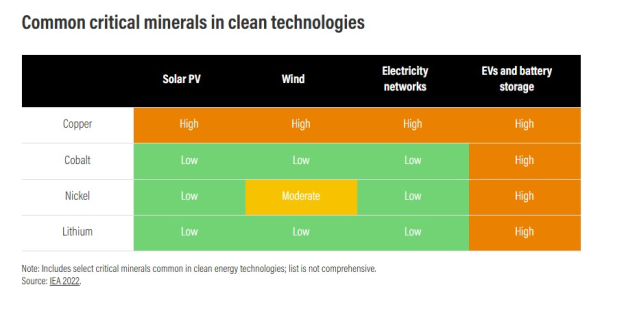
The U.S. Energy Act of 2020 defines a mineral as “critical” if it meets three conditions: it is essential to economic or national security, its supply chain is vulnerable to disruption, and it performs a function in manufacturing that cannot be replaced without serious consequences, whether higher costs for key technologies, slower deployment of clean energy, or risks to defense and communications systems. Rapid growth in the demand for low-carbon technologies such as electric vehicles has increased the need for critical minerals. The International Energy Agency (IEA) estimates that if governments are to meet their announced energy and climate pledges, critical mineral demand could more than double from 2022 levels by 2030 and quadruple by 2050. Critical minerals (with rare earth minerals primarily among them) are mined (via terrestrial means) in different geographies but as of 2023, 90% of refining of rare earth elements took place in China. As other countries have identified critical minerals as a strategic resource given their future importance, they are trying to build their own markets focused on these minerals. For example, countries with mineral resources are using their position in mining to capture more of the value chain and looking for alternate sources of critical minerals. Similarly, countries are looking for alternative domestic sources of critical minerals to improve the sustainability of extraction methods and to build a domestic supply chain. [caption id="attachment_12377" align="aligncenter" width="624"] Figure 1 : Common critical minerals in clean technologies and their level of importance Source: excerpted from IEA (2022) as cited in World Resources Institute. High/Medium/Low indicate the dependency of the technology on the specific mineral. Note: The term "critical minerals" encompasses a wide range of elements — from lithium, cobalt, and nickel used in battery chemistries as shown here to rare earth elements (REEs) used in permanent magnets and generators, to platinum group metals (PGMs) used in catalysts and fuel cells.[/caption]
Why are seaweeds being considered as a source of critical minerals?
Seaweeds naturally bioaccumulate elements from the vast, yet dilute, reserve of mineralogical wealth found in the ocean. This exploratory approach, called algal mining, mirrors similar approaches with terrestrial crops called phytomining or agromining (Dang et al., 2022). The ocean holds virtually every element in the periodic table, but often in extremely low concentrations (parts per trillion). Seaweeds act as natural sponges, concentrating certain critical minerals in their tissue to levels over a millionfold higher than found in the surrounding seawater. Seaweeds can absorb rare earth elements (REEs) like scandium, yttrium, neodymium, dysprosium, and cerium, as well as platinum group metals (PGMs) and other critical metals such as copper, nickel, cobalt, lithium, and magnesium. These minerals are essential for technologies supporting the transition away from fossil fuels, such as EV batteries, wind turbines, electric motors, and generators. While this ability of seaweeds to concentrate certain rare earth metals has been known for a while (Sakamoto et al., 2008), an Advanced Research Project Agency-Energy (ARPA-E) exploratory program from 2023 brought recent interest and funding to the approach. Note: A related but distinct application involves cultivating seaweeds in nutrient-enriched coastal waters or aquaculture effluents to remove excess nitrogen and phosphorus, with harvested biomass potentially applied as biostimulant or biofertilizer. Readers interested in seaweed-based nutrient recovery and its agronomic applications are directed to the road map chapter, "Agricultural Supplements".Why Explore Seaweed-based Mining of Critical Minerals?
The U.S. Energy Act of 2020 defines a mineral as “critical” if it meets three conditions: it is essential to economic or national security, its supply chain is vulnerable to disruption, and it performs a function in manufacturing that cannot be replaced without serious consequences, whether higher costs for key technologies, slower deployment of clean energy, or risks to defense and communications systems. Rapid growth in the demand for low-carbon technologies such as electric vehicles has increased the need for critical minerals. The International Energy Agency (IEA) estimates that if governments are to meet their announced energy and climate pledges, critical mineral demand could more than double from 2022 levels by 2030 and quadruple by 2050. Critical minerals (with rare earth minerals primarily among them) are mined (via terrestrial means) in different geographies but as of 2023, 90% of refining of rare earth elements took place in China. As other countries have identified critical minerals as a strategic resource given their future importance, they are trying to build their own markets focused on these minerals. For example, countries with mineral resources are using their position in mining to capture more of the value chain and looking for alternate sources of critical minerals. Similarly, countries are looking for alternative domestic sources of critical minerals to improve the sustainability of extraction methods and to build a domestic supply chain. [caption id="attachment_12377" align="aligncenter" width="624"] Figure 1 : Common critical minerals in clean technologies and their level of importance Source: excerpted from IEA (2022) as cited in World Resources Institute. High/Medium/Low indicate the dependency of the technology on the specific mineral. Note: The term "critical minerals" encompasses a wide range of elements — from lithium, cobalt, and nickel used in battery chemistries as shown here to rare earth elements (REEs) used in permanent magnets and generators, to platinum group metals (PGMs) used in catalysts and fuel cells.[/caption]
Why are seaweeds being considered as a source of critical minerals?
Seaweeds naturally bioaccumulate elements from the vast, yet dilute, reserve of mineralogical wealth found in the ocean. This exploratory approach, called algal mining, mirrors similar approaches with terrestrial crops called phytomining or agromining (Dang et al., 2022). The ocean holds virtually every element in the periodic table, but often in extremely low concentrations (parts per trillion). Seaweeds act as natural sponges, concentrating certain critical minerals in their tissue to levels over a millionfold higher than found in the surrounding seawater. Seaweeds can absorb rare earth elements (REEs) like scandium, yttrium, neodymium, dysprosium, and cerium, as well as platinum group metals (PGMs) and other critical metals such as copper, nickel, cobalt, lithium, and magnesium. These minerals are essential for technologies supporting the transition away from fossil fuels, such as EV batteries, wind turbines, electric motors, and generators. While this ability of seaweeds to concentrate certain rare earth metals has been known for a while (Sakamoto et al., 2008), an Advanced Research Project Agency-Energy (ARPA-E) exploratory program from 2023 brought recent interest and funding to the approach. Note: A related but distinct application involves cultivating seaweeds in nutrient-enriched coastal waters or aquaculture effluents to remove excess nitrogen and phosphorus, with harvested biomass potentially applied as biostimulant or biofertilizer. Readers interested in seaweed-based nutrient recovery and its agronomic applications are directed to the Agricultural Supplements section of this roadmap.Why Explore Seaweed-based Mining of Critical Minerals?
The U.S. Energy Act of 2020 defines a mineral as “critical” if it meets three conditions: it is essential to economic or national security, its supply chain is vulnerable to disruption, and it performs a function in manufacturing that cannot be replaced without serious consequences, whether higher costs for key technologies, slower deployment of clean energy, or risks to defense and communications systems. Rapid growth in the demand for low-carbon technologies such as electric vehicles has increased the need for critical minerals. The International Energy Agency (IEA) estimates that if governments are to meet their announced energy and climate pledges, critical mineral demand could more than double from 2022 levels by 2030 and quadruple by 2050. Critical minerals (with rare earth minerals primarily among them) are mined (via terrestrial means) in different geographies but as of 2023, 90% of refining of rare earth elements took place in China. As other countries have identified critical minerals as a strategic resource given their future importance, they are trying to build their own markets focused on these minerals. For example, countries with mineral resources are using their position in mining to capture more of the value chain and looking for alternate sources of critical minerals. Similarly, countries are looking for alternative domestic sources of critical minerals to improve the sustainability of extraction methods and to build a domestic supply chain. [caption id="attachment_12377" align="aligncenter" width="624"] Figure 1 : Common critical minerals in clean technologies and their level of importance Source: excerpted from IEA (2022) as cited in World Resources Institute. High/Medium/Low indicate the dependency of the technology on the specific mineral.[/caption]
Figure 1 : Common critical minerals in clean technologies and their level of importance Source: excerpted from IEA as cited in World Resources Institute. High/Medium/Low indicate the dependency of the technology on the specific mineral. Note: The term "critical minerals" encompasses a wide range of elements — from lithium, cobalt, and nickel used in battery chemistries as shown here to rare earth elements (REEs) used in permanent magnets and generators, to platinum group metals (PGMs) used in catalysts and fuel cells .
Why are seaweeds being considered as a source of critical minerals?
Seaweeds naturally bioaccumulate elements from the vast, yet dilute, reserve of mineralogical wealth found in the ocean. This exploratory approach, called algal mining, mirrors similar approaches with terrestrial crops called phytomining or agromining (Dang et al., 2022). The ocean holds virtually every element in the periodic table, but often in extremely low concentrations (parts per trillion). Seaweeds act as natural sponges, concentrating certain critical minerals in their tissue to levels over a millionfold higher than found in the surrounding seawater. Seaweeds can absorb rare earth elements (REEs) like scandium, yttrium, neodymium, dysprosium, and cerium, as well as platinum group metals (PGMs) and other critical metals such as copper, nickel, cobalt, lithium, and magnesium. These minerals are essential for technologies supporting the transition away from fossil fuels, such as EV batteries, wind turbines, electric motors, and generators. While this ability of seaweeds to concentrate certain rare earth metals has been known for a while (Sakamoto et al., 2008), an Advanced Research Project Agency-Energy (ARPA-E) exploratory program from 2023 brought recent interest and funding to the approach. Note: A related but distinct application involves cultivating seaweeds in nutrient-enriched coastal waters or aquaculture effluents to remove excess nitrogen and phosphorus, with harvested biomass potentially applied as biostimulant or biofertilizer. Readers interested in seaweed-based nutrient recovery and its agronomic applications are directed to the Agricultural Supplements section of this roadmap.Why Explore Seaweed-based Mining of Critical Minerals?
The U.S. Energy Act of 2020 defines a mineral as “critical” if it meets three conditions: it is essential to economic or national security, its supply chain is vulnerable to disruption, and it performs a function in manufacturing that cannot be replaced without serious consequences, whether higher costs for key technologies, slower deployment of clean energy, or risks to defense and communications systems. Rapid growth in the demand for low-carbon technologies such as electric vehicles has increased the need for critical minerals. The International Energy Agency (IEA) estimates that if governments are to meet their announced energy and climate pledges, critical mineral demand could more than double from 2022 levels by 2030 and quadruple by 2050. Critical minerals (with rare earth minerals primarily among them) are mined (via terrestrial means) in different geographies but as of 2023, 90% of refining of rare earth elements took place in China. As other countries have identified critical minerals as a strategic resource given their future importance, they are trying to build their own markets focused on these minerals. For example, countries with mineral resources are using their position in mining to capture more of the value chain and looking for alternate sources of critical minerals. Similarly, countries are looking for alternative domestic sources of critical minerals to improve the sustainability of extraction methods and to build a domestic supply chain.Figure 1 : Common critical minerals in clean technologies and their level of importance Source: excerpted from IEA as cited in World Resources Institute. High/Medium/Low indicate the dependency of the technology on the specific mineral. Note: The term "critical minerals" encompasses a wide range of elements — from lithium, cobalt, and nickel used in battery chemistries as shown here to rare earth elements (REEs) used in permanent magnets and generators, to platinum group metals (PGMs) used in catalysts and fuel cells .
Why are seaweeds being considered as a source of critical minerals?
Seaweeds naturally bioaccumulate elements from the vast, yet dilute, reserve of mineralogical wealth found in the ocean. This exploratory approach, called algal mining, mirrors similar approaches with terrestrial crops called phytomining or agromining (Dang et al., 2022). The ocean holds virtually every element in the periodic table, but often in extremely low concentrations (parts per trillion). Seaweeds act as natural sponges, concentrating certain critical minerals in their tissue to levels over a millionfold higher than found in the surrounding seawater. Seaweeds can absorb rare earth elements (REEs) like scandium, yttrium, neodymium, dysprosium, and cerium, as well as platinum group metals (PGMs) and other critical metals such as copper, nickel, cobalt, lithium, and magnesium. These minerals are essential for technologies supporting the transition away from fossil fuels, such as EV batteries, wind turbines, electric motors, and generators. While this ability of seaweeds to concentrate certain rare earth metals has been known for a while (Sakamoto et al., 2008), an Advanced Research Project Agency-Energy (ARPA-E) exploratory program from 2023 brought recent interest and funding to the approach. Note: A related but distinct application involves cultivating seaweeds in nutrient-enriched coastal waters or aquaculture effluents to remove excess nitrogen and phosphorus, with harvested biomass potentially applied as biostimulant or biofertilizer. Readers interested in seaweed-based nutrient recovery and its agronomic applications are directed to the Agricultural Supplements section of this roadmap.Why Explore Seaweed-based Mining of Critical Minerals?
The U.S. Energy Act of 2020 defines a mineral as “critical” if it meets three conditions: it is essential to economic or national security, its supply chain is vulnerable to disruption, and it performs a function in manufacturing that cannot be replaced without serious consequences, whether higher costs for key technologies, slower deployment of clean energy, or risks to defense and communications systems. Rapid growth in the demand for low-carbon technologies such as electric vehicles has increased the need for critical minerals. The International Energy Agency (IEA) estimates that if governments are to meet their announced energy and climate pledges, critical mineral demand could more than double from 2022 levels by 2030 and quadruple by 2050. Critical minerals (with rare earth minerals primarily among them) are mined (via terrestrial means) in different geographies but as of 2023, 90% of refining of rare earth elements took place in China. As other countries have identified critical minerals as a strategic resource given their future importance, they are trying to build their own markets focused on these minerals. For example, countries with mineral resources are using their position in mining to capture more of the value chain and looking for alternate sources of critical minerals. Similarly, countries are looking for alternative domestic sources of critical minerals to improve the sustainability of extraction methods and to build a domestic supply chain.Figure 1 : Common critical minerals in clean technologies and their level of importance Source: excerpted from IEA as cited in World Resources Institute. High/Medium/Low indicate the dependency of the technology on the specific mineral. Note: The term "critical minerals" encompasses a wide range of elements — from lithium, cobalt, and nickel used in battery chemistries as shown here to rare earth elements (REEs) used in permanent magnets and generators, to platinum group metals (PGMs) used in catalysts and fuel cells .
Why are seaweeds being considered as a source of critical minerals?
Seaweeds naturally bioaccumulate elements from the vast, yet dilute, reserve of mineralogical wealth found in the ocean. This exploratory approach, called algal mining, mirrors similar approaches with terrestrial crops called phytomining or agromining (Dang et al., 2022). The ocean holds virtually every element in the periodic table, but often in extremely low concentrations (parts per trillion). Seaweeds act as natural sponges, concentrating certain critical minerals in their tissue to levels over a millionfold higher than found in the surrounding seawater. Seaweeds can absorb rare earth elements (REEs) like scandium, yttrium, neodymium, dysprosium, and cerium, as well as platinum group metals (PGMs) and other critical metals such as copper, nickel, cobalt, lithium, and magnesium. These minerals are essential for technologies supporting the transition away from fossil fuels, such as EV batteries, wind turbines, electric motors, and generators. While this ability of seaweeds to concentrate certain rare earth metals has been known for a while (Sakamoto et al., 2008), an Advanced Research Project Agency-Energy (ARPA-E) exploratory program from 2023 brought recent interest and funding to the approach.Why Explore Seaweed-based Mining of Critical Minerals?
The U.S. Energy Act of 2020 defines a mineral as “critical” if it meets three conditions: it is essential to economic or national security, its supply chain is vulnerable to disruption, and it performs a function in manufacturing that cannot be replaced without serious consequences, whether higher costs for key technologies, slower deployment of clean energy, or risks to defense and communications systems. Rapid growth in the demand for low-carbon technologies such as electric vehicles has increased the need for critical minerals. The International Energy Agency (IEA) estimates that if governments are to meet their announced energy and climate pledges, critical mineral demand could more than double from 2022 levels by 2030 and quadruple by 2050. Critical minerals (with rare earth minerals primarily among them) are mined (via terrestrial means) in different geographies but as of 2023, 90% of refining of rare earth elements took place in China. As other countries have identified critical minerals as a strategic resource given their future importance, they are trying to build their own markets focused on these minerals. For example, countries with mineral resources are using their position in mining to capture more of the value chain and looking for alternate sources of critical minerals. Similarly, countries are looking for alternative domestic sources of critical minerals to improve the sustainability of extraction methods and to build a domestic supply chain.Figure 1 : Common critical minerals in clean technologies and their level of importance Source: excerpted from IEA as cited in World Resources Institute. High/Medium/Low indicate the dependency of the technology on the specific mineral.
Why are seaweeds being considered as a source of critical minerals?
Seaweeds naturally bioaccumulate elements from the vast, yet dilute, reserve of mineralogical wealth found in the ocean. This exploratory approach, called algal mining, mirrors similar approaches with terrestrial crops called phytomining or agromining (Dang et al., 2022). The ocean holds virtually every element in the periodic table, but often in extremely low concentrations (parts per trillion). Seaweeds act as natural sponges, concentrating certain critical minerals in their tissue to levels over a millionfold higher than found in the surrounding seawater. Seaweeds can absorb rare earth elements (REEs) like scandium, yttrium, neodymium, dysprosium, and cerium, as well as platinum group metals (PGMs) and other critical metals such as copper, nickel, cobalt, lithium, and magnesium. These minerals are essential for technologies supporting the transition away from fossil fuels, such as EV batteries, wind turbines, electric motors, and generators. While this ability of seaweeds to concentrate certain rare earth metals has been known for a while (Sakamoto et al., 2008), an Advanced Research Project Agency-Energy (ARPA-E) exploratory program from 2023 brought recent interest and funding to the approach.Why Explore Seaweed-based Mining of Critical Minerals?
The U.S. Energy Act of 2020 defines a mineral as “critical” if it meets three conditions: it is essential to economic or national security, its supply chain is vulnerable to disruption, and it performs a function in manufacturing that cannot be replaced without serious consequences, whether higher costs for key technologies, slower deployment of clean energy, or risks to defense and communications systems. Rapid growth in the demand for low-carbon technologies such as electric vehicles has increased the need for critical minerals. The International Energy Agency (IEA) estimates that if governments are to meet their announced energy and climate pledges, critical mineral demand could more than double from 2022 levels by 2030 and quadruple by 2050. Critical minerals (with rare earth minerals primarily among them) are mined (via terrestrial means) in different geographies but as of 2023, 90% of refining of rare earth elements took place in China. As other countries have identified critical minerals as a strategic resource given their future importance, they are trying to build their own markets focused on these minerals. For example, countries with mineral resources are using their position in mining to capture more of the value chain and looking for alternate sources of critical minerals. Similarly, countries are looking for alternative domestic sources of critical minerals to improve the sustainability of extraction methods and to build a domestic supply chain.Figure 1 : Common critical minerals in clean technologies and their level of importance Source: excerpted from IEA as cited in World Resources Institute. High/Medium/Low indicate the dependency of the technology on the specific mineral.
Why are seaweeds being considered as a source of critical minerals?
Seaweedsnaturally bioaccumulate elements from the vast, yet dilute, reserve of mineralogical wealth found in the ocean. This exploratory approach, called algal mining, mirrors similar approaches with terrestrial crops called phytomining or agromining (Dang et al., 2022). The ocean holds virtually every element in the periodic table, but often in extremely low concentrations (parts per trillion). Seaweeds act as natural sponges, concentrating certain critical minerals in their tissue to levels over a millionfold higher than found in the surrounding seawater. Seaweeds can absorb rare earth elements (REEs) like scandium, yttrium, neodymium, dysprosium, and cerium, as well as platinum group metals (PGMs) and other critical metals such as copper, nickel, cobalt, lithium, and magnesium. These minerals are essential for technologies supporting the transition away from fossil fuels, such as EV batteries, wind turbines, electric motors, and generators. While this ability of seaweeds to concentrate certain rare earth metals has been known for a while (Sakamoto et al., 2008), an Advanced Research Project Agency-Energy (ARPA-E) exploratory program from 2023 brought recent interest and funding to the approach.Why Explore Seaweed-based Mining of Critical Minerals?
The U.S. Energy Act of 2020 defines a mineral as “critical” if it meets three conditions: it is essential to economic or national security, its supply chain is vulnerable to disruption, and it performs a function in manufacturing that cannot be replaced without serious consequences, whether higher costs for key technologies, slower deployment of clean energy, or risks to defense and communications systems. Rapid growth in the demand for low-carbon technologies such as electric vehicles has increased the need for critical minerals. The International Energy Agency (IEA) estimates that if governments are to meet their announced energy and climate pledges, critical mineral demand could more than double from 2022 levels by 2030 and quadruple by 2050. Critical minerals (with rare earth minerals primarily among them) are mined (via terrestrial means) in different geographies but as of 2023, 90% of refining of rare earth elements took place in China. As other countries have identified critical minerals as a strategic resource given their future importance, they are trying to build their own markets focused on these minerals. For example, countries with mineral resources are using their position in mining to capture more of the value chain and looking for alternate sources of critical minerals. Similarly, countries are looking for alternative domestic sources of critical minerals to improve the sustainability of extraction methods and to build a domestic supply chain. [caption id="attachment_12377" align="aligncenter" width="624"] Figure 1 : Common critical minerals in clean technologies and their level of importance Source: excerpted from IEA (2022) as cited in World Resources Institute, “Critical Minerals Explained”. High/Medium/Low indicate the dependency of the technology on the specific mineral.[/caption]
Why are seaweeds being considered as a source of critical minerals?
Seaweedsnaturally bioaccumulate elements from the vast, yet dilute, reserve of mineralogical wealth found in the ocean. This exploratory approach, called algal mining, mirrors similar approaches with terrestrial crops called phytomining or agromining (Dang et al., 2022). The ocean holds virtually every element in the periodic table, but often in extremely low concentrations (parts per trillion). Seaweeds act as natural sponges, concentrating certain critical minerals in their tissue to levels over a millionfold higher than found in the surrounding seawater. Seaweeds can absorb rare earth elements (REEs) like scandium, yttrium, neodymium, dysprosium, and cerium, as well as platinum group metals (PGMs) and other critical metals such as copper, nickel, cobalt, lithium, and magnesium. These minerals are essential for technologies supporting the transition away from fossil fuels, such as EV batteries, wind turbines, electric motors, and generators. While this ability of seaweeds to concentrate certain rare earth metals has been known for a while (Sakamoto et al., 2008), an Advanced Research Project Agency-Energy (ARPA-E) exploratory program from 2023 brought recent interest and funding to the approach.Why Explore Seaweed-based Mining of Critical Minerals?
The U.S. Energy Act of 2020 defines a mineral as “critical” if it meets three conditions: it is essential to economic or national security, its supply chain is vulnerable to disruption, and it performs a function in manufacturing that cannot be replaced without serious consequences, whether higher costs for key technologies, slower deployment of clean energy, or risks to defense and communications systems. Rapid growth in the demand for low-carbon technologies such as electric vehicles has increased the need for critical minerals. The International Energy Agency (IEA) estimates that if governments are to meet their announced energy and climate pledges, critical mineral demand could more than double from 2022 levels by 2030 and quadruple by 2050. Critical minerals (with rare earth minerals primarily among them) are mined (via terrestrial means) in different geographies but as of 2023, 90% of refining of rare earth elements took place in China. As other countries have identified critical minerals as a strategic resource given their future importance, they are trying to build their own markets focused on these minerals. For example, countries with mineral resources are using their position in mining to capture more of the value chain and looking for alternate sources of critical minerals. Similarly, countries are looking for alternative domestic sources of critical minerals to improve the sustainability of extraction methods and to build a domestic supply chain. [caption id="attachment_12377" align="aligncenter" width="640"] Figure 1 : Common critical minerals in clean technologies and their level of importance Source: excerpted from IEA (2022) as cited in World Resources Institute, “Critical Minerals Explained”. High/Medium/Low indicate the dependency of the technology on the specific mineral.[/caption]
Why are seaweeds being considered as a source of critical minerals?
Seaweedsnaturally bioaccumulate elements from the vast, yet dilute, reserve of mineralogical wealth found in the ocean. This exploratory approach, called algal mining, mirrors similar approaches with terrestrial crops called phytomining or agromining (Dang et al., 2022). The ocean holds virtually every element in the periodic table, but often in extremely low concentrations (parts per trillion). Seaweeds act as natural sponges, concentrating certain critical minerals in their tissue to levels over a millionfold higher than found in the surrounding seawater. Seaweeds can absorb rare earth elements (REEs) like scandium, yttrium, neodymium, dysprosium, and cerium, as well as platinum group metals (PGMs) and other critical metals such as copper, nickel, cobalt, lithium, and magnesium. These minerals are essential for technologies supporting the transition away from fossil fuels, such as EV batteries, wind turbines, electric motors, and generators. While this ability of seaweeds to concentrate certain rare earth metals has been known for a while (Sakamoto et al., 2008), an Advanced Research Project Agency-Energy (ARPA-E) exploratory program from 2023 brought recent interest and funding to the approach.Why Explore Seaweed-based Mining of Critical Minerals?
The U.S. Energy Act of 2020 defines a mineral as “critical” if it meets three conditions: it is essential to economic or national security, its supply chain is vulnerable to disruption, and it performs a function in manufacturing that cannot be replaced without serious consequences, whether higher costs for key technologies, slower deployment of clean energy, or risks to defense and communications systems. Rapid growth in the demand for low-carbon technologies such as electric vehicles has increased the need for critical minerals. The International Energy Agency (IEA) estimates that if governments are to meet their announced energy and climate pledges, critical mineral demand could more than double from 2022 levels by 2030 and quadruple by 2050. Critical minerals (with rare earth minerals primarily among them) are mined (via terrestrial means) in different geographies but as of 2023, 90% of refining of rare earth elements took place in China. As other countries have identified critical minerals as a strategic resource given their future importance, they are trying to build their own markets focused on these minerals. For example, countries with mineral resources are using their position in mining to capture more of the value chain and looking for alternate sources of critical minerals. Similarly, countries are looking for alternative domestic sources of critical minerals to improve the sustainability of extraction methods and to build a domestic supply chain. [caption id="attachment_12377" align="aligncenter" width="640"] Figure 1 : Common critical minerals in clean technologies and their level of importance Source: excerpted from IEA (2022) as cited in World Resources Institute, “Critical Minerals Explained”. High/Medium/Low indicate the dependency of the technology on the specific mineral.[/caption]
Why are seaweeds being considered as a source of critical minerals?
Seaweeds naturally bioaccumulate elements from the vast, yet dilute, reserve of mineralogical wealth found in the ocean. This exploratory approach, called algal mining, mirrors similar approaches with terrestrial crops called phytomining or agromining (Dang et al., 2022). The ocean holds virtually every element in the periodic table, but often in extremely low concentrations (parts per trillion). Seaweeds act as natural sponges, concentrating certain critical minerals in their tissue to levels over a millionfold higher than found in the surrounding seawater. Seaweeds can absorb rare earth elements (REEs) like scandium, yttrium, neodymium, dysprosium, and cerium, as well as platinum group metals (PGMs) and other critical metals such as copper, nickel, cobalt, lithium, and magnesium. These minerals are essential for technologies supporting the transition away from fossil fuels, such as EV batteries, wind turbines, electric motors, and generators. While this ability of seaweeds to concentrate certain rare earth metals has been known for a while (Sakamoto et al., 2008), an Advanced Research Project Agency-Energy (ARPA-E) exploratory program from 2023 brought recent interest and funding to the approach.Why Explore Seaweed-based Mining of Critical Minerals?
The U.S. Energy Act of 2020 defines a mineral as “critical” if it meets three conditions: it is essential to economic or national security, its supply chain is vulnerable to disruption, and it performs a function in manufacturing that cannot be replaced without serious consequences, whether higher costs for key technologies, slower deployment of clean energy, or risks to defense and communications systems . Rapid growth in the demand for low-carbon technologies such as electric vehicles has increased the need for critical minerals. The International Energy Agency (IEA) estimates that if governments are to meet their announced energy and climate pledges, critical mineral demand could more than double from 2022 levels by 2030 and quadruple by 2050. Critical minerals (with rare earth minerals primarily among them) are mined (via terrestrial means) in different geographies but as of 2023, 90% of refining of rare earth elements took place in China. As other countries have identified critical minerals as a strategic resource given their future importance, they are trying to build their own markets focused on these minerals. For example, countries with mineral resources are using their position in mining to capture more of the value chain and looking for alternate sources of critical minerals. Similarly, countries are looking for alternative domestic sources of critical minerals to improve the sustainability of extraction methods and to build a domestic supply chain.
Figure 1 : Common critical minerals in clean technologies and their level of importance Source: excerpted from IEA 2022 as cited in World Resources Institute, “Critical Minerals Explained”. High/Medium/Low indicate the dependency of the technology on the specific mineral.
Why are seaweeds being considered as a source of critical minerals?
Seaweeds naturally bioaccumulate elements from the vast, yet dilute, reserve of mineralogical wealth found in the ocean. This exploratory approach, called algal mining, mirrors similar approaches with terrestrial crops called phytomining or agromining (Dang et al., 2022). The ocean holds virtually every element in the periodic table, but often in extremely low concentrations (parts per trillion). Seaweeds act as natural sponges, concentrating certain critical minerals in their tissue to levels over a millionfold higher than found in the surrounding seawater. Seaweeds can absorb rare earth elements (REEs) like scandium, yttrium, neodymium, dysprosium, and cerium, as well as platinum group metals (PGMs) and other critical metals such as copper, nickel, cobalt, lithium, and magnesium. These minerals are essential for technologies supporting the transition away from fossil fuels, such as EV batteries, wind turbines, electric motors, and generators. While this ability of seaweeds to concentrate certain rare earth metals has been known for a while (Sakamoto et al., 2008), an Advanced Research Project Agency-Energy (ARPA-E) exploratory program from 2023 brought recent interest and funding to the approach.Why Explore Seaweed-based Mining of Critical Minerals?
The U.S. Energy Act of 2020 defines a mineral as “critical” if it meets three conditions: it is essential to economic or national security, its supply chain is vulnerable to disruption, and it performs a function in manufacturing that cannot be replaced without serious consequences, whether higher costs for key technologies, slower deployment of clean energy, or risks to defense and communications systems . Rapid growth in the demand for low-carbon technologies such as electric vehicles has increased the need for critical minerals. The International Energy Agency (IEA) estimates that if governments are to meet their announced energy and climate pledges, critical mineral demand could more than double from 2022 levels by 2030 and quadruple by 2050. Critical minerals (with rare earth minerals primarily among them) are mined (via terrestrial means) in different geographies but as of 2023, 90% of refining of rare earth elements took place in China. As other countries have identified critical minerals as a strategic resource given their future importance, they are trying to build their own markets focused on these minerals. For example, countries with mineral resources are using their position in mining to capture more of the value chain and looking for alternate sources of critical minerals. Similarly, countries are looking for alternative domestic sources of critical minerals to improve the sustainability of extraction methods and to build a domestic supply chain. [caption id="attachment_12375" align="aligncenter" width="640"]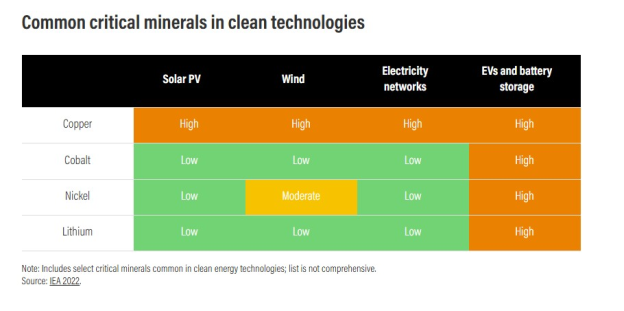 Common critical minerals in clean technologies and their level of importance Source: excerpted from IEA 2022 as cited in World Resources Institute, “Critical Minerals Explained”. High/Medium/Low indicate the dependency of the technology on the specific mineral.[/caption]
Figure 1 : Common critical minerals in clean technologies and their level of importance Source: excerpted from IEA 2022 as cited in World Resources Institute, “Critical Minerals Explained”. High/Medium/Low indicate the dependency of the technology on the specific mineral.
Common critical minerals in clean technologies and their level of importance Source: excerpted from IEA 2022 as cited in World Resources Institute, “Critical Minerals Explained”. High/Medium/Low indicate the dependency of the technology on the specific mineral.[/caption]
Figure 1 : Common critical minerals in clean technologies and their level of importance Source: excerpted from IEA 2022 as cited in World Resources Institute, “Critical Minerals Explained”. High/Medium/Low indicate the dependency of the technology on the specific mineral.
Why are seaweeds being considered as a source of critical minerals?
Seaweeds naturally bioaccumulate elements from the vast, yet dilute, reserve of mineralogical wealth found in the ocean. This exploratory approach, called algal mining, mirrors similar approaches with terrestrial crops called phytomining or agromining (Dang et al., 2022). The ocean holds virtually every element in the periodic table, but often in extremely low concentrations (parts per trillion). Seaweeds act as natural sponges, concentrating certain critical minerals in their tissue to levels over a millionfold higher than found in the surrounding seawater. Seaweeds can absorb rare earth elements (REEs) like scandium, yttrium, neodymium, dysprosium, and cerium, as well as platinum group metals (PGMs) and other critical metals such as copper, nickel, cobalt, lithium, and magnesium. These minerals are essential for technologies supporting the transition away from fossil fuels, such as EV batteries, wind turbines, electric motors, and generators. While this ability of seaweeds to concentrate certain rare earth metals has been known for a while (Sakamoto et al., 2008), an Advanced Research Project Agency-Energy (ARPA-E) exploratory program from 2023 brought recent interest and funding to the approach.Why Explore Seaweed-based Mining of Critical Minerals?
The U.S. Energy Act of 2020 defines a mineral as “critical” if it meets three conditions: it is essential to economic or national security, its supply chain is vulnerable to disruption, and it performs a function in manufacturing that cannot be replaced without serious consequences, whether higher costs for key technologies, slower deployment of clean energy, or risks to defense and communications systems . Rapid growth in the demand for low-carbon technologies such as electric vehicles has increased the need for critical minerals. The International Energy Agency (IEA) estimates that if governments are to meet their announced energy and climate pledges, critical mineral demand could more than double from 2022 levels by 2030 and quadruple by 2050. Critical minerals (with rare earth minerals primarily among them) are mined (via terrestrial means) in different geographies but as of 2023, 90% of refining of rare earth elements took place in China. As other countries have identified critical minerals as a strategic resource given their future importance, they are trying to build their own markets focused on these minerals. For example, countries with mineral resources are using their position in mining to capture more of the value chain and looking for alternate sources of critical minerals. Similarly, countries are looking for alternative domestic sources of critical minerals to improve the sustainability of extraction methods and to build a domestic supply chain. Figure 1 : Common critical minerals in clean technologies and their level of importance Source: excerpted from IEA 2022 as cited in World Resources Institute, “Critical Minerals Explained”. High/Medium/Low indicate the dependency of the technology on the specific mineral.
Why are seaweeds being considered as a source of critical minerals?
Seaweeds naturally bioaccumulate elements from the vast, yet dilute, reserve of mineralogical wealth found in the ocean. This exploratory approach, called algal mining, mirrors similar approaches with terrestrial crops called phytomining or agromining (Dang et al., 2022). The ocean holds virtually every element in the periodic table, but often in extremely low concentrations (parts per trillion). Seaweeds act as natural sponges, concentrating certain critical minerals in their tissue to levels over a millionfold higher than found in the surrounding seawater. Seaweeds can absorb rare earth elements (REEs) like scandium, yttrium, neodymium, dysprosium, and cerium, as well as platinum group metals (PGMs) and other critical metals such as copper, nickel, cobalt, lithium, and magnesium. These minerals are essential for technologies supporting the transition away from fossil fuels, such as EV batteries, wind turbines, electric motors, and generators. While this ability of seaweeds to concentrate certain rare earth metals has been known for a while (Sakamoto et al., 2008), an Advanced Research Project Agency-Energy (ARPA-E) exploratory program from 2023 brought recent interest and funding to the approach.
Figure 1 : Common critical minerals in clean technologies and their level of importance Source: excerpted from IEA 2022 as cited in World Resources Institute, “Critical Minerals Explained”. High/Medium/Low indicate the dependency of the technology on the specific mineral.
Seaweeds are being considered as a source for critical materials primarily because they This exploratory approach, called algal mining, mirrors similar approaches with terrestrial crops called phytomining or agromining. (Dang et. Al, 2022).
The ocean holds virtually every element in the periodic table, but often in extremely low concentrations (parts per trillion). Seaweeds act as natural sponges, concentrating certain critical minerals in their tissue to levels over a millionfold higher than found in the surrounding seawater.
Seaweeds can absorb rare earth elements (REEs) like scandium, yttrium, neodymium, dysprosium, and cerium, as well as platinum group metals (PGMs) and other critical metals such as copper, nickel, cobalt, lithium, and magnesium. These minerals are essential for technologies supporting the transition away from fossil fuels, such as EV batteries, wind turbines, electric motors, and generators.
While this ability of seaweeds to concentrate certain rare earth metals has been known for a while (Sakamoto et al., 2008), an Advanced Research Project Agency-Energy (ARPA-E) exploratory program from 2023 brought recent interest and funding to the approach.
High/Medium/Low what? Demand?
Probably need a preceding sentence or two about where these minerals are coming from currently and why that poses challenges that would cause you to look to seaweeds Science, Technology and Engineering
Species Selection, Cultivation and Harvesting
Species selection
Identifying seaweed species that grow quickly and concentrate critical minerals in sufficient quantities is the foundational research question for algal mining. Early work, including studies from Japan (Sakamoto et al., 2008) and France (Barrat et al., 2024) established that seaweeds bioaccumulate rare earth elements (REEs) from their surrounding water, with concentrations varying substantially by species, geography, and tissue type. This provided the scientific basis for the current generation of purposive research programs.
An ARPA-E funded project led by University of Alaska, Fairbanks working in partnership with National Laboratory of the Rockies (NLR) focuses on understanding the mechanistic, physiological, and geochemical drivers of REE uptake in Alaskan seaweed species. Researchers collected and analyzed over 1,300 seaweed samples from Southeast Alaska, where terrestrial REE deposits from the Bokan Mountain leach naturally into coastal waters. A key output of this work is the development of new analytical methods for quantifying very small amounts of REEs in seaweed biomass — a prerequisite capability for the field that did not previously exist (NLR, 2025).
The most comprehensive species selection work to date has been conducted by the Pacific Northwest National Laboratory (PNNL) as part of the UNCLE-SAM project (Edmundson et al., 2024). Researchers screened multiple seaweed species cultivated in seawater from Washington State’s Sequim Bay, finding substantial variation in mineral accumulation across species. Ulva Expansa, a fast-growing green seaweed, proved particularly effective at concentrating REEs, while Fucus, a brown seaweed, showed higher accumulation of nickel. A key finding is that species selectivity can potentially be matched to the specific mineral of interest, offering flexibility as the target mineral landscape evolves with technology needs.
Researchers at the University of Aveiro in Portugal have tested a wider range of species under controlled biosorption conditions. Studies using living Ulva species, Gracilaria Gracilis, Fucus Vesiculosus, have confirmed that REE accumulation varies substantially across green, red, and brown algae, and that within-species performance is sensitive to salinity and initial REE concentration (Milinovic et al., 2021; Viana et al., 2023). This body of work is primarily concerned with industrial wastewater treatment rather than open-seawater farming, and the REE concentrations tested are generally higher than those found in open seawater — but the species performance data is informative for identifying candidates for cultivation-based approaches.
Cultivation and Harvesting
The UNCLE-SAM project cultivated Ulva expansa in onshore raceway ponds allowing researchers to control temperature, lighting, and nutrient conditions, and to pump in seawater from Sequim Bay. This controlled environment simplified early-stage research but may not reflect cultivation approaches at commercial scale, where offshore or open-water systems would likely be necessary to access the volumes of seawater needed to produce meaningful mineral yields (Edmundson et al., 2024).
For broader context on cultivation at scale, including onshore systems and harvesting technologies, see the chapter, “Cultivation and Drying Considerations”.
Processing Methods
Once seaweed biomass has been harvested and dried, minerals must be separated from the organic tissue. Researchers are pursuing several distinct processing approaches, which differ substantially in their chemistry, energy requirements, and compatibility with co-product recovery. The field has not yet converged on a dominant method.
Some approaches are shown in the table below.
| PNNL / UNCLE-SAM | Seaweed is ground into a paste and mixed with an acidic liquid (lixiviant) at high temperatures to break chemical bonds and release minerals. The organic fraction is simultaneously converted into a liquid suitable for biofuel production, producing “bio-ore” as a mineral-rich residue (Edmundson et al., 2024). PNNL has set a baseline target of recovering at least 50% of the critical mineral content from the biomass. This approach maximizes carbon recovery alongside mineral extraction but relies on acids that have environmental management implications. |
| Umaro Foods/HOPO Therapeutics | Chelator-based selective extraction: Umaro Foods, an ARPA-E-funded food technology startup, is developing advanced metal chelator molecules that selectively bind to and extract REEs and PGMs in a non-destructive manner from seaweed processing streams. This approach is designed to run alongside the production of food-grade seaweed proteins and commercial hydrocolloids such as agar, alginate, and carrageenan, extracting minerals without destroying the biomass value for food applications (DOE, 2023). |
| NLR | Ion exchange: NLR researchers are adapting ion exchange technology — a method originally developed for removing contaminants from water by running it through a charged chemical separation system — to extract minerals from Alaskan seaweed. This approach is potentially lower in chemical intensity than lixiviant-based methods and is being developed in parallel with NLR’s analytical method development work (NLR, 2025) |
| UCLA / Schmidt Sciences | Alkaline thermal treatment + molten salt electrolysis: Researchers at UCLA, funded by Schmidt Sciences’ Virtual Institute of Feedstocks of the Future, are working with Sargassum — the brown seaweed that washes ashore in massive quantities along Atlantic and Caribbean coasts — as an opportunistic feedstock. They use alkaline thermal treatment to break down the seaweed and produce hydrogen fuel, then recover REEs from the residual biomass using molten salt electrolysis, a process already used industrially for aluminum production (ACS Sustainable Chem. Eng., 2025). This model is notable for using problem biomass (invasive Sargassum blooms) as a feedstock rather than cultivated seaweed, and for avoiding the energy-intensive drying step. |
Table 1: Approaches being explored to recover critical minerals from seaweed biomass
Species Selection, Cultivation and Harvesting
Species selection
Identifying seaweed species that grow quickly and concentrate critical minerals in sufficient quantities is the foundational research question for algal mining. Early work, including studies from Japan (Sakamoto et al., 2008) and France (Barrat et al., 2024) established that seaweeds bioaccumulate rare earth elements (REEs) from their surrounding water, with concentrations varying substantially by species, geography, and tissue type. This provided the scientific basis for the current generation of purposive research programs. An ARPA-E funded project led by University of Alaska, Fairbanks working in partnership with National Laboratory of the Rockies (NLR) focuses on understanding the mechanistic, physiological, and geochemical drivers of REE uptake in Alaskan seaweed species. Researchers collected and analyzed over 1,300 seaweed samples from Southeast Alaska, where terrestrial REE deposits from the Bokan Mountain leach naturally into coastal waters. A key output of this work is the development of new analytical methods for quantifying very small amounts of REEs in seaweed biomass — a prerequisite capability for the field that did not previously exist (NLR, 2025). The most comprehensive species selection work to date has been conducted by the Pacific Northwest National Laboratory (PNNL) as part of the UNCLE-SAM project (Edmundson et al., 2024). Researchers screened multiple seaweed species cultivated in seawater from Washington State’s Sequim Bay, finding substantial variation in mineral accumulation across species. Ulva Expansa, a fast-growing green seaweed, proved particularly effective at concentrating REEs, while Fucus, a brown seaweed, showed higher accumulation of nickel. A key finding is that species selectivity can potentially be matched to the specific mineral of interest, offering flexibility as the target mineral landscape evolves with technology needs. Researchers at the University of Aveiro in Portugal have tested a wider range of species under controlled biosorption conditions. Studies using living Ulva species, Gracilaria Gracilis, Fucus Vesiculosus, have confirmed that REE accumulation varies substantially across green, red, and brown algae, and that within-species performance is sensitive to salinity and initial REE concentration (Milinovic et al., 2021; Viana et al., 2023). This body of work is primarily concerned with industrial wastewater treatment rather than open-seawater farming, and the REE concentrations tested are generally higher than those found in open seawater — but the species performance data is informative for identifying candidates for cultivation-based approaches.Cultivation and Harvesting
The UNCLE-SAM project cultivated Ulva expansa in onshore raceway ponds allowing researchers to control temperature, lighting, and nutrient conditions, and to pump in seawater from Sequim Bay. This controlled environment simplified early-stage research but may not reflect cultivation approaches at commercial scale, where offshore or open-water systems would likely be necessary to access the volumes of seawater needed to produce meaningful mineral yields (Edmundson et al., 2024). Orca Minerals (launched 2025 by Blue Evolution) is developing a modular cultivation platform that can operate both offshore and in controlled onshore environments, with seaweed strains selected and bred for mineral hyperaccumulation. Initial development draws on existing seaweed farming infrastructure in Alaska and Mexico. For broader context on cultivation at scale, including onshore systems and harvesting technologies, see the chapter, "Cultivation and Drying Considerations".Processing Methods
Once seaweed biomass has been harvested and dried, minerals must be separated from the organic tissue. Researchers are pursuing several distinct processing approaches, which differ substantially in their chemistry, energy requirements, and compatibility with co-product recovery. The field has not yet converged on a dominant method. Some approaches are shown in the table below.| PNNL / UNCLE-SAM | Seaweed is ground into a paste and mixed with an acidic liquid (lixiviant) at high temperatures to break chemical bonds and release minerals. The organic fraction is simultaneously converted into a liquid suitable for biofuel production, producing “bio-ore” as a mineral-rich residue (Edmundson et al., 2024). PNNL has set a baseline target of recovering at least 50% of the critical mineral content from the biomass. This approach maximizes carbon recovery alongside mineral extraction but relies on acids that have environmental management implications. |
| Umaro Foods/HOPO Therapeutics | Chelator-based selective extraction: Umaro Foods, an ARPA-E-funded food technology startup, is developing advanced metal chelator molecules that selectively bind to and extract REEs and PGMs in a non-destructive manner from seaweed processing streams. This approach is designed to run alongside the production of food-grade seaweed proteins and commercial hydrocolloids such as agar, alginate, and carrageenan, extracting minerals without destroying the biomass value for food applications (DOE, 2023). |
| NLR | Ion exchange: NLR researchers are adapting ion exchange technology — a method originally developed for removing contaminants from water by running it through a charged chemical separation system — to extract minerals from Alaskan seaweed. This approach is potentially lower in chemical intensity than lixiviant-based methods and is being developed in parallel with NLR’s analytical method development work (NLR, 2025) |
| UCLA / Schmidt Sciences | Alkaline thermal treatment + molten salt electrolysis: Researchers at UCLA, funded by Schmidt Sciences’ Virtual Institute of Feedstocks of the Future, are working with Sargassum — the brown seaweed that washes ashore in massive quantities along Atlantic and Caribbean coasts — as an opportunistic feedstock. They use alkaline thermal treatment to break down the seaweed and produce hydrogen fuel, then recover REEs from the residual biomass using molten salt electrolysis, a process already used industrially for aluminum production (ACS Sustainable Chem. Eng., 2025). This model is notable for using problem biomass (invasive Sargassum blooms) as a feedstock rather than cultivated seaweed, and for avoiding the energy-intensive drying step. |
Species Selection, Cultivation and Harvesting
Species selection
Identifying seaweed species that grow quickly and concentrate critical minerals in sufficient quantities is the foundational research question for algal mining. Early work, including studies from Japan (Sakamoto et al., 2008) and France (Barrat et al., 2024) established that seaweeds bioaccumulate rare earth elements (REEs) from their surrounding water, with concentrations varying substantially by species, geography, and tissue type. This provided the scientific basis for the current generation of purposive research programs. An ARPA-E funded project led by University of Alaska, Fairbanks working in partnership with National Laboratory of the Rockies (NLR) focuses on understanding the mechanistic, physiological, and geochemical drivers of REE uptake in Alaskan seaweed species. Researchers collected and analyzed over 1,300 seaweed samples from Southeast Alaska, where terrestrial REE deposits from the Bokan Mountain leach naturally into coastal waters. A key output of this work is the development of new analytical methods for quantifying very small amounts of REEs in seaweed biomass — a prerequisite capability for the field that did not previously exist (NLR, 2025). The most comprehensive species selection work to date has been conducted by the Pacific Northwest National Laboratory (PNNL) as part of the UNCLE-SAM project (Edmundson et al., 2024). Researchers screened multiple seaweed species cultivated in seawater from Washington State’s Sequim Bay, finding substantial variation in mineral accumulation across species. Ulva Expansa, a fast-growing green seaweed, proved particularly effective at concentrating REEs, while Fucus, a brown seaweed, showed higher accumulation of nickel. A key finding is that species selectivity can potentially be matched to the specific mineral of interest, offering flexibility as the target mineral landscape evolves with technology needs. Researchers at the University of Aveiro in Portugal have tested a wider range of species under controlled biosorption conditions. Studies using living Ulva species, Gracilaria Gracilis, Fucus Vesiculosus, have confirmed that REE accumulation varies substantially across green, red, and brown algae, and that within-species performance is sensitive to salinity and initial REE concentration (Milinovic et al., 2021; Viana et al., 2023). This body of work is primarily concerned with industrial wastewater treatment rather than open-seawater farming, and the REE concentrations tested are generally higher than those found in open seawater — but the species performance data is informative for identifying candidates for cultivation-based approaches.Cultivation and Harvesting
The UNCLE-SAM project cultivated Ulva expansa in onshore raceway ponds allowing researchers to control temperature, lighting, and nutrient conditions, and to pump in seawater from Sequim Bay. This controlled environment simplified early-stage research but may not reflect cultivation approaches at commercial scale, where offshore or open-water systems would likely be necessary to access the volumes of seawater needed to produce meaningful mineral yields (Edmundson et al., 2024). Orca Minerals (launched 2025 by Blue Evolution) is developing a modular cultivation platform that can operate both offshore and in controlled onshore environments, with seaweed strains selected and bred for mineral hyperaccumulation. Initial development draws on existing seaweed farming infrastructure in Alaska and Mexico. For broader context on cultivation at scale, including onshore systems and harvesting technologies, see the chapter, "Cultivation and Drying Considerations".Processing Methods
Once seaweed biomass has been harvested and dried, minerals must be separated from the organic tissue. Researchers are pursuing several distinct processing approaches, which differ substantially in their chemistry, energy requirements, and compatibility with co-product recovery. The field has not yet converged on a dominant method. Some approaches are shown in the table below.| PNNL / UNCLE-SAM | Seaweed is ground into a paste and mixed with an acidic liquid (lixiviant) at high temperatures to break chemical bonds and release minerals. The organic fraction is simultaneously converted into a liquid suitable for biofuel production, producing “bio-ore” as a mineral-rich residue (Edmundson et al., 2024). PNNL has set a baseline target of recovering at least 50% of the critical mineral content from the biomass. This approach maximizes carbon recovery alongside mineral extraction but relies on acids that have environmental management implications. |
| Umaro Foods/HOPO Therapeutics | Chelator-based selective extraction: Umaro Foods, an ARPA-E-funded food technology startup, is developing advanced metal chelator molecules that selectively bind to and extract REEs and PGMs in a non-destructive manner from seaweed processing streams. This approach is designed to run alongside the production of food-grade seaweed proteins and commercial hydrocolloids such as agar, alginate, and carrageenan, extracting minerals without destroying the biomass value for food applications (DOE, 2023). |
| NLR | Ion exchange: NLR researchers are adapting ion exchange technology — a method originally developed for removing contaminants from water by running it through a charged chemical separation system — to extract minerals from Alaskan seaweed. This approach is potentially lower in chemical intensity than lixiviant-based methods and is being developed in parallel with NLR’s analytical method development work (NLR, 2025) |
| UCLA / Schmidt Sciences | Alkaline thermal treatment + molten salt electrolysis: Researchers at UCLA, funded by Schmidt Sciences’ Virtual Institute of Feedstocks of the Future, are working with Sargassum — the brown seaweed that washes ashore in massive quantities along Atlantic and Caribbean coasts — as an opportunistic feedstock. They use alkaline thermal treatment to break down the seaweed and produce hydrogen fuel, then recover REEs from the residual biomass using molten salt electrolysis, a process already used industrially for aluminum production (ACS Sustainable Chem. Eng., 2025). This model is notable for using problem biomass (invasive Sargassum blooms) as a feedstock rather than cultivated seaweed, and for avoiding the energy-intensive drying step. |
Species Selection, Cultivation and Harvesting
Species selection
Identifying seaweed species that grow quickly and concentrate critical minerals in sufficient quantities is the foundational research question for algal mining. Early work, including studies from Japan (Sakamoto et al., 2008) and France (Barrat et al., 2024) established that seaweeds bioaccumulate rare earth elements (REEs) from their surrounding water, with concentrations varying substantially by species, geography, and tissue type. This provided the scientific basis for the current generation of purposive research programs. An ARPA-E funded project led by University of Alaska, Fairbanks working in partnership with National Laboratory of the Rockies (NLR) focuses on understanding the mechanistic, physiological, and geochemical drivers of REE uptake in Alaskan seaweed species. Researchers collected and analyzed over 1,300 seaweed samples from Southeast Alaska, where terrestrial REE deposits from the Bokan Mountain leach naturally into coastal waters. A key output of this work is the development of new analytical methods for quantifying very small amounts of REEs in seaweed biomass — a prerequisite capability for the field that did not previously exist (NLR, 2025). The most comprehensive species selection work to date has been conducted by the Pacific Northwest National Laboratory (PNNL) as part of the UNCLE-SAM project (Edmundson et al., 2024). Researchers screened multiple seaweed species cultivated in seawater from Washington State’s Sequim Bay, finding substantial variation in mineral accumulation across species. Ulva Expansa, a fast-growing green seaweed, proved particularly effective at concentrating REEs, while Fucus, a brown seaweed, showed higher accumulation of nickel. A key finding is that species selectivity can potentially be matched to the specific mineral of interest, offering flexibility as the target mineral landscape evolves with technology needs. Researchers at the University of Aveiro in Portugal have tested a wider range of species under controlled biosorption conditions. Studies using living Ulva species, Gracilaria Gracilis, Fucus Vesiculosus, have confirmed that REE accumulation varies substantially across green, red, and brown algae, and that within-species performance is sensitive to salinity and initial REE concentration (Milinovic et al., 2021; Viana et al., 2023). This body of work is primarily concerned with industrial wastewater treatment rather than open-seawater farming, and the REE concentrations tested are generally higher than those found in open seawater — but the species performance data is informative for identifying candidates for cultivation-based approaches.Cultivation and Harvesting
The UNCLE-SAM project cultivated Ulva expansa in onshore raceway ponds allowing researchers to control temperature, lighting, and nutrient conditions, and to pump in seawater from Sequim Bay. This controlled environment simplified early-stage research but may not reflect cultivation approaches at commercial scale, where offshore or open-water systems would likely be necessary to access the volumes of seawater needed to produce meaningful mineral yields (Edmundson et al., 2024). Orca Minerals (launched 2025 by Blue Evolution) is developing a modular cultivation platform that can operate both offshore and in controlled onshore environments, with seaweed strains selected and bred for mineral hyperaccumulation. Initial development draws on existing seaweed farming infrastructure in Alaska and Mexico. For broader context on cultivation at scale, including onshore systems and harvesting technologies, see the chapter, "Cultivation and Drying Considerations".Processing Methods
Once seaweed biomass has been harvested and dried, minerals must be separated from the organic tissue. Researchers are pursuing several distinct processing approaches, which differ substantially in their chemistry, energy requirements, and compatibility with co-product recovery. The field has not yet converged on a dominant method. Some approaches are shown in the table below.| PNNL / UNCLE-SAM | Seaweed is ground into a paste and mixed with an acidic liquid (lixiviant) at high temperatures to break chemical bonds and release minerals. The organic fraction is simultaneously converted into a liquid suitable for biofuel production, producing “bio-ore” as a mineral-rich residue (Edmundson et al., 2024). PNNL has set a baseline target of recovering at least 50% of the critical mineral content from the biomass. This approach maximizes carbon recovery alongside mineral extraction but relies on acids that have environmental management implications. |
| Umaro Foods/HOPO Therapeutics | Chelator-based selective extraction: Umaro Foods, an ARPA-E-funded food technology startup, is developing advanced metal chelator molecules that selectively bind to and extract REEs and PGMs in a non-destructive manner from seaweed processing streams. This approach is designed to run alongside the production of food-grade seaweed proteins and commercial hydrocolloids such as agar, alginate, and carrageenan, extracting minerals without destroying the biomass value for food applications (DOE, 2023). |
| NLR | Ion exchange: NLR researchers are adapting ion exchange technology — a method originally developed for removing contaminants from water by running it through a charged chemical separation system — to extract minerals from Alaskan seaweed. This approach is potentially lower in chemical intensity than lixiviant-based methods and is being developed in parallel with NLR’s analytical method development work (NLR, 2025) |
| UCLA / Schmidt Sciences | Alkaline thermal treatment + molten salt electrolysis: Researchers at UCLA, funded by Schmidt Sciences’ Virtual Institute of Feedstocks of the Future, are working with Sargassum — the brown seaweed that washes ashore in massive quantities along Atlantic and Caribbean coasts — as an opportunistic feedstock. They use alkaline thermal treatment to break down the seaweed and produce hydrogen fuel, then recover REEs from the residual biomass using molten salt electrolysis, a process already used industrially for aluminum production (ACS Sustainable Chem. Eng., 2025). This model is notable for using problem biomass (invasive Sargassum blooms) as a feedstock rather than cultivated seaweed, and for avoiding the energy-intensive drying step. |
Species Selection, Cultivation and Harvesting
Species selection
Identifying seaweed species that grow quickly and concentrate critical minerals in sufficient quantities is the foundational research question for algal mining. Early work, including studies from Japan (Sakamoto et al., 2008) and France (Barrat et al., 2024) established that seaweeds bioaccumulate rare earth elements (REEs) from their surrounding water, with concentrations varying substantially by species, geography, and tissue type. This provided the scientific basis for the current generation of purposive research programs. An ARPA-E funded project led by University of Alaska, Fairbanks working in partnership with National Laboratory of the Rockies (NLR) focuses on understanding the mechanistic, physiological, and geochemical drivers of REE uptake in Alaskan seaweed species. Researchers collected and analyzed over 1,300 seaweed samples from Southeast Alaska, where terrestrial REE deposits from the Bokan Mountain leach naturally into coastal waters. A key output of this work is the development of new analytical methods for quantifying very small amounts of REEs in seaweed biomass — a prerequisite capability for the field that did not previously exist (NLR, 2025). The most comprehensive species selection work to date has been conducted by the Pacific Northwest National Laboratory (PNNL) as part of the UNCLE-SAM project (Edmundson et al., 2024). Researchers screened multiple seaweed species cultivated in seawater from Washington State’s Sequim Bay, finding substantial variation in mineral accumulation across species. Ulva Expansa, a fast-growing green seaweed, proved particularly effective at concentrating REEs, while Fucus, a brown seaweed, showed higher accumulation of nickel. A key finding is that species selectivity can potentially be matched to the specific mineral of interest, offering flexibility as the target mineral landscape evolves with technology needs. Researchers at the University of Aveiro in Portugal have tested a wider range of species under controlled biosorption conditions. Studies using living Ulva species, Gracilaria Gracilis, Fucus Vesiculosus, have confirmed that REE accumulation varies substantially across green, red, and brown algae, and that within-species performance is sensitive to salinity and initial REE concentration (Milinovic et al., 2021; Viana et al., 2023). This body of work is primarily concerned with industrial wastewater treatment rather than open-seawater farming, and the REE concentrations tested are generally higher than those found in open seawater — but the species performance data is informative for identifying candidates for cultivation-based approaches.Cultivation and Harvesting
The UNCLE-SAM project cultivated Ulva expansa in onshore raceway ponds allowing researchers to control temperature, lighting, and nutrient conditions, and to pump in seawater from Sequim Bay. This controlled environment simplified early-stage research but may not reflect cultivation approaches at commercial scale, where offshore or open-water systems would likely be necessary to access the volumes of seawater needed to produce meaningful mineral yields (Edmundson et al., 2024). Orca Minerals (launched 2025 by Blue Evolution) is developing a modular cultivation platform that can operate both offshore and in controlled onshore environments, with seaweed strains selected and bred for mineral hyperaccumulation. Initial development draws on existing seaweed farming infrastructure in Alaska and Mexico. For broader context on cultivation at scale, including onshore systems and harvesting technologies, see the chapter, "Cultivation and Drying Considerations".Processing Methods
Once seaweed biomass has been harvested and dried, minerals must be separated from the organic tissue. Researchers are pursuing several distinct processing approaches, which differ substantially in their chemistry, energy requirements, and compatibility with co-product recovery. The field has not yet converged on a dominant method. Some approaches are shown in the table below.| PNNL / UNCLE-SAM | Seaweed is ground into a paste and mixed with an acidic liquid (lixiviant) at high temperatures to break chemical bonds and release minerals. The organic fraction is simultaneously converted into a liquid suitable for biofuel production, producing “bio-ore” as a mineral-rich residue (Edmundson et al., 2024). PNNL has set a baseline target of recovering at least 50% of the critical mineral content from the biomass. This approach maximizes carbon recovery alongside mineral extraction but relies on acids that have environmental management implications. |
| Umaro Foods/HOPO Therapeutics | Chelator-based selective extraction: Umaro Foods, an ARPA-E-funded food technology startup, is developing advanced metal chelator molecules that selectively bind to and extract REEs and PGMs in a non-destructive manner from seaweed processing streams. This approach is designed to run alongside the production of food-grade seaweed proteins and commercial hydrocolloids such as agar, alginate, and carrageenan, extracting minerals without destroying the biomass value for food applications (DOE, 2023). |
| NLR | Ion exchange: NLR researchers are adapting ion exchange technology — a method originally developed for removing contaminants from water by running it through a charged chemical separation system — to extract minerals from Alaskan seaweed. This approach is potentially lower in chemical intensity than lixiviant-based methods and is being developed in parallel with NLR’s analytical method development work (NLR, 2025) |
| UCLA / Schmidt Sciences | Alkaline thermal treatment + molten salt electrolysis: Researchers at UCLA, funded by Schmidt Sciences’ Virtual Institute of Feedstocks of the Future, are working with Sargassum — the brown seaweed that washes ashore in massive quantities along Atlantic and Caribbean coasts — as an opportunistic feedstock. They use alkaline thermal treatment to break down the seaweed and produce hydrogen fuel, then recover REEs from the residual biomass using molten salt electrolysis, a process already used industrially for aluminum production (ACS Sustainable Chem. Eng., 2025). This model is notable for using problem biomass (invasive Sargassum blooms) as a feedstock rather than cultivated seaweed, and for avoiding the energy-intensive drying step. |
Species Selection, Cultivation and Harvesting
Species selection
Identifying seaweed species that grow quickly and concentrate critical minerals in sufficient quantities is the foundational research question for algal mining. Early work, including studies from Japan (Sakamoto et al., 2008) and France (Barrat et al., 2024) established that seaweeds bioaccumulate REEs from their surrounding water, with concentrations varying substantially by species, geography, and tissue type. This provided the scientific basis for the current generation of purposive research programs. An ARPA-E funded project led by University of Alaska, Fairbanks working in partnership with National Laboratory of the Rockies (NLR) focuses on understanding the mechanistic, physiological, and geochemical drivers of REE uptake in Alaskan seaweed species. Researchers collected and analyzed over 1,300 seaweed samples from Southeast Alaska, where terrestrial REE deposits from the Bokan Mountain leach naturally into coastal waters. A key output of this work is the development of new analytical methods for quantifying very small amounts of REEs in seaweed biomass — a prerequisite capability for the field that did not previously exist. (NLR, 2025) The most comprehensive species selection work to date has been conducted by the Pacific Northwest National Laboratory (PNNL) as part of the UNCLE-SAM project (Edmundson et al., 2024). Researchers screened multiple seaweed species cultivated in seawater from Washington State’s Sequim Bay, finding substantial variation in mineral accumulation across species. Ulva Expansa, a fast-growing green seaweed, proved particularly effective at concentrating REEs, while Fucus, a brown seaweed, showed higher accumulation of nickel. A key finding is that species selectivity can potentially be matched to the specific mineral of interest, offering flexibility as the target mineral landscape evolves with technology needs. Researchers at the University of Aveiro in Portugal have tested a wider range of species under controlled biosorption conditions. Studies using living Ulva sp., Gracilaria Gracilis, Fucus Vesiculosus, have confirmed that REE accumulation varies substantially across green, red, and brown algae, and that within-species performance is sensitive to salinity and initial REE concentration (Milinovic et al., 2021; Viana et al., 2023). This body of work is primarily concerned with industrial wastewater treatment rather than open-seawater farming, and the REE concentrations tested are generally higher than those found in open seawater — but the species performance data is informative for identifying candidates for cultivation-based approaches.Cultivation and Harvesting
The UNCLE-SAM project cultivated Ulva expansa in onshore raceway ponds allowing researchers to control temperature, lighting, and nutrient conditions, and to pump in seawater from Sequim Bay. This controlled environment simplified early-stage research but may not reflect cultivation approaches at commercial scale, where offshore or open-water systems would likely be necessary to access the volumes of seawater needed to produce meaningful mineral yields (Edmundson et al., 2024). Orca Minerals (launched 2025 by Blue Evolution) is developing a modular cultivation platform that can operate both offshore and in controlled onshore environments, with seaweed strains selected and bred for mineral hyperaccumulation. Initial development draws on existing seaweed farming infrastructure in Alaska and Mexico. For broader context on cultivation at scale, including onshore systems and harvesting technologies, see the chapter, "Cultivation and Drying Considerations".Processing Methods
Once seaweed biomass has been harvested and dried, minerals must be separated from the organic tissue. Researchers are pursuing several distinct processing approaches, which differ substantially in their chemistry, energy requirements, and compatibility with co-product recovery. The field has not yet converged on a dominant method. Some approaches are shown in the table below.| PNNL / UNCLE-SAM | Seaweed is ground into a paste and mixed with an acidic liquid (lixiviant) at high temperatures to break chemical bonds and release minerals. The organic fraction is simultaneously converted into a liquid suitable for biofuel production, producing “bio-ore” as a mineral-rich residue (Edmundson et al., 2024). PNNL has set a baseline target of recovering at least 50% of the critical mineral content from the biomass. This approach maximizes carbon recovery alongside mineral extraction but relies on acids that have environmental management implications. |
| Umaro Foods/HOPO Therapeutics | Chelator-based selective extraction: Umaro Foods, an ARPA-E-funded food technology startup, is developing advanced metal chelator molecules that selectively bind to and extract REEs and PGMs in a non-destructive manner from seaweed processing streams. This approach is designed to run alongside the production of food-grade seaweed proteins and commercial hydrocolloids such as agar, alginate, and carrageenan, extracting minerals without destroying the biomass value for food applications (DOE, 2023). |
| NLR | Ion exchange: NLR researchers are adapting ion exchange technology — a method originally developed for removing contaminants from water by running it through a charged chemical separation system — to extract minerals from Alaskan seaweed. This approach is potentially lower in chemical intensity than lixiviant-based methods and is being developed in parallel with NLR’s analytical method development work (NLR, 2025) |
| UCLA / Schmidt Sciences | Alkaline thermal treatment + molten salt electrolysis: Researchers at UCLA, funded by Schmidt Sciences’ Virtual Institute of Feedstocks of the Future, are working with Sargassum — the brown seaweed that washes ashore in massive quantities along Atlantic and Caribbean coasts — as an opportunistic feedstock. They use alkaline thermal treatment to break down the seaweed and produce hydrogen fuel, then recover REEs from the residual biomass using molten salt electrolysis, a process already used industrially for aluminum production (ACS Sustainable Chem. Eng., 2025). This model is notable for using problem biomass (invasive Sargassum blooms) as a feedstock rather than cultivated seaweed, and for avoiding the energy-intensive drying step. |
Species Selection, Cultivation and Harvesting
Species selection
Identifying seaweed species that grow quickly and concentrate critical minerals in sufficient quantities is the foundational research question for algal mining. Early work, including studies from Japan (Sakamoto et al., 2008) and France (Barrat et al., 2024) established that seaweeds bioaccumulate REEs from their surrounding water, with concentrations varying substantially by species, geography, and tissue type. This provided the scientific basis for the current generation of purposive research programs. An ARPA-E funded project led by University of Alaska, Fairbanks working in partnership with NLR focuses on understanding the mechanistic, physiological, and geochemical drivers of REE uptake in Alaskan seaweed species. Researchers collected and analyzed over 1,300 seaweed samples from Southeast Alaska, where terrestrial REE deposits from the Bokan Mountain leach naturally into coastal waters. A key output of this work is the development of new analytical methods for quantifying very small amounts of REEs in seaweed biomass — a prerequisite capability for the field that did not previously exist. (NLR, 2025) The most comprehensive species selection work to date has been conducted by the Pacific Northwest National Laboratory (PNNL) as part of the UNCLE-SAM project (Edmundson et al., 2024). Researchers screened multiple seaweed species cultivated in seawater from Washington State’s Sequim Bay, finding substantial variation in mineral accumulation across species. Ulva Expansa, a fast-growing green seaweed, proved particularly effective at concentrating REEs, while Fucus, a brown seaweed, showed higher accumulation of nickel. A key finding is that species selectivity can potentially be matched to the specific mineral of interest, offering flexibility as the target mineral landscape evolves with technology needs. Researchers at the University of Aveiro in Portugal have tested a wider range of species under controlled biosorption conditions. Studies using living Ulva sp., Gracilaria Gracilis, Fucus Vesiculosus, have confirmed that REE accumulation varies substantially across green, red, and brown algae, and that within-species performance is sensitive to salinity and initial REE concentration (Milinovic et al., 2021; Viana et al., 2023). This body of work is primarily concerned with industrial wastewater treatment rather than open-seawater farming, and the REE concentrations tested are generally higher than those found in open seawater — but the species performance data is informative for identifying candidates for cultivation-based approaches.Cultivation and Harvesting
The UNCLE-SAM project cultivated Ulva expansa in onshore raceway ponds allowing researchers to control temperature, lighting, and nutrient conditions, and to pump in seawater from Sequim Bay. This controlled environment simplified early-stage research but may not reflect cultivation approaches at commercial scale, where offshore or open-water systems would likely be necessary to access the volumes of seawater needed to produce meaningful mineral yields (Edmundson et al., 2024). Orca Minerals (launched 2025 by Blue Evolution) is developing a modular cultivation platform that can operate both offshore and in controlled onshore environments, with seaweed strains selected and bred for mineral hyperaccumulation. Initial development draws on existing seaweed farming infrastructure in Alaska and Mexico. For broader context on cultivation at scale, including onshore systems and harvesting technologies, see the chapter, "Cultivation and Drying Considerations".Processing Methods
Once seaweed biomass has been harvested and dried, minerals must be separated from the organic tissue. Researchers are pursuing several distinct processing approaches, which differ substantially in their chemistry, energy requirements, and compatibility with co-product recovery. The field has not yet converged on a dominant method. Some approaches are shown in the table below.| PNNL / UNCLE-SAM | Seaweed is ground into a paste and mixed with an acidic liquid (lixiviant) at high temperatures to break chemical bonds and release minerals. The organic fraction is simultaneously converted into a liquid suitable for biofuel production, producing “bio-ore” as a mineral-rich residue (Edmundson et al., 2024). PNNL has set a baseline target of recovering at least 50% of the critical mineral content from the biomass. This approach maximizes carbon recovery alongside mineral extraction but relies on acids that have environmental management implications. |
| Umaro Foods/HOPO Therapeutics | Chelator-based selective extraction: Umaro Foods, an ARPA-E-funded food technology startup, is developing advanced metal chelator molecules that selectively bind to and extract REEs and PGMs in a non-destructive manner from seaweed processing streams. This approach is designed to run alongside the production of food-grade seaweed proteins and commercial hydrocolloids such as agar, alginate, and carrageenan, extracting minerals without destroying the biomass value for food applications (DOE, 2023). |
| NLR | Ion exchange: NLR researchers are adapting ion exchange technology — a method originally developed for removing contaminants from water by running it through a charged chemical separation system — to extract minerals from Alaskan seaweed. This approach is potentially lower in chemical intensity than lixiviant-based methods and is being developed in parallel with NLR’s analytical method development work (NLR, 2025) |
| UCLA / Schmidt Sciences | Alkaline thermal treatment + molten salt electrolysis: Researchers at UCLA, funded by Schmidt Sciences’ Virtual Institute of Feedstocks of the Future, are working with Sargassum — the brown seaweed that washes ashore in massive quantities along Atlantic and Caribbean coasts — as an opportunistic feedstock. They use alkaline thermal treatment to break down the seaweed and produce hydrogen fuel, then recover REEs from the residual biomass using molten salt electrolysis, a process already used industrially for aluminum production (ACS Sustainable Chem. Eng., 2025). This model is notable for using problem biomass (invasive Sargassum blooms) as a feedstock rather than cultivated seaweed, and for avoiding the energy-intensive drying step. |
Species Selection, Cultivation and Harvesting
Species selection
Identifying seaweed species that grow quickly and concentrate critical minerals in sufficient quantities is the foundational research question for algal mining. Early work, including studies from Japan (Sakamoto et al., 2008) and France (Barrat et al., 2024) established that seaweeds bioaccumulate REEs from their surrounding water, with concentrations varying substantially by species, geography, and tissue type. This provided the scientific basis for the current generation of purposive research programs. An ARPA-E funded project led by NREL working in partnership with University of Alaska, Fairbanks focuses on understanding the mechanistic, physiological, and geochemical drivers of REE uptake in Alaskan seaweed species. Researchers collected and analyzed over 1,300 seaweed samples from Southeast Alaska, where terrestrial REE deposits from the Bokan Mountain leach naturally into coastal waters. A key output of this work is the development of new analytical methods for quantifying very small amounts of REEs in seaweed biomass — a prerequisite capability for the field that did not previously exist. (NREL, 2025) The most comprehensive species selection work to date has been conducted by the Pacific Northwest National Laboratory (PNNL) as part of the UNCLE-SAM project (Edmundson et al., 2024). Researchers screened multiple seaweed species cultivated in seawater from Washington State’s Sequim Bay, finding substantial variation in mineral accumulation across species. Ulva Expansa, a fast-growing green seaweed, proved particularly effective at concentrating REEs, while Fucus, a brown seaweed, showed higher accumulation of nickel. A key finding is that species selectivity can potentially be matched to the specific mineral of interest, offering flexibility as the target mineral landscape evolves with technology needs. Researchers at the University of Aveiro in Portugal have tested a wider range of species under controlled biosorption conditions. Studies using living Ulva sp., Gracilaria Gracilis, Fucus Vesiculosus, have confirmed that REE accumulation varies substantially across green, red, and brown algae, and that within-species performance is sensitive to salinity and initial REE concentration (Milinovic et al., 2021; Viana et al., 2023). This body of work is primarily concerned with industrial wastewater treatment rather than open-seawater farming, and the REE concentrations tested are generally higher than those found in open seawater — but the species performance data is informative for identifying candidates for cultivation-based approaches.Cultivation and Harvesting
The UNCLE-SAM project cultivated Ulva expansa in onshore raceway ponds allowing researchers to control temperature, lighting, and nutrient conditions, and to pump in seawater from Sequim Bay. This controlled environment simplified early-stage research but may not reflect cultivation approaches at commercial scale, where offshore or open-water systems would likely be necessary to access the volumes of seawater needed to produce meaningful mineral yields (Edmundson et al., 2024). Orca Minerals (launched 2025 by Blue Evolution) is developing a modular cultivation platform that can operate both offshore and in controlled onshore environments, with seaweed strains selected and bred for mineral hyperaccumulation. Initial development draws on existing seaweed farming infrastructure in Alaska and Mexico. For broader context on cultivation at scale, including onshore systems and harvesting technologies, see the chapter, "Cultivation and Drying Considerations".Processing Methods
Once seaweed biomass has been harvested and dried, minerals must be separated from the organic tissue. Researchers are pursuing several distinct processing approaches, which differ substantially in their chemistry, energy requirements, and compatibility with co-product recovery. The field has not yet converged on a dominant method. Some approaches are shown in the table below.| PNNL / UNCLE-SAM | Seaweed is ground into a paste and mixed with an acidic liquid (lixiviant) at high temperatures to break chemical bonds and release minerals. The organic fraction is simultaneously converted into a liquid suitable for biofuel production, producing “bio-ore” as a mineral-rich residue (Edmundson et al., 2024). PNNL has set a baseline target of recovering at least 50% of the critical mineral content from the biomass. This approach maximizes carbon recovery alongside mineral extraction but relies on acids that have environmental management implications. |
| Umaro Foods/HOPO Therapeutics | Chelator-based selective extraction: Umaro Foods, an ARPA-E-funded food technology startup, is developing advanced metal chelator molecules that selectively bind to and extract REEs and PGMs in a non-destructive manner from seaweed processing streams. This approach is designed to run alongside the production of food-grade seaweed proteins and commercial hydrocolloids such as agar, alginate, and carrageenan, extracting minerals without destroying the biomass value for food applications (DOE, 2023). |
| NREL | Ion exchange: NREL researchers are adapting ion exchange technology — a method originally developed for removing contaminants from water by running it through a charged chemical separation system — to extract minerals from Alaskan seaweed. This approach is potentially lower in chemical intensity than lixiviant-based methods and is being developed in parallel with NREL’s analytical method development work (NREL, 2025) |
| UCLA / Schmidt Sciences | Alkaline thermal treatment + molten salt electrolysis: Researchers at UCLA, funded by Schmidt Sciences’ Virtual Institute of Feedstocks of the Future, are working with Sargassum — the brown seaweed that washes ashore in massive quantities along Atlantic and Caribbean coasts — as an opportunistic feedstock. They use alkaline thermal treatment to break down the seaweed and produce hydrogen fuel, then recover REEs from the residual biomass using molten salt electrolysis, a process already used industrially for aluminum production (ACS Sustainable Chem. Eng., 2025). This model is notable for using problem biomass (invasive Sargassum blooms) as a feedstock rather than cultivated seaweed, and for avoiding the energy-intensive drying step. |
Species Selection, Cultivation and Harvesting
Species selection
Identifying seaweed species that grow quickly and concentrate critical minerals in sufficient quantities is the foundational research question for algal mining. Early work, including studies from Japan (Sakamoto et al., 2008) and France (Barrat et al., 2024) established that seaweeds bioaccumulate REEs from their surrounding water, with concentrations varying substantially by species, geography, and tissue type. This provided the scientific basis for the current generation of purposive research programs. An ARPA-E funded project led by NREL working in partnership with University of Alaska, Fairbanks focuses on understanding the mechanistic, physiological, and geochemical drivers of REE uptake in Alaskan seaweed species. Researchers collected and analyzed over 1,300 seaweed samples from Southeast Alaska, where terrestrial REE deposits from the Bokan Mountain leach naturally into coastal waters. A key output of this work is the development of new analytical methods for quantifying very small amounts of REEs in seaweed biomass — a prerequisite capability for the field that did not previously exist. (NREL, 2025) The most comprehensive species selection work to date has been conducted by the Pacific Northwest National Laboratory (PNNL) as part of the UNCLE-SAM project (Edmundson et al., 2024). Researchers screened multiple seaweed species cultivated in seawater from Washington State’s Sequim Bay, finding substantial variation in mineral accumulation across species. Ulva Expansa, a fast-growing green seaweed, proved particularly effective at concentrating REEs, while Fucus, a brown seaweed, showed higher accumulation of nickel. A key finding is that species selectivity can potentially be matched to the specific mineral of interest, offering flexibility as the target mineral landscape evolves with technology needs. Researchers at the University of Aveiro in Portugal have tested a wider range of species under controlled biosorption conditions. Studies using living Ulva sp., Gracilaria Gracilis, Fucus Vesiculosus, have confirmed that REE accumulation varies substantially across green, red, and brown algae, and that within-species performance is sensitive to salinity and initial REE concentration (Milinovic et al., 2021; Viana et al., 2023). This body of work is primarily concerned with industrial wastewater treatment rather than open-seawater farming, and the REE concentrations tested are generally higher than those found in open seawater — but the species performance data is informative for identifying candidates for cultivation-based approaches.Cultivation and Harvesting
The UNCLE-SAM project cultivated Ulva expansa in onshore raceway ponds allowing researchers to control temperature, lighting, and nutrient conditions, and to pump in seawater from Sequim Bay. This controlled environment simplified early-stage research but may not reflect cultivation approaches at commercial scale, where offshore or open-water systems would likely be necessary to access the volumes of seawater needed to produce meaningful mineral yields (Edmundson et al., 2024). Orca Minerals (launched 2025 by Blue Evolution) is developing a modular cultivation platform that can operate both offshore and in controlled onshore environments, with seaweed strains selected and bred for mineral hyperaccumulation. Initial development draws on existing seaweed farming infrastructure in Alaska and Mexico. For broader context on cultivation at scale, including onshore systems and harvesting technologies, see the chapter, "Cultivation and Drying Considerations".Processing Methods
Once seaweed biomass has been harvested and dried, minerals must be separated from the organic tissue. Researchers are pursuing several distinct processing approaches, which differ substantially in their chemistry, energy requirements, and compatibility with co-product recovery. The field has not yet converged on a dominant method. Some approaches are shown in the table below.| PNNL / UNCLE-SAM | Seaweed is ground into a paste and mixed with an acidic liquid (lixiviant) at high temperatures to break chemical bonds and release minerals. The organic fraction is simultaneously converted into a liquid suitable for biofuel production, producing “bio-ore” as a mineral-rich residue (Edmundson et al., 2024). PNNL has set a baseline target of recovering at least 50% of the critical mineral content from the biomass. This approach maximizes carbon recovery alongside mineral extraction but relies on acids that have environmental management implications. |
| Umaro Foods/HOPO Therapeutics | Chelator-based selective extraction: Umaro Foods, an ARPA-E-funded food technology startup, is developing advanced metal chelator molecules that selectively bind to and extract REEs and PGMs in a non-destructive manner from seaweed processing streams. This approach is designed to run alongside the production of food-grade seaweed proteins and commercial hydrocolloids such as agar, alginate, and carrageenan, extracting minerals without destroying the biomass value for food applications (DOE, 2023). |
| NREL | Ion exchange: NREL researchers are adapting ion exchange technology — a method originally developed for removing contaminants from water by running it through a charged chemical separation system — to extract minerals from Alaskan seaweed. This approach is potentially lower in chemical intensity than lixiviant-based methods and is being developed in parallel with NREL’s analytical method development work (NREL, 2025) |
| UCLA / Schmidt Sciences | Alkaline thermal treatment + molten salt electrolysis: Researchers at UCLA, funded by Schmidt Sciences’ Virtual Institute of Feedstocks of the Future, are working with Sargassum — the brown seaweed that washes ashore in massive quantities along Atlantic and Caribbean coasts — as an opportunistic feedstock. They use alkaline thermal treatment to break down the seaweed and produce hydrogen fuel, then recover REEs from the residual biomass using molten salt electrolysis, a process already used industrially for aluminum production (ACS Sustainable Chem. Eng., 2025). This model is notable for using problem biomass (invasive Sargassum blooms) as a feedstock rather than cultivated seaweed, and for avoiding the energy-intensive drying step. |
Species Selection, Cultivation and Harvesting
Species selection:
Identifying seaweed species that grow quickly and concentrate critical minerals in sufficient quantities is the foundational research question for algal mining. Early work,including studies from Japan (Sakamoto et al., 2008) and France (Barrat et al., 2024) established that seaweeds bioaccumulate REEs from their surrounding water, with concentrations varying substantially by species, geography, and tissue type. This provided the scientific basis for the current generation of purposive research programs. An ARPA-E funded project led by NREL working in partnership with University of Alaska, Fairbanks focuses on understanding the mechanistic, physiological, and geochemical drivers of REE uptake in Alaskan seaweed species. Researchers collected and analyzed over 1,300 seaweed samples from Southeast Alaska, where terrestrial REE deposits from the Bokan Mountain leach naturally into coastal waters. A key output of this work is the development of new analytical methods for quantifying very small amounts of REEs in seaweed biomass — a prerequisite capability for the field that did not previously exist. (NREL, 2025) The most comprehensive species selection work to date has been conducted by the Pacific Northwest National Laboratory (PNNL) as part of the UNCLE-SAM project (Edmundson et al., 2024). Researchers screened multiple seaweed species cultivated in seawater from Washington State’s Sequim Bay, finding substantial variation in mineral accumulation across species. Ulva Expansa, a fast-growing green seaweed, proved particularly effective at concentrating REEs, while Fucus, a brown seaweed, showed higher accumulation of nickel. A key finding is that species selectivity can potentially be matched to the specific mineral of interest, offering flexibility as the target mineral landscape evolves with technology needs. Researchers at the University of Aveiro in Portugal have tested a wider range of species under controlled biosorption conditions. Studies using living Ulva sp., Gracilaria Gracilis, Fucus Vesiculosus, have confirmed that REE accumulation varies substantially across green, red, and brown algae, and that within-species performance is sensitive to salinity and initial REE concentration (Milinovic et al., 2021; Viana et al., 2023). This body of work is primarily concerned with industrial wastewater treatment rather than open-seawater farming, and the REE concentrations tested are generally higher than those found in open seawater — but the species performance data is informative for identifying candidates for cultivation-based approaches.Cultivation and Harvesting
The UNCLE-SAM project cultivated Ulva expansa in onshore raceway ponds allowing researchers to control temperature, lighting, and nutrient conditions, and to pump in seawater from Sequim Bay. This controlled environment simplified early-stage research but may not reflect cultivation approaches at commercial scale, where offshore or open-water systems would likely be necessary to access the volumes of seawater needed to produce meaningful mineral yields (Edmundson et al., 2024). Orca Minerals (launched 2025 by Blue Evolution) is developing a modular cultivation platform that can operate both offshore and in controlled onshore environments, with seaweed strains selected and bred for mineral hyperaccumulation. Initial development draws on existing seaweed farming infrastructure in Alaska and Mexico For broader context on cultivation at scale, including onshore systems and harvesting technologies, see the Cross-cutting: Cultivation sectionProcessing Methods
Once seaweed biomass has been harvested and dried, minerals must be separated from the organic tissue. Researchers are pursuing several distinct processing approaches, which differ substantially in their chemistry, energy requirements, and compatibility with co-product recovery. The field has not yet converged on a dominant method. Some approaches are shown in the table below| PNNL / UNCLE-SAM | Seaweed is ground into a paste and mixed with an acidic liquid (lixiviant) at high temperatures to break chemical bonds and release minerals. The organic fraction is simultaneously converted into a liquid suitable for biofuel production, producing “bio-ore” as a mineral-rich residue (Edmundson et al., 2024). PNNL has set a baseline target of recovering at least 50% of the critical mineral content from the biomass. This approach maximizes carbon recovery alongside mineral extraction but relies on acids that have environmental management implications. |
| Umaro Foods/HOPO Therapeutics | Chelator-based selective extraction: Umaro Foods, an ARPA-E-funded food technology startup, is developing advanced metal chelator molecules that selectively bind to and extract REEs and PGMs in a non-destructive manner from seaweed processing streams. This approach is designed to run alongside the production of food-grade seaweed proteins and commercial hydrocolloids such as agar, alginate, and carrageenan, extracting minerals without destroying the biomass value for food applications (DOE, 2023). |
| NREL | Ion exchange: NREL researchers are adapting ion exchange technology — a method originally developed for removing contaminants from water by running it through a charged chemical separation system — to extract minerals from Alaskan seaweed. This approach is potentially lower in chemical intensity than lixiviant-based methods and is being developed in parallel with NREL’s analytical method development work (NREL, 2025) |
| UCLA / Schmidt Sciences | Alkaline thermal treatment + molten salt electrolysis: Researchers at UCLA, funded by Schmidt Sciences’ Virtual Institute of Feedstocks of the Future, are working with Sargassum — the brown seaweed that washes ashore in massive quantities along Atlantic and Caribbean coasts — as an opportunistic feedstock. They use alkaline thermal treatment to break down the seaweed and produce hydrogen fuel, then recover REEs from the residual biomass using molten salt electrolysis, a process already used industrially for aluminum production (ACS Sustainable Chem. Eng., 2025). This model is notable for using problem biomass (invasive Sargassum blooms) as a feedstock rather than cultivated seaweed, and for avoiding the energy-intensive drying step. |
Figure 2: Process flow for the macroalgae mining process for the UNCLE-SAM project (Source: Edmunson et al., 2023)
Species Selection, Cultivation and Harvesting (Cross-Cutting)
Species selection:
Identifying seaweed species that grow quickly and concentrate critical minerals in sufficient quantities is the foundational research question for algal mining. Early work,including studies from Japan (Sakamoto et al., 2008) and France (Barrat et al., 2024) established that seaweeds bioaccumulate REEs from their surrounding water, with concentrations varying substantially by species, geography, and tissue type. This provided the scientific basis for the current generation of purposive research programs. An ARPA-E funded project led by NREL working in partnership with University of Alaska, Fairbanks focuses on understanding the mechanistic, physiological, and geochemical drivers of REE [?]rare earth elements uptake in Alaskan seaweed species. Researchers collected and analyzed over 1,300 seaweed samples from Southeast Alaska, where terrestrial REE deposits from the Bokan Mountain leach naturally into coastal waters. They examined how variables such as depth, location, species, nutrients, and salinity correlate with REE accumulation. A key output of this work is the development of new analytical methods for quantifying very small amounts of REEs in seaweed biomass — a prerequisite capability for the field that did not previously exist. (NREL, 2025) The most comprehensive species selection work to date has been conducted by the Pacific Northwest National Laboratory (PNNL) as part of the UNCLE-SAM project (Edmundson et al., 2024). Researchers screened multiple seaweed species cultivated in seawater from Washington State’s Sequim Bay, finding substantial variation in mineral accumulation across species. Ulva (sea lettuce), a fast-growing green seaweed, proved particularly effective at concentrating REEs, while Fucus, a brown seaweed, showed higher accumulation of nickel. A key finding is that species selectivity can potentially be matched to the specific mineral of interest, offering flexibility as the target mineral landscape evolves with technology needs. Researchers at the University of Aveiro in Portugal have tested a wider range of species under controlled biosorption conditions. Studies using living Ulva sp., Gracilaria Gracilis, Fucus Vesiculosus, have confirmed that REE accumulation varies substantially across green, red, and brown algae, and that within-species performance is sensitive to salinity and initial REE concentration (Milinovic et al., 2021; Viana et al., 2023). This body of work is primarily concerned with industrial wastewater treatment rather than open-seawater farming, and the REE concentrations tested are generally higher than those found in open seawater — but the species performance data is informative for identifying candidates for cultivation-based approaches.Cultivation and Harvesting
The UNCLE-SAM project cultivated Ulva expansa in onshore raceway ponds — shallow recirculating channels — which allowed researchers to control temperature, lighting, and nutrient conditions, and to pump in seawater from Sequim Bay. This controlled environment simplified early-stage research but may not reflect cultivation approaches at commercial scale, where offshore or open-water systems would likely be necessary to access the volumes of seawater needed to produce meaningful mineral yields (Edmundson et al., 2024). Orca Minerals (launched 2025 by Blue Evolution) is developing a modular cultivation platform that can operate both offshore and in controlled onshore environments, with seaweed strains selected and bred for mineral hyperaccumulation. Initial development draws on existing seaweed farming infrastructure in Alaska and Mexico For broader context on cultivation at scale, including onshore systems and harvesting technologies, see the Cross-cutting: Cultivation sectionProcessing Methods
Once seaweed biomass has been harvested and dried, minerals must be separated from the organic tissue. Researchers are pursuing several distinct processing approaches, which differ substantially in their chemistry, energy requirements, and compatibility with co-product recovery. The field has not yet converged on a dominant method.| PNNL / UNCLE-SAM | Seaweed is ground into a paste and mixed with an acidic liquid (lixiviant) at high temperatures to break chemical bonds and release minerals. The organic fraction is simultaneously converted into a liquid suitable for biofuel production, producing “bio-ore” as a mineral-rich residue (Edmundson et al., 2024). PNNL has set a baseline target of recovering at least 50% of the critical mineral content from the biomass. This approach maximizes carbon recovery alongside mineral extraction but relies on acids that have environmental management implications. |

Figure 2: Process flow for the macroalgae mining process for the UNCLE-SAM project (Source: Edmunson et al., 2023)
Species Selection, Cultivation and Harvesting (Cross-Cutting)
Species selection:
Identifying seaweed species that grow quickly and concentrate critical minerals in sufficient quantities is the foundational research question for algal mining. Early work,including studies from Japan (Sakamoto et al., 2008) and France (Barrat et al., 2024) established that seaweeds bioaccumulate REEs from their surrounding water, with concentrations varying substantially by species, geography, and tissue type. This provided the scientific basis for the current generation of purposive research programs. An ARPA-E funded project led by NREL working in partnership with University of Alaska, Fairbanks focuses on understanding the mechanistic, physiological, and geochemical drivers of REE [?]rare earth elements uptake in Alaskan seaweed species. Researchers collected and analyzed over 1,300 seaweed samples from Southeast Alaska, where terrestrial REE deposits from the Bokan Mountain leach naturally into coastal waters. They examined how variables such as depth, location, species, nutrients, and salinity correlate with REE accumulation. A key output of this work is the development of new analytical methods for quantifying very small amounts of REEs in seaweed biomass — a prerequisite capability for the field that did not previously exist. (NREL, 2025) The most comprehensive species selection work to date has been conducted by the Pacific Northwest National Laboratory (PNNL) as part of the UNCLE-SAM project (Edmundson et al., 2024). Researchers screened multiple seaweed species cultivated in seawater from Washington State’s Sequim Bay, finding substantial variation in mineral accumulation across species. Ulva (sea lettuce), a fast-growing green seaweed, proved particularly effective at concentrating REEs, while Fucus, a brown seaweed, showed higher accumulation of nickel. A key finding is that species selectivity can potentially be matched to the specific mineral of interest, offering flexibility as the target mineral landscape evolves with technology needs. Researchers at the University of Aveiro in Portugal have tested a wider range of species under controlled biosorption conditions. Studies using living Ulva sp., Gracilaria Gracilis, Fucus Vesiculosus, have confirmed that REE accumulation varies substantially across green, red, and brown algae, and that within-species performance is sensitive to salinity and initial REE concentration (Milinovic et al., 2021; Viana et al., 2023). This body of work is primarily concerned with industrial wastewater treatment rather than open-seawater farming, and the REE concentrations tested are generally higher than those found in open seawater — but the species performance data is informative for identifying candidates for cultivation-based approaches.Cultivation and Harvesting
The UNCLE-SAM project cultivated Ulva expansa in onshore raceway ponds — shallow recirculating channels — which allowed researchers to control temperature, lighting, and nutrient conditions, and to pump in seawater from Sequim Bay. This controlled environment simplified early-stage research but may not reflect cultivation approaches at commercial scale, where offshore or open-water systems would likely be necessary to access the volumes of seawater needed to produce meaningful mineral yields (Edmundson et al., 2024). Orca Minerals (launched 2025 by Blue Evolution) is developing a modular cultivation platform that can operate both offshore and in controlled onshore environments, with seaweed strains selected and bred for mineral hyperaccumulation. Initial development draws on existing seaweed farming infrastructure in Alaska and Mexico For broader context on cultivation at scale, including onshore systems and harvesting technologies, see the Cross-cutting: Cultivation sectionProcessing Methods
Once seaweed biomass has been harvested and dried, minerals must be separated from the organic tissue. Researchers are pursuing several distinct processing approaches, which differ substantially in their chemistry, energy requirements, and compatibility with co-product recovery. The field has not yet converged on a dominant method.| PNNL / UNCLE-SAM | Seaweed is ground into a paste and mixed with an acidic liquid (lixiviant) at high temperatures to break chemical bonds and release minerals. The organic fraction is simultaneously converted into a liquid suitable for biofuel production, producing “bio-ore” as a mineral-rich residue (Edmundson et al., 2024). PNNL has set a baseline target of recovering at least 50% of the critical mineral content from the biomass. This approach maximizes carbon recovery alongside mineral extraction but relies on acids that have environmental management implications. |
Figure 2: Process flow for the macroalgae mining process for the UNCLE-SAM project (Source: Edmunson et al., 2023)
Species Selection, Cultivation and Harvesting (Cross-Cutting)
Species selection:
Identifying seaweed species that grow quickly and concentrate critical minerals in sufficient quantities is the foundational research question for algal mining. Early work,including studies from Japan (Sakamoto et al., 2008) and France (Barrat et al., 2024) established that seaweeds bioaccumulate REEs from their surrounding water, with concentrations varying substantially by species, geography, and tissue type. This provided the scientific basis for the current generation of purposive research programs. An ARPA-E funded project led by NREL working in partnership with University of Alaska, Fairbanks focuses on understanding the mechanistic, physiological, and geochemical drivers of REE ((1)) uptake in Alaskan seaweed species. Researchers collected and analyzed over 1,300 seaweed samples from Southeast Alaska, where terrestrial REE deposits from the Bokan Mountain leach naturally into coastal waters. They examined how variables such as depth, location, species, nutrients, and salinity correlate with REE accumulation. A key output of this work is the development of new analytical methods for quantifying very small amounts of REEs in seaweed biomass — a prerequisite capability for the field that did not previously exist. (NREL, 2025) The most comprehensive species selection work to date has been conducted by the Pacific Northwest National Laboratory (PNNL) as part of the UNCLE-SAM project (Edmundson et al., 2024). Researchers screened multiple seaweed species cultivated in seawater from Washington State’s Sequim Bay, finding substantial variation in mineral accumulation across species. Ulva (sea lettuce), a fast-growing green seaweed, proved particularly effective at concentrating REEs, while Fucus, a brown seaweed, showed higher accumulation of nickel. A key finding is that species selectivity can potentially be matched to the specific mineral of interest, offering flexibility as the target mineral landscape evolves with technology needs. Researchers at the University of Aveiro in Portugal have tested a wider range of species under controlled biosorption conditions. Studies using living Ulva sp., Gracilaria Gracilis, Fucus Vesiculosus, have confirmed that REE accumulation varies substantially across green, red, and brown algae, and that within-species performance is sensitive to salinity and initial REE concentration (Milinovic et al., 2021; Viana et al., 2023). This body of work is primarily concerned with industrial wastewater treatment rather than open-seawater farming, and the REE concentrations tested are generally higher than those found in open seawater — but the species performance data is informative for identifying candidates for cultivation-based approaches.Cultivation and Harvesting
The UNCLE-SAM project cultivated Ulva expansa in onshore raceway ponds — shallow recirculating channels — which allowed researchers to control temperature, lighting, and nutrient conditions, and to pump in seawater from Sequim Bay. This controlled environment simplified early-stage research but may not reflect cultivation approaches at commercial scale, where offshore or open-water systems would likely be necessary to access the volumes of seawater needed to produce meaningful mineral yields (Edmundson et al., 2024). Orca Minerals (launched 2025 by Blue Evolution) is developing a modular cultivation platform that can operate both offshore and in controlled onshore environments, with seaweed strains selected and bred for mineral hyperaccumulation. Initial development draws on existing seaweed farming infrastructure in Alaska and Mexico For broader context on cultivation at scale, including onshore systems and harvesting technologies, see the Cross-cutting: Cultivation sectionProcessing Methods
Once seaweed biomass has been harvested and dried, minerals must be separated from the organic tissue. Researchers are pursuing several distinct processing approaches, which differ substantially in their chemistry, energy requirements, and compatibility with co-product recovery. The field has not yet converged on a dominant method.| PNNL / UNCLE-SAM | Seaweed is ground into a paste and mixed with an acidic liquid (lixiviant) at high temperatures to break chemical bonds and release minerals. The organic fraction is simultaneously converted into a liquid suitable for biofuel production, producing “bio-ore” as a mineral-rich residue (Edmundson et al., 2024). PNNL has set a baseline target of recovering at least 50% of the critical mineral content from the biomass. This approach maximizes carbon recovery alongside mineral extraction but relies on acids that have environmental management implications. |
Figure 2: Process flow for the macroalgae mining process for the UNCLE-SAM project (Source: Edmunson et al., 2023)
Species Selection, Cultivation and Harvesting (Cross-Cutting)
Species selection:
Identifying seaweed species that grow quickly and concentrate critical minerals in sufficient quantities is the foundational research question for algal mining. Early work,including studies from Japan (Sakamoto et al., 2008) and France (Barrat et al., 2024) established that seaweeds bioaccumulate REEs from their surrounding water, with concentrations varying substantially by species, geography, and tissue type. This provided the scientific basis for the current generation of purposive research programs. An ARPA-E funded project led by NREL working in partnership with University of Alaska, Fairbanks focuses on understanding the mechanistic, physiological, and geochemical drivers of REE uptake in Alaskan seaweed species. Researchers collected and analyzed over 1,300 seaweed samples from Southeast Alaska, where terrestrial REE deposits from the Bokan Mountain leach naturally into coastal waters. They examined how variables such as depth, location, species, nutrients, and salinity correlate with REE accumulation. A key output of this work is the development of new analytical methods for quantifying very small amounts of REEs in seaweed biomass — a prerequisite capability for the field that did not previously exist. (NREL, 2025) The most comprehensive species selection work to date has been conducted by the Pacific Northwest National Laboratory (PNNL) as part of the UNCLE-SAM project (Edmundson et al., 2024). Researchers screened multiple seaweed species cultivated in seawater from Washington State’s Sequim Bay, finding substantial variation in mineral accumulation across species. Ulva (sea lettuce), a fast-growing green seaweed, proved particularly effective at concentrating REEs, while Fucus, a brown seaweed, showed higher accumulation of nickel. A key finding is that species selectivity can potentially be matched to the specific mineral of interest, offering flexibility as the target mineral landscape evolves with technology needs. Researchers at the University of Aveiro in Portugal have tested a wider range of species under controlled biosorption conditions. Studies using living Ulva sp., Gracilaria Gracilis, Fucus Vesiculosus, have confirmed that REE accumulation varies substantially across green, red, and brown algae, and that within-species performance is sensitive to salinity and initial REE concentration (Milinovic et al., 2021; Viana et al., 2023). This body of work is primarily concerned with industrial wastewater treatment rather than open-seawater farming, and the REE concentrations tested are generally higher than those found in open seawater — but the species performance data is informative for identifying candidates for cultivation-based approaches.Cultivation and Harvesting
The UNCLE-SAM project cultivated Ulva expansa in onshore raceway ponds — shallow recirculating channels — which allowed researchers to control temperature, lighting, and nutrient conditions, and to pump in seawater from Sequim Bay. This controlled environment simplified early-stage research but may not reflect cultivation approaches at commercial scale, where offshore or open-water systems would likely be necessary to access the volumes of seawater needed to produce meaningful mineral yields (Edmundson et al., 2024). Orca Minerals (launched 2025 by Blue Evolution) is developing a modular cultivation platform that can operate both offshore and in controlled onshore environments, with seaweed strains selected and bred for mineral hyperaccumulation. Initial development draws on existing seaweed farming infrastructure in Alaska and Mexico For broader context on cultivation at scale, including onshore systems and harvesting technologies, see the Cross-cutting: Cultivation sectionProcessing Methods
Once seaweed biomass has been harvested and dried, minerals must be separated from the organic tissue. Researchers are pursuing several distinct processing approaches, which differ substantially in their chemistry, energy requirements, and compatibility with co-product recovery. The field has not yet converged on a dominant method.| PNNL / UNCLE-SAM | Seaweed is ground into a paste and mixed with an acidic liquid (lixiviant) at high temperatures to break chemical bonds and release minerals. The organic fraction is simultaneously converted into a liquid suitable for biofuel production, producing “bio-ore” as a mineral-rich residue (Edmundson et al., 2024). PNNL has set a baseline target of recovering at least 50% of the critical mineral content from the biomass. This approach maximizes carbon recovery alongside mineral extraction but relies on acids that have environmental management implications. |
Figure 2: Process flow for the macroalgae mining process for the UNCLE-SAM project (Source: Edmunson et al., 2023)
Technology Readiness Level
Technology Readiness Level 3: The technology is still exploratory with the ARPA-E funded projects being one of very few projects focused on extraction of critical minerals. The UNCLE-SAM project has demonstrated the technological feasibility of using marine macroalgal cultivation as a feedstock for critical minerals.
Mitigation Potential
Context
Conventional mining is a source of global carbon emissions, with the entire mining industry contributing 8% of the global carbon footprint (Cox et al., 2022), which is approximately 4.3 GT CO2eq. A seaweed-based alternative that could supply some of these minerals with a lower carbon intensity would therefore be doubly valuable: addressing both supply chain concentration risk and emissions.
However, algal mining is at Technology Readiness Level 3. This means laboratory feasibility has been demonstrated — seaweed can accumulate REEs from seawater to concentrations orders of magnitude higher than the surrounding water, and a process for extracting them has been piloted at bench scale, but not beyond.
The Department of Energy-funded UNCLE-SAM project also calculated the emissions for the process in developing Alga-ore, which is the product at the end of the HTL processing phase in Figure 2.
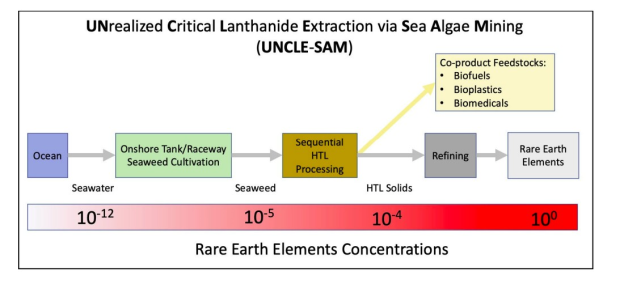
Figure 2: Process flow for the macroalgae mining process for the UNCLE-SAM project (Source: Edmunson et al., 2023)
As the current process stands, the emissions from the process are 2.2 kg CO2eq/kg Alga-Ore. By minimizing the required seawater pumping and simplifying the grinding process, the model illustrates a pathway to achieving an extraction process until the refining phase that has no net emissions. However, rare earth metal extraction from Alga-ore and product transport are outside the bounds of the current model.
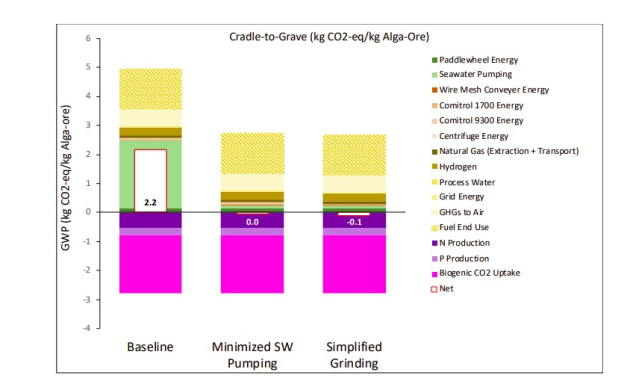
Figure 3: Life Cycle Analysis performed as part of the UNCLE-SAM project shows the net emissions and the improvement from minimized water pumping and simplified grinding. X axis shows the baseline process as well as the two improved processes, while the Y axis shows the emissions from the processes in CO2eq/kg Alga-Ore. Source: Edmunson et al. (2023)
The Smerigan & Shi (2026) review makes clear that meaningful like-for-like comparisons between seaweed-based and conventional rare earth element production are not yet possible, for reasons that cut in both directions. On the conventional mining side, while most conventional mining LCAs extend through separation and refining. the global warming impact of conventional REE production varies nearly an order of magnitude across different studies. This is because primary data availability from industry is limited and methodology of attribution is challenging since rare earth metals are often extracted together.
Context
Conventional mining is a source of global carbon emissions, with the entire mining industry contributing 8% of the global carbon footprint (Cox et al., 2022), which is approximately 4.3 GT CO2eq. A seaweed-based alternative that could supply some of these minerals with a lower carbon intensity would therefore be doubly valuable: addressing both supply chain concentration risk and emissions. However, algal mining is at Technology Readiness Level 3. This means laboratory feasibility has been demonstrated — seaweed can accumulate REEs from seawater to concentrations orders of magnitude higher than the surrounding water, and a process for extracting them has been piloted at bench scale, but not beyond. The Department of Energy-funded UNCLE-SAM project also calculated the emissions for the process in developing Alga-ore, which is the product at the end of the HTL processing phase in Figure 2.
Figure 2: Process flow for the macroalgae mining process for the UNCLE-SAM project (Source: Edmunson et al., 2023)
As the current process stands, the emissions from the process are 2.2 kg CO2eq/kg Alga-Ore. By minimizing the required seawater pumping and simplifying the grinding process, the model illustrates a pathway to achieving an extraction process until the refining phase that has no net emissions. However, rare earth metal extraction from Alga-ore and product transport are outside the bounds of the current model.
Figure 3: Life Cycle Analysis performed as part of the UNCLE-SAM project shows the net emissions and the improvement from minimized water pumping and simplified grinding. X axis shows the baseline process as well as the two improved processes, while the Y axis shows the emissions from the processes in CO2eq/kg Alga-Ore. Source: Edmunson et al. (2023)
The Smerigan & Shi (2026) review makes clear that meaningful like-for-like comparisons between seaweed-based and conventional rare earth element production are not yet possible, for reasons that cut in both directions. On the conventional mining side, while most conventional mining LCAs extend through separation and refining. the global warming impact of conventional REE production varies nearly an order of magnitude across different studies. This is because primary data availability from industry is limited and methodology of attribution is challenging since rare earth metals are often extracted together.
Context
Conventional mining is a source of global carbon emissions, with the entire mining industry contributing 8% of the global carbon footprint (Cox et al., 2022), which is approximately 4.3 GT CO2eq. A seaweed-based alternative that could supply some of these minerals with a lower carbon intensity would therefore be doubly valuable: addressing both supply chain concentration risk and emissions. However, algal mining is at Technology Readiness Level 3. This means laboratory feasibility has been demonstrated — seaweed can accumulate REEs from seawater to concentrations orders of magnitude higher than the surrounding water, and a process for extracting them has been piloted at bench scale, but not beyond. The Department of Energy-funded UNCLE-SAM project also calculated the emissions for the process in developing Alga-ore, which is the product at the end of the HTL processing phase in Figure 2.
Figure 2: Process flow for the macroalgae mining process for the UNCLE-SAM project (Source: Edmunson et al., 2023)
As the current process stands, the emissions from the process are 2.2 kg CO2eq/kg Alga-Ore. By minimizing the required seawater pumping and simplifying the grinding process, the model illustrates a pathway to achieving an extraction process until the refining phase that has no net emissions. However, rare earth metal extraction from Alga-ore and product transport are outside the bounds of the current model.
Figure 3: Life Cycle Analysis performed as part of the UNCLE-SAM project shows the net emissions and the improvement from minimized water pumping and simplified grinding. X axis shows the baseline process as well as the two improved processes, while the Y axis shows the emissions from the processes in CO2eq/kg Alga-Ore. Source: Edmunson et al. (2023)
The Smerigan & Shi (2026) review makes clear that meaningful like-for-like comparisons between seaweed-based and conventional rare earth element production are not yet possible, for reasons that cut in both directions. On the conventional mining side, while most conventional mining LCAs extend through separation and refining. the global warming impact of conventional REE production varies nearly an order of magnitude across different studies. This is because primary data availability from industry is limited and methodology of attribution is challenging since rare earth metals are often extracted together.
However, even if clear data existed, until we have end to end LCAs for the seaweed-based process, comparisons and calculations of the impact of substitution are not possible.
Context
Conventional mining is a source of global carbon emissions, with the entire mining industry contributing 8% of the global carbon footprint (Cox et al., 2022), which is approximately 4.3 GT CO2eq. A seaweed-based alternative that could supply some of these minerals with a lower carbon intensity would therefore be doubly valuable: addressing both supply chain concentration risk and emissions. However, algal mining is at Technology Readiness Level 3. This means laboratory feasibility has been demonstrated — seaweed can accumulate REEs from seawater to concentrations orders of magnitude higher than the surrounding water, and a process for extracting them has been piloted at bench scale, but not beyond. The Department of Energy-funded UNCLE-SAM project also calculated the emissions for the process in developing Alga-ore, which is the product at the end of the HTL processing phase in Figure 2.
Figure 2: Process flow for the macroalgae mining process for the UNCLE-SAM project (Source: Edmunson et al., 2023)
As the current process stands, the emissions from the process are 2.2 kg CO2eq/kg Alga-Ore. By minimizing the required seawater pumping and simplifying the grinding process, the model illustrates a pathway to achieving an extraction process until the refining phase that has no net emissions. However, rare earth metal extraction from Alga-ore and product transport are outside the bounds of the current model.
Figure 3: Life Cycle Analysis performed as part of the UNCLE-SAM project shows the net emissions and the improvement from minimized water pumping and simplified grinding. X axis shows the baseline process as well as the two improved processes, while the Y axis shows the emissions from the processes in CO2eq/kg Alga-Ore. Source: Edmunson et al. (2023)
The Smerigan & Shi (2026) review makes clear that meaningful like-for-like comparisons between seaweed-based and conventional rare earth element production are not yet possible, for reasons that cut in both directions. On the conventional mining side, while most conventional mining LCAs extend through separation and refining. the global warming impact of conventional REE production varies nearly an order of magnitude across different studies. This is because primary data availability from industry is limited and methodology of attribution is challenging since rare earth metals are often extracted together.
However, even if clear data existed, until we have end to end LCAs for the seaweed-based process, comparisons and calculations of the impact of substitution are not possible.
Context
Conventional mining is a source of global carbon emissions, with the entire mining industry contributing 8% of the global carbon footprint (Cox et al., 2022), which is approximately 4.3 GT CO2eq. A seaweed-based alternative that could supply some of these minerals with a lower carbon intensity would therefore be doubly valuable: addressing both supply chain concentration risk and emissions. However, algal mining is at Technology Readiness Level 3. This means laboratory feasibility has been demonstrated — seaweed can accumulate REEs from seawater to concentrations orders of magnitude higher than the surrounding water, and a process for extracting them has been piloted at bench scale, but not beyond. The Department of Energy-funded UNCLE-SAM project also calculated the emissions for the process in developing Alga-ore, which is the product at the end of the HTL processing phase in Figure 2.
Figure 2: Process flow for the macroalgae mining process for the UNCLE-SAM project (Source: Edmunson et al., 2023)
As the current process stands, the emissions from the process are 2.2 kg CO2eq/kg Alga-Ore. By minimizing the required seawater pumping and simplifying the grinding process, the model illustrates a pathway to achieving a process that has no net emissions (until the refining phase). However, rare earth metal extraction and product transport are outside the bounds of the current model.
Figure 3: Life Cycle Analysis performed as part of the UNCLE-SAM project shows the net emissions and the improvement from minimized water pumping and simplified grinding. X axis shows the baseline process as well as the two improved processes, while the Y axis shows the emissions from the processes in CO2eq/kg Alga-Ore. Source: Edmunson et al. (2023)
The Smerigan & Shi (2026) review makes clear that meaningful like-for-like comparisons between seaweed-based and conventional rare earth element production are not yet possible, for reasons that cut in both directions. On the conventional mining side, while most conventional mining LCAs extend through separation and refining. the global warming impact of conventional REE production varies nearly an order of magnitude across different studies. This is because primary data availability from industry is limited and methodology of attribution is challenging since rare earth metals are often extracted together.
However, even if clear data existed, until we have end to end LCAs for the seaweed-based process, comparisons and calculations of the impact of substitution are not possible.
Context
Conventional mining is a source of global carbon emissions, with the entire mining industry contributing 8% of the global carbon footprint (Cox et al., 2022), which is approximately 4.3 GT CO2eq. A seaweed-based alternative that could supply some of these minerals with a lower carbon intensity would therefore be doubly valuable: addressing both supply chain concentration risk and emissions. However, algal mining is at Technology Readiness Level 3. This means laboratory feasibility has been demonstrated — seaweed can accumulate REEs from seawater to concentrations orders of magnitude higher than the surrounding water, and a process for extracting them has been piloted at bench scale, but not beyond. The Department of Energy-funded UNCLE-SAM project also calculated the emissions for the process in developing Alga-ore, which is the product at the end of the HTL processing phase in Figure 2. Figure 2: Process flow for the macroalgae mining process for the UNCLE-SAM project (Source: Edmunson et al., 2023) As the current process stands, the emissions from the process are 2.2 kg CO2eq/kg Alga-Ore. By minimizing the required seawater pumping and simplifying the grinding process, the model illustrates a pathway to achieving a process that has no net emissions (until the refining phase). However, rare earth metal extraction and product transport are outside the bounds of the current model.
Figure 3: Life Cycle Analysis performed as part of the UNCLE-SAM project shows the net emissions and the improvement from minimized water pumping and simplified grinding. X axis shows the baseline process as well as the two improved processes, while the Y axis shows the emissions from the processes in CO2eq/kg Alga-Ore. Source: Edmunson et al. (2023)
The Smerigan & Shi (2026) review makes clear that meaningful like-for-like comparisons between seaweed-based and conventional rare earth element production are not yet possible, for reasons that cut in both directions. On the conventional mining side, while most conventional mining LCAs extend through separation and refining. the global warming impact of conventional REE production varies nearly an order of magnitude across different studies. This is because primary data availability from industry is limited and methodology of attribution is challenging since rare earth metals are often extracted together.
However, even if clear data existed, until we have end to end LCAs for the seaweed-based process, comparisons and calculations of the impact of substitution are not possible.
Context
Conventional mining is a source of global carbon emissions, with the entire mining industry contributing 8% of the global carbon footprint (Cox et al., 2022), which is approximately 4.3 GT CO2eq. A seaweed-based alternative that could supply some of these minerals with a lower carbon intensity would therefore be doubly valuable: addressing both supply chain concentration risk and emissions. However, algal mining is at Technology Readiness Level 3. This means laboratory feasibility has been demonstrated — seaweed can accumulate REEs from seawater to concentrations orders of magnitude higher than the surrounding water, and a process for extracting them has been piloted at bench scale, but not beyond. The Department of Energy-funded UNCLE-SAM project also calculated the emissions for the process in developing Alga-ore, which is the product at the end of the HTL processing phase in Figure 1. As the current process stands, the emissions from the process are 2.2 kg CO2eq/kg Alga-Ore. By minimizing the required seawater pumping and simplifying the grinding process, the model illustrates a pathway to achieving net carbon negative critical minerals up until the refining phase. However, rare earth metal extractions and product transport are outside the bounds of the current model.
Figure 3: Life Cycle Analysis performed as part of the UNCLE-SAM project shows the net emissions and the improvement from minimized water pumping and simplified grinding. X axis shows the baseline process as well as the two improved processes, while the Y axis shows the emissions from the processes in CO2eq/kg Alga-Ore. Source: Edmunson et al. (2023)
The Smerigan & Shi (2026) review makes clear that meaningful like-for-like comparisons between seaweed-based and conventional rare earth element production are not yet possible, for reasons that cut in both directions. On the conventional mining side, while most conventional mining LCAs extend through separation and refining. the global warming impact of conventional REE production varies nearly an order of magnitude across different studies. This is because primary data availability from industry is limited and methodology of attribution is challenging since rare earth metals are often extracted together.
However, even if clear data existed, until we have end to end LCAs for the seaweed-based process, comparisons and calculations of the impact of substitution are not possible.
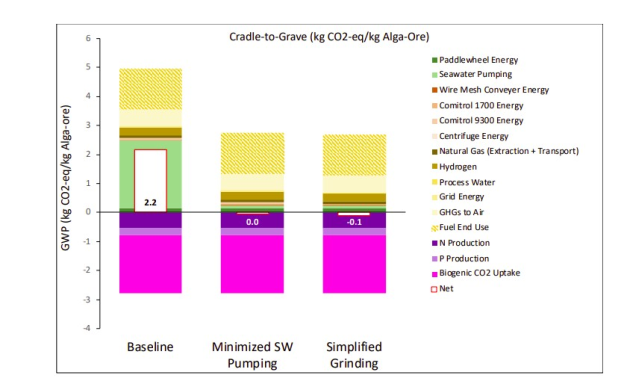 Figure 3: Life Cycle Analysis performed as part of the UNCLE-SAM project shows the net emissions and the improvement from minimized water pumping and simplified grinding. X axis shows the baseline process as well as the two improved processes, while the Y axis shows the emissions from the processes in CO2eq/kg Alga-Ore. Source: Edmunson et al. (2023)[/caption]
Figure 3: Life Cycle Analysis performed as part of the UNCLE-SAM project shows the net emissions and the improvement from minimized water pumping and simplified grinding. X axis shows the baseline process as well as the two improved processes, while the Y axis shows the emissions from the processes in CO2eq/kg Alga-Ore (Source: Edmunson et al., 2023)
Figure 3: Life Cycle Analysis performed as part of the UNCLE-SAM project shows the net emissions and the improvement from minimized water pumping and simplified grinding. X axis shows the baseline process as well as the two improved processes, while the Y axis shows the emissions from the processes in CO2eq/kg Alga-Ore (Source: Edmunson et al., 2023)
Figure 3: Life Cycle Analysis performed as part of the UNCLE-SAM project shows the net emissions and the improvement from minimized water pumping and simplified grinding. X axis shows the baseline process as well as the two improved processes, while the Y axis shows the emissions from the processes in CO2eq/kg Alga-Ore. Source: Edmunson et al. (2023)[/caption]
Figure 3: Life Cycle Analysis performed as part of the UNCLE-SAM project shows the net emissions and the improvement from minimized water pumping and simplified grinding. X axis shows the baseline process as well as the two improved processes, while the Y axis shows the emissions from the processes in CO2eq/kg Alga-Ore (Source: Edmunson et al., 2023)
Figure 3: Life Cycle Analysis performed as part of the UNCLE-SAM project shows the net emissions and the improvement from minimized water pumping and simplified grinding. X axis shows the baseline process as well as the two improved processes, while the Y axis shows the emissions from the processes in CO2eq/kg Alga-Ore (Source: Edmunson et al., 2023)
 Figure 3: Life Cycle Analysis performed as part of the UNCLE-SAM project shows the net emissions and the improvement from minimized water pumping and simplified grinding. X axis shows the baseline process as well as the two improved processes, while the Y axis shows the emissions from the processes in CO2eq/kg Alga-Ore (Source: Edmunson et al., 2023)
Figure 3: Life Cycle Analysis performed as part of the UNCLE-SAM project shows the net emissions and the improvement from minimized water pumping and simplified grinding. X axis shows the baseline process as well as the two improved processes, while the Y axis shows the emissions from the processes in CO2eq/kg Alga-Ore (Source: Edmunson et al., 2023)
Figure 3: Life Cycle Analysis performed as part of the UNCLE-SAM project shows the net emissions and the improvement from minimized water pumping and simplified grinding. X axis shows the baseline process as well as the two improved processes, while the Y axis shows the emissions from the processes in CO2eq/kg Alga-Ore (Source: Edmunson et al., 2023)
Product Performance
In the exploratory phase, the key question is whether seaweed can absorb enough critical minerals from seawater — and whether those minerals can then be extracted efficiently during processing. To measure this, researchers use a bioconcentration factor (BCF): a simple ratio comparing how much of a given element ends up concentrated in the dried seaweed biomass versus how much was present in the surrounding seawater. A higher BCF means the seaweed is doing more of the “heavy lifting” as a natural concentrator.
The UNCLE-SAM project set an ambitious Go/No-Go threshold: at least 1×10⁵ (100,000x concentration) for at least one rare earth element (REE) absorbed directly from seawater. The Ulva isolates tested not only cleared that bar — they met it for several elements, a meaningful proof-of-concept result.
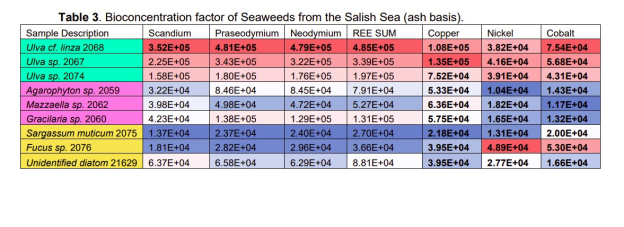
Figure 4: Bioconcentration factor of Seaweeds from the Salish Sea. Source:Edmunson et al. (2023)
Scale considerations:
Because REEs are present in seaweed biomass at only trace levels (parts per million), large volumes of biomass are needed to produce meaningful quantities of REEs. To reach tonne-scale REE production — for context, projected global mine supply of REEs by 2035 is around 105,000 tonnes — processing would need to handle millions of dry tons of seaweed biomass. (Source: Edmunson et al., 2023). An alternative approach under active investigation is to grow or harvest seaweed in waters that are naturally or incidentally enriched in REEs above background seawater concentrations, improving the gradient that drives bioaccumulation. The UAF-led DOE-funded project embodies this approach.
Figure 4: Bioconcentration factor of Seaweeds from the Salish Sea. Source:Edmunson et al. (2023)
Scale considerations:
Because REEs are present in seaweed biomass at only trace levels (parts per million), large volumes of biomass are needed to produce meaningful quantities of REEs. To reach tonne-scale REE production — for context, projected global mine supply of REEs by 2035 is around 105,000 tonnes — processing would need to handle millions of dry tons of seaweed biomass. (Source: Edmunson et al., 2023). An alternative approach under active investigation is to grow or harvest seaweed in waters that are naturally or incidentally enriched in REEs above background seawater concentrations, improving the gradient that drives bioaccumulation. The UAF-led DOE-funded project embodies this approach.
Figure 4: Bioconcentration factor of Seaweeds from the Salish Sea. Source:Edmunson et al. (2023)
Scale considerations:
Because REEs are present in seaweed biomass at only trace levels (parts per million), large volumes of biomass are needed to produce meaningful quantities of REEs. To reach tonne-scale REE production — for context, projected global mine supply of REEs by 2035 is around 105,000 tonnes — processing would need to handle millions of dry tons of seaweed biomass. (Source: Edmunson et al., 2023) Figure 4: Bioconcentration factor of Seaweeds from the Salish Sea. Source: Edmunson et al. (2023)[/caption]
Scale considerations:
Because REEs are present in seaweed biomass at only trace levels (parts per million), large volumes of biomass are needed to produce meaningful quantities of REEs. To reach tonne-scale REE production — for context, projected global mine supply of REEs by 2035 is around 105,000 tonnes — processing would need to handle millions of dry tons of seaweed biomass. (Source: Edmunson et al., 2023)
Figure 4: Bioconcentration factor of Seaweeds from the Salish Sea (Source: Edmunson et al., 2023)
Scale considerations: Because REEs are present in seaweed biomass at only trace levels (parts per million), large volumes of biomass are needed to produce meaningful quantities of REEs. To reach tonne-scale REE production — for context, projected global mine supply of REEs by 2035 is around 105,000 tonnes — processing would need to handle millions of dry tons of seaweed biomass. (Source: Edmunson et al., 2023)
Figure 4: Bioconcentration factor of Seaweeds from the Salish Sea (Source: Edmunson et al., 2023)
Scale considerations: Because REEs are present in seaweed biomass at only trace levels (parts per million), large volumes of biomass are needed to produce meaningful quantities of REEs. To reach tonne-scale REE production — for context, projected global mine supply of REEs by 2035 is around 105,000 tonnes — processing would need to handle millions of dry tons of seaweed biomass. (Source: Edmunson et al., 2023)- Geopolitical and Supply Chain Drivers: A primary factor driving the adoption of alternative critical mineral sources is the current focus on the development of domestic supply chains, particularly for rare earth elements. The U.S. and other nations are currently striving to reduce reliance on China, which controls about 70% of global REE production and 90% of processing and permanent magnet manufacturing.
- Economic Factors: For a new source of critical minerals to achieve widespread market adoption, it must be cost-competitive with conventional methods as well as with alternative exploratory approaches such as deep-sea mining. Economic viability will require generating multiple revenue streams from the harvested biomass such as biofuels, biostimulants and bioplastics (see Section “Cascading Biorefineries” for more information).
- Environmental Drivers: The desire for greener sourcing is a powerful driver for market adoption, especially for components used in clean energy technologies like electrical vehicles and wind turbines. Conventional mining is a source of global carbon emissions, with the entire mining industry contributing 8% of the global carbon footprint (Cox et al., 2022). Seabed mining, which is the mining of mineral resources on the seabed, will have several environmental impacts including the potential impact to deep-sea biodiversity (Miller et al,, 2018)
Figure 4: Bioconcentration factor of Seaweeds from the Salish Sea (Source: Edmunson et al., 2023)
Scale considerations: Because REEs are present in seaweed biomass at only trace levels (parts per million), large volumes of biomass are needed to produce meaningful quantities of REEs. To reach tonne-scale REE production — for context, projected global mine supply of REEs by 2035 is around 105,000 tonnes — processing would need to handle millions of dry tons of seaweed biomass. (Source: Edmunson et al., 2023)Cost/Market Adoption
The analysis done as part of the UNCLE-SAM project showed that the cost of production of the current process far exceeds the total value of the “algae-ore” extracted from the Ulva. (which is at $527.22/tonne of ore). The analysis provided a pathway to profitability which includes minimized seawater pumping, reduction in CAPEX for the pathway ponds to bring the cost of production to $295/tonne of ore. The market value of the mineral content in a tonne of Alga-Ore has not been publicly disclosed in the UNCLE-SAM reports; the profitability threshold lies somewhere between these two figures, depending on REE prices, extraction efficiency, and co-product revenue.
Seaweed-based critical minerals are not currently on the market. The startup Orca Minerals, which focuses on this new form of mining, is working toward a goal of having an operational prototype by 2027 so widespread market adoption is realistically several years away.
The market adoption of critical minerals, particularly those sourced through emerging methods like seaweed biomining, will be influenced by geopolitical, economic, and environmental factors.
- Geopolitical and Supply Chain Drivers: A primary factor driving the adoption of alternative critical mineral sources is the current focus on the development of domestic supply chains, particularly for rare earth elements. The U.S. and other nations are currently striving to reduce reliance on China, which controls about 70% of global REE production and 90% of processing and permanent magnet manufacturing.
- Economic Factors: For a new source of critical minerals to achieve widespread market adoption, it must be cost-competitive with conventional methods as well as with alternative exploratory approaches such as deep-sea mining. Economic viability will require generating multiple revenue streams from the harvested biomass such as biofuels, biostimulants and bioplastics (see Section “Cascading Biorefineries” for more information).
- Environmental Drivers: The desire for greener sourcing is a powerful driver for market adoption, especially for components used in clean energy technologies like electrical vehicles and wind turbines. Conventional mining is a source of global carbon emissions, with the entire mining industry contributing 8% of the global carbon footprint (Cox et al., 2022). Seabed mining, which is the mining of mineral resources on the seabed, will have several environmental impacts including the potential impact to deep-sea biodiversity (Miller et al., 2018)
- Geopolitical and Supply Chain Drivers: A primary factor driving the adoption of alternative critical mineral sources is the current focus on the development of domestic supply chains, particularly for rare earth elements. The U.S. and other nations are currently striving to reduce reliance on China, which controls about 70% of global REE production and 90% of processing and permanent magnet manufacturing.
- Economic Factors: For a new source of critical minerals to achieve widespread market adoption, it must be cost-competitive with conventional methods as well as with alternative exploratory approaches such as deep-sea mining. Economic viability will require generating multiple revenue streams from the harvested biomass such as biofuels, biostimulants and bioplastics (see Section “Cascading Biorefineries” for more information).
- Environmental Drivers: The desire for greener sourcing is a powerful driver for market adoption, especially for components used in clean energy technologies like electrical vehicles and wind turbines. Conventional mining is a source of global carbon emissions, with the entire mining industry contributing 8% of the global carbon footprint (Cox et al., 2022). Seabed mining, which is the mining of mineral resources on the seabed, will have several environmental impacts including the potential impact to deep-sea biodiversity (Miller et al., 2018)
- Geopolitical and Supply Chain Drivers: A primary factor driving the adoption of alternative critical mineral sources is the current focus on the development of domestic supply chains, particularly for rare earth elements. The U.S. and other nations are currently striving to reduce reliance on China, which controls about 70% of global REE production and 90% of processing and permanent magnet manufacturing.
- Economic Factors: For a new source of critical minerals to achieve widespread market adoption, it must be cost-competitive with conventional methods as well as with alternative exploratory approaches such as deep-sea mining. Economic viability will require generating multiple revenue streams from the harvested biomass such as biofuels, biostimulants and bioplastics (see Section “Cascading Biorefineries” for more information).
- Environmental Drivers: The desire for greener sourcing is a powerful driver for market adoption, especially for components used in clean energy technologies like electrical vehicles and wind turbines. Conventional mining is a source of global carbon emissions, with the entire mining industry contributing 8% of the global carbon footprint (Cox et al., 2022). Seabed mining, which is the mining of mineral resources on the seabed, will have several environmental impacts including the potential impact to deep-sea biodiversity (Miller et al,, 2018)
- Geopolitical and Supply Chain Drivers: A primary factor driving the adoption of alternative critical mineral sources is the current focus on the development of domestic supply chains, particularly for rare earth elements. The U.S. and other nations are currently striving to reduce reliance on China, which controls about 70% of global REE production and 90% of processing and permanent magnet manufacturing.
- Economic Factors: For a new source of critical minerals to achieve widespread market adoption, it must be cost-competitive with conventional methods as well as with alternative exploratory approaches such as deep-sea mining. Economic viability will require generating multiple revenue streams from the harvested biomass such as biofuels, biostimulants and bioplastics (see Section “Cascading Biorefineries” for more information).
- Environmental Drivers: The desire for greener sourcing is a powerful driver for market adoption, especially for components used in clean energy technologies like electrical vehicles and wind turbines. Conventional mining is a source of global carbon emissions, with the entire mining industry contributing 8% of the global carbon footprint (Cox et al., 2022). Seabed mining, which is the mining of mineral resources on the seabed, will have several environmental impacts including the potential impact to deep-sea biodiversity (Miller et al,, 2018)
- Geopolitical and Supply Chain Drivers: A primary factor driving the adoption of alternative critical mineral sources is the current focus on the development of domestic supply chains, particularly for rare earth elements. The U.S. and other nations are currently striving to reduce reliance on China, which controls about 70% of global REE production and 90% of processing and permanent magnet manufacturing.
- Economic Factors: For a new source of critical minerals to achieve widespread market adoption, it must be cost-competitive with conventional methods as well as with alternative exploratory approaches such as deep-sea mining. Economic viability will require generating multiple revenue streams from the harvested biomass such as biofuels, biostimulants and bioplastics (see Section “Cascading Biorefineries” for more information).
- Environmental Drivers: The desire for greener sourcing is a powerful driver for market adoption, especially for components used in clean energy technologies like electrical vehicles and wind turbines. Conventional mining is a source of global carbon emissions, with the entire mining industry contributing 8% of the global carbon footprint (Cox et al., 2022). Seabed mining, which is the mining of mineral resources on the seabed, will have several environmental impacts including the potential impact to deep-sea biodiversity (Miller et al,, 2018)
Environmental Co-benefits and Risks
Benefits
- Extraction of critical minerals using seaweeds can minimize the environmental impacts caused by conventional mining, such as displacing wildlife habitats, polluting water/soil/air, and creating mining waste as described here.
- Mining can also strain water quality and supplies. Sixteen percent of critical mineral mines, deposits and districts are in highly water-stressed areas (places that already use 40% of their available water each year to meet demand). Seaweed-based mining can be developed to be less water intensive.
- Seaweed draws nitrogen (N) and phosphorus (P) from surrounding water as it grows, offering a potential bioremediation benefit in nutrient-enriched coastal areas prone to harmful algal blooms. That sequestered N and P could potentially be extracted and used in biostimulants, fostering a circular economy (Neveux et al., 2017).
- The minerals absorbed by seaweed originate from geological weathering processes that have, over vast timescales, built up a large reservoir of dissolved elements in the ocean. The oceanic reservoir is so large that depletion through seaweed-based extraction is not a meaningful near-term constraint (Elderfield et al., 1990).
- Extraction of critical minerals by seaweeds could support the cleanup of ocean areas impacted by industrial runoff (for example minerals leached from mines into the ocean).
Risks
- Chemical pre-treatment using lixiviants (acidic liquids used in standard ore mining to extract minerals from rock) has the potential to cause environmental impacts if they leak into groundwater systems. Strong process controls need to be built in to track these chemicals and prevent leakage if alternative chemicals or less agressive lixiviants cannot be found (Crane et al., 2025).
- Concerns exist regarding the potential for introducing invasive species if non-native seaweed is farmed and the impacts to the native seaweed population and the broader ecosystem. Mitigation could include prioritizing sterile non-clonal species could lower biosecurity risks if prioritizing species endemic to the region is not possible (Lodge et al., 2006; Piazzi & Ceccherelli, 2006; Spillias et al., 2024).
Benefits
- Extraction of critical minerals using seaweeds can minimize the environmental impacts caused by conventional mining, such as displacing wildlife habitats, polluting water/soil/air, and creating mining waste as described here.
- Mining can also strain water quality and supplies. Sixteen percent of critical mineral mines, deposits and districts are in highly water-stressed areas (places that already use 40% of their available water each year to meet demand). Seaweed-based mining can be developed to be less water intensive.
- Seaweed draws nitrogen (N) and phosphorus (P) from surrounding water as it grows, offering a potential bioremediation benefit in nutrient-enriched coastal areas prone to harmful algal blooms. That sequestered N and P could potentially be extracted and used in biostimulants, fostering a circular economy (Neveux et al., 2017).
- The minerals absorbed by seaweed originate from geological weathering processes that have, over vast timescales, built up a large reservoir of dissolved elements in the ocean. The oceanic reservoir is so large that depletion through seaweed-based extraction is not a meaningful near-term constraint (Elderfield et al., 1990).
- Extraction of critical minerals by seaweeds could support the cleanup of ocean areas impacted by industrial runoff (for example minerals leached from mines into the ocean).
Risks
- Chemical pre-treatment using lixiviants (acidic liquids used in standard ore mining to extract minerals from rock) has the potential to cause environmental impacts if they leak into groundwater systems. Strong process controls need to be built in to track these chemicals and prevent leakage if alternative chemicals or less agressive lixiviants cannot be found (Crane et al., 2025).
- Concerns exist regarding the potential for introducing invasive species if non-native seaweed is farmed and the impacts to the native seaweed population and the broader ecosystem. Mitigation could include prioritizing sterile non-clonal species could lower biosecurity risks if prioritizing species endemic to the region is not possible (Lodge et al., 2006; Piazzi & Ceccherelli, 2006; Spillias et al., 2024).
Benefits
- Extraction of critical minerals using seaweeds can minimize the environmental impacts caused by conventional mining, such as displacing wildlife habitats, polluting water/soil/air, and creating mining waste as described here.
- Mining can also strain water quality and supplies. Sixteen percent of critical mineral mines, deposits and districts are in highly water-stressed areas (places that already use 40% of their available water each year to meet demand). Seaweed-based mining can be developed to be less water intensive.
- Seaweed draws nitrogen (N) and phosphorus (P) from surrounding water as it grows, offering a potential bioremediation benefit in nutrient-enriched coastal areas prone to harmful algal blooms. That sequestered N and P could potentially be extracted and used in biostimulants, fostering a circular economy (Neveux et al., 2017).
- The minerals absorbed by seaweed originate from geological weathering processes that have, over vast timescales, built up a large reservoir of dissolved elements in the ocean. The oceanic reservoir is so large that depletion through seaweed-based extraction is not a meaningful near-term constraint (Elderfield et al., 1990).
Risks
- Chemical pre-treatment using lixiviants (acidic liquids used in standard ore mining to extract minerals from rock) has the potential to cause environmental impacts if they leak into groundwater systems. Strong process controls need to be built in to track these chemicals and prevent leakage if alternative chemicals or less agressive lixiviants cannot be found (Crane et al., 2025).
- Concerns exist regarding the potential for introducing invasive species if non-native seaweed is farmed and the impacts to the native seaweed population and the broader ecosystem. Mitigation could include prioritizing sterile non-clonal species could lower biosecurity risks if prioritizing species endemic to the region is not possible (Lodge et al., 2006; Piazzi & Ceccherelli, 2006; Spillias et al., 2024).
Benefits
- Extraction of critical minerals using seaweeds can minimize the environmental impacts caused by conventional mining, such as displacing wildlife habitats, polluting water/soil/air, and creating mining waste as described here.
- Mining can also strain water quality and supplies. Sixteen percent of critical mineral mines, deposits and districts are in highly water-stressed areas (places that already use 40% of their available water each year to meet demand). Seaweed-based mining can be developed to be less water intensive.
- Seaweed draws nitrogen (N) and phosphorus (P) from surrounding water as it grows, offering a potential bioremediation benefit in nutrient-enriched coastal areas prone to harmful algal blooms. That sequestered N and P could potentially be extracted and used in biostimulants, fostering a circular economy.
- The minerals absorbed by seaweed originate from geological weathering processes that have, over vast timescales, built up a large reservoir of dissolved elements in the ocean. The oceanic reservoir is so large that depletion through seaweed-based extraction is not a meaningful near-term constraint (Elderfield et al., 1990).
Risks
- Chemical pre-treatment using lixiviants (acidic liquids used in standard ore mining to extract minerals from rock) has the potential to cause environmental impacts if they leak into groundwater systems. Strong process controls need to be built in to track these chemicals and prevent leakage if alternative chemicals cannot be found that are less harmful.
- Concerns exist regarding the potential for introducing invasive species if non-native seaweed is farmed and the impacts to the native seaweed population and the broader ecosystem. Mitigation could include prioritizing sterile non-clonal species could lower biosecurity risks if prioritizing species endemic to the region is not possible.
- While seaweed offers environmental benefits, the carrying capacity of ecosystems and optimal cultivation conditions are crucial for obtaining high yields sustainably and must be considered and studied to avoid negative impacts.
Benefits
- Reduced mining impact: Extraction of critical minerals using seaweeds can minimize the environmental impacts caused by conventional mining, such as displacing wildlife habitats, polluting water/soil/air, and creating mining waste as described here.
- Reduced resource usage: Mining can also strain water quality and supplies. Sixteen percent of critical mineral mines, deposits and districts are in highly water-stressed areas (places that already use 40% of their available water each year to meet demand). Seaweed-based mining can be developed to be less water intensive.
- Water quality improvement: Seaweed draws nitrogen (N) and phosphorus (P) from surrounding water as it grows, offering a potential bioremediation benefit in nutrient-enriched coastal areas prone to harmful algal blooms. That sequestered N and P could potentially be extracted and used in biostimulants, fostering a circular economy.
- Renewable supply of minerals: The minerals absorbed by seaweed originate from geological weathering processes that have, over vast timescales, built up a large reservoir of dissolved elements in the ocean. The oceanic reservoir is so large that depletion through seaweed-based extraction is not a meaningful near-term constraint (Elderfield et al., 1990).
Risks
- Potential impact of pre-processing: Chemical pre-treatment using lixiviants (acidic liquids used in standard ore mining to extract minerals from rock) has the potential to cause environmental impacts if they leak into groundwater systems. Strong process controls need to be built in to track these chemicals and prevent leakage if alternative chemicals cannot be found that are less harmful.
- Potential for introducing invasive species: Concerns exist regarding the potential for introducing invasive species if non-native seaweed is farmed and the impacts to the native seaweed population and the broader ecosystem. Mitigation could include prioritizing sterile non-clonal species could lower biosecurity risks if prioritizing species endemic to the region is not possible.
- Scaling cultivation can result in local ecosystems exceeding carrying capacity: While seaweed offers environmental benefits, the carrying capacity of ecosystems and optimal cultivation conditions are crucial for obtaining high yields sustainably and must be considered and studied to avoid negative impacts.
Benefits
- Reduced Mining Impact: Extraction of critical minerals using seaweeds can minimize the environmental impacts caused by conventional mining, such as displacing wildlife habitats, polluting water/soil/air, and creating mining waste as described here.
- Reduced Resource Usage: Mining can also strain water quality and supplies. Sixteen percent of critical mineral mines, deposits and districts are in highly water-stressed areas (places that already use 40% of their available water each year to meet demand). Seaweed-based mining can be developed to be less water intensive.
- Water Quality Improvement: Seaweed draws nitrogen (N) and phosphorus (P) from surrounding water as it grows, offering a potential bioremediation benefit in nutrient-enriched coastal areas prone to harmful algal blooms. That sequestered N and P could potentially be extracted and used in biostimulants, fostering a circular economy.
- Renewable Supply of Minerals: The minerals absorbed by seaweed originate from geological weathering processes that have, over vast timescales, built up a large reservoir of dissolved elements in the ocean. The oceanic reservoir is so large that depletion through seaweed-based extraction is not a meaningful near-term constraint (Elderfield et al., 1990).
Risks
- Potential impact of pre-processing: Chemical pre-treatment using lixiviants (acidic liquids used in standard ore mining to extract minerals from rock) has the potential to cause environmental impacts if they leak into groundwater systems. Strong process controls need to be built in to track these chemicals and prevent leakage if alternative chemicals cannot be found that are less harmful.
- Potential for introducing invasive species: Concerns exist regarding the potential for introducing invasive species if non-native seaweed is farmed and the impacts to the native seaweed population and the broader ecosystem. Mitigation could include prioritizing sterile non-clonal species could lower biosecurity risks if prioritizing species endemic to the region is not possible.
- Scaling cultivation can result in local ecosystems exceeding carrying capacity: While seaweed offers environmental benefits, the carrying capacity of ecosystems and optimal cultivation conditions are crucial for obtaining high yields sustainably and must be considered and studied to avoid negative impacts.
Benefits
- Reduced Mining Impact: Extraction of critical minerals using seaweeds can minimize the environmental impacts caused by conventional mining, such as displacing wildlife habitats, polluting water/soil/air, and creating mining waste as described here.
- Reduced Resource Usage: Mining can also strain water quality and supplies. Sixteen percent of critical mineral mines, deposits and districts are in highly water-stressed areas (places that already use 40% of their available water each year to meet demand). Seaweed-based mining can be developed to be less water intensive.
- Water Quality Improvement: Seaweed draws nitrogen (N) and phosphorus (P) from surrounding water as it grows, offering a potential bioremediation benefit in nutrient-enriched coastal areas prone to harmful algal blooms. That sequestered N and P could potentially be extracted and used in biostimulants, fostering a circular economy.
- Renewable Supply of Minerals: The minerals absorbed by seaweed originate from geological weathering processes that have, over vast timescales, built up a large reservoir of dissolved elements in the ocean. The oceanic reservoir is so large that depletion through seaweed-based extraction is not a meaningful near-term constraint (Elderfield et al., 1990).
Risks
- Potential impact of pre-processing: Chemical pre-treatment using lixiviants (acidic liquids used in standard ore mining to extract minerals from rock) has the potential to cause environmental impacts if they leak into groundwater systems. Strong process controls need to be built in to track these chemicals and prevent leakage if alternative chemicals cannot be found that are less harmful.
- Potential for introducing invasive species: Concerns exist regarding the potential for introducing invasive species if non-native seaweed is farmed and the impacts to the native seaweed population and the broader ecosystem. Mitigation could include prioritizing sterile non-clonal species could lower biosecurity risks if prioritizing species endemic to the region is not possible.
- Scaling cultivation can result in local ecosystems exceeding carrying capacity: While seaweed offers environmental benefits, the carrying capacity of ecosystems and optimal cultivation conditions are crucial for obtaining high yields sustainably and must be considered and studied to avoid negative impacts.
Benefits
- Reduced Mining Impact: Extraction of critical minerals using seaweeds can minimize the environmental impacts caused by conventional mining, such as displacing wildlife habitats, polluting water/soil/air, and creating mining waste as described here.
- Reduced Resource Usage: Mining can also strain water quality and supplies. Sixteen percent of critical mineral mines, deposits and districts are in highly water-stressed areas (places that already use 40% of their available water each year to meet demand). Seaweed-based mining can be developed to be less water intensive.
- Water Quality Improvement: Seaweed draws nitrogen (N) and phosphorus (P) from surrounding water as it grows, offering a potential bioremediation benefit in nutrient-enriched coastal areas prone to harmful algal blooms. That sequestered N and P could potentially be extracted and used in biostimulants, fostering a circular economy.
- Renewable Supply of Minerals: The minerals absorbed by seaweed originate from geological weathering processes that have, over vast timescales, built up a large reservoir of dissolved elements in the ocean. The oceanic reservoir is so large that depletion through seaweed-based extraction is not a meaningful near-term constraint (Elderfield et al., 1990).
Risks
- Potential impact of pre-processing: Chemical pre-treatment using lixiviants (acidic liquids used in standard ore mining to extract minerals from rock) has the potential to cause environmental impacts if they leak into groundwater systems. Strong process controls need to be built in to track these chemicals and prevent leakage if alternative chemicals cannot be found that are less harmful.
- Potential for introducing invasive species: Concerns exist regarding the potential for introducing invasive species if non-native seaweed is farmed and the impacts to the native seaweed population and the broader ecosystem. Mitigation could include prioritizing sterile non-clonal species could lower biosecurity risks if prioritizing species endemic to the region is not possible.
- Scaling cultivation can result in local ecosystems exceeding carrying capacity: While seaweed offers environmental benefits, the carrying capacity of ecosystems and optimal cultivation conditions are crucial for obtaining high yields sustainably and must be considered and studied to avoid negative impacts.
Policy and Regulation
The race to develop new rare-earth extraction/separation methods is driven by policy: national security, clean-energy industrial strategy, and supply-chain de-risking. The policies that drive accelerated development of seaweed-based mining are shown below.
| Jurisdiction | Specific policy / program (examples) | What it does (mechanism) | How it could drive seaweed-based mining (Algal mining) |
| United States | DOE ARPA-E “Algal Mining” / ocean macroalgae critical mineral extraction topic (incl. team selections + project portfolio such as UNCLE-SAM / EMC2) | Competitive R&D funding for feasibility, cultivation parameters, and extraction/separation approaches for critical minerals from macroalgae | Directly funds algal mining: validates bioaccumulation, identifies target species, and develops/benchmarks extraction routes (chelation, adsorbents, hydrothermal processing, etc.) |
| United States | DOE programs to strengthen REE supply chains and recover/refine REEs from unconventional feedstocks | Cost-shared demos and applied R&D to show commercial viability of recovery/refining from nontraditional sources | Creates a funding template + commercialization pathway that seaweed-based mining projects can plug into as they mature (especially if framed as “unconventional feedstock” with a viable refining route) |
| European Union | Critical Raw Materials Act (CRMA) with 2030 benchmarks (extraction/processing/recycling) + strategic projects/permitting acceleration | Sets EU-wide supply-security targets and enables “strategic projects,” with faster permitting timelines and coordinated support | Provides demand pull for EU processing/recycling capacity and encourages novel sourcing; algal mining can be positioned as a low-footprint, EU-based feedstock route if it can hit scale/cost/environmental constraints |
| European Union | EU Algae Initiative / EU4Algae (Commission-led, launched 2022; actions on markets, regulatory improvements, R&D | Improves governance/regulatory clarity and supports scale-up of an EU algae sector | Helps algal mining by addressing the supply; cultivating and permitting macroalgae at scale, building supply chains, and normalizing algae as an industrial feedstock |
| European Union | Horizon Europe support for critical raw materials R&D (funding calls) | Funds technology development for extraction/processing/recovery of critical raw materials | Can fund the separation chemistry and recovery engineering pieces that algal mining needs (even if calls are not seaweed-specific) |
Table 2: Policies that could drive acceleration of seaweed-based mining approaches
| Jurisdiction | Specific policy / program (examples) | What it does (mechanism) | How it could drive seaweed-based mining (Algal mining) |
| United States | DOE ARPA-E “Algal Mining” / ocean macroalgae critical mineral extraction topic (incl. team selections + project portfolio such as UNCLE-SAM / EMC2) | Competitive R&D funding for feasibility, cultivation parameters, and extraction/separation approaches for critical minerals from macroalgae | Directly funds algal mining: validates bioaccumulation, identifies target species, and develops/benchmarks extraction routes (chelation, adsorbents, hydrothermal processing, etc.) |
| United States | DOE programs to strengthen REE supply chains and recover/refine REEs from unconventional feedstocks | Cost-shared demos and applied R&D to show commercial viability of recovery/refining from nontraditional sources | Creates a funding template + commercialization pathway that seaweed-based mining projects can plug into as they mature (especially if framed as “unconventional feedstock” with a viable refining route) |
| European Union | Critical Raw Materials Act (CRMA) with 2030 benchmarks (extraction/processing/recycling) + strategic projects/permitting acceleration | Sets EU-wide supply-security targets and enables “strategic projects,” with faster permitting timelines and coordinated support | Provides demand pull for EU processing/recycling capacity and encourages novel sourcing; algal mining can be positioned as a low-footprint, EU-based feedstock route if it can hit scale/cost/environmental constraints |
| European Union | EU Algae Initiative / EU4Algae (Commission-led, launched 2022; actions on markets, regulatory improvements, R&D | Improves governance/regulatory clarity and supports scale-up of an EU algae sector | Helps algal mining by addressing the supply; cultivating and permitting macroalgae at scale, building supply chains, and normalizing algae as an industrial feedstock |
| European Union | Horizon Europe support for critical raw materials R&D (funding calls) | Funds technology development for extraction/processing/recovery of critical raw materials | Can fund the separation chemistry and recovery engineering pieces that algal mining needs (even if calls are not seaweed-specific) |
| Jurisdiction | Specific policy / program (examples) | What it does (mechanism) | How it could drive seaweed-based mining (Algal mining) |
| United States | DOE ARPA-E “Algal Mining” / ocean macroalgae critical mineral extraction topic (incl. team selections + project portfolio such as UNCLE-SAM / EMC2) | Competitive R&D funding for feasibility, cultivation parameters, and extraction/separation approaches for critical minerals from macroalgae | Directly funds algal mining: validates bioaccumulation, identifies target species, and develops/benchmarks extraction routes (chelation, adsorbents, hydrothermal processing, etc.) |
| United States | DOE programs to strengthen REE supply chains and recover/refine REEs from unconventional feedstocks | Cost-shared demos and applied R&D to show commercial viability of recovery/refining from nontraditional sources | Creates a funding template + commercialization pathway that seaweed-based mining projects can plug into as they mature (especially if framed as “unconventional feedstock” with a viable refining route) |
| European Union | Critical Raw Materials Act (CRMA) with 2030 benchmarks (extraction/processing/recycling) + strategic projects/permitting acceleration | Sets EU-wide supply-security targets and enables “strategic projects,” with faster permitting timelines and coordinated support | Provides demand pull for EU processing/recycling capacity and encourages novel sourcing; algal mining can be positioned as a low-footprint, EU-based feedstock route if it can hit scale/cost/environmental constraints |
| European Union | EU Algae Initiative / EU4Algae (Commission-led, launched 2022; actions on markets, regulatory improvements, R&D | Improves governance/regulatory clarity and supports scale-up of an EU algae sector | Helps algal mining by addressing the supply; cultivating and permitting macroalgae at scale, building supply chains, and normalizing algae as an industrial feedstock |
| European Union | Horizon Europe support for critical raw materials R&D (funding calls) | Funds technology development for extraction/processing/recovery of critical raw materials | Can fund the separation chemistry and recovery engineering pieces that algal mining needs (even if calls are not seaweed-specific) |
| Jurisdiction | Specific policy / program (examples) | What it does (mechanism) | How it could drive seaweed-based mining (Algal mining) |
| United States | DOE ARPA-E “Algal Mining” / ocean macroalgae critical mineral extraction topic (incl. team selections + project portfolio such as UNCLE-SAM / EMC2) | Competitive R&D funding for feasibility, cultivation parameters, and extraction/separation approaches for critical minerals from macroalgae | Directly funds algal mining: validates bioaccumulation, identifies target species, and develops/benchmarks extraction routes (chelation, adsorbents, hydrothermal processing, etc.) |
| United States | DOE programs to strengthen REE supply chains and recover/refine REEs from unconventional feedstocks | Cost-shared demos and applied R&D to show commercial viability of recovery/refining from nontraditional sources | Creates a funding template + commercialization pathway that seaweed-based mining projects can plug into as they mature (especially if framed as “unconventional feedstock” with a viable refining route) |
| European Union | Critical Raw Materials Act (CRMA) with 2030 benchmarks (extraction/processing/recycling) + strategic projects/permitting acceleration | Sets EU-wide supply-security targets and enables “strategic projects,” with faster permitting timelines and coordinated support | Provides demand pull for EU processing/recycling capacity and encourages novel sourcing; algal mining can be positioned as a low-footprint, EU-based feedstock route if it can hit scale/cost/environmental constraints |
| European Union | EU Algae Initiative / EU4Algae (Commission-led, launched 2022; actions on markets, regulatory improvements, R&D | Improves governance/regulatory clarity and supports scale-up of an EU algae sector | Helps algal mining by addressing the supply; cultivating and permitting macroalgae at scale, building supply chains, and normalizing algae as an industrial feedstock |
| European Union | Horizon Europe support for critical raw materials R&D (funding calls) | Funds technology development for extraction/processing/recovery of critical raw materials | Can fund the separation chemistry and recovery engineering pieces that algal mining needs (even if calls are not seaweed-specific) |
| Jurisdiction | Specific policy / program (examples) | What it does (mechanism) | How it could drive seaweed-based mining (Algal mining) |
| United States | DOE ARPA-E “Algal Mining” / ocean macroalgae critical mineral extraction topic (incl. team selections + project portfolio such as UNCLE-SAM / EMC2) | Competitive R&D funding for feasibility, cultivation parameters, and extraction/separation approaches for critical minerals from macroalgae | Directly funds algal mining: validates bioaccumulation, identifies target species, and develops/benchmarks extraction routes (chelation, adsorbents, hydrothermal processing, etc.) |
| United States | DOE programs to strengthen REE supply chains and recover/refine REEs from unconventional feedstocks | Cost-shared demos and applied R&D to show commercial viability of recovery/refining from nontraditional sources | Creates a funding template + commercialization pathway that seaweed-based mining projects can plug into as they mature (especially if framed as “unconventional feedstock” with a viable refining route) |
| European Union | Critical Raw Materials Act (CRMA) with 2030 benchmarks (extraction/processing/recycling) + strategic projects/permitting acceleration | Sets EU-wide supply-security targets and enables “strategic projects,” with faster permitting timelines and coordinated support | Provides demand pull for EU processing/recycling capacity and encourages novel sourcing; algal mining can be positioned as a low-footprint, EU-based feedstock route if it can hit scale/cost/environmental constraints |
| European Union | EU Algae Initiative / EU4Algae (Commission-led, launched 2022; actions on markets, regulatory improvements, R&D | Improves governance/regulatory clarity and supports scale-up of an EU algae sector | Helps algal mining by addressing the supply; cultivating and permitting macroalgae at scale, building supply chains, and normalizing algae as an industrial feedstock |
| European Union | Horizon Europe support for critical raw materials R&D (funding calls) | Funds technology development for extraction/processing/recovery of critical raw materials | Can fund the separation chemistry and recovery engineering pieces that algal mining needs (even if calls are not seaweed-specific) |
| Jurisdiction | Specific policy / program (examples) | What it does (mechanism) | How it could drive seaweed-based mining (Algal mining) |
| United States | DOE ARPA-E “Algal Mining” / ocean macroalgae critical mineral extraction topic (incl. team selections + project portfolio such as UNCLE-SAM / EMC2) | Competitive R&D funding for feasibility, cultivation parameters, and extraction/separation approaches for critical minerals from macroalgae | Directly funds algal mining: validates bioaccumulation, identifies target species, and develops/benchmarks extraction routes (chelation, adsorbents, hydrothermal processing, etc.) |
| United States | DOE programs to strengthen REE supply chains and recover/refine REEs from unconventional feedstocks | Cost-shared demos and applied R&D to show commercial viability of recovery/refining from nontraditional sources | Creates a funding template + commercialization pathway that seaweed-based mining projects can plug into as they mature (especially if framed as “unconventional feedstock” with a viable refining route) |
| European Union | Critical Raw Materials Act (CRMA) with 2030 benchmarks (extraction/processing/recycling) + strategic projects/permitting acceleration | Sets EU-wide supply-security targets and enables “strategic projects,” with faster permitting timelines and coordinated support | Provides demand pull for EU processing/recycling capacity and encourages novel sourcing; algal mining can be positioned as a low-footprint, EU-based feedstock route if it can hit scale/cost/environmental constraints |
| European Union | EU Algae Initiative / EU4Algae (Commission-led, launched 2022; actions on markets, regulatory improvements, R&D | Improves governance/regulatory clarity and supports scale-up of an EU algae sector | Helps algal mining by addressing the supply; cultivating and permitting macroalgae at scale, building supply chains, and normalizing algae as an industrial feedstock |
| European Union | Horizon Europe support for critical raw materials R&D (funding calls) | Funds technology development for extraction/processing/recovery of critical raw materials | Can fund the separation chemistry and recovery engineering pieces that algal mining needs (even if calls are not seaweed-specific) |
| Jurisdiction | Specific policy / program (examples) | What it does (mechanism) | How it could drive seaweed-based mining (Algal mining) |
| United States | DOE ARPA-E “Algal Mining” / ocean macroalgae critical mineral extraction topic (incl. team selections + project portfolio such as UNCLE-SAM / EMC2) | Competitive R&D funding for feasibility, cultivation parameters, and extraction/separation approaches for critical minerals from macroalgae | Directly funds algal mining: validates bioaccumulation, identifies target species, and develops/benchmarks extraction routes (chelation, adsorbents, hydrothermal processing, etc.) |
| United States | DOE programs to strengthen REE supply chains and recover/refine REEs from unconventional feedstocks | Cost-shared demos and applied R&D to show commercial viability of recovery/refining from nontraditional sources | Creates a funding template + commercialization pathway that seaweed-based mining projects can plug into as they mature (especially if framed as “unconventional feedstock” with a viable refining route) |
| European Union | Critical Raw Materials Act (CRMA) with 2030 benchmarks (extraction/processing/recycling) + strategic projects/permitting acceleration | Sets EU-wide supply-security targets and enables “strategic projects,” with faster permitting timelines and coordinated support | Provides demand pull for EU processing/recycling capacity and encourages novel sourcing; algal mining can be positioned as a low-footprint, EU-based feedstock route if it can hit scale/cost/environmental constraints |
| European Union | EU Algae Initiative / EU4Algae (Commission-led, launched 2022; actions on markets, regulatory improvements, R&D | Improves governance/regulatory clarity and supports scale-up of an EU algae sector | Helps algal mining by addressing the supply; cultivating and permitting macroalgae at scale, building supply chains, and normalizing algae as an industrial feedstock |
| European Union | Horizon Europe support for critical raw materials R&D (funding calls) | Funds technology development for extraction/processing/recovery of critical raw materials | Can fund the separation chemistry and recovery engineering pieces that algal mining needs (even if calls are not seaweed-specific) |
| Jurisdiction | Specific policy / program (examples) | What it does (mechanism) | How it could drive seaweed-based mining (Algal mining) |
| United States | DOE ARPA-E “Algal Mining” / ocean macroalgae critical mineral extraction topic (incl. team selections + project portfolio such as UNCLE-SAM / EMC2) | Competitive R&D funding for feasibility, cultivation parameters, and extraction/separation approaches for critical minerals from macroalgae | Directly funds algal mining: validates bioaccumulation, identifies target species, and develops/benchmarks extraction routes (chelation, adsorbents, hydrothermal processing, etc.) |
| United States | DOE programs to strengthen REE supply chains and recover/refine REEs from unconventional feedstocks | Cost-shared demos and applied R&D to show commercial viability of recovery/refining from nontraditional sources | Creates a funding template + commercialization pathway that seaweed-based mining projects can plug into as they mature (especially if framed as “unconventional feedstock” with a viable refining route) |
| European Union | Critical Raw Materials Act (CRMA) with 2030 benchmarks (extraction/processing/recycling) + strategic projects/permitting acceleration | Sets EU-wide supply-security targets and enables “strategic projects,” with faster permitting timelines and coordinated support | Provides demand pull for EU processing/recycling capacity and encourages novel sourcing; algal mining can be positioned as a low-footprint, EU-based feedstock route if it can hit scale/cost/environmental constraints |
| European Union | EU Algae Initiative / EU4Algae (Commission-led, launched 2022; actions on markets, regulatory improvements, R&D | Improves governance/regulatory clarity and supports scale-up of an EU algae sector | Helps algal mining by addressing the supply; cultivating and permitting macroalgae at scale, building supply chains, and normalizing algae as an industrial feedstock |
| European Union | Horizon Europe support for critical raw materials R&D (funding calls) | Funds technology development for extraction/processing/recovery of critical raw materials | Can fund the separation chemistry and recovery engineering pieces that algal mining needs (even if calls are not seaweed-specific) |
| Jurisdiction | Specific policy / program (examples) | What it does (mechanism) | How it could drive seaweed-based mining (Algal mining) |
| United States | DOE ARPA-E “Algal Mining” / ocean macroalgae critical mineral extraction topic (incl. team selections + project portfolio such as UNCLE-SAM / EMC2) | Competitive R&D funding for feasibility, cultivation parameters, and extraction/separation approaches for critical minerals from macroalgae | Directly funds algal mining: validates bioaccumulation, identifies target species, and develops/benchmarks extraction routes (chelation, adsorbents, hydrothermal processing, etc.) |
| United States | DOE programs to strengthen REE supply chains and recover/refine REEs from unconventional feedstocks | Cost-shared demos and applied R&D to show commercial viability of recovery/refining from nontraditional sources | Creates a funding template + commercialization pathway that seaweed-based mining projects can plug into as they mature (especially if framed as “unconventional feedstock” with a viable refining route) |
| European Union | Critical Raw Materials Act (CRMA) with 2030 benchmarks (extraction/processing/recycling) + strategic projects/permitting acceleration | Sets EU-wide supply-security targets and enables “strategic projects,” with faster permitting timelines and coordinated support | Provides demand pull for EU processing/recycling capacity and encourages novel sourcing; algal mining can be positioned as a low-footprint, EU-based feedstock route if it can hit scale/cost/environmental constraints |
| European Union | EU Algae Initiative / EU4Algae (Commission-led, launched 2022; actions on markets, regulatory improvements, R&D | Improves governance/regulatory clarity and supports scale-up of an EU algae sector | Helps algal mining by addressing the supply; cultivating and permitting macroalgae at scale, building supply chains, and normalizing algae as an industrial feedstock |
| European Union | Horizon Europe support for critical raw materials R&D (funding calls) | Funds technology development for extraction/processing/recovery of critical raw materials | Can fund the separation chemistry and recovery engineering pieces that algal mining needs (even if calls are not seaweed-specific) |
| Jurisdiction | Specific policy / program (examples) | What it does (mechanism) | How it could drive seaweed-based mining (Algal mining) |
| United States | DOE ARPA-E “Algal Mining” / ocean macroalgae critical mineral extraction topic (incl. team selections + project portfolio such as UNCLE-SAM / EMC2) | Competitive R&D funding for feasibility, cultivation parameters, and extraction/separation approaches for critical minerals from macroalgae | Directly funds algal mining: validates bioaccumulation, identifies target species, and develops/benchmarks extraction routes (chelation, adsorbents, hydrothermal processing, etc.) |
| United States | DOE programs to strengthen REE supply chains and recover/refine REEs from unconventional feedstocks | Cost-shared demos and applied R&D to show commercial viability of recovery/refining from nontraditional sources | Creates a funding template + commercialization pathway that seaweed-based mining projects can plug into as they mature (especially if framed as “unconventional feedstock” with a viable refining route) |
| European Union | Critical Raw Materials Act (CRMA) with 2030 benchmarks (extraction/processing/recycling) + strategic projects/permitting acceleration | Sets EU-wide supply-security targets and enables “strategic projects,” with faster permitting timelines and coordinated support | Provides demand pull for EU processing/recycling capacity and encourages novel sourcing; algal mining can be positioned as a low-footprint, EU-based feedstock route if it can hit scale/cost/environmental constraints |
| European Union | EU Algae Initiative / EU4Algae (Commission-led, launched 2022; actions on markets, regulatory improvements, R&D | Improves governance/regulatory clarity and supports scale-up of an EU algae sector | Helps algal mining by addressing the supply; cultivating and permitting macroalgae at scale, building supply chains, and normalizing algae as an industrial feedstock |
| European Union | Horizon Europe support for critical raw materials R&D (funding calls) | Funds technology development for extraction/processing/recovery of critical raw materials | Can fund the separation chemistry and recovery engineering pieces that algal mining needs (even if calls are not seaweed-specific) |
| Jurisdiction | Specific policy / program (examples) | What it does (mechanism) | How it could drive seaweed-based mining (Algal mining) |
| United States | DOE ARPA-E “Algal Mining” / ocean macroalgae critical mineral extraction topic (incl. team selections + project portfolio such as UNCLE-SAM / EMC2) | Competitive R&D funding for feasibility, cultivation parameters, and extraction/separation approaches for critical minerals from macroalgae | Directly funds algal mining: validates bioaccumulation, identifies target species, and develops/benchmarks extraction routes (chelation, adsorbents, hydrothermal processing, etc.) |
| United States | DOE programs to strengthen REE supply chains and recover/refine REEs from unconventional feedstocks | Cost-shared demos and applied R&D to show commercial viability of recovery/refining from nontraditional sources | Creates a funding template + commercialization pathway that seaweed-based mining projects can plug into as they mature (especially if framed as “unconventional feedstock” with a viable refining route) |
| European Union | Critical Raw Materials Act (CRMA) with 2030 benchmarks (extraction/processing/recycling) + strategic projects/permitting acceleration | Sets EU-wide supply-security targets and enables “strategic projects,” with faster permitting timelines and coordinated support | Provides demand pull for EU processing/recycling capacity and encourages novel sourcing; algal mining can be positioned as a low-footprint, EU-based feedstock route if it can hit scale/cost/environmental constraints |
| European Union | EU Algae Initiative / EU4Algae (Commission-led, launched 2022; actions on markets, regulatory improvements, R&D | Improves governance/regulatory clarity and supports scale-up of an EU algae sector | Helps algal mining by addressing the supply; cultivating and permitting macroalgae at scale, building supply chains, and normalizing algae as an industrial feedstock |
| European Union | Horizon Europe support for critical raw materials R&D (funding calls) | Funds technology development for extraction/processing/recovery of critical raw materials | Can fund the separation chemistry and recovery engineering pieces that algal mining needs (even if calls are not seaweed-specific) |
| Jurisdiction | Specific policy / program (examples) | What it does (mechanism) | How it could drive seaweed-based mining (Algal mining) |
| United States | DOE ARPA-E “Algal Mining” / ocean macroalgae critical mineral extraction topic (incl. team selections + project portfolio such as UNCLE-SAM / EMC2) | Competitive R&D funding for feasibility, cultivation parameters, and extraction/separation approaches for critical minerals from macroalgae | Directly funds algal mining: validates bioaccumulation, identifies target species, and develops/benchmarks extraction routes (chelation, adsorbents, hydrothermal processing, etc.) |
| United States | DOE programs to strengthen REE supply chains and recover/refine REEs from unconventional feedstocks | Cost-shared demos and applied R&D to show commercial viability of recovery/refining from nontraditional sources | Creates a funding template + commercialization pathway that seaweed-based mining projects can plug into as they mature (especially if framed as “unconventional feedstock” with a viable refining route) |
| European Union | Critical Raw Materials Act (CRMA) with 2030 benchmarks (extraction/processing/recycling) + strategic projects/permitting acceleration | Sets EU-wide supply-security targets and enables “strategic projects,” with faster permitting timelines and coordinated support | Provides demand pull for EU processing/recycling capacity and encourages novel sourcing; algal mining can be positioned as a low-footprint, EU-based feedstock route if it can hit scale/cost/environmental constraints |
| European Union | EU Algae Initiative / EU4Algae (Commission-led, launched 2022; actions on markets, regulatory improvements, R&D | Improves governance/regulatory clarity and supports scale-up of an EU algae sector | Helps algal mining by addressing the supply; cultivating and permitting macroalgae at scale, building supply chains, and normalizing algae as an industrial feedstock |
| European Union | Horizon Europe support for critical raw materials R&D (funding calls) | Funds technology development for extraction/processing/recovery of critical raw materials | Can fund the separation chemistry and recovery engineering pieces that algal mining needs (even if calls are not seaweed-specific) |
| Jurisdiction | Specific policy / program (examples) | What it does (mechanism) | How it could drive seaweed-based mining (Algal mining) |
| United States | DOE ARPA-E “Algal Mining” / ocean macroalgae critical mineral extraction topic (incl. team selections + project portfolio such as UNCLE-SAM / EMC2) | Competitive R&D funding for feasibility, cultivation parameters, and extraction/separation approaches for critical minerals from macroalgae | Directly funds algal mining: validates bioaccumulation, identifies target species, and develops/benchmarks extraction routes (chelation, adsorbents, hydrothermal processing, etc.) |
| United States | DOE programs to strengthen REE supply chains and recover/refine REEs from unconventional feedstocks | Cost-shared demos and applied R&D to show commercial viability of recovery/refining from nontraditional sources | Creates a funding template + commercialization pathway that seaweed-based mining projects can plug into as they mature (especially if framed as “unconventional feedstock” with a viable refining route) |
| European Union | Critical Raw Materials Act (CRMA) with 2030 benchmarks (extraction/processing/recycling) + strategic projects/permitting acceleration | Sets EU-wide supply-security targets and enables “strategic projects,” with faster permitting timelines and coordinated support | Provides demand pull for EU processing/recycling capacity and encourages novel sourcing; algal mining can be positioned as a low-footprint, EU-based feedstock route if it can hit scale/cost/environmental constraints |
| European Union | EU Algae Initiative / EU4Algae (Commission-led, launched 2022; actions on markets, regulatory improvements, R&D | Improves governance/regulatory clarity and supports scale-up of an EU algae sector | Helps algal mining by addressing the supply; cultivating and permitting macroalgae at scale, building supply chains, and normalizing algae as an industrial feedstock |
| European Union | Horizon Europe support for critical raw materials R&D (funding calls) | Funds technology development for extraction/processing/recovery of critical raw materials | Can fund the separation chemistry and recovery engineering pieces that algal mining needs (even if calls are not seaweed-specific) |
| Jurisdiction | Specific policy / program (examples) | What it does (mechanism) | How it could drive seaweed-based mining (Algal mining) |
| United States | DOE ARPA-E “Algal Mining” / ocean macroalgae critical mineral extraction topic (incl. team selections + project portfolio such as UNCLE-SAM / EMC2) | Competitive R&D funding for feasibility, cultivation parameters, and extraction/separation approaches for critical minerals from macroalgae | Directly funds algal mining: validates bioaccumulation, identifies target species, and develops/benchmarks extraction routes (chelation, adsorbents, hydrothermal processing, etc.) |
| United States | DOE programs to strengthen REE supply chains and recover/refine REEs from unconventional feedstocks | Cost-shared demos and applied R&D to show commercial viability of recovery/refining from nontraditional sources | Creates a funding template + commercialization pathway that seaweed-based mining projects can plug into as they mature (especially if framed as “unconventional feedstock” with a viable refining route) |
| European Union | Critical Raw Materials Act (CRMA) with 2030 benchmarks (extraction/processing/recycling) + strategic projects/permitting acceleration | Sets EU-wide supply-security targets and enables “strategic projects,” with faster permitting timelines and coordinated support | Provides demand pull for EU processing/recycling capacity and encourages novel sourcing; algal mining can be positioned as a low-footprint, EU-based feedstock route if it can hit scale/cost/environmental constraints |
| European Union | EU Algae Initiative / EU4Algae (Commission-led, launched 2022; actions on markets, regulatory improvements, R&D | Improves governance/regulatory clarity and supports scale-up of an EU algae sector | Helps algal mining by addressing the supply; cultivating and permitting macroalgae at scale, building supply chains, and normalizing algae as an industrial feedstock |
| European Union | Horizon Europe support for critical raw materials R&D (funding calls) | Funds technology development for extraction/processing/recovery of critical raw materials | Can fund the separation chemistry and recovery engineering pieces that algal mining needs (even if calls are not seaweed-specific) |
| Jurisdiction | Specific policy / program (examples) | What it does (mechanism) | How it could drive seaweed-based mining (Algal mining) |
| United States | DOE ARPA-E “Algal Mining” / ocean macroalgae critical mineral extraction topic (incl. team selections + project portfolio such as UNCLE-SAM / EMC2) | Competitive R&D funding for feasibility, cultivation parameters, and extraction/separation approaches for critical minerals from macroalgae | Directly funds algal mining: validates bioaccumulation, identifies target species, and develops/benchmarks extraction routes (chelation, adsorbents, hydrothermal processing, etc.) |
| United States | DOE programs to strengthen REE supply chains and recover/refine REEs from unconventional feedstocks | Cost-shared demos and applied R&D to show commercial viability of recovery/refining from nontraditional sources | Creates a funding template + commercialization pathway that seaweed-based mining projects can plug into as they mature (especially if framed as “unconventional feedstock” with a viable refining route) |
| European Union | Critical Raw Materials Act (CRMA) with 2030 benchmarks (extraction/processing/recycling) + strategic projects/permitting acceleration | Sets EU-wide supply-security targets and enables “strategic projects,” with faster permitting timelines and coordinated support | Provides demand pull for EU processing/recycling capacity and encourages novel sourcing; algal mining can be positioned as a low-footprint, EU-based feedstock route if it can hit scale/cost/environmental constraints |
| European Union | EU Algae Initiative / EU4Algae (Commission-led, launched 2022; actions on markets, regulatory improvements, R&D | Improves governance/regulatory clarity and supports scale-up of an EU algae sector | Helps algal mining by addressing the supply; cultivating and permitting macroalgae at scale, building supply chains, and normalizing algae as an industrial feedstock |
| European Union | Horizon Europe support for critical raw materials R&D (funding calls) | Funds technology development for extraction/processing/recovery of critical raw materials | Can fund the separation chemistry and recovery engineering pieces that algal mining needs (even if calls are not seaweed-specific) |
| Jurisdiction | Specific policy / program (examples) | What it does (mechanism) | How it could drive seaweed-based mining (Algal mining) |
| United States | DOE ARPA-E “Algal Mining” / ocean macroalgae critical mineral extraction topic (incl. team selections + project portfolio such as UNCLE-SAM / EMC2) | Competitive R&D funding for feasibility, cultivation parameters, and extraction/separation approaches for critical minerals from macroalgae | Directly funds algal mining: validates bioaccumulation, identifies target species, and develops/benchmarks extraction routes (chelation, adsorbents, hydrothermal processing, etc.) |
| United States | DOE programs to strengthen REE supply chains and recover/refine REEs from unconventional feedstocks | Cost-shared demos and applied R&D to show commercial viability of recovery/refining from nontraditional sources | Creates a funding template + commercialization pathway that seaweed-based mining projects can plug into as they mature (especially if framed as “unconventional feedstock” with a viable refining route) |
| European Union | Critical Raw Materials Act (CRMA) with 2030 benchmarks (extraction/processing/recycling) + strategic projects/permitting acceleration | Sets EU-wide supply-security targets and enables “strategic projects,” with faster permitting timelines and coordinated support | Provides demand pull for EU processing/recycling capacity and encourages novel sourcing; algal mining can be positioned as a low-footprint, EU-based feedstock route if it can hit scale/cost/environmental constraints |
| European Union | EU Algae Initiative / EU4Algae (Commission-led, launched 2022; actions on markets, regulatory improvements, R&D | Improves governance/regulatory clarity and supports scale-up of an EU algae sector | Helps algal mining by addressing the supply; cultivating and permitting macroalgae at scale, building supply chains, and normalizing algae as an industrial feedstock |
| European Union | Horizon Europe support for critical raw materials R&D (funding calls) | Funds technology development for extraction/processing/recovery of critical raw materials | Can fund the separation chemistry and recovery engineering pieces that algal mining needs (even if calls are not seaweed-specific) |
| Jurisdiction | Specific policy / program (examples) | What it does (mechanism) | How it could drive seaweed-based mining (Algal mining) |
| United States | DOE ARPA-E “Algal Mining” / ocean macroalgae critical mineral extraction topic (incl. team selections + project portfolio such as UNCLE-SAM / EMC2) | Competitive R&D funding for feasibility, cultivation parameters, and extraction/separation approaches for critical minerals from macroalgae | Directly funds algal mining: validates bioaccumulation, identifies target species, and develops/benchmarks extraction routes (chelation, adsorbents, hydrothermal processing, etc.) |
| United States | DOE programs to strengthen REE supply chains and recover/refine REEs from unconventional feedstocks | Cost-shared demos and applied R&D to show commercial viability of recovery/refining from nontraditional sources | Creates a funding template + commercialization pathway that seaweed-based mining projects can plug into as they mature (especially if framed as “unconventional feedstock” with a viable refining route) |
| European Union | Critical Raw Materials Act (CRMA) with 2030 benchmarks (extraction/processing/recycling) + strategic projects/permitting acceleration | Sets EU-wide supply-security targets and enables “strategic projects,” with faster permitting timelines and coordinated support | Provides demand pull for EU processing/recycling capacity and encourages novel sourcing; algal mining can be positioned as a low-footprint, EU-based feedstock route if it can hit scale/cost/environmental constraints |
| European Union | EU Algae Initiative / EU4Algae (Commission-led, launched 2022; actions on markets, regulatory improvements, R&D | Improves governance/regulatory clarity and supports scale-up of an EU algae sector | Helps algal mining by addressing the supply; cultivating and permitting macroalgae at scale, building supply chains, and normalizing algae as an industrial feedstock |
| European Union | Horizon Europe support for critical raw materials R&D (funding calls) | Funds technology development for extraction/processing/recovery of critical raw materials | Can fund the separation chemistry and recovery engineering pieces that algal mining needs (even if calls are not seaweed-specific) |
How to submit comments:
Thanks for helping to advance these roadmaps. Here is how it works!
Or, send general feedback to info@oceanvisions.org
All submitted comments will be reviewed by the Ocean Visions team to ensure that they are true, verifiable, and additive before being added to the road maps. You can increase the likelihood that your comments will be incorporated into the road maps by providing references (where appropriate).