

First-order priorities
Overview
FIRST-ORDER PRIORITIES SUMMARY
The order in tackling these first order priorities matters. Some need to come first because they create the conditions for others to succeed. For example, once technical viability is achieved for low-carbon seaweed cultivation, then policy can be produced to create enabling market conditions for scale. Strong technical foundations and seaweed-positive regulatory frameworks will demonstrate verifiable value for market growth, attracting investment, unlocking diverse financing instruments, and scaling production.
Collectively, addressing the First-Order Priorities can help cultivate enough seaweed through affordable energy-efficient operations to produce cost-competitive, environmentally responsible, and commercially viable products that can achieve significant CO2e mitigation.
The Knowledge and Development Gaps were used to identify the following priorities to address within the next 10 years.
- Achieve technical viability for low-carbon cultivation -Develop high-yield climate-resilient strains; advance autonomous sensing and mechanical harvesting for offshore systems
- Develop low-carbon drying innovations -Prioritize biological and hydrothermal processes where minimal drying and dewatering are needed; reduce carbon footprint where drying is necessary
- Build seaweed-positive regulatory frameworks -Own seed banks as a federal resource; create spatial planning, permitting, and licensing guidelines tailored to seaweed cultivation
- Attract investment and unlock financing instruments -Demonstrate technical and commercial viability to unlock blended finance, revolving loans, and DFI infrastructure funding
- Scale production for gigaton-scale impact -Build cooperative supply contracts, traceability systems, and coastal processing hubs to support year-round, quality-consistent supply
- Achieve technical viability for low-carbon cultivation -Develop high-yield climate-resilient strains; advance autonomous sensing and mechanical harvesting for offshore systems
- Develop low-carbon drying innovations -Prioritize biological and hydrothermal processes where minimal drying and dewatering are needed; reduce carbon footprint where drying is necessary
- Build seaweed-positive regulatory frameworks -Own seed banks as a federal resource; create spatial planning, permitting, and licensing guidelines tailored to seaweed cultivation
- Attract investment and unlock financing instruments -Demonstrate technical and commercial viability to unlock blended finance, revolving loans, and DFI infrastructure funding
- Scale production for gigaton-scale impact -Build cooperative supply contracts, traceability systems, and coastal processing hubs to support year-round, quality-consistent supply
- Achieve technical viability for low-carbon cultivation -Develop high-yield climate-resilient strains; advance autonomous sensing and mechanical harvesting for offshore systems
- Develop low-carbon drying innovations -Prioritize biological and hydrothermal processes; pyrolysis and gasification are not viable for seaweed at commercial scale
- Build seaweed-positive regulatory frameworks -Own seed banks as a federal resource; create spatial planning, permitting, and licensing guidelines tailored to seaweed cultivation
- Attract investment and unlock financing instruments -Demonstrate technical and commercial viability to unlock blended finance, revolving loans, and DFI infrastructure funding
- Scale production for gigaton-scale impact -Build cooperative supply contracts, traceability systems, and coastal processing hubs to support year-round, quality-consistent supply
Reduce the cost and carbon footprint of seaweed production
Goal:
Biomass production increases by 12% per year until 2050 (based on estimates from DeAngelo et al., 2023)
Key Actions
- Support genetic programs for the top 10 species cultivated. Strains developed should be fast-growing, are heat-tolerant and disease-resistant, and limit negative impacts of crop-to-wild interactions
- In emerging markets, expand genetic programs to regional species of interest
- Develop seed banks that can provide affordable seedstock to multiple farms without associated high labor costs of farm-specific nursery/hatchery operations (e.g., Woods Hole Oceanographic Institution MARINER Saccharina latissima breeding project)
- Develop automated infrastructure that increases labor capacity (e.g., rate of seeding cultivation lines, evaluating seaweed health) by 40% to decrease production costs while maintaining or improving yield
- Develop low-cost automated sensors to monitor seaweed and water quality and biofouling
Key Actors and Roles
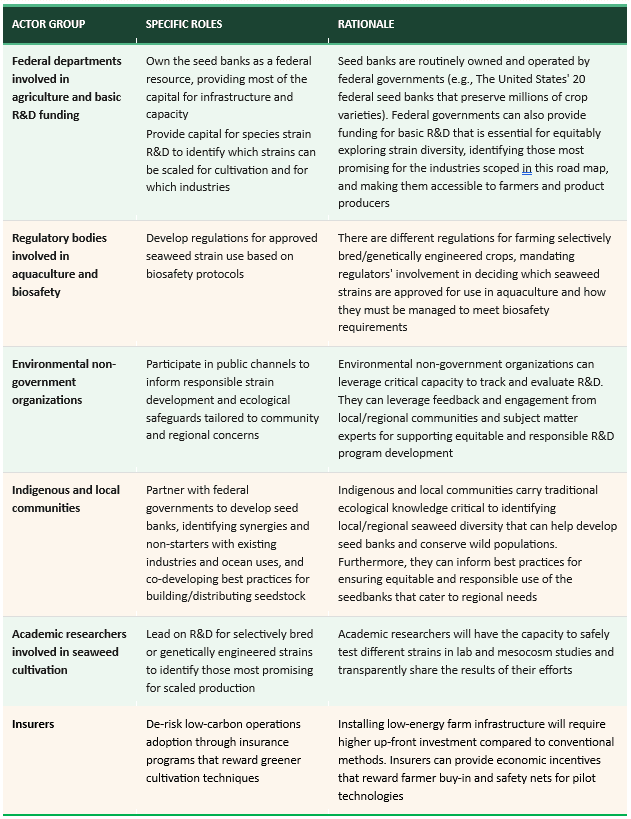
| Actor Group | Specific Roles | Rationale |
| Federal departments involved in agriculture and basic R&D funding | Own the seed banks as a federal resource, providing most of the capital for infrastructure and capacity
Provide capital for species strain R&D to identify which strains can be scaled for cultivation and for which industries |
Seed banks are routinely owned and operated by federal governments (e.g., The United States’ 20 federal seed banks that preserve millions of crop varieties). Federal governments can also provide funding for basic R&D that is essential for equitably exploring strain diversity, identifying those most promising for the industries scoped in this road map, and making them accessible to farmers and product producers |
| Regulatory bodies involved in aquaculture and biosafety | Develop regulations for approved seaweed strain use based on biosafety protocols | There are different regulations for farming selectively bred/genetically engineered crops, mandating regulators’ involvement in deciding which seaweed strains are approved for use in aquaculture and how they must be managed to meet biosafety requirements |
| Environmental non-government organizations | Participate in public channels to inform responsible strain development and ecological safeguards tailored to community and regional concerns | Environmental non-government organizations can leverage critical capacity to track and evaluate R&D. They can leverage feedback and engagement from local/regional communities and subject matter experts for supporting equitable and responsible R&D program development |
| Indigenous and local communities | Partner with federal governments to develop seed banks, identifying synergies and non-starters with existing industries and ocean uses, and co-developing best practices for building/distributing seedstock | Indigenous and local communities carry traditional ecological knowledge critical to identifying local/regional seaweed diversity that can help develop seed banks and conserve wild populations. Furthermore, they can inform best practices for ensuring equitable and responsible use of the seedbanks that cater to regional needs |
| Academic researchers involved in seaweed cultivation | Lead on R&D for selectively bred or genetically engineered strains to identify those most promising for scaled production | Academic researchers will have the capacity to safely test different strains in lab and mesocosm studies and transparently share the results of their efforts |
| Insurers | De-risk low-carbon operations adoption through insurance programs that reward greener cultivation techniques | Installing low-energy farm infrastructure will require higher up-front investment compared to conventional methods. Insurers can provide economic incentives that reward farmer buy-in and safety nets for pilot technologies |
Goal:
Energy and throughput needs of seaweed farms are reduced by up to 30–40% by 2035 (range conservatively estimated given goals outlined in ARPA-E, 2025)
Key Actions
- Produce low-carbon drying methods that can efficiently reduce water content by up to 90% and integrate into onsite farm operations
- Co-locate renewable energy sources with seaweed farms
- Co-locate offshore seaweed farms with marine renewable energy plants to access existing infrastructure and energy sources
Key Actors and Roles
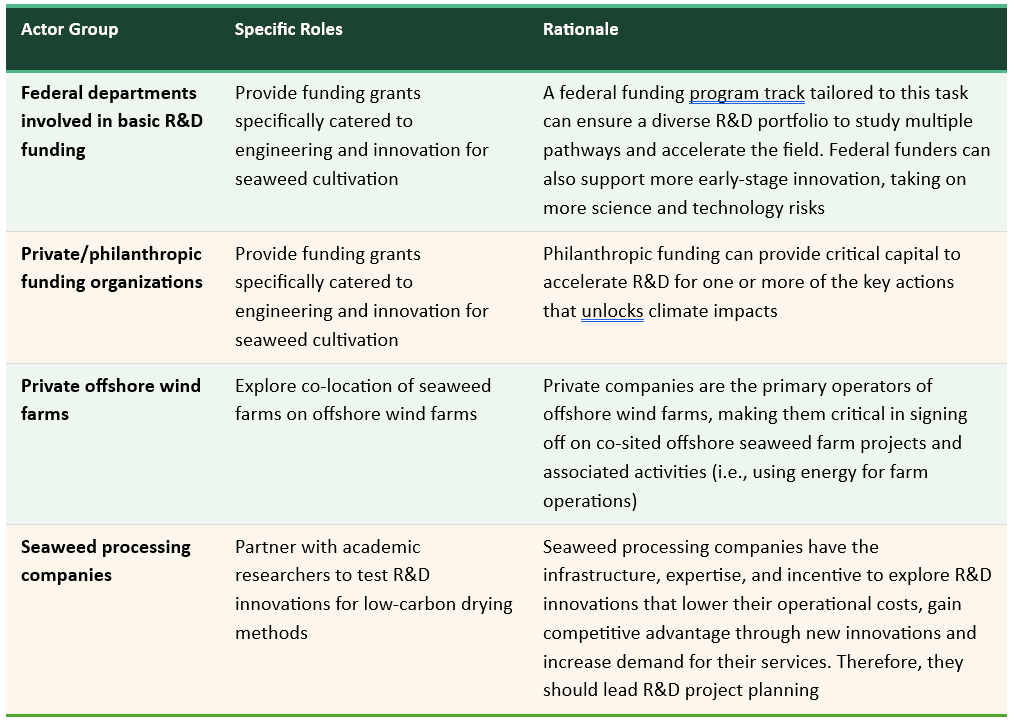
| Actor Group | Specific Roles | Rationale |
| Federal departments involved in basic R&D funding | Provide funding grants specifically catered to engineering and innovation for seaweed cultivation | A federal funding program track tailored to this task can ensure a diverse R&D portfolio to study multiple pathways and accelerate the field. Federal funders can also support more early-stage innovation, taking on more science and technology risks |
| Private/philanthropic funding organizations | Provide funding grants specifically catered to engineering and innovation for seaweed cultivation | Philanthropic funding can provide critical capital to accelerate R&D for one or more of the key actions that unlocks climate impacts |
| Private offshore wind farms | Explore co-location of seaweed farms on offshore wind farms | Private companies are the primary operators of offshore wind farms, making them critical in signing off on co-sited offshore seaweed farm projects and associated activities (i.e., using energy for farm operations) |
| Seaweed processing companies | Partner with academic researchers to test R&D innovations for low-carbon drying methods | Seaweed processing companies have the infrastructure, expertise, and incentive to explore R&D innovations that lower their operational costs, gain competitive advantage through new innovations and increase demand for their services. Therefore, they should lead R&D project planning |
Goal:
Biomass production increases by 12% per year until 2050 (based on estimates from DeAngelo et al., 2023)Key Actions
- Support genetic programs for the top 10 species cultivated. Strains developed should be fast-growing, are heat-tolerant and disease-resistant, and limit negative impacts of crop-to-wild interactions
- In emerging markets, expand genetic programs to regional species of interest
- Develop seed banks that can provide affordable seedstock to multiple farms without associated high labor costs of farm-specific nursery/hatchery operations (e.g., Woods Hole Oceanographic Institution MARINER Saccharina latissima breeding project)
- Develop automated infrastructure that increases labor capacity (e.g., rate of seeding cultivation lines, evaluating seaweed health) by 40% to decrease production costs while maintaining or improving yield
- Develop low-cost automated sensors to monitor seaweed and water quality and biofouling
Key Actors and Roles
| Actor Group | Specific Roles | Rationale |
| Federal departments involved in agriculture and basic R&D funding | Own the seed banks as a federal resource, providing most of the capital for infrastructure and capacity Provide capital for species strain R&D to identify which strains can be scaled for cultivation and for which industries | Seed banks are routinely owned and operated by federal governments (e.g., The United States' 20 federal seed banks that preserve millions of crop varieties). Federal governments can also provide funding for basic R&D that is essential for equitably exploring strain diversity, identifying those most promising for the industries scoped in this road map, and making them accessible to farmers and product producers |
| Regulatory bodies involved in aquaculture and biosafety | Develop regulations for approved seaweed strain use based on biosafety protocols | There are different regulations for farming selectively bred/genetically engineered crops, mandating regulators' involvement in deciding which seaweed strains are approved for use in aquaculture and how they must be managed to meet biosafety requirements |
| Environmental non-government organizations | Participate in public channels to inform responsible strain development and ecological safeguards tailored to community and regional concerns | Environmental non-government organizations can leverage critical capacity to track and evaluate R&D. They can leverage feedback and engagement from local/regional communities and subject matter experts for supporting equitable and responsible R&D program development |
| Indigenous and local communities | Partner with federal governments to develop seed banks, identifying synergies and non-starters with existing industries and ocean uses, and co-developing best practices for building/distributing seedstock | Indigenous and local communities carry traditional ecological knowledge critical to identifying local/regional seaweed diversity that can help develop seed banks and conserve wild populations. Furthermore, they can inform best practices for ensuring equitable and responsible use of the seedbanks that cater to regional needs |
| Academic researchers involved in seaweed cultivation | Lead on R&D for selectively bred or genetically engineered strains to identify those most promising for scaled production | Academic researchers will have the capacity to safely test different strains in lab and mesocosm studies and transparently share the results of their efforts |
| Insurers | De-risk low-carbon operations adoption through insurance programs that reward greener cultivation techniques | Installing low-energy farm infrastructure will require higher up-front investment compared to conventional methods. Insurers can provide economic incentives that reward farmer buy-in and safety nets for pilot technologies |
Goal:
Energy and throughput needs of seaweed farms are reduced by up to 30–40% by 2035 (range conservatively estimated given goals outlined in ARPA-E, 2025)Key Actions
- Produce low-carbon drying methods that can efficiently reduce water content by up to 90% and integrate into onsite farm operations
- Co-locate renewable energy sources with seaweed farms
- Co-locate offshore seaweed farms with marine renewable energy plants to access existing infrastructure and energy sources
Key Actors and Roles
| Actor Group | Specific Roles | Rationale |
| Federal departments involved in basic R&D funding | Provide funding grants specifically catered to engineering and innovation for seaweed cultivation | A federal funding program track tailored to this task can ensure a diverse R&D portfolio to study multiple pathways and accelerate the field. Federal funders can also support more early-stage innovation, taking on more science and technology risks |
| Private/philanthropic funding organizations | Provide funding grants specifically catered to engineering and innovation for seaweed cultivation | Philanthropic funding can provide critical capital to accelerate R&D for one or more of the key actions that unlocks climate impacts |
| Private offshore wind farms | Explore co-location of seaweed farms on offshore wind farms | Private companies are the primary operators of offshore wind farms, making them critical in signing off on co-sited offshore seaweed farm projects and associated activities (i.e., using energy for farm operations) |
| Seaweed processing companies | Partner with academic researchers to test R&D innovations for low-carbon drying methods | Seaweed processing companies have the infrastructure, expertise, and incentive to explore R&D innovations that lower their operational costs, gain competitive advantage through new innovations and increase demand for their services. Therefore, they should lead R&D project planning |
Goal:
Biomass production increases by 12% per year until 2050 (based on estimates from DeAngelo et al., 2023)Key Actions
- Support genetic programs for the top 10 species cultivated. Strains developed should be fast-growing, are heat-tolerant and disease-resistant, and limit negative impacts of crop-to-wild interactions
- Develop seed banks that can provide affordable seedstock to multiple farms without associated high labor costs of farm-specific nursery/hatchery operations (e.g., Woods Hole Oceanographic Institution MARINER Saccharina latissima breeding project)
- Develop automated infrastructure that increases labor capacity (e.g., rate of seeding cultivation lines, evaluating seaweed health) by 40% to decrease production costs while maintaining or improving yield
- Develop low-cost automated sensors to monitor seaweed and water quality and biofouling
Key Actors and Roles
| Actor Group | Specific Roles | Rationale |
| Federal departments involved in agriculture and basic R&D funding | Own the seed banks as a federal resource, providing most of the capital for infrastructure and capacity Provide capital for species strain R&D to identify which strains can be scaled for cultivation and for which industries | Seed banks are routinely owned and operated by federal governments (e.g., The United States' 20 federal seed banks that preserve millions of crop varieties). Federal governments can also provide funding for basic R&D that is essential for equitably exploring strain diversity, identifying those most promising for the industries scoped in this road map, and making them accessible to farmers and product producers |
| Regulatory bodies involved in aquaculture and biosafety | Develop regulations for approved seaweed strain use based on biosafety protocols | There are different regulations for farming selectively bred/genetically engineered crops, mandating regulators' involvement in deciding which seaweed strains are approved for use in aquaculture and how they must be managed to meet biosafety requirements |
| Environmental non-government organizations | Participate in public channels to inform responsible strain development and ecological safeguards tailored to community and regional concerns | Environmental non-government organizations can leverage critical capacity to track and evaluate R&D. They can leverage feedback and engagement from local/regional communities and subject matter experts for supporting equitable and responsible R&D program development |
| Indigenous and local communities | Partner with federal governments to develop seed banks, identifying synergies and non-starters with existing industries and ocean uses, and co-developing best practices for building/distributing seedstock | Indigenous and local communities carry traditional ecological knowledge critical to identifying local/regional seaweed diversity that can help develop seed banks and conserve wild populations. Furthermore, they can inform best practices for ensuring equitable and responsible use of the seedbanks that cater to regional needs |
| Academic researchers involved in seaweed cultivation | Lead on R&D for selectively bred or genetically engineered strains to identify those most promising for scaled production | Academic researchers will have the capacity to safely test different strains in lab and mesocosm studies and transparently share the results of their efforts |
| Insurers | De-risk low-carbon operations adoption through insurance programs that reward greener cultivation techniques | Installing low-energy farm infrastructure will require higher up-front investment compared to conventional methods. Insurers can provide economic incentives that reward farmer buy-in and safety nets for pilot technologies |
Goal:
Energy and throughput needs of seaweed farms are reduced by up to 30–40% by 2035 (range conservatively estimated given goals outlined in ARPA-E, 2025)Key Actions
- Produce low-carbon drying methods that can efficiently reduce water content by up to 90% and integrate into onsite farm operations
- Co-locate renewable energy sources with seaweed farms
- Co-locate offshore seaweed farms with marine renewable energy plants to access existing infrastructure and energy sources
Key Actors and Roles
| Actor Group | Specific Roles | Rationale |
| Federal departments involved in basic R&D funding | Provide funding grants specifically catered to engineering and innovation for seaweed cultivation | A federal funding program track tailored to this task can ensure a diverse R&D portfolio to study multiple pathways and accelerate the field. Federal funders can also support more early-stage innovation, taking on more science and technology risks |
| Private/philanthropic funding organizations | Provide funding grants specifically catered to engineering and innovation for seaweed cultivation | Philanthropic funding can provide critical capital to accelerate R&D for one or more of the key actions that unlocks climate impacts |
| Private offshore wind farms | Explore co-location of seaweed farms on offshore wind farms | Private companies are the primary operators of offshore wind farms, making them critical in signing off on co-sited offshore seaweed farm projects and associated activities (i.e., using energy for farm operations) |
| Seaweed processing companies | Partner with academic researchers to test R&D innovations for low-carbon drying methods | Seaweed processing companies have the infrastructure, expertise, and incentive to explore R&D innovations that lower their operational costs, gain competitive advantage through new innovations and increase demand for their services. Therefore, they should lead R&D project planning |
Goal:
Biomass production increases by 12% per year until 2050 (based on estimated from DeAngelo et al., 2023)Key Actions
- Support genetic programs for the top 10 species cultivated. Strains developed should be fast-growing, are heat-tolerant and disease-resistant, and limit negative impacts of crop-to-wild interactions
- Develop seed banks that can provide affordable seedstock to multiple farms without associated high labor costs of farm-specific nursery/hatchery operations (e.g., Woods Hole Oceanographic Institution MARINER Saccharina latissima breeding project)
- Develop automated infrastructure that increases labor capacity (e.g., rate of seeding cultivation lines, evaluating seaweed health) by 40% to decrease production costs while maintaining or improving yield
- Develop low-cost automated sensors to monitor seaweed and water quality and biofouling
Key Actors and Roles
| Actor Group | Specific Roles | Rationale |
| Federal departments involved in agriculture and basic R&D funding | Own the seed banks as a federal resource, providing most of the capital for infrastructure and capacity Provide capital for species strain R&D to identify which strains can be scaled for cultivation and for which industries | Seed banks are routinely owned and operated by federal governments (e.g., The United States' 20 federal seed banks that preserve millions of crop varieties). Federal governments can also provide funding for basic R&D that is essential for equitably exploring strain diversity, identifying those most promising for the industries scoped in this road map, and making them accessible to farmers and product producers |
| Regulatory bodies involved in aquaculture and biosafety | Develop regulations for approved seaweed strain use based on biosafety protocols | There are different regulations for farming selectively bred/genetically engineered crops, mandating regulators' involvement in deciding which seaweed strains are approved for use in aquaculture and how they must be managed to meet biosafety requirements |
| Environmental non-government organizations | Participate in public channels to inform responsible strain development and ecological safeguards tailored to community and regional concerns | Environmental non-government organizations can leverage critical capacity to track and evaluate R&D. They can leverage feedback and engagement from local/regional communities and subject matter experts for supporting equitable and responsible R&D program development |
| Indigenous and local communities | Partner with federal governments to develop seed banks, identifying synergies and non-starters with existing industries and ocean uses, and co-developing best practices for building/distributing seedstock | Indigenous and local communities carry traditional ecological knowledge critical to identifying local/regional seaweed diversity that can help develop seed banks and conserve wild populations. Furthermore, they can inform best practices for ensuring equitable and responsible use of the seedbanks that cater to regional needs |
| Academic researchers involved in seaweed cultivation | Lead on R&D for selectively bred or genetically engineered strains to identify those most promising for scaled production | Academic researchers will have the capacity to safely test different strains in lab and mesocosm studies and transparently share the results of their efforts |
| Insurers | De-risk low-carbon operations adoption through insurance programs that reward greener cultivation techniques | Installing low-energy farm infrastructure will require higher up-front investment compared to conventional methods. Insurers can provide economic incentives that reward farmer buy-in and safety nets for pilot technologies |
Goal:
Energy and throughput needs of seaweed farms are reduced by up to 30–40% by 2035 (range conservatively estimated given goals outlined in ARPA-E, 2025)Key Actions
- Produce low-carbon drying methods that can efficiently reduce water content by up to 90% and integrate into onsite farm operations
- Co-locate renewable energy sources with seaweed farms
- Co-locate offshore seaweed farms with marine renewable energy plants to access existing infrastructure and energy sources
Key Actors and Roles
| Actor Group | Specific Roles | Rationale |
| Federal departments involved in basic R&D funding | Provide funding grants specifically catered to engineering and innovation for seaweed cultivation | A federal funding program track tailored to this task can ensure a diverse R&D portfolio to study multiple pathways and accelerate the field. Federal funders can also support more early-stage innovation, taking on more science and technology risks |
| Private/philanthropic funding organizations | Provide funding grants specifically catered to engineering and innovation for seaweed cultivation | Philanthropic funding can provide critical capital to accelerate R&D for one or more of the key actions that unlocks climate impacts |
| Private offshore wind farms | Explore co-location of seaweed farms on offshore wind farms | Private companies are the primary operators of offshore wind farms, making them critical in signing off on co-sited offshore seaweed farm projects and associated activities (i.e., using energy for farm operations) |
| Seaweed processing companies | Partner with academic researchers to test R&D innovations for low-carbon drying methods | Seaweed processing companies have the infrastructure, expertise, and incentive to explore R&D innovations that lower their operational costs, gain competitive advantage through new innovations and increase demand for their services. Therefore, they should lead R&D project planning |
Goal:
Biomass production increases by 12% per year until 2050 (based on estimated from DeAngelo et al., 2023)Key Actions
- Support genetic programs for the top 10 species cultivated. Strains developed should be fast-growing, are heat-tolerant and disease-resistant, and limit negative impacts of crop-to-wild interactions
- Develop seed banks that can provide affordable seedstock to multiple farms without associated high labor costs of farm-specific nursery/hatchery operations (e.g., Woods Hole Oceanographic Institution MARINER Saccharina latissima breeding project)
- Develop automated infrastructure that increases labor capacity (e.g., rate of seeding cultivation lines, evaluating seaweed health) by 40% to decrease production costs while maintaining or improving yield
- Develop low-cost automated sensors to monitor seaweed and water quality and biofouling
Key Actors and Roles
| Actor Group | Specific Roles | Rationale |
| Federal departments involved in agriculture and basic R&D funding | Own the seed banks as a federal resource, providing most of the capital for infrastructure and capacity Provide capital for species strain R&D to identify which strains can be scaled for cultivation and for which industries | Seed banks are routinely owned and operated by federal governments (e.g., The United States' 20 federal seed banks that preserve millions of crop varieties). Federal governments can also provide funding for basic R&D that is essential for equitably exploring strain diversity, identifying those most promising for the industries scoped in this road map, and making them accessible to farmers and product producers |
| Regulatory bodies involved in aquaculture and biosafety | Develop regulations for approved seaweed strain use based on biosafety protocols | There are different regulations for farming selectively bred/genetically engineered crops, mandating regulators' involvement in deciding which seaweed strains are approved for use in aquaculture and how they must be managed to meet biosafety requirements |
| Environmental non-government organizations | Participate in public channels to inform responsible strain development and ecological safeguards tailored to community and regional concerns | Environmental non-government organizations can leverage critical capacity to track and evaluate R&D. They can leverage feedback and engagement from local/regional communities and subject matter experts for supporting equitable and responsible R&D program development |
| Indigenous and local communities | Partner with federal governments to develop seed banks, identifying synergies and non-starters with existing industries and ocean uses, and co-developing best practices for building/distributing seedstock | Indigenous and local communities carry traditional ecological knowledge critical to identifying local/regional seaweed diversity that can help develop seed banks and conserve wild populations. Furthermore, they can inform best practices for ensuring equitable and responsible use of the seedbanks that cater to regional needs |
| Academic researchers involved in seaweed cultivation | Lead on R&D for selectively bred or genetically engineered strains to identify those most promising for scaled production | Academic researchers will have the capacity to safely test different strains in lab and mesocosm studies and transparently share the results of their efforts |
| Insurers | De-risk low-carbon operations adoption through insurance programs that reward greener cultivation techniques | Installing low-energy farm infrastructure will require higher up-front investment compared to conventional methods. Insurers can provide economic incentives that reward farmer buy-in and safety nets for pilot technologies |
Goal:
Energy needs of seaweed farms are reduced by up to 30–40% by 2035 (range conservatively estimated given goals outlined in ARPA-E, 2025)Key Actions
- Produce low-carbon drying methods that can reduce water content by up to 90% and integrate into onsite farm operations
- Co-locate renewable energy sources with seaweed farms
- Co-locate offshore seaweed farms with marine renewable energy plants to access existing infrastructure and energy sources
Key Actors and Roles
| Actor Group | Specific Roles | Rationale |
| Federal departments involved in basic R&D funding | Provide funding grants specifically catered to engineering and innovation for seaweed cultivation | A federal funding program track tailored to this task can ensure a diverse R&D portfolio to study multiple pathways and accelerate the field. Federal funders can also support more early-stage innovation, taking on more science and technology risks |
| Private/philanthropic funding organizations | Provide funding grants specifically catered to engineering and innovation for seaweed cultivation | Philanthropic funding can provide critical capital to accelerate R&D for one or more of the key actions that unlocks climate impacts |
| Private offshore wind farms | Explore co-location of seaweed farms on offshore wind farms | Private companies are the primary operators of offshore wind farms, making them critical in signing off on co-sited offshore seaweed farm projects and associated activities (i.e., using energy for farm operations) |
| Seaweed processing companies | Partner with academic researchers to test R&D innovations for low-carbon drying methods | Seaweed processing companies have the infrastructure, expertise, and incentive to explore R&D innovations that lower their operational costs, gain competitive advantage through new innovations and increase demand for their services. Therefore, they should lead R&D project planning |
- Support genetic programs for the top 10 species cultivated. Strains developed should be fast-growing, are heat-tolerant and disease-resistant, and limit negative impacts of crop-to-wild interactions
- Develop seed banks that can provide affordable seedstock to multiple farms without associated high labor costs of farm-specific nursery/hatchery operations (e.g., Woods Hole Oceanographic Institution MARINER Saccharina latissima breeding project)
- Develop automated infrastructure that increases labor capacity (e.g., rate of seeding cultivation lines, evaluating seaweed health) by 40% to decrease production costs while maintaining or improving yield
- Develop low-cost automated sensors to monitor seaweed and water quality and biofouling
| Actor Group | Specific Roles | Rationale |
| Federal departments involved in agriculture and basic R&D funding | Own the seed banks as a federal resource, providing most of the capital for infrastructure and capacity Provide capital for species strain R&D to identify which strains can be scaled for cultivation and for which industries | Seed banks are routinely owned and operated by federal governments (e.g., The United States' 20 federal seed banks that preserve millions of crop varieties). Federal governments can also provide funding for basic R&D that is essential for equitably exploring strain diversity, identifying those most promising for the industries scoped in this road map, and making them accessible to farmers and product producers |
| Regulatory bodies involved in aquaculture and biosafety | Develop regulations for approved seaweed strain use based on biosafety protocols | There are different regulations for farming selectively bred/genetically engineered crops, mandating regulators' involvement in deciding which seaweed strains are approved for use in aquaculture and how they must be managed to meet biosafety requirements |
| Environmental non-government organizations | Participate in public channels to inform responsible strain development and ecological safeguards tailored to community and regional concerns | Environmental non-government organizations can leverage critical capacity to track and evaluate R&D. They can leverage feedback and engagement from local/regional communities and subject matter experts for supporting equitable and responsible R&D program development |
| Indigenous and local communities | Partner with federal governments to develop seed banks, identifying synergies and non-starters with existing industries and ocean uses, and co-developing best practices for building/distributing seedstock | Indigenous and local communities carry traditional ecological knowledge critical to identifying local/regional seaweed diversity that can help develop seed banks and conserve wild populations. Furthermore, they can inform best practices for ensuring equitable and responsible use of the seedbanks that cater to regional needs |
| Academic researchers involved in seaweed cultivation | Lead on R&D for selectively bred or genetically engineered strains to identify those most promising for scaled production | Academic researchers will have the capacity to safely test different strains in lab and mesocosm studies and transparently share the results of their efforts |
| Insurers | De-risk low-carbon operations adoption through insurance programs that reward greener cultivation techniques | Installing low-energy farm infrastructure will require higher up-front investment compared to conventional methods. Insurers can provide economic incentives that reward farmer buy-in and safety nets for pilot technologies |
- Produce low-carbon drying methods that can reduce water content by up to 90% and integrate into onsite farm operations
- Co-locate renewable energy sources with seaweed farms
- Co-locate offshore seaweed farms with marine renewable energy plants to access existing infrastructure and energy sources
| Actor Group | Specific Roles | Rationale |
| Federal departments involved in basic R&D funding | Provide funding grants specifically catered to engineering and innovation for seaweed cultivation | A federal funding program track tailored to this task can ensure a diverse R&D portfolio to study multiple pathways and accelerate the field. Federal funders can also support more early-stage innovation, taking on more science and technology risks |
| Private/philanthropic funding organizations | Provide funding grants specifically catered to engineering and innovation for seaweed cultivation | Philanthropic funding can provide critical capital to accelerate R&D for one or more of the key actions that unlocks climate impacts |
| Private offshore wind farms | Explore co-location of seaweed farms on offshore wind farms | Private companies are the primary operators of offshore wind farms, making them critical in signing off on co-sited offshore seaweed farm projects and associated activities (i.e., using energy for farm operations) |
| Seaweed processing companies | Partner with academic researchers to test R&D innovations for low-carbon drying methods | Seaweed processing companies have the infrastructure, expertise, and incentive to explore R&D innovations that lower their operational costs, gain competitive advantage through new innovations and increase demand for their services. Therefore, they should lead R&D project planning |
- Support genetic programs for the top 10 species cultivated. Strains developed should be fast-growing, are heat-tolerant and disease-resistant, and limit negative impacts of crop-to-wild interactions
- Develop seed banks that can provide affordable seedstock to multiple farms without associated high labor costs of farm-specific nursery/hatchery operations (e.g., Woods Hole Oceanographic Institution MARINER Saccharina latissima breeding project)
- Develop automated infrastructure that increases labor capacity (e.g., rate of seeding cultivation lines, evaluating seaweed health) by 40% to decrease production costs while maintaining or improving yield
- Develop low-cost automated sensors to monitor seaweed and water quality and biofouling
 Goal:
Energy needs of seaweed farms are reduced by up to 30–40% by 2035 (range conservatively estimated given goals outlined in ARPA-E, 2025)
Key Actions
Goal:
Energy needs of seaweed farms are reduced by up to 30–40% by 2035 (range conservatively estimated given goals outlined in ARPA-E, 2025)
Key Actions
- Produce low-carbon drying methods that can reduce water content by up to 90% and integrate into onsite farm operations
- Co-locate renewable energy sources with seaweed farms
- Co-locate offshore seaweed farms with marine renewable energy plants to access existing infrastructure and energy sources
- Support genetic programs for the top 10 species cultivated. Strains developed should be fast-growing, are heat-tolerant and disease-resistant, and limit negative impacts of crop-to-wild interactions
- Develop seed banks that can provide affordable seedstock to multiple farms without associated high labor costs of farm-specific nursery/hatchery operations (e.g., Woods Hole Oceanographic Institution MARINER Saccharina latissima breeding project)
- Develop automated infrastructure that increases labor capacity (e.g., rate of seeding cultivation lines, evaluating seaweed health) by 40% to decrease production costs while maintaining or improving yield
- Develop low-cost automated sensors to monitor seaweed and water quality and biofouling
Prioritize seaweed cultivation as a global industry
Goal:
Nations/regions have aquaculture policies to streamline seaweed farm permitting and to incentivize seaweed production for low-carbon products.
Key Actions
- Implement seaweed-specific legislation and regulations to encourage market growth and streamline permitting and licensing requirements
- Set a carbon price to incentivize seaweed production, especially through low-carbon cultivation practices for emerging seaweed-based product markets
- Create spatial planning to identify areas suitable for farming, identifying biophysical limits and synergies with existing industries (e.g., finfish/shellfish aquaculture) while limiting spatial conflicts with other ocean uses
- Encourage corporate buyers to pay extra for low-carbon seaweed via certification programs to meet net-zero or ESG targets
Key Actors and Roles
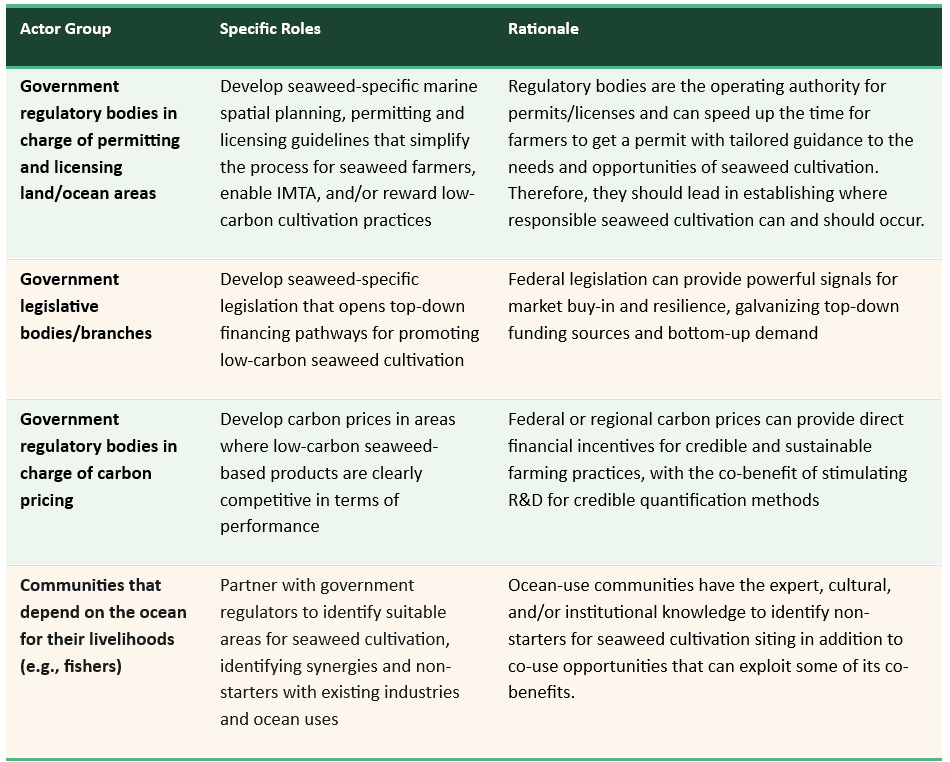
| Actor | Specific Roles | Rationale |
| Government regulatory bodies in charge of permitting and licensing land/ocean areas | Develop seaweed-specific marine spatial planning, permitting and licensing guidelines that simplify the process for seaweed farmers, enable IMTA, and/or reward low-carbon cultivation practices | Regulatory bodies are the operating authority for permits/licenses and can speed up the time for farmers to get a permit with tailored guidance to the needs and opportunities of seaweed cultivation. Therefore, they should lead in establishing where responsible seaweed cultivation can and should occur. |
| Government legislative bodies/branches | Develop seaweed-specific legislation that opens top-down financing pathways for promoting low-carbon seaweed cultivation | Federal legislation can provide powerful signals for market buy-in and resilience, galvanizing top-down funding sources and bottom-up demand |
| Government regulatory bodies in charge of carbon pricing | Develop carbon prices in areas where low-carbon seaweed-based products are clearly competitive in terms of performance | Federal or regional carbon prices can provide direct financial incentives for credible and sustainable farming practices, with the co-benefit of stimulating R&D for credible quantification methods |
| Communities that depend on the ocean for their livelihoods (e.g., fishers) | Partner with government regulators to identify suitable areas for seaweed cultivation, identifying synergies and non-starters with existing industries and ocean uses | Ocean-use communities have the expert, cultural, and/or institutional knowledge to identify non-starters for seaweed cultivation siting in addition to co-use opportunities that can exploit some of its co-benefits. |
Goal:
Nations/regions have aquaculture policies to streamline seaweed farm permitting and to incentivize seaweed production for low-carbon products.Key Actions
- Implement seaweed-specific legislation and regulations to encourage market growth and streamline permitting and licensing requirements
- Set a carbon price to incentivize seaweed production, especially through low-carbon cultivation practices for emerging seaweed-based product markets
- Create spatial planning to identify areas suitable for farming, identifying biophysical limits and synergies with existing industries (e.g., finfish/shellfish aquaculture) while limiting spatial conflicts with other ocean uses
- Encourage corporate buyers to pay extra for low-carbon seaweed via certification programs to meet net-zero or ESG targets
Key Actors and Roles
| Actor | Specific Roles | Rationale |
| Government regulatory bodies in charge of permitting and licensing land/ocean areas | Develop seaweed-specific marine spatial planning, permitting and licensing guidelines that simplify the process for seaweed farmers, enable IMTA, and/or reward low-carbon cultivation practices | Regulatory bodies are the operating authority for permits/licenses and can speed up the time for farmers to get a permit with tailored guidance to the needs and opportunities of seaweed cultivation. Therefore, they should lead in establishing where responsible seaweed cultivation can and should occur. |
| Government legislative bodies/branches | Develop seaweed-specific legislation that opens top-down financing pathways for promoting low-carbon seaweed cultivation | Federal legislation can provide powerful signals for market buy-in and resilience, galvanizing top-down funding sources and bottom-up demand |
| Government regulatory bodies in charge of carbon pricing | Develop carbon prices in areas where low-carbon seaweed-based products are clearly competitive in terms of performance | Federal or regional carbon prices can provide direct financial incentives for credible and sustainable farming practices, with the co-benefit of stimulating R&D for credible quantification methods |
| Communities that depend on the ocean for their livelihoods (e.g., fishers) | Partner with government regulators to identify suitable areas for seaweed cultivation, identifying synergies and non-starters with existing industries and ocean uses | Ocean-use communities have the expert, cultural, and/or institutional knowledge to identify non-starters for seaweed cultivation siting in addition to co-use opportunities that can exploit some of its co-benefits. |
Goal:
Nations/regions have aquaculture policies to streamline seaweed farm permitting and to incentivize seaweed production for low-carbon productsKey Actions
- Implement seaweed-specific legislation and regulations to encourage market growth and streamline permitting and licensing requirements
- Set a carbon price to incentivize seaweed production, especially through low-carbon cultivation practices
- Create spatial planning to identify areas suitable for farming, identifying biophysical limits and synergies with existing industries (e.g., finfish/shellfish aquaculture) while limiting spatial conflicts with other ocean uses
- Encourage corporate buyers to pay extra for low-carbon seaweed via certification programs to meet net-zero or ESG targets
Key Actors and Roles
| Actor | Specific Roles | Rationale |
| Government regulatory bodies in charge of permitting and licensing land/ocean areas | Develop seaweed-specific marine spatial planning, permitting and licensing guidelines that simplify the process for seaweed farmers, enable IMTA, and/or reward low-carbon cultivation practices | Regulatory bodies are the operating authority for permits/licenses and can speed up the time for farmers to get a permit with tailored guidance to the needs and opportunities of seaweed cultivation. Therefore, they should lead in establishing where responsible seaweed cultivation can and should occur. |
| Government legislative bodies/branches | Develop seaweed-specific legislation that opens top-down financing pathways for promoting low-carbon seaweed cultivation | Federal legislation can provide powerful signals for market buy-in and resilience, galvanizing top-down funding sources and bottom-up demand |
| Government regulatory bodies in charge of carbon pricing | Develop carbon prices in areas where low-carbon seaweed-based products are clearly competitive in terms of performance | Federal or regional carbon prices can provide direct financial incentives for credible and sustainable farming practices, with the co-benefit of stimulating R&D for credible quantification methods |
| Communities that depend on the ocean for their livelihoods (e.g., fishers) | Partner with government regulators to identify suitable areas for seaweed cultivation, identifying synergies and non-starters with existing industries and ocean uses | Ocean-use communities have the expert, cultural, and/or institutional knowledge to identify non-starters for seaweed cultivation siting in addition to co-use opportunities that can exploit some of its co-benefits. |
- Implement seaweed-specific legislation and regulations to encourage market growth and streamline permitting and licensing requirements
- Set a carbon price to incentivize seaweed production, especially through low-carbon cultivation practices
- Create spatial planning to identify areas suitable for farming, identifying biophysical limits and synergies with existing industries (e.g., finfish/shellfish aquaculture) while limiting spatial conflicts with other ocean uses
- Encourage corporate buyers to pay extra for low-carbon seaweed via certification programs to meet net-zero or ESG targets
| Actor Group | Specific Roles | Rationale |
| Government regulatory bodies in charge of permitting and licensing land/ocean areas | Develop seaweed-specific marine spatial planning, permitting and licensing guidelines that simplify the process for seaweed farmers, enable IMTA, and/or reward low-carbon cultivation practices | Regulatory bodies are the operating authority for permits/licenses and can speed up the time for farmers to get a permit with tailored guidance to the needs and opportunities of seaweed cultivation. Therefore, they should lead in establishing where responsible seaweed cultivation can and should occur. |
| Government legislative bodies/branches | Develop seaweed-specific legislation that opens top-down financing pathways for promoting low-carbon seaweed cultivation | Federal legislation can provide powerful signals for market buy-in and resilience, galvanizing top-down funding sources and bottom-up demand |
| Government regulatory bodies in charge of carbon pricing | Develop carbon prices in areas where low-carbon seaweed-based products are clearly competitive in terms of performance | Federal or regional carbon prices can provide direct financial incentives for credible and sustainable farming practices, with the co-benefit of stimulating R&D for credible quantification methods |
| Communities that depend on the ocean for their livelihoods (e.g., fishers) | Partner with government regulators to identify suitable areas for seaweed cultivation, identifying synergies and non-starters with existing industries and ocean uses | Ocean-use communities have the expert, cultural, and/or institutional knowledge to identify non-starters for seaweed cultivation siting in addition to co-use opportunities that can exploit some of its co-benefits. |
- Implement seaweed-specific legislation and regulations to encourage market growth and streamline permitting and licensing requirements
- Set a carbon price to incentivize seaweed production, especially through low-carbon cultivation practices
- Create spatial planning to identify areas suitable for farming, identifying biophysical limits and synergies with existing industries (e.g., finfish/shellfish aquaculture) while limiting spatial conflicts with other ocean uses
- Encourage corporate buyers to pay extra for low-carbon seaweed via certification programs to meet net-zero or ESG targets

- Implement seaweed-specific legislation and regulations to encourage market growth and streamline permitting and licensing requirements
- Set a carbon price to incentivize seaweed production, especially through low-carbon cultivation practices
- Create spatial planning to identify areas suitable for farming, identifying biophysical limits and synergies with existing industries (e.g., finfish/shellfish aquaculture) while limiting spatial conflicts with other ocean uses
- Encourage corporate buyers to pay extra for low-carbon seaweed via certification programs to meet net-zero or ESG targets
- Implement seaweed-specific legislation and regulations to encourage market growth and streamline permitting and licensing requirements
- Set a carbon price to incentivize seaweed production, especially through low-carbon cultivation practices
- Create spatial planning to identify areas suitable for farming, identifying biophysical limits and synergies with existing industries (e.g., finfish/shellfish aquaculture) while limiting spatial conflicts with other ocean uses
- Encourage corporate buyers to pay extra for low-carbon seaweed via certification programs to meet net-zero or ESG targets
Demonstrate value of seaweed cultivation
Goal:
Stakeholders in potential production regions have access to economic and environmental data to support decision making
Key Actions
- Expand LCA studies beyond the Global North to paint a more realistic picture of seaweed farms’ financial and environmental cost, and identify opportunities for value addition within the context of emerging and mature markets
- Produce cost-benefit analyses of seaweed farms to quantify the benefits and risks that seaweed cultivation has at scale, particularly for offshore seaweed farms that can accelerate seaweed production
- Establish standardized carbon accounting and verification best practices to quantify seaweed farms’ carbon sequestration potential for more informed LCA and cost-benefit analyses across the full carbon cycle
Key Actors and Roles
| Actor | Specific Roles | Rationale |
| Academic research institutions | Conduct independent lifecycle analyses and cost-benefit analyses to quantify the economic and environmental footprint of seaweed farms, with estimates for what this means at scale. The research should be down in collaboration with seaweed farm practitioners, managers, and workers
Develop standardized methodologies for measuring and reporting carbon transport throughout the cultivation process |
Academic researchers can act as a third-party in assessing end-to-end cost and benefits of seaweed cultivation. This can inform top-down decision-makers in supporting seaweed cultivation. They can also conduct R&D that builds understanding of seaweed farms’ carbon pathways, enabling more confident assessment of their carbon footprint |
| Environmental non-government organizations | Conduct independent lifecycle analyses and cost-benefit analyses to quantify the economic and environmental footprint of seaweed farms, with estimates for what this means at scale. The research should be down in collaboration with seaweed farm practitioners, managers, and workers | Environmental non-government organizations can act as a third-party in assessing end-to-end cost and benefits of seaweed cultivation. This can inform top-down decision-makers in supporting seaweed cultivation |
| Federal departments involved in basic R&D funding | Provide capital for R&D into carbon accounting at seaweed farms | There is limited knowledge on the level of passive carbon sequestration that occurs on seaweed farms, as well as standardized methods for measuring and reporting said sequestration. Federal funders can fill this knowledge gap with a diverse funding portfolio and consistent funding channels |
| Private/philanthropic funding organizations | Provide capital for R&D into carbon accounting at seaweed farms | There is limited knowledge on the level of passive carbon sequestration that occurs on seaweed farms, as well as standardized methods for measuring and reporting said sequestration. Private funders can fill this knowledge with targeted funding pathways that enable accelerated R&D for standardized, measured, and verified carbon accounting |
Goal:
Seaweed farmers have diverse avenues for financing that can manage cashflow mismatch and help them scale and/or build resilience
Key Actions
- Explore and develop diverse funding mechanisms like debt financing, revolving loans, tax incentives, blended finance, and brokerages to enable more market entrants and de-risk farming investment
Key Actors and Roles
| Actor | Specific Roles | Rationale |
| Academic research institutions | Lead economic research projects and programs that design, test, and implement financing strategies for building seaweed cultivation in emerging markets and strengthening it in existing markets | Academic research institutions can provide the technical capacity for leading economic sciences projects, identifying key constraints and opportunities tailored to the needs of different regions |
| Private/philanthropic funding organizations, community banks, non-governmental organizations with venture capital funds | Explore different financing mechanisms to build avenues for new entrants in the market and manage cashflow mismatch | Funding actors can provide the capital for testing different financing mechanisms diversified for emerging seaweed farms and/or existing farms that are testing low-carbon operational practices |
| Federal departments involved in basic R&D funding | Explore different financing mechanisms to build avenues for new entrants in the market and manage cashflow mismatch | Federal funders can provide the capital for supporting research on different financing mechanisms diversified for emerging seaweed farms and/or existing farms that are testing low-carbon operational practices |
Goal:
Seaweed farmers have access to crop insurance products that accurately reflect their risk exposure
Key actions
- Develop seaweed crop insurance mechanisms that offer the same safeguards as found in terrestrial agriculture but are catered to the unique risks found in aquaculture (e.g., extreme climate events, disease and pathogens)
- Conduct risk and vulnerability assessments of seaweed farms to ensure that insurance premiums and payouts accurately reflect localized environmental realities
Key Actors and Roles
| Actor | Specific Roles | Rationale |
| Academic research institutions | Lead economic research projects and programs that design, test, and implement financing strategies for building seaweed cultivation in emerging markets and strengthening it in existing markets | Academic research institutions can provide the technical capacity for leading economic sciences projects, identifying key constraints and opportunities tailored to the needs of different regions |
| Private/philanthropic funding organizations, community banks, non-governmental organizations with venture capital funds | Explore different financing mechanisms to build avenues for new entrants in the market and manage cashflow mismatch | Funding actors can provide the capital for testing different financing mechanisms diversified for emerging seaweed farms and/or existing farms that are testing low-carbon operational practices |
| Federal departments involved in basic R&D funding | Explore different financing mechanisms to build avenues for new entrants in the market and manage cashflow mismatch | Federal funders can provide the capital for supporting research on different financing mechanisms diversified for emerging seaweed farms and/or existing farms that are testing low-carbon operational practices |
Goal:
Stakeholders in potential production regions have access to economic and environmental data to support decision makingKey Actions
- Expand LCA studies beyond the Global North to paint a more realistic picture of seaweed farms’ financial and environmental cost, and identify opportunities for value addition within the context of emerging and mature markets
- Produce cost-benefit analyses of seaweed farms to quantify the benefits and risks that seaweed cultivation has at scale, particularly for offshore seaweed farms that can accelerate seaweed production
- Establish standardized carbon accounting and verification best practices to quantify seaweed farms’ carbon sequestration potential for more informed LCA and cost-benefit analyses across the full carbon cycle
Key Actors and Roles
| Actor | Specific Roles | Rationale |
| Academic research institutions | Conduct independent lifecycle analyses and cost-benefit analyses to quantify the economic and environmental footprint of seaweed farms, with estimates for what this means at scale. The research should be down in collaboration with seaweed farm practitioners, managers, and workers Develop standardized methodologies for measuring and reporting carbon transport throughout the cultivation process | Academic researchers can act as a third-party in assessing end-to-end cost and benefits of seaweed cultivation. This can inform top-down decision-makers in supporting seaweed cultivation. They can also conduct R&D that builds understanding of seaweed farms' carbon pathways, enabling more confident assessment of their carbon footprint |
| Environmental non-government organizations | Conduct independent lifecycle analyses and cost-benefit analyses to quantify the economic and environmental footprint of seaweed farms, with estimates for what this means at scale. The research should be down in collaboration with seaweed farm practitioners, managers, and workers | Environmental non-government organizations can act as a third-party in assessing end-to-end cost and benefits of seaweed cultivation. This can inform top-down decision-makers in supporting seaweed cultivation |
| Federal departments involved in basic R&D funding | Provide capital for R&D into carbon accounting at seaweed farms | There is limited knowledge on the level of passive carbon sequestration that occurs on seaweed farms, as well as standardized methods for measuring and reporting said sequestration. Federal funders can fill this knowledge gap with a diverse funding portfolio and consistent funding channels |
| Private/philanthropic funding organizations | Provide capital for R&D into carbon accounting at seaweed farms | There is limited knowledge on the level of passive carbon sequestration that occurs on seaweed farms, as well as standardized methods for measuring and reporting said sequestration. Private funders can fill this knowledge with targeted funding pathways that enable accelerated R&D for standardized, measured, and verified carbon accounting |
Goal:
Seaweed farmers have diverse avenues for financing that can manage cashflow mismatch and help them scale and/or build resilienceKey Actions
- Explore and develop diverse funding mechanisms like debt financing, revolving loans, tax incentives, blended finance, and brokerages to enable more market entrants and de-risk farming investment
Key Actors and Roles
| Actor | Specific Roles | Rationale |
| Academic research institutions | Lead economic research projects and programs that design, test, and implement financing strategies for building seaweed cultivation in emerging markets and strengthening it in existing markets | Academic research institutions can provide the technical capacity for leading economic sciences projects, identifying key constraints and opportunities tailored to the needs of different regions |
| Private/philanthropic funding organizations, community banks, non-governmental organizations with venture capital funds | Explore different financing mechanisms to build avenues for new entrants in the market and manage cashflow mismatch | Funding actors can provide the capital for testing different financing mechanisms diversified for emerging seaweed farms and/or existing farms that are testing low-carbon operational practices |
| Federal departments involved in basic R&D funding | Explore different financing mechanisms to build avenues for new entrants in the market and manage cashflow mismatch | Federal funders can provide the capital for supporting research on different financing mechanisms diversified for emerging seaweed farms and/or existing farms that are testing low-carbon operational practices |
Goal:
Seaweed farmers have access to crop insurance products that accurately reflect their risk exposureKey actions
- Develop seaweed crop insurance mechanisms that offer the same safeguards as found in terrestrial agriculture but are catered to the unique risks found in aquaculture (e.g., extreme climate events, disease and pathogens)
- Conduct risk and vulnerability assessments of seaweed farms to ensure that insurance premiums and payouts accurately reflect localized environmental realities
Key Actors and Roles
| Actor | Specific Roles | Rationale |
| Academic research institutions | Lead economic research projects and programs that design, test, and implement financing strategies for building seaweed cultivation in emerging markets and strengthening it in existing markets | Academic research institutions can provide the technical capacity for leading economic sciences projects, identifying key constraints and opportunities tailored to the needs of different regions |
| Private/philanthropic funding organizations, community banks, non-governmental organizations with venture capital funds | Explore different financing mechanisms to build avenues for new entrants in the market and manage cashflow mismatch | Funding actors can provide the capital for testing different financing mechanisms diversified for emerging seaweed farms and/or existing farms that are testing low-carbon operational practices |
| Federal departments involved in basic R&D funding | Explore different financing mechanisms to build avenues for new entrants in the market and manage cashflow mismatch | Federal funders can provide the capital for supporting research on different financing mechanisms diversified for emerging seaweed farms and/or existing farms that are testing low-carbon operational practices |
Goal:
Stakeholders in potential production regions have access to economic and environmental data to support decision makingKey Actions
- Expand LCA studies beyond the Global North to paint a more realistic picture of seaweed farms’ financial and environmental cost, and identify opportunities for value addition within the context of emerging and mature markets
- Produce cost-benefit analyses of seaweed farms to quantify the benefits and risks that seaweed cultivation has at scale, particularly for offshore seaweed farms that can accelerate seaweed production
- Establish standardized carbon accounting and verification best practices to quantify seaweed farms’ carbon sequestration potential for more informed LCA and cost-benefit analyses
Key Actors and Roles
| Actor | Specific Roles | Rationale |
| Academic research institutions | Conduct independent lifecycle analyses and cost-benefit analyses to quantify the economic and environmental footprint of seaweed farms, with estimates for what this means at scale. The research should be down in collaboration with seaweed farm practitioners, managers, and workers Develop standardized methodologies for measuring and reporting carbon transport throughout the cultivation process | Academic researchers can act as a third-party in assessing end-to-end cost and benefits of seaweed cultivation. This can inform top-down decision-makers in supporting seaweed cultivation. They can also conduct R&D that builds understanding of seaweed farms' carbon pathways, enabling more confident assessment of their carbon footprint |
| Environmental non-government organizations | Conduct independent lifecycle analyses and cost-benefit analyses to quantify the economic and environmental footprint of seaweed farms, with estimates for what this means at scale. The research should be down in collaboration with seaweed farm practitioners, managers, and workers | Environmental non-government organizations can act as a third-party in assessing end-to-end cost and benefits of seaweed cultivation. This can inform top-down decision-makers in supporting seaweed cultivation |
| Federal departments involved in basic R&D funding | Provide capital for R&D into carbon accounting at seaweed farms | There is limited knowledge on the level of passive carbon sequestration that occurs on seaweed farms, as well as standardized methods for measuring and reporting said sequestration. Federal funders can fill this knowledge gap with a diverse funding portfolio and consistent funding channels |
| Private/philanthropic funding organizations | Provide capital for R&D into carbon accounting at seaweed farms | There is limited knowledge on the level of passive carbon sequestration that occurs on seaweed farms, as well as standardized methods for measuring and reporting said sequestration. Private funders can fill this knowledge with targeted funding pathways that enable accelerated R&D for standardized, measured, and verified carbon accounting |
Goal:
Seaweed farmers have diverse avenues for financing that can manage cashflow mismatch and help them scale and/or build resilienceKey Actions
- Explore and develop diverse funding mechanisms like debt financing, revolving loans, tax incentives, blended finance, and brokerages to enable more market entrants and de-risk farming investment
Key Actors and Roles
| Actor | Specific Roles | Rationale |
| Academic research institutions | Lead economic research projects and programs that design, test, and implement financing strategies for building seaweed cultivation in emerging markets and strengthening it in existing markets | Academic research institutions can provide the technical capacity for leading economic sciences projects, identifying key constraints and opportunities tailored to the needs of different regions |
| Private/philanthropic funding organizations, community banks, non-governmental organizations with venture capital funds | Explore different financing mechanisms to build avenues for new entrants in the market and manage cashflow mismatch | Funding actors can provide the capital for testing different financing mechanisms diversified for emerging seaweed farms and/or existing farms that are testing low-carbon operational practices |
| Federal departments involved in basic R&D funding | Explore different financing mechanisms to build avenues for new entrants in the market and manage cashflow mismatch | Federal funders can provide the capital for supporting research on different financing mechanisms diversified for emerging seaweed farms and/or existing farms that are testing low-carbon operational practices |
Goal:
Seaweed farmers have access to crop insurance products that accurately reflect their risk exposureKey actions
- Develop seaweed crop insurance mechanisms that offer the same safeguards as found in terrestrial agriculture but are catered to the unique risks found in aquaculture (e.g., extreme climate events, disease and pathogens)
- Conduct risk and vulnerability assessments of seaweed farms to ensure that insurance premiums and payouts accurately reflect localized environmental realities
Key Actors and Roles
| Actor | Specific Roles | Rationale |
| Academic research institutions | Lead economic research projects and programs that design, test, and implement financing strategies for building seaweed cultivation in emerging markets and strengthening it in existing markets | Academic research institutions can provide the technical capacity for leading economic sciences projects, identifying key constraints and opportunities tailored to the needs of different regions |
| Private/philanthropic funding organizations, community banks, non-governmental organizations with venture capital funds | Explore different financing mechanisms to build avenues for new entrants in the market and manage cashflow mismatch | Funding actors can provide the capital for testing different financing mechanisms diversified for emerging seaweed farms and/or existing farms that are testing low-carbon operational practices |
| Federal departments involved in basic R&D funding | Explore different financing mechanisms to build avenues for new entrants in the market and manage cashflow mismatch | Federal funders can provide the capital for supporting research on different financing mechanisms diversified for emerging seaweed farms and/or existing farms that are testing low-carbon operational practices |
Goal:
Stakeholders in potential production regions have access to economic and environmental data to support decision makingKey Actions
- Expand LCA studies beyond the Global North to paint a more realistic picture of seaweed farms’ financial and environmental cost, and identify opportunities for value addition within the context of emerging and mature markets
- Produce cost-benefit analyses of seaweed farms to quantify the benefits and risks that seaweed cultivation has at scale, particularly for offshore seaweed farms that can accelerate seaweed production
- Establish standardized carbon accounting and verification best practices to quantify seaweed farms’ carbon sequestration potential for more informed LCA and cost-benefit analyses
Key Actors and Roles
| Actor | Specific Roles | Rationale |
| Academic research institutions | Conduct independent lifecycle analyses and cost-benefit analyses to quantify the economic and environmental footprint of seaweed farms, with estimates for what this means at scale Develop standardized methodologies for measuring and reporting carbon transport throughout the cultivation process | Academic researchers can act as a third-party in assessing end-to-end cost and benefits of seaweed cultivation. This can inform top-down decision-makers in supporting seaweed cultivation. They can also conduct R&D that builds understanding of seaweed farms' carbon pathways, enabling more confident assessment of their carbon footprint |
| Environmental non-government organizations | Conduct independent lifecycle analyses and cost-benefit analyses to quantify the economic and environmental footprint of seaweed farms, with estimates for what this means at scale | Environmental non-government organizations can act as a third-party in assessing end-to-end cost and benefits of seaweed cultivation. This can inform top-down decision-makers in supporting seaweed cultivation |
| Federal departments involved in basic R&D funding | Provide capital for R&D into carbon accounting at seaweed farms | There is limited knowledge on the level of passive carbon sequestration that occurs on seaweed farms, as well as standardized methods for measuring and reporting said sequestration. Federal funders can fill this knowledge gap with a diverse funding portfolio and consistent funding channels |
| Private/philanthropic funding organizations | Provide capital for R&D into carbon accounting at seaweed farms | There is limited knowledge on the level of passive carbon sequestration that occurs on seaweed farms, as well as standardized methods for measuring and reporting said sequestration. Private funders can fill this knowledge with targeted funding pathways that enable accelerated R&D for standardized, measured, and verified carbon accounting |
Goal:
Seaweed farmers have diverse avenues for financing that can manage cashflow mismatch and help them scale and/or build resilienceKey Actions
- Explore and develop diverse funding mechanisms like debt financing, revolving loans, tax incentives, blended finance, and brokerages to enable more market entrants and de-risk farming investment
Key Actors and Roles
| Actor | Specific Roles | Rationale |
| Academic research institutions | Lead economic research projects and programs that design, test, and implement financing strategies for building seaweed cultivation in emerging markets and strengthening it in existing markets | Academic research institutions can provide the technical capacity for leading economic sciences projects, identifying key constraints and opportunities tailored to the needs of different regions |
| Private/philanthropic funding organizations, community banks, non-governmental organizations with venture capital funds | Explore different financing mechanisms to build avenues for new entrants in the market and manage cashflow mismatch | Funding actors can provide the capital for testing different financing mechanisms diversified for emerging seaweed farms and/or existing farms that are testing low-carbon operational practices |
| Federal departments involved in basic R&D funding | Explore different financing mechanisms to build avenues for new entrants in the market and manage cashflow mismatch | Federal funders can provide the capital for supporting research on different financing mechanisms diversified for emerging seaweed farms and/or existing farms that are testing low-carbon operational practices |
Goal:
Seaweed farmers have access to crop insurance products that accurately reflect their risk exposureKey actions
- Develop seaweed crop insurance mechanisms that offer the same safeguards as found in terrestrial agriculture but are catered to the unique risks found in aquaculture (e.g., extreme climate events, disease and pathogens)
- Conduct risk and vulnerability assessments of seaweed farms to ensure that insurance premiums and payouts accurately reflect localized environmental realities
Key Actors and Roles
| Actor | Specific Roles | Rationale |
| Academic research institutions | Lead economic research projects and programs that design, test, and implement financing strategies for building seaweed cultivation in emerging markets and strengthening it in existing markets | Academic research institutions can provide the technical capacity for leading economic sciences projects, identifying key constraints and opportunities tailored to the needs of different regions |
| Private/philanthropic funding organizations, community banks, non-governmental organizations with venture capital funds | Explore different financing mechanisms to build avenues for new entrants in the market and manage cashflow mismatch | Funding actors can provide the capital for testing different financing mechanisms diversified for emerging seaweed farms and/or existing farms that are testing low-carbon operational practices |
| Federal departments involved in basic R&D funding | Explore different financing mechanisms to build avenues for new entrants in the market and manage cashflow mismatch | Federal funders can provide the capital for supporting research on different financing mechanisms diversified for emerging seaweed farms and/or existing farms that are testing low-carbon operational practices |
- Expand LCA studies beyond the Global North to paint a more realistic picture of seaweed farms’ financial and environmental cost, and identify opportunities for value addition within the context of emerging and mature markets
- Produce cost-benefit analyses of seaweed farms to quantify the benefits and risks that seaweed cultivation has at scale, particularly for offshore seaweed farms that can accelerate seaweed production
- Establish standardized carbon accounting and verification best practices to quantify seaweed farms’ carbon sequestration potential for more informed LCA and cost-benefit analyses
| Actor Group | Specific Roles | Rationale |
| Academic research institutions | Conduct independent lifecycle analyses and cost-benefit analyses to quantify the economic and environmental footprint of seaweed farms, with estimates for what this means at scale Develop standardized methodologies for measuring and reporting carbon transport throughout the cultivation process | Academic researchers can act as a third-party in assessing end-to-end cost and benefits of seaweed cultivation. This can inform top-down decision-makers in supporting seaweed cultivation. They can also conduct R&D that builds understanding of seaweed farms' carbon pathways, enabling more confident assessment of their carbon footprint |
| Environmental non-government organizations | Conduct independent lifecycle analyses and cost-benefit analyses to quantify the economic and environmental footprint of seaweed farms, with estimates for what this means at scale | Environmental non-government organizations can act as a third-party in assessing end-to-end cost and benefits of seaweed cultivation. This can inform top-down decision-makers in supporting seaweed cultivation |
| Federal departments involved in basic R&D funding | Provide capital for R&D into carbon accounting at seaweed farms | There is limited knowledge on the level of passive carbon sequestration that occurs on seaweed farms, as well as standardized methods for measuring and reporting said sequestration. Federal funders can fill this knowledge gap with a diverse funding portfolio and consistent funding channels |
| Private/philanthropic funding organizations | Provide capital for R&D into carbon accounting at seaweed farms | There is limited knowledge on the level of passive carbon sequestration that occurs on seaweed farms, as well as standardized methods for measuring and reporting said sequestration. Private funders can fill this knowledge with targeted funding pathways that enable accelerated R&D for standardized, measured, and verified carbon accounting |
- Explore and develop diverse funding mechanisms like debt financing, revolving loans, tax incentives, blended finance, and brokerages to enable more market entrants and de-risk farming investment
| Actor Group | Specific Roles | Rationale |
| Academic research institutions | Lead economic research projects and programs that design, test, and implement financing strategies for building seaweed cultivation in emerging markets and strengthening it in existing markets | Academic research institutions can provide the technical capacity for leading economic sciences projects, identifying key constraints and opportunities tailored to the needs of different regions |
| Private/philanthropic funding organizations, community banks, non-governmental organizations with venture capital funds | Explore different financing mechanisms to build avenues for new entrants in the market and manage cashflow mismatch | Funding actors can provide the capital for testing different financing mechanisms diversified for emerging seaweed farms and/or existing farms that are testing low-carbon operational practices |
| Federal departments involved in basic R&D funding | Explore different financing mechanisms to build avenues for new entrants in the market and manage cashflow mismatch | Federal funders can provide the capital for supporting research on different financing mechanisms diversified for emerging seaweed farms and/or existing farms that are testing low-carbon operational practices |
- Develop seaweed crop insurance mechanisms that offer the same safeguards as found in terrestrial agriculture but are catered to the unique risks found in aquaculture (e.g., extreme climate events, disease and pathogens)
- Conduct risk and vulnerability assessments of seaweed farms to ensure that insurance premiums and payouts accurately reflect localized environmental realities
| Actor Group | Specific Roles | Rationale |
| Academic research institutions | Lead economic research projects and programs that design, test, and implement financing strategies for building seaweed cultivation in emerging markets and strengthening it in existing markets | Academic research institutions can provide the technical capacity for leading economic sciences projects, identifying key constraints and opportunities tailored to the needs of different regions |
| Private/philanthropic funding organizations, community banks, non-governmental organizations with venture capital funds | Explore different financing mechanisms to build avenues for new entrants in the market and manage cashflow mismatch | Funding actors can provide the capital for testing different financing mechanisms diversified for emerging seaweed farms and/or existing farms that are testing low-carbon operational practices |
| Federal departments involved in basic R&D funding | Explore different financing mechanisms to build avenues for new entrants in the market and manage cashflow mismatch | Federal funders can provide the capital for supporting research on different financing mechanisms diversified for emerging seaweed farms and/or existing farms that are testing low-carbon operational practices |
- Expand LCA studies beyond the Global North to paint a more realistic picture of seaweed farms’ financial and environmental cost, and identify opportunities for value addition within the context of emerging and mature markets
- Produce cost-benefit analyses of seaweed farms to quantify the benefits and risks that seaweed cultivation has at scale, particularly for offshore seaweed farms that can accelerate seaweed production
- Establish standardized carbon accounting and verification best practices to quantify seaweed farms’ carbon sequestration potential for more informed LCA and cost-benefit analyses
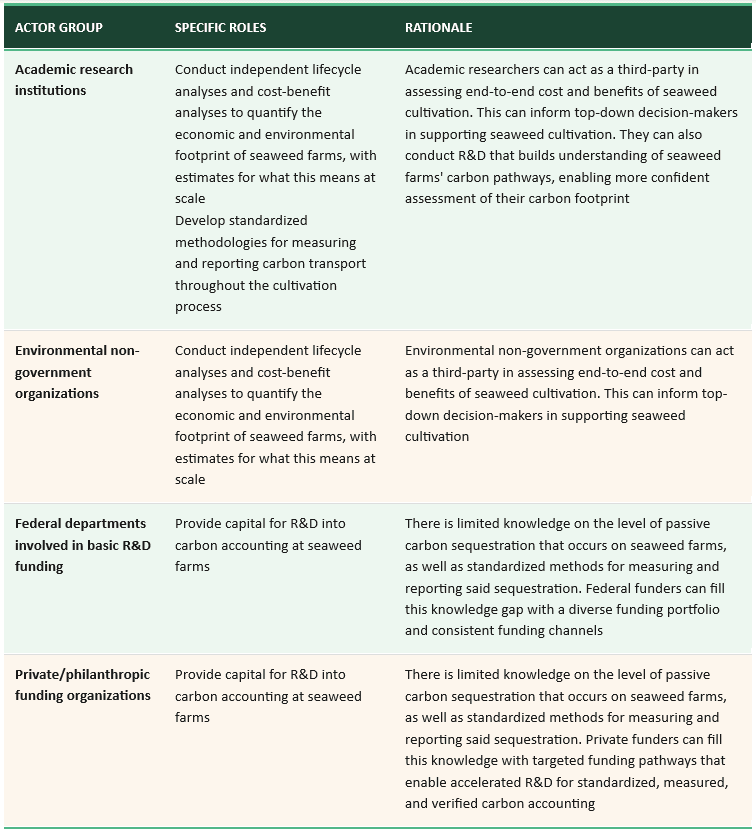 Goal:
Seaweed farmers have diverse avenues for financing that can manage cashflow mismatch and help them scale and/or build resilience
Key Actions
Goal:
Seaweed farmers have diverse avenues for financing that can manage cashflow mismatch and help them scale and/or build resilience
Key Actions
- Explore and develop diverse funding mechanisms like debt financing, revolving loans, tax incentives, blended finance, and brokerages to enable more market entrants and de-risk farming investment
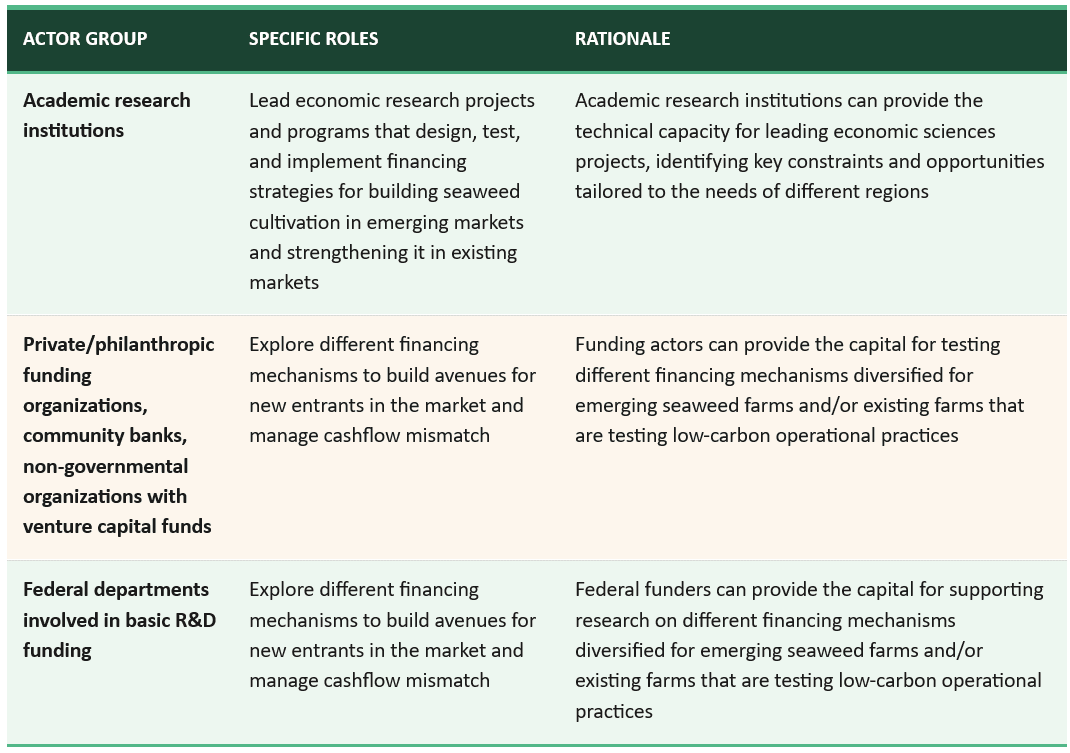 Goal: Seaweed farmers have access to crop insurance products that accurately reflect their risk exposure
Key actions
Goal: Seaweed farmers have access to crop insurance products that accurately reflect their risk exposure
Key actions
- Develop seaweed crop insurance mechanisms that offer the same safeguards as found in terrestrial agriculture but are catered to the unique risks found in aquaculture (e.g., extreme climate events, disease and pathogens)
- Conduct risk and vulnerability assessments of seaweed farms to ensure that insurance premiums and payouts accurately reflect localized environmental realities

- Expand LCA studies beyond the Global North to paint a more realistic picture of seaweed farms’ financial and environmental cost, and identify opportunities for value addition within the context of emerging and mature markets
- Produce cost-benefit analyses of seaweed farms to quantify the benefits and risks that seaweed cultivation has at scale, particularly for offshore seaweed farms that can accelerate seaweed production
- Establish standardized carbon accounting and verification best practices to quantify seaweed farms’ carbon sequestration potential for more informed LCA and cost-benefit analyses
Goal:
Seaweed farmers have diverse avenues for financing that can manage cashflow mismatch and help them scale and/or build resilience
Key Actions
- Explore and develop diverse funding mechanisms like debt financing, revolving loans, tax incentives, blended finance, and brokerages to enable more market entrants and de-risk farming investment
Goal: Seaweed farmers have access to crop insurance products that accurately reflect their risk exposure
Key actions
- Develop seaweed crop insurance mechanisms that offer the same safeguards as found in terrestrial agriculture but are catered to the unique risks found in aquaculture (e.g., extreme climate events, disease and pathogens)
- Conduct risk and vulnerability assessments of seaweed farms to ensure that insurance premiums and payouts accurately reflect localized environmental realities
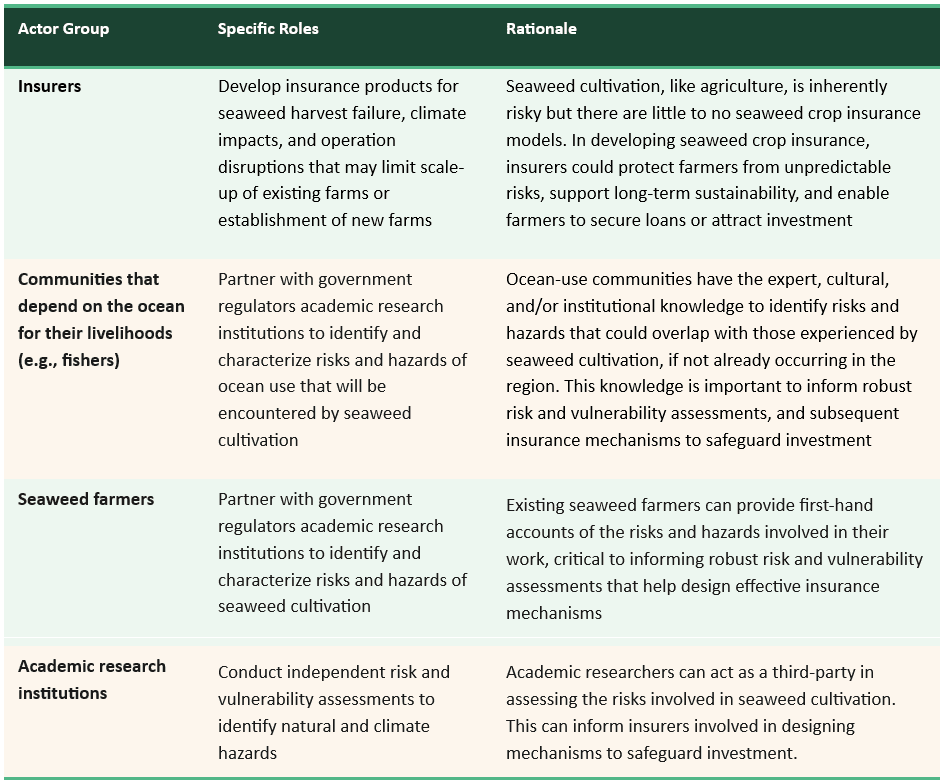
- Expand LCA studies beyond the Global North to paint a more realistic picture of seaweed farms’ financial and environmental cost, and identify opportunities for value addition within the context of emerging and mature markets
- Produce cost-benefit analyses of seaweed farms to quantify the benefits and risks that seaweed cultivation has at scale, particularly for offshore seaweed farms that can accelerate seaweed production
- Establish standardized carbon accounting and verification best practices to quantify seaweed farms’ carbon sequestration potential for more informed LCA and cost-benefit analyses
Goal:
Seaweed farmers have diverse avenues for financing that can manage cashflow mismatch and help them scale and/or build resilience
Key Actions
- Explore and develop diverse funding mechanisms like debt financing, revolving loans, tax incentives, blended finance, and brokerages to enable more market entrants and de-risk farming investment
Goal: Seaweed farmers have access to crop insurance products that accurately reflect their risk exposure
Key actions
- Develop seaweed crop insurance mechanisms that offer the same safeguards as found in terrestrial agriculture but are catered to the unique risks found in aquaculture (e.g., extreme climate events, disease and pathogens)
- Conduct risk and vulnerability assessments of seaweed farms to ensure that insurance premiums and payouts accurately reflect localized environmental realities
How to submit comments:
Thanks for helping to advance these roadmaps. Here is how it works!
Or, send general feedback to info@oceanvisions.org
All submitted comments will be reviewed by the Ocean Visions team to ensure that they are true, verifiable, and additive before being added to the road maps. You can increase the likelihood that your comments will be incorporated into the road maps by providing references (where appropriate).