

State of approach
Overview
With the human population expected to reach 9 billion by 2050, food production needs to grow to meet the demand, bringing with it with it the risk of higher greenhouse gas (GHG) emissions (World Bank, 2023). In 2020, synthetic fertilizer use in land-based crop farming contributed roughly 475 million tons CO2e to the global carbon footprint (World Resources Institute, 2026).
Seaweed-based agriculture supplements are growing in demand with rising consumer interest in sustainable agricultural practices (Chapman & Chapman, 1980; O’Connor, 2017). Liquid “biostimulant” extracts, meal/mulch, and biochar have been shown to benefit different crops; applied during key growth stages or stress conditions, they can increase yield, enhance nutrient uptake, and strengthen plant immunity and resilience to disease and adverse environmental conditions (Khan et al., 2009).
Seaweed-based supplements are only one major category within the broader market. Compared with conventional agricultural supplements made with fulvic or humic acid, microbial inoculants, trace elements, or amino acid mixtures, seaweed-based products may offer higher efficacy and stronger sustainability profiles, although the evidence base explaining their performance is less developed (Gupta et al., 2023; World Bank, 2023). Other widely used options include protein hydrolysates and amino acids derived from plant and animal proteins; while they have positively impacted crops like wheat they have yet to be studied in comparison to seaweed-based products (López-Serrano et al., 2026).
This chapter covers the state of the science, market, and policies involved in producing seaweed-based agriculture supplements, specifically liquid extracts, compost/mulch, and biochar, after raw seaweed biomass is dried and up to product use with specific crops. For seaweed cultivation and dewatering/drying, refer to the “Cultivation and Drying Considerations” chapter. After harvest, seaweed biomass is cleaned and dewatered, then kept wet or dried depending on the end product. Wet biomass is composted into meal/mulch for soil amendment, while dried biomass is either extracted (via soaking or heating) into a liquid extract applied as foliar spray/seed treatment/root soak or thermally converted into biochar for soil amendment use.
Pre-treatment for Processing
After being cleaned and dewatered, seaweed biomass is either kept wet or dry depending on the use-case. For example, seaweed compost/mulch performs better when processed wet while biochar production requires dry seaweed biomass. Liquid extracts can be produced with wet or dry seaweed biomass, depending on processing approach.
Processing
The processing stage is where pre-treated seaweed biomass is refined into the final agriculture supplement product and varies according to product.
Liquid extract
Seaweed-based liquid extracts were traditionally made by soaking seaweed in solvents (e.g., ethanol, methanol, water) until desirable compounds in the seaweed have passively diffused; more conventional methods use heating/boiling methods to promote extraction and screw press dewatering, though at the risk of quality (Rabhi et al., 2025). The final product is applied to crops as a diluted foliar spray, seed primer, or root soak for short- or long-term benefits (Kumar et al., 2020).
Seaweed fertilizer meal/mulch
Seaweed fertilizer meal/mulch is made by compositing wet seaweed and is used as a supplement to existing fertilizer or compost mixes (reviewed in Dang et al., 2023). It can provide long-term benefits due to the remediation effects it has on soil and subsequent plant quality (Battacharyya et al., 2015; Chapman & Chapman, 1980). The final product is packaged and distributed as a seaweed meal or pre-mixed with terrestrial bio-matter.
Biochar
Seaweed biochar is produced by heating seaweed over time. Compared to terrestrial biochar, it has a lower carbon content and surface area but a higher yield; furthermore, its alkalinity and richness in essential trace elements (e.g., nitrogen, phosphorus, and potassium) help it retain more nutrients, sequester more carbon, and even absorb metals from wastewater (Farghali et al., 2023; Roberts et al., 2015). The final product is packaged and distributed as a soil supplement.
Pre-treatment for Processing
After being cleaned and dewatered, seaweed biomass is either kept wet or dry depending on the use-case. For example, seaweed compost/mulch performs better when processed wet while biochar production requires dry seaweed biomass. Liquid extracts can be produced with wet or dry seaweed biomass, depending on processing approach.Processing
The processing stage is where pre-treated seaweed biomass is refined into the final agriculture supplement product and varies according to product.Liquid extract
Seaweed-based liquid extracts were traditionally made by soaking seaweed in solvents (e.g., ethanol, methanol, water) until desirable compounds in the seaweed have passively diffused; more conventional methods use heating/boiling methods to promote extraction and screw press dewatering, though at the risk of quality (Rabhi et al., 2025). The final product is applied to crops as a diluted foliar spray, seed primer, or root soak for short- or long-term benefits (Kumar et al., 2020).Seaweed fertilizer meal/mulch
Seaweed fertilizer meal/mulch is made by compositing wet seaweed and is used as a supplement to existing fertilizer or compost mixes (reviewed in Dang et al., 2023). It can provide long-term benefits due to the remediation effects it has on soil and subsequent plant quality (Battacharyya et al., 2015; Chapman & Chapman, 1980). The final product is packaged and distributed as a seaweed meal or pre-mixed with terrestrial bio-matter.Biochar
Seaweed biochar is produced by heating seaweed over time. Compared to terrestrial biochar, it has a lower carbon content and surface area but a higher yield; furthermore, its alkalinity and richness in essential trace elements (e.g., nitrogen, phosphorus, and potassium) help it retain more nutrients, sequester more carbon, and even absorb metals from wastewater (Farghali et al., 2023; Roberts et al., 2015). The final product is packaged and distributed as a soil supplement.Pre-treatment for Processing
After being cleaned and dewatered, seaweed biomass is either kept wet or dry depending on the use-case. For example, seaweed compost/mulch performs better when processed wet while biochar production requires dry seaweed biomass. Liquid extracts can be produced with wet or dry seaweed biomass, depending on processing approach.Processing
The processing stage is where pre-treated seaweed biomass is refined into the final agriculture supplement product and varies according to product.Liquid extract
Seaweed-based liquid extracts were traditionally made by soaking seaweed in solvents (e.g., ethanol, methanol, water) until desirable compounds in the seaweed have passively diffused; more conventional methods use heating/boiling methods to promote extraction and screw press dewatering, though at the risk of quality (Rabhi et al., 2025). The final product is applied to crops as a diluted foliar spray, seed primer, or root soak for short- or long-term benefits (Kumar et al., 2020).Seaweed fertilizer meal/mulch
Seaweed fertilizer meal/mulch is made by compositing wet seaweed and is used as a supplement to existing fertilizer or compost mixes (reviewed in Dang et al., 2023). It can provide long-term benefits due to the remediation effects it has on soil and subsequent plant quality (Battacharyya et al., 2015; Chapman & Chapman, 1980). The final product is packaged and distributed as a seaweed meal or pre-mixed with terrestrial bio-matter.Biochar
Seaweed biochar is produced by heating seaweed over time. Compared to terrestrial biochar, it has a lower carbon content and surface area but a higher yield; furthermore, its alkalinity and richness in essential trace elements (e.g., nitrogen, phosphorus, and potassium) help it retain more nutrients, sequester more carbon, and even absorb metals from wastewater (Farghali et al., 2023; Roberts et al., 2015). The final product is packaged and distributed as a soil supplement.Pre-treatment for Processing
After being cleaned and dewatered, seaweed biomass is either kept wet or dry depending on the use-case. For example, seaweed compost/mulch performs better when processed wet while biochar production requires dry seaweed biomass. Liquid extracts can be produced with wet or dry seaweed biomass, depending on processing approach.Processing
The processing stage is where pre-treated seaweed biomass is refined into the final agriculture supplement product and varies according to product.Liquid extract
Seaweed-based liquid extracts were traditionally made by soaking seaweed in solvents (e.g., ethanol, methanol, water) until desirable compounds in the seaweed have passively diffused; more conventional methods use heating/boiling methods to promote extraction and screw press dewatering, though at the risk of quality (Rabhi et al., 2025). The final product is applied to crops as a diluted foliar spray, seed primer, or root soak for short- or long-term benefits (Kumar et al., 2020).Seaweed fertilizer meal/mulch
Seaweed fertilizer meal/mulch is made by compositing wet seaweed and is used as a supplement to existing fertilizer or compost mixes (reviewed in Dang et al., 2023). It can provide long-term benefits due to the remediation effects it has on soil and subsequent plant quality (Battacharyya et al., 2015; Chapman & Chapman, 1980). The final product is packaged and distributed as a seaweed meal or pre-mixed with terrestrial bio-matter.Biochar
Seaweed biochar is produced by heating seaweed over time. Compared to terrestrial biochar, it has a lower carbon content and surface area but a higher yield; furthermore, its alkalinity and richness in essential trace elements (e.g., nitrogen, phosphorus, and potassium) help it retain more nutrients, sequester more carbon, and even absorb metals from wastewater (Farghali et al., 2023; Roberts et al., 2015). The final product is packaged and distributed as a soil supplement.Pre-treatment for Processing
After being cleaned and dewatered, seaweed biomass is either kept wet or dry depending on the use-case. For example, seaweed compost/mulch performs better when processed wet while biochar production requires dry seaweed biomass. Liquid extracts can be produced with wet or dry seaweed biomass, depending on processing approach.Processing
The processing stage is where pre-treated seaweed biomass is refined into the final agriculture supplement product and varies according to product.Liquid extract
Seaweed-based liquid extracts were traditionally made by soaking seaweed in solvents (e.g., ethanol, methanol, water) until desirable compounds in the seaweed have passively diffused; more conventional methods use heating/boiling methods to promote extraction and screw press dewatering, though at the risk of quality (Rabhi et al., 2025). The final product is applied to crops as a diluted foliar spray, seed primer, or root soak for short- or long-term benefits (Kumar et al., 2020).Seaweed fertilizer meal/mulch
Seaweed fertilizer meal/mulch is made by compositing wet seaweed and is used as a supplement to existing fertilizer or compost mixes (reviewed in Dang et al., 2023). It can provide long-term benefits due to the remediation effects it has on soil and subsequent plant quality (Battacharyya et al., 2015; Chapman & Chapman, 1980). The final product is packaged and distributed as a seaweed meal or pre-mixed with terrestrial bio-matter.Biochar
Seaweed biochar is produced by heating seaweed over time. Compared to terrestrial biochar, it has a lower carbon content and surface area but a higher yield; furthermore, its alkalinity and richness in essential trace elements (e.g., nitrogen, phosphorus, and potassium) help it retain more nutrients, sequester more carbon, and even absorb metals from wastewater (Farghali et al., 2023; Roberts et al., 2015). The final product is packaged and distributed as a soil supplement.Pre-treatment for Processing
After being cleaned and dewatered, seaweed biomass is either kept wet or dry depending on the use-case. For example, seaweed compost/mulch performs better when processed wet while biochar production requires dry seaweed biomass. Liquid extracts can be produced with wet or dry seaweed biomass, depending on processing approach.Processing
The processing stage is where pre-treated seaweed biomass is refined into the final agriculture supplement product and varies according to product.Liquid extract
Seaweed-based liquid extracts were traditionally made by soaking seaweed in solvents (e.g., ethanol, methanol, water) until desirable compounds in the seaweed have passively diffused; more conventional methods use heating/boiling methods to promote extraction and screw press dewatering, though at the risk of quality (Rabhi et al., 2025). The final product is applied to crops as a diluted foliar spray, seed primer, or root soak for short- or long-term benefits (Kumar et al., 2020).Seaweed fertilizer meal/mulch
Seaweed fertilizer meal/mulch is made by compositing wet seaweed and is used as a supplement to existing fertilizer or compost mixes (reviewed in Dang et al., 2023). It can provide long-term benefits due to the remediation effects it has on soil and subsequent plant quality (Battacharyya et al., 2015; Chapman & Chapman, 1980). The final product is packaged and distributed as a seaweed meal or pre-mixed with terrestrial bio-matter.Biochar
Seaweed biochar is produced by heating seaweed over time. Compared to terrestrial biochar, it has a lower carbon content and surface area but a higher yield; furthermore, its alkalinity and richness in essential trace elements (e.g., nitrogen, phosphorus, and potassium) help it retain more nutrients, sequester more carbon, and even absorb metals from wastewater (Farghali et al., 2023; Roberts et al., 2015). The final product is packaged and distributed as a soil supplement.Pre-treatment for Processing
After being cleaned and dewatered, seaweed biomass is either kept wet or dry depending on the use-case. For example, seaweed compost/mulch performs better when processed wet while biochar production requires dry seaweed biomass. Liquid extracts can be produced with wet or dry seaweed biomass, depending on processing approach.Processing
The processing stage is where pre-treated seaweed biomass is refined into the final agriculture supplement product and varies according to product.Liquid extract
Seaweed-based liquid extracts were traditionally made by soaking seaweed in solvents (e.g., ethanol, methanol, water) until desirable compounds in the seaweed have passively diffused; more conventional methods use heating/boiling methods to promote extraction, though at the risk of quality (Rabhi et al., 2025). The final product is applied to crops as a diluted foliar spray, seed primer, or root soak for short- or long-term benefits (Kumar et al., 2020).Seaweed fertilizer meal/mulch
Seaweed fertilizer meal/mulch is made by compositing wet seaweed and is used as a supplement to existing fertilizer or compost mixes (reviewed in Dang et al., 2023). It can provide long-term benefits due to the remediation effects it has on soil and subsequent plant quality (Battacharyya et al., 2015; Chapman & Chapman, 1980). The final product is packaged and distributed as a seaweed meal or pre-mixed with terrestrial bio-matter.Biochar
Seaweed biochar is produced by heating seaweed over time. Compared to terrestrial biochar, it has a lower carbon content and surface area but a higher yield; furthermore, its alkalinity and richness in essential trace elements (e.g., nitrogen, phosphorus, and potassium) help it retain more nutrients, sequester more carbon, and even absorb metals from wastewater (Farghali et al., 2023; Roberts et al., 2015). The final product is packaged and distributed as a soil supplement.Pre-treatment for Processing
After being cleaned and dewatered, seaweed biomass is either kept wet or dry depending on the use-case. For example, seaweed compost/mulch performs better when processed wet while seaweed liquid extracts or biochar require dry seaweed biomass.Processing
The processing stage is where pre-treated seaweed biomass is refined into the final agriculture supplement product and varies according to product.Liquid extract
Seaweed-based liquid extracts were traditionally made by soaking seaweed in solvents (e.g., ethanol, methanol, water) until desirable compounds in the seaweed have passively diffused; more conventional methods use heating/boiling methods to promote extraction, though at the risk of quality (Rabhi et al., 2025). The final product is applied to crops as a diluted foliar spray, seed primer, or root soak for short- or long-term benefits (Kumar et al., 2020).Seaweed fertilizer meal/mulch
Seaweed fertilizer meal/mulch is made by compositing wet seaweed and is used as a supplement to existing fertilizer or compost mixes (reviewed in Dang et al., 2023). It can provide long-term benefits due to the remediation effects it has on soil and subsequent plant quality (Battacharyya et al., 2015; Chapman & Chapman, 1980). The final product is packaged and distributed as a seaweed meal or pre-mixed with terrestrial bio-matter.Biochar
Seaweed biochar is produced by heating seaweed over time. Compared to terrestrial biochar, it has a lower carbon content and surface area but a higher yield; furthermore, its alkalinity and richness in essential trace elements (e.g., nitrogen, phosphorus, and potassium) help it retain more nutrients, sequester more carbon, and even absorb metals from wastewater (Farghali et al., 2023; Roberts et al., 2015). The final product is packaged and distributed as a soil supplement.Pre-treatment for Processing
After being cleaned and dewatered, seaweed biomass is either kept wet or dry depending on the use-case. For example, seaweed compost/mulch performs better when processed wet while seaweed liquid extracts or biochar require dry seaweed biomass.Processing
The processing stage is where pre-treated seaweed biomass is refined into the final agriculture supplement product and varies according to product.Liquid extract
Seaweed-based liquid extracts were traditionally made by soaking seaweed in solvents (e.g., ethanol, methanol, water) until desirable compounds in the seaweed have passively diffused; more conventional methods use heating/boiling methods to promote extraction, though at the risk of quality (Rabhi et al., 2025). The final product is applied to crops as a diluted foliar spray, seed primer, or root soak for short- or long-term benefits (Kumar et al., 2020).Seaweed fertilizer meal/mulch
Seaweed fertilizer meal/mulch is made by compositing wet seaweed and is used as a supplement to existing fertilizer or compost mixes (reviewed in Dang et al., 2023). It can provide long-term benefits due to the remediation effects it has on soil and subsequent plant quality (Battacharyya et al., 2015; Chapman & Chapman, 1980). The final product is packaged and distributed as a seaweed meal or pre-mixed with terrestrial bio-matter.Biochar
Seaweed biochar is produced by heating seaweed over time. Compared to terrestrial biochar, it has a lower carbon content and surface area but a higher yield; furthermore, its alkalinity and richness in essential trace elements (e.g., nitrogen, phosphorus, and potassium) help it retain more nutrients, sequester more carbon, and even absorb metals from wastewater (Farghali et al., 2023; Roberts et al., 2015). The final product is packaged and distributed as a soil supplement.Pre-treatment for processing
After being cleaned and dewatered, seaweed biomass is either kept wet or dry depending on the use-case. For example, seaweed compost/mulch performs better when processed wet while seaweed liquid extracts or biochar require dry seaweed biomass.Processing
The processing stage is where pre-treated seaweed biomass is refined into the final agriculture supplement product and varies according to product.Liquid extract
Seaweed-based liquid extracts were traditionally made by soaking seaweed in solvents (e.g., ethanol, methanol, water) until desirable compounds in the seaweed have passively diffused; more conventional methods use heating/boiling methods to promote extraction, though at the risk of quality (Rabhi et al., 2025). The final product is applied to crops as a diluted foliar spray, seed primer, or root soak for short- or long-term benefits (Kumar et al., 2020).Seaweed fertilizer meal/mulch
Seaweed fertilizer meal/mulch is made by compositing wet seaweed and is used as a supplement to existing fertilizer or compost mixes (reviewed in Dang et al., 2023). It can provide long-term benefits due to the remediation effects it has on soil and subsequent plant quality (Battacharyya et al., 2015; Chapman & Chapman, 1980). The final product is packaged and distributed as a seaweed meal or pre-mixed with terrestrial bio-matter.Biochar
Seaweed biochar is produced by heating seaweed over time. Compared to terrestrial biochar, it has a lower carbon content and surface area but a higher yield; furthermore, its alkalinity and richness in essential trace elements (e.g., nitrogen, phosphorus, and potassium) help it retain more nutrients, sequester more carbon, and even absorb metals from wastewater (Farghali et al., 2023; Roberts et al., 2015). The final product is packaged and distributed as a soil supplement.Pre-treatment for processing
After being cleaned and dewatered, seaweed biomass is either kept wet or dry depending on the use-case. For example, seaweed compost/mulch performs better when processed wet while seaweed liquid extracts or biochar require dry seaweed biomass.Processing
The processing stage is where pre-treated seaweed biomass is refined into the final agriculture supplement product and varies according to product.Liquid extract
Seaweed-based liquid extracts were traditionally made by soaking seaweed in solvents (e.g., ethanol, methanol, water) until desirable compounds in the seaweed have passively diffused; more conventional methods use heating/boiling methods to promote extraction, though at the risk of quality (Rabhi et al., 2025). The final product is applied to crops as a diluted foliar spray, seed primer, or root soak for short- or long-term benefits (Kumar et al., 2020).Seaweed fertilizer meal/mulch
Seaweed fertilizer meal/mulch is made by compositing wet seaweed and is used as a supplement to existing fertilizer or compost mixes (reviewed in Dang et al., 2023). It can provide long-term benefits due to the remediation effects it has on soil and subsequent plant quality (Battacharyya et al., 2015; Chapman & Chapman, 1980). The final product is packaged and distributed as a seaweed meal or pre-mixed with terrestrial bio-matter.Biochar
Seaweed biochar is produced by heating seaweed over time. Compared to terrestrial biochar, it has a lower carbon content and surface area but a higher yield; furthermore, its alkalinity and richness in essential trace elements (e.g., nitrogen, phosphorus, and potassium) help it retain more nutrients, sequester more carbon, and even absorb metals from wastewater (Farghali et al., 2023; Roberts et al., 2015). The final product is packaged and distributed as a soil supplement.Pre-treatment for processing
After being cleaned and dewatered, seaweed biomass is either kept wet or dry depending on the use-case. For example, seaweed compost/mulch performs better when processed wet while seaweed liquid extracts or biochar require dry seaweed biomass.Processing
The processing stage is where pre-treated seaweed biomass is refined into the final agriculture supplement product and varies according to product.Liquid extract
Seaweed-based liquid extracts were traditionally made by soaking seaweed in solvents (e.g., ethanol, methanol, water) until desirable compounds in the seaweed have passively diffused; more conventional methods use heating/boiling methods to promote extraction, though at the risk of quality (Rabhi et al., 2025). The final product is applied to crops as a diluted foliar spray, seed primer, or root soak for short- or long-term benefits (Kumar et al., 2020).Seaweed fertilizer meal/mulch
Seaweed fertilizer meal/mulch is made by compositing wet seaweed and is used as a supplement to existing fertilizer or compost mixes (reviewed in Dang et al., 2023). It can provide long-term benefits due to the remediation effects it has on soil and subsequent plant quality (Battacharyya et al., 2015; Chapman & Chapman, 1980). The final product is packaged and distributed as a seaweed meal or pre-mixed with terrestrial bio-matter.Biochar
Seaweed biochar is produced by heating seaweed over time. Compared to terrestrial biochar, it has a lower carbon content and surface area but a higher yield; furthermore, its alkalinity and richness in essential trace elements (e.g., nitrogen, phosphorus, and potassium) help it retain more nutrients, sequester more carbon, and even absorb metals from wastewater (Farghali et al., 2023; Roberts et al., 2015). The final product is packaged and distributed as a soil supplement.Pre-treatment for processing
After being cleaned and dewatered, seaweed biomass is either kept wet or dry depending on the use-case. For example, seaweed compost/mulch performs better when processed wet while seaweed liquid extracts or biochar require dry seaweed biomass.Processing
The processing stage is where pre-treated seaweed biomass is refined into the final agriculture supplement product and varies according to product.Liquid extract
Seaweed-based liquid extracts were traditionally made by soaking seaweed in solvents (e.g., ethanol, methanol, water) until desirable compounds in the seaweed have passively diffused; more conventional methods use heating/boiling methods to promote extraction, though at the risk of quality (Rabhi et al., 2025). The final product is applied to crops as a diluted foliar spray, seed primer, or root soak for short- or long-term benefits (Kumar et al., 2020).Seaweed fertilizer meal/mulch
Seaweed fertilizer meal/mulch is made by compositing wet seaweed and is used as a supplement to existing fertilizer or compost mixes (reviewed in Dang et al., 2023). It can provide long-term benefits due to the remediation effects it has on soil and subsequent plant quality (Battacharyya et al., 2015; Chapman & Chapman, 1980). The final product is packaged and distributed as a seaweed meal or pre-mixed with terrestrial bio-matter.Biochar
Seaweed biochar is produced by heating seaweed over time. Compared to terrestrial biochar, it has a lower carbon content and surface area but a higher yield; furthermore, its alkalinity and richness in essential trace elements (e.g., nitrogen, phosphorus, and potassium) help it retain more nutrients, sequester more carbon, and even absorb metals from wastewater (Farghali et al., 2023; Roberts et al., 2015). The final product is packaged and distributed as a soil supplement.Science, Technology and Engineering
Species Selection, Cultivation and Harvesting
Species Selection
There are over 10,000 species of seaweed that vary substantially in chemical composition across geography, life cycle, and seasonality. These factors determine the concentration of bioactive compounds most desirable for product performance specific to crops’ needs. Brown (e.g., Ascophyllum nodosum, Laminaria, Sargassum, Ecklonia maxima, Undaria, Macrocystis) and red (e.g., Kappaphycus alvarezii) species are more commonly used due to their fast growth and large size, followed by green species (e.g., Ulva). Table 1 summarizes species used in commercial agriculture supplement production.
| Seaweed species | Products made | Companies |
| Ascophyllum nodosum | Liquid extracts
Meal/mulch |
Acadian Plant Health Atlantic Mariculture Kelpcrofting |
| Ecklonia maxima | Liquid extracts
Meal/mulch |
Afrikelp Kelpak |
| Kappaphycus alvarezii | Liquid extracts
Meal/mulch Biochar |
Sea6 Energy |
| Laminaria spp. | Liquid extracts
Meal/mulch Biochar |
Seawin Biotech |
| Macrocystis Pyrifera | Liquid Extracts | Ocean Rainforest PatBio |
| Nereocystis sp. | Liquid extracts | Pacific Northwest Organics |
| Saccharina latissima | Liquid extracts | AgriSea US Cascadia Holdfast NL |
| Sargassum spp. | Liquid extracts Meal/mulch Biochar |
Carbonwave Red Diamond Compost RubisCO2 |
| Ulva spp. | Liquid extracts
Meal/mulch |
Wild Coast Aquaculture |
| Undaria spp. | Liquid extracts
Biochar |
Waikaitu |
Table 1. Examples of seaweed species used in agriculture supplement production and a non-exhaustive list of companies.
Harvesting and cultivation
Seaweed used for agriculture supplements are harvested wildly or cultivated, but the method of cultivation impacts final product suitability. For liquid extracts, the timing of harvest matters because the seaweed’s chemical composition—key to product performance—changes with time, meriting cultivated approaches (Craigie et al., 2008; Featonby-Smith & Staden, 1984; Mooney & Staden, 1984). Timing of harvest for seaweed fertilizer meal/mulch and biochar is less relevant, permitting harvest of “waste” seaweed that has washed up on beaches or accumulated around waste management sites. Companies like Carbonwave are taking advantage of Sargassum blooms to harvest seaweed for agricultural supplements, reducing the risk of adverse ecological and economic impacts, while at the same time lowering production costs.
Processing
Processing information is proprietary in most cases, but general processing methods and active R&D are detailed below for each final product covered in this chapter.
Liquid Extracts
Four general techniques exist: alkaline, acid, physical disruption, and cell-burst. All methods aim to release soluble components within algal cells that contain compounds key to product performance; alkaline and acid conversions are unique in that they can impact extracts’ chemical compositions. Alkaline extraction is the most common method, and liquefies the whole seaweed into a slurry (Craigie, 2011; Craigie et al., 2008). Acid extraction and enzymatic and fermentative extractions also occur, the former most commonly as a pre-treatment before alkaline extraction (Battacharyya et al., 2015; Craigie, 2011; Craigie et al., 2008). Physical disruption or cell-burst technology conversions create a “micronized” suspension of fine particles released from the cells ( e.g., ~50 µm in diameter; Temple & Bomke, 1989). This can be achieved with low-temperature milling (e.g., cryo-crushing) or high-pressure forces (e.g., sub-critical water extraction) that rupture the cell walls (Battacharyya et al., 2015; Craigie, 2011; Geelen & Xu, 2020). After extraction, the final product is either dried into a soluble powder or prepared in liquid format. Liquid extract processes are summarized in Figure 1.

Novel cell disruption, cell-burst, and enzymatic extraction methods are being developed to cut down on extraction time, solvent usage, and energy needs (Table 2). Compared to traditional hot‑water extraction, microwave‑assisted extraction (MAE) delivers higher yields (6.17% vs. 5.2%) in a shorter time and with only a third of the solvent required (e.g., Yuan and Macquarrie, 2015; Sharma and Zalpouri, 2022). Furthermore, it can be applied directly in fresh biomass, avoiding one of the most energy-intensive steps in a seaweed-based product’s lifecycle (Zollmann et al., 2019). Ultrasound-assisted extraction (UAE) can also be used with fresh seaweed and avoids impacting heat-sensitive compounds. Furthermore, it can produce extracts with a fraction of the toxic chloride and sulfate concentrations retained in conventional high-pressure water extractions (for example, 12.5 mg/L of sulfate was retained using UAE versus 1520 mg/L using sub-critical water extraction; Zollman et al., 2019; Lewandowska et al., 2023). Enzyme-assisted extraction (EAE) uses hydrolytic enzymes (e.g., cellulase) to break down cell walls, where the enzymes used are specifically tailored to the plant’s cellular wall composition (e.g., cellulose; Choulot et al., 2025). Studies have demonstrated the potential of EAE to improve seaweed liquid extraction using commercial enzymes for terrestrial plants. For example, Naseri et al. (2020) treated Eucheuma denticulatum with Viscozyme® and produced 48.5% extraction efficiency, more than triple the efficiency of water-based extractions.
MAE, UAE, and EAE are desirable for industry-scale use due to their specificity in targeting desirable compounds, higher yields compared to traditional methods, and lower environmental impact compared to current commercial methods. However, each is in varying levels of technological readiness. For example, excessive temperature and microwave power for MAE can degrade polysaccharides and reduce total yield, requiring fine-scale controls (Dobrinčić et al., 2020). UAE requires specialized equipment to control ultrasound waves as well as the surface tension and viscosity of the solvent for optimal performance (Bordoloi et al., 2020). EAE will provide maximum efficiency at scale if cost-effective seaweed-specific enzymes are developed (Matos et al., 2021).
| Innovation | What it is / How it works | Claimed benefits | Readiness / Status |
| Microwave-assisted extraction (MAE) | Uses microwaves to break cell walls and release compounds in solvent or through vapor distillation | Higher yields, less solvent
Can use fresh seaweed |
Emerging / Laboratory experiments |
| Ultrasound-assisted extraction (UAE) | High-frequency waves increase cell porosity, allowing solvent penetration | Improved yields, scalable
Does not impact heat-sensitive compounds Can use fresh seaweed |
Emerging / Laboratory experiments |
| Enzyme-assisted extraction (EAE) | Hydrolytic enzymes break cell walls, releasing cell contents to solvent | Lower environmental impact | Emerging / Laboratory experiments |
Table 2. Alternate extraction techniques for seaweed liquid extract production, claimed benefits, and technological readiness/status.
Seaweed fertilizer meal/mulch
Meal/mulch processing uses wet seaweed biomass to preserve a seaweed’s nitrogen content, though excessive moisture can impact quality. It is processed through aeration composting or vermicomposting (using earthworms), either alone or with terrestrial bio-matter and/or manure (Ananthavalli et al., 2019; Biruntha et al., 2020; Dang et al., 2023). The seaweed is then ground into a meal or powder through mechanical disruption (Craigie, 2011).
Active R&D is exploring different co-composting methods (i.e., composting seaweed with different terrestrial plant, fecal, or microorganism feedstocks) to produce carbon-to-nitrogen ratios more suitable for crops, decrease salinity and heavy metal concentrations, and boost degradation of polysaccharides and phenols (reviewed in Dang et al., 2023).
Biochar/Hydrochar
Seaweed biochar is produced through energy-intensive thermochemical conversion processes like pyrolysis and gasification(Table 3; Dang et al., 2023; Farghali et al., 2023). An active area of R&D is on reducing the energy needs to produce seaweed biochar at a quality beneficial to crops (Dang et al., 2023).
| Conversion Method | Process Description | Typical Conditions | Yield & Carbon Content | Notable Characteristics |
| Pyrolysis | Dried and milled seaweed is heated in an oxygen-free environment to produce char. | 300–500°C
~24h drying at 60°C Particle size ~1–2 mm |
45–62% yield (slow pyrolysis at 450°C); higher ash and lower yield at higher temps | Most common method. High temps reduce Environmentally Persistent Free Radicals (EPFRs), which can harm crops. |
| Gasification | Dried seaweed reacts with oxygen/air or steam to produce gas and char. | 700–1,200°C
Fixed- or fluidized-bed reactors |
Generally lower yield than pyrolysis or HTC | Produces biochar with higher ash, volatile matter, and mineral content. High water/protein/mineral content affects decomposition and performance. High temps (>700°C) may reduce quality. |
Table 3. Biochar conversion methods, typical conditions and performance, and notable characteristics.
Note: Hydrothermal liquefaction of wet seaweed biomass (for the generation of fuels) produces a byproduct named hydrochar. Hydrochar is less effective for carbon sequestration in soils compared to pyrolysis biochar, due to a higher content of more easily decomposable carbon. However, it is in early exploration as a solid heating fuel (Patel et. al, 2021).
Cascading biorefineries
Cascading biorefineries seek to produce multiple final products from the waste of other workstreams to use the “whole seaweed” and cut on production costs. For example, Pascual et al. (2020) found that using fermented seaweed sludge byproduct from seaweed water production significantly out-performed conventional fertilizer for growing Lactuca lettuce. Processing liquid extracts as a byproduct of existing (e.g., algin, hydrocolloid) and emerging industries (e.g., biofuel) is also being explored (Dang et al., 2023; Farghali et al., 2023; Seghetta et al., 2016)
Species Selection, Cultivation and Harvesting
Species Selection
There are over 10,000 species of seaweed that vary substantially in chemical composition across geography, life cycle, and seasonality. These factors determine the concentration of bioactive compounds most desirable for product performance specific to crops’ needs. Brown (e.g., Ascophyllum nodosum, Laminaria, Sargassum, Ecklonia maxima, Undaria, Macrocystis) and red (e.g., Kappaphycus alvarezii) species are more commonly used due to their fast growth and large size, followed by green species (e.g., Ulva). Table 1 summarizes species used in commercial agriculture supplement production.| Seaweed species | Products made | Companies |
| Ascophyllum nodosum | Liquid extracts Meal/mulch | Acadian Plant Health Atlantic Mariculture Kelpcrofting |
| Ecklonia maxima | Liquid extracts Meal/mulch | Afrikelp Kelpak |
| Kappaphycus alvarezii | Liquid extracts Meal/mulch Biochar | Sea6 Energy Seadling |
| Laminaria spp. | Liquid extracts Meal/mulch Biochar | Seawin Biotech |
| Macrocystis Pyrifera | Liquid Extracts | Ocean Rainforest PatBio |
| Nereocystis sp. | Liquid extracts | Pacific Northwest Organics |
| Saccharina latissima | Liquid extracts | AgriSea US Cascadia Holdfast NL |
| Sargassum spp. | Liquid extracts Meal/mulch Biochar | Carbonwave Red Diamond Compost RubisCO2 |
| Ulva spp. | Liquid extracts Meal/mulch | Wild Coast Aquaculture |
| Undaria spp. | Liquid extracts Biochar | Waikaitu |
Harvesting and cultivation
Seaweed used for agriculture supplements are harvested wildly or cultivated, but the method of cultivation impacts final product suitability. For liquid extracts, the timing of harvest matters because the seaweed’s chemical composition—key to product performance—changes with time, meriting cultivated approaches (Craigie et al., 2008; Featonby-Smith & Staden, 1984; Mooney & Staden, 1984). Timing of harvest for seaweed fertilizer meal/mulch and biochar is less relevant, permitting harvest of “waste” seaweed that has washed up on beaches or accumulated around waste management sites. Companies like Carbonwave are taking advantage of Sargassum blooms to harvest seaweed for agricultural supplements, reducing the risk of adverse ecological and economic impacts, while at the same time lowering production costs.Processing
Processing information is proprietary in most cases, but general processing methods and active R&D are detailed below for each final product covered in this chapter.Liquid Extracts
Four general techniques exist: alkaline, acid, physical disruption, and cell-burst. All methods aim to release soluble components within algal cells that contain compounds key to product performance; alkaline and acid conversions are unique in that they can impact extracts’ chemical compositions. Alkaline extraction is the most common method, and liquefies the whole seaweed into a slurry (Craigie, 2011; Craigie et al., 2008). Acid extraction and enzymatic and fermentative extractions also occur, the former most commonly as a pre-treatment before alkaline extraction (Battacharyya et al., 2015; Craigie, 2011; Craigie et al., 2008). Physical disruption or cell-burst technology conversions create a “micronized” suspension of fine particles released from the cells ( e.g., ~50 µm in diameter; Temple & Bomke, 1989). This can be achieved with low-temperature milling (e.g., cryo-crushing) or high-pressure forces (e.g., sub-critical water extraction) that rupture the cell walls (Battacharyya et al., 2015; Craigie, 2011; Geelen & Xu, 2020). After extraction, the final product is either dried into a soluble powder or prepared in liquid format. Liquid extract processes are summarized in Figure 1. [caption id="attachment_12802" align="aligncenter" width="2560"] Figure 1. Example flowchart of alkaline extraction used to produce seaweed liquid extracts.[/caption]
Novel cell disruption, cell-burst, and enzymatic extraction methods are being developed to cut down on extraction time, solvent usage, and energy needs (Table 2). Compared to traditional hot‑water extraction, microwave‑assisted extraction (MAE) delivers higher yields (6.17% vs. 5.2%) in a shorter time and with only a third of the solvent required (e.g., Yuan and Macquarrie, 2015; Sharma and Zalpouri, 2022). Furthermore, it can be applied directly in fresh biomass, avoiding one of the most energy-intensive steps in a seaweed-based product’s lifecycle (Zollmann et al., 2019). Ultrasound-assisted extraction (UAE) can also be used with fresh seaweed and avoids impacting heat-sensitive compounds. Furthermore, it can produce extracts with a fraction of the toxic chloride and sulfate concentrations retained in conventional high-pressure water extractions (for example, 12.5 mg/L of sulfate was retained using UAE versus 1520 mg/L using sub-critical water extraction; Zollman et al., 2019; Lewandowska et al., 2023). Enzyme-assisted extraction (EAE) uses hydrolytic enzymes (e.g., cellulase) to break down cell walls, where the enzymes used are specifically tailored to the plant’s cellular wall composition (e.g., cellulose; Choulot et al., 2025). Studies have demonstrated the potential of EAE to improve seaweed liquid extraction using commercial enzymes for terrestrial plants. For example, Naseri et al. (2020) treated Eucheuma denticulatum with Viscozyme® and produced 48.5% extraction efficiency, more than triple the efficiency of water-based extractions.
MAE, UAE, and EAE are desirable for industry-scale use due to their specificity in targeting desirable compounds, higher yields compared to traditional methods, and lower environmental impact compared to current commercial methods. However, each is in varying levels of technological readiness. For example, excessive temperature and microwave power for MAE can degrade polysaccharides and reduce total yield, requiring fine-scale controls (Dobrinčić et al., 2020). UAE requires specialized equipment to control ultrasound waves as well as the surface tension and viscosity of the solvent for optimal performance (Bordoloi et al., 2020). EAE will provide maximum efficiency at scale if cost-effective seaweed-specific enzymes are developed (Matos et al., 2021).
| Innovation | What it is / How it works | Claimed benefits | Readiness / Status |
| Microwave-assisted extraction (MAE) | Uses microwaves to break cell walls and release compounds in solvent or through vapor distillation | Higher yields, less solvent Can use fresh seaweed | Emerging / Laboratory experiments |
| Ultrasound-assisted extraction (UAE) | High-frequency waves increase cell porosity, allowing solvent penetration | Improved yields, scalable Does not impact heat-sensitive compounds Can use fresh seaweed | Emerging / Laboratory experiments |
| Enzyme-assisted extraction (EAE) | Hydrolytic enzymes break cell walls, releasing cell contents to solvent | Lower environmental impact | Emerging / Laboratory experiments |
Seaweed fertilizer meal/mulch
Meal/mulch processing uses wet seaweed biomass to preserve a seaweed’s nitrogen content, though excessive moisture can impact quality. It is processed through aeration composting or vermicomposting (using earthworms), either alone or with terrestrial bio-matter and/or manure (Ananthavalli et al., 2019; Biruntha et al., 2020; Dang et al., 2023). The seaweed is then ground into a meal or powder through mechanical disruption (Craigie, 2011). Active R&D is exploring different co-composting methods (i.e., composting seaweed with different terrestrial plant, fecal, or microorganism feedstocks) to produce carbon-to-nitrogen ratios more suitable for crops, decrease salinity and heavy metal concentrations, and boost degradation of polysaccharides and phenols (reviewed in Dang et al., 2023).Biochar/Hydrochar
Seaweed biochar is produced through energy-intensive thermochemical conversion processes like pyrolysis and gasification(Table 3; Dang et al., 2023; Farghali et al., 2023). An active area of R&D is on reducing the energy needs to produce seaweed biochar at a quality beneficial to crops (Dang et al., 2023).| Conversion Method | Process Description | Typical Conditions | Yield & Carbon Content | Notable Characteristics |
| Pyrolysis | Dried and milled seaweed is heated in an oxygen-free environment to produce char. | 300–500°C ~24h drying at 60°C Particle size ~1–2 mm | 45–62% yield (slow pyrolysis at 450°C); higher ash and lower yield at higher temps | Most common method. High temps reduce Environmentally Persistent Free Radicals (EPFRs), which can harm crops. |
| Gasification | Dried seaweed reacts with oxygen/air or steam to produce gas and char. | 700–1,200°C Fixed- or fluidized-bed reactors | Generally lower yield than pyrolysis or HTC | Produces biochar with higher ash, volatile matter, and mineral content. High water/protein/mineral content affects decomposition and performance. High temps (>700°C) may reduce quality. |
Cascading biorefineries
Cascading biorefineries seek to produce multiple final products from the waste of other workstreams to use the “whole seaweed” and cut on production costs. For example, Pascual et al. (2020) found that using fermented seaweed sludge byproduct from seaweed water production significantly out-performed conventional fertilizer for growing Lactuca lettuce. Processing liquid extracts as a byproduct of existing (e.g., algin, hydrocolloid) and emerging industries (e.g., biofuel) is also being explored (Dang et al., 2023; Farghali et al., 2023; Seghetta et al., 2016)Species Selection, Cultivation and Harvesting
Species Selection
There are over 10,000 species of seaweed that vary substantially in chemical composition across geography, life cycle, and seasonality. These factors determine the concentration of bioactive compounds most desirable for product performance specific to crops’ needs. Brown (e.g., Ascophyllum nodosum, Laminaria, Sargassum, Ecklonia maxima, Undaria, Macrocystis) and red (e.g., Kappaphycus alvarezii) species are more commonly used due to their fast growth and large size, followed by green species (e.g., Ulva). Table 1 summarizes species used in commercial agriculture supplement production.| Seaweed species | Products made | Companies |
| Ascophyllum nodosum | Liquid extracts Meal/mulch | Acadian Plant Health Atlantic Mariculture Kelpcrofting |
| Ecklonia maxima | Liquid extracts Meal/mulch | Afrikelp Kelpak |
| Kappaphycus alvarezii | Liquid extracts Meal/mulch Biochar | Sea6 Energy Seadling |
| Laminaria spp. | Liquid extracts Meal/mulch Biochar | Seawin Biotech |
| Macrocystis Pyrifera | Liquid Extracts | Ocean Rainforest PatBio |
| Nereocystis sp. | Liquid extracts | Pacific Northwest Organics |
| Saccharina latissima | Liquid extracts | AgriSea US Cascadia Holdfast NL |
| Sargassum spp. | Liquid extracts Meal/mulch Biochar | Carbonwave Red Diamond Compost RubisCO2 |
| Ulva spp. | Liquid extracts Meal/mulch | Wild Coast Aquaculture |
| Undaria spp. | Liquid extracts Biochar | Waikaitu |
Harvesting and cultivation
Seaweed used for agriculture supplements are harvested wildly or cultivated, but the method of cultivation impacts final product suitability. For liquid extracts, the timing of harvest matters because the seaweed’s chemical composition—key to product performance—changes with time, meriting cultivated approaches (Craigie et al., 2008; Featonby-Smith & Staden, 1984; Mooney & Staden, 1984). Timing of harvest for seaweed fertilizer meal/mulch and biochar is less relevant, permitting harvest of “waste” seaweed that has washed up on beaches or accumulated around waste management sites. Companies like Carbonwave are taking advantage of Sargassum blooms to harvest seaweed for agricultural supplements, reducing the risk of adverse ecological and economic impacts, while at the same time lowering production costs.Processing
Processing information is proprietary in most cases, but general processing methods and active R&D are detailed below for each final product covered in this chapter.Liquid Extracts
Four general techniques exist: alkaline, acid, physical disruption, and cell-burst. All methods aim to release soluble components within algal cells that contain compounds key to product performance; alkaline and acid conversions are unique in that they can impact extracts’ chemical compositions. Alkaline extraction is the most common method, and liquefies the whole seaweed into a slurry (Craigie, 2011; Craigie et al., 2008). Acid extraction and enzymatic and fermentative extractions also occur, the former most commonly as a pre-treatment before alkaline extraction (Battacharyya et al., 2015; Craigie, 2011; Craigie et al., 2008). Physical disruption or cell-burst technology conversions create a “micronized” suspension of fine particles released from the cells ( e.g., ~50 µm in diameter; Temple & Bomke, 1989). This can be achieved with low-temperature milling (e.g., cryo-crushing) or high-pressure forces (e.g., sub-critical water extraction) that rupture the cell walls (Battacharyya et al., 2015; Craigie, 2011; Geelen & Xu, 2020). After extraction, the final product is either dried into a soluble powder or prepared in liquid format. Liquid extract processes are summarized in Figure 1. [caption id="attachment_12802" align="aligncenter" width="2560"] Figure 1. Example flowchart of alkaline extraction used to produce seaweed liquid extracts.[/caption]
Novel cell disruption, cell-burst, and enzymatic extraction methods are being developed to cut down on extraction time, solvent usage, and energy needs (Table 2). Compared to traditional hot‑water extraction, microwave‑assisted extraction (MAE) delivers higher yields (6.17% vs. 5.2%) in a shorter time and with only a third of the solvent required (e.g., Yuan and Macquarrie, 2015; Sharma and Zalpouri, 2022). Furthermore, it can be applied directly in fresh biomass, avoiding one of the most energy-intensive steps in a seaweed-based product’s lifecycle (Zollmann et al., 2019). Ultrasound-assisted extraction (UAE) can also be used with fresh seaweed and avoids impacting heat-sensitive compounds. Furthermore, it can produce extracts with a fraction of the toxic chloride and sulfate concentrations retained in conventional high-pressure water extractions (for example, 12.5 mg/L of sulfate was retained using UAE versus 1520 mg/L using sub-critical water extraction; Zollman et al., 2019; Lewandowska et al., 2023). Enzyme-assisted extraction (EAE) uses hydrolytic enzymes (e.g., cellulase) to break down cell walls, where the enzymes used are specifically tailored to the plant’s cellular wall composition (e.g., cellulose; Choulot et al., 2025). Studies have demonstrated the potential of EAE to improve seaweed liquid extraction using commercial enzymes for terrestrial plants. For example, Naseri et al. (2020) treated Eucheuma denticulatum with Viscozyme® and produced 48.5% extraction efficiency, more than triple the efficiency of water-based extractions.
MAE, UAE, and EAE are desirable for industry-scale use due to their specificity in targeting desirable compounds, higher yields compared to traditional methods, and lower environmental impact compared to current commercial methods. However, each is in varying levels of technological readiness. For example, excessive temperature and microwave power for MAE can degrade polysaccharides and reduce total yield, requiring fine-scale controls (Dobrinčić et al., 2020). UAE requires specialized equipment to control ultrasound waves as well as the surface tension and viscosity of the solvent for optimal performance (Bordoloi et al., 2020). EAE will provide maximum efficiency at scale if cost-effective seaweed-specific enzymes are developed (Matos et al., 2021).
| Innovation | What it is / How it works | Claimed benefits | Readiness / Status |
| Microwave-assisted extraction (MAE) | Uses microwaves to break cell walls and release compounds in solvent or through vapor distillation | Higher yields, less solvent Can use fresh seaweed | Emerging / Laboratory experiments |
| Ultrasound-assisted extraction (UAE) | High-frequency waves increase cell porosity, allowing solvent penetration | Improved yields, scalable Does not impact heat-sensitive compounds Can use fresh seaweed | Emerging / Laboratory experiments |
| Enzyme-assisted extraction (EAE) | Hydrolytic enzymes break cell walls, releasing cell contents to solvent | Lower environmental impact | Emerging / Laboratory experiments |
Seaweed fertilizer meal/mulch
Meal/mulch processing uses wet seaweed biomass to preserve a seaweed’s nitrogen content, though excessive moisture can impact quality. It is processed through aeration composting or vermicomposting (using earthworms), either alone or with terrestrial bio-matter and/or manure (Ananthavalli et al., 2019; Biruntha et al., 2020; Dang et al., 2023). The seaweed is then ground into a meal or powder through mechanical disruption (Craigie, 2011). Active R&D is exploring different co-composting methods (i.e., composting seaweed with different terrestrial plant, fecal, or microorganism feedstocks) to produce carbon-to-nitrogen ratios more suitable for crops, decrease salinity and heavy metal concentrations, and boost degradation of polysaccharides and phenols (reviewed in Dang et al., 2023).Biochar
Seaweed biochar is produced through energy-intensive thermochemical conversion processes like pyrolysis, gasification, or hydrothermal carbonization (Table 3; Dang et al., 2023; Farghali et al., 2023). An active area of R&D is on reducing the energy needs to produce seaweed biochar at a quality beneficial to crops (Dang et al., 2023).| Conversion Method | Process Description | Typical Conditions | Yield & Carbon Content | Notable Characteristics |
| Pyrolysis | Dried and milled seaweed is heated in an oxygen-free environment to produce char. | 300–500°C ~24h drying at 60°C Particle size ~1–2 mm | 45–62% yield (slow pyrolysis at 450°C); higher ash and lower yield at higher temps | Most common method. High temps reduce Environmentally Persistent Free Radicals (EPFRs), which can harm crops. |
| Hydrothermal Carbonization (HTC) | Wet seaweed is treated with hot compressed water to produce a hydrochar. | 180°C for 6h or 800°C for 2h | Ascophyllum nodosum: 81.7% yield, carbon increased from 35.1% to 56.2% Eucheuma cottonii: 7.5% yield at 800°C | Lower surface area than terrestrial biochar. Pre/post-treatments (e.g., KOH activation, water washing) increase porosity. Mixed-method HTC+pyrolysis approaches can optimize yield and quality. |
| Gasification | Dried seaweed reacts with oxygen/air or steam to produce gas and char. | 700–1,200°C Fixed- or fluidized-bed reactors | Generally lower yield than pyrolysis or HTC | Produces biochar with higher ash, volatile matter, and mineral content. High water/protein/mineral content affects decomposition and performance. High temps (>700°C) may reduce quality. |
Cascading biorefineries
Cascading biorefineries seek to produce multiple final products from the waste of other workstreams to use the “whole seaweed” and cut on production costs. For example, Pascual et al. (2020) found that using fermented seaweed sludge byproduct from seaweed water production significantly out-performed conventional fertilizer for growing Lactuca lettuce. Processing liquid extracts as a byproduct of existing (e.g., algin, hydrocolloid) and emerging industries (e.g., biofuel) is also being explored (Dang et al., 2023; Farghali et al., 2023; Seghetta et al., 2016)Species Selection, Cultivation and Harvesting
Species Selection
There are over 10,000 species of seaweed that vary substantially in chemical composition across geography, life cycle, and seasonality. These factors determine the concentration of bioactive compounds most desirable for product performance specific to crops’ needs. Brown (e.g., Ascophyllum nodosum, Laminaria, Sargassum, Ecklonia maxima, Undaria, Macrocystis) and red (e.g., Kappaphycus alvarezii) species are more commonly used due to their fast growth and large size, followed by green species (e.g., Ulva). Table 1 summarizes species used in commercial agriculture supplement production.| Seaweed species | Products made | Companies |
| Ascophyllum nodosum | Liquid extracts Meal/mulch | Acadian Plant Health Atlantic Mariculture Kelpcrofting |
| Ecklonia maxima | Liquid extracts Meal/mulch | Afrikelp Kelpak |
| Kappaphycus alvarezii | Liquid extracts Meal/mulch Biochar | Sea6 Energy Seadling |
| Laminaria spp. | Liquid extracts Meal/mulch Biochar | Seawin Biotech |
| Nereocystis sp. | Liquid extracts | Pacific Northwest Organics |
| Saccharina latissima | Liquid extracts | AgriSea US Cascadia Holdfast NL |
| Sargassum spp. | Liquid extracts Meal/mulch Biochar | Carbonwave Red Diamond Compost RubisCO2 |
| Ulva spp. | Liquid extracts Meal/mulch | Wild Coast Aquaculture |
| Undaria spp. | Liquid extracts Biochar | Waikaitu |
Harvesting and cultivation
Seaweed used for agriculture supplements are harvested wildly or cultivated, but the method of cultivation impacts final product suitability. For liquid extracts, the timing of harvest matters because the seaweed’s chemical composition—key to product performance—changes with time, meriting cultivated approaches (Craigie et al., 2008; Featonby-Smith & Staden, 1984; Mooney & Staden, 1984). Timing of harvest for seaweed fertilizer meal/mulch and biochar is less relevant, permitting harvest of “waste” seaweed that has washed up on beaches or accumulated around waste management sites. Companies like Carbonwave are taking advantage of Sargassum blooms to harvest seaweed for agricultural supplements, reducing the risk of adverse ecological and economic impacts, while at the same time lowering production costs.Processing
Processing information is proprietary in most cases, but general processing methods and active R&D are detailed below for each final product covered in this chapter.Liquid Extracts
Four general techniques exist: alkaline, acid, physical disruption, and cell-burst. All methods aim to release soluble components within algal cells that contain compounds key to product performance; alkaline and acid conversions are unique in that they can impact extracts’ chemical compositions. Alkaline extraction is the most common method, and liquefies the whole seaweed into a slurry (Craigie, 2011; Craigie et al., 2008). Acid extraction and enzymatic and fermentative extractions also occur, the former most commonly as a pre-treatment before alkaline extraction (Battacharyya et al., 2015; Craigie, 2011; Craigie et al., 2008). Physical disruption or cell-burst technology conversions create a “micronized” suspension of fine particles released from the cells ( e.g., ~50 µm in diameter; Temple & Bomke, 1989). This can be achieved with low-temperature milling (e.g., cryo-crushing) or high-pressure forces (e.g., sub-critical water extraction) that rupture the cell walls (Battacharyya et al., 2015; Craigie, 2011; Geelen & Xu, 2020). After extraction, the final product is either dried into a soluble powder or prepared in liquid format. Liquid extract processes are summarized in Figure 1. [caption id="attachment_12802" align="aligncenter" width="2560"] Figure 1. Example flowchart of alkaline extraction used to produce seaweed liquid extracts.[/caption]
Novel cell disruption, cell-burst, and enzymatic extraction methods are being developed to cut down on extraction time, solvent usage, and energy needs (Table 2). Compared to traditional hot‑water extraction, microwave‑assisted extraction (MAE) delivers higher yields (6.17% vs. 5.2%) in a shorter time and with only a third of the solvent required (e.g., Yuan and Macquarrie, 2015; Sharma and Zalpouri, 2022). Furthermore, it can be applied directly in fresh biomass, avoiding one of the most energy-intensive steps in a seaweed-based product’s lifecycle (Zollmann et al., 2019). Ultrasound-assisted extraction (UAE) can also be used with fresh seaweed and avoids impacting heat-sensitive compounds. Furthermore, it can produce extracts with a fraction of the toxic chloride and sulfate concentrations retained in conventional high-pressure water extractions (for example, 12.5 mg/L of sulfate was retained using UAE versus 1520 mg/L using sub-critical water extraction; Zollman et al., 2019; Lewandowska et al., 2023). Enzyme-assisted extraction (EAE) uses hydrolytic enzymes (e.g., cellulase) to break down cell walls, where the enzymes used are specifically tailored to the plant’s cellular wall composition (e.g., cellulose; Choulot et al., 2025). Studies have demonstrated the potential of EAE to improve seaweed liquid extraction using commercial enzymes for terrestrial plants. For example, Naseri et al. (2020) treated Eucheuma denticulatum with Viscozyme® and produced 48.5% extraction efficiency, more than triple the efficiency of water-based extractions.
MAE, UAE, and EAE are desirable for industry-scale use due to their specificity in targeting desirable compounds, higher yields compared to traditional methods, and lower environmental impact compared to current commercial methods. However, each is in varying levels of technological readiness. For example, excessive temperature and microwave power for MAE can degrade polysaccharides and reduce total yield, requiring fine-scale controls (Dobrinčić et al., 2020). UAE requires specialized equipment to control ultrasound waves as well as the surface tension and viscosity of the solvent for optimal performance (Bordoloi et al., 2020). EAE will provide maximum efficiency at scale if cost-effective seaweed-specific enzymes are developed (Matos et al., 2021).
| Innovation | What it is / How it works | Claimed benefits | Readiness / Status |
| Microwave-assisted extraction (MAE) | Uses microwaves to break cell walls and release compounds in solvent or through vapor distillation | Higher yields, less solvent Can use fresh seaweed | Emerging / Laboratory experiments |
| Ultrasound-assisted extraction (UAE) | High-frequency waves increase cell porosity, allowing solvent penetration | Improved yields, scalable Does not impact heat-sensitive compounds Can use fresh seaweed | Emerging / Laboratory experiments |
| Enzyme-assisted extraction (EAE) | Hydrolytic enzymes break cell walls, releasing cell contents to solvent | Lower environmental impact | Emerging / Laboratory experiments |
Seaweed fertilizer meal/mulch
Meal/mulch processing uses wet seaweed biomass to preserve a seaweed’s nitrogen content, though excessive moisture can impact quality. It is processed through aeration composting or vermicomposting (using earthworms), either alone or with terrestrial bio-matter and/or manure (Ananthavalli et al., 2019; Biruntha et al., 2020; Dang et al., 2023). The seaweed is then ground into a meal or powder through mechanical disruption (Craigie, 2011). Active R&D is exploring different co-composting methods (i.e., composting seaweed with different terrestrial plant, fecal, or microorganism feedstocks) to produce carbon-to-nitrogen ratios more suitable for crops, decrease salinity and heavy metal concentrations, and boost degradation of polysaccharides and phenols (reviewed in Dang et al., 2023).Biochar
Seaweed biochar is produced through energy-intensive thermochemical conversion processes like pyrolysis, gasification, or hydrothermal carbonization (Table 3; Dang et al., 2023; Farghali et al., 2023). An active area of R&D is on reducing the energy needs to produce seaweed biochar at a quality beneficial to crops (Dang et al., 2023).| Conversion Method | Process Description | Typical Conditions | Yield & Carbon Content | Notable Characteristics |
| Pyrolysis | Dried and milled seaweed is heated in an oxygen-free environment to produce char. | 300–500°C ~24h drying at 60°C Particle size ~1–2 mm | 45–62% yield (slow pyrolysis at 450°C); higher ash and lower yield at higher temps | Most common method. High temps reduce Environmentally Persistent Free Radicals (EPFRs), which can harm crops. |
| Hydrothermal Carbonization (HTC) | Wet seaweed is treated with hot compressed water to produce a hydrochar. | 180°C for 6h or 800°C for 2h | Ascophyllum nodosum: 81.7% yield, carbon increased from 35.1% to 56.2% Eucheuma cottonii: 7.5% yield at 800°C | Lower surface area than terrestrial biochar. Pre/post-treatments (e.g., KOH activation, water washing) increase porosity. Mixed-method HTC+pyrolysis approaches can optimize yield and quality. |
| Gasification | Dried seaweed reacts with oxygen/air or steam to produce gas and char. | 700–1,200°C Fixed- or fluidized-bed reactors | Generally lower yield than pyrolysis or HTC | Produces biochar with higher ash, volatile matter, and mineral content. High water/protein/mineral content affects decomposition and performance. High temps (>700°C) may reduce quality. |
Cascading biorefineries
Cascading biorefineries seek to produce multiple final products from the waste of other workstreams to use the “whole seaweed” and cut on production costs. For example, Pascual et al. (2020) found that using fermented seaweed sludge byproduct from seaweed water production significantly out-performed conventional fertilizer for growing Lactuca lettuce. Processing liquid extracts as a byproduct of existing (e.g., algin, hydrocolloid) and emerging industries (e.g., biofuel) is also being explored (Dang et al., 2023; Farghali et al., 2023; Seghetta et al., 2016)Species Selection, Cultivation and Harvesting
Species Selection
There are over 10,000 species of seaweed that vary substantially in chemical composition across geography, life cycle, and seasonality. These factors determine the concentration of bioactive compounds most desirable for product performance specific to crops’ needs. Brown (e.g., Ascophyllum nodosum, Laminaria, Sargassum, Ecklonia maxima, Undaria, Macrocystis) and red (e.g., Kappaphycus alvarezii) species are more commonly used due to their fast growth and large size, followed by green species (e.g., Ulva). Table 1 summarizes species used in commercial agriculture supplement production.| Seaweed species | Products made | Companies |
| Ascophyllum nodosum | Liquid extracts Meal/mulch | Acadian Plant Health Atlantic Mariculture Kelpcrofting |
| Ecklonia maxima | Liquid extracts Meal/mulch | Afrikelp Kelpak |
| Kappaphycus alvarezii | Liquid extracts Meal/mulch Biochar | Sea6 Energy Seadling |
| Laminaria spp. | Liquid extracts Meal/mulch Biochar | Seawin Biotech |
| Nereocystis sp. | Liquid extracts | Pacific Northwest Organics |
| Saccharina latissima | Liquid extracts | AgriSea US Cascadia Holdfast NL |
| Sargassum spp. | Liquid extracts Meal/mulchBiochar | Carbonwave Red Diamond Compost |
| Ulva spp. | Liquid extracts Meal/mulch | Wild Coast Aquaculture |
| Undaria spp. | Liquid extracts Biochar | Waikaitu |
Harvesting and cultivation
Seaweed used for agriculture supplements are harvested wildly or cultivated, but the method of cultivation impacts final product suitability. For liquid extracts, the timing of harvest matters because the seaweed’s chemical composition—key to product performance—changes with time, meriting cultivated approaches (Craigie et al., 2008; Featonby-Smith & Staden, 1984; Mooney & Staden, 1984). Timing of harvest for seaweed fertilizer meal/mulch and biochar is less relevant, permitting harvest of “waste” seaweed that has washed up on beaches or accumulated around waste management sites. Companies like Carbonwave are taking advantage of Sargassum blooms to harvest seaweed for agricultural supplements, reducing the risk of adverse ecological and economic impacts, while at the same time lowering production costs.Processing
Processing information is proprietary in most cases, but general processing methods and active R&D are detailed below for each final product covered in this chapter.Liquid Extracts
Four general techniques exist: alkaline, acid, physical disruption, and cell-burst. All methods aim to release soluble components within algal cells that contain compounds key to product performance; alkaline and acid conversions are unique in that they can impact extracts’ chemical compositions. Alkaline extraction is the most common method, and liquefies the whole seaweed into a slurry (Craigie, 2011; Craigie et al., 2008). Acid extraction and enzymatic and fermentative extractions also occur, the former most commonly as a pre-treatment before alkaline extraction (Battacharyya et al., 2015; Craigie, 2011; Craigie et al., 2008). Physical disruption or cell-burst technology conversions create a “micronized” suspension of fine particles released from the cells ( e.g., ~50 µm in diameter; Temple & Bomke, 1989). This can be achieved with low-temperature milling (e.g., cryo-crushing) or high-pressure forces (e.g., sub-critical water extraction) that rupture the cell walls (Battacharyya et al., 2015; Craigie, 2011; Geelen & Xu, 2020). After extraction, the final product is either dried into a soluble powder or prepared in liquid format. Liquid extract processes are summarized in Figure 1. [caption id="attachment_12802" align="aligncenter" width="2560"] Figure 1. Example flowchart of alkaline extraction used to produce seaweed liquid extracts.[/caption]
Novel cell disruption, cell-burst, and enzymatic extraction methods are being developed to cut down on extraction time, solvent usage, and energy needs (Table 2). Compared to traditional hot‑water extraction, microwave‑assisted extraction (MAE) delivers higher yields (6.17% vs. 5.2%) in a shorter time and with only a third of the solvent required (e.g., Yuan and Macquarrie, 2015; Sharma and Zalpouri, 2022). Furthermore, it can be applied directly in fresh biomass, avoiding one of the most energy-intensive steps in a seaweed-based product’s lifecycle (Zollmann et al., 2019). Ultrasound-assisted extraction (UAE) can also be used with fresh seaweed and avoids impacting heat-sensitive compounds. Furthermore, it can produce extracts with a fraction of the toxic chloride and sulfate concentrations retained in conventional high-pressure water extractions (for example, 12.5 mg/L of sulfate was retained using UAE versus 1520 mg/L using sub-critical water extraction; Zollman et al., 2019; Lewandowska et al., 2023). Enzyme-assisted extraction (EAE) uses hydrolytic enzymes (e.g., cellulase) to break down cell walls, where the enzymes used are specifically tailored to the plant’s cellular wall composition (e.g., cellulose; Choulot et al., 2025). Studies have demonstrated the potential of EAE to improve seaweed liquid extraction using commercial enzymes for terrestrial plants. For example, Naseri et al. (2020) treated Eucheuma denticulatum with Viscozyme® and produced 48.5% extraction efficiency, more than triple the efficiency of water-based extractions.
MAE, UAE, and EAE are desirable for industry-scale use due to their specificity in targeting desirable compounds, higher yields compared to traditional methods, and lower environmental impact compared to current commercial methods. However, each is in varying levels of technological readiness. For example, excessive temperature and microwave power for MAE can degrade polysaccharides and reduce total yield, requiring fine-scale controls (Dobrinčić et al., 2020). UAE requires specialized equipment to control ultrasound waves as well as the surface tension and viscosity of the solvent for optimal performance (Bordoloi et al., 2020). EAE will provide maximum efficiency at scale if cost-effective seaweed-specific enzymes are developed (Matos et al., 2021).
| Innovation | What it is / How it works | Claimed benefits | Readiness / Status |
| Microwave-assisted extraction (MAE) | Uses microwaves to break cell walls and release compounds in solvent or through vapor distillation | Higher yields, less solvent Can use fresh seaweed | Emerging / Laboratory experiments |
| Ultrasound-assisted extraction (UAE) | High-frequency waves increase cell porosity, allowing solvent penetration | Improved yields, scalable Does not impact heat-sensitive compounds Can use fresh seaweed | Emerging / Laboratory experiments |
| Enzyme-assisted extraction (EAE) | Hydrolytic enzymes break cell walls, releasing cell contents to solvent | Lower environmental impact | Emerging / Laboratory experiments |
Seaweed fertilizer meal/mulch
Meal/mulch processing uses wet seaweed biomass to preserve a seaweed’s nitrogen content, though excessive moisture can impact quality. It is processed through aeration composting or vermicomposting (using earthworms), either alone or with terrestrial bio-matter and/or manure (Ananthavalli et al., 2019; Biruntha et al., 2020; Dang et al., 2023). The seaweed is then ground into a meal or powder through mechanical disruption (Craigie, 2011). Active R&D is exploring different co-composting methods (i.e., composting seaweed with different terrestrial plant, fecal, or microorganism feedstocks) to produce carbon-to-nitrogen ratios more suitable for crops, decrease salinity and heavy metal concentrations, and boost degradation of polysaccharides and phenols (reviewed in Dang et al., 2023).Biochar
Seaweed biochar is produced through energy-intensive thermochemical conversion processes like pyrolysis, gasification, or hydrothermal carbonization (Table 3; Dang et al., 2023; Farghali et al., 2023). An active area of R&D is on reducing the energy needs to produce seaweed biochar at a quality beneficial to crops (Dang et al., 2023).| Conversion Method | Process Description | Typical Conditions | Yield & Carbon Content | Notable Characteristics |
| Pyrolysis | Dried and milled seaweed is heated in an oxygen-free environment to produce char. | 300–500°C ~24h drying at 60°C Particle size ~1–2 mm | 45–62% yield (slow pyrolysis at 450°C); higher ash and lower yield at higher temps | Most common method. High temps reduce Environmentally Persistent Free Radicals (EPFRs), which can harm crops. |
| Hydrothermal Carbonization (HTC) | Wet seaweed is treated with hot compressed water to produce a hydrochar. | 180°C for 6h or 800°C for 2h | Ascophyllum nodosum: 81.7% yield, carbon increased from 35.1% to 56.2% Eucheuma cottonii: 7.5% yield at 800°C | Lower surface area than terrestrial biochar. Pre/post-treatments (e.g., KOH activation, water washing) increase porosity. Mixed-method HTC+pyrolysis approaches can optimize yield and quality. |
| Gasification | Dried seaweed reacts with oxygen/air or steam to produce gas and char. | 700–1,200°C Fixed- or fluidized-bed reactors | Generally lower yield than pyrolysis or HTC | Produces biochar with higher ash, volatile matter, and mineral content. High water/protein/mineral content affects decomposition and performance. High temps (>700°C) may reduce quality. |
Cascading biorefineries
Cascading biorefineries seek to produce multiple final products from the waste of other workstreams to use the “whole seaweed” and cut on production costs. For example, Pascual et al. (2020) found that using fermented seaweed sludge byproduct from seaweed water production significantly out-performed conventional fertilizer for growing Lactuca lettuce. Processing liquid extracts as a byproduct of existing (e.g., algin, hydrocolloid) and emerging industries (e.g., biofuel) is also being explored (Dang et al., 2023; Farghali et al., 2023; Seghetta et al., 2016)Species Selection, Cultivation and Harvesting
Species Selection
There are over 10,000 species of seaweed that vary substantially in chemical composition across geography, life cycle, and seasonality. These factors determine the concentration of bioactive compounds most desirable for product performance specific to crops’ needs. Brown (e.g., Ascophyllum nodosum, Laminaria, Sargassum, Ecklonia maxima, Undaria, Macrocystis) and red (e.g., Kappaphycus alvarezii) species are more commonly used due to their fast growth and large size, followed by green species (e.g., Ulva). Table 1 summarizes species used in commercial agriculture supplement production.| Seaweed species | Products made | Companies |
| Ascophyllum nodosum | Liquid extracts Meal/mulch | Acadian Plant Health |
| Ecklonia maxima | Liquid extracts Meal/mulch | Kelpak Afrikelp |
| Kappaphycus alvarezii | Liquid extracts Meal/mulch Biochar | Sea6 Energy Seadling |
| Laminaria spp. | Liquid extracts Meal/mulch Biochar | Seawin Biotech |
| Nereocystis sp. | Liquid extracts | Pacific Northwest Organics |
| Saccharina latissima | Liquid extracts | AgriSea US Cascadia Holdfast NL |
| Sargassum spp. | Liquid extracts Meal/mulch Biochar | Carbonwave Red Diamond Compost |
| Ulva spp. | Liquid extracts Meal/mulch | Wild Coast Aquaculture |
| Undaria spp. | Liquid extracts Biochar | Waikaitu |
Harvesting and cultivation
Seaweed used for agriculture supplements are harvested wildly or cultivated, but the method of cultivation impacts final product suitability. For liquid extracts, the timing of harvest matters because the seaweed’s chemical composition—key to product performance—changes with time, meriting cultivated approaches (Craigie et al., 2008; Featonby-Smith & Staden, 1984; Mooney & Staden, 1984). Timing of harvest for seaweed fertilizer meal/mulch and biochar is less relevant, permitting harvest of “waste” seaweed that has washed up on beaches or accumulated around waste management sites. Companies like Carbonwave are taking advantage of Sargassum blooms to harvest seaweed for agricultural supplements, reducing the risk of adverse ecological and economic impacts, while at the same time lowering production costs.Processing
Processing information is proprietary in most cases, but general processing methods and active R&D are detailed below for each final product covered in this chapter.Liquid Extracts
Four general techniques exist: alkaline, acid, physical disruption, and cell-burst. All methods aim to release soluble components within algal cells that contain compounds key to product performance; alkaline and acid conversions are unique in that they can impact extracts’ chemical compositions. Alkaline extraction is the most common method, and liquefies the whole seaweed into a slurry (Craigie, 2011; Craigie et al., 2008). Acid extraction and enzymatic and fermentative extractions also occur, the former most commonly as a pre-treatment before alkaline extraction (Battacharyya et al., 2015; Craigie, 2011; Craigie et al., 2008). Physical disruption or cell-burst technology conversions create a “micronized” suspension of fine particles released from the cells ( e.g., ~50 µm in diameter; Temple & Bomke, 1989). This can be achieved with low-temperature milling (e.g., cryo-crushing) or high-pressure forces (e.g., sub-critical water extraction) that rupture the cell walls (Battacharyya et al., 2015; Craigie, 2011; Geelen & Xu, 2020). After extraction, the final product is either dried into a soluble powder or prepared in liquid format. Liquid extract processes are summarized in Figure 1. [caption id="attachment_12802" align="aligncenter" width="2560"] Figure 1. Example flowchart of alkaline extraction used to produce seaweed liquid extracts.[/caption]
Novel cell disruption, cell-burst, and enzymatic extraction methods are being developed to cut down on extraction time, solvent usage, and energy needs (Table 2). Compared to traditional hot‑water extraction, microwave‑assisted extraction (MAE) delivers higher yields (6.17% vs. 5.2%) in a shorter time and with only a third of the solvent required (e.g., Yuan and Macquarrie, 2015; Sharma and Zalpouri, 2022). Furthermore, it can be applied directly in fresh biomass, avoiding one of the most energy-intensive steps in a seaweed-based product’s lifecycle (Zollmann et al., 2019). Ultrasound-assisted extraction (UAE) can also be used with fresh seaweed and avoids impacting heat-sensitive compounds. Furthermore, it can produce extracts with a fraction of the toxic chloride and sulfate concentrations retained in conventional high-pressure water extractions (for example, 12.5 mg/L of sulfate was retained using UAE versus 1520 mg/L using sub-critical water extraction; Zollman et al., 2019; Lewandowska et al., 2023). Enzyme-assisted extraction (EAE) uses hydrolytic enzymes (e.g., cellulase) to break down cell walls, where the enzymes used are specifically tailored to the plant’s cellular wall composition (e.g., cellulose; Choulot et al., 2025). Studies have demonstrated the potential of EAE to improve seaweed liquid extraction using commercial enzymes for terrestrial plants. For example, Naseri et al. (2020) treated Eucheuma denticulatum with Viscozyme® and produced 48.5% extraction efficiency, more than triple the efficiency of water-based extractions.
MAE, UAE, and EAE are desirable for industry-scale use due to their specificity in targeting desirable compounds, higher yields compared to traditional methods, and lower environmental impact compared to current commercial methods. However, each is in varying levels of technological readiness. For example, excessive temperature and microwave power for MAE can degrade polysaccharides and reduce total yield, requiring fine-scale controls (Dobrinčić et al., 2020). UAE requires specialized equipment to control ultrasound waves as well as the surface tension and viscosity of the solvent for optimal performance (Bordoloi et al., 2020). EAE will provide maximum efficiency at scale if cost-effective seaweed-specific enzymes are developed (Matos et al., 2021).
| Innovation | What it is / How it works | Claimed benefits | Readiness / Status |
| Microwave-assisted extraction (MAE) | Uses microwaves to break cell walls and release compounds in solvent or through vapor distillation | Higher yields, less solvent Can use fresh seaweed | Emerging / Laboratory experiments |
| Ultrasound-assisted extraction (UAE) | High-frequency waves increase cell porosity, allowing solvent penetration | Improved yields, scalable Does not impact heat-sensitive compounds Can use fresh seaweed | Emerging / Laboratory experiments |
| Enzyme-assisted extraction (EAE) | Hydrolytic enzymes break cell walls, releasing cell contents to solvent | Lower environmental impact | Emerging / Laboratory experiments |
Seaweed fertilizer meal/mulch
Meal/mulch processing uses wet seaweed biomass to preserve a seaweed’s nitrogen content, though excessive moisture can impact quality. It is processed through aeration composting or vermicomposting (using earthworms), either alone or with terrestrial bio-matter and/or manure (Ananthavalli et al., 2019; Biruntha et al., 2020; Dang et al., 2023). The seaweed is then ground into a meal or powder through mechanical disruption (Craigie, 2011). Active R&D is exploring different co-composting methods (i.e., composting seaweed with different terrestrial plant, fecal, or microorganism feedstocks) to produce carbon-to-nitrogen ratios more suitable for crops, decrease salinity and heavy metal concentrations, and boost degradation of polysaccharides and phenols (reviewed in Dang et al., 2023).Biochar
Seaweed biochar is produced through energy-intensive thermochemical conversion processes like pyrolysis, gasification, or hydrothermal carbonization (Table 3; Dang et al., 2023; Farghali et al., 2023). An active area of R&D is on reducing the energy needs to produce seaweed biochar at a quality beneficial to crops (Dang et al., 2023).| Conversion Method | Process Description | Typical Conditions | Yield & Carbon Content | Notable Characteristics |
| Pyrolysis | Dried and milled seaweed is heated in an oxygen-free environment to produce char. | 300–500°C ~24h drying at 60°C Particle size ~1–2 mm | 45–62% yield (slow pyrolysis at 450°C); higher ash and lower yield at higher temps | Most common method. High temps reduce Environmentally Persistent Free Radicals (EPFRs), which can harm crops. |
| Hydrothermal Carbonization (HTC) | Wet seaweed is treated with hot compressed water to produce a hydrochar. | 180°C for 6h or 800°C for 2h | Ascophyllum nodosum: 81.7% yield, carbon increased from 35.1% to 56.2% Eucheuma cottonii: 7.5% yield at 800°C | Lower surface area than terrestrial biochar. Pre/post-treatments (e.g., KOH activation, water washing) increase porosity. Mixed-method HTC+pyrolysis approaches can optimize yield and quality. |
| Gasification | Dried seaweed reacts with oxygen/air or steam to produce gas and char. | 700–1,200°C Fixed- or fluidized-bed reactors | Generally lower yield than pyrolysis or HTC | Produces biochar with higher ash, volatile matter, and mineral content. High water/protein/mineral content affects decomposition and performance. High temps (>700°C) may reduce quality. |
Cascading biorefineries
Cascading biorefineries seek to produce multiple final products from the waste of other workstreams to use the “whole seaweed” and cut on production costs. For example, Pascual et al. (2020) found that using fermented seaweed sludge byproduct from seaweed water production significantly out-performed conventional fertilizer for growing Lactuca lettuce. Processing liquid extracts as a byproduct of existing (e.g., algin, hydrocolloid) and emerging industries (e.g., biofuel) is also being explored (Dang et al., 2023; Farghali et al., 2023; Seghetta et al., 2016)Species Selection, Cultivation and Harvesting
Species Selection
There are over 10,000 species of seaweed that vary substantially in chemical composition across geography, life cycle, and seasonality. These factors determine the concentration of bioactive compounds most desirable for product performance specific to crops’ needs. Brown (e.g., Ascophyllum nodosum, Laminaria, Sargassum, Ecklonia maxima, Undaria, Macrocystis) and red (e.g., Kappaphycus alvarezii) species are more commonly used due to their fast growth and large size, followed by green species (e.g., Ulva). Table 1 summarizes species used in commercial agriculture supplement production.| Seaweed species | Products made | Companies |
| Ascophyllum nodosum | Liquid extracts Meal/mulch | Acadian Plant Health |
| Ecklonia maxima | Liquid extracts Meal/mulch | Kelpak Afrikelp |
| Kappaphycus alvarezii | Liquid extracts Meal/mulch Biochar | Sea6 Energy Seadling |
| Laminaria spp. | Liquid extracts Meal/mulch Biochar | Seawin Biotech |
| Nereocystis sp. | Liquid extracts | Pacific Northwest Organics |
| Saccharina latissima | Liquid extracts | AgriSea US Cascadia Holdfast NL |
| Sargassum spp. | Meal/mulch Biochar | Red Diamond Compost |
| Ulva spp. | Liquid extracts Meal/mulch | Wild Coast Aquaculture |
| Undaria spp. | Liquid extracts Biochar | Waikaitu |
Harvesting and cultivation
Seaweed used for agriculture supplements are harvested wildly or cultivated, but the method of cultivation impacts final product suitability. For liquid extracts, the timing of harvest matters because the seaweed’s chemical composition—key to product performance—changes with time, meriting cultivated approaches (Craigie et al., 2008; Featonby-Smith & Staden, 1984; Mooney & Staden, 1984). Timing of harvest for seaweed fertilizer meal/mulch and biochar is less relevant, permitting harvest of “waste” seaweed that has washed up on beaches or accumulated around waste management sites. Companies like Carbonwave are taking advantage of Sargassum blooms to harvest seaweed for agricultural supplements, reducing the risk of adverse ecological and economic impacts, while at the same time lowering production costs.Processing
Processing information is proprietary in most cases, but general processing methods and active R&D are detailed below for each final product covered in this chapter.Liquid Extracts
Four general techniques exist: alkaline, acid, physical disruption, and cell-burst. All methods aim to release soluble components within algal cells that contain compounds key to product performance; alkaline and acid conversions are unique in that they can impact extracts’ chemical compositions. Alkaline extraction is the most common method, and liquefies the whole seaweed into a slurry (Craigie, 2011; Craigie et al., 2008). Acid extraction and enzymatic and fermentative extractions also occur, the former most commonly as a pre-treatment before alkaline extraction (Battacharyya et al., 2015; Craigie, 2011; Craigie et al., 2008). Physical disruption or cell-burst technology conversions create a “micronized” suspension of fine particles released from the cells ( e.g., ~50 µm in diameter; Temple & Bomke, 1989). This can be achieved with low-temperature milling (e.g., cryo-crushing) or high-pressure forces (e.g., sub-critical water extraction) that rupture the cell walls (Battacharyya et al., 2015; Craigie, 2011; Geelen & Xu, 2020). After extraction, the final product is either dried into a soluble powder or prepared in liquid format. Liquid extract processes are summarized in Figure 1. [caption id="attachment_12802" align="aligncenter" width="2560"] Figure 1. Example flowchart of alkaline extraction used to produce seaweed liquid extracts.[/caption]
Novel cell disruption, cell-burst, and enzymatic extraction methods are being developed to cut down on extraction time, solvent usage, and energy needs (Table 2). Compared to traditional hot‑water extraction, microwave‑assisted extraction (MAE) delivers higher yields (6.17% vs. 5.2%) in a shorter time and with only a third of the solvent required (e.g., Yuan and Macquarrie, 2015; Sharma and Zalpouri, 2022). Furthermore, it can be applied directly in fresh biomass, avoiding one of the most energy-intensive steps in a seaweed-based product’s lifecycle (Zollmann et al., 2019). Ultrasound-assisted extraction (UAE) can also be used with fresh seaweed and avoids impacting heat-sensitive compounds. Furthermore, it can produce extracts with a fraction of the toxic chloride and sulfate concentrations retained in conventional high-pressure water extractions (for example, 12.5 mg/L of sulfate was retained using UAE versus 1520 mg/L using sub-critical water extraction; Zollman et al., 2019; Lewandowska et al., 2023). Enzyme-assisted extraction (EAE) uses hydrolytic enzymes (e.g., cellulase) to break down cell walls, where the enzymes used are specifically tailored to the plant’s cellular wall composition (e.g., cellulose; Choulot et al., 2025). Studies have demonstrated the potential of EAE to improve seaweed liquid extraction using commercial enzymes for terrestrial plants. For example, Naseri et al. (2020) treated Eucheuma denticulatum with Viscozyme® and produced 48.5% extraction efficiency, more than triple the efficiency of water-based extractions.
MAE, UAE, and EAE are desirable for industry-scale use due to their specificity in targeting desirable compounds, higher yields compared to traditional methods, and lower environmental impact compared to current commercial methods. However, each is in varying levels of technological readiness. For example, excessive temperature and microwave power for MAE can degrade polysaccharides and reduce total yield, requiring fine-scale controls (Dobrinčić et al., 2020). UAE requires specialized equipment to control ultrasound waves as well as the surface tension and viscosity of the solvent for optimal performance (Bordoloi et al., 2020). EAE will provide maximum efficiency at scale if cost-effective seaweed-specific enzymes are developed (Matos et al., 2021).
| Innovation | What it is / How it works | Claimed benefits | Readiness / Status |
| Microwave-assisted extraction (MAE) | Uses microwaves to break cell walls and release compounds in solvent or through vapor distillation | Higher yields, less solvent Can use fresh seaweed | Emerging / Laboratory experiments |
| Ultrasound-assisted extraction (UAE) | High-frequency waves increase cell porosity, allowing solvent penetration | Improved yields, scalable Does not impact heat-sensitive compounds Can use fresh seaweed | Emerging / Laboratory experiments |
| Enzyme-assisted extraction (EAE) | Hydrolytic enzymes break cell walls, releasing cell contents to solvent | Lower environmental impact | Emerging / Laboratory experiments |
Seaweed fertilizer meal/mulch
Meal/mulch processing uses wet seaweed biomass to preserve a seaweed’s nitrogen content, though excessive moisture can impact quality. It is processed through aeration composting or vermicomposting (using earthworms), either alone or with terrestrial bio-matter and/or manure (Ananthavalli et al., 2019; Biruntha et al., 2020; Dang et al., 2023). The seaweed is then ground into a meal or powder through mechanical disruption (Craigie, 2011). Active R&D is exploring different co-composting methods (i.e., composting seaweed with different terrestrial plant, fecal, or microorganism feedstocks) to produce carbon-to-nitrogen ratios more suitable for crops, decrease salinity and heavy metal concentrations, and boost degradation of polysaccharides and phenols (reviewed in Dang et al., 2023).Biochar
Seaweed biochar is produced through energy-intensive thermochemical conversion processes like pyrolysis, gasification, or hydrothermal carbonization (Table 3; Dang et al., 2023; Farghali et al., 2023). An active area of R&D is on reducing the energy needs to produce seaweed biochar at a quality beneficial to crops (Dang et al., 2023).| Conversion Method | Process Description | Typical Conditions | Yield & Carbon Content | Notable Characteristics |
| Pyrolysis | Dried and milled seaweed is heated in an oxygen-free environment to produce char. | 300–500°C ~24h drying at 60°C Particle size ~1–2 mm | 45–62% yield (slow pyrolysis at 450°C); higher ash and lower yield at higher temps | Most common method. High temps reduce Environmentally Persistent Free Radicals (EPFRs), which can harm crops. |
| Hydrothermal Carbonization (HTC) | Wet seaweed is treated with hot compressed water to produce a hydrochar. | 180°C for 6h or 800°C for 2h | Ascophyllum nodosum: 81.7% yield, carbon increased from 35.1% to 56.2% Eucheuma cottonii: 7.5% yield at 800°C | Lower surface area than terrestrial biochar. Pre/post-treatments (e.g., KOH activation, water washing) increase porosity. Mixed-method HTC+pyrolysis approaches can optimize yield and quality. |
| Gasification | Dried seaweed reacts with oxygen/air or steam to produce gas and char. | 700–1,200°C Fixed- or fluidized-bed reactors | Generally lower yield than pyrolysis or HTC | Produces biochar with higher ash, volatile matter, and mineral content. High water/protein/mineral content affects decomposition and performance. High temps (>700°C) may reduce quality. |
Cascading biorefineries
Cascading biorefineries seek to produce multiple final products from the waste of other workstreams to use the “whole seaweed” and cut on production costs. For example, Pascual et al. (2020) found that using fermented seaweed sludge byproduct from seaweed water production significantly out-performed conventional fertilizer for growing Lactuca lettuce. Processing liquid extracts as a byproduct of existing (e.g., algin, hydrocolloid) and emerging industries (e.g., biofuel) is also being explored (Dang et al., 2023; Farghali et al., 2023; Seghetta et al., 2016)Species Selection, Cultivation and Harvesting
Species Selection
There are over 10,000 species of seaweed that vary substantially in chemical composition across geography, life cycle, and seasonality. These factors determine the concentration of bioactive compounds most desirable for product performance specific to crops’ needs. Brown (e.g., Ascophyllum nodosum, Laminaria, Sargassum, Ecklonia maxima, Undaria) and red (e.g., Kappaphycus alvarezii) species are more commonly used due to their fast growth and large size, followed by green species (e.g., Ulva). Table 1 summarizes species used in commercial agriculture supplement production.| Seaweed species | Products made | Companies |
| Ascophyllum nodosum | Liquid extracts Meal/mulch | Acadian Plant Health |
| Ecklonia maxima | Liquid extracts Meal/mulch | Kelpak Afrikelp |
| Kappaphycus alvarezii | Liquid extracts Meal/mulch Biochar | Sea6 Energy Seadling |
| Laminaria spp. | Liquid extracts Meal/mulch Biochar | Seawin Biotech |
| Nereocystis sp. | Liquid extracts | Pacific Northwest Organics |
| Saccharina latissima | Liquid extracts | AgriSea US Cascadia Holdfast NL |
| Sargassum spp. | Meal/mulch Biochar | Red Diamond Compost |
| Ulva spp. | Liquid extracts Meal/mulch | Wild Coast Aquaculture |
| Undaria spp. | Liquid extracts Biochar | Waikaitu |
Harvesting and cultivation
Seaweed used for agriculture supplements are harvested wildly or cultivated, but the method of cultivation impacts final product suitability. For liquid extracts, the timing of harvest matters because the seaweed’s chemical composition—key to product performance—changes with time, meriting cultivated approaches (Craigie et al., 2008; Featonby-Smith & Staden, 1984; Mooney & Staden, 1984). Timing of harvest for seaweed fertilizer meal/mulch and biochar is less relevant, permitting harvest of “waste” seaweed that has washed up on beaches or accumulated around waste management sites. Companies like Carbonwave are taking advantage of Sargassum blooms to harvest seaweed for agricultural supplements, reducing the risk of adverse ecological and economic impacts, while at the same time lowering production costs.Processing
Processing information is proprietary in most cases, but general processing methods and active R&D are detailed below for each final product covered in this chapter.Liquid Extracts
Four general techniques exist: alkaline, acid, physical disruption, and cell-burst. All methods aim to release soluble components within algal cells that contain compounds key to product performance; alkaline and acid conversions are unique in that they can impact extracts’ chemical compositions. Alkaline extraction is the most common method, and liquefies the whole seaweed into a slurry (Craigie, 2011; Craigie et al., 2008). Acid extraction and enzymatic and fermentative extractions also occur, the former most commonly as a pre-treatment before alkaline extraction (Battacharyya et al., 2015; Craigie, 2011; Craigie et al., 2008). Physical disruption or cell-burst technology conversions create a “micronized” suspension of fine particles released from the cells ( e.g., ~50 µm in diameter; Temple & Bomke, 1989). This can be achieved with low-temperature milling (e.g., cryo-crushing) or high-pressure forces (e.g., sub-critical water extraction) that rupture the cell walls (Battacharyya et al., 2015; Craigie, 2011; Geelen & Xu, 2020). After extraction, the final product is either dried into a soluble powder or prepared in liquid format. Liquid extract processes are summarized in Figure 1. [caption id="attachment_12802" align="aligncenter" width="2560"] Figure 1. Example flowchart of alkaline extraction used to produce seaweed liquid extracts.[/caption]
Novel cell disruption, cell-burst, and enzymatic extraction methods are being developed to cut down on extraction time, solvent usage, and energy needs (Table 2). Compared to traditional hot‑water extraction, microwave‑assisted extraction (MAE) delivers higher yields (6.17% vs. 5.2%) in a shorter time and with only a third of the solvent required (e.g., Yuan and Macquarrie, 2015; Sharma and Zalpouri, 2022). Furthermore, it can be applied directly in fresh biomass, avoiding one of the most energy-intensive steps in a seaweed-based product’s lifecycle (Zollmann et al., 2019). Ultrasound-assisted extraction (UAE) can also be used with fresh seaweed and avoids impacting heat-sensitive compounds. Furthermore, it can produce extracts with a fraction of the toxic chloride and sulfate concentrations retained in conventional high-pressure water extractions (for example, 12.5 mg/L of sulfate was retained using UAE versus 1520 mg/L using sub-critical water extraction; Zollman et al., 2019; Lewandowska et al., 2023). Enzyme-assisted extraction (EAE) uses hydrolytic enzymes (e.g., cellulase) to break down cell walls, where the enzymes used are specifically tailored to the plant’s cellular wall composition (e.g., cellulose; Choulot et al., 2025). Studies have demonstrated the potential of EAE to improve seaweed liquid extraction using commercial enzymes for terrestrial plants. For example, Naseri et al. (2020) treated Eucheuma denticulatum with Viscozyme® and produced 48.5% extraction efficiency, more than triple the efficiency of water-based extractions.
MAE, UAE, and EAE are desirable for industry-scale use due to their specificity in targeting desirable compounds, higher yields compared to traditional methods, and lower environmental impact compared to current commercial methods. However, each is in varying levels of technological readiness. For example, excessive temperature and microwave power for MAE can degrade polysaccharides and reduce total yield, requiring fine-scale controls (Dobrinčić et al., 2020). UAE requires specialized equipment to control ultrasound waves as well as the surface tension and viscosity of the solvent for optimal performance (Bordoloi et al., 2020). EAE will provide maximum efficiency at scale if cost-effective seaweed-specific enzymes are developed (Matos et al., 2021).
| Innovation | What it is / How it works | Claimed benefits | Readiness / Status |
| Microwave-assisted extraction (MAE) | Uses microwaves to break cell walls and release compounds in solvent or through vapor distillation | Higher yields, less solvent Can use fresh seaweed | Emerging / Laboratory experiments |
| Ultrasound-assisted extraction (UAE) | High-frequency waves increase cell porosity, allowing solvent penetration | Improved yields, scalable Does not impact heat-sensitive compounds Can use fresh seaweed | Emerging / Laboratory experiments |
| Enzyme-assisted extraction (EAE) | Hydrolytic enzymes break cell walls, releasing cell contents to solvent | Lower environmental impact | Emerging / Laboratory experiments |
Seaweed fertilizer meal/mulch
Meal/mulch processing uses wet seaweed biomass to preserve a seaweed’s nitrogen content, though excessive moisture can impact quality. It is processed through aeration composting or vermicomposting (using earthworms), either alone or with terrestrial bio-matter and/or manure (Ananthavalli et al., 2019; Biruntha et al., 2020; Dang et al., 2023). The seaweed is then ground into a meal or powder through mechanical disruption (Craigie, 2011). Active R&D is exploring different co-composting methods (i.e., composting seaweed with different terrestrial plant, fecal, or microorganism feedstocks) to produce carbon-to-nitrogen ratios more suitable for crops, decrease salinity and heavy metal concentrations, and boost degradation of polysaccharides and phenols (reviewed in Dang et al., 2023).Biochar
Seaweed biochar is produced through energy-intensive thermochemical conversion processes like pyrolysis, gasification, or hydrothermal carbonization (Table 3; Dang et al., 2023; Farghali et al., 2023). An active area of R&D is on reducing the energy needs to produce seaweed biochar at a quality beneficial to crops (Dang et al., 2023).| Conversion Method | Process Description | Typical Conditions | Yield & Carbon Content | Notable Characteristics |
| Pyrolysis | Dried and milled seaweed is heated in an oxygen-free environment to produce char. | 300–500°C ~24h drying at 60°C Particle size ~1–2 mm | 45–62% yield (slow pyrolysis at 450°C); higher ash and lower yield at higher temps | Most common method. High temps reduce Environmentally Persistent Free Radicals (EPFRs), which can harm crops. |
| Hydrothermal Carbonization (HTC) | Wet seaweed is treated with hot compressed water to produce a hydrochar. | 180°C for 6h or 800°C for 2h | Ascophyllum nodosum: 81.7% yield, carbon increased from 35.1% to 56.2% Eucheuma cottonii: 7.5% yield at 800°C | Lower surface area than terrestrial biochar. Pre/post-treatments (e.g., KOH activation, water washing) increase porosity. Mixed-method HTC+pyrolysis approaches can optimize yield and quality. |
| Gasification | Dried seaweed reacts with oxygen/air or steam to produce gas and char. | 700–1,200°C Fixed- or fluidized-bed reactors | Generally lower yield than pyrolysis or HTC | Produces biochar with higher ash, volatile matter, and mineral content. High water/protein/mineral content affects decomposition and performance. High temps (>700°C) may reduce quality. |
Cascading biorefineries
Cascading biorefineries seek to produce multiple final products from the waste of other workstreams to use the “whole seaweed” and cut on production costs. For example, Pascual et al. (2020) found that using fermented seaweed sludge byproduct from seaweed water production significantly out-performed conventional fertilizer for growing Lactuca lettuce. Processing liquid extracts as a byproduct of existing (e.g., algin, hydrocolloid) and emerging industries (e.g., biofuel) is also being explored (Dang et al., 2023; Farghali et al., 2023; Seghetta et al., 2016)Species Selection, Cultivation and Harvesting
Species Selection
There are over 10,000 species of seaweed that vary substantially in chemical composition across geography, life cycle, and seasonality. These factors determine the concentration of bioactive compounds most desirable for product performance specific to crops’ needs. Brown (e.g., Ascophyllum nodosum, Laminaria, Sargassum, Ecklonia maxima, Undaria) and red (e.g., Kappaphycus alvarezii) species are more commonly used due to their fast growth and large size, followed by green species (e.g., Ulva). Table 1 summarizes species used in commercial agriculture supplement production.| Seaweed species | Products made | Companies |
| Ascophyllum nodosum | Liquid extracts Meal/mulch | Acadian Plant Health |
| Ecklonia maxima | Liquid extracts Meal/mulch | Kelpak Afrikelp |
| Kappaphycus alvarezii | Liquid extracts Meal/mulch Biochar | Sea6 Energy Seadling |
| Laminaria spp. | Liquid extracts Meal/mulch Biochar | Seawin Biotech |
| Nereocystis sp. | Liquid extracts | Pacific Northwest Organics |
| Saccharina latissima | Liquid extracts | AgriSea US Cascadia Holdfast NL |
| Sargassum spp. | Meal/mulch Biochar | Red Diamond Compost |
| Ulva spp. | Liquid extracts Meal/mulch | Wild Coast Aquaculture |
| Undaria spp. | Liquid extracts Biochar | Waikaitu |
Harvesting and cultivation
Seaweed used for agriculture supplements are harvested wildly or cultivated, but it depends on the final product. For liquid extracts, the timing of harvest matters because because the seaweed’s chemical composition—key to product performance—changes with time, meriting cultivated approaches (Craigie et al., 2008; Featonby-Smith & Staden, 1984; Mooney & Staden, 1984). Timing of harvest for seaweed fertilizer meal/mulch and biochar is less relevant, permitting harvest of “waste” seaweed that has washed up on beaches or accumulated around waste management sites. Companies like Carbonwave are taking advantage of Sargassum blooms to harvest seaweed for agricultural supplements, reducing the risk of adverse ecological and economic impacts, while at the same time lowering production costs.Processing
Processing information is proprietary in most cases, but general processing methods and active R&D are detailed below for each final product covered in this chapter.Liquid Extracts
Four general techniques exist: alkaline, acid, physical disruption, and cell-burst. All methods aim to release soluble components within algal cells that contain compounds key to product performance; alkaline and acid conversions are unique in that they can impact extracts’ chemical compositions. Alkaline extraction is the most common method, and liquefies the whole seaweed into a slurry (Craigie, 2011; Craigie et al., 2008). Acid extraction and enzymatic and fermentative extractions also occur, the former most commonly as a pre-treatment before alkaline extraction (Battacharyya et al., 2015; Craigie, 2011; Craigie et al., 2008). Physical disruption or cell-burst technology conversions create a “micronized” suspension of fine particles released from the cells ( e.g., ~50 µm in diameter; Temple & Bomke, 1989). This can be achieved with low-temperature milling (e.g., cryo-crushing) or high-pressure forces (e.g., sub-critical water extraction) that rupture the cell walls (Battacharyya et al., 2015; Craigie, 2011; Geelen & Xu, 2020). After extraction, the final product is either dried into a soluble powder or prepared in liquid format. Liquid extract processes are summarized in Figure 1. [caption id="attachment_12802" align="aligncenter" width="2560"] Figure 1. Example flowchart of alkaline extraction used to produce seaweed liquid extracts.[/caption]
Novel cell disruption, cell-burst, and enzymatic extraction methods are being developed to cut down on extraction time, solvent usage, and energy needs (Table 2). Compared to traditional hot‑water extraction, microwave‑assisted extraction (MAE) delivers higher yields (6.17% vs. 5.2%) in a shorter time and with only a third of the solvent required (e.g., Yuan and Macquarrie, 2015; Sharma and Zalpouri, 2022). Furthermore, it can be applied directly in fresh biomass, avoiding one of the most energy-intensive steps in a seaweed-based product’s lifecycle (Zollmann et al., 2019). Ultrasound-assisted extraction (UAE) can also be used with fresh seaweed and avoids impacting heat-sensitive compounds. Furthermore, it can produce extracts with a fraction of the toxic chloride and sulfate concentrations retained in conventional high-pressure water extractions (for example, 12.5 mg/L of sulfate was retained using UAE versus 1520 mg/L using sub-critical water extraction; Zollman et al., 2019; Lewandowska et al., 2023). Enzyme-assisted extraction (EAE) uses hydrolytic enzymes (e.g., cellulase) to break down cell walls, where the enzymes used are specifically tailored to the plant’s cellular wall composition (e.g., cellulose; Choulot et al., 2025). Studies have demonstrated the potential of EAE to improve seaweed liquid extraction using commercial enzymes for terrestrial plants. For example, Naseri et al. (2020) treated Eucheuma denticulatum with Viscozyme® and produced 48.5% extraction efficiency, more than triple the efficiency of water-based extractions.
MAE, UAE, and EAE are desirable for industry-scale use due to their specificity in targeting desirable compounds, higher yields compared to traditional methods, and lower environmental impact compared to current commercial methods. However, each is in varying levels of technological readiness. For example, excessive temperature and microwave power for MAE can degrade polysaccharides and reduce total yield, requiring fine-scale controls (Dobrinčić et al., 2020). UAE requires specialized equipment to control ultrasound waves as well as the surface tension and viscosity of the solvent for optimal performance (Bordoloi et al., 2020). EAE will provide maximum efficiency at scale if cost-effective seaweed-specific enzymes are developed (Matos et al., 2021).
| Innovation | What it is / How it works | Claimed benefits | Readiness / Status |
| Microwave-assisted extraction (MAE) | Uses microwaves to break cell walls and release compounds in solvent or through vapor distillation | Higher yields, less solvent Can use fresh seaweed | Emerging / Laboratory experiments |
| Ultrasound-assisted extraction (UAE) | High-frequency waves increase cell porosity, allowing solvent penetration | Improved yields, scalable Does not impact heat-sensitive compounds Can use fresh seaweed | Emerging / Laboratory experiments |
| Enzyme-assisted extraction (EAE) | Hydrolytic enzymes break cell walls, releasing cell contents to solvent | Lower environmental impact | Emerging / Laboratory experiments |
Seaweed fertilizer meal/mulch
Meal/mulch processing uses wet seaweed biomass to preserve a seaweed’s nitrogen content, though excessive moisture can impact quality. It is processed through aeration composting or vermicomposting (using earthworms), either alone or with terrestrial bio-matter and/or manure (Ananthavalli et al., 2019; Biruntha et al., 2020; Dang et al., 2023). The seaweed is then ground into a meal or powder through mechanical disruption (Craigie, 2011). Active R&D is exploring different co-composting methods (i.e., composting seaweed with different terrestrial plant, fecal, or microorganism feedstocks) to produce carbon-to-nitrogen ratios more suitable for crops, decrease salinity and heavy metal concentrations, and boost degradation of polysaccharides and phenols (reviewed in Dang et al., 2023).Biochar
Seaweed biochar is produced through energy-intensive thermochemical conversion processes like pyrolysis, gasification, or hydrothermal carbonization (Table 3; Dang et al., 2023; Farghali et al., 2023). An active area of R&D is on reducing the energy needs to produce seaweed biochar at a quality beneficial to crops (Dang et al., 2023).| Conversion Method | Process Description | Typical Conditions | Yield & Carbon Content | Notable Characteristics |
| Pyrolysis | Dried and milled seaweed is heated in an oxygen-free environment to produce char. | 300–500°C ~24h drying at 60°C Particle size ~1–2 mm | 45–62% yield (slow pyrolysis at 450°C); higher ash and lower yield at higher temps | Most common method. High temps reduce Environmentally Persistent Free Radicals (EPFRs), which can harm crops. |
| Hydrothermal Carbonization (HTC) | Wet seaweed is treated with hot compressed water to produce a hydrochar. | 180°C for 6h or 800°C for 2h | Ascophyllum nodosum: 81.7% yield, carbon increased from 35.1% to 56.2% Eucheuma cottonii: 7.5% yield at 800°C | Lower surface area than terrestrial biochar. Pre/post-treatments (e.g., KOH activation, water washing) increase porosity. Mixed-method HTC+pyrolysis approaches can optimize yield and quality. |
| Gasification | Dried seaweed reacts with oxygen/air or steam to produce gas and char. | 700–1,200°C Fixed- or fluidized-bed reactors | Generally lower yield than pyrolysis or HTC | Produces biochar with higher ash, volatile matter, and mineral content. High water/protein/mineral content affects decomposition and performance. High temps (>700°C) may reduce quality. |
Cascading biorefineries
Cascading biorefineries seek to produce multiple final products from the waste of other workstreams to use the “whole seaweed” and cut on production costs. For example, Pascual et al. (2020) found that using fermented seaweed sludge byproduct from seaweed water production significantly out-performed conventional fertilizer for growing Lactuca lettuce. Processing liquid extracts as a byproduct of existing (e.g., algin, hydrocolloid) and emerging industries (e.g., biofuel) is also being explored (Dang et al., 2023; Farghali et al., 2023; Seghetta et al., 2016)Species Selection, Cultivation and Harvesting
Species Selection
There are over 10,000 species of seaweed that vary substantially in chemical composition across geography, life cycle, and seasonality. These factors determine the concentration of bioactive compounds most desirable for product performance specific to crops’ needs. Brown (e.g., Ascophyllum nodosum, Laminaria, Sargassum, Ecklonia maxima, Undaria) and red (e.g., Kappaphycus alvarezii) species are more commonly used due to their fast growth and large size, followed by green species (e.g., Ulva). Table 1 summarizes species used in commercial agriculture supplement production.| Seaweed species | Products made | Companies |
| Ascophyllum nodosum | Liquid extracts Meal/mulch | Acadian Plant Health |
| Ecklonia maxima | Liquid extracts Meal/mulch | Kelpak Afrikelp |
| Kappaphycus alvarezii | Liquid extracts Meal/mulch Biochar | Sea6 Energy Seadling |
| Laminaria spp. | Liquid extracts Meal/mulch Biochar | Seawin Biotech |
| Sargassum spp. | Meal/mulch Biochar | Red Diamond Compost |
| Ulva spp. | Liquid extracts Meal/mulch | Wild Coast Aquaculture |
| Undaria spp. | Liquid extracts Biochar | Waikaitu |
Harvesting and cultivation
Seaweed used for agriculture supplements are harvested wildly or cultivated, but it depends on the final product. For liquid extracts, the timing of harvest matters because because the seaweed’s chemical composition—key to product performance—changes with time, meriting cultivated approaches (Craigie et al., 2008; Featonby-Smith & Staden, 1984; Mooney & Staden, 1984). Timing of harvest for seaweed fertilizer meal/mulch and biochar is less relevant, permitting harvest of “waste” seaweed that has washed up on beaches or accumulated around waste management sites. Companies like Carbonwave are taking advantage of Sargassum blooms to harvest seaweed for agricultural supplements, reducing the risk of adverse ecological and economic impacts, while at the same time lowering production costs.Processing
Processing information is proprietary in most cases, but general processing methods and active R&D are detailed below for each final product covered in this chapter.Liquid Extracts
Four general techniques exist: alkaline, acid, physical disruption, and cell-burst. All methods aim to release soluble components within algal cells that contain compounds key to product performance; alkaline and acid conversions are unique in that they can impact extracts’ chemical compositions. Alkaline extraction is the most common method, and liquefies the whole seaweed into a slurry (Craigie, 2011; Craigie et al., 2008). Acid extraction and enzymatic and fermentative extractions also occur, the former most commonly as a pre-treatment before alkaline extraction (Battacharyya et al., 2015; Craigie, 2011; Craigie et al., 2008). Physical disruption or cell-burst technology conversions create a “micronized” suspension of fine particles released from the cells ( e.g., ~50 µm in diameter; Temple & Bomke, 1989). This can be achieved with low-temperature milling (e.g., cryo-crushing) or high-pressure forces (e.g., sub-critical water extraction) that rupture the cell walls (Battacharyya et al., 2015; Craigie, 2011; Geelen & Xu, 2020). After extraction, the final product is either dried into a soluble powder or prepared in liquid format. Liquid extract processes are summarized in Figure 1. [caption id="attachment_12802" align="aligncenter" width="2560"] Figure 1. Example flowchart of alkaline extraction used to produce seaweed liquid extracts.[/caption]
Novel cell disruption, cell-burst, and enzymatic extraction methods are being developed to cut down on extraction time, solvent usage, and energy needs (Table 2). Compared to traditional hot‑water extraction, microwave‑assisted extraction (MAE) delivers higher yields (6.17% vs. 5.2%) in a shorter time and with only a third of the solvent required (e.g., Yuan and Macquarrie, 2015; Sharma and Zalpouri, 2022). Furthermore, it can be applied directly in fresh biomass, avoiding one of the most energy-intensive steps in a seaweed-based product’s lifecycle (Zollmann et al., 2019). Ultrasound-assisted extraction (UAE) can also be used with fresh seaweed and avoids impacting heat-sensitive compounds. Furthermore, it can produce extracts with a fraction of the toxic chloride and sulfate concentrations retained in conventional high-pressure water extractions (for example, 12.5 mg/L of sulfate was retained using UAE versus 1520 mg/L using sub-critical water extraction; Zollman et al., 2019; Lewandowska et al., 2023). Enzyme-assisted extraction (EAE) uses hydrolytic enzymes (e.g., cellulase) to break down cell walls, where the enzymes used are specifically tailored to the plant’s cellular wall composition (e.g., cellulose; Choulot et al., 2025). Studies have demonstrated the potential of EAE to improve seaweed liquid extraction using commercial enzymes for terrestrial plants. For example, Naseri et al. (2020) treated Eucheuma denticulatum with Viscozyme® and produced 48.5% extraction efficiency, more than triple the efficiency of water-based extractions.
MAE, UAE, and EAE are desirable for industry-scale use due to their specificity in targeting desirable compounds, higher yields compared to traditional methods, and lower environmental impact compared to current commercial methods. However, each is in varying levels of technological readiness. For example, excessive temperature and microwave power for MAE can degrade polysaccharides and reduce total yield, requiring fine-scale controls (Dobrinčić et al., 2020). UAE requires specialized equipment to control ultrasound waves as well as the surface tension and viscosity of the solvent for optimal performance (Bordoloi et al., 2020). EAE will provide maximum efficiency at scale if cost-effective seaweed-specific enzymes are developed (Matos et al., 2021).
| Innovation | What it is / How it works | Claimed benefits | Readiness / Status |
| Microwave-assisted extraction (MAE) | Uses microwaves to break cell walls and release compounds in solvent or through vapor distillation | Higher yields, less solvent Can use fresh seaweed | Emerging / Laboratory experiments |
| Ultrasound-assisted extraction (UAE) | High-frequency waves increase cell porosity, allowing solvent penetration | Improved yields, scalable Does not impact heat-sensitive compounds Can use fresh seaweed | Emerging / Laboratory experiments |
| Enzyme-assisted extraction (EAE) | Hydrolytic enzymes break cell walls, releasing cell contents to solvent | Lower environmental impact | Emerging / Laboratory experiments |
Seaweed fertilizer meal/mulch
Meal/mulch processing uses wet seaweed biomass to preserve a seaweed’s nitrogen content, though excessive moisture can impact quality. It is processed through aeration composting or vermicomposting (using earthworms), either alone or with terrestrial bio-matter and/or manure (Ananthavalli et al., 2019; Biruntha et al., 2020; Dang et al., 2023). The seaweed is then ground into a meal or powder through mechanical disruption (Craigie, 2011). Active R&D is exploring different co-composting methods (i.e., composting seaweed with different terrestrial plant, fecal, or microorganism feedstocks) to produce carbon-to-nitrogen ratios more suitable for crops, decrease salinity and heavy metal concentrations, and boost degradation of polysaccharides and phenols (reviewed in Dang et al., 2023).Biochar
Seaweed biochar is produced through energy-intensive thermochemical conversion processes like pyrolysis, gasification, or hydrothermal carbonization (Table 3; Dang et al., 2023; Farghali et al., 2023). An active area of R&D is on reducing the energy needs to produce seaweed biochar at a quality beneficial to crops (Dang et al., 2023).| Conversion Method | Process Description | Typical Conditions | Yield & Carbon Content | Notable Characteristics |
| Pyrolysis | Dried and milled seaweed is heated in an oxygen-free environment to produce char. | 300–500°C ~24h drying at 60°C Particle size ~1–2 mm | 45–62% yield (slow pyrolysis at 450°C); higher ash and lower yield at higher temps | Most common method. High temps reduce Environmentally Persistent Free Radicals (EPFRs), which can harm crops. |
| Hydrothermal Carbonization (HTC) | Wet seaweed is treated with hot compressed water to produce a hydrochar. | 180°C for 6h or 800°C for 2h | Ascophyllum nodosum: 81.7% yield, carbon increased from 35.1% to 56.2% Eucheuma cottonii: 7.5% yield at 800°C | Lower surface area than terrestrial biochar. Pre/post-treatments (e.g., KOH activation, water washing) increase porosity. Mixed-method HTC+pyrolysis approaches can optimize yield and quality. |
| Gasification | Dried seaweed reacts with oxygen/air or steam to produce gas and char. | 700–1,200°C Fixed- or fluidized-bed reactors | Generally lower yield than pyrolysis or HTC | Produces biochar with higher ash, volatile matter, and mineral content. High water/protein/mineral content affects decomposition and performance. High temps (>700°C) may reduce quality. |
Cascading biorefineries
Cascading biorefineries seek to produce multiple final products from the waste of other workstreams to use the “whole seaweed” and cut on production costs. For example, Pascual et al. (2020) found that using fermented seaweed sludge byproduct from seaweed water production significantly out-performed conventional fertilizer for growing Lactuca lettuce. Processing liquid extracts as a byproduct of existing (e.g., algin, hydrocolloid) and emerging industries (e.g., biofuel) is also being explored (Dang et al., 2023; Farghali et al., 2023; Seghetta et al., 2016)Species Selection, Cultivation and Harvesting
Species Selection
There are over 10,000 species of seaweed that vary substantially in chemical composition across geography, life cycle, and seasonality. These factors determine the concentration of bioactive compounds most desirable for product performance specific to crops’ needs. Brown (e.g., Ascophyllum nodosum, Laminaria, Sargassum, Ecklonia maxima, Undaria) and red (e.g., Kappaphycus alvarezii) species are more commonly used due to their fast growth and large size, followed by green species (e.g., Ulva). Table 1 summarizes species used in commercial agriculture supplement production.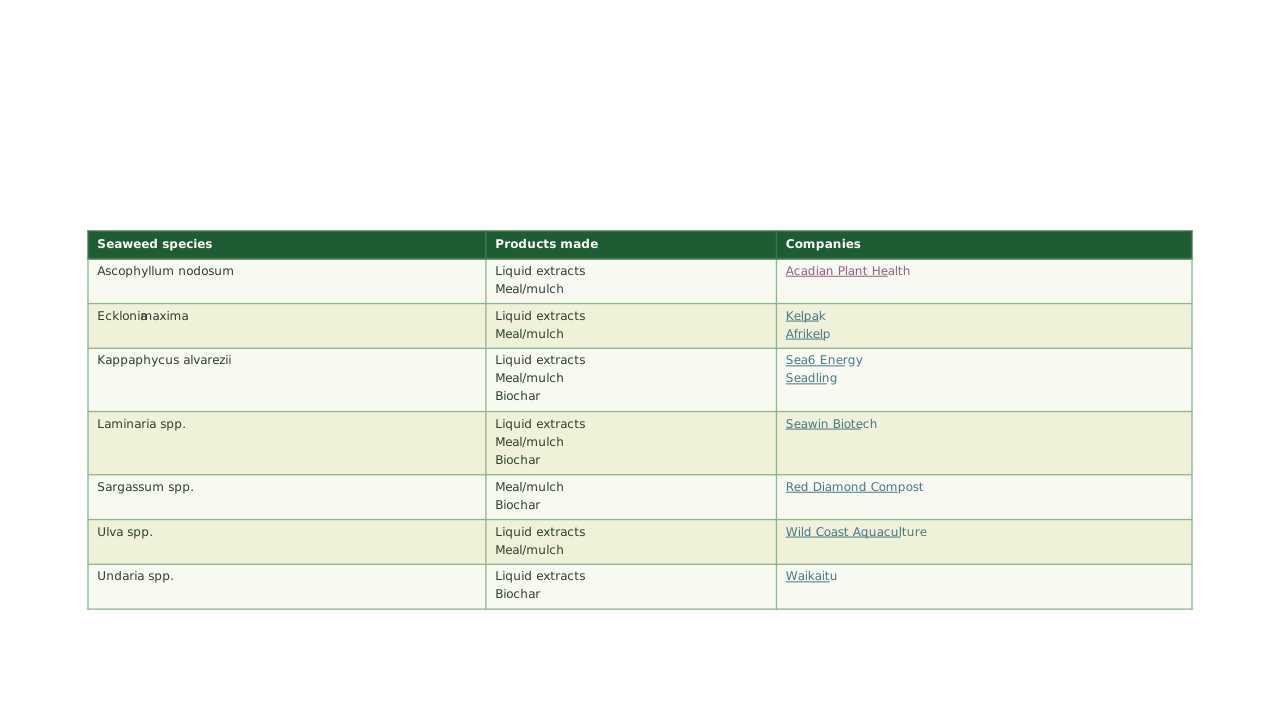
| Seaweed species | Products made | Companies |
| Ascophyllum nodosum | Liquid extracts Meal/mulch | Acadian Plant Health |
| Ecklonia maxima | Liquid extracts Meal/mulch | Kelpak Afrikelp |
| Kappaphycus alvarezii | Liquid extracts Meal/mulch Biochar | Sea6 Energy Seadling |
| Laminaria spp. | Liquid extracts Meal/mulch Biochar | Seawin Biotech |
| Sargassum spp. | Meal/mulch Biochar | Red Diamond Compost |
| Ulva spp. | Liquid extracts Meal/mulch | Wild Coast Aquaculture |
| Undaria spp. | Liquid extracts Biochar | Waikaitu |
Table 1. Examples of seaweed species used in agriculture supplement production and companies.
Harvesting and cultivation
Seaweed used for agriculture supplements are harvested wildly or cultivated, but it depends on the final product. For liquid extracts, the timing of harvest matters because because the seaweed’s chemical composition—key to product performance—changes with time, meriting cultivated approaches (Craigie et al., 2008; Featonby-Smith & Staden, 1984; Mooney & Staden, 1984). Timing of harvest for seaweed fertilizer meal/mulch and biochar is less relevant, permitting harvest of “waste” seaweed that has washed up on beaches or accumulated around waste management sites. Companies like Carbonwave are taking advantage of Sargassum blooms to harvest seaweed for agricultural supplements, reducing the risk of adverse ecological and economic impacts, while at the same time lowering production costs.Processing
Processing information is proprietary in most cases, but general processing methods and active R&D are detailed below for each final product covered in this chapter.Liquid Extracts
Four general techniques exist: alkaline, acid, physical disruption, and cell-burst. All methods aim to release soluble components within algal cells that contain compounds key to product performance; alkaline and acid conversions are unique in that they can impact extracts’ chemical compositions. Alkaline extraction is the most common method, and liquefies the whole seaweed into a slurry (Craigie, 2011; Craigie et al., 2008). Acid extraction and enzymatic and fermentative extractions also occur, the former most commonly as a pre-treatment before alkaline extraction (Battacharyya et al., 2015; Craigie, 2011; Craigie et al., 2008). Physical disruption or cell-burst technology conversions create a “micronized” suspension of fine particles released from the cells ( e.g., ~50 µm in diameter; Temple & Bomke, 1989). This can be achieved with low-temperature milling (e.g., cryo-crushing) or high-pressure forces (e.g., sub-critical water extraction) that rupture the cell walls (Battacharyya et al., 2015; Craigie, 2011; Geelen & Xu, 2020). After extraction, the final product is either dried into a soluble powder or prepared in liquid format. Liquid extract processes are summarized in Figure 1.
Figure 1. Example flowchart of alkaline extraction used to produce seaweed liquid extracts.
Novel cell disruption, cell-burst, and enzymatic extraction methods are being developed to cut down on extraction time, solvent usage, and energy needs (Table 2). Compared to traditional hot‑water extraction, microwave‑assisted extraction (MAE) delivers higher yields (6.17% vs. 5.2%) in a shorter time and with only a third of the solvent required (e.g., Yuan and Macquarrie, 2015; Sharma and Zalpouri, 2022). Furthermore, it can be applied directly in fresh biomass, avoiding one of the most energy-intensive steps in a seaweed-based product’s lifecycle (Zollmann et al., 2019). Ultrasound-assisted extraction (UAE) can also be used with fresh seaweed and avoids impacting heat-sensitive compounds. Furthermore, it can produce extracts with a fraction of the toxic chloride and sulfate concentrations retained in conventional high-pressure water extractions (for example, 12.5 mg/L of sulfate was retained using UAE versus 1520 mg/L using sub-critical water extraction; Zollman et al., 2019; Lewandowska et al., 2023). Enzyme-assisted extraction (EAE) uses hydrolytic enzymes (e.g., cellulase) to break down cell walls, where the enzymes used are specifically tailored to the plant’s cellular wall composition (e.g., cellulose; Choulot et al., 2025). Studies have demonstrated the potential of EAE to improve seaweed liquid extraction using commercial enzymes for terrestrial plants. For example, Naseri et al. (2020) treated Eucheuma denticulatum with Viscozyme® and produced 48.5% extraction efficiency, more than triple the efficiency of water-based extractions. MAE, UAE, and EAE are desirable for industry-scale use due to their specificity in targeting desirable compounds, higher yields compared to traditional methods, and lower environmental impact compared to current commercial methods. However, each is in varying levels of technological readiness. For example, excessive temperature and microwave power for MAE can degrade polysaccharides and reduce total yield, requiring fine-scale controls (Dobrinčić et al., 2020). UAE requires specialized equipment to control ultrasound waves as well as the surface tension and viscosity of the solvent for optimal performance (Bordoloi et al., 2020). EAE will provide maximum efficiency at scale if cost-effective seaweed-specific enzymes are developed (Matos et al., 2021).| Innovation | What it is / How it works | Claimed benefits | Readiness / Status |
| Microwave-assisted extraction (MAE) | Uses microwaves to break cell walls and release compounds in solvent or through vapor distillation | Higher yields, less solvent Can use fresh seaweed | Emerging / Laboratory experiments |
| Ultrasound-assisted extraction (UAE) | High-frequency waves increase cell porosity, allowing solvent penetration | Improved yields, scalable Does not impact heat-sensitive compounds Can use fresh seaweed | Emerging / Laboratory experiments |
| Enzyme-assisted extraction (EAE) | Hydrolytic enzymes break cell walls, releasing cell contents to solvent | Lower environmental impact | Emerging / Laboratory experiments |
Table 2. Alternate extraction techniques for seaweed liquid extract production, claimed benefits, and technological readiness/status.
Seaweed fertilizer meal/mulch
Meal/mulch processing uses wet seaweed biomass to preserve a seaweed’s nitrogen content, though excessive moisture can impact quality. It is processed through aeration composting or vermicomposting (using earthworms), either alone or with terrestrial bio-matter and/or manure (Ananthavalli et al., 2019; Biruntha et al., 2020; Dang et al., 2023). The seaweed is then ground into a meal or powder through mechanical disruption (Craigie, 2011). Active R&D is exploring different co-composting methods (i.e., composting seaweed with different terrestrial plant, fecal, or microorganism feedstocks) to produce carbon-to-nitrogen ratios more suitable for crops, decrease salinity and heavy metal concentrations, and boost degradation of polysaccharides and phenols (reviewed in Dang et al., 2023).Biochar
Seaweed biochar is produced through energy-intensive thermochemical conversion processes like pyrolysis, gasification, or hydrothermal carbonization (Table 3; Dang et al., 2023; Farghali et al., 2023). An active area of R&D is on reducing the energy needs to produce seaweed biochar at a quality beneficial to crops (Dang et al., 2023).| Conversion Method | Process Description | Typical Conditions | Yield & Carbon Content | Notable Characteristics |
| Pyrolysis | Dried and milled seaweed is heated in an oxygen-free environment to produce char. | 300–500°C ~24h drying at 60°C Particle size ~1–2 mm | 45–62% yield (slow pyrolysis at 450°C); higher ash and lower yield at higher temps | Most common method. High temps reduce Environmentally Persistent Free Radicals (EPFRs), which can harm crops. |
| Hydrothermal Carbonization (HTC) | Wet seaweed is treated with hot compressed water to produce a hydrochar. | 180°C for 6h or 800°C for 2h | Ascophyllum nodosum: 81.7% yield, carbon increased from 35.1% to 56.2% Eucheuma cottonii: 7.5% yield at 800°C | Lower surface area than terrestrial biochar. Pre/post-treatments (e.g., KOH activation, water washing) increase porosity. Mixed-method HTC+pyrolysis approaches can optimize yield and quality. |
| Gasification | Dried seaweed reacts with oxygen/air or steam to produce gas and char. | 700–1,200°C Fixed- or fluidized-bed reactors | Generally lower yield than pyrolysis or HTC | Produces biochar with higher ash, volatile matter, and mineral content. High water/protein/mineral content affects decomposition and performance. High temps (>700°C) may reduce quality. |
Table 3. Biochar conversion methods, typical conditions and performance, and notable characteristics.
Cascading biorefineries
Cascading biorefineries seek to produce multiple final products from the waste of other workstreams to use the “whole seaweed” and cut on production costs. For example, Pascual et al. (2020) found that using fermented seaweed sludge byproduct from seaweed water production significantly out-performed conventional fertilizer for growing Lactuca lettuce. Processing liquid extracts as a byproduct of existing (e.g., algin, hydrocolloid) and emerging industries (e.g., biofuel) is also being explored (Dang et al., 2023; Farghali et al., 2023; Seghetta et al., 2016)Species Selection, Cultivation and Harvesting
Species Selection
There are over 10,000 species of seaweed that vary substantially in chemical composition across geography, life cycle, and seasonality. These factors determine the concentration of bioactive compounds most desirable for product performance specific to crops’ needs. Brown (e.g., Ascophyllum nodosum, Laminaria, Sargassum, Ecklonia maxima, Undaria) and red (e.g., Kappaphycus alvarezii) species are more commonly used due to their fast growth and large size, followed by green species (e.g., Ulva). Table 1 summarizes species used in commercial agriculture supplement production.| Seaweed species | Products made | Companies |
| Ascophyllum nodosum | Liquid extracts Meal/mulch | Acadian Plant Health |
| Ecklonia maxima | Liquid extracts Meal/mulch | Kelpak Afrikelp |
| Kappaphycus alvarezii | Liquid extracts Meal/mulch Biochar | Sea6 Energy Seadling |
| Laminaria spp. | Liquid extracts Meal/mulch Biochar | Seawin Biotech |
| Sargassum spp. | Meal/mulch Biochar | Red Diamond Compost |
| Ulva spp. | Liquid extracts Meal/mulch | Wild Coast Aquaculture |
| Undaria spp. | Liquid extracts Biochar | Waikaitu |
Table 1. Examples of seaweed species used in agriculture supplement production and companies.
Harvesting and cultivation
Seaweed used for agriculture supplements are harvested wildly or cultivated, but it depends on the final product. For liquid extracts, the timing of harvest matters because because the seaweed’s chemical composition—key to product performance—changes with time, meriting cultivated approaches (Craigie et al., 2008; Featonby-Smith & Staden, 1984; Mooney & Staden, 1984). Timing of harvest for seaweed fertilizer meal/mulch and biochar is less relevant, permitting harvest of “waste” seaweed that has washed up on beaches or accumulated around waste management sites. Companies like Carbonwave are taking advantage of Sargassum blooms to harvest seaweed for agricultural supplements, reducing the risk of adverse ecological and economic impacts, while at the same time lowering production costs.Processing
Processing information is proprietary in most cases, but general processing methods and active R&D are detailed below for each final product covered in this chapter.Liquid Extracts
Four general techniques exist: alkaline, acid, physical disruption, and cell-burst. All methods aim to release soluble components within algal cells that contain compounds key to product performance; alkaline and acid conversions are unique in that they can impact extracts’ chemical compositions. Alkaline extraction is the most common method, and liquefies the whole seaweed into a slurry (Craigie, 2011; Craigie et al., 2008). Acid extraction and enzymatic and fermentative extractions also occur, the former most commonly as a pre-treatment before alkaline extraction (Battacharyya et al., 2015; Craigie, 2011; Craigie et al., 2008). Physical disruption or cell-burst technology conversions create a “micronized” suspension of fine particles released from the cells ( e.g., ~50 µm in diameter; Temple & Bomke, 1989). This can be achieved with low-temperature milling (e.g., cryo-crushing) or high-pressure forces (e.g., sub-critical water extraction) that rupture the cell walls (Battacharyya et al., 2015; Craigie, 2011; Geelen & Xu, 2020). After extraction, the final product is either dried into a soluble powder or prepared in liquid format. Liquid extract processes are summarized in Figure 1.
Figure 1. Example flowchart of alkaline extraction used to produce seaweed liquid extracts.
Novel cell disruption, cell-burst, and enzymatic extraction methods are being developed to cut down on extraction time, solvent usage, and energy needs (Table 2). Compared to traditional hot‑water extraction, microwave‑assisted extraction (MAE) delivers higher yields (6.17% vs. 5.2%) in a shorter time and with only a third of the solvent required (e.g., Yuan and Macquarrie, 2015; Sharma and Zalpouri, 2022). Furthermore, it can be applied directly in fresh biomass, avoiding one of the most energy-intensive steps in a seaweed-based product’s lifecycle (Zollmann et al., 2019). Ultrasound-assisted extraction (UAE) can also be used with fresh seaweed and avoids impacting heat-sensitive compounds. Furthermore, it can produce extracts with a fraction of the toxic chloride and sulfate concentrations retained in conventional high-pressure water extractions (for example, 12.5 mg/L of sulfate was retained using UAE versus 1520 mg/L using sub-critical water extraction; Zollman et al., 2019; Lewandowska et al., 2023). Enzyme-assisted extraction (EAE) uses hydrolytic enzymes (e.g., cellulase) to break down cell walls, where the enzymes used are specifically tailored to the plant’s cellular wall composition (e.g., cellulose; Choulot et al., 2025). Studies have demonstrated the potential of EAE to improve seaweed liquid extraction using commercial enzymes for terrestrial plants. For example, Naseri et al. (2020) treated Eucheuma denticulatum with Viscozyme® and produced 48.5% extraction efficiency, more than triple the efficiency of water-based extractions. MAE, UAE, and EAE are desirable for industry-scale use due to their specificity in targeting desirable compounds, higher yields compared to traditional methods, and lower environmental impact compared to current commercial methods. However, each is in varying levels of technological readiness. For example, excessive temperature and microwave power for MAE can degrade polysaccharides and reduce total yield, requiring fine-scale controls (Dobrinčić et al., 2020). UAE requires specialized equipment to control ultrasound waves as well as the surface tension and viscosity of the solvent for optimal performance (Bordoloi et al., 2020). EAE will provide maximum efficiency at scale if cost-effective seaweed-specific enzymes are developed (Matos et al., 2021).| Innovation | What it is / How it works | Claimed benefits | Readiness / Status |
| Microwave-assisted extraction (MAE) | Uses microwaves to break cell walls and release compounds in solvent or through vapor distillation | Higher yields, less solvent Can use fresh seaweed | Emerging / Laboratory experiments |
| Ultrasound-assisted extraction (UAE) | High-frequency waves increase cell porosity, allowing solvent penetration | Improved yields, scalable Does not impact heat-sensitive compounds Can use fresh seaweed | Emerging / Laboratory experiments |
| Enzyme-assisted extraction (EAE) | Hydrolytic enzymes break cell walls, releasing cell contents to solvent | Lower environmental impact | Emerging / Laboratory experiments |
Table 2. Alternate extraction techniques for seaweed liquid extract production, claimed benefits, and technological readiness/status.
Seaweed fertilizer meal/mulch
Meal/mulch processing uses wet seaweed biomass to preserve a seaweed’s nitrogen content, though excessive moisture can impact quality. It is processed through aeration composting or vermicomposting (using earthworms), either alone or with terrestrial bio-matter and/or manure (Ananthavalli et al., 2019; Biruntha et al., 2020; Dang et al., 2023). The seaweed is then ground into a meal or powder through mechanical disruption (Craigie, 2011). Active R&D is exploring different co-composting methods (i.e., composting seaweed with different terrestrial plant, fecal, or microorganism feedstocks) to produce carbon-to-nitrogen ratios more suitable for crops, decrease salinity and heavy metal concentrations, and boost degradation of polysaccharides and phenols (reviewed in Dang et al., 2023).Biochar
Seaweed biochar is produced through energy-intensive thermochemical conversion processes like pyrolysis, gasification, or hydrothermal carbonization (Table 3; Dang et al., 2023; Farghali et al., 2023). An active area of R&D is on reducing the energy needs to produce seaweed biochar at a quality beneficial to crops (Dang et al., 2023).| Conversion Method | Process Description | Typical Conditions | Yield & Carbon Content | Notable Characteristics |
| Pyrolysis | Dried and milled seaweed is heated in an oxygen-free environment to produce char. | 300–500°C ~24h drying at 60°C Particle size ~1–2 mm | 45–62% yield (slow pyrolysis at 450°C); higher ash and lower yield at higher temps | Most common method. High temps reduce Environmentally Persistent Free Radicals (EPFRs), which can harm crops. |
| Hydrothermal Carbonization (HTC) | Wet seaweed is treated with hot compressed water to produce a hydrochar. | 180°C for 6h or 800°C for 2h | Ascophyllum nodosum: 81.7% yield, carbon increased from 35.1% to 56.2% Eucheuma cottonii: 7.5% yield at 800°C | Lower surface area than terrestrial biochar. Pre/post-treatments (e.g., KOH activation, water washing) increase porosity. Mixed-method HTC+pyrolysis approaches can optimize yield and quality. |
| Gasification | Dried seaweed reacts with oxygen/air or steam to produce gas and char. | 700–1,200°C Fixed- or fluidized-bed reactors | Generally lower yield than pyrolysis or HTC | Produces biochar with higher ash, volatile matter, and mineral content. High water/protein/mineral content affects decomposition and performance. High temps (>700°C) may reduce quality. |
Table 3. Biochar conversion methods, typical conditions and performance, and notable characteristics.
Cascading biorefineries
Cascading biorefineries seek to produce multiple final products from the waste of other workstreams to use the “whole seaweed” and cut on production costs. For example, Pascual et al. (2020) found that using fermented seaweed sludge byproduct from seaweed water production significantly out-performed conventional fertilizer for growing Lactuca lettuce. Processing liquid extracts as a byproduct of existing (e.g., algin, hydrocolloid) and emerging industries (e.g., biofuel) is also being explored (Dang et al., 2023; Farghali et al., 2023; Seghetta et al., 2016)Species Selection, Cultivation and Harvesting
Species Selection
There are over 10,000 species of seaweed that vary substantially in chemical composition across geography, life cycle, and seasonality. These factors determine the concentration of bioactive compounds most desirable for product performance specific to crops’ needs. Brown (e.g., Ascophyllum nodosum, Laminaria, Sargassum, Ecklonia maxima, Undaria) and red (e.g., Kappaphycus alvarezii) species are more commonly used due to their fast growth and large size, followed by green species (e.g., Ulva). Table 1 summarizes species used in commercial agriculture supplement production.| Seaweed species | Products made | Companies |
| Ascophyllum nodosum | Liquid extracts Meal/mulch | Acadian Plant Health |
| Ecklonia maxima | Liquid extracts Meal/mulch | Kelpak Afrikelp |
| Kappaphycus alvarezii | Liquid extracts Meal/mulch Biochar | Sea6 Energy Seadling |
| Laminaria spp. | Liquid extracts Meal/mulch Biochar | Seawin Biotech |
| Sargassum spp. | Meal/mulch Biochar | Red Diamond Compost |
| Ulva spp. | Liquid extracts Meal/mulch | Wild Coast Aquaculture |
| Undaria spp. | Liquid extracts Biochar | Waikaitu |
Table 1. Examples of seaweed species used in agriculture supplement production and companies.
Harvesting and cultivation
Seaweed used for agriculture supplements are harvested wildly or cultivated, but it depends on the final product. For liquid extracts, the timing of harvest matters because because the seaweed’s chemical composition—key to product performance—changes with time, meriting cultivated approaches (Craigie et al., 2008; Featonby-Smith & Staden, 1984; Mooney & Staden, 1984). Timing of harvest for seaweed fertilizer meal/mulch and biochar is less relevant, permitting harvest of “waste” seaweed that has washed up on beaches or accumulated around waste management sites. Companies like Carbonwave are taking advantage of Sargassum blooms to harvest seaweed for agricultural supplements, reducing the risk of adverse ecological and economic impacts, while at the same time lowering production costs.Processing
Processing information is proprietary in most cases, but general processing methods and active R&D are detailed below for each final product covered in this chapter.Liquid Extracts
Four general techniques exist: alkaline, acid, physical disruption, and cell-burst. All methods aim to release soluble components within algal cells that contain compounds key to product performance; alkaline and acid conversions are unique in that they can impact extracts’ chemical compositions. Alkaline extraction is the most common method, and liquefies the whole seaweed into a slurry (Craigie, 2011; Craigie et al., 2008). Acid extraction and enzymatic and fermentative extractions also occur, the former most commonly as a pre-treatment before alkaline extraction (Battacharyya et al., 2015; Craigie, 2011; Craigie et al., 2008). Physical disruption or cell-burst technology conversions create a “micronized” suspension of fine particles released from the cells ( e.g., ~50 µm in diameter; Temple & Bomke, 1989). This can be achieved with low-temperature milling (e.g., cryo-crushing) or high-pressure forces (e.g., sub-critical water extraction) that rupture the cell walls (Battacharyya et al., 2015; Craigie, 2011; Geelen & Xu, 2020). After extraction, the final product is either dried into a soluble powder or prepared in liquid format. Liquid extract processes are summarized in Figure 1.
Figure 1. Example flowchart of alkaline extraction used to produce seaweed liquid extracts.
Novel cell disruption, cell-burst, and enzymatic extraction methods are being developed to cut down on extraction time, solvent usage, and energy needs (Table 2). Compared to traditional hot‑water extraction, microwave‑assisted extraction (MAE) delivers higher yields (6.17% vs. 5.2%) in a shorter time and with only a third of the solvent required (e.g., Yuan and Macquarrie, 2015; Sharma and Zalpouri, 2022). Furthermore, it can be applied directly in fresh biomass, avoiding one of the most energy-intensive steps in a seaweed-based product’s lifecycle (Zollmann et al., 2019). Ultrasound-assisted extraction (UAE) can also be used with fresh seaweed and avoids impacting heat-sensitive compounds. Furthermore, it can produce extracts with a fraction of the toxic chloride and sulfate concentrations retained in conventional high-pressure water extractions (for example, 12.5 mg/L of sulfate was retained using UAE versus 1520 mg/L using sub-critical water extraction; Zollman et al., 2019; Lewandowska et al., 2023). Enzyme-assisted extraction (EAE) uses hydrolytic enzymes (e.g., cellulase) to break down cell walls, where the enzymes used are specifically tailored to the plant’s cellular wall composition (e.g., cellulose; Choulot et al., 2025). Studies have demonstrated the potential of EAE to improve seaweed liquid extraction using commercial enzymes for terrestrial plants. For example, Naseri et al. (2020) treated Eucheuma denticulatum with Viscozyme® and produced 48.5% extraction efficiency, more than triple the efficiency of water-based extractions. MAE, UAE, and EAE are desirable for industry-scale use due to their specificity in targeting desirable compounds, higher yields compared to traditional methods, and lower environmental impact compared to current commercial methods. However, each is in varying levels of technological readiness. For example, excessive temperature and microwave power for MAE can degrade polysaccharides and reduce total yield, requiring fine-scale controls (Dobrinčić et al., 2020). UAE requires specialized equipment to control ultrasound waves as well as the surface tension and viscosity of the solvent for optimal performance (Bordoloi et al., 2020). EAE will provide maximum efficiency at scale if cost-effective seaweed-specific enzymes are developed (Matos et al., 2021).| Innovation | What it is / How it works | Claimed benefits | Readiness / Status |
| Microwave-assisted extraction (MAE) | Uses microwaves to break cell walls and release compounds in solvent or through vapor distillation | Higher yields, less solvent Can use fresh seaweed | Emerging / Laboratory experiments |
| Ultrasound-assisted extraction (UAE) | High-frequency waves increase cell porosity, allowing solvent penetration | Improved yields, scalable Does not impact heat-sensitive compounds Can use fresh seaweed | Emerging / Laboratory experiments |
| Enzyme-assisted extraction (EAE) | Hydrolytic enzymes break cell walls, releasing cell contents to solvent | Lower environmental impact | Emerging / Laboratory experiments |
Table 2. Alternate extraction techniques for seaweed liquid extract production, claimed benefits, and technological readiness/status.
Seaweed fertilizer meal/mulch
Meal/mulch processing uses wet seaweed biomass to preserve a seaweed’s nitrogen content, though excessive moisture can impact quality. It is processed through aeration composting or vermicomposting (using earthworms), either alone or with terrestrial bio-matter and/or manure (Ananthavalli et al., 2019; Biruntha et al., 2020; Dang et al., 2023). The seaweed is then ground into a meal or powder through mechanical disruption (Craigie, 2011). Active R&D is exploring different co-composting methods (i.e., composting seaweed with different terrestrial plant, fecal, or microorganism feedstocks) to produce carbon-to-nitrogen ratios more suitable for crops, decrease salinity and heavy metal concentrations, and boost degradation of polysaccharides and phenols (reviewed in Dang et al., 2023).Biochar
Seaweed biochar is produced through energy-intensive thermochemical conversion processes like pyrolysis, gasification, or hydrothermal carbonization (Table 3; Dang et al., 2023; Farghali et al., 2023). An active area of R&D is on reducing the energy needs to produce seaweed biochar at a quality beneficial to crops (Dang et al., 2023).| Conversion Method | Process Description | Typical Conditions | Yield & Carbon Content | Notable Characteristics |
| Pyrolysis | Dried and milled seaweed is heated in an oxygen-free environment to produce char. | 300–500°C ~24h drying at 60°C Particle size ~1–2 mm | 45–62% yield (slow pyrolysis at 450°C); higher ash and lower yield at higher temps | Most common method. High temps reduce Environmentally Persistent Free Radicals (EPFRs), which can harm crops. |
| Hydrothermal Carbonization (HTC) | Wet seaweed is treated with hot compressed water to produce a hydrochar. | 180°C for 6h or 800°C for 2h | Ascophyllum nodosum: 81.7% yield, carbon increased from 35.1% to 56.2% Eucheuma cottonii: 7.5% yield at 800°C | Lower surface area than terrestrial biochar. Pre/post-treatments (e.g., KOH activation, water washing) increase porosity. Mixed-method HTC+pyrolysis approaches can optimize yield and quality. |
| Gasification | Dried seaweed reacts with oxygen/air or steam to produce gas and char. | 700–1,200°C Fixed- or fluidized-bed reactors | Generally lower yield than pyrolysis or HTC | Produces biochar with higher ash, volatile matter, and mineral content. High water/protein/mineral content affects decomposition and performance. High temps (>700°C) may reduce quality. |
Table 3. Biochar conversion methods, typical conditions and performance, and notable characteristics.
Cascading biorefineries
Cascading biorefineries seek to produce multiple final products from the waste of other workstreams to use the “whole seaweed” and cut on production costs. For example, Pascual et al. (2020) found that using fermented seaweed sludge byproduct from seaweed water production significantly out-performed conventional fertilizer for growing Lactuca lettuce. Processing liquid extracts as a byproduct of existing (e.g., algin, hydrocolloid) and emerging industries (e.g., biofuel) is also being explored (Dang et al., 2023; Farghali et al., 2023; Seghetta et al., 2016)Species Selection, Cultivation and Harvesting
Species Selection
There are over 10,000 species of seaweed that vary substantially in chemical composition across geography, life cycle, and seasonality. These factors determine the concentration of bioactive compounds most desirable for product performance specific to crops’ needs. Brown (e.g., Ascophyllum nodosum, Laminaria, Sargassum, Ecklonia maxima, Undaria) and red (e.g., Kappaphycus alvarezii) species are more commonly used due to their fast growth and large size, followed by green species (e.g., Ulva). Table 1 summarizes species used in commercial agriculture supplement production.| Seaweed species | Products made | Companies |
| Ascophyllum nodosum | Liquid extracts Meal/mulch | Acadian Plant Health |
| Ecklonia maxima | Liquid extracts Meal/mulch | Kelpak Afrikelp |
| Kappaphycus alvarezii | Liquid extracts Meal/mulch Biochar | Sea6 Energy Seadling |
| Laminaria spp. | Liquid extracts Meal/mulch Biochar | Seawin Biotech |
| Sargassum spp. | Meal/mulch Biochar | Red Diamond Compost |
| Ulva spp. | Liquid extracts Meal/mulch | Wild Coast Aquaculture |
| Undaria spp. | Liquid extracts Biochar | Waikaitu |
Table 1. Examples of seaweed species used in agriculture supplement production and companies.
Harvesting and cultivation
Seaweed used for agriculture supplements are harvested wildly or cultivated, but it depends on the final product. For liquid extracts, the timing of harvest matters because because the seaweed’s chemical composition—key to product performance—changes with time, meriting cultivated approaches (Craigie et al., 2008; Featonby-Smith & Staden, 1984; Mooney & Staden, 1984). Timing of harvest for seaweed fertilizer meal/mulch and biochar is less relevant, permitting harvest of “waste” seaweed that has washed up on beaches or accumulated around waste management sites. Companies like Carbonwave are taking advantage of Sargassum blooms to harvest seaweed for agricultural supplements, reducing the risk of adverse ecological and economic impacts, while at the same time lowering production costs.Processing
Processing information is proprietary in most cases, but general processing methods and active R&D are detailed below for each final product covered in this chapter.Liquid Extracts
Four general techniques exist: alkaline, acid, physical disruption, and cell-burst. All methods aim to release soluble components within algal cells that contain compounds key to product performance; alkaline and acid conversions are unique in that they can impact extracts’ chemical compositions. Alkaline extraction is the most common method, and liquefies the whole seaweed into a slurry (Craigie, 2011; Craigie et al., 2008). Acid extraction and enzymatic and fermentative extractions also occur, the former most commonly as a pre-treatment before alkaline extraction (Battacharyya et al., 2015; Craigie, 2011; Craigie et al., 2008). Physical disruption or cell-burst technology conversions create a “micronized” suspension of fine particles released from the cells ( e.g., ~50 µm in diameter; Temple & Bomke, 1989). This can be achieved with low-temperature milling (e.g., cryo-crushing) or high-pressure forces (e.g., sub-critical water extraction) that rupture the cell walls (Battacharyya et al., 2015; Craigie, 2011; Geelen & Xu, 2020). After extraction, the final product is either dried into a soluble powder or prepared in liquid format. Liquid extract processes are summarized in Figure 1.
Figure 1. Example flowchart of alkaline extraction used to produce seaweed liquid extracts.
Novel cell disruption, cell-burst, and enzymatic extraction methods are being developed to cut down on extraction time, solvent usage, and energy needs (Table 2). Compared to traditional hot‑water extraction, microwave‑assisted extraction (MAE) delivers higher yields (6.17% vs. 5.2%) in a shorter time and with only a third of the solvent required (e.g., Yuan and Macquarrie, 2015; Sharma and Zalpouri, 2022). Furthermore, it can be applied directly in fresh biomass, avoiding one of the most energy-intensive steps in a seaweed-based product’s lifecycle (Zollmann et al., 2019). Ultrasound-assisted extraction (UAE) can also be used with fresh seaweed and avoids impacting heat-sensitive compounds. Furthermore, it can produce extracts with a fraction of the toxic chloride and sulfate concentrations retained in conventional high-pressure water extractions (for example, 12.5 mg/L of sulfate was retained using UAE versus 1520 mg/L using sub-critical water extraction; Zollman et al., 2019; Lewandowska et al., 2023). Enzyme-assisted extraction (EAE) uses hydrolytic enzymes (e.g., cellulase) to break down cell walls, where the enzymes used are specifically tailored to the plant’s cellular wall composition (e.g., cellulose; Choulot et al., 2025). Studies have demonstrated the potential of EAE to improve seaweed liquid extraction using commercial enzymes for terrestrial plants. For example, Naseri et al. (2020) treated Eucheuma denticulatum with Viscozyme® and produced 48.5% extraction efficiency, more than triple the efficiency of water-based extractions. MAE, UAE, and EAE are desirable for industry-scale use due to their specificity in targeting desirable compounds, higher yields compared to traditional methods, and lower environmental impact compared to current commercial methods. However, each is in varying levels of technological readiness. For example, excessive temperature and microwave power for MAE can degrade polysaccharides and reduce total yield, requiring fine-scale controls (Dobrinčić et al., 2020). UAE requires specialized equipment to control ultrasound waves as well as the surface tension and viscosity of the solvent for optimal performance (Bordoloi et al., 2020). EAE will provide maximum efficiency at scale if cost-effective seaweed-specific enzymes are developed (Matos et al., 2021).| Innovation | What it is / How it works | Claimed benefits | Readiness / Status |
| Microwave-assisted extraction (MAE) | Uses microwaves to break cell walls and release compounds in solvent or through vapor distillation | Higher yields, less solvent Can use fresh seaweed | Emerging / Laboratory experiments |
| Ultrasound-assisted extraction (UAE) | High-frequency waves increase cell porosity, allowing solvent penetration | Improved yields, scalable Does not impact heat-sensitive compounds Can use fresh seaweed | Emerging / Laboratory experiments |
| Enzyme-assisted extraction (EAE) | Hydrolytic enzymes break cell walls, releasing cell contents to solvent | Lower environmental impact | Emerging / Laboratory experiments |
Table 2. Alternate extraction techniques for seaweed liquid extract production, claimed benefits, and technological readiness/status.
Seaweed fertilizer meal/mulch
Meal/mulch processing uses wet seaweed biomass to preserve a seaweed’s nitrogen content, though excessive moisture can impact quality. It is processed through aeration composting or vermicomposting (using earthworms), either alone or with terrestrial bio-matter and/or manure (Ananthavalli et al., 2019; Biruntha et al., 2020; Dang et al., 2023). The seaweed is then ground into a meal or powder through mechanical disruption (Craigie, 2011). Active R&D is exploring different co-composting methods (i.e., composting seaweed with different terrestrial plant, fecal, or microorganism feedstocks) to produce carbon-to-nitrogen ratios more suitable for crops, decrease salinity and heavy metal concentrations, and boost degradation of polysaccharides and phenols (reviewed in Dang et al., 2023).Biochar
Seaweed biochar is produced through energy-intensive thermochemical conversion processes like pyrolysis, gasification, or hydrothermal carbonization (Table 3; Dang et al., 2023; Farghali et al., 2023). An active area of R&D is on reducing the energy needs to produce seaweed biochar at a quality beneficial to crops (Dang et al., 2023).| Conversion Method | Process Description | Typical Conditions | Yield & Carbon Content | Notable Characteristics |
| Pyrolysis | Dried and milled seaweed is heated in an oxygen-free environment to produce char. | 300–500°C ~24h drying at 60°C Particle size ~1–2 mm | 45–62% yield (slow pyrolysis at 450°C); higher ash and lower yield at higher temps | Most common method. High temps reduce Environmentally Persistent Free Radicals (EPFRs), which can harm crops. |
| Hydrothermal Carbonization (HTC) | Wet seaweed is treated with hot compressed water to produce a hydrochar. | 180°C for 6h or 800°C for 2h | Ascophyllum nodosum: 81.7% yield, carbon increased from 35.1% to 56.2% Eucheuma cottonii: 7.5% yield at 800°C | Lower surface area than terrestrial biochar. Pre/post-treatments (e.g., KOH activation, water washing) increase porosity. Mixed-method HTC+pyrolysis approaches can optimize yield and quality. |
| Gasification | Dried seaweed reacts with oxygen/air or steam to produce gas and char. | 700–1,200°C Fixed- or fluidized-bed reactors | Generally lower yield than pyrolysis or HTC | Produces biochar with higher ash, volatile matter, and mineral content. High water/protein/mineral content affects decomposition and performance. High temps (>700°C) may reduce quality. |
Table 3. Biochar conversion methods, typical conditions and performance, and notable characteristics.
Cascading biorefineries
Cascading biorefineries seek to produce multiple final products from the waste of other workstreams to use the “whole seaweed” and cut on production costs. For example, Pascual et al. (2020) found that using fermented seaweed sludge byproduct from seaweed water production significantly out-performed conventional fertilizer for growing Lactuca lettuce. Processing liquid extracts as a byproduct of existing (e.g., algin, hydrocolloid) and emerging industries (e.g., biofuel) is also being explored (Dang et al., 2023; Farghali et al., 2023; Seghetta et al., 2016)Species Selection, Cultivation and Harvesting
Species Selection
There are over 10,000 species of seaweed that vary substantially in chemical composition across geography, life cycle, and seasonality. These factors determine the concentration of bioactive compounds most desirable for product performance specific to crops’ needs. Brown (e.g., Ascophyllum nodosum, Laminaria, Sargassum, Ecklonia maxima, Undaria) and red (e.g., Kappaphycus alvarezii) species are more commonly used due to their fast growth and large size, followed by green species (e.g., Ulva). Table 1 summarizes species used in commercial agriculture supplement production.| Seaweed species | Products made | Companies |
| Ascophyllum nodosum | Liquid extracts Meal/mulch | Acadian Plant Health |
| Ecklonia maxima | Liquid extracts Meal/mulch | Kelpak Afrikelp |
| Kappaphycus alvarezii | Liquid extracts Meal/mulch Biochar | Sea6 Energy Seadling |
| Laminaria spp. | Liquid extracts Meal/mulch Biochar | Seawin Biotech |
| Sargassum spp. | Meal/mulch Biochar | Red Diamond Compost |
| Ulva spp. | Liquid extracts Meal/mulch | Wild Coast Aquaculture |
| Undaria spp. | Liquid extracts Biochar | Waikaitu |
Harvesting and cultivation
Seaweed used for agriculture supplements are harvested wildly or cultivated, but it depends on the final product. For liquid extracts, the timing of harvest matters because because the seaweed’s chemical composition—key to product performance—changes with time, meriting cultivated approaches (Craigie et al., 2008; Featonby-Smith & Staden, 1984; Mooney & Staden, 1984). Timing of harvest for seaweed fertilizer meal/mulch and biochar is less relevant, permitting harvest of “waste” seaweed that has washed up on beaches or accumulated around waste management sites. Companies like Carbonwave are taking advantage of Sargassum blooms to harvest seaweed for agricultural supplements, reducing the risk of adverse ecological and economic impacts, while at the same time lowering production costs.Processing
Processing information is proprietary in most cases, but general processing methods and active R&D are detailed below for each final product covered in this chapter.Liquid Extracts
Four general techniques exist: alkaline, acid, physical disruption, and cell-burst. All methods aim to release soluble components within algal cells that contain compounds key to product performance; alkaline and acid conversions are unique in that they can impact extracts’ chemical compositions. Alkaline extraction is the most common method, and liquefies the whole seaweed into a slurry (Craigie, 2011; Craigie et al., 2008). Acid extraction and enzymatic and fermentative extractions also occur, the former most commonly as a pre-treatment before alkaline extraction (Battacharyya et al., 2015; Craigie, 2011; Craigie et al., 2008). Physical disruption or cell-burst technology conversions create a “micronized” suspension of fine particles released from the cells ( e.g., ~50 µm in diameter; Temple & Bomke, 1989). This can be achieved with low-temperature milling (e.g., cryo-crushing) or high-pressure forces (e.g., sub-critical water extraction) that rupture the cell walls (Battacharyya et al., 2015; Craigie, 2011; Geelen & Xu, 2020). After extraction, the final product is either dried into a soluble powder or prepared in liquid format. Liquid extract processes are summarized in Figure 1.
Figure 1. Example flowchart of alkaline extraction used to produce seaweed liquid extracts.
Novel cell disruption, cell-burst, and enzymatic extraction methods are being developed to cut down on extraction time, solvent usage, and energy needs (Table 2). Compared to traditional hot‑water extraction, microwave‑assisted extraction (MAE) delivers higher yields (6.17% vs. 5.2%) in a shorter time and with only a third of the solvent required (e.g., Yuan and Macquarrie, 2015; Sharma and Zalpouri, 2022). Furthermore, it can be applied directly in fresh biomass, avoiding one of the most energy-intensive steps in a seaweed-based product’s lifecycle (Zollmann et al., 2019). Ultrasound-assisted extraction (UAE) can also be used with fresh seaweed and avoids impacting heat-sensitive compounds. Furthermore, it can produce extracts with a fraction of the toxic chloride and sulfate concentrations retained in conventional high-pressure water extractions (for example, 12.5 mg/L of sulfate was retained using UAE versus 1520 mg/L using sub-critical water extraction; Zollman et al., 2019; Lewandowska et al., 2023). Enzyme-assisted extraction (EAE) uses hydrolytic enzymes (e.g., cellulase) to break down cell walls, where the enzymes used are specifically tailored to the plant’s cellular wall composition (e.g., cellulose; Choulot et al., 2025). Studies have demonstrated the potential of EAE to improve seaweed liquid extraction using commercial enzymes for terrestrial plants. For example, Naseri et al. (2020) treated Eucheuma denticulatum with Viscozyme® and produced 48.5% extraction efficiency, more than triple the efficiency of water-based extractions.
MAE, UAE, and EAE are desirable for industry-scale use due to their specificity in targeting desirable compounds, higher yields compared to traditional methods, and lower environmental impact compared to current commercial methods. However, each is in varying levels of technological readiness. For example, excessive temperature and microwave power for MAE can degrade polysaccharides and reduce total yield, requiring fine-scale controls (
| Innovation | What it is / How it works | Claimed benefits | Readiness / Status |
| Microwave-assisted extraction (MAE) | Uses microwaves to break cell walls and release compounds in solvent or through vapor distillation | Higher yields, less solvent Can use fresh seaweed | Emerging / Laboratory experiments |
| Ultrasound-assisted extraction (UAE) | High-frequency waves increase cell porosity, allowing solvent penetration | Improved yields, scalable Does not impact heat-sensitive compounds Can use fresh seaweed | Emerging / Laboratory experiments |
| Enzyme-assisted extraction (EAE) | Hydrolytic enzymes break cell walls, releasing cell contents to solvent | Lower environmental impact | Emerging / Laboratory experiments |
Seaweed fertilizer meal/mulch
Meal/mulch processing uses wet seaweed biomass to preserve a seaweed’s nitrogen content, though excessive moisture can impact quality. It is processed through aeration composting or vermicomposting (using earthworms), either alone or with terrestrial bio-matter and/or manure (Ananthavalli et al., 2019; Biruntha et al., 2020; Dang et al., 2023). The seaweed is then ground into a meal or powder through mechanical disruption (Craigie, 2011). Active R&D is exploring different co-composting methods (i.e., composting seaweed with different terrestrial plant, fecal, or microorganism feedstocks) to produce carbon-to-nitrogen ratios more suitable for crops, decrease salinity and heavy metal concentrations, and boost degradation of polysaccharides and phenols (reviewed in Dang et al., 2023).Biochar
Seaweed biochar is produced through energy-intensive thermochemical conversion processes like pyrolysis, gasification, or hydrothermal carbonization (Table 3; Dang et al., 2023; Farghali et al., 2023). An active area of R&D is on reducing the energy needs to produce seaweed biochar at a quality beneficial to crops (Dang et al., 2023).| Conversion Method | Process Description | Typical Conditions | Yield & Carbon Content | Notable Characteristics |
| Pyrolysis | Dried and milled seaweed is heated in an oxygen-free environment to produce char. | 300–500°C ~24h drying at 60°C Particle size ~1–2 mm | 45–62% yield (slow pyrolysis at 450°C); higher ash and lower yield at higher temps | Most common method. High temps reduce Environmentally Persistent Free Radicals (EPFRs), which can harm crops. |
| Hydrothermal Carbonization (HTC) | Wet seaweed is treated with hot compressed water to produce a hydrochar. | 180°C for 6h or 800°C for 2h | Ascophyllum nodosum: 81.7% yield, carbon increased from 35.1% to 56.2% Eucheuma cottonii: 7.5% yield at 800°C | Lower surface area than terrestrial biochar. Pre/post-treatments (e.g., KOH activation, water washing) increase porosity. Mixed-method HTC+pyrolysis approaches can optimize yield and quality. |
| Gasification | Dried seaweed reacts with oxygen/air or steam to produce gas and char. | 700–1,200°C Fixed- or fluidized-bed reactors | Generally lower yield than pyrolysis or HTC | Produces biochar with higher ash, volatile matter, and mineral content. High water/protein/mineral content affects decomposition and performance. High temps (>700°C) may reduce quality. |
Cascading biorefineries
Cascading biorefineries seek to produce multiple final products from the waste of other workstreams to use the “whole seaweed” and cut on production costs. For example, Pascual et al. (2020) found that using fermented seaweed sludge byproduct from seaweed water production significantly out-performed conventional fertilizer for growing Lactuca lettuce. Processing liquid extracts as a byproduct of existing (e.g., algin, hydrocolloid) and emerging industries (e.g., biofuel) is also being explored (Dang et al., 2023; Farghali et al., 2023; Seghetta et al., 2016)Species Selection, Cultivation and Harvesting
Species Selection
There are over 10,000 species of seaweed that vary substantially in chemical composition across geography, life cycle, and seasonality. These factors determine the concentration of bioactive compounds most desirable for product performance specific to crops’ needs. Brown (e.g., Ascophyllum nodosum, Laminaria, Sargassum, Ecklonia maxima, Undaria) and red (e.g., Kappaphycus alvarezii) species are more commonly used due to their fast growth and large size, followed by green species (e.g., Ulva). Table 1 summarizes species used in commercial agriculture supplement production.| Seaweed species | Products made | Companies |
| Ascophyllum nodosum | Liquid extracts Meal/mulch | Acadian Plant Health |
| Ecklonia maxima | Liquid extracts Meal/mulch | Kelpak Afrikelp |
| Kappaphycus alvarezii | Liquid extracts Meal/mulch Biochar | Sea6 Energy Seadling |
| Laminaria spp. | Liquid extracts Meal/mulch Biochar | Seawin Biotech |
| Sargassum spp. | Meal/mulch Biochar | Red Diamond Compost |
| Ulva spp. | Liquid extracts Meal/mulch | Wild Coast Aquaculture |
| Undaria spp. | Liquid extracts Biochar | Waikaitu |
Harvesting and cultivation
Seaweed used for agriculture supplements are harvested wildly or cultivated, but it depends on the final product. For liquid extracts, the timing of harvest matters because because the seaweed’s chemical composition—key to product performance—changes with time, meriting cultivated approaches (Craigie et al., 2008; Featonby-Smith & Staden, 1984; Mooney & Staden, 1984). Timing of harvest for seaweed fertilizer meal/mulch and biochar is less relevant, permitting harvest of “waste” seaweed that has washed up on beaches or accumulated around waste management sites. Companies like Carbonwave are taking advantage of Sargassum blooms to harvest seaweed for agricultural supplements, reducing the risk of adverse ecological and economic impacts, while at the same time lowering production costs.Processing
Processing information is proprietary in most cases, but general processing methods and active R&D are detailed below for each final product covered in this chapter.Liquid Extracts
Four general techniques exist: alkaline, acid, physical disruption, and cell-burst. All methods aim to release soluble components within algal cells that contain compounds key to product performance; alkaline and acid conversions are unique in that they can impact extracts’ chemical compositions. Alkaline extraction is the most common method, and liquefies the whole seaweed into a slurry (Craigie, 2011; Craigie et al., 2008). Acid extraction and enzymatic and fermentative extractions also occur, the former most commonly as a pre-treatment before alkaline extraction (Battacharyya et al., 2015; Craigie, 2011; Craigie et al., 2008). Physical disruption or cell-burst technology conversions create a “micronized” suspension of fine particles released from the cells ( e.g., ~50 µm in diameter; Temple & Bomke, 1989). This can be achieved with low-temperature milling (e.g., cryo-crushing) or high-pressure forces (e.g., sub-critical water extraction) that rupture the cell walls (Battacharyya et al., 2015; Craigie, 2011; Geelen & Xu, 2020). After extraction, the final product is either dried into a soluble powder or prepared in liquid format. Liquid extract processes are summarized in Figure 1.
Figure 1. Example flowchart of alkaline extraction used to produce seaweed liquid extracts.
Novel cell disruption, cell-burst, and enzymatic extraction methods are being developed to cut down on extraction time, solvent usage, and energy needs (Table 2). Compared to traditional hot‑water extraction, microwave‑assisted extraction (MAE) delivers higher yields (6.17% vs. 5.2%) in a shorter time and with only a third of the solvent required (e.g., Yuan and Macquarrie, 2015; Sharma and Zalpouri, 2022). Furthermore, it can be applied directly in fresh biomass, avoiding one of the most energy-intensive steps in a seaweed-based product’s lifecycle (Zollmann et al., 2019). Ultrasound-assisted extraction (UAE) can also be used with fresh seaweed and avoids impacting heat-sensitive compounds. Furthermore, it can produce extracts with a fraction of the toxic chloride and sulfate concentrations retained in conventional high-pressure water extractions (for example, 12.5 mg/L of sulfate was retained using UAE versus 1520 mg/L using sub-critical water extraction; Zollman et al., 2019; Lewandowska et al., 2023). Enzyme-assisted extraction (EAE) uses hydrolytic enzymes (e.g., cellulase) to break down cell walls, where the enzymes used are specifically tailored to the plant’s cellular wall composition (e.g., cellulose; Choulot et al., 2025). Studies have demonstrated the potential of EAE to improve seaweed liquid extraction using commercial enzymes for terrestrial plants. For example, Naseri et al. (2020) treated Eucheuma denticulatum with Viscozyme® and produced 48.5% extraction efficiency, more than triple the efficiency of water-based extractions.
MAE, UAE, and EAE are desirable for industry-scale use due to their specificity in targeting desirable compounds, higher yields compared to traditional methods, and lower environmental impact compared to current commercial methods. However, each is in varying levels of technological readiness. For example, excessive temperature and microwave power for MAE can degrade polysaccharides and reduce total yield, requiring fine-scale controls (
| Innovation | What it is / How it works | Claimed benefits | Readiness / Status |
| Microwave-assisted extraction (MAE) | Uses microwaves to break cell walls and release compounds in solvent or through vapor distillation | Higher yields, less solvent Can use fresh seaweed | Emerging / Laboratory experiments |
| Ultrasound-assisted extraction (UAE) | High-frequency waves increase cell porosity, allowing solvent penetration | Improved yields, scalable Does not impact heat-sensitive compounds Can use fresh seaweed | Emerging / Laboratory experiments |
| Enzyme-assisted extraction (EAE) | Hydrolytic enzymes break cell walls, releasing cell contents to solvent | Lower environmental impact | Emerging / Laboratory experiments |
Seaweed fertilizer meal/mulch
Meal/mulch processing uses wet seaweed biomass to preserve a seaweed’s nitrogen content, though excessive moisture can impact quality. It is processed through aeration composting or vermicomposting (using earthworms), either alone or with terrestrial bio-matter and/or manure (Ananthavalli et al., 2019; Biruntha et al., 2020; Dang et al., 2023). The seaweed is then ground into a meal or powder through mechanical disruption (Craigie, 2011). Active R&D is exploring different co-composting methods (i.e., composting seaweed with different terrestrial plant, fecal, or microorganism feedstocks) to produce carbon-to-nitrogen ratios more suitable for crops, decrease salinity and heavy metal concentrations, and boost degradation of polysaccharides and phenols (reviewed in Dang et al., 2023).Biochar
Seaweed biochar is produced through energy-intensive thermochemical conversion processes like pyrolysis, gasification, or hydrothermal carbonization (Table 3; Dang et al., 2023; Farghali et al., 2023). An active area of R&D is on reducing the energy needs to produce seaweed biochar at a quality beneficial to crops (Dang et al., 2023).| Conversion Method | Process Description | Typical Conditions | Yield & Carbon Content | Notable Characteristics |
| Pyrolysis | Dried and milled seaweed is heated in an oxygen-free environment to produce char. | 300–500°C ~24h drying at 60°C Particle size ~1–2 mm | 45–62% yield (slow pyrolysis at 450°C); higher ash and lower yield at higher temps | Most common method. High temps reduce Environmentally Persistent Free Radicals (EPFRs), which can harm crops. |
| Hydrothermal Carbonization (HTC) | Wet seaweed is treated with hot compressed water to produce a hydrochar. | 180°C for 6h or 800°C for 2h | Ascophyllum nodosum: 81.7% yield, carbon increased from 35.1% to 56.2% Eucheuma cottonii: 7.5% yield at 800°C | Lower surface area than terrestrial biochar. Pre/post-treatments (e.g., KOH activation, water washing) increase porosity. Mixed-method HTC+pyrolysis approaches can optimize yield and quality. |
| Gasification | Dried seaweed reacts with oxygen/air or steam to produce gas and char. | 700–1,200°C Fixed- or fluidized-bed reactors | Generally lower yield than pyrolysis or HTC | Produces biochar with higher ash, volatile matter, and mineral content. High water/protein/mineral content affects decomposition and performance. High temps (>700°C) may reduce quality. |
Cascading biorefineries
Cascading biorefineries seek to produce multiple final products from the waste of other workstreams to use the “whole seaweed” and cut on production costs. For example, Pascual et al. (2020) found that using fermented seaweed sludge byproduct from seaweed water production significantly out-performed conventional fertilizer for growing Lactuca lettuce. Processing liquid extracts as a byproduct of existing (e.g., algin, hydrocolloid) and emerging industries (e.g., biofuel) is also being explored (Dang et al., 2023; Farghali et al., 2023; Seghetta et al., 2016)Species Selection, Cultivation and Harvesting
Species Selection
There are over 10,000 species of seaweed that vary substantially in chemical composition across geography, life cycle, and seasonality. These factors determine the concentration of bioactive compounds most desirable for product performance specific to crops’ needs. Brown (e.g., Ascophyllum nodosum, Laminaria, Sargassum, Ecklonia maxima, Undaria) and red (e.g., Kappaphycus alvarezii) species are more commonly used due to their fast growth and large size, followed by green species (e.g., Ulva). Table 1 summarizes species used in commercial agriculture supplement production.| Seaweed species | Products made | Companies |
| Ascophyllum nodosum | Liquid extracts Meal/mulch | Acadian Plant Health |
| Ecklonia maxima | Liquid extracts Meal/mulch | Kelpak Afrikelp |
| Kappaphycus alvarezii | Liquid extracts Meal/mulch Biochar | Sea6 Energy Seadling |
| Laminaria spp. | Liquid extracts Meal/mulch Biochar | Seawin Biotech |
| Sargassum spp. | Meal/mulch Biochar | Red Diamond Compost |
| Ulva spp. | Liquid extracts Meal/mulch | Wild Coast Aquaculture |
| Undaria spp. | Liquid extracts Biochar | Waikaitu |
Harvesting and cultivation
Seaweed used for agriculture supplements are harvested wildly or cultivated, but it depends on the final product. For liquid extracts, the timing of harvest matters because because the seaweed’s chemical composition—key to product performance—changes with time, meriting cultivated approaches (Craigie et al., 2008; Featonby-Smith & Staden, 1984; Mooney & Staden, 1984). Timing of harvest for seaweed fertilizer meal/mulch and biochar is less relevant, permitting harvest of “waste” seaweed that has washed up on beaches or accumulated around waste management sites. Companies like Carbonwave are taking advantage of Sargassum blooms to harvest seaweed for agricultural supplements, reducing the risk of adverse ecological and economic impacts, while at the same time lowering production costs.Processing
Processing information is proprietary in most cases, but general processing methods and active R&D are detailed below for each final product covered in this chapter.Liquid Extracts
Four general techniques exist: alkaline, acid, physical disruption, and cell-burst. All methods aim to release soluble components within algal cells that contain compounds key to product performance; alkaline and acid conversions are unique in that they can impact extracts’ chemical compositions. Alkaline extraction is the most common method, and liquefies the whole seaweed into a slurry (Craigie, 2011; Craigie et al., 2008). Acid extraction and enzymatic and fermentative extractions also occur, the former most commonly as a pre-treatment before alkaline extraction (Battacharyya et al., 2015; Craigie, 2011; Craigie et al., 2008). Physical disruption or cell-burst technology conversions create a “micronized” suspension of fine particles released from the cells ( e.g., ~50 µm in diameter; Temple & Bomke, 1989). This can be achieved with low-temperature milling (e.g., cryo-crushing) or high-pressure forces (e.g., sub-critical water extraction) that rupture the cell walls (Battacharyya et al., 2015; Craigie, 2011; Geelen & Xu, 2020). After extraction, the final product is either dried into a soluble powder or prepared in liquid format. Liquid extract processes are summarized in Figure 1.
Figure 1. Example flowchart of alkaline extraction used to produce seaweed liquid extracts.
Novel cell disruption, cell-burst, and enzymatic extraction methods are being developed to cut down on extraction time, solvent usage, and energy needs (Table 2). Compared to traditional hot‑water extraction, microwave‑assisted extraction (MAE) delivers higher yields (6.17% vs. 5.2%) in a shorter time and with only a third of the solvent required (e.g., Yuan and Macquarrie, 2015; Sharma and Zalpouri, 2022). Furthermore, it can be applied directly in fresh biomass, avoiding one of the most energy-intensive steps in a seaweed-based product’s lifecycle (Zollmann et al., 2019). Ultrasound-assisted extraction (UAE) can also be used with fresh seaweed and avoids impacting heat-sensitive compounds. Furthermore, it can produce extracts with a fraction of the toxic chloride and sulfate concentrations retained in conventional high-pressure water extractions (for example, 12.5 mg/L of sulfate was retained using UAE versus 1520 mg/L using sub-critical water extraction; Zollman et al., 2019; Lewandowska et al., 2023). Enzyme-assisted extraction (EAE) uses hydrolytic enzymes (e.g., cellulase) to break down cell walls, where the enzymes used are specifically tailored to the plant’s cellular wall composition (e.g., cellulose; Choulot et al., 2025). Studies have demonstrated the potential of EAE to improve seaweed liquid extraction using commercial enzymes for terrestrial plants. For example, Naseri et al. (2020) treated Eucheuma denticulatum with Viscozyme® and produced 48.5% extraction efficiency, more than triple the efficiency of water-based extractions.
MAE, UAE, and EAE are desirable for industry-scale use due to their specificity in targeting desirable compounds, higher yields compared to traditional methods, and lower environmental impact compared to current commercial methods. However, each is in varying levels of technological readiness. For example, excessive temperature and microwave power for MAE can degrade polysaccharides and reduce total yield, requiring fine-scale controls (
| Innovation | What it is / How it works | Claimed benefits | Readiness / Status |
| Microwave-assisted extraction (MAE) | Uses microwaves to break cell walls and release compounds in solvent or through vapor distillation | Higher yields, less solvent Can use fresh seaweed | Emerging / Laboratory experiments |
| Ultrasound-assisted extraction (UAE) | High-frequency waves increase cell porosity, allowing solvent penetration | Improved yields, scalable Does not impact heat-sensitive compounds Can use fresh seaweed | Emerging / Laboratory experiments |
| Enzyme-assisted extraction (EAE) | Hydrolytic enzymes break cell walls, releasing cell contents to solvent | Lower environmental impact | Emerging / Laboratory experiments |
Seaweed fertilizer meal/mulch
Meal/mulch processing uses wet seaweed biomass to preserve a seaweed’s nitrogen content, though excessive moisture can impact quality. It is processed through aeration composting or vermicomposting (using earthworms), either alone or with terrestrial bio-matter and/or manure (Ananthavalli et al., 2019; Biruntha et al., 2020; Dang et al., 2023). The seaweed is then ground into a meal or powder through mechanical disruption (Craigie, 2011). Active R&D is exploring different co-composting methods (i.e., composting seaweed with different terrestrial plant, fecal, or microorganism feedstocks) to produce carbon-to-nitrogen ratios more suitable for crops, decrease salinity and heavy metal concentrations, and boost degradation of polysaccharides and phenols (reviewed in Dang et al., 2023).Biochar
Seaweed biochar is produced through energy-intensive thermochemical conversion processes like pyrolysis, gasification, or hydrothermal carbonization (Table 3; Dang et al., 2023; Farghali et al., 2023). An active area of R&D is on reducing the energy needs to produce seaweed biochar at a quality beneficial to crops (Dang et al., 2023).| Conversion Method | Process Description | Typical Conditions | Yield & Carbon Content | Notable Characteristics |
| Pyrolysis | Dried and milled seaweed is heated in an oxygen-free environment to produce char. | 300–500°C ~24h drying at 60°C Particle size ~1–2 mm | 45–62% yield (slow pyrolysis at 450°C); higher ash and lower yield at higher temps | Most common method. High temps reduce Environmentally Persistent Free Radicals (EPFRs), which can harm crops. |
| Hydrothermal Carbonization (HTC) | Wet seaweed is treated with hot compressed water to produce a hydrochar. | 180°C for 6h or 800°C for 2h | Ascophyllum nodosum: 81.7% yield, carbon increased from 35.1% to 56.2% Eucheuma cottonii: 7.5% yield at 800°C | Lower surface area than terrestrial biochar. Pre/post-treatments (e.g., KOH activation, water washing) increase porosity. Mixed-method HTC+pyrolysis approaches can optimize yield and quality. |
| Gasification | Dried seaweed reacts with oxygen/air or steam to produce gas and char. | 700–1,200°C Fixed- or fluidized-bed reactors | Generally lower yield than pyrolysis or HTC | Produces biochar with higher ash, volatile matter, and mineral content. High water/protein/mineral content affects decomposition and performance. High temps (>700°C) may reduce quality. |
Cascading biorefineries
Cascading biorefineries seek to produce multiple final products from the waste of other workstreams to use the “whole seaweed” and cut on production costs. For example, Pascual et al. (2020) found that using fermented seaweed sludge byproduct from seaweed water production significantly out-performed conventional fertilizer for growing Lactuca lettuce. Processing liquid extracts as a byproduct of existing (e.g., algin, hydrocolloid) and emerging industries (e.g., biofuel) is also being explored (Dang et al., 2023; Farghali et al., 2023; Seghetta et al., 2016)Technology Readiness Level
See below for the Technology Readiness Levels of liquid extracts, fertilizer meal/mulch, and biochar.
Liquid extracts (TRL 8–9)
- There is already a liquid extract market with regional/global reach
- Uncertainty in product validation has limited consistent buy-in
Fertilizer meal/mulch (TRL 4–7)
- Using seaweed meal/mulch is an old practice, but traditional methods are slow to activate benefits for crops, limiting scale-up
Biochar (TRL 3–9)
- High-energy needs impede scaled production
Liquid extracts (TRL 8–9)
- There is already a liquid extract market with regional/global reach
- Uncertainty in product validation has limited consistent buy-in
Fertilizer meal/mulch (TRL 4–7)
- Using seaweed meal/mulch is an old practice, but traditional methods are slow to activate benefits for crops, limiting scale-up
Biochar (TRL 3–9)
- High-energy needs impede scaled production
Liquid extracts (TRL 8–9)
- There is already a liquid extract market with regional/global reach
- Uncertainty in product validation has limited consistent buy-in
Fertilizer meal/mulch (TRL 4–7)
- Using seaweed meal/mulch is an old practice, but traditional methods are slow to activate benefits for crops, limiting scale-up
Biochar (TRL 3–6)
- High-energy needs impede scaled production
Liquid extracts (TRL 8–9)
- There is already a liquid extract market with regional/global reach
- Uncertainty in product validation has limited consistent buy-in
Fertilizer meal/mulch (TRL 4–7)
- Using seaweed meal/mulch is an old practice, but traditional methods are slow to activate benefits for crops, limiting scale-up
Biochar (TRL 3–6)
- High-energy needs impede scaled production
Liquid extracts (TRL 8–9)
- There is already a liquid extract market with regional/global reach
- Uncertainty in product validation has limited consistent buy-in
Fertilizer meal/mulch (TRL 4–7)
- Using seaweed meal/mulch is an old practice, but traditional methods are slow to activate benefits for crops, limiting scale-up
Biochar (TRL 3–6)
- High-energy needs impede scaled production
Liquid extracts (TRL 8–9)
- There is already a liquid extract market with regional/global reach
- Uncertainty in product validation has limited consistent buy-in
Fertilizer meal/mulch (TRL 4–7)
- Using seaweed meal/mulch is an old practice, but traditional methods are slow to activate benefits for crops, limiting scale-up
Biochar (TRL 3–6)
- High-energy needs impede scaled production
Liquid extracts (8–9)
- There is already a liquid extract market with regional/global reach
- Uncertainty in product validation has limited consistent buy-in
Fertilizer meal/mulch (4–7)
- Using seaweed meal/mulch is an old practice, but traditional methods are slow to activate benefits for crops, limiting scale-up
Biochar (3–6)
- High-energy needs impede scaled production
Mitigation Potential
Context
In 2020, crop farming generated 2.5 gigatons of greenhouse gas (GHG) emissions; with about 23% (575 million tons) coming from synthetic fertilizer use (World Resources Institute, 2026). Seaweed-based liquid extracts reduce synthetic fertilizer use while maintaining or improving crop yield, operating primarily through two mechanisms: direct fertilizer substitution (applying less synthetic nitrogen thus avoiding process emissions from the manufacture of synthetic fertilizers) and nitrogen use efficiency improvement (achieving the same yield from less fertilizer, thereby reducing field N₂O emissions).
Seaweed extracts (SWE) have demonstrated consistent yield benefits across open-field conditions. Li et al. ,2022, a meta-analysis of 449 paired observations across 82 open-field studies, found a mean yield increase of +17.1% (CI: 15.6–18.6%) for SWE. the most consistent result of any biostimulant category analyzed, a property the authors attribute to standardized hot-alkaline extraction methods. The overall results showed that the add-on yield benefit among all biostimulant categories is on average 17.9%. Importantly, SWE effectiveness was highest under arid climates (+24.8% yield response) and in degraded, nutrient-poor soils. TNC/Bain (2023 developed a sector adoption model estimating gross mitigation of 0.3–1.2 Mt CO2e/yr when SWE is applied to 3% of global farmland, implying a mixed-crop displacement rate of approximately 1.34 kg CO2e per ton of crop produced.
However, the end-to-end carbon footprint of liquid extract production remains incompletely characterized. Current LCAs have not quantified every stage of the seaweed lifecycle from nursery to product end-of-life, and have not consistently captured carbon sequestered during cultivation (see Table 5). All estimates below are therefore screening-level calculations intended to establish order-of-magnitude plausibility under specific adoption scenarios.
Mitigation Potential
Note: The mitigation potential estimates presented here are screening-level calculations to establish order-of-magnitude plausibility under specific adoption scenarios. Each estimate is derived by combining published displacement factors with assumptions about farmland coverage and adoption trajectories. All figures should be treated as indicative only.
| 2030 | 2050 Scenario A | 2050 Scenario B | |
|---|---|---|---|
| Seaweed used for biostimulants | ~3 Mt ww/yr | ~30 Mt ww/yr | ~30 Mt ww/yr |
| Farmland coverage (indicative) | ~3% of global farmland | ~30% of global farmland | ~30% of global farmland (arid/degraded cropland targeted) |
| Mitigation | 0.3–1.2 Mt CO₂e/yr | 3–12 Mt CO₂e/yr | 5–17 Mt CO₂e/yr |
| As % of crop farming fertilizer emissions (~575 Mt) | ~0.05–0.2% | ~0.5–2.1% | ~0.9–2.3% |
Evidence Base
Step 1 — The Evidence Base
The displacement factor used across all scenarios is drawn from TNC / Bain & Company (2023), a sector adoption model covering mixed-crop average performance globally. The yield effectiveness underpinning 2050 Scenario B is drawn from Li et al. ,2022.
| Feature | Detail |
|---|---|
| Primary displacement source | TNC / Bain & Company (2023) |
| Crop system | Mixed-crop global average |
| Functional unit | Per tonne of marketable crop yield |
| Yield evidence (Scenario B) | Li et al. (2022) meta-analysis, arid-climate subgroup |
Note: Li et al. ,2022 measures yield response, not GHG displacement directly. The translation from yield improvement to fertilizer reduction to emissions avoided requires the intermediary displacement rate from TNC / Bain & Company (2023), which blends across crop types and geographies.
Step 2 — Displacement Factor
The TNC / Bain & Company (2023) report states two displacement figures directly, from which an implied per-ton rate can be derived:
| Seaweed volume | CO2e avoided | Implied rate |
|---|---|---|
| 1 Mt wet weight | 0.1–0.4 Mt CO2e/yr | 0.10–0.40 kg CO2e / kg seaweed ww |
| 3 Mt wet weight | 0.3–1.2 Mt CO2e/yr | 0.10–0.40 kg CO2e / kg seaweed ww |
The implied rate is consistent across both figures, which suggests a linear relationship between avoided CO2e and seaweed volume in the TNC/Bain model.
For Scenario B, Li et al. ,2022 supports a higher effective displacement rate when SWE adoption is concentrated in arid climates and degraded soils. The arid-climate yield response (+24.8%) is approximately 1.45× the overall SWE mean (+17.1%), supporting an uplift of 1.45× applied to the TNC/Bain central rate, giving an effective rate of approximately 0.15–0.58 kg CO2e per kg seaweed ww. This uplift has not been directly measured and should be treated as indicative.
Step 3-Mitigation
| Parameter | 2030 | 2050 Scenario A | 2050 Scenario B | Source |
|---|---|---|---|---|
| Seaweed volume | 3 Mt ww/yr | 30 Mt ww/yr | 30 Mt ww/yr | Assumption |
| Displacement rate | 0.10–0.40 kg CO2e/kg ww | 0.10–0.40 kg CO2ekg ww | 0.15–0.58 kg CO2e/kg ww | Step 2 |
| Gross mitigation | 0.3–1.2 Mt CO2e/yr | 3–12 Mt CO2e/yr | 5–17 Mt CO2e/yr | Derived |
Step 4- Seaweed Sector Growth Required
| Assumption | Value used | Uncertainty |
|---|---|---|
| Displacement rate | 0.10–0.40 kg CO2e/kg seaweed ww (central: 0.25) | Taken directly from TNC/Bain (2023); not a field-measured LCA value; covers mixed-crop average and does not disaggregate by crop type, geography, or application method |
| Scenario B uplift | 1.45× TNC/Bain central rate | Derived from Li et al. (2022) arid-climate yield uplift (+24.8% vs. +17.1% overall); translation from yield response to GHG displacement due to reduced fertilizer use not directly measured |
| Seaweed volume, 2050 Scenario A | 30 Mt ww/yr | Linear scaling of TNC/Bain 3 Mt anchor by factor of 10; no independent validation that displacement rate holds constant at this volume |
| Seaweed volume, 2050 Scenario B | 30 Mt ww/yr | Bounded by estimated share of global cropland under arid or semi-arid conditions |
| Soil N₂O reductions | Not included | Reduced synthetic N application lowers field N₂O emissions; N₂O has ~265× GWP of CO₂ over 100 years; inclusion could increase mitigation estimates materially |
| Competing uses of seaweed biomass | Not included | Scenario A requires seaweed volume equivalent to ~86% of current total global production dedicated to bio stimulants; no deduction made for food, feed, materials, or fuel uses |
| SWE production carbon footprint | Not fully characterized | Current LCAs incomplete across full lifecycle; While it’s unclear which study with a 50% reduction in emissions is used by TNC/Bain (2023), it likely reflects the incompleteness of LCAs. |
| Wild harvest displacement | Not modeled | TNC/Bain (2023) notes the majority of current SWE feedstock is wild harvested; scaling to farmed supply is a necessary condition for sustainability of the mitigation claim but is not captured in the emissions accounting |
| Functional unit | Biogenic carbon | Parent selection | Hatchery | Cultivation | Harvest | Processing | Product use | End of life | Reference | |
| Gracilaria chilensis or Kappaphycus alvarezii seaweed extract | “[ton] t⁻¹ rice production” | ✗ | ✗ | ✗ | ✓* | ✓* | ✓* | ✗ | ✗ | Sharma et al., 2017 |
| Kappaphycus alvarezii seaweed extract | “cumulative fertilizer application as per treatments for cane production in 1ha for 2y” | ✗ | ✗ | ✗ | ✓ | ✓ | ✓ | ✗ | ✗ | Singh et al., 2018 |
| Kappaphycus alvarezii seaweed extract | “application of 100% RRF or 50% RRF per hectare” | ✗ | ✗ | ✗ | ✓ | ✓ | ✓ | ✗ | ✗ | Singh et al., 2016 |
| Gracilaria edulis seaweed extract | “application of 100% RRF or 50% RRF per hectare” | ✗ | ✗ | ✗ | ✓ | ✓ | ✓ | ✗ | ✗ | Singh et al., 2016 |
| Gracilaria seaweed extract (GSWE) | “one kiloliter (1m³) of GSWE” | ✗ | n/a | n/a | ✓ | ✓ | ✓ | ✗ | ✗ | Vijay Anand et al., 2018 |
| Kappaphycus alvarezii sap | “1 kL of extract” | ✗ | n/a | n/a | ✓ | ✓ | ✓ | ✓ | ✗ | Ghosh et al., 2015 |
| Biogas, bioethanol and fertilizer | “Cultivation and processing of 1 ton of dry seaweed biomass […] for biofuels production” | ✗ | ✗ | ✗ | ✓ | ✓ | ✓ | ✓ | ✓ | Alvarado-Morales et al., 2013 |
| Bioethanol, bioelectricity and fertilizer | “1 MJ of energy” | ✗ | ✓ | ✓ | ✓ | ✓ | ✓ | ✓ | ✗ | Aitken et al., 2014 |
| Fertilizer, bioethanol and fish feed ingredients | “1 ha of sea under cultivation” | ✓ | ns | ✓ | ✓ | ✓ | ✓ | ✓ | ✓ | Seghetta et al., 2017 |
| Saccharina japonica biochar production | “300,000 tons kelp wet weight” | ✗ | ✗ | ✓ | ✓ | ✓ | ✓ | ✗ | ✗ | Lian et al., 2023 |
Table 5. Adapted from Hasselström and Thomas (2022). Comparison of system products, functional units, and system boundaries which include climate impact categories. *Sharma et al. (2017) did not directly measure metrics and referred readers to Ghosh et al. (2015). Presence and absence of a system boundary is depicted with a check and x mark, respectively. ns : not significant; n/a: not applicable.
Context
In 2020, crop farming generated 2.5 gigatons of greenhouse gas (GHG) emissions; with about 23% (575 million tons) coming from synthetic fertilizer use (World Resources Institute, 2026). Seaweed-based liquid extracts reduce synthetic fertilizer use while maintaining or improving crop yield, operating primarily through two mechanisms: direct fertilizer substitution (applying less synthetic nitrogen thus avoiding process emissions from the manufacture of synthetic fertilizers) and nitrogen use efficiency improvement (achieving the same yield from less fertilizer, thereby reducing field N₂O emissions). Seaweed extracts (SWE) have demonstrated consistent yield benefits across open-field conditions. Li et al. ,2022, a meta-analysis of 449 paired observations across 82 open-field studies, found a mean yield increase of +17.1% (CI: 15.6–18.6%) for SWE. the most consistent result of any biostimulant category analyzed, a property the authors attribute to standardized hot-alkaline extraction methods. The overall results showed that the add-on yield benefit among all biostimulant categories is on average 17.9%. Importantly, SWE effectiveness was highest under arid climates (+24.8% yield response) and in degraded, nutrient-poor soils. TNC/Bain (2023 developed a sector adoption model estimating gross mitigation of 0.3–1.2 Mt CO2e/yr when SWE is applied to 3% of global farmland, implying a mixed-crop displacement rate of approximately 1.34 kg CO2e per ton of crop produced. However, the end-to-end carbon footprint of liquid extract production remains incompletely characterized. Current LCAs have not quantified every stage of the seaweed lifecycle from nursery to product end-of-life, and have not consistently captured carbon sequestered during cultivation (see Table 5). All estimates below are therefore screening-level calculations intended to establish order-of-magnitude plausibility under specific adoption scenarios.Mitigation Potential
Note: The mitigation potential estimates presented here are screening-level calculations to establish order-of-magnitude plausibility under specific adoption scenarios. Each estimate is derived by combining published displacement factors with assumptions about farmland coverage and adoption trajectories. All figures should be treated as indicative only.| 2030 | 2050 Scenario A | 2050 Scenario B | |
|---|---|---|---|
| Seaweed used for biostimulants | ~3 Mt ww/yr | ~30 Mt ww/yr | ~30 Mt ww/yr |
| Farmland coverage (indicative) | ~3% of global farmland | ~30% of global farmland | ~30% of global farmland (arid/degraded cropland targeted) |
| Mitigation | 0.3–1.2 Mt CO₂e/yr | 3–12 Mt CO₂e/yr | 5–17 Mt CO₂e/yr |
| As % of crop farming fertilizer emissions (~575 Mt) | ~0.05–0.2% | ~0.5–2.1% | ~0.9–2.3% |
Evidence Base
Step 1 — The Evidence Base
The displacement factor used across all scenarios is drawn from TNC / Bain & Company (2023), a sector adoption model covering mixed-crop average performance globally. The yield effectiveness underpinning 2050 Scenario B is drawn from Li et al. ,2022.
| Feature | Detail |
|---|---|
| Primary displacement source | TNC / Bain & Company (2023) |
| Crop system | Mixed-crop global average |
| Functional unit | Per tonne of marketable crop yield |
| Yield evidence (Scenario B) | Li et al. (2022) meta-analysis, arid-climate subgroup |
Note: Li et al. ,2022 measures yield response, not GHG displacement directly. The translation from yield improvement to fertilizer reduction to emissions avoided requires the intermediary displacement rate from TNC / Bain & Company (2023), which blends across crop types and geographies.
Step 2 — Displacement Factor
The TNC / Bain & Company (2023) report states two displacement figures directly, from which an implied per-ton rate can be derived:
| Seaweed volume | CO2e avoided | Implied rate |
|---|---|---|
| 1 Mt wet weight | 0.1–0.4 Mt CO2e/yr | 0.10–0.40 kg CO2e / kg seaweed ww |
| 3 Mt wet weight | 0.3–1.2 Mt CO2e/yr | 0.10–0.40 kg CO2e / kg seaweed ww |
Step 3-Mitigation
| Parameter | 2030 | 2050 Scenario A | 2050 Scenario B | Source |
|---|---|---|---|---|
| Seaweed volume | 3 Mt ww/yr | 30 Mt ww/yr | 30 Mt ww/yr | Assumption |
| Displacement rate | 0.10–0.40 kg CO2e/kg ww | 0.10–0.40 kg CO2ekg ww | 0.15–0.58 kg CO2e/kg ww | Step 2 |
| Gross mitigation | 0.3–1.2 Mt CO2e/yr | 3–12 Mt CO2e/yr | 5–17 Mt CO2e/yr | Derived |
Step 4- Seaweed Sector Growth Required
| Assumption | Value used | Uncertainty |
|---|---|---|
| Displacement rate | 0.10–0.40 kg CO2e/kg seaweed ww (central: 0.25) | Taken directly from TNC/Bain (2023); not a field-measured LCA value; covers mixed-crop average and does not disaggregate by crop type, geography, or application method |
| Scenario B uplift | 1.45× TNC/Bain central rate | Derived from Li et al. (2022) arid-climate yield uplift (+24.8% vs. +17.1% overall); translation from yield response to GHG displacement due to reduced fertilizer use not directly measured |
| Seaweed volume, 2050 Scenario A | 30 Mt ww/yr | Linear scaling of TNC/Bain 3 Mt anchor by factor of 10; no independent validation that displacement rate holds constant at this volume |
| Seaweed volume, 2050 Scenario B | 30 Mt ww/yr | Bounded by estimated share of global cropland under arid or semi-arid conditions |
| Soil N₂O reductions | Not included | Reduced synthetic N application lowers field N₂O emissions; N₂O has ~265× GWP of CO₂ over 100 years; inclusion could increase mitigation estimates materially |
| Competing uses of seaweed biomass | Not included | Scenario A requires seaweed volume equivalent to ~86% of current total global production dedicated to bio stimulants; no deduction made for food, feed, materials, or fuel uses |
| SWE production carbon footprint | Not fully characterized | Current LCAs incomplete across full lifecycle; While it's unclear which study with a 50% reduction in emissions is used by TNC/Bain (2023), it likely reflects the incompleteness of LCAs. |
| Wild harvest displacement | Not modeled | TNC/Bain (2023) notes the majority of current SWE feedstock is wild harvested; scaling to farmed supply is a necessary condition for sustainability of the mitigation claim but is not captured in the emissions accounting |
| Functional unit | Biogenic carbon | Parent selection | Hatchery | Cultivation | Harvest | Processing | Product use | End of life | Reference | |
| Gracilaria chilensis or Kappaphycus alvarezii seaweed extract | "[ton] t⁻¹ rice production" | ✗ | ✗ | ✗ | ✓* | ✓* | ✓* | ✗ | ✗ | Sharma et al., 2017 |
| Kappaphycus alvarezii seaweed extract | "cumulative fertilizer application as per treatments for cane production in 1ha for 2y" | ✗ | ✗ | ✗ | ✓ | ✓ | ✓ | ✗ | ✗ | Singh et al., 2018 |
| Kappaphycus alvarezii seaweed extract | "application of 100% RRF or 50% RRF per hectare" | ✗ | ✗ | ✗ | ✓ | ✓ | ✓ | ✗ | ✗ | Singh et al., 2016 |
| Gracilaria edulis seaweed extract | "application of 100% RRF or 50% RRF per hectare" | ✗ | ✗ | ✗ | ✓ | ✓ | ✓ | ✗ | ✗ | Singh et al., 2016 |
| Gracilaria seaweed extract (GSWE) | "one kiloliter (1m³) of GSWE" | ✗ | n/a | n/a | ✓ | ✓ | ✓ | ✗ | ✗ | Vijay Anand et al., 2018 |
| Kappaphycus alvarezii sap | "1 kL of extract" | ✗ | n/a | n/a | ✓ | ✓ | ✓ | ✓ | ✗ | Ghosh et al., 2015 |
| Biogas, bioethanol and fertilizer | "Cultivation and processing of 1 ton of dry seaweed biomass [...] for biofuels production" | ✗ | ✗ | ✗ | ✓ | ✓ | ✓ | ✓ | ✓ | Alvarado-Morales et al., 2013 |
| Bioethanol, bioelectricity and fertilizer | "1 MJ of energy" | ✗ | ✓ | ✓ | ✓ | ✓ | ✓ | ✓ | ✗ | Aitken et al., 2014 |
| Fertilizer, bioethanol and fish feed ingredients | "1 ha of sea under cultivation" | ✓ | ns | ✓ | ✓ | ✓ | ✓ | ✓ | ✓ | Seghetta et al., 2017 |
| Saccharina japonica biochar production | "300,000 tons kelp wet weight" | ✗ | ✗ | ✓ | ✓ | ✓ | ✓ | ✗ | ✗ | Lian et al., 2023 |
Mitigation Potential
Note: The mitigation potential estimates presented here are screening-level calculations to establish order-of-magnitude plausibility under specific adoption scenarios. Each estimate is derived by combining published displacement factors with assumptions about farmland coverage and adoption trajectories. All figures should be treated as indicative only.Mitigation Potential
| 2030 | 2050 Scenario A | 2050 Scenario B | |
|---|---|---|---|
| Seaweed used for biostimulants | ~3 Mt ww/yr | ~30 Mt ww/yr | ~30 Mt ww/yr |
| Farmland coverage (indicative) | ~3% of global farmland | ~30% of global farmland | ~30% of global farmland (arid/degraded cropland targeted) |
| Mitigation | 0.3–1.2 Mt CO₂e/yr | 3–12 Mt CO₂e/yr | 5–17 Mt CO₂e/yr |
| As % of crop farming fertilizer emissions (~575 Mt) | ~0.05–0.2% | ~0.5–2.1% | ~0.9–2.3% |
Evidence Base
Step 1 — The Evidence Base
The displacement factor used across all scenarios is drawn from TNC / Bain & Company (2023), a sector adoption model covering mixed-crop average performance globally. The yield effectiveness underpinning 2050 Scenario B is drawn from Li et al. ,2022.
| Feature | Detail |
|---|---|
| Primary displacement source | TNC / Bain & Company (2023) |
| Crop system | Mixed-crop global average |
| Functional unit | Per tonne of marketable crop yield |
| Yield evidence (Scenario B) | Li et al. (2022) meta-analysis, arid-climate subgroup |
Note: Li et al. ,2022 measures yield response, not GHG displacement directly. The translation from yield improvement to fertilizer reduction to emissions avoided requires the intermediary displacement rate from TNC / Bain & Company (2023), which blends across crop types and geographies.
Step 2 — Displacement Factor
The TNC / Bain & Company (2023) report states two displacement figures directly, from which an implied per-ton rate can be derived:
| Seaweed volume | CO2e avoided | Implied rate |
|---|---|---|
| 1 Mt wet weight | 0.1–0.4 Mt CO2e/yr | 0.10–0.40 kg CO2e / kg seaweed ww |
| 3 Mt wet weight | 0.3–1.2 Mt CO2e/yr | 0.10–0.40 kg CO2e / kg seaweed ww |
Step 3-Mitigation
| Parameter | 2030 | 2050 Scenario A | 2050 Scenario B | Source |
|---|---|---|---|---|
| Seaweed volume | 3 Mt ww/yr | 30 Mt ww/yr | 30 Mt ww/yr | Assumption |
| Displacement rate | 0.10–0.40 kg CO2e/kg ww | 0.10–0.40 kg CO2ekg ww | 0.15–0.58 kg CO2e/kg ww | Step 2 |
| Gross mitigation | 0.3–1.2 Mt CO2e/yr | 3–12 Mt CO2e/yr | 5–17 Mt CO2e/yr | Derived |
| Assumption | Value used | Uncertainty |
|---|---|---|
| Displacement rate | 0.10–0.40 kg CO2e/kg seaweed ww (central: 0.25) | Taken directly from TNC/Bain (2023); not a field-measured LCA value; covers mixed-crop average and does not disaggregate by crop type, geography, or application method |
| Scenario B uplift | 1.45× TNC/Bain central rate | Derived from Li et al. (2022) arid-climate yield uplift (+24.8% vs. +17.1% overall); translation from yield response to GHG displacement due to reduced fertilizer use not directly measured |
| Seaweed volume, 2050 Scenario A | 30 Mt ww/yr | Linear scaling of TNC/Bain 3 Mt anchor by factor of 10; no independent validation that displacement rate holds constant at this volume |
| Seaweed volume, 2050 Scenario B | 30 Mt ww/yr | Bounded by estimated share of global cropland under arid or semi-arid conditions |
| Soil N₂O reductions | Not included | Reduced synthetic N application lowers field N₂O emissions; N₂O has ~265× GWP of CO₂ over 100 years; inclusion could increase mitigation estimates materially |
| Competing uses of seaweed biomass | Not included | Scenario A requires seaweed volume equivalent to ~86% of current total global production dedicated to bio stimulants; no deduction made for food, feed, materials, or fuel uses |
| SWE production carbon footprint | Not fully characterized | Current LCAs incomplete across full lifecycle; While it's unclear which study with a 50% reduction in emissions is used by TNC/Bain (2023), it likely reflects the incompleteness of LCAs. |
| Wild harvest displacement | Not modeled | TNC/Bain (2023) notes the majority of current SWE feedstock is wild harvested; scaling to farmed supply is a necessary condition for sustainability of the mitigation claim but is not captured in the emissions accounting |
| Functional unit | Biogenic carbon | Parent selection | Hatchery | Cultivation | Harvest | Processing | Product use | End of life | Reference | |
| Gracilaria chilensis or Kappaphycus alvarezii seaweed extract | "[ton] t⁻¹ rice production" | ✗ | ✗ | ✗ | ✓* | ✓* | ✓* | ✗ | ✗ | Sharma et al., 2017 |
| Kappaphycus alvarezii seaweed extract | "cumulative fertilizer application as per treatments for cane production in 1ha for 2y" | ✗ | ✗ | ✗ | ✓ | ✓ | ✓ | ✗ | ✗ | Singh et al., 2018 |
| Kappaphycus alvarezii seaweed extract | "application of 100% RRF or 50% RRF per hectare" | ✗ | ✗ | ✗ | ✓ | ✓ | ✓ | ✗ | ✗ | Singh et al., 2016 |
| Gracilaria edulis seaweed extract | "application of 100% RRF or 50% RRF per hectare" | ✗ | ✗ | ✗ | ✓ | ✓ | ✓ | ✗ | ✗ | Singh et al., 2016 |
| Gracilaria seaweed extract (GSWE) | "one kiloliter (1m³) of GSWE" | ✗ | n/a | n/a | ✓ | ✓ | ✓ | ✗ | ✗ | Vijay Anand et al., 2018 |
| Kappaphycus alvarezii sap | "1 kL of extract" | ✗ | n/a | n/a | ✓ | ✓ | ✓ | ✓ | ✗ | Ghosh et al., 2015 |
| Biogas, bioethanol and fertilizer | "Cultivation and processing of 1 ton of dry seaweed biomass [...] for biofuels production" | ✗ | ✗ | ✗ | ✓ | ✓ | ✓ | ✓ | ✓ | Alvarado-Morales et al., 2013 |
| Bioethanol, bioelectricity and fertilizer | "1 MJ of energy" | ✗ | ✓ | ✓ | ✓ | ✓ | ✓ | ✓ | ✗ | Aitken et al., 2014 |
| Fertilizer, bioethanol and fish feed ingredients | "1 ha of sea under cultivation" | ✓ | ns | ✓ | ✓ | ✓ | ✓ | ✓ | ✓ | Seghetta et al., 2017 |
| Saccharina japonica biochar production | "300,000 tons kelp wet weight" | ✗ | ✗ | ✓ | ✓ | ✓ | ✓ | ✗ | ✗ | Lian et al., 2023 |
Mitigation Potential
Note: The mitigation potential estimates presented here are screening-level calculations to establish order-of-magnitude plausibility under specific adoption scenarios. Each estimate is derived by combining published displacement factors with assumptions about farmland coverage and adoption trajectories. All figures should be treated as indicative only.Mitigation Potential
| 2030 | 2050 Scenario A | 2050 Scenario B | |
|---|---|---|---|
| Seaweed used for biostimulants | ~3 Mt ww/yr | ~30 Mt ww/yr | ~30 Mt ww/yr |
| Farmland coverage (indicative) | ~3% of global farmland | ~30% of global farmland | ~30% of global farmland (arid/degraded cropland targeted) |
| Mitigation | 0.3–1.2 Mt CO₂e/yr | 3–12 Mt CO₂e/yr | 5–17 Mt CO₂e/yr |
| As % of crop farming fertilizer emissions (~575 Mt) | ~0.05–0.2% | ~0.5–2.1% | ~0.9–2.3% |
Evidence Base
Step 1 — The Evidence Base
The displacement factor used across all scenarios is drawn from TNC / Bain & Company (2023), a sector adoption model covering mixed-crop average performance globally. The yield effectiveness underpinning 2050 Scenario B is drawn from Li et al. ,2022.
| Feature | Detail |
|---|---|
| Primary displacement source | TNC / Bain & Company (2023) |
| Crop system | Mixed-crop global average |
| Functional unit | Per tonne of marketable crop yield |
| Yield evidence (Scenario B) | Li et al. (2022) meta-analysis, arid-climate subgroup |
Note: Li et al. ,2022 measures yield response, not GHG displacement directly. The translation from yield improvement to fertilizer reduction to emissions avoided requires the intermediary displacement rate from TNC / Bain & Company (2023), which blends across crop types and geographies.
Step 2 — Displacement Factor
The TNC / Bain & Company (2023) report states two displacement figures directly, from which an implied per-ton rate can be derived:
| Seaweed volume | CO2e avoided | Implied rate |
|---|---|---|
| 1 Mt wet weight | 0.1–0.4 Mt CO2e/yr | 0.10–0.40 kg CO2e / kg seaweed ww |
| 3 Mt wet weight | 0.3–1.2 Mt CO2e/yr | 0.10–0.40 kg CO2e / kg seaweed ww |
Step 3-Mitigation
| Parameter | 2030 | 2050 Scenario A | 2050 Scenario B | Source |
|---|---|---|---|---|
| Seaweed volume | 3 Mt ww/yr | 30 Mt ww/yr | 30 Mt ww/yr | Assumption |
| Displacement rate | 0.10–0.40 kg CO2e/kg ww | 0.10–0.40 kg CO2ekg ww | 0.15–0.58 kg CO2e/kg ww | Step 2 |
| Gross mitigation | 0.3–1.2 Mt CO2e/yr | 3–12 Mt CO2e/yr | 5–17 Mt CO2e/yr | Derived |
| Assumption | Value used | Uncertainty |
|---|---|---|
| Displacement rate | 0.10–0.40 kg CO2e/kg seaweed ww (central: 0.25) | Taken directly from TNC/Bain (2023); not a field-measured LCA value; covers mixed-crop average and does not disaggregate by crop type, geography, or application method |
| Scenario B uplift | 1.45× TNC/Bain central rate | Derived from Li et al. (2022) arid-climate yield uplift (+24.8% vs. +17.1% overall); translation from yield response to GHG displacement due to reduced fertilizer use not directly measured |
| Seaweed volume, 2050 Scenario A | 30 Mt ww/yr | Linear scaling of TNC/Bain 3 Mt anchor by factor of 10; no independent validation that displacement rate holds constant at this volume |
| Seaweed volume, 2050 Scenario B | 30 Mt ww/yr | Bounded by estimated share of global cropland under arid or semi-arid conditions |
| Soil N₂O reductions | Not included | Reduced synthetic N application lowers field N₂O emissions; N₂O has ~265× GWP of CO₂ over 100 years; inclusion could increase mitigation estimates materially |
| Competing uses of seaweed biomass | Not included | Scenario A requires seaweed volume equivalent to ~86% of current total global production dedicated to bio stimulants; no deduction made for food, feed, materials, or fuel uses |
| SWE production carbon footprint | Not fully characterized | Current LCAs incomplete across full lifecycle; While it's unclear which study with a 50% reduction in emissions is used by TNC/Bain (2023), it likely reflects the incompleteness of LCAs. |
| Wild harvest displacement | Not modeled | TNC/Bain (2023) notes the majority of current SWE feedstock is wild harvested; scaling to farmed supply is a necessary condition for sustainability of the mitigation claim but is not captured in the emissions accounting |
| Functional unit | Biogenic carbon | Parent selection | Hatchery | Cultivation | Harvest | Processing | Product use | End of life | Reference | |
| Gracilaria chilensis or Kappaphycus alvarezii seaweed extract | "[ton] t⁻¹ rice production" | ✗ | ✗ | ✗ | ✓* | ✓* | ✓* | ✗ | ✗ | Sharma et al., 2017 |
| Kappaphycus alvarezii seaweed extract | "cumulative fertilizer application as per treatments for cane production in 1ha for 2y" | ✗ | ✗ | ✗ | ✓ | ✓ | ✓ | ✗ | ✗ | Singh et al., 2018 |
| Kappaphycus alvarezii seaweed extract | "application of 100% RRF or 50% RRF per hectare" | ✗ | ✗ | ✗ | ✓ | ✓ | ✓ | ✗ | ✗ | Singh et al., 2016 |
| Gracilaria edulis seaweed extract | "application of 100% RRF or 50% RRF per hectare" | ✗ | ✗ | ✗ | ✓ | ✓ | ✓ | ✗ | ✗ | Singh et al., 2016 |
| Gracilaria seaweed extract (GSWE) | "one kiloliter (1m³) of GSWE" | ✗ | n/a | n/a | ✓ | ✓ | ✓ | ✗ | ✗ | Vijay Anand et al., 2018 |
| Kappaphycus alvarezii sap | "1 kL of extract" | ✗ | n/a | n/a | ✓ | ✓ | ✓ | ✓ | ✗ | Ghosh et al., 2015 |
| Biogas, bioethanol and fertilizer | "Cultivation and processing of 1 ton of dry seaweed biomass [...] for biofuels production" | ✗ | ✗ | ✗ | ✓ | ✓ | ✓ | ✓ | ✓ | Alvarado-Morales et al., 2013 |
| Bioethanol, bioelectricity and fertilizer | "1 MJ of energy" | ✗ | ✓ | ✓ | ✓ | ✓ | ✓ | ✓ | ✗ | Aitken et al., 2014 |
| Fertilizer, bioethanol and fish feed ingredients | "1 ha of sea under cultivation" | ✓ | ns | ✓ | ✓ | ✓ | ✓ | ✓ | ✓ | Seghetta et al., 2017 |
| Saccharina japonica biochar production | "300,000 tons kelp wet weight" | ✗ | ✗ | ✓ | ✓ | ✓ | ✓ | ✗ | ✗ | Lian et al., 2023 |
Mitigation Potential
Note: The mitigation potential estimates presented here are screening-level calculations to establish order-of-magnitude plausibility under specific adoption scenarios. Each estimate is derived by combining published displacement factors with assumptions about farmland coverage and adoption trajectories. All figures should be treated as indicative only.Mitigation Potential
| 2030 | 2050 Scenario A | 2050 Scenario B | |
|---|---|---|---|
| Seaweed used for biostimulants | ~3 Mt ww/yr | ~30 Mt ww/yr | ~30 Mt ww/yr |
| Farmland coverage (indicative) | ~3% of global farmland | ~30% of global farmland | ~30% of global farmland (arid/degraded cropland targeted) |
| Mitigation | 0.3–1.2 Mt CO₂e/yr | 3–12 Mt CO₂e/yr | 5–17 Mt CO₂e/yr |
| As % of crop farming fertilizer emissions (~575 Mt) | ~0.05–0.2% | ~0.5–2.1% | ~0.9–2.3% |
Evidence Base
Step 1 — The Evidence Base
The displacement factor used across all scenarios is drawn from TNC / Bain & Company (2023), a sector adoption model covering mixed-crop average performance globally. The yield effectiveness underpinning 2050 Scenario B is drawn from Li et al. ,2022.
| Feature | Detail |
|---|---|
| Primary displacement source | TNC / Bain & Company (2023) |
| Crop system | Mixed-crop global average |
| Functional unit | Per tonne of marketable crop yield |
| Yield evidence (Scenario B) | Li et al. (2022) meta-analysis, arid-climate subgroup |
Note: Li et al. ,2022 measures yield response, not GHG displacement directly. The translation from yield improvement to fertilizer reduction to emissions avoided requires the intermediary displacement rate from TNC / Bain & Company (2023), which blends across crop types and geographies.
Step 2 — Displacement Factor
The TNC / Bain & Company (2023) report states two displacement figures directly, from which an implied per-ton rate can be derived:
| Seaweed volume | CO₂e avoided | Implied rate |
|---|---|---|
| 1 Mt wet weight | 0.1–0.4 Mt CO₂e/yr | 0.10–0.40 kg CO₂e / kg seaweed ww |
| 3 Mt wet weight | 0.3–1.2 Mt CO₂e/yr | 0.10–0.40 kg CO₂e / kg seaweed ww |
Step 3-Mitigation
| Parameter | 2030 | 2050 Scenario A | 2050 Scenario B | Source |
|---|---|---|---|---|
| Seaweed volume | 3 Mt ww/yr | 30 Mt ww/yr | 30 Mt ww/yr | Assumption |
| Displacement rate | 0.10–0.40 kg CO₂e/kg ww | 0.10–0.40 kg CO₂e/kg ww | 0.15–0.58 kg CO₂e/kg ww | Step 2 |
| Gross mitigation | 0.3–1.2 Mt CO₂e/yr | 3–12 Mt CO₂e/yr | 5–17 Mt CO₂e/yr | Derived |
| Assumption | Value used | Uncertainty |
|---|---|---|
| Displacement rate | 0.10–0.40 kg CO₂e/kg seaweed ww (central: 0.25) | Taken directly from TNC/Bain (2023); not a field-measured LCA value; covers mixed-crop average and does not disaggregate by crop type, geography, or application method |
| Scenario B uplift | 1.45× TNC/Bain central rate | Derived from Li et al. (2022) arid-climate yield uplift (+24.8% vs. +17.1% overall); translation from yield response to GHG displacement due to reduced fertilizer use not directly measured |
| Seaweed volume, 2050 Scenario A | 30 Mt ww/yr | Linear scaling of TNC/Bain 3 Mt anchor by factor of 10; no independent validation that displacement rate holds constant at this volume |
| Seaweed volume, 2050 Scenario B | 30 Mt ww/yr | Bounded by estimated share of global cropland under arid or semi-arid conditions |
| Soil N₂O reductions | Not included | Reduced synthetic N application lowers field N₂O emissions; N₂O has ~265× GWP of CO₂ over 100 years; inclusion could increase mitigation estimates materially |
| Competing uses of seaweed biomass | Not included | Scenario A requires seaweed volume equivalent to ~86% of current total global production dedicated to bio stimulants; no deduction made for food, feed, materials, or fuel uses |
| SWE production carbon footprint | Not fully characterized | Current LCAs incomplete across full lifecycle; While it's unclear which study with a 50% reduction in emissions is used by TNC/Bain (2023), it likely reflects the incompleteness of LCAs. |
| Wild harvest displacement | Not modeled | TNC/Bain (2023) notes the majority of current SWE feedstock is wild harvested; scaling to farmed supply is a necessary condition for sustainability of the mitigation claim but is not captured in the emissions accounting |
| Functional unit | Biogenic carbon | Parent selection | Hatchery | Cultivation | Harvest | Processing | Product use | End of life | Reference | |
| Gracilaria chilensis or Kappaphycus alvarezii seaweed extract | "[ton] t⁻¹ rice production" | ✗ | ✗ | ✗ | ✓* | ✓* | ✓* | ✗ | ✗ | Sharma et al., 2017 |
| Kappaphycus alvarezii seaweed extract | "cumulative fertilizer application as per treatments for cane production in 1ha for 2y" | ✗ | ✗ | ✗ | ✓ | ✓ | ✓ | ✗ | ✗ | Singh et al., 2018 |
| Kappaphycus alvarezii seaweed extract | "application of 100% RRF or 50% RRF per hectare" | ✗ | ✗ | ✗ | ✓ | ✓ | ✓ | ✗ | ✗ | Singh et al., 2016 |
| Gracilaria edulis seaweed extract | "application of 100% RRF or 50% RRF per hectare" | ✗ | ✗ | ✗ | ✓ | ✓ | ✓ | ✗ | ✗ | Singh et al., 2016 |
| Gracilaria seaweed extract (GSWE) | "one kiloliter (1m³) of GSWE" | ✗ | n/a | n/a | ✓ | ✓ | ✓ | ✗ | ✗ | Vijay Anand et al., 2018 |
| Kappaphycus alvarezii sap | "1 kL of extract" | ✗ | n/a | n/a | ✓ | ✓ | ✓ | ✓ | ✗ | Ghosh et al., 2015 |
| Biogas, bioethanol and fertilizer | "Cultivation and processing of 1 ton of dry seaweed biomass [...] for biofuels production" | ✗ | ✗ | ✗ | ✓ | ✓ | ✓ | ✓ | ✓ | Alvarado-Morales et al., 2013 |
| Bioethanol, bioelectricity and fertilizer | "1 MJ of energy" | ✗ | ✓ | ✓ | ✓ | ✓ | ✓ | ✓ | ✗ | Aitken et al., 2014 |
| Fertilizer, bioethanol and fish feed ingredients | "1 ha of sea under cultivation" | ✓ | ns | ✓ | ✓ | ✓ | ✓ | ✓ | ✓ | Seghetta et al., 2017 |
| Saccharina japonica biochar production | "300,000 tons kelp wet weight" | ✗ | ✗ | ✓ | ✓ | ✓ | ✓ | ✗ | ✗ | Lian et al., 2023 |
Mitigation Potential
Note: The mitigation potential estimates presented here are screening-level calculations to establish order-of-magnitude plausibility under specific adoption scenarios. Each estimate is derived by combining published displacement factors with assumptions about farmland coverage and adoption trajectories. All figures should be treated as indicative only.Mitigation Potential
| 2030 | 2050 Scenario A | 2050 Scenario B | |
|---|---|---|---|
| Seaweed used for biostimulants | ~3 Mt ww/yr | ~30 Mt ww/yr | ~30 Mt ww/yr |
| Farmland coverage (indicative) | ~3% of global farmland | ~30% of global farmland | ~30% of global farmland (arid/degraded cropland targeted) |
| Mitigation | 0.3–1.2 Mt CO₂e/yr | 3–12 Mt CO₂e/yr | 5–17 Mt CO₂e/yr |
| As % of crop farming fertilizer emissions (~575 Mt) | ~0.05–0.2% | ~0.5–2.1% | ~0.9–2.3% |
Evidence Base
Step 1 — The Evidence Base
The displacement factor used across all scenarios is drawn from TNC / Bain & Company (2023), a sector adoption model covering mixed-crop average performance globally. The yield effectiveness underpinning 2050 Scenario B is drawn from Li et al. ,2022.
| Feature | Detail |
|---|---|
| Primary displacement source | TNC / Bain & Company (2023) |
| Crop system | Mixed-crop global average |
| Functional unit | Per tonne of marketable crop yield |
| Yield evidence (Scenario B) | Li et al. (2022) meta-analysis, arid-climate subgroup |
Note: Li et al. ,2022 measures yield response, not GHG displacement directly. The translation from yield improvement to fertilizer reduction to emissions avoided requires the intermediary displacement rate from TNC / Bain & Company (2023), which blends across crop types and geographies.
Step 2 — Displacement Factor
The TNC / Bain & Company (2023) report states two displacement figures directly, from which an implied per-ton rate can be derived:
| Seaweed volume | CO₂e avoided | Implied rate |
|---|---|---|
| 1 Mt wet weight | 0.1–0.4 Mt CO₂e/yr | 0.10–0.40 kg CO₂e / kg seaweed ww |
| 3 Mt wet weight | 0.3–1.2 Mt CO₂e/yr | 0.10–0.40 kg CO₂e / kg seaweed ww |
Step 3-Mitigation
| Parameter | 2030 | 2050 Scenario A | 2050 Scenario B | Source |
|---|---|---|---|---|
| Seaweed volume | 3 Mt ww/yr | 30 Mt ww/yr | 30 Mt ww/yr | Assumption |
| Displacement rate | 0.10–0.40 kg CO₂e/kg ww | 0.10–0.40 kg CO₂e/kg ww | 0.15–0.58 kg CO₂e/kg ww | Step 2 |
| Gross mitigation | 0.3–1.2 Mt CO₂e/yr | 3–12 Mt CO₂e/yr | 5–17 Mt CO₂e/yr | Derived |
| Assumption | Value used | Uncertainty |
|---|---|---|
| Displacement rate | 0.10–0.40 kg CO₂e/kg seaweed ww (central: 0.25) | Taken directly from TNC/Bain (2023); not a field-measured LCA value; covers mixed-crop average and does not disaggregate by crop type, geography, or application method |
| Scenario B uplift | 1.45× TNC/Bain central rate | Derived from Li et al. (2022) arid-climate yield uplift (+24.8% vs. +17.1% overall); translation from yield response to GHG displacement due to reduced fertilizer use not directly measured |
| Seaweed volume, 2050 Scenario A | 30 Mt ww/yr | Linear scaling of TNC/Bain 3 Mt anchor by factor of 10; no independent validation that displacement rate holds constant at this volume |
| Seaweed volume, 2050 Scenario B | 30 Mt ww/yr | Bounded by estimated share of global cropland under arid or semi-arid conditions |
| Soil N₂O reductions | Not included | Reduced synthetic N application lowers field N₂O emissions; N₂O has ~265× GWP of CO₂ over 100 years; inclusion could increase mitigation estimates materially |
| Competing uses of seaweed biomass | Not included | Scenario A requires seaweed volume equivalent to ~86% of current total global production dedicated to bio stimulants; no deduction made for food, feed, materials, or fuel uses |
| SWE production carbon footprint | Not fully characterized | Current LCAs incomplete across full lifecycle; While it's unclear which study with a 50% reduction in emissions is used by TNC/Bain (2023), it likely reflects the incompleteness of LCAs. |
| Wild harvest displacement | Not modeled | TNC/Bain (2023) notes the majority of current SWE feedstock is wild harvested; scaling to farmed supply is a necessary condition for sustainability of the mitigation claim but is not captured in the emissions accounting |
| Functional unit | Biogenic carbon | Parent selection | Hatchery | Cultivation | Harvest | Processing | Product use | End of life | Reference | |
| Gracilaria chilensis or Kappaphycus alvarezii seaweed extract | "[ton] t⁻¹ rice production" | ✗ | ✗ | ✗ | ✓* | ✓* | ✓* | ✗ | ✗ | Sharma et al., 2017 |
| Kappaphycus alvarezii seaweed extract | "cumulative fertilizer application as per treatments for cane production in 1ha for 2y" | ✗ | ✗ | ✗ | ✓ | ✓ | ✓ | ✗ | ✗ | Singh et al., 2018 |
| Kappaphycus alvarezii seaweed extract | "application of 100% RRF or 50% RRF per hectare" | ✗ | ✗ | ✗ | ✓ | ✓ | ✓ | ✗ | ✗ | Singh et al., 2016 |
| Gracilaria edulis seaweed extract | "application of 100% RRF or 50% RRF per hectare" | ✗ | ✗ | ✗ | ✓ | ✓ | ✓ | ✗ | ✗ | Singh et al., 2016 |
| Gracilaria seaweed extract (GSWE) | "one kiloliter (1m³) of GSWE" | ✗ | n/a | n/a | ✓ | ✓ | ✓ | ✗ | ✗ | Vijay Anand et al., 2018 |
| Kappaphycus alvarezii sap | "1 kL of extract" | ✗ | n/a | n/a | ✓ | ✓ | ✓ | ✓ | ✗ | Ghosh et al., 2015 |
| Biogas, bioethanol and fertilizer | "Cultivation and processing of 1 ton of dry seaweed biomass [...] for biofuels production" | ✗ | ✗ | ✗ | ✓ | ✓ | ✓ | ✓ | ✓ | Alvarado-Morales et al., 2013 |
| Bioethanol, bioelectricity and fertilizer | "1 MJ of energy" | ✗ | ✓ | ✓ | ✓ | ✓ | ✓ | ✓ | ✗ | Aitken et al., 2014 |
| Fertilizer, bioethanol and fish feed ingredients | "1 ha of sea under cultivation" | ✓ | ns | ✓ | ✓ | ✓ | ✓ | ✓ | ✓ | Seghetta et al., 2017 |
| Saccharina japonica biochar production | "300,000 tons kelp wet weight" | ✗ | ✗ | ✓ | ✓ | ✓ | ✓ | ✗ | ✗ | Lian et al., 2023 |
Mitigation Potential
Note: The mitigation potential estimates presented here are screening-level calculations to establish order-of-magnitude plausibility under specific adoption scenarios. In this case we used the existing TNC/Bain (2023) model.| Scenario | Basis | Mitigation Potential | Key condition |
| TNC/Bain 2030 scenario: 3% of global farmland | TNC/Bain (2023) | 0.3-1.2 Mt CO2e/yr | Primary 2030 estimate; mixed-crop average; |
| 2050 ambitious scenario: 30% of global farmland | TNC/Bain (2023) implied rate × 10 | 3-12 Mt CO2e/yr | TNC/Bain mixed-crop displacement rate scaled; requires ~13% growth in seaweed cultivation through 2050 |
Evidence Base
| Source | Crop | Displacement factor | Treatment | LCA boundary |
| Sharma et al. (2017) | Rice | 9.5 kg CO2e per tonne of rice | Kappaphycus extract at 15%; full recommended fertilizer rate; yield +28% | Cultivation-to-farm-gate; India |
| Singh et al. (2023) | Sugarcane | 2.17 kg CO2e per tonne of cane | Gracilaria extract at 5%; full recommended fertilizer rate; yield ≥+8% | Cultivation-to-farm-gate; India |
| TNC / Bain & Company (2023) | Mixed crops | ~0.3-1.2 Mt CO2e/yr at 3% farmland | Sector adoption model; mixed-crop average across all farmland | Sector model — not a field LCA |
Calculation
Step 1 — TNC/Bain 2030 anchor and implied mixed-crop displacement rate
The TNC/Bain figure is used directly as the primary 2030 estimate. Working backwards through their numbers also yields the implied mixed-crop displacement rate, which is used to build the 2050 Scenario A on a consistent methodological basis.| Parameter | Value | Derivation |
| Global farmland | ~4.9 billion ha | FAO, 2023 |
| TNC/Bain target coverage | 3% = 147 million ha | TNC/Bain (2023) |
| Seaweed demand at 3% | ~3 million t wet weight/yr | TNC/Bain (2023) |
| Gross mitigation | ~0.75 Mt CO2e/yr | TNC/Bain (2023) — used directly |
Step 2 — 2050 scenarios
Scenario A holds the TNC/Bain mixed-crop displacement rate constant at 1.34 kg CO2e/t and scales farmland coverage to 30% — ten times the 2030 scenario, with an ambitious scale up of seaweed cultivation 9X to approximately 9M Ha. by 2050 (approximate growth rate of 13% per year)| Parameter | Value | Derivation |
| Gross mitigation | ~7.5 Mt CO2e/yr | 0.75*10 |
| Seaweed required | ~30 Mt wet weight | 735M ha × 20 kg ww/ha |
| Functional unit | Biogenic carbon | Parent selection | Hatchery | Cultivation | Harvest | Processing | Product use | End of life | Reference | |
| Gracilaria chilensis or Kappaphycus alvarezii seaweed extract | "[ton] t⁻¹ rice production" | ✗ | ✗ | ✗ | ✓* | ✓* | ✓* | ✗ | ✗ | Sharma et al., 2017 |
| Kappaphycus alvarezii seaweed extract | "cumulative fertilizer application as per treatments for cane production in 1ha for 2y" | ✗ | ✗ | ✗ | ✓ | ✓ | ✓ | ✗ | ✗ | Singh et al., 2018 |
| Kappaphycus alvarezii seaweed extract | "application of 100% RRF or 50% RRF per hectare" | ✗ | ✗ | ✗ | ✓ | ✓ | ✓ | ✗ | ✗ | Singh et al., 2016 |
| Gracilaria edulis seaweed extract | "application of 100% RRF or 50% RRF per hectare" | ✗ | ✗ | ✗ | ✓ | ✓ | ✓ | ✗ | ✗ | Singh et al., 2016 |
| Gracilaria seaweed extract (GSWE) | "one kiloliter (1m³) of GSWE" | ✗ | n/a | n/a | ✓ | ✓ | ✓ | ✗ | ✗ | Vijay Anand et al., 2018 |
| Kappaphycus alvarezii sap | "1 kL of extract" | ✗ | n/a | n/a | ✓ | ✓ | ✓ | ✓ | ✗ | Ghosh et al., 2015 |
| Biogas, bioethanol and fertilizer | "Cultivation and processing of 1 ton of dry seaweed biomass [...] for biofuels production" | ✗ | ✗ | ✗ | ✓ | ✓ | ✓ | ✓ | ✓ | Alvarado-Morales et al., 2013 |
| Bioethanol, bioelectricity and fertilizer | "1 MJ of energy" | ✗ | ✓ | ✓ | ✓ | ✓ | ✓ | ✓ | ✗ | Aitken et al., 2014 |
| Fertilizer, bioethanol and fish feed ingredients | "1 ha of sea under cultivation" | ✓ | ns | ✓ | ✓ | ✓ | ✓ | ✓ | ✓ | Seghetta et al., 2017 |
| Saccharina japonica biochar production | "300,000 tons kelp wet weight" | ✗ | ✗ | ✓ | ✓ | ✓ | ✓ | ✗ | ✗ | Lian et al., 2023 |
Mitigation Potential
| Scenario | Basis | Mitigation Potential | Key condition |
| TNC/Bain 2030 scenario: 3% of global farmland | TNC/Bain (2023) | 0.3-1.2 Mt CO2e/yr | Primary 2030 estimate; mixed-crop average; |
| 2050 ambitious scenario: 30% of global farmland | TNC/Bain (2023) implied rate × 10 | 3-12 Mt CO2e/yr | TNC/Bain mixed-crop displacement rate scaled; requires ~13% growth in seaweed cultivation through 2050 |
Evidence Base
| Source | Crop | Displacement factor | Treatment | LCA boundary |
| Sharma et al. (2017) | Rice | 9.5 kg CO2e per tonne of rice | Kappaphycus extract at 15%; full recommended fertilizer rate; yield +28% | Cultivation-to-farm-gate; India |
| Singh et al. (2023) | Sugarcane | 2.17 kg CO2e per tonne of cane | Gracilaria extract at 5%; full recommended fertilizer rate; yield ≥+8% | Cultivation-to-farm-gate; India |
| TNC / Bain & Company (2023) | Mixed crops | ~0.3-1.2 Mt CO2e/yr at 3% farmland | Sector adoption model; mixed-crop average across all farmland | Sector model — not a field LCA |
Calculation
Step 1 — TNC/Bain 2030 anchor and implied mixed-crop displacement rate
The TNC/Bain figure is used directly as the primary 2030 estimate. Working backwards through their numbers also yields the implied mixed-crop displacement rate, which is used to build the 2050 Scenario A on a consistent methodological basis.| Parameter | Value | Derivation |
| Global farmland | ~4.9 billion ha | FAO, 2023 |
| TNC/Bain target coverage | 3% = 147 million ha | TNC/Bain (2023) |
| Seaweed demand at 3% | ~3 million t wet weight/yr | TNC/Bain (2023) |
| Gross mitigation | ~0.75 Mt CO2e/yr | TNC/Bain (2023) — used directly |
Step 2 — 2050 scenarios
Scenario A holds the TNC/Bain mixed-crop displacement rate constant at 1.34 kg CO2e/t and scales farmland coverage to 30% — ten times the 2030 scenario, with an ambitious scale up of seaweed cultivation 9X to approximately 9M Ha. by 2050 (approximate growth rate of 13% per year)| Parameter | Value | Derivation |
| Gross mitigation | ~7.5 Mt CO2e/yr | 0.75*10 |
| Seaweed required | ~30 Mt wet weight | 735M ha × 20 kg ww/ha |
| Functional unit | Biogenic carbon | Parent selection | Hatchery | Cultivation | Harvest | Processing | Product use | End of life | Reference | |
| Gracilaria chilensis or Kappaphycus alvarezii seaweed extract | "[ton] t⁻¹ rice production" | ✗ | ✗ | ✗ | ✓* | ✓* | ✓* | ✗ | ✗ | Sharma et al., 2017 |
| Kappaphycus alvarezii seaweed extract | "cumulative fertilizer application as per treatments for cane production in 1ha for 2y" | ✗ | ✗ | ✗ | ✓ | ✓ | ✓ | ✗ | ✗ | Singh et al., 2018 |
| Kappaphycus alvarezii seaweed extract | "application of 100% RRF or 50% RRF per hectare" | ✗ | ✗ | ✗ | ✓ | ✓ | ✓ | ✗ | ✗ | Singh et al., 2016 |
| Gracilaria edulis seaweed extract | "application of 100% RRF or 50% RRF per hectare" | ✗ | ✗ | ✗ | ✓ | ✓ | ✓ | ✗ | ✗ | Singh et al., 2016 |
| Gracilaria seaweed extract (GSWE) | "one kiloliter (1m³) of GSWE" | ✗ | n/a | n/a | ✓ | ✓ | ✓ | ✗ | ✗ | Vijay Anand et al., 2018 |
| Kappaphycus alvarezii sap | "1 kL of extract" | ✗ | n/a | n/a | ✓ | ✓ | ✓ | ✓ | ✗ | Ghosh et al., 2015 |
| Biogas, bioethanol and fertilizer | "Cultivation and processing of 1 ton of dry seaweed biomass [...] for biofuels production" | ✗ | ✗ | ✗ | ✓ | ✓ | ✓ | ✓ | ✓ | Alvarado-Morales et al., 2013 |
| Bioethanol, bioelectricity and fertilizer | "1 MJ of energy" | ✗ | ✓ | ✓ | ✓ | ✓ | ✓ | ✓ | ✗ | Aitken et al., 2014 |
| Fertilizer, bioethanol and fish feed ingredients | "1 ha of sea under cultivation" | ✓ | ns | ✓ | ✓ | ✓ | ✓ | ✓ | ✓ | Seghetta et al., 2017 |
| Saccharina japonica biochar production | "300,000 tons kelp wet weight" | ✗ | ✗ | ✓ | ✓ | ✓ | ✓ | ✗ | ✗ | Lian et al., 2023 |
Mitigation Potential
| Scenario | Basis | Mitigation Potential | Key condition |
| TNC/Bain 2030 scenario: 3% of global farmland | TNC/Bain (2023) | ~0.75 Mt CO2e/yr | Primary 2030 estimate; mixed-crop average; |
| 2050 ambitious scenario: 30% of global farmland | TNC/Bain (2023) implied rate × 10 | ~7.5 Mt CO2e/yr | TNC/Bain mixed-crop displacement rate scaled; requires ~13% growth in seaweed cultivation through 2050 |
Evidence Base
| Source | Crop | Displacement factor | Treatment | LCA boundary |
| Sharma et al. (2017) | Rice | 9.5 kg CO2e per tonne of rice | Kappaphycus extract at 15%; full recommended fertilizer rate; yield +28% | Cultivation-to-farm-gate; India |
| Singh et al. (2023) | Sugarcane | 2.17 kg CO2e per tonne of cane | Gracilaria extract at 5%; full recommended fertilizer rate; yield ≥+8% | Cultivation-to-farm-gate; India |
| TNC / Bain & Company (2023) | Mixed crops | ~0.75 Mt CO2e/yr at 3% farmland | Sector adoption model; mixed-crop average across all farmland | Sector model — not a field LCA |
Calculation
Step 1 — TNC/Bain 2030 anchor and implied mixed-crop displacement rate
The TNC/Bain figure is used directly as the primary 2030 estimate. Working backwards through their numbers also yields the implied mixed-crop displacement rate, which is used to build the 2050 Scenario A on a consistent methodological basis.| Parameter | Value | Derivation |
| Global farmland | ~4.9 billion ha | FAO, 2023 |
| TNC/Bain target coverage | 3% = 147 million ha | TNC/Bain (2023) |
| Seaweed demand at 3% | ~3 million t wet weight/yr | TNC/Bain (2023) |
| Gross mitigation | ~0.75 Mt CO2e/yr | TNC/Bain (2023) — used directly |
Step 2 — 2050 scenarios
Scenario A holds the TNC/Bain mixed-crop displacement rate constant at 1.34 kg CO2e/t and scales farmland coverage to 30% — ten times the 2030 scenario, with an ambitious scale up of seaweed cultivation 9X to approximately 9M Ha. by 2050 (approximate growth rate of 13% per year)| Parameter | Value | Derivation |
| Gross mitigation | ~7.5 Mt CO2e/yr | 0.75*10 |
| Seaweed required | ~30 Mt wet weight | 735M ha × 20 kg ww/ha |
| Crop | Global production | 95% treated | Displacement | Calculation | Mitigation |
| Rice | 780 Mt/yr (FAO) | 741 Mt | 9.5 kg CO₂e/t | 741,000,000 × 9.5 = 7,039,500,000,000 g ÷ 10¹² | 7.04 Mt CO₂e/yr |
| Sugarcane | 1,900 Mt/yr (FAO) | 1,805 Mt | 2.17 kg CO₂e/t | 1,805,000,000 × 2.17 = 3,916,850,000,000 g ÷ 10¹² | 3.92 Mt CO₂e/yr |
| Combined | — | 2,546 Mt | — | 7.04 + 3.92 | ~10.96 Mt CO₂e/yr |
| Functional unit | Biogenic carbon | Parent selection | Hatchery | Cultivation | Harvest | Processing | Product use | End of life | Reference | |
| Gracilaria chilensis or Kappaphycus alvarezii seaweed extract | "[ton] t⁻¹ rice production" | ✗ | ✗ | ✗ | ✓* | ✓* | ✓* | ✗ | ✗ | Sharma et al., 2017 |
| Kappaphycus alvarezii seaweed extract | "cumulative fertilizer application as per treatments for cane production in 1ha for 2y" | ✗ | ✗ | ✗ | ✓ | ✓ | ✓ | ✗ | ✗ | Singh et al., 2018 |
| Kappaphycus alvarezii seaweed extract | "application of 100% RRF or 50% RRF per hectare" | ✗ | ✗ | ✗ | ✓ | ✓ | ✓ | ✗ | ✗ | Singh et al., 2016 |
| Gracilaria edulis seaweed extract | "application of 100% RRF or 50% RRF per hectare" | ✗ | ✗ | ✗ | ✓ | ✓ | ✓ | ✗ | ✗ | Singh et al., 2016 |
| Gracilaria seaweed extract (GSWE) | "one kiloliter (1m³) of GSWE" | ✗ | n/a | n/a | ✓ | ✓ | ✓ | ✗ | ✗ | Vijay Anand et al., 2018 |
| Kappaphycus alvarezii sap | "1 kL of extract" | ✗ | n/a | n/a | ✓ | ✓ | ✓ | ✓ | ✗ | Ghosh et al., 2015 |
| Biogas, bioethanol and fertilizer | "Cultivation and processing of 1 ton of dry seaweed biomass [...] for biofuels production" | ✗ | ✗ | ✗ | ✓ | ✓ | ✓ | ✓ | ✓ | Alvarado-Morales et al., 2013 |
| Bioethanol, bioelectricity and fertilizer | "1 MJ of energy" | ✗ | ✓ | ✓ | ✓ | ✓ | ✓ | ✓ | ✗ | Aitken et al., 2014 |
| Fertilizer, bioethanol and fish feed ingredients | "1 ha of sea under cultivation" | ✓ | ns | ✓ | ✓ | ✓ | ✓ | ✓ | ✓ | Seghetta et al., 2017 |
| Saccharina japonica biochar production | "300,000 tons kelp wet weight" | ✗ | ✗ | ✓ | ✓ | ✓ | ✓ | ✗ | ✗ | Lian et al., 2023 |
Mitigation Potential
| Scenario | Basis | Mitigation Potential | Key condition |
| TNC/Bain 2030 scenario: 3% of global farmland | TNC/Bain (2023) | ~0.75 Mt CO₂e/yr | Primary 2030 estimate; mixed-crop average; |
| 2050 ambitious scenario: 30% of global farmland | TNC/Bain (2023) implied rate × 10 | ~7.5 Mt CO₂e/yr | TNC/Bain mixed-crop displacement rate scaled; requires ~13% growth in seaweed cultivation through 2050 |
Evidence Base
| Source | Crop | Displacement factor | Treatment | LCA boundary |
| Sharma et al. (2017) | Rice | 9.5 kg CO₂e per tonne of rice | Kappaphycus extract at 15%; full recommended fertilizer rate; yield +28% | Cultivation-to-farm-gate; India |
| Singh et al. (2023) | Sugarcane | 2.17 kg CO₂e per tonne of cane | Gracilaria extract at 5%; full recommended fertilizer rate; yield ≥+8% | Cultivation-to-farm-gate; India |
| TNC / Bain & Company (2023) | Mixed crops | ~0.75 Mt CO₂e/yr at 3% farmland | Sector adoption model; mixed-crop average across all farmland | Sector model — not a field LCA |
Calculation
Step 1 — TNC/Bain 2030 anchor and implied mixed-crop displacement rate
The TNC/Bain figure is used directly as the primary 2030 estimate. Working backwards through their numbers also yields the implied mixed-crop displacement rate, which is used to build the 2050 Scenario A on a consistent methodological basis.| Parameter | Value | Derivation |
| Global farmland | ~4.9 billion ha | FAO, 2023 |
| TNC/Bain target coverage | 3% = 147 million ha | TNC/Bain (2023) |
| Seaweed demand at 3% | ~3 million t wet weight/yr | TNC/Bain (2023) |
| Gross mitigation | ~0.75 Mt CO₂e/yr | TNC/Bain (2023) — used directly |
Step 2 — 2050 scenarios
Scenario A holds the TNC/Bain mixed-crop displacement rate constant at 1.34 kg CO₂e/t and scales farmland coverage to 30% — ten times the 2030 scenario, with an ambitious scale up of seaweed cultivation 9X to approximately 9M Ha. by 2050 (approximate growth rate of 13% per year)| Parameter | Value | Derivation |
| Gross mitigation | ~7.5 Mt CO₂e/yr | 0.75*10 |
| Seaweed required | ~30 Mt wet weight | 735M ha × 20 kg ww/ha |
| Crop | Global production | 95% treated | Displacement | Calculation | Mitigation |
| Rice | 780 Mt/yr (FAO) | 741 Mt | 9.5 kg CO₂e/t | 741,000,000 × 9.5 = 7,039,500,000,000 g ÷ 10¹² | 7.04 Mt CO₂e/yr |
| Sugarcane | 1,900 Mt/yr (FAO) | 1,805 Mt | 2.17 kg CO₂e/t | 1,805,000,000 × 2.17 = 3,916,850,000,000 g ÷ 10¹² | 3.92 Mt CO₂e/yr |
| Combined | — | 2,546 Mt | — | 7.04 + 3.92 | ~10.96 Mt CO₂e/yr |
| Functional unit | Biogenic carbon | Parent selection | Hatchery | Cultivation | Harvest | Processing | Product use | End of life | Reference | |
| Gracilaria chilensis or Kappaphycus alvarezii seaweed extract | "[ton] t⁻¹ rice production" | ✗ | ✗ | ✗ | ✓* | ✓* | ✓* | ✗ | ✗ | Sharma et al., 2017 |
| Kappaphycus alvarezii seaweed extract | "cumulative fertilizer application as per treatments for cane production in 1ha for 2y" | ✗ | ✗ | ✗ | ✓ | ✓ | ✓ | ✗ | ✗ | Singh et al., 2018 |
| Kappaphycus alvarezii seaweed extract | "application of 100% RRF or 50% RRF per hectare" | ✗ | ✗ | ✗ | ✓ | ✓ | ✓ | ✗ | ✗ | Singh et al., 2016 |
| Gracilaria edulis seaweed extract | "application of 100% RRF or 50% RRF per hectare" | ✗ | ✗ | ✗ | ✓ | ✓ | ✓ | ✗ | ✗ | Singh et al., 2016 |
| Gracilaria seaweed extract (GSWE) | "one kiloliter (1m³) of GSWE" | ✗ | n/a | n/a | ✓ | ✓ | ✓ | ✗ | ✗ | Vijay Anand et al., 2018 |
| Kappaphycus alvarezii sap | "1 kL of extract" | ✗ | n/a | n/a | ✓ | ✓ | ✓ | ✓ | ✗ | Ghosh et al., 2015 |
| Biogas, bioethanol and fertilizer | "Cultivation and processing of 1 ton of dry seaweed biomass [...] for biofuels production" | ✗ | ✗ | ✗ | ✓ | ✓ | ✓ | ✓ | ✓ | Alvarado-Morales et al., 2013 |
| Bioethanol, bioelectricity and fertilizer | "1 MJ of energy" | ✗ | ✓ | ✓ | ✓ | ✓ | ✓ | ✓ | ✗ | Aitken et al., 2014 |
| Fertilizer, bioethanol and fish feed ingredients | "1 ha of sea under cultivation" | ✓ | ns | ✓ | ✓ | ✓ | ✓ | ✓ | ✓ | Seghetta et al., 2017 |
| Saccharina japonica biochar production | "300,000 tons kelp wet weight" | ✗ | ✗ | ✓ | ✓ | ✓ | ✓ | ✗ | ✗ | Lian et al., 2023 |
Mitigation Potential
| Scenario | Source | Mt CO₂e/yr | Key condition |
| TNC/Bain 2030 scenario: 3% of global farmland | TNC/Bain (2023) | ~0.75 Mt CO₂e/yr | Primary 2030 estimate; mixed-crop average; |
| 2050 ambitious scenario: 30% of global farmland | TNC/Bain implied rate × 5 | ~7.5 Mt CO₂e/yr | TNC/Bain mixed-crop displacement rate scaled; requires ~13% growth in seaweed cultivation through 2050 |
Evidence Base
| Source | Crop | Displacement factor | Treatment | LCA boundary |
| Sharma et al. (2017) | Rice | 9.5 kg CO₂e per tonne of rice | Kappaphycus extract at 15%; full recommended fertilizer rate; yield +28% | Cultivation-to-farm-gate; India |
| Singh et al. (2023) | Sugarcane | 2.17 kg CO₂e per tonne of cane | Gracilaria extract at 5%; full recommended fertilizer rate; yield ≥+8% | Cultivation-to-farm-gate; India |
| TNC / Bain & Company (2023) | Mixed crops | ~0.75 Mt CO₂e/yr at 3% farmland | Sector adoption model; mixed-crop average across all farmland | Sector model — not a field LCA |
Calculation
Step 1 — TNC/Bain 2030 anchor and implied mixed-crop displacement rate
The TNC/Bain figure is used directly as the primary 2030 estimate. Working backwards through their numbers also yields the implied mixed-crop displacement rate, which is used to build the 2050 Scenario A on a consistent methodological basis.| Parameter | Value | Derivation |
| Global farmland | ~4.9 billion ha | FAO, 2023 |
| TNC/Bain target coverage | 3% = 147 million ha | TNC/Bain (2023) |
| Seaweed demand at 3% | ~3 million t wet weight/yr | TNC/Bain (2023) |
| Gross mitigation | ~0.75 Mt CO₂e/yr | TNC/Bain (2023) — used directly |
Step 2 — 2050 scenarios
Scenario A holds the TNC/Bain mixed-crop displacement rate constant at 1.34 kg CO₂e/t and scales farmland coverage to 30% — ten times the 2030 scenario, with an ambitious scale up of seaweed cultivation 9X to approximately 9M Ha. by 2050 (approximate growth rate of 13% per year)| Parameter | Value | Derivation |
| Gross mitigation | ~7.5 Mt CO₂e/yr | 0.75*10 |
| Seaweed required | ~30 Mt wet weight | 735M ha × 20 kg ww/ha |
| Crop | Global production | 95% treated | Displacement | Calculation | Mitigation |
| Rice | 780 Mt/yr (FAO) | 741 Mt | 9.5 kg CO₂e/t | 741,000,000 × 9.5 = 7,039,500,000,000 g ÷ 10¹² | 7.04 Mt CO₂e/yr |
| Sugarcane | 1,900 Mt/yr (FAO) | 1,805 Mt | 2.17 kg CO₂e/t | 1,805,000,000 × 2.17 = 3,916,850,000,000 g ÷ 10¹² | 3.92 Mt CO₂e/yr |
| Combined | — | 2,546 Mt | — | 7.04 + 3.92 | ~10.96 Mt CO₂e/yr |
| Functional unit | Biogenic carbon | Parent selection | Hatchery | Cultivation | Harvest | Processing | Product use | End of life | Reference | |
| Gracilaria chilensis or Kappaphycus alvarezii seaweed extract | "[ton] t⁻¹ rice production" | ✗ | ✗ | ✗ | ✓* | ✓* | ✓* | ✗ | ✗ | Sharma et al., 2017 |
| Kappaphycus alvarezii seaweed extract | "cumulative fertilizer application as per treatments for cane production in 1ha for 2y" | ✗ | ✗ | ✗ | ✓ | ✓ | ✓ | ✗ | ✗ | Singh et al., 2018 |
| Kappaphycus alvarezii seaweed extract | "application of 100% RRF or 50% RRF per hectare" | ✗ | ✗ | ✗ | ✓ | ✓ | ✓ | ✗ | ✗ | Singh et al., 2016 |
| Gracilaria edulis seaweed extract | "application of 100% RRF or 50% RRF per hectare" | ✗ | ✗ | ✗ | ✓ | ✓ | ✓ | ✗ | ✗ | Singh et al., 2016 |
| Gracilaria seaweed extract (GSWE) | "one kiloliter (1m³) of GSWE" | ✗ | n/a | n/a | ✓ | ✓ | ✓ | ✗ | ✗ | Vijay Anand et al., 2018 |
| Kappaphycus alvarezii sap | "1 kL of extract" | ✗ | n/a | n/a | ✓ | ✓ | ✓ | ✓ | ✗ | Ghosh et al., 2015 |
| Biogas, bioethanol and fertilizer | "Cultivation and processing of 1 ton of dry seaweed biomass [...] for biofuels production" | ✗ | ✗ | ✗ | ✓ | ✓ | ✓ | ✓ | ✓ | Alvarado-Morales et al., 2013 |
| Bioethanol, bioelectricity and fertilizer | "1 MJ of energy" | ✗ | ✓ | ✓ | ✓ | ✓ | ✓ | ✓ | ✗ | Aitken et al., 2014 |
| Fertilizer, bioethanol and fish feed ingredients | "1 ha of sea under cultivation" | ✓ | ns | ✓ | ✓ | ✓ | ✓ | ✓ | ✓ | Seghetta et al., 2017 |
| Saccharina japonica biochar production | "300,000 tons kelp wet weight" | ✗ | ✗ | ✓ | ✓ | ✓ | ✓ | ✗ | ✗ | Lian et al., 2023 |
Mitigation Potential
| Scenario | Source | Mt CO₂e/yr | Key condition |
| TNC/Bain 2030 scenario: 3% of global farmland | TNC/Bain (2023) | ~0.75 Mt CO₂e/yr | Primary 2030 estimate; mixed-crop average; |
| 2050 ambitious scenario: 30% of global farmland | TNC/Bain implied rate × 5 | ~7.5 Mt CO₂e/yr | TNC/Bain mixed-crop displacement rate scaled; requires ~13% growth in seaweed cultivation through 2050 |
Evidence Base
| Source | Crop | Displacement factor | Treatment | LCA boundary |
| Sharma et al. (2017) | Rice | 9.5 kg CO₂e per tonne of rice | Kappaphycus extract at 15%; full recommended fertilizer rate; yield +28% | Cultivation-to-farm-gate; India |
| Singh et al. (2023) | Sugarcane | 2.17 kg CO₂e per tonne of cane | Gracilaria extract at 5%; full recommended fertilizer rate; yield ≥+8% | Cultivation-to-farm-gate; India |
| TNC / Bain & Company (2023) | Mixed crops | ~0.75 Mt CO₂e/yr at 3% farmland | Sector adoption model; mixed-crop average across all farmland | Sector model — not a field LCA |
Calculation
Step 1 — TNC/Bain 2030 anchor and implied mixed-crop displacement rate
The TNC/Bain figure is used directly as the primary 2030 estimate. Working backwards through their numbers also yields the implied mixed-crop displacement rate, which is used to build the 2050 Scenario A on a consistent methodological basis.| Parameter | Value | Derivation |
| Global farmland | ~4.9 billion ha | FAO, 2023 |
| TNC/Bain target coverage | 3% = 147 million ha | TNC/Bain (2023) |
| Seaweed demand at 3% | ~3 million t wet weight/yr | TNC/Bain (2023) |
| Gross mitigation | ~0.75 Mt CO₂e/yr | TNC/Bain (2023) — used directly |
Step 2 — 2050 scenarios
Scenario A holds the TNC/Bain mixed-crop displacement rate constant at 1.34 kg CO₂e/t and scales farmland coverage to 30% — ten times the 2030 scenario, with an ambitious scale up of seaweed cultivation 9X to approximately 9M Ha. by 2050 (approximate growth rate of 13% per year)| Parameter | Value | Derivation |
| Gross mitigation | ~7.5 Mt CO₂e/yr | 0.75*10 |
| Seaweed required | ~30 Mt wet weight | 735M ha × 20 kg ww/ha |
| Crop | Global production | 95% treated | Displacement | Calculation | Mitigation |
| Rice | 780 Mt/yr (FAO) | 741 Mt | 9.5 kg CO₂e/t | 741,000,000 × 9.5 = 7,039,500,000,000 g ÷ 10¹² | 7.04 Mt CO₂e/yr |
| Sugarcane | 1,900 Mt/yr (FAO) | 1,805 Mt | 2.17 kg CO₂e/t | 1,805,000,000 × 2.17 = 3,916,850,000,000 g ÷ 10¹² | 3.92 Mt CO₂e/yr |
| Combined | — | 2,546 Mt | — | 7.04 + 3.92 | ~10.96 Mt CO₂e/yr |
| Functional unit | Biogenic carbon | Parent selection | Hatchery | Cultivation | Harvest | Processing | Product use | End of life | Reference | |
| Gracilaria chilensis or Kappaphycus alvarezii seaweed extract | "[ton] t⁻¹ rice production" | ✗ | ✗ | ✗ | ✓* | ✓* | ✓* | ✗ | ✗ | Sharma et al., 2017 |
| Kappaphycus alvarezii seaweed extract | "cumulative fertilizer application as per treatments for cane production in 1ha for 2y" | ✗ | ✗ | ✗ | ✓ | ✓ | ✓ | ✗ | ✗ | Singh et al., 2018 |
| Kappaphycus alvarezii seaweed extract | "application of 100% RRF or 50% RRF per hectare" | ✗ | ✗ | ✗ | ✓ | ✓ | ✓ | ✗ | ✗ | Singh et al., 2016 |
| Gracilaria edulis seaweed extract | "application of 100% RRF or 50% RRF per hectare" | ✗ | ✗ | ✗ | ✓ | ✓ | ✓ | ✗ | ✗ | Singh et al., 2016 |
| Gracilaria seaweed extract (GSWE) | "one kiloliter (1m³) of GSWE" | ✗ | n/a | n/a | ✓ | ✓ | ✓ | ✗ | ✗ | Vijay Anand et al., 2018 |
| Kappaphycus alvarezii sap | "1 kL of extract" | ✗ | n/a | n/a | ✓ | ✓ | ✓ | ✓ | ✗ | Ghosh et al., 2015 |
| Biogas, bioethanol and fertilizer | "Cultivation and processing of 1 ton of dry seaweed biomass [...] for biofuels production" | ✗ | ✗ | ✗ | ✓ | ✓ | ✓ | ✓ | ✓ | Alvarado-Morales et al., 2013 |
| Bioethanol, bioelectricity and fertilizer | "1 MJ of energy" | ✗ | ✓ | ✓ | ✓ | ✓ | ✓ | ✓ | ✗ | Aitken et al., 2014 |
| Fertilizer, bioethanol and fish feed ingredients | "1 ha of sea under cultivation" | ✓ | ns | ✓ | ✓ | ✓ | ✓ | ✓ | ✓ | Seghetta et al., 2017 |
| Saccharina japonica biochar production | "300,000 tons kelp wet weight" | ✗ | ✗ | ✓ | ✓ | ✓ | ✓ | ✗ | ✗ | Lian et al., 2023 |
Mitigation Potential
| Scenario | Source | Mt CO₂e/yr | Key condition |
| TNC/Bain: 3% of global farmland | TNC/Bain (2023) | ~0.75 Mt CO₂e/yr | Primary 2030 estimate; mixed-crop average; |
| World Bank Market Estimate for 2030 | Sharma (2017) + Singh (2023) + World Bank (2023) | ~1.86 Mt CO₂e/yr | Crop-specific LCA; India conditions; shown as upper 2030 reference |
| 2050 ambitious: 15% of global farmland | TNC/Bain implied rate × 5 | ~3.74 Mt CO₂e/yr | TNC/Bain mixed-crop displacement rate scaled; requires 13% market CAGR to 2050 |
| 2050 ceiling: near-universal rice + sugarcane | Sharma (2017) + Singh (2023) | ~10.96 Mt CO₂e/yr | 95% coverage of both crops; ~12 Mt wet weight seaweed required |
Evidence Base
Evidence Base
| Source | Crop | Displacement factor | Treatment | LCA boundary |
| Sharma et al. (2017) | Rice | 9.5 kg CO₂e per tonne of rice | Kappaphycus extract at 15%; full recommended fertilizer rate; yield +28% | Cultivation-to-farm-gate; India |
| Singh et al. (2023) | Sugarcane | 2.17 kg CO₂e per tonne of cane | Gracilaria extract at 5%; full recommended fertilizer rate; yield ≥+8% | Cultivation-to-farm-gate; India |
| TNC / Bain & Company (2023) | Mixed crops | ~0.75 Mt CO₂e/yr at 3% farmland | Sector adoption model; mixed-crop average across all farmland | Sector model — not a field LCA |
Calculation
Step 1 — TNC/Bain 2030 anchor and implied mixed-crop displacement rate
The TNC/Bain figure is used directly as the primary 2030 estimate. Working backwards through their numbers also yields the implied mixed-crop displacement rate, which is used to build the 2050 Scenario A on a consistent methodological basis.| Parameter | Value | Derivation |
| Global farmland | ~4.9 billion ha | FAO, 2023 |
| TNC/Bain target coverage | 3% = 147 million ha | TNC/Bain (2023) |
| Seaweed demand at 3% | ~3 million t wet weight/yr | TNC/Bain (2023) |
| Implied application rate | ~20 kg wet weight/ha/yr | 3,000,000 t ÷ 147,000,000 ha |
| Crop production treated | ~558 Mt/yr | 147M ha × 3.8 t/ha global average crop yield |
| Implied mixed-crop displacement rate | ~1.34 kg CO₂e/t crop | 750,000,000,000 g ÷ 558,000,000,000 kg |
| Gross mitigation | ~0.75 Mt CO₂e/yr | TNC/Bain (2023) — used directly |
Step 2 — WB 2030 market and crop-specific calculation
The World Bank 2030 biostimulants market projection is $1,078M. At $8/kg product and a 60/40 split between rice and sugarcane for which we have the most complete LCA data:| Crop | Market | Biostimulant Product (t/yr) | Area covered | Crop treated | Displacement | Mitigation |
| Rice | $647M (60%) | 80,875 t | 12.94M ha | 58.2 Mt/yr | 9.5 kg CO₂e/t | 0.553 Mt CO₂e/yr |
| Sugarcane | $431M (40%) | 53,875 t | 8.62M ha | 603.4 Mt/yr | 2.17 kg CO₂e/t | 1.309 Mt CO₂e/yr |
| Combined | $1,078M | 134,750 t | 21.56M ha | — | — | ~1.86 Mt CO₂e/yr |
Step 3 — 2050 scenarios
Scenario A holds the TNC/Bain mixed-crop displacement rate constant at 1.34 kg CO₂e/t and scales farmland coverage to 15% — five times the 2030 scenario, consistent with TNC/Bain's own projected 13% annual market growth.| Parameter | Value | Derivation |
| 2050 farmland coverage | 15% of 4.9B ha = 735 million ha | 5× TNC/Bain 3% scenario |
| Crop production treated | 735M ha × 3.8 t/ha = 2,793 Mt/yr | Global average (FAO) |
| Mixed-crop displacement rate | 1.34 kg CO₂e/t | Derived from TNC/Bain above; held constant |
| Gross mitigation | ~3.74 Mt CO₂e/yr | 2,793,000,000 × 1.34 ÷ 10¹² = 3.74 Mt |
| Seaweed required | ~14.7 Mt wet weight (~40% of 2023 production) | 735M ha × 20 kg ww/ha |
| Crop | Global production | 95% treated | Displacement | Calculation | Mitigation |
| Rice | 780 Mt/yr (FAO) | 741 Mt | 9.5 kg CO₂e/t | 741,000,000 × 9.5 = 7,039,500,000,000 g ÷ 10¹² | 7.04 Mt CO₂e/yr |
| Sugarcane | 1,900 Mt/yr (FAO) | 1,805 Mt | 2.17 kg CO₂e/t | 1,805,000,000 × 2.17 = 3,916,850,000,000 g ÷ 10¹² | 3.92 Mt CO₂e/yr |
| Combined | — | 2,546 Mt | — | 7.04 + 3.92 | ~10.96 Mt CO₂e/yr |
| Functional unit | Biogenic carbon | Parent selection | Hatchery | Cultivation | Harvest | Processing | Product use | End of life | Reference | |
| Gracilaria chilensis or Kappaphycus alvarezii seaweed extract | "[ton] t⁻¹ rice production" | ✗ | ✗ | ✗ | ✓* | ✓* | ✓* | ✗ | ✗ | Sharma et al., 2017 |
| Kappaphycus alvarezii seaweed extract | "cumulative fertilizer application as per treatments for cane production in 1ha for 2y" | ✗ | ✗ | ✗ | ✓ | ✓ | ✓ | ✗ | ✗ | Singh et al., 2018 |
| Kappaphycus alvarezii seaweed extract | "application of 100% RRF or 50% RRF per hectare" | ✗ | ✗ | ✗ | ✓ | ✓ | ✓ | ✗ | ✗ | Singh et al., 2016 |
| Gracilaria edulis seaweed extract | "application of 100% RRF or 50% RRF per hectare" | ✗ | ✗ | ✗ | ✓ | ✓ | ✓ | ✗ | ✗ | Singh et al., 2016 |
| Gracilaria seaweed extract (GSWE) | "one kiloliter (1m³) of GSWE" | ✗ | n/a | n/a | ✓ | ✓ | ✓ | ✗ | ✗ | Vijay Anand et al., 2018 |
| Kappaphycus alvarezii sap | "1 kL of extract" | ✗ | n/a | n/a | ✓ | ✓ | ✓ | ✓ | ✗ | Ghosh et al., 2015 |
| Biogas, bioethanol and fertilizer | "Cultivation and processing of 1 ton of dry seaweed biomass [...] for biofuels production" | ✗ | ✗ | ✗ | ✓ | ✓ | ✓ | ✓ | ✓ | Alvarado-Morales et al., 2013 |
| Bioethanol, bioelectricity and fertilizer | "1 MJ of energy" | ✗ | ✓ | ✓ | ✓ | ✓ | ✓ | ✓ | ✗ | Aitken et al., 2014 |
| Fertilizer, bioethanol and fish feed ingredients | "1 ha of sea under cultivation" | ✓ | ns | ✓ | ✓ | ✓ | ✓ | ✓ | ✓ | Seghetta et al., 2017 |
| Saccharina japonica biochar production | "300,000 tons kelp wet weight" | ✗ | ✗ | ✓ | ✓ | ✓ | ✓ | ✗ | ✗ | Lian et al., 2023 |
| Seaweed-based agriculture supplement | Net emissions change (kg CO₂e) | Functional unit | Seaweed species | Country of study | GHG mitigation potential (tons CO₂e) | Amount of seaweed needed (tons wet weight, increase from 2020) |
| Liquid extract (7.5% dilution) | −35 | 1 ton rice per hectare | Gracilaria chilensis, Kappaphycus alvarezii | India | 3.1 × 10⁷ | 1.9 × 10⁸ (↑5.2×) |
| Liquid extract (5% dilution) | −260 | 1 ton sugarcane per hectare per 2 years | Kappaphycus alvarezii | India | 2.9 × 10⁸ | 2.1 × 10⁸ (↑5.9×) |
| Liquid extract (7.5% dilution) | −3.11 | 100 kg maize | Kappaphycus alvarezii | India | 4.3 × 10⁷ | 2.8 × 10⁹ (↑77.6×) |
| Liquid extract (5% dilution) | −4.11 | 100 kg maize | Gracilaria edulis | India | 5.6 × 10⁷ | 1.9 × 10⁹ (↑51.7×) |
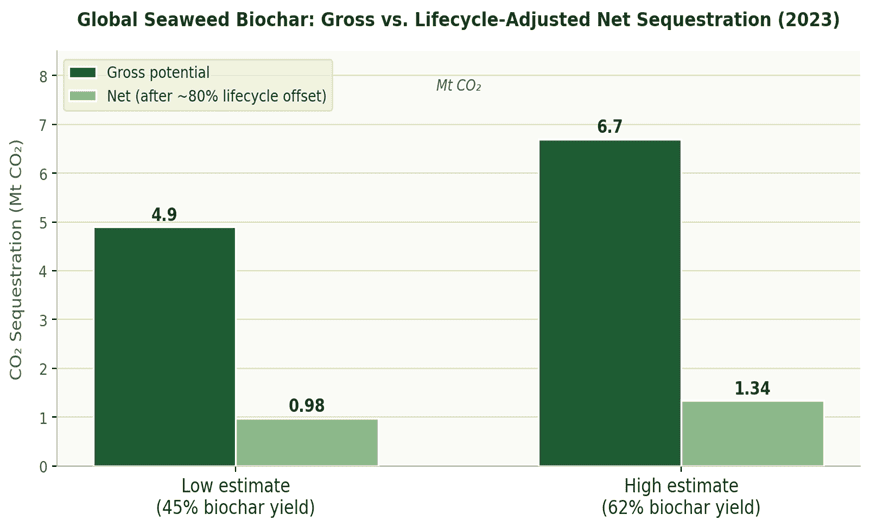 Figure 2. Gross and lifecycle-adjusted net CO₂ sequestration potential (Mt CO₂) from 2023 global seaweed production converted to biochar, under low and high yield estimates. Net applies ~80% lifecycle emission offset. Sources: Chung et al. (2011), Roberts et al. (2015), Lian et al. (2023).[/caption]
| System product(s) | Functional unit | Biogenic carbon | Parent selection | Hatchery | Cultivation | Harvest | Processing | Product use | End of life | Reference |
| Gracilaria chilensis or Kappaphycus alvarezii seaweed extract | "[ton] t⁻¹ rice production" | ✗ | ✗ | ✗ | ✓* | ✓* | ✓* | ✗ | ✗ | Sharma et al., 2017 |
| Kappaphycus alvarezii seaweed extract | "cumulative fertilizer application as per treatments for cane production in 1ha for 2y" | ✗ | ✗ | ✗ | ✓ | ✓ | ✓ | ✗ | ✗ | Singh et al., 2018 |
| Kappaphycus alvarezii seaweed extract | "application of 100% RRF or 50% RRF per hectare" | ✗ | ✗ | ✗ | ✓ | ✓ | ✓ | ✗ | ✗ | Singh et al., 2016 |
| Gracilaria edulis seaweed extract | "application of 100% RRF or 50% RRF per hectare" | ✗ | ✗ | ✗ | ✓ | ✓ | ✓ | ✗ | ✗ | Singh et al., 2016 |
| Gracilaria seaweed extract (GSWE) | "one kiloliter (1m³) of GSWE" | ✗ | n/a | n/a | ✓ | ✓ | ✓ | ✗ | ✗ | Vijay Anand et al., 2018 |
| Kappaphycus alvarezii sap | "1 kL of extract" | ✗ | n/a | n/a | ✓ | ✓ | ✓ | ✓ | ✗ | Ghosh et al., 2015 |
| Biogas, bioethanol and fertilizer | "Cultivation and processing of 1 ton of dry seaweed biomass [...] for biofuels production" | ✗ | ✗ | ✗ | ✓ | ✓ | ✓ | ✓ | ✓ | Alvarado-Morales et al., 2013 |
| Bioethanol, bioelectricity and fertilizer | "1 MJ of energy" | ✗ | ✓ | ✓ | ✓ | ✓ | ✓ | ✓ | ✗ | Aitken et al., 2014 |
| Fertilizer, bioethanol and fish feed ingredients | "1 ha of sea under cultivation" | ✓ | ns | ✓ | ✓ | ✓ | ✓ | ✓ | ✓ | Seghetta et al., 2017 |
| Saccharina japonica biochar production | "300,000 tons kelp wet weight" | ✗ | ✗ | ✓ | ✓ | ✓ | ✓ | ✗ | ✗ | Lian et al., 2023 |
| Seaweed-based agriculture supplement | Net emissions change (kg CO₂e) | Functional unit | Seaweed species | Country of study | GHG mitigation potential (tons CO₂e) | Amount of seaweed needed (tons wet weight, increase from 2020) |
| Liquid extract (7.5% dilution) | −35 | 1 ton rice per hectare | Gracilaria chilensis, Kappaphycus alvarezii | India | 3.1 × 10⁷ | 1.9 × 10⁸ (↑5.2×) |
| Liquid extract (5% dilution) | −260 | 1 ton sugarcane per hectare per 2 years | Kappaphycus alvarezii | India | 2.9 × 10⁸ | 2.1 × 10⁸ (↑5.9×) |
| Liquid extract (7.5% dilution) | −3.11 | 100 kg maize | Kappaphycus alvarezii | India | 4.3 × 10⁷ | 2.8 × 10⁹ (↑77.6×) |
| Liquid extract (5% dilution) | −4.11 | 100 kg maize | Gracilaria edulis | India | 5.6 × 10⁷ | 1.9 × 10⁹ (↑51.7×) |
Table 4. Based on referenced studies, the carbon-equivalent mitigation potential of seaweed-based agriculture supplements as applied to specific crops. Seaweed-based agriculture supplement: the type of seaweed-based product tested in the study. Net emissions change: the number of emissions (kg CO2e) that would be saved if adding a seaweed-based agriculture supplement to conventional fertilizer practices involved in producing the Functional unit. Functional unit: the crop and its amount that was grown in the study, used as a metric for quantifying the emissions mitigated. Country: the country in which the study took place. 2023 Global greenhouse gas (GHG) mitigation potential: The calculated amount of GHG emissions (tons CO2e) that could be mitigated if the Seaweed-based Agriculture Supplement was applied to every Functional Unit produced in 2023. This value was calculated using the value in Net Emissions Change and the 2023 global Functional Unit production as reported in Our World in Data (FAO, 2025). Amount of seaweed needed to result in 2023 global mitigation potential: The amount of whole seaweed (tons wet weight) needed for producing enough agriculture supplement to achieve the 2023 global mitigation potential, and how much increased production would be from 2020 values. The 2020 global seaweed production value (36 million tons wet weight) is from the World Bank (2023). Note that a 1:1 conversion of liter to gram for whole seaweed used to produce seaweed extract was assumed given the high water density of seaweed and Karthikeyan and Shanmugam (2017).
Using calculated biochar yield (45-62%) from six different types of seaweed and assuming that 30% of carbon is sequestered through biochar, the amount of seaweed produced in 2023 (36 million tons wet weight) would have been able to sequester approximately 4.9 – 6.7 million tons if it was all converted to biochar, but note that this value does not include energy costs associated with biochar production (Chung et al., 2011; Roberts et al., 2015). Lian et al. (2023) conducted an LCA of Saccharina japonica biochar production in Ailian Bay, People’s Republic of China and found that while the biochar produced could sequester almost 10,000 tons of CO2/year, more than 80% of that potential would be offset by the carbon emissions released during the cultivation and processing stages. Figure 2 summarizes what mitigation potential could be before and after accounting for said energy costs.
Figure 2. Gross and lifecycle-adjusted net CO₂ sequestration potential (Mt CO₂) from 2023 global seaweed production converted to biochar, under low and high yield estimates. Net applies ~80% lifecycle emission offset. Sources: Chung et al. (2011), Roberts et al. (2015), Lian et al. (2023).
| System product(s) | Functional unit | Biogenic carbon | Parent selection | Hatchery | Cultivation | Harvest | Processing | Product use | End of life | Reference |
| Gracilaria chilensis or Kappaphycus alvarezii seaweed extract | "[ton] t⁻¹ rice production" | ✗ | ✗ | ✗ | ✓* | ✓* | ✓* | ✗ | ✗ | Sharma et al., 2017 |
| Kappaphycus alvarezii seaweed extract | "cumulative fertilizer application as per treatments for cane production in 1ha for 2y" | ✗ | ✗ | ✗ | ✓ | ✓ | ✓ | ✗ | ✗ | Singh et al., 2018 |
| Kappaphycus alvarezii seaweed extract | "application of 100% RRF or 50% RRF per hectare" | ✗ | ✗ | ✗ | ✓ | ✓ | ✓ | ✗ | ✗ | Singh et al., 2016 |
| Gracilaria edulis seaweed extract | "application of 100% RRF or 50% RRF per hectare" | ✗ | ✗ | ✗ | ✓ | ✓ | ✓ | ✗ | ✗ | Singh et al., 2016 |
| Gracilaria seaweed extract (GSWE) | "one kiloliter (1m³) of GSWE" | ✗ | n/a | n/a | ✓ | ✓ | ✓ | ✗ | ✗ | Vijay Anand et al., 2018 |
| Kappaphycus alvarezii sap | "1 kL of extract" | ✗ | n/a | n/a | ✓ | ✓ | ✓ | ✓ | ✗ | Ghosh et al., 2015 |
| Biogas, bioethanol and fertilizer | "Cultivation and processing of 1 ton of dry seaweed biomass [...] for biofuels production" | ✗ | ✗ | ✗ | ✓ | ✓ | ✓ | ✓ | ✓ | Alvarado-Morales et al., 2013 |
| Bioethanol, bioelectricity and fertilizer | "1 MJ of energy" | ✗ | ✓ | ✓ | ✓ | ✓ | ✓ | ✓ | ✗ | Aitken et al., 2014 |
| Fertilizer, bioethanol and fish feed ingredients | "1 ha of sea under cultivation" | ✓ | ns | ✓ | ✓ | ✓ | ✓ | ✓ | ✓ | Seghetta et al., 2017 |
| Saccharina japonica biochar production | "300,000 tons kelp wet weight" | ✗ | ✗ | ✓ | ✓ | ✓ | ✓ | ✗ | ✗ | Lian et al., 2023 |
Table 5. Adapted from Hasselström and Thomas (2022). Comparison of system products, functional units, and system boundaries which include climate impact categories. *Sharma et al. (2017) did not directly measure metrics and referred readers to Ghosh et al. (2015). ns : not significant; n/a: not applicable.
| Seaweed-based agriculture supplement | Net emissions change (kg CO₂e) | Functional unit | Seaweed species | Country of study | GHG mitigation potential (tons CO₂e) | Amount of seaweed needed (tons wet weight, increase from 2020) |
| Liquid extract (7.5% dilution) | −35 | 1 ton rice per hectare | Gracilaria chilensis, Kappaphycus alvarezii | India | 3.1 × 10⁷ | 1.9 × 10⁸ (↑5.2×) |
| Liquid extract (5% dilution) | −260 | 1 ton sugarcane per hectare per 2 years | Kappaphycus alvarezii | India | 2.9 × 10⁸ | 2.1 × 10⁸ (↑5.9×) |
| Liquid extract (7.5% dilution) | −3.11 | 100 kg maize | Kappaphycus alvarezii | India | 4.3 × 10⁷ | 2.8 × 10⁹ (↑77.6×) |
| Liquid extract (5% dilution) | −4.11 | 100 kg maize | Gracilaria edulis | India | 5.6 × 10⁷ | 1.9 × 10⁹ (↑51.7×) |
Table 4. Based on referenced studies, the carbon-equivalent mitigation potential of seaweed-based agriculture supplements as applied to specific crops. Seaweed-based agriculture supplement: the type of seaweed-based product tested in the study. Net emissions change: the number of emissions (kg CO2e) that would be saved if adding a seaweed-based agriculture supplement to conventional fertilizer practices involved in producing the Functional unit. Functional unit: the crop and its amount that was grown in the study, used as a metric for quantifying the emissions mitigated. Country: the country in which the study took place. 2023 Global greenhouse gas (GHG) mitigation potential: The calculated amount of GHG emissions (tons CO2e) that could be mitigated if the Seaweed-based Agriculture Supplement was applied to every Functional Unit produced in 2023. This value was calculated using the value in Net Emissions Change and the 2023 global Functional Unit production as reported in Our World in Data (FAO, 2025). Amount of seaweed needed to result in 2023 global mitigation potential: The amount of whole seaweed (tons wet weight) needed for producing enough agriculture supplement to achieve the 2023 global mitigation potential, and how much increased production would be from 2020 values. The 2020 global seaweed production value (36 million tons wet weight) is from the World Bank (2023). Note that a 1:1 conversion of liter to gram for whole seaweed used to produce seaweed extract was assumed given the high water density of seaweed and Karthikeyan and Shanmugam (2017).
Using calculated biochar yield (45-62%) from six different types of seaweed and assuming that 30% of carbon is sequestered through biochar, the amount of seaweed produced in 2023 (36 million tons wet weight) would have been able to sequester approximately 4.9 – 6.7 million tons if it was all converted to biochar, but note that this value does not include energy costs associated with biochar production (Chung et al., 2011; Roberts et al., 2015). Lian et al. (2023) conducted an LCA of Saccharina japonica biochar production in Ailian Bay, People’s Republic of China and found that while the biochar produced could sequester almost 10,000 tons of CO2/year, more than 80% of that potential would be offset by the carbon emissions released during the cultivation and processing stages. Figure 2 summarizes what mitigation potential could be before and after accounting for said energy costs.
Figure 2. Gross and lifecycle-adjusted net CO₂ sequestration potential (Mt CO₂) from 2023 global seaweed production converted to biochar, under low and high yield estimates. Net applies ~80% lifecycle emission offset. Sources: Chung et al. (2011), Roberts et al. (2015), Lian et al. (2023).
| System product(s) | Functional unit | Biogenic carbon | Parent selection | Hatchery | Cultivation | Harvest | Processing | Product use | End of life | Reference |
| Gracilaria chilensis or Kappaphycus alvarezii seaweed extract | "[ton] t⁻¹ rice production" | ✗ | ✗ | ✗ | ✓* | ✓* | ✓* | ✗ | ✗ | Sharma et al., 2017 |
| Kappaphycus alvarezii seaweed extract | "cumulative fertilizer application as per treatments for cane production in 1ha for 2y" | ✗ | ✗ | ✗ | ✓ | ✓ | ✓ | ✗ | ✗ | Singh et al., 2018 |
| Kappaphycus alvarezii seaweed extract | "application of 100% RRF or 50% RRF per hectare" | ✗ | ✗ | ✗ | ✓ | ✓ | ✓ | ✗ | ✗ | Singh et al., 2016 |
| Gracilaria edulis seaweed extract | "application of 100% RRF or 50% RRF per hectare" | ✗ | ✗ | ✗ | ✓ | ✓ | ✓ | ✗ | ✗ | Singh et al., 2016 |
| Gracilaria seaweed extract (GSWE) | "one kiloliter (1m³) of GSWE" | ✗ | n/a | n/a | ✓ | ✓ | ✓ | ✗ | ✗ | Vijay Anand et al., 2018 |
| Kappaphycus alvarezii sap | "1 kL of extract" | ✗ | n/a | n/a | ✓ | ✓ | ✓ | ✓ | ✗ | Ghosh et al., 2015 |
| Biogas, bioethanol and fertilizer | "Cultivation and processing of 1 ton of dry seaweed biomass [...] for biofuels production" | ✗ | ✗ | ✗ | ✓ | ✓ | ✓ | ✓ | ✓ | Alvarado-Morales et al., 2013 |
| Bioethanol, bioelectricity and fertilizer | "1 MJ of energy" | ✗ | ✓ | ✓ | ✓ | ✓ | ✓ | ✓ | ✗ | Aitken et al., 2014 |
| Fertilizer, bioethanol and fish feed ingredients | "1 ha of sea under cultivation" | ✓ | ns | ✓ | ✓ | ✓ | ✓ | ✓ | ✓ | Seghetta et al., 2017 |
| Saccharina japonica biochar production | "300,000 tons kelp wet weight" | ✗ | ✗ | ✓ | ✓ | ✓ | ✓ | ✗ | ✗ | Lian et al., 2023 |
Table 5. Adapted from Hasselström and Thomas (2022). Comparison of system products, functional units, and system boundaries which include climate impact categories. *Sharma et al. (2017) did not directly measure metrics and referred readers to Ghosh et al. (2015). ns : not significant; n/a: not applicable.
Product Performance
Agriculture supplement performance and crop yield
The largest concern to potential users of seaweed-based agricultural supplements is the drop in crop yield if management practices change (Pramanick et al., 2022; World Bank, 2023). Most studies find that adding seaweed extract to conventional fertilizers significantly boosts crop yields compared to using fertilizers alone. For example, multiple studies on global crops like maize, rice, pulses, potato, and sugarcane using Kappaphycus alvarezii and Gracilaria edulis liquid extracts have produced between 8-25% increased crop yield as a supplement, two produced statistical parity between control yield and yield from a substitution of conventional fertilizer with liquid extract, and two increased yield as a substitute (reviewed in Veeragurunathan et al., 2023; Table 7).
| Crop | Treatment | Relationship with TF | Seaweed species | Yield | Unit | Change in Yield relative to control (%) | Reference | ||
| Green gram | 15% SWE + 100% TF | Supplement | Kappaphycus alvarezii | 5,220 | Kg of stover per hectare | ↑ 40.6 | Pramanick et al., 2013 | ||
| Green gram | 15% SWE + 100% TF | Supplement | Gracilaria edulis | 5,107 | Kg of stover per hectare | ↑ 37.5 | Pramanick et al., 2013 | ||
| Green gram | 15% SWE + 100% TF | Supplement | Kappaphycus alvarezii | 1,265 | Kg of seed per hectare | ↑ 39.0 | Pramanick et al., 2013 | ||
| Green gram | 15% SWE + 100% TF | Supplement | Gracilaria edulis | 1,216.1 | Kg of seed per hectare | ↑ 33.6 | Pramanick et al., 2013 | ||
| Potato | 7.5% SWE + 100% TF | Supplement | Kappaphycus alvarezii | 30.2 | Tons of tuber per hectare | ↑ 35.4 | Pramanick et al., 2017 | ||
| Rice | 15% SWE + 100% TF | Supplement | Kappaphycus alvarezii | 5.74 | Tons of grain per hectare | ↑ 29.3 | Sharma et al., 2017 | ||
| Rice | 15% SWE + 100% TF | Supplement | Gracilaria edulis | 5.69 | Tons of grain per hectare | ↑ 28.2 | Sharma et al., 2017 | ||
| Rice | 15% SWE + 50% TF | Supplement | Kappaphycus alvarezii | 5.36 | Tons of grain per hectare | ↑ 11.9 | Layek et al., 2018 | ||
| Rice | 15% SWE + 50% TF | Supplement | Gracilaria edulis | 5.28 | Tons of grain per hectare | ↑ 10.2 | Layek et al., 2018 | ||
| Sugarcane | 10% SWE + 100% TF | Supplement | Kappaphycus alvarezii | 67.7 | Megagrams of plant crop per hectare | ↑ 13.0 | Singh et al., 2018 | ||
| Green gram | 7.5% SWE + 50% TF | Substitute | Kappaphycus alvarezii | 4,298 | Kg of stover per hectare | ↑ 15.8 | Pramanick et al., 2013 | ||
| Green gram | 7.5% SWE + 50% TF | Substitute | Kappaphycus alvarezii | 1,101.7 | Kg of seed per hectare | ↑ 21.0 | Pramanick et al., 2013 | ||
| Maize | 15% SWE + 50% TF | Substitute | Kappaphycus alvarezii | 2,405 | Kg of grain per hectare | ↓ 28.7 | Singh et al., 2016 | ||
| Maize | 15% SWE + 50% TF | Substitute | Gracilaria edulis | 2,480 | Kg of grain per hectare | ↓ 26.4 | Singh et al., 2016 | ||
| Potato | 7.5% SWE + 75% TF | Substitute | Kappaphycus alvarezii | 24.4 | Tons of tuber per hectare | ↑ 9.4 | Pramanick et al., 2017 | ||
| Potato | 7.5% SWE + 50% TF | Substitute | Kappaphycus alvarezii | 17.1 | Tons of tuber per hectare | ↓ 22.0 | Pramanick et al., 2017 | ||
| Sugarcane | 6.25% SWE + 50% TF | Substitute | Kappaphycus alvarezii | 55.2 | Megagrams of plant crop per hectare | ↓ 7.8 | Singh et al., 2018 | ||
| Sugarcane | 6.25% SWE + 50% TF | Substitute | Kappaphycus alvarezii | 50.7 | Megagrams of ratoon crop per hectare | Not significant | Singh et al., 2018 | ||
| Rice | 7.5% SWE + 50% TF | Substitute | Kappaphycus alvarezii | 4.42 | Tons of grain per hectare | Not significant | Sharma et al., 2017 | ||
| Rice | 7.5% SWE + 50% TF | Substitute | Gracilaria edulis | 4.33 | Tons of grain per hectare | Not significant | Sharma et al., 2017 | ||
Table 7. Impacts on crop yield by using seaweed extract (SWE) as a supplement or substitute for traditional fertilizer (TF). In all studies, the control was a 100% recommended rate of conventional fertilizer and a water spray.
Agriculture supplement performance and crop yield
The largest concern to potential users of seaweed-based agricultural supplements is the drop in crop yield if management practices change (Pramanick et al., 2022; World Bank, 2023). Most studies find that adding seaweed extract to conventional fertilizers significantly boosts crop yields compared to using fertilizers alone. For example, multiple studies on global crops like maize, rice, pulses, potato, and sugarcane using Kappaphycus alvarezii and Gracilaria edulis liquid extracts have produced between 8-25% increased crop yield as a supplement, two produced statistical parity between control yield and yield from a substitution of conventional fertilizer with liquid extract, and two increased yield as a substitute (reviewed in Veeragurunathan et al., 2023; Table 7).| Crop | Treatment | Relationship with TF | Seaweed species | Yield | Unit | Change in Yield relative to control (%) | Reference | ||
| Green gram | 15% SWE + 100% TF | Supplement | Kappaphycus alvarezii | 5,220 | Kg of stover per hectare | ↑ 40.6 | Pramanick et al., 2013 | ||
| Green gram | 15% SWE + 100% TF | Supplement | Gracilaria edulis | 5,107 | Kg of stover per hectare | ↑ 37.5 | Pramanick et al., 2013 | ||
| Green gram | 15% SWE + 100% TF | Supplement | Kappaphycus alvarezii | 1,265 | Kg of seed per hectare | ↑ 39.0 | Pramanick et al., 2013 | ||
| Green gram | 15% SWE + 100% TF | Supplement | Gracilaria edulis | 1,216.1 | Kg of seed per hectare | ↑ 33.6 | Pramanick et al., 2013 | ||
| Potato | 7.5% SWE + 100% TF | Supplement | Kappaphycus alvarezii | 30.2 | Tons of tuber per hectare | ↑ 35.4 | Pramanick et al., 2017 | ||
| Rice | 15% SWE + 100% TF | Supplement | Kappaphycus alvarezii | 5.74 | Tons of grain per hectare | ↑ 29.3 | Sharma et al., 2017 | ||
| Rice | 15% SWE + 100% TF | Supplement | Gracilaria edulis | 5.69 | Tons of grain per hectare | ↑ 28.2 | Sharma et al., 2017 | ||
| Rice | 15% SWE + 50% TF | Supplement | Kappaphycus alvarezii | 5.36 | Tons of grain per hectare | ↑ 11.9 | Layek et al., 2018 | ||
| Rice | 15% SWE + 50% TF | Supplement | Gracilaria edulis | 5.28 | Tons of grain per hectare | ↑ 10.2 | Layek et al., 2018 | ||
| Sugarcane | 10% SWE + 100% TF | Supplement | Kappaphycus alvarezii | 67.7 | Megagrams of plant crop per hectare | ↑ 13.0 | Singh et al., 2018 | ||
| Green gram | 7.5% SWE + 50% TF | Substitute | Kappaphycus alvarezii | 4,298 | Kg of stover per hectare | ↑ 15.8 | Pramanick et al., 2013 | ||
| Green gram | 7.5% SWE + 50% TF | Substitute | Kappaphycus alvarezii | 1,101.7 | Kg of seed per hectare | ↑ 21.0 | Pramanick et al., 2013 | ||
| Maize | 15% SWE + 50% TF | Substitute | Kappaphycus alvarezii | 2,405 | Kg of grain per hectare | ↓ 28.7 | Singh et al., 2016 | ||
| Maize | 15% SWE + 50% TF | Substitute | Gracilaria edulis | 2,480 | Kg of grain per hectare | ↓ 26.4 | Singh et al., 2016 | ||
| Potato | 7.5% SWE + 75% TF | Substitute | Kappaphycus alvarezii | 24.4 | Tons of tuber per hectare | ↑ 9.4 | Pramanick et al., 2017 | ||
| Potato | 7.5% SWE + 50% TF | Substitute | Kappaphycus alvarezii | 17.1 | Tons of tuber per hectare | ↓ 22.0 | Pramanick et al., 2017 | ||
| Sugarcane | 6.25% SWE + 50% TF | Substitute | Kappaphycus alvarezii | 55.2 | Megagrams of plant crop per hectare | ↓ 7.8 | Singh et al., 2018 | ||
| Sugarcane | 6.25% SWE + 50% TF | Substitute | Kappaphycus alvarezii | 50.7 | Megagrams of ratoon crop per hectare | Not significant | Singh et al., 2018 | ||
| Rice | 7.5% SWE + 50% TF | Substitute | Kappaphycus alvarezii | 4.42 | Tons of grain per hectare | Not significant | Sharma et al., 2017 | ||
| Rice | 7.5% SWE + 50% TF | Substitute | Gracilaria edulis | 4.33 | Tons of grain per hectare | Not significant | Sharma et al., 2017 | ||
Table 7. Impacts on crop yield by using seaweed extract (SWE) as a supplement or substitute for traditional fertilizer (TF). In all studies, the control was a 100% recommended rate of conventional fertilizer and a water spray.
Cost/Market Adoption
| State of the Market | USD value as of 2023 | Ten-year Growth Rate (%) |
| Global seaweed market | 7–17.1 billion | 8.2–8.7 |
| Global seaweed-based agriculture supplement market | 1 billion | 7.5 (2021–2030) |
| Biofertilizer meal/mulch | 100–500 million | 5.5 |
| Liquid extract | 1.04 billion | 11.2 |
| Biochar | <1% of global seaweed market
Part of global biochar market (600 million) |
– |
Table 6. State of the Market of global seaweed production and seaweed-based agricultural supplement sectors, including its value and growth rate as of 2023.
Market adoption and competitiveness in cost
Seaweed-based agricultural supplements currently cost more than conventional major fertilizers due to the price of processing and conversion, inconsistent efficacy between cultivars (measured in price per crop yield), regulatory gaps, and supply chain limitations, but similarly priced as competitor alternate fertilizers like microbial soil supplements and slightly more expensive than humic supplements (Table 8). Cost could decrease with increased seaweed production and extraction efficiency; to reduce competition with non-seaweed supplements, products would need to be differentiated on consistently superior performance as well (Thamrin et al., 2020).
| Product Type | Typical Price Range (USD per ton) |
| Seaweed Liquid Extract | 2,358–11,791 |
| Seaweed Meal/Mulch | 798–1,596 |
| Seaweed Biochar | No current market estimate; likely higher than terrestrial biochar (~$131/ton) |
| Microbial soil supplements | 4,535–13,605 |
| Humic supplements | 633–907 |
| Top 8 major conventional fertilizers as reported by Progressive Farmer DTN | |
| DAP (conventional fertilizer) | 780 |
| MAP (conventional fertilizer) | 830 |
| Urea (conventional fertilizer) | 585 |
| 10-34-0 (conventional fertilizer) | 641 |
| Anhydrous (conventional fertilizer) | 794 |
| UAN28 (conventional fertilizer) | 364 |
| UAN32 (conventional fertilizer) | 418 |
Table 8. Comparative cost ranges and considerations for seaweed-based agricultural products versus conventional fertilizers.
| State of the Market | USD value as of 2023 | Ten-year Growth Rate (%) |
| Global seaweed market | 7–17.1 billion | 8.2–8.7 |
| Global seaweed-based agriculture supplement market | 1 billion | 7.5 (2021–2030) |
| Biofertilizer meal/mulch | 100–500 million | 5.5 |
| Liquid extract | 1.04 billion | 11.2 |
| Biochar | <1% of global seaweed market Part of global biochar market (600 million) | – |
Table 6. State of the Market of global seaweed production and seaweed-based agricultural supplement sectors, including its value and growth rate as of 2023.
Market adoption and competitiveness in cost
Seaweed-based agricultural supplements currently cost more than conventional major fertilizers due to the price of processing and conversion, inconsistent efficacy between cultivars (measured in price per crop yield), regulatory gaps, and supply chain limitations, but similarly priced as competitor alternate fertilizers like microbial soil supplements and slightly more expensive than humic supplements (Table 8). Cost could decrease with increased seaweed production and extraction efficiency; to reduce competition with non-seaweed supplements, products would need to be differentiated on consistently superior performance as well (Thamrin et al., 2020).| Product Type | Typical Price Range (USD per ton) |
| Seaweed Liquid Extract | 2,358–11,791 |
| Seaweed Meal/Mulch | 798–1,596 |
| Seaweed Biochar | No current market estimate; likely higher than terrestrial biochar (~$131/ton) |
| Microbial soil supplements | 4,535–13,605 |
| Humic supplements | 633–907 |
| Top 8 major conventional fertilizers as reported by Progressive Farmer DTN | |
| DAP (conventional fertilizer) | 780 |
| MAP (conventional fertilizer) | 830 |
| Urea (conventional fertilizer) | 585 |
| 10-34-0 (conventional fertilizer) | 641 |
| Anhydrous (conventional fertilizer) | 794 |
| UAN28 (conventional fertilizer) | 364 |
| UAN32 (conventional fertilizer) | 418 |
Table 8. Comparative cost ranges and considerations for seaweed-based agricultural products versus conventional fertilizers.
| State of the Market | USD value as of 2023 | Ten-year Growth Rate (%) |
| Global seaweed market | 7–17.1 billion | 8.2–8.7 |
| Global seaweed-based agriculture supplement market | 1 billion | 7.5 (2021–2030) |
| Biofertilizer meal/mulch | 100–500 million | 5.5 |
| Liquid extract | 1.04 billion | 11.2 |
| Biochar | <1% of global seaweed market Part of global biochar market (600 million) | – |
Table 6. State of the Market of global seaweed production and seaweed-based agricultural supplement sectors, including its value and growth rate as of 2023.
Market adoption and competitiveness in cost
Seaweed-based agricultural supplements currently cost more than conventional major fertilizers due to the price of processing and conversion, inconsistent efficacy (measured in price per crop yield), regulatory gaps, and supply chain limitations, but similarly priced as competitor alternate fertilizers like microbial soil supplements and slightly more expensive than humic supplements (Table 8). Cost could decrease with increased seaweed production and extraction efficiency; to reduce competition with non-seaweed supplements, products would need to be differentiated on consistently superior performance as well (Thamrin et al., 2020).| Product Type | Typical Price Range (USD per ton) |
| Seaweed Liquid Extract | 2,358–11,791 |
| Seaweed Meal/Mulch | 798–1,596 |
| Seaweed Biochar | No current market estimate; likely higher than terrestrial biochar (~$131/ton) |
| Microbial soil supplements | 4,535–13,605 |
| Humic supplements | 633–907 |
| Top 8 major conventional fertilizers as reported by Progressive Farmer DTN | |
| DAP (conventional fertilizer) | 780 |
| MAP (conventional fertilizer) | 830 |
| Urea (conventional fertilizer) | 585 |
| 10-34-0 (conventional fertilizer) | 641 |
| Anhydrous (conventional fertilizer) | 794 |
| UAN28 (conventional fertilizer) | 364 |
| UAN32 (conventional fertilizer) | 418 |
Table 8. Comparative cost ranges and considerations for seaweed-based agricultural products versus conventional fertilizers.
| State of the Market | USD value as of 2023 | Ten-year Growth Rate (%) |
| Global seaweed market | 7–17.1 billion | 8.2–8.7 |
| Global seaweed-based agriculture supplement market | 1 billion | 7.5 (2021–2030) |
| Biofertilizer meal/mulch | 100–500 million | 5.5 |
| Liquid extract | 1.04 billion | 11.2 |
| Biochar | <1% of global seaweed market Part of global biochar market (600 million) | – |
Table 6. State of the Market of global seaweed production and seaweed-based agricultural supplement sectors, including its value and growth rate as of 2023.
Cost-competitiveness and market adoption
Seaweed-based agricultural supplements currently cost more than conventional major fertilizers due to the price of processing and conversion, inconsistent efficacy (measured in price per crop yield), regulatory gaps, and supply chain limitations, but similarly priced as competitor alternate fertilizers like microbial soil supplements and slightly more expensive than humic supplements (Table 8). Cost could decrease with increased seaweed production and extraction efficiency; to reduce competition with non-seaweed supplements, products would need to be differentiated on consistently superior performance as well (Thamrin et al., 2020).| Product Type | Typical Price Range (USD per ton) |
| Seaweed Liquid Extract | 2,358–11,791 |
| Seaweed Meal/Mulch | 798–1,596 |
| Seaweed Biochar | No current market estimate; likely higher than terrestrial biochar (~$131/ton) |
| Microbial soil supplements | 4,535–13,605 |
| Humic supplements | 633–907 |
| Top 8 major conventional fertilizers as reported by Progressive Farmer DTN | |
| DAP (conventional fertilizer) | 780 |
| MAP (conventional fertilizer) | 830 |
| Urea (conventional fertilizer) | 585 |
| 10-34-0 (conventional fertilizer) | 641 |
| Anhydrous (conventional fertilizer) | 794 |
| UAN28 (conventional fertilizer) | 364 |
| UAN32 (conventional fertilizer) | 418 |
Table 8. Comparative cost ranges and considerations for seaweed-based agricultural products versus conventional fertilizers.
| State of the Market | USD value as of 2023 | Ten-year Growth Rate (%) |
| Global seaweed market | 7–17.1 billion | 8.2–8.7 |
| Global seaweed-based agriculture supplement market | 1 billion | 7.5 (2021–2030) |
| Biofertilizer meal/mulch | 100–500 million | 5.5 |
| Liquid extract | 1.04 billion | 11.2 |
| Biochar | <1% of global seaweed market Part of global biochar market (600 million) | – |
Table 6. State of the Market of global seaweed production and seaweed-based agricultural supplement sectors, including its value and growth rate as of 2023.
Agriculture supplement performance and crop yield
The largest concern to potential users of seaweed-based agricultural supplements is the drop in crop yield if management practices change (Pramanick et al., 2022; World Bank, 2023). Most studies find that adding seaweed extract to conventional fertilizers significantly boosts crop yields compared to using fertilizers alone. For example, multiple studies on global crops like maize, rice, pulses, potato, and sugarcane using Kappaphycus alvarezii and Gracilaria edulis liquid extracts have produced between 8-25% increased crop yield as a supplement, two produced statistical parity between control yield and yield from a substitution of conventional fertilizer with liquid extract, and two increased yield as a substitute (reviewed in Veeragurunathan et al., 2023; Table 7).| Crop | Treatment | Relationship with TF | Seaweed species | Yield | Unit | Change in Yield relative to control (%) | Reference | ||
| Green gram | 15% SWE + 100% TF | Supplement | Kappaphycus alvarezii | 5,220 | Kg of stover per hectare | ↑ 40.6 | Pramanick et al., 2013 | ||
| Green gram | 15% SWE + 100% TF | Supplement | Gracilaria edulis | 5,107 | Kg of stover per hectare | ↑ 37.5 | Pramanick et al., 2013 | ||
| Green gram | 15% SWE + 100% TF | Supplement | Kappaphycus alvarezii | 1,265 | Kg of seed per hectare | ↑ 39.0 | Pramanick et al., 2013 | ||
| Green gram | 15% SWE + 100% TF | Supplement | Gracilaria edulis | 1,216.1 | Kg of seed per hectare | ↑ 33.6 | Pramanick et al., 2013 | ||
| Potato | 7.5% SWE + 100% TF | Supplement | Kappaphycus alvarezii | 30.2 | Tons of tuber per hectare | ↑ 35.4 | Pramanick et al., 2017 | ||
| Rice | 15% SWE + 100% TF | Supplement | Kappaphycus alvarezii | 5.74 | Tons of grain per hectare | ↑ 29.3 | Sharma et al., 2017 | ||
| Rice | 15% SWE + 100% TF | Supplement | Gracilaria edulis | 5.69 | Tons of grain per hectare | ↑ 28.2 | Sharma et al., 2017 | ||
| Rice | 15% SWE + 50% TF | Supplement | Kappaphycus alvarezii | 5.36 | Tons of grain per hectare | ↑ 11.9 | Layek et al., 2018 | ||
| Rice | 15% SWE + 50% TF | Supplement | Gracilaria edulis | 5.28 | Tons of grain per hectare | ↑ 10.2 | Layek et al., 2018 | ||
| Sugarcane | 10% SWE + 100% TF | Supplement | Kappaphycus alvarezii | 67.7 | Megagrams of plant crop per hectare | ↑ 13.0 | Singh et al., 2018 | ||
| Green gram | 7.5% SWE + 50% TF | Substitute | Kappaphycus alvarezii | 4,298 | Kg of stover per hectare | ↑ 15.8 | Pramanick et al., 2013 | ||
| Green gram | 7.5% SWE + 50% TF | Substitute | Kappaphycus alvarezii | 1,101.7 | Kg of seed per hectare | ↑ 21.0 | Pramanick et al., 2013 | ||
| Maize | 15% SWE + 50% TF | Substitute | Kappaphycus alvarezii | 2,405 | Kg of grain per hectare | ↓ 28.7 | Singh et al., 2016 | ||
| Maize | 15% SWE + 50% TF | Substitute | Gracilaria edulis | 2,480 | Kg of grain per hectare | ↓ 26.4 | Singh et al., 2016 | ||
| Potato | 7.5% SWE + 75% TF | Substitute | Kappaphycus alvarezii | 24.4 | Tons of tuber per hectare | ↑ 9.4 | Pramanick et al., 2017 | ||
| Potato | 7.5% SWE + 50% TF | Substitute | Kappaphycus alvarezii | 17.1 | Tons of tuber per hectare | ↓ 22.0 | Pramanick et al., 2017 | ||
| Sugarcane | 6.25% SWE + 50% TF | Substitute | Kappaphycus alvarezii | 55.2 | Megagrams of plant crop per hectare | ↓ 7.8 | Singh et al., 2018 | ||
| Sugarcane | 6.25% SWE + 50% TF | Substitute | Kappaphycus alvarezii | 50.7 | Megagrams of ratoon crop per hectare | Not significant | Singh et al., 2018 | ||
| Rice | 7.5% SWE + 50% TF | Substitute | Kappaphycus alvarezii | 4.42 | Tons of grain per hectare | Not significant | Sharma et al., 2017 | ||
| Rice | 7.5% SWE + 50% TF | Substitute | Gracilaria edulis | 4.33 | Tons of grain per hectare | Not significant | Sharma et al., 2017 | ||
Table 7. Impacts on crop yield by using seaweed extract (SWE) as a supplement or substitute for traditional fertilizer (TF). In all studies, the control was a 100% recommended rate of conventional fertilizer and a water spray.
Cost-competitiveness and market adoption
Seaweed-based agricultural supplements currently cost more than conventional major fertilizers due to the price of processing and conversion, inconsistent efficacy (measured in price per crop yield), regulatory gaps, and supply chain limitations, but similarly priced as competitor alternate fertilizers like microbial soil supplements and slightly more expensive than humic supplements (Table 8). Cost could decrease with increased seaweed production and extraction efficiency; to reduce competition with non-seaweed supplements, products would need to be differentiated on consistently superior performance as well (Thamrin et al., 2020).| Product Type | Typical Price Range (USD per ton) |
| Seaweed Liquid Extract | 2,358–11,791 |
| Seaweed Meal/Mulch | 798–1,596 |
| Seaweed Biochar | No current market estimate; likely higher than terrestrial biochar (~$131/ton) |
| Microbial soil supplements | 4,535–13,605 |
| Humic supplements | 633–907 |
| Top 8 major conventional fertilizers as reported by Progressive Farmer DTN | |
| DAP (conventional fertilizer) | 780 |
| MAP (conventional fertilizer) | 830 |
| Urea (conventional fertilizer) | 585 |
| 10-34-0 (conventional fertilizer) | 641 |
| Anhydrous (conventional fertilizer) | 794 |
| UAN28 (conventional fertilizer) | 364 |
| UAN32 (conventional fertilizer) | 418 |
Table 8. Comparative cost ranges and considerations for seaweed-based agricultural products versus conventional fertilizers.
| State of the Market | USD value as of 2023 | Ten-year Growth Rate (%) |
| Global seaweed market | 7–17.1 billion | 8.2–8.7 |
| Global seaweed-based agriculture supplement market | 1 billion | 7.5 (2021–2030) |
| Biofertilizer meal/mulch | 100–500 million | 5.5 |
| Liquid extract | 1.04 billion | 11.2 |
| Biochar | <1% of global seaweed market Part of global biochar market (600 million) | – |
Table 6. State of the Market of global seaweed production and seaweed-based agricultural supplement sectors, including its value and growth rate as of 2023.
Agriculture supplement performance and crop yield
The largest concern to potential users of seaweed-based agricultural supplements is the drop in crop yield if management practices change (Pramanick et al., 2022; World Bank, 2023). Most studies find that adding seaweed extract to conventional fertilizers significantly boosts crop yields compared to using fertilizers alone. For example, multiple studies on global crops like maize, rice, pulses, potato, and sugarcane using Kappaphycus alvarezii and Gracilaria edulis liquid extracts have produced between 8-25% increased crop yield as a supplement, two produced statistical parity between control yield and yield from a substitution of conventional fertilizer with liquid extract, and two increased yield as a substitute (reviewed in Veeragurunathan et al., 2023; Table 7).| Crop | Treatment | Relationship with TF | Seaweed species | Yield | Unit | Change in Yield relative to control (%) | Reference | ||
| Green gram | 15% SWE + 100% TF | Supplement | Kappaphycus alvarezii | 5,220 | Kg of stover per hectare | ↑ 40.6 | Pramanick et al., 2013 | ||
| Green gram | 15% SWE + 100% TF | Supplement | Gracilaria edulis | 5,107 | Kg of stover per hectare | ↑ 37.5 | Pramanick et al., 2013 | ||
| Green gram | 15% SWE + 100% TF | Supplement | Kappaphycus alvarezii | 1,265 | Kg of seed per hectare | ↑ 39.0 | Pramanick et al., 2013 | ||
| Green gram | 15% SWE + 100% TF | Supplement | Gracilaria edulis | 1,216.1 | Kg of seed per hectare | ↑ 33.6 | Pramanick et al., 2013 | ||
| Potato | 7.5% SWE + 100% TF | Supplement | Kappaphycus alvarezii | 30.2 | Tons of tuber per hectare | ↑ 35.4 | Pramanick et al., 2017 | ||
| Rice | 15% SWE + 100% TF | Supplement | Kappaphycus alvarezii | 5.74 | Tons of grain per hectare | ↑ 29.3 | Sharma et al., 2017 | ||
| Rice | 15% SWE + 100% TF | Supplement | Gracilaria edulis | 5.69 | Tons of grain per hectare | ↑ 28.2 | Sharma et al., 2017 | ||
| Rice | 15% SWE + 50% TF | Supplement | Kappaphycus alvarezii | 5.36 | Tons of grain per hectare | ↑ 11.9 | Layek et al., 2018 | ||
| Rice | 15% SWE + 50% TF | Supplement | Gracilaria edulis | 5.28 | Tons of grain per hectare | ↑ 10.2 | Layek et al., 2018 | ||
| Sugarcane | 10% SWE + 100% TF | Supplement | Kappaphycus alvarezii | 67.7 | Megagrams of plant crop per hectare | ↑ 13.0 | Singh et al., 2018 | ||
| Green gram | 7.5% SWE + 50% TF | Substitute | Kappaphycus alvarezii | 4,298 | Kg of stover per hectare | ↑ 15.8 | Pramanick et al., 2013 | ||
| Green gram | 7.5% SWE + 50% TF | Substitute | Kappaphycus alvarezii | 1,101.7 | Kg of seed per hectare | ↑ 21.0 | Pramanick et al., 2013 | ||
| Maize | 15% SWE + 50% TF | Substitute | Kappaphycus alvarezii | 2,405 | Kg of grain per hectare | ↓ 28.7 | Singh et al., 2016 | ||
| Maize | 15% SWE + 50% TF | Substitute | Gracilaria edulis | 2,480 | Kg of grain per hectare | ↓ 26.4 | Singh et al., 2016 | ||
| Potato | 7.5% SWE + 75% TF | Substitute | Kappaphycus alvarezii | 24.4 | Tons of tuber per hectare | ↑ 9.4 | Pramanick et al., 2017 | ||
| Potato | 7.5% SWE + 50% TF | Substitute | Kappaphycus alvarezii | 17.1 | Tons of tuber per hectare | ↓ 22.0 | Pramanick et al., 2017 | ||
| Sugarcane | 6.25% SWE + 50% TF | Substitute | Kappaphycus alvarezii | 55.2 | Megagrams of plant crop per hectare | ↓ 7.8 | Singh et al., 2018 | ||
| Sugarcane | 6.25% SWE + 50% TF | Substitute | Kappaphycus alvarezii | 50.7 | Megagrams of ratoon crop per hectare | Not significant | Singh et al., 2018 | ||
| Rice | 7.5% SWE + 50% TF | Substitute | Kappaphycus alvarezii | 4.42 | Tons of grain per hectare | Not significant | Sharma et al., 2017 | ||
| Rice | 7.5% SWE + 50% TF | Substitute | Gracilaria edulis | 4.33 | Tons of grain per hectare | Not significant | Sharma et al., 2017 | ||
Table 7. Impacts on crop yield by using seaweed extract (SWE) as a supplement or substitute for traditional fertilizer (TF). In all studies, the control was a 100% recommended rate of conventional fertilizer and a water spray.
Cost-competitiveness and market adoption
Seaweed-based agricultural supplements currently cost more than conventional major fertilizers due to the price of processing and conversion, inconsistent efficacy (measured in price per crop yield), regulatory gaps, and supply chain limitations, but similarly priced as competitor alternate fertilizers like microbial soil supplements and slightly more expensive than humic supplements (Table 8). Cost could decrease with increased seaweed production and extraction efficiency; to reduce competition with non-seaweed supplements, products would need to be differentiated on consistently superior performance as well (Thamrin et al., 2020).| Product Type | Typical Price Range (USD per ton) |
| Seaweed Liquid Extract | 2,358–11,791 |
| Seaweed Meal/Mulch | 798–1,596 |
| Seaweed Biochar | No current market estimate; likely higher than terrestrial biochar (~$131/ton) |
| Microbial soil supplements | 4,535–13,605 |
| Humic supplements | 633–907 |
| Top 8 major conventional fertilizers as reported by Progressive Farmer DTN | |
| DAP (conventional fertilizer) | 780 |
| MAP (conventional fertilizer) | 830 |
| Urea (conventional fertilizer) | 585 |
| 10-34-0 (conventional fertilizer) | 641 |
| Anhydrous (conventional fertilizer) | 794 |
| UAN28 (conventional fertilizer) | 364 |
| UAN32 (conventional fertilizer) | 418 |
Table 8. Comparative cost ranges and considerations for seaweed-based agricultural products versus conventional fertilizers.
| State of the Market | USD value as of 2023 | Ten-year Growth Rate (%) |
| Global seaweed market | 7–17.1 billion | 8.2–8.7 |
| Global seaweed-based agriculture supplement market | 1 billion | 7.5 (2021–2030) |
| Biofertilizer meal/mulch | 100–500 million | 5.5 |
| Liquid extract | 1.04 billion | 11.2 |
| Biochar | <1% of global seaweed market Part of global biochar market (600 million) | – |
Table 6. State of the Market of global seaweed production and seaweed-based agricultural supplement sectors, including its value and growth rate as of 2023.
Agriculture supplement performance and crop yield
The largest concern to potential users of seaweed-based agricultural supplements is the drop in crop yield if management practices change (Pramanick et al., 2022; World Bank, 2023). Most studies find that adding seaweed extract to conventional fertilizers significantly boosts crop yields compared to using fertilizers alone. For example, multiple studies on global crops like maize, rice, pulses, potato, and sugarcane using Kappaphycus alvarezii and Gracilaria edulis liquid extracts have produced between 8-25% increased crop yield as a supplement, two produced statistical parity between control yield and yield from a substitution of conventional fertilizer with liquid extract, and two increased yield as a substitute (reviewed in Veeragurunathan et al., 2023; Table 7).| Crop | Treatment | Relationship with TF | Seaweed species | Yield | Unit | Change in Yield relative to control (%) | Reference | ||
| Green gram | 15% SWE + 100% TF | Supplement | Kappaphycus alvarezii | 5,220 | Kg of stover per hectare | ↑ 40.6 | Pramanick et al., 2013 | ||
| Green gram | 15% SWE + 100% TF | Supplement | Gracilaria edulis | 5,107 | Kg of stover per hectare | ↑ 37.5 | Pramanick et al., 2013 | ||
| Green gram | 15% SWE + 100% TF | Supplement | Kappaphycus alvarezii | 1,265 | Kg of seed per hectare | ↑ 39.0 | Pramanick et al., 2013 | ||
| Green gram | 15% SWE + 100% TF | Supplement | Gracilaria edulis | 1,216.1 | Kg of seed per hectare | ↑ 33.6 | Pramanick et al., 2013 | ||
| Potato | 7.5% SWE + 100% TF | Supplement | Kappaphycus alvarezii | 30.2 | Tons of tuber per hectare | ↑ 35.4 | Pramanick et al., 2017 | ||
| Rice | 15% SWE + 100% TF | Supplement | Kappaphycus alvarezii | 5.74 | Tons of grain per hectare | ↑ 29.3 | Sharma et al., 2017 | ||
| Rice | 15% SWE + 100% TF | Supplement | Gracilaria edulis | 5.69 | Tons of grain per hectare | ↑ 28.2 | Sharma et al., 2017 | ||
| Rice | 15% SWE + 50% TF | Supplement | Kappaphycus alvarezii | 5.36 | Tons of grain per hectare | ↑ 11.9 | Layek et al., 2018 | ||
| Rice | 15% SWE + 50% TF | Supplement | Gracilaria edulis | 5.28 | Tons of grain per hectare | ↑ 10.2 | Layek et al., 2018 | ||
| Sugarcane | 10% SWE + 100% TF | Supplement | Kappaphycus alvarezii | 67.7 | Megagrams of plant crop per hectare | ↑ 13.0 | Singh et al., 2018 | ||
| Green gram | 7.5% SWE + 50% TF | Substitute | Kappaphycus alvarezii | 4,298 | Kg of stover per hectare | ↑ 15.8 | Pramanick et al., 2013 | ||
| Green gram | 7.5% SWE + 50% TF | Substitute | Kappaphycus alvarezii | 1,101.7 | Kg of seed per hectare | ↑ 21.0 | Pramanick et al., 2013 | ||
| Maize | 15% SWE + 50% TF | Substitute | Kappaphycus alvarezii | 2,405 | Kg of grain per hectare | ↓ 28.7 | Singh et al., 2016 | ||
| Maize | 15% SWE + 50% TF | Substitute | Gracilaria edulis | 2,480 | Kg of grain per hectare | ↓ 26.4 | Singh et al., 2016 | ||
| Potato | 7.5% SWE + 75% TF | Substitute | Kappaphycus alvarezii | 24.4 | Tons of tuber per hectare | ↑ 9.4 | Pramanick et al., 2017 | ||
| Potato | 7.5% SWE + 50% TF | Substitute | Kappaphycus alvarezii | 17.1 | Tons of tuber per hectare | ↓ 22.0 | Pramanick et al., 2017 | ||
| Sugarcane | 6.25% SWE + 50% TF | Substitute | Kappaphycus alvarezii | 55.2 | Megagrams of plant crop per hectare | ↓ 7.8 | Singh et al., 2018 | ||
| Sugarcane | 6.25% SWE + 50% TF | Substitute | Kappaphycus alvarezii | 50.7 | Megagrams of ratoon crop per hectare | Not significant | Singh et al., 2018 | ||
| Rice | 7.5% SWE + 50% TF | Substitute | Kappaphycus alvarezii | 4.42 | Tons of grain per hectare | Not significant | Sharma et al., 2017 | ||
| Rice | 7.5% SWE + 50% TF | Substitute | Gracilaria edulis | 4.33 | Tons of grain per hectare | Not significant | Sharma et al., 2017 | ||
Table 7. Impacts on crop yield by using seaweed extract (SWE) as a supplement or substitute for traditional fertilizer (TF). In all studies, the control was a 100% recommended rate of conventional fertilizer and a water spray.
Cost-competitiveness and market adoption
Seaweed-based agricultural supplements currently cost more than conventional major fertilizers due to the price of processing and conversion, inconsistent efficacy (measured in price per crop yield), regulatory gaps, and supply chain limitations, but similarly priced as competitor alternate fertilizers like microbial soil supplements and slightly more expensive than humic supplements (Table 8). Cost could decrease with increased seaweed production and extraction efficiency; to reduce competition with non-seaweed supplements, products would need to be differentiated on consistently superior performance as well (Thamrin et al., 2020).| Product Type | Typical Price Range (USD per ton) |
| Seaweed Liquid Extract | 2,358–11,791 |
| Seaweed Meal/Mulch | 798–1,596 |
| Seaweed Biochar | No current market estimate; likely higher than terrestrial biochar (~$131/ton) |
| Microbial soil supplements | 4,535–13,605 |
| Humic supplements | 633–907 |
| Top 8 major conventional fertilizers as reported by Progressive Farmer DTN | |
| DAP (conventional fertilizer) | 780 |
| MAP (conventional fertilizer) | 830 |
| Urea (conventional fertilizer) | 585 |
| 10-34-0 (conventional fertilizer) | 641 |
| Anhydrous (conventional fertilizer) | 794 |
| UAN28 (conventional fertilizer) | 364 |
| UAN32 (conventional fertilizer) | 418 |
Table 8. Comparative cost ranges and considerations for seaweed-based agricultural products versus conventional fertilizers.
| State of the Market | USD value as of 2023 | Ten-year Growth Rate (%) |
| Global seaweed market | 7–17.1 billion | 8.2–8.7 |
| Global seaweed-based agriculture supplement market | 1 billion | 7.5 (2021–2030) |
| Biofertilizer meal/mulch | 100–500 million | 5.5 |
| Liquid extract | 1.04 billion | 11.2 |
| Biochar | <1% of global seaweed market Part of global biochar market (600 million) | – |
Table 6. State of the Market of global seaweed production and seaweed-based agricultural supplement sectors, including its value and growth rate as of 2023.
Agriculture supplement performance and crop yield
The largest concern to potential users of seaweed-based agricultural supplements is the drop in crop yield if management practices change (Pramanick et al., 2022; World Bank, 2023). Most studies find that adding seaweed extract to conventional fertilizers significantly boosts crop yields compared to using fertilizers alone. For example, multiple studies on global crops like maize, rice, pulses, potato, and sugarcane using Kappaphycus alvarezii and Gracilaria edulis liquid extracts have produced between 8-25% increased crop yield as a supplement, two produced statistical parity between control yield and yield from a substitution of conventional fertilizer with liquid extract, and two increased yield as a substitute (reviewed in Veeragurunathan et al., 2023; Table 7).| Crop | Treatment | Relationship with TF | Seaweed species | Yield | Unit | Change in Yield relative to control (%) | Reference | ||
| Green gram | 15% SWE + 100% TF | Supplement | Kappaphycus alvarezii | 5,220 | Kg of stover per hectare | ↑ 40.6 | Pramanick et al., 2013 | ||
| Green gram | 15% SWE + 100% TF | Supplement | Gracilaria edulis | 5,107 | Kg of stover per hectare | ↑ 37.5 | Pramanick et al., 2013 | ||
| Green gram | 15% SWE + 100% TF | Supplement | Kappaphycus alvarezii | 1,265 | Kg of seed per hectare | ↑ 39.0 | Pramanick et al., 2013 | ||
| Green gram | 15% SWE + 100% TF | Supplement | Gracilaria edulis | 1,216.1 | Kg of seed per hectare | ↑ 33.6 | Pramanick et al., 2013 | ||
| Potato | 7.5% SWE + 100% TF | Supplement | Kappaphycus alvarezii | 30.2 | Tons of tuber per hectare | ↑ 35.4 | Pramanick et al., 2017 | ||
| Rice | 15% SWE + 100% TF | Supplement | Kappaphycus alvarezii | 5.74 | Tons of grain per hectare | ↑ 29.3 | Sharma et al., 2017 | ||
| Rice | 15% SWE + 100% TF | Supplement | Gracilaria edulis | 5.69 | Tons of grain per hectare | ↑ 28.2 | Sharma et al., 2017 | ||
| Rice | 15% SWE + 50% TF | Supplement | Kappaphycus alvarezii | 5.36 | Tons of grain per hectare | ↑ 11.9 | Layek et al., 2018 | ||
| Rice | 15% SWE + 50% TF | Supplement | Gracilaria edulis | 5.28 | Tons of grain per hectare | ↑ 10.2 | Layek et al., 2018 | ||
| Sugarcane | 10% SWE + 100% TF | Supplement | Kappaphycus alvarezii | 67.7 | Megagrams of plant crop per hectare | ↑ 13.0 | Singh et al., 2018 | ||
| Green gram | 7.5% SWE + 50% TF | Substitute | Kappaphycus alvarezii | 4,298 | Kg of stover per hectare | ↑ 15.8 | Pramanick et al., 2013 | ||
| Green gram | 7.5% SWE + 50% TF | Substitute | Kappaphycus alvarezii | 1,101.7 | Kg of seed per hectare | ↑ 21.0 | Pramanick et al., 2013 | ||
| Maize | 15% SWE + 50% TF | Substitute | Kappaphycus alvarezii | 2,405 | Kg of grain per hectare | ↓ 28.7 | Singh et al., 2016 | ||
| Maize | 15% SWE + 50% TF | Substitute | Gracilaria edulis | 2,480 | Kg of grain per hectare | ↓ 26.4 | Singh et al., 2016 | ||
| Potato | 7.5% SWE + 75% TF | Substitute | Kappaphycus alvarezii | 24.4 | Tons of tuber per hectare | ↑ 9.4 | Pramanick et al., 2017 | ||
| Potato | 7.5% SWE + 50% TF | Substitute | Kappaphycus alvarezii | 17.1 | Tons of tuber per hectare | ↓ 22.0 | Pramanick et al., 2017 | ||
| Sugarcane | 6.25% SWE + 50% TF | Substitute | Kappaphycus alvarezii | 55.2 | Megagrams of plant crop per hectare | ↓ 7.8 | Singh et al., 2018 | ||
| Sugarcane | 6.25% SWE + 50% TF | Substitute | Kappaphycus alvarezii | 50.7 | Megagrams of ratoon crop per hectare | Not significant | Singh et al., 2018 | ||
| Rice | 7.5% SWE + 50% TF | Substitute | Kappaphycus alvarezii | 4.42 | Tons of grain per hectare | Not significant | Sharma et al., 2017 | ||
| Rice | 7.5% SWE + 50% TF | Substitute | Gracilaria edulis | 4.33 | Tons of grain per hectare | Not significant | Sharma et al., 2017 | ||
Table 7. Impacts on crop yield by using seaweed extract (SWE) as a supplement or substitute for traditional fertilizer (TF). In all studies, the control was a 100% recommended rate of conventional fertilizer and a water spray.
Cost-competitiveness and market adoption
Seaweed-based agricultural supplements currently cost more than conventional major fertilizers due to the price of processing and conversion, inconsistent efficacy (measured in price per crop yield), regulatory gaps, and supply chain limitations, but similarly priced as competitor alternate fertilizers like microbial soil supplements and slightly more expensive than humic supplements (Table 8). Cost could decrease with increased seaweed production and extraction efficiency; to reduce competition with non-seaweed supplements, products would need to be differentiated on consistently superior performance as well (Thamrin et al., 2020).| Product Type | Typical Price Range (USD per ton) |
| Seaweed Liquid Extract | 2,358–11,791 |
| Seaweed Meal/Mulch | 798–1,596 |
| Seaweed Biochar | No current market estimate; likely higher than terrestrial biochar (~$131/ton) |
| Microbial soil supplements | 4,535–13,605 |
| Humic supplements | 633–907 |
| Top 8 major conventional fertilizers as reported by Progressive Farmer DTN | |
| DAP (conventional fertilizer) | 780 |
| MAP (conventional fertilizer) | 830 |
| Urea (conventional fertilizer) | 585 |
| 10-34-0 (conventional fertilizer) | 641 |
| Anhydrous (conventional fertilizer) | 794 |
| UAN28 (conventional fertilizer) | 364 |
| UAN32 (conventional fertilizer) | 418 |
Table 8. Comparative cost ranges and considerations for seaweed-based agricultural products versus conventional fertilizers.
| State of the Market | USD value as of 2023 | Ten-year Growth Rate (%) |
| Global seaweed market | 7–17.1 billion | 8.2–8.7 |
| Global seaweed-based agriculture supplement market | 1 billion | 7.5 (2021–2030) |
| Biofertilizer meal/mulch | 100–500 million | 5.5 |
| Liquid extract | 1.04 billion | 11.2 |
| Biochar | <1% of global seaweed market Part of global biochar market (600 million) | – |
Table 6. State of the Market of global seaweed production and seaweed-based agricultural supplement sectors, including its value and growth rate as of 2023.
Agriculture supplement performance and crop yield
The largest concern to potential users of seaweed-based agricultural supplements is the drop in crop yield if management practices change (Pramanick et al., 2022; World Bank, 2023). Most studies find that adding seaweed extract to conventional fertilizers significantly boosts crop yields compared to using fertilizers alone. For example, multiple studies on global crops like maize, rice, pulses, potato, and sugarcane using Kappaphycus alvarezii and Gracilaria edulis liquid extracts have produced between 8-25% increased crop yield as a supplement, two produced statistical parity between control yield and yield from a substitution of conventional fertilizer with liquid extract, and two increased yield as a substitute (reviewed in Veeragurunathan et al., 2023; Table 7).| Crop | Treatment | Relationship with TF | Seaweed species | Yield | Unit | Change in Yield relative to control (%) | Reference | |||
| Green gram | 15% SWE + 100% TF | Supplement | Kappaphycus alvarezii | 5,220 | Kg of stover per hectare | ↑ 40.6 | Pramanick et al., 2013 | |||
| Green gram | 15% SWE + 100% TF | Supplement | Gracilaria edulis | 5,107 | Kg of stover per hectare | ↑ 37.5 | Pramanick et al., 2013 | |||
| Green gram | 15% SWE + 100% TF | Supplement | Kappaphycus alvarezii | 1,265 | Kg of seed per hectare | ↑ 39.0 | Pramanick et al., 2013 | |||
| Green gram | 15% SWE + 100% TF | Supplement | Gracilaria edulis | 1,216.1 | Kg of seed per hectare | ↑ 33.6 | Pramanick et al., 2013 | |||
| Potato | 7.5% SWE + 100% TF | Supplement | Kappaphycus alvarezii | 30.2 | Tons of tuber per hectare | ↑ 35.4 | Pramanick et al., 2017 | |||
| Rice | 15% SWE + 100% TF | Supplement | Kappaphycus alvarezii | 5.74 | Tons of grain per hectare | ↑ 29.3 | Sharma et al., 2017 | |||
| Rice | 15% SWE + 100% TF | Supplement | Gracilaria edulis | 5.69 | Tons of grain per hectare | ↑ 28.2 | Sharma et al., 2017 | |||
| Rice | 15% SWE + 50% TF | Supplement | Kappaphycus alvarezii | 5.36 | Tons of grain per hectare | ↑ 11.9 | Layek et al., 2018 | |||
| Rice | 15% SWE + 50% TF | Supplement | Gracilaria edulis | 5.28 | Tons of grain per hectare | ↑ 10.2 | Layek et al., 2018 | |||
| Sugarcane | 10% SWE + 100% TF | Supplement | Kappaphycus alvarezii | 67.7 | Megagrams of plant crop per hectare | ↑ 13.0 | Singh et al., 2018 | |||
| Green gram | 7.5% SWE + 50% TF | Substitute | Kappaphycus alvarezii | 4,298 | Kg of stover per hectare | ↑ 15.8 | Pramanick et al., 2013 | |||
| Green gram | 7.5% SWE + 50% TF | Substitute | Kappaphycus alvarezii | 1,101.7 | Kg of seed per hectare | ↑ 21.0 | Pramanick et al., 2013 | |||
| Maize | 15% SWE + 50% TF | Substitute | Kappaphycus alvarezii | 2,405 | Kg of grain per hectare | ↓ 28.7 | Singh et al., 2016 | |||
| Maize | 15% SWE + 50% TF | Substitute | Gracilaria edulis | 2,480 | Kg of grain per hectare | ↓ 26.4 | Singh et al., 2016 | |||
| Potato | 7.5% SWE + 75% TF | Substitute | Kappaphycus alvarezii | 24.4 | Tons of tuber per hectare | ↑ 9.4 | Pramanick et al., 2017 | |||
| Potato | 7.5% SWE + 50% TF | Substitute | Kappaphycus alvarezii | 17.1 | Tons of tuber per hectare | ↓ 22.0 | Pramanick et al., 2017 | |||
| Sugarcane | 6.25% SWE + 50% TF | Substitute | Kappaphycus alvarezii | 55.2 | Megagrams of plant crop per hectare | ↓ 7.8 | Singh et al., 2018 | |||
| Sugarcane | 6.25% SWE + 50% TF | Substitute | Kappaphycus alvarezii | 50.7 | Megagrams of ratoon crop per hectare | Not significant | Singh et al., 2018 | |||
| Rice | 7.5% SWE + 50% TF | Substitute | Kappaphycus alvarezii | 4.42 | Tons of grain per hectare | Not significant | Sharma et al., 2017 | |||
| Rice | 7.5% SWE + 50% TF | Substitute | Gracilaria edulis | 4.33 | Tons of grain per hectare | Not significant | Sharma et al., 2017 | |||
Table 7. Impacts on crop yield by using seaweed extract (SWE) as a supplement or substitute for traditional fertilizer (TF). In all studies, the control was a 100% recommended rate of conventional fertilizer and a water spray.
Cost-competitiveness and market adoption
Seaweed-based agricultural supplements currently cost more than conventional major fertilizers due to the price of processing and conversion, inconsistent efficacy (measured in price per crop yield), regulatory gaps, and supply chain limitations, but similarly priced as competitor alternate fertilizers like microbial soil supplements and slightly more expensive than humic supplements (Table 8). Cost could decrease with increased seaweed production and extraction efficiency; to reduce competition with non-seaweed supplements, products would need to be differentiated on consistently superior performance as well (Thamrin et al., 2020).| Product Type | Typical Price Range (USD per ton) |
| Seaweed Liquid Extract | 2,358–11,791 |
| Seaweed Meal/Mulch | 798–1,596 |
| Seaweed Biochar | No current market estimate; likely higher than terrestrial biochar (~$131/ton) |
| Microbial soil supplements | 4,535–13,605 |
| Humic supplements | 633–907 |
| Top 8 major conventional fertilizers as reported by Progressive Farmer DTN | |
| DAP (conventional fertilizer) | 780 |
| MAP (conventional fertilizer) | 830 |
| Urea (conventional fertilizer) | 585 |
| 10-34-0 (conventional fertilizer) | 641 |
| Anhydrous (conventional fertilizer) | 794 |
| UAN28 (conventional fertilizer) | 364 |
| UAN32 (conventional fertilizer) | 418 |
Table 8. Comparative cost ranges and considerations for seaweed-based agricultural products versus conventional fertilizers.
Liquid extracts (8–9)
- There is already a liquid extract market with regional/global reach
- Uncertainty in product validation has limited consistent buy-in
Fertilizer meal/mulch (4–7)
- Using seaweed meal/mulch is an old practice, but traditional methods are slow to activate benefits for crops, limiting scale-up
Biochar (3–6)
- High-energy needs impede scaled production
Environmental Co-benefits and Risks
Benefits
- When wild algal blooms (like Sargassum) are removed for agriculture supplement production, it increases access for tourism activities and removes sources of unpleasant odors and additional greenhouse gas emissions (Dang et al., 2023).
- Substituting seaweed-based agricultural supplements reduces the environmental burden caused by the production, transport, and use of chemical fertilizers (Ghosh et al., 2015; Pramanick et al., 2022).
- Seaweed-based agricultural supplements increase plant and soil microbe nutrient efficiency, mitigating greenhouse gas emissions caused by nutrient leakage (Battacharyya et al., 2015; Veeragurunathan et al., 2023).
- Seaweed-based agricultural supplements can increase plant resilience and tolerance to environmental stresses like salinity, drought, extreme temperatures, and disease (Battacharyya et al., 2015; Khan et al., 2009).
Risks
- Low-quality seaweed-based agricultural supplements risk damaging crops and soil (Dang et al., 2023; Farghali et al., 2023).
- Because seaweed absorbs and concentrates persistent organic pollutants and heavy metals, there is a risk that this can pass to crops (Veeragurunathan et al., 2023; Waqas et al., 2024).
- Some conversions (e.g., biochar) are energy-intensive and will need to be optimized in order to mitigate greenhouse gas emissions at scale (Jones et al., 2022).
- There is uncertainty in the permanence of carbon sequestration achieved due to partial LCA studies (Farghali et al., 2023; Jones et al., 2022).
Benefits
- When wild algal blooms (like Sargassum) are removed for agriculture supplement production, it increases access for tourism activities and removes sources of unpleasant odors and additional greenhouse gas emissions (Dang et al., 2023).
- Substituting seaweed-based agricultural supplements reduces the environmental burden caused by the production, transport, and use of chemical fertilizers (Ghosh et al., 2015; Pramanick et al., 2022).
- Seaweed-based agricultural supplements increase plant and soil microbe nutrient efficiency, mitigating greenhouse gas emissions caused by nutrient leakage (Battacharyya et al., 2015; Veeragurunathan et al., 2023).
- Seaweed-based agricultural supplements can increase plant resilience and tolerance to environmental stresses like salinity, drought, extreme temperatures, and disease (Battacharyya et al., 2015; Khan et al., 2009).
Risks
- Low-quality seaweed-based agricultural supplements risk damaging crops and soil (Dang et al., 2023; Farghali et al., 2023).
- Because seaweed absorbs and concentrates persistent organic pollutants and heavy metals, there is a risk that this can pass to crops (Veeragurunathan et al., 2023; Waqas et al., 2024).
- Some conversions (e.g., biochar) are energy-intensive and will need to be optimized in order to mitigate greenhouse gas emissions at scale (Jones et al., 2022).
- There is uncertainty in the permanence of carbon sequestration achieved due to partial LCA studies (Farghali et al., 2023; Jones et al., 2022).
Benefits
- When wild algal blooms (like Sargassum) are removed for agriculture supplement production, it increases access for tourism activities and removes sources of unpleasant odors and additional greenhouse gas emissions (Dang et al., 2023).
- Substituting seaweed-based agricultural supplements reduces the environmental burden caused by the production, transport, and use of chemical fertilizers (Ghosh et al., 2015; Pramanick et al., 2022).
- Seaweed-based agricultural supplements increase plant and soil microbe nutrient efficiency, mitigating greenhouse gas emissions caused by nutrient leakage (Battacharyya et al., 2015; Veeragurunathan et al., 2023).
- Seaweed-based agricultural supplements can increase plant resilience and tolerance to environmental stresses like salinity, drought, extreme temperatures, and disease (Battacharyya et al., 2015; Khan et al., 2009).
Risks
- Low-quality seaweed-based agricultural supplements risk damaging crops and soil (Dang et al., 2023; Farghali et al., 2023).
- Because seaweed absorbs and concentrates POPs and heavy metals, there is a risk that this can pass to crops (Veeragurunathan et al., 2023; Waqas et al., 2024).
- Some conversions (e.g., biochar) are energy-intensive and will need to be optimized in order to mitigate greenhouse gas emissions at scale (Jones et al., 2022).
- There is uncertainty in the permanence of carbon sequestration achieved due to partial LCA studies (Farghali et al., 2023; Jones et al., 2022).
Benefits
- When wild algal blooms (like Sargassum) are removed for agriculture supplement production, it increases access for tourism activities and removes sources of unpleasant odors and additional greenhouse gas emissions (Dang et al., 2023).
- Substituting seaweed-based agricultural supplements reduces the environmental burden caused by the production, transport, and use of chemical fertilizers (Ghosh et al., 2015; Pramanick et al., 2022).
- Seaweed-based agricultural supplements increase plant and soil microbe nutrient efficiency, mitigating greenhouse gas emissions caused by nutrient leakage (Battacharyya et al., 2015; Veeragurunathan et al., 2023).
- Seaweed-based agricultural supplements can increase plant resilience and tolerance to environmental stresses like salinity, drought, extreme temperatures, and disease (Battacharyya et al., 2015; Khan et al., 2009).
Risks
- Low-quality seaweed-based agricultural supplements risk damaging crops and soil (Dang et al., 2023; Farghali et al., 2023).
- Because seaweed absorbs and concentrates POPs and heavy metals, there is a risk that this can pass to crops (Veeragurunathan et al., 2023; Waqas et al., 2024).
- Some conversions (e.g., biochar) are energy-intensive and will need to be optimized in order to mitigate greenhouse gas emissions at scale (Jones et al., 2022).
- There is uncertainty in the permanence of carbon sequestration achieved due to partial LCA studies (Farghali et al., 2023; Jones et al., 2022).
Benefits
- When wild algal blooms (like Sargassum) are removed for agriculture supplement production, it increases access for tourism activities and removes sources of unpleasant odors and additional greenhouse gas emissions (Dang et al., 2023).
- Substituting seaweed-based agricultural supplements reduces the environmental burden caused by the production, transport, and use of chemical fertilizers (Ghosh et al., 2015; Pramanick et al., 2022).
- Seaweed-based agricultural supplements increase plant and soil microbe nutrient efficiency, mitigating greenhouse gas emissions caused by nutrient leakage (Battacharyya et al., 2015; Veeragurunathan et al., 2023).
- Seaweed-based agricultural supplements can increase plant resilience and tolerance to environmental stresses like salinity, drought, extreme temperatures, and disease (Battacharyya et al., 2015; Khan et al., 2009).
Risks
- Low-quality seaweed-based agricultural supplements risk damaging crops and soil (Dang et al., 2023; Farghali et al., 2023).
- Because seaweed absorbs and concentrates POPs and heavy metals, there is a risk that this can pass to crops (Veeragurunathan et al., 2023; Waqas et al., 2024).
- Some conversions (e.g., biochar) are energy-intensive and will need to be optimized in order to mitigate greenhouse gas emissions at scale (Jones et al., 2022).
- There is uncertainty in the permanence of carbon sequestration achieved due to partial LCA studies (Farghali et al., 2023; Jones et al., 2022).
Benefits
- When wild algal blooms (like Sargassum) are removed for agriculture supplement production, it increases access for tourism activities and removes sources of unpleasant odors and additional greenhouse gas emissions (Dang et al., 2023).
- Substituting seaweed-based agricultural supplements reduces the environmental burden caused by the production, transport, and use of chemical fertilizers (Ghosh et al., 2015; Pramanick et al., 2022).
- Seaweed-based agricultural supplements increase plant and soil microbe nutrient efficiency, mitigating greenhouse gas emissions caused by nutrient leakage (Battacharyya et al., 2015; Veeragurunathan et al., 2023).
- Seaweed-based agricultural supplements can increase plant resilience and tolerance to environmental stresses like salinity, drought, extreme temperatures, and disease (Battacharyya et al., 2015; Khan et al., 2009).
Risks
- Low-quality seaweed-based agricultural supplements risk damaging crops and soil (Dang et al., 2023; Farghali et al., 2023).
- Because seaweed absorbs and concentrates POPs and heavy metals, there is a risk that this can pass to crops (Veeragurunathan et al., 2023; Waqas et al., 2024).
- Some conversions (e.g., biochar) are energy-intensive and will need to be optimized in order to mitigate greenhouse gas emissions at scale (Jones et al., 2022).
- There is uncertainty in the permanence of carbon sequestration achieved due to partial LCA studies (Farghali et al., 2023; Jones et al., 2022).
Community Perception
Uncertainty from buyers and investors about seaweed-based agriculture supplements include supplement availability, versatility, benefit/cost analysis, and compatibility with existing agricultural machinery and practices (World Bank, 2023). Therefore, increasing awareness and trust in seaweed-based agriculture supplements as a cost-effective way to produce quality crop yield is necessary to market successful products and sustainable demand.
| Region | Policy / Regulation | Classification | Regulation requirements |
| European Union | Fertilizing Products Regulation (EU) 2019/1009 | Non-microbial biostimulants | Safety, efficacy, contaminant (heavy-metal) limits, and sourcing |
| United States | Agricultural Improvement Act (Farm Bill) 2018, EPA "Plant Regulator Label Claims" guidance Proposed Plant Biostimulant Act of 2025 | Absent | Claims of plant regulator or pest control |
| United States | California Agricultural Order 4.0 | Not applicable | Sets limits on nitrogen fertilizer irrigation, incentivizing more sustainable farm practices |
| Canada | Fertilizer Act & Regulations (Fertilizer Supplements) | Fertilizer supplements | Heavy metal and/or pathogen content, safety assessment |
| India | Draft Plant Biostimulants Policy (2021); Fertilizer (Control) Order (1985, 2024) | Seaweed extract | Bio-efficacy trials, chemistry, and toxicity assessment |
| Brazil | MAPA Normative Instruction 46/2021 | Seaweed extracts under existing legislation for agricultural inputs | Must be washed prior to treatment and observe organic regulations; focus on product efficacy |
| Australia | Agricultural & Veterinary Chemicals Code (APVMA) | Plant and other extracts | Full or near-full characterization of active compounds |
| International (ISO) | ISO/TC 134 standard (under development) | Not applicable | Not applicable |
| Japan | Fertilizer Control Law and Soil Fertility Enhancement Act | General fertilizer or special fertilizer | Products are registered under general fertilizer regulations |
| South Africa | Fertilizers, Farm Feeds, Seeds and Remedies Act 36 of 1947 | General fertilizer | Products are registered as "agricultural remedies" or "fertilizers" |
| Nigeria | Customized regulations overseen by the National Agency for Food and Drug Administration and Control | Biopesticides | Specific requirements, including efficacy and safety data |
Table 7. Example policies and regulations on seaweed-based agriculture supplement production and use.
| Region | Policy / Regulation | Classification | Regulation requirements |
| European Union | Fertilizing Products Regulation (EU) 2019/1009 | Non-microbial biostimulants | Safety, efficacy, contaminant (heavy-metal) limits, and sourcing |
| United States | Agricultural Improvement Act (Farm Bill) 2018, EPA "Plant Regulator Label Claims" guidance Proposed Plant Biostimulant Act of 2025 | Absent | Claims of plant regulator or pest control |
| United States | California Agricultural Order 4.0 | Not applicable | Sets limits on nitrogen fertilizer irrigation, incentivizing more sustainable farm practices |
| Canada | Fertilizer Act & Regulations (Fertilizer Supplements) | Fertilizer supplements | Heavy metal and/or pathogen content, safety assessment |
| India | Draft Plant Biostimulants Policy (2021); Fertilizer (Control) Order (1985, 2024) | Seaweed extract | Bio-efficacy trials, chemistry, and toxicity assessment |
| Brazil | MAPA Normative Instruction 46/2021 | Seaweed extracts under existing legislation for agricultural inputs | Must be washed prior to treatment and observe organic regulations; focus on product efficacy |
| Australia | Agricultural & Veterinary Chemicals Code (APVMA) | Plant and other extracts | Full or near-full characterization of active compounds |
| International (ISO) | ISO/TC 134 standard (under development) | Not applicable | Not applicable |
| Japan | Fertilizer Control Law and Soil Fertility Enhancement Act | General fertilizer or special fertilizer | Products are registered under general fertilizer regulations |
| South Africa | Fertilizers, Farm Feeds, Seeds and Remedies Act 36 of 1947 | General fertilizer | Products are registered as "agricultural remedies" or "fertilizers" |
| Nigeria | Customized regulations overseen by the National Agency for Food and Drug Administration and Control | Biopesticides | Specific requirements, including efficacy and safety data |
Table 7. Example policies and regulations on seaweed-based agriculture supplement production and use.
Policy and Regulation
Global policies for seaweed-based agricultural supplements vary widely. The EU and China enforce strict testing and approval, while the U.S. allows limited federal oversight but stricter state rules. Japan classifies products as “specialty fertilizers,” and African nations rely on case-by-case reviews or draft policies. Regulatory clarity and consistent bioactive composition are essential for market growth both regionally and internationally.
| Region | Policy / Regulation | Classification | Regulation requirements |
| European Union | Fertilizing Products Regulation (EU) 2019/1009 | Non-microbial biostimulants | Safety, efficacy, contaminant (heavy-metal) limits, and sourcing |
| United States | Agricultural Improvement Act (Farm Bill) 2018, EPA “Plant Regulator Label Claims” guidance
Proposed Plant Biostimulant Act of 2025 |
Absent | Claims of plant regulator or pest control |
| United States | California Agricultural Order 4.0 | Not applicable | Sets limits on nitrogen fertilizer irrigation, incentivizing more sustainable farm practices |
| Canada | Fertilizer Act & Regulations (Fertilizer Supplements) | Fertilizer supplements | Heavy metal and/or pathogen content, safety assessment |
| India | Draft Plant Biostimulants Policy (2021); Fertilizer (Control) Order (1985, 2024) | Seaweed extract | Bio-efficacy trials, chemistry, and toxicity assessment |
| Brazil | MAPA Normative Instruction 46/2021 | Seaweed extracts under existing legislation for agricultural inputs | Must be washed prior to treatment and observe organic regulations; focus on product efficacy |
| Australia | Agricultural & Veterinary Chemicals Code (APVMA) | Plant and other extracts | Full or near-full characterization of active compounds |
| International (ISO) | ISO/TC 134 standard (under development) | Not applicable | Not applicable |
| Japan | Fertilizer Control Law and Soil Fertility Enhancement Act | General fertilizer or special fertilizer | Products are registered under general fertilizer regulations |
| South Africa | Fertilizers, Farm Feeds, Seeds and Remedies Act 36 of 1947 | General fertilizer | Products are registered as “agricultural remedies” or “fertilizers” |
| Nigeria | Customized regulations overseen by the National Agency for Food and Drug Administration and Control | Biopesticides | Specific requirements, including efficacy and safety data |
Table 7. Example policies and regulations on seaweed-based agriculture supplement production and use.
| Region | Policy / Regulation | Classification | Regulation requirements |
| European Union | Fertilizing Products Regulation (EU) 2019/1009 | Non-microbial biostimulants | Safety, efficacy, contaminant (heavy-metal) limits, and sourcing |
| United States | Agricultural Improvement Act (Farm Bill) 2018, EPA "Plant Regulator Label Claims" guidance Proposed Plant Biostimulant Act of 2025 | Absent | Claims of plant regulator or pest control |
| United States | California Agricultural Order 4.0 | Not applicable | Sets limits on nitrogen fertilizer irrigation, incentivizing more sustainable farm practices |
| Canada | Fertilizer Act & Regulations (Fertilizer Supplements) | Fertilizer supplements | Heavy metal and/or pathogen content, safety assessment |
| India | Draft Plant Biostimulants Policy (2021); Fertilizer (Control) Order (1985, 2024) | Seaweed extract | Bio-efficacy trials, chemistry, and toxicity assessment |
| Brazil | MAPA Normative Instruction 46/2021 | Seaweed extracts under existing legislation for agricultural inputs | Must be washed prior to treatment and observe organic regulations; focus on product efficacy |
| Australia | Agricultural & Veterinary Chemicals Code (APVMA) | Plant and other extracts | Full or near-full characterization of active compounds |
| International (ISO) | ISO/TC 134 standard (under development) | Not applicable | Not applicable |
| Japan | Fertilizer Control Law and Soil Fertility Enhancement Act | General fertilizer or special fertilizer | Products are registered under general fertilizer regulations |
| South Africa | Fertilizers, Farm Feeds, Seeds and Remedies Act 36 of 1947 | General fertilizer | Products are registered as "agricultural remedies" or "fertilizers" |
| Nigeria | Customized regulations overseen by the National Agency for Food and Drug Administration and Control | Biopesticides | Specific requirements, including efficacy and safety data |
Table 7. Example policies and regulations on seaweed-based agriculture supplement production and use.
| Region | Policy / Regulation | Classification | Regulation requirements |
| European Union | Fertilizing Products Regulation (EU) 2019/1009 | Non-microbial biostimulants | Safety, efficacy, contaminant (heavy-metal) limits, and sourcing |
| United States | Agricultural Improvement Act (Farm Bill) 2018, EPA "Plant Regulator Label Claims" guidance Proposed Plant Biostimulant Act of 2025 | Absent | Claims of plant regulator or pest control |
| United States | California Agricultural Order 4.0 | Not applicable | Sets limits on nitrogen fertilizer irrigation, incentivizing more sustainable farm practices |
| Canada | Fertilizer Act & Regulations (Fertilizer Supplements) | Fertilizer supplements | Heavy metal and/or pathogen content, safety assessment |
| India | Draft Plant Biostimulants Policy (2021); Fertilizer (Control) Order (1985, 2024) | Seaweed extract | Bio-efficacy trials, chemistry, and toxicity assessment |
| Brazil | MAPA Normative Instruction 46/2021 | Seaweed extracts under existing legislation for agricultural inputs | Must be washed prior to treatment and observe organic regulations; focus on product efficacy |
| Australia | Agricultural & Veterinary Chemicals Code (APVMA) | Plant and other extracts | Full or near-full characterization of active compounds |
| International (ISO) | ISO/TC 134 standard (under development) | Not applicable | Not applicable |
| Japan | Fertilizer Control Law and Soil Fertility Enhancement Act | General fertilizer or special fertilizer | Products are registered under general fertilizer regulations |
| South Africa | Fertilizers, Farm Feeds, Seeds and Remedies Act 36 of 1947 | General fertilizer | Products are registered as "agricultural remedies" or "fertilizers" |
| Nigeria | Customized regulations overseen by the National Agency for Food and Drug Administration and Control | Biopesticides | Specific requirements, including efficacy and safety data |
Table 7. Example policies and regulations on seaweed-based agriculture supplement production and use.
How to submit comments:
Thanks for helping to advance these roadmaps. Here is how it works!
Or, send general feedback to info@oceanvisions.org
All submitted comments will be reviewed by the Ocean Visions team to ensure that they are true, verifiable, and additive before being added to the road maps. You can increase the likelihood that your comments will be incorporated into the road maps by providing references (where appropriate).