

State of approach
Overview
In 2023, the apparel sector generated 944 million tons of global greenhouse gas emissions, almost 2% of the global carbon footprint (Apparel Impact Institute, 2025). Consumer desire is increasing for sustainable fashion that reduces waste and uses low-carbon alternatives to conventional fibers such as cotton and polyester. Seaweed-based fabrics could be part of the solution. In addition to potentially reducing emissions if substituting for conventional fabrics, they can also potentially reduce pressures on the use of water and arable land. Seaweed-based alginate and cellulose fibers have desirable properties for fabrics, are currently used in medical applications such as wound dressings and are gaining attention in garment and furniture fabrics, hygiene products, and more.
This chapter covers the state of science, policies, and markets underpinning seaweed-based fiber production for use in fabrics, covering process steps after seaweed biomass is harvest and before the fiber is woven into a fabric. For seaweed cultivation and dewatering/drying, refer to the “Cultivation and Dewatering/Drying” chapter. Figure 1 summarizes the lifecycle elements discussed below.
Cleaned, dewatered, and dried seaweed is milled into a fine powder to increase surface area, then soaked to break down cell walls and remove compounds like fats and proteins that can weaken fiber quality. The pre-treated material is then refined into either alginate or cellulose intermediates: sodium alginate is extracted and formed into a spinnable solution, while cellulose is isolated and regenerated into filaments. Alginate routes typically spin the alginate into filaments (or mold it into sheets for bio-leather). Cellulose routes wet-spin regenerated cellulose into fibers similar to plant-derived cellulose, which are the most common fibers used for “seaweed fabrics” in medical, home, and fashion contexts.
Pre-processing
After being cleaned, dewatered, and dried, fresh seaweed is milled into a fine powder to increase surface area for subsequent soaking treatments. This can range from simple integration into existing soaks (e.g., cellulose) to complex acid or alkaline chemical baths (e.g., alginate). The goal is to dissolve cell walls and remove compounds that can degrade fiber quality (e.g., fats, proteins; Saji et al., 2022).
Processing
The processing stage is where pre-treated seaweed powder is refined to generate desired alginate/cellulose filaments or gels which are then spun into fibers or molded into sheets, respectively.
Alginate fibers/gels
Alginate fibers are created by spinning extracted sodium alginate into filaments; sodium alginate can also be molded into sheets to make bio-leather. Alginate fibers are very good at soaking up liquid and turning into a soft gel, which makes them well-suited for one-time use products like medical bandages. However, this quality limits their use in everyday clothes and water-resistant use-cases (Qin, 2008; World Bank, 2023).
Cellulose fibers
Seaweed-based cellulose fibers are made by isolating glucose-based cellulose and regenerating it into filaments, then wet-spinning into fibers. The fibers are similar to those found in terrestrial plants, and are used to produce the “seaweed fabrics” seen today (Gregersen, 2019; Baghel et al., 2021).
Post-processing
Seaweed-based fibers are then blended with other fibers for further manufacturing into fabrics for different use-cases (e.g., medical, home, fashion; see Figure 1) and scale (e.g., personal use, fashion brand, commercial-scale).

Pre-processing
After being cleaned, dewatered, and dried, fresh seaweed is milled into a fine powder to increase surface area for subsequent soaking treatments. This can range from simple integration into existing soaks (e.g., cellulose) to complex acid or alkaline chemical baths (e.g., alginate). The goal is to dissolve cell walls and remove compounds that can degrade fiber quality (e.g., fats, proteins; Saji et al., 2022).Processing
The processing stage is where pre-treated seaweed powder is refined to generate desired alginate/cellulose filaments or gels which are then spun into fibers or molded into sheets, respectively.Alginate fibers/gels
Alginate fibers are created by spinning extracted sodium alginate into filaments; sodium alginate can also be molded into sheets to make bio-leather. Alginate fibers are very good at soaking up liquid and turning into a soft gel, which makes them well-suited for one-time use products like medical bandages. However, this quality limits their use in everyday clothes and water-resistant use-cases (Qin, 2008; World Bank, 2023).Cellulose fibers
Seaweed-based cellulose fibers are made by isolating glucose-based cellulose and regenerating it into filaments, then wet-spinning into fibers. The fibers are similar to those found in terrestrial plants, and are used to produce the “seaweed fabrics” seen today (Gregersen, 2019; Baghel et al., 2021).Post-processing
Seaweed-based fibers are then blended with other fibers for further manufacturing into fabrics for different use-cases (e.g., medical, home, fashion; see Figure 1) and scale (e.g., personal use, fashion brand, commercial-scale). [caption id="attachment_12409" align="aligncenter" width="1430"] Figure 1. FTC x SeaCell collaboration fashion campaign, using SEACELL Cashmere. Source: SMARTFIBER AG | SEACELL[/caption] Pre-processing
After being cleaned, dewatered, and dried, fresh seaweed is milled into a fine powder to increase surface area for subsequent soaking treatments. This can range from simple integration into existing soaks (e.g., cellulose) to complex acid or alkaline chemical baths (e.g., alginate). The goal is to dissolve cell walls and remove compounds that can degrade fiber quality (e.g., fats, proteins; Saji et al., 2022).Processing
The processing stage is where pre-treated seaweed powder is refined to generate desired alginate/cellulose filaments or gels which are then spun into fibers or molded into sheets, respectively.Alginate fibers/gels
Alginate fibers are created by spinning extracted sodium alginate into filaments; sodium alginate can also be molded into sheets to make bio-leather. Alginate fibers are very good at soaking up liquid and turning into a soft gel, which makes them well-suited for one-time use products like medical bandages. However, this quality limits their use in everyday clothes and water-resistant use-cases (Qin, 2008; World Bank, 2023).Cellulose fibers
Seaweed-based cellulose fibers are made by isolating glucose-based cellulose and regenerating it into filaments, then wet-spinning into fibers. The fibers are similar to those found in terrestrial plants, and are used to produce the “seaweed fabrics” seen today (Gregersen, 2019; Baghel et al., 2021).Post-processing
Seaweed-based fibers are then blended with other fibers for further manufacturing into fabrics for different use-cases (e.g., medical, home, fashion; see Figure 1) and scale (e.g., personal use, fashion brand, commercial-scale). [caption id="attachment_12409" align="aligncenter" width="1430"] Figure 1. FTC x SeaCell collaboration fashion campaign, using SEACELL Cashmere. Source: SMARTFIBER AG | SEACELL[/caption] Pre-processing
After being cleaned, dewatered, and dried, fresh seaweed is milled into a fine powder to increase surface area for subsequent soaking treatments. This can range from simple integration into existing soaks (e.g., cellulose) to complex acid or alkaline chemical baths (e.g., alginate). The goal is to dissolve cell walls and remove compounds that can degrade fiber quality (e.g., fats, proteins; Saji et al., 2022).Processing
The processing stage is where pre-treated seaweed powder is refined to generate desired alginate/cellulose filaments or gels which are then spun into fibers or molded into sheets, respectively.
Alginate fibers/gels
Alginate fibers are created by spinning extracted sodium alginate into filaments; sodium alginate can also be molded into sheets to make bio-leather. Alginate fibers are very good at soaking up liquid and turning into a soft gel, which makes them well-suited for one-time use products like medical bandages or paper towels. However, this quality limits their use in everyday clothes and water-resistant use-cases (Qin, 2008; World Bank, 2023).Cellulose fibers
Seaweed-based cellulose fibers are made by isolating glucose-based cellulose and regenerating it into filaments, then wet-spinning into fibers. The fibers are similar to those found in terrestrial plants, and are used to produce the “seaweed fabrics” seen today (Gregersen, 2019; Baghel et al., 2021).Post-processing
Seaweed-based fibers are then blended with other fibers for further manufacturing into fabrics for different use-cases (e.g., medical, home, fashion; see Figure 1) and scale (e.g., personal use, fashion brand, commercial-scale). [caption id="attachment_12409" align="aligncenter" width="1430"] Figure 1. FTC x SeaCell collaboration fashion campaign, using SEACELL Cashmere. Source: SMARTFIBER AG | SEACELL[/caption] Pre-processing
After being cleaned, dewatered, and dried, fresh seaweed is milled into a fine powder to increase surface area for subsequent soaking treatments. This can range from simple integration into existing soaks (e.g., cellulose) to complex acid or alkaline chemical baths (e.g., alginate). The goal is to dissolve cell walls and remove compounds that can degrade fiber quality (e.g., fats, proteins; Saji et al., 2022).Processing
The processing stage is where pre-treated seaweed powder is refined to generate desired alginate/cellulose filaments or gels which are then spun into fibers or molded into sheets, respectively.
Alginate fibers/gels
Alginate fibers are created by spinning extracted sodium alginate into filaments; sodium alginate can also be molded into sheets to make bio-leather. Alginate fibers are very good at soaking up liquid and turning into a soft gel, which makes them well-suited for medical bandages. However, this quality limits their use in everyday clothes and water-resistant use-cases (Qin, 2008; World Bank, 2023).Cellulose fibers
Seaweed-based cellulose fibers are made by isolating glucose-based cellulose and regenerating it into filaments, then wet-spinning into fibers. The fibers are similar to those found in terrestrial plants, and are used to produce the “seaweed fabrics” seen today (Gregersen, 2019; Baghel et al., 2021).Post-processing
Seaweed-based fibers are then blended with other fibers for further manufacturing into fabrics for different use-cases (e.g., medical, home, fashion; see Figure 1) and scale (e.g., personal use, fashion brand, commercial-scale). [caption id="attachment_12409" align="aligncenter" width="1430"] Figure 1. FTC x SeaCell collaboration fashion campaign, using SEACELL Cashmere. Source: SMARTFIBER AG | SEACELL[/caption] Science, Technology and Engineering
Species Selection, Cultivation and Harvesting
Species Selection
There are over 10,000 species of seaweed that vary substantially in their life cycles, impacting the concentration of compounds suitable for fiber production. Given the emerging exploration of seaweed-based fibers, seaweed species selected for production have been limited to regional seaweed supply. Species high in cellulose or alginate are desirable because the fibers produced are similar in chemical composition, mechanical performance, and tactile properties to conventional fibers (e.g., cellulose), or are already extracted in high volumes for other industries (e.g., alginates) (Felgueiras et al., 2021). Common products using seaweed-based cellulose have <10% inclusion, but with alginates it can increase to as much as 100%. Table 1 summarizes how seaweed-based fibers are commonly used and by what companies.
| Seaweed Species | Fiber Production Type | Use Cases | Example Commercial Products (seaweed inclusion % if provided) |
| Saccharina latissima (Sugar Kelp) | Alginate & Cellulose | Yoga and loungewear prototypes | TaraTekstil (aimed for >70% seaweed) |
| Durvillaea antarctica | Alginate | Home and fashion fabrics | Biodegradable “sea leather” alternatives |
| Lithothamnium calcareum | Cellulose Additive | Active wellness garments | SeaCell™ (~4% seaweed) |
| Laminaria digitata | Alginate | Medical wound dressings | Celluheal Chamfond biotech Algicell |
| Ascophyllum nodosum | Alginate & Cellulose Additive | Active wellness garments Shirts/undergarments Fashion collections |
SeaCell™ (~4% seaweed) Vitadylan™ (8–10% seaweed) Tabinotabi (uses SeaCell, ~4% seaweed) |
Table 1. Examples of species used in fiber production, use cases, and associated companies/institutions with publicly available records of seaweed inclusion in the product.
Cultivation
For more information on the cultivation approaches, see the “Cultivation and Drying Considerations” chapter.
Harvesting
Currently the most common fibers made with seaweed (e.g., SeaCell) are sourced from wild harvests, which can produce variable quality. This is also seen in studies with cultivated seaweed species – for example, Ocean Rainforest has shown that the concentrations of alginates and cellulose can vary with seasonality (Gregersen, 2019).
Processing information is proprietary in most cases, but general processing methods and active R&D are detailed below for alginate and cellulose-based fiber production (summarized in Figure 3).
Processing and Post-processing
Alginate
Following preprocessing, seaweed is added to a tank with an alkaline solution (e.g., sodium carbonate). Consistent heating (e.g., 40°C for three hours) then converts the seaweed’s alginic acid to sodium alginate, the desired material. After conversion, the mixture is filtered to separate the solid fraction (containing materials like cellulose, fucoidan, laminarin) from the liquid fraction containing sodium alginate. Ethanol-induced precipitation purifies the sodium alginate for downstream processing (Gregersen, 2019; Managò, 2022; World Bank, 2023; Figure 2).
Downstream Processing: Alginate fiber
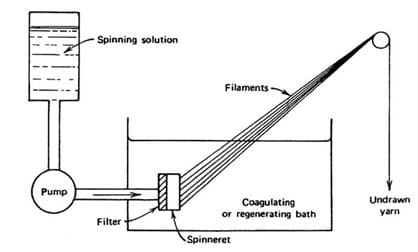
Wet spinning mixes sodium alginate powder with water and soluble additives. The solution is passed through a spinneret or nozzle within a coagulation bath filled with a salt solution to link the polymer chains, producing fiber. Multiple rounds of washing, stretching, and drying occur to shape the fibers before they are cut to size for further processing into yarn and fabrics (Bojorges et al., 2023).
Downstream Processing: Alginate leather
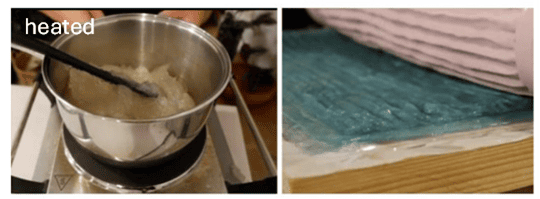
Sodium alginate powder is poured and set into a plasticizer (made of cardboard and/or faux leather) shaped to mimic a leather finish. Once the plaster is completely dried, a pigment-containing hydrogel is poured into the mold cavity and then compressed. Applying calcium chloride then nebulizes the hydrogel, curing the alginate without cracking the material; it also provides a protective patina to the exterior, which can give the material water and microbial resistance (Managò, 2022).
Novel alginate extraction methods
More novel methods (e.g., ultrasound-, microwave, or enzyme-assisted extractions; MAE, UAE, EAE, respectively) are also being explored to extract sodium alginate for higher quality and efficiency (Saji et al., 2022; Bojorges et al., 2023). MAE, UAE, and EAE are desirable for industry-scale use due to their specificity in targeting desirable compounds, higher yields compared to traditional methods, and lower environmental impact compared to current commercial methods. Table 2 below summarizes the novel extraction methods and their current readiness.
| Innovation | What it is / How it works | Claimed benefits |
| Microwave-assisted extraction (MAE) | Uses microwaves to break cell walls and release compounds in solvent or through vapor distillation | Higher yields, less solvent
Can use fresh seaweed |
| Ultrasound-assisted extraction (UAE) | High-frequency waves increase cell porosity, allowing solvent penetration | Improved yields, scalable
Does not impact heat-sensitive compounds Can use fresh seaweed |
| Enzyme-assisted extraction (EAE) | Hydrolytic enzymes break cell walls, releasing cell contents to solvent | Lower environmental impact |
Table 2. Emerging extraction techniques for seaweed-based fiber production, claimed benefits, and technological readiness/status. Sources: Saji et al., (2022), Bojorges et al. (2023)
Cellulose
Cellulose fiber production occurs primarily through viscose, modal, and lyocell processes and with tree-based feedstock (e.g., eucalyptus, oak, birch; Varnaitė-Žuravliova and Baltušnikaitė-Guzaitienė, 2024). None of the current manufacturing methods incorporates raw seaweed as the dominant material in production. The lyocell process has been most commonly used in producing seaweed-based fibers given the lower environmental impacts of its production (Guo et al., 2021).
Lyocell Process
Dried and ground seaweed is suspended in an amine oxide (surfactants used as stabilizers, thickeners etc.) solution with wood pulp at constant heat. The seaweed suspension is then added to another wood pulp suspension in doses. Dosing occurs at the wood pulp treatment, subsequent cellulose suspension, and at the spinning and filtration stages. The mixture is then filtered, spun, washed, and dried, producing a fiber with approximately 4% seaweed for yarn and fabric manufacturing (Gregersen, 2019).
If seaweed cellulose by-product is used following a prior product extraction process (e.g., after alginate extraction), it can be separated and characterized by whether its chemical composition (e.g., moisture, ash content, viscosity, dissolvability in lyocell solvents) enables further refinement into cellulose fibers (Figure 2B). If so, the by-product is processed using the lyocell method referenced above to purify the cellulose at levels suitable for fiber manufacture, sometimes in multiple rounds after chemical characterization.
The diluted amine oxide can be recycled for future processing batches by purifying and evaporating the water. Research is ongoing to valorize seaweed residues from the hydrocolloid industry as a primary feedstock for cellulose; while the research is being developed for producing films, it could apply to fiber production for fabrics (Jiang et al., 2025).


Species Selection, Cultivation and Harvesting
Species Selection
There are over 10,000 species of seaweed that vary substantially in their life cycles, impacting the concentration of compounds suitable for fiber production. Given the emerging exploration of seaweed-based fibers, seaweed species selected for production have been limited to regional seaweed supply. Species high in cellulose or alginate are desirable because the fibers produced are similar in chemical composition, mechanical performance, and tactile properties to conventional fibers (e.g., cellulose), or are already extracted in high volumes for other industries (e.g., alginates) (Felgueiras et al., 2021). Common products using seaweed-based cellulose have <10% inclusion, but with alginates it can increase to as much as 100%. Table 1 summarizes how seaweed-based fibers are commonly used and by what companies.| Seaweed Species | Fiber Production Type | Use Cases | Example Commercial Products (seaweed inclusion % if provided) |
| Saccharina latissima (Sugar Kelp) | Alginate & Cellulose | Yoga and loungewear prototypes | TaraTekstil (aimed for >70% seaweed) |
| Durvillaea antarctica | Alginate | Home and fashion fabrics | Biodegradable "sea leather" alternatives |
| Lithothamnium calcareum | Cellulose Additive | Active wellness garments | SeaCell™ (~4% seaweed) |
| Laminaria digitata | Alginate | Medical wound dressings | Celluheal Chamfond biotech Algicell |
| Ascophyllum nodosum | Alginate & Cellulose Additive | Active wellness garments Shirts/undergarments Fashion collections | SeaCell™ (~4% seaweed) Vitadylan™ (8–10% seaweed) Tabinotabi (uses SeaCell, ~4% seaweed) |
Cultivation
For more information on the cultivation approaches, see the “Cultivation and Drying Considerations” chapter.Harvesting
Currently the most common fibers made with seaweed (e.g., SeaCell) are sourced from wild harvests, which can produce variable quality. This is also seen in studies with cultivated seaweed species – for example, Ocean Rainforest has shown that the concentrations of alginates and cellulose can vary with seasonality (Gregersen, 2019). Processing information is proprietary in most cases, but general processing methods and active R&D are detailed below for alginate and cellulose-based fiber production (summarized in Figure 3).Processing and Post-processing
Alginate
Following preprocessing, seaweed is added to a tank with an alkaline solution (e.g., sodium carbonate). Consistent heating (e.g., 40°C for three hours) then converts the seaweed’s alginic acid to sodium alginate, the desired material. After conversion, the mixture is filtered to separate the solid fraction (containing materials like cellulose, fucoidan, laminarin) from the liquid fraction containing sodium alginate. Ethanol-induced precipitation purifies the sodium alginate for downstream processing (Gregersen, 2019; Managò, 2022; World Bank, 2023; Figure 2).Downstream Processing: Alginate fiber
Wet spinning mixes sodium alginate powder with water and soluble additives. The solution is passed through a spinneret or nozzle within a coagulation bath filled with a salt solution to link the polymer chains, producing fiber. Multiple rounds of washing, stretching, and drying occur to shape the fibers before they are cut to size for further processing into yarn and fabrics (Bojorges et al., 2023). [caption id="attachment_12414" align="aligncenter" width="418"] Figure 2. Schematic of the wet spinning process to produce fiber filaments and yarn. Source: Textile Learner (2022)[/caption]
Downstream Processing: Alginate leather
Sodium alginate powder is poured and set into a plasticizer (made of cardboard and/or faux leather) shaped to mimic a leather finish. Once the plaster is completely dried, a pigment-containing hydrogel is poured into the mold cavity and then compressed. Applying calcium chloride then nebulizes the hydrogel, curing the alginate without cracking the material; it also provides a protective patina to the exterior, which can give the material water and microbial resistance (Managò, 2022). [caption id="attachment_12416" align="aligncenter" width="540"] Figure 3. Heating sodium alginate for application to a mold cavity to set as alginate leather. Source: Managó (2022)[/caption]
Novel alginate extraction methods
More novel methods (e.g., ultrasound-, microwave, or enzyme-assisted extractions; MAE, UAE, EAE, respectively) are also being explored to extract sodium alginate for higher quality and efficiency (Saji et al., 2022; Bojorges et al., 2023). MAE, UAE, and EAE are desirable for industry-scale use due to their specificity in targeting desirable compounds, higher yields compared to traditional methods, and lower environmental impact compared to current commercial methods. Table 2 below summarizes the novel extraction methods and their current readiness.| Innovation | What it is / How it works | Claimed benefits |
| Microwave-assisted extraction (MAE) | Uses microwaves to break cell walls and release compounds in solvent or through vapor distillation | Higher yields, less solvent Can use fresh seaweed |
| Ultrasound-assisted extraction (UAE) | High-frequency waves increase cell porosity, allowing solvent penetration | Improved yields, scalable Does not impact heat-sensitive compounds Can use fresh seaweed |
| Enzyme-assisted extraction (EAE) | Hydrolytic enzymes break cell walls, releasing cell contents to solvent | Lower environmental impact |
Cellulose
Cellulose fiber production occurs primarily through viscose, modal, and lyocell processes and with tree-based feedstock (e.g., eucalyptus, oak, birch; Varnaitė-Žuravliova and Baltušnikaitė-Guzaitienė, 2024). None of the current manufacturing methods incorporates raw seaweed as the dominant material in production. The lyocell process has been most commonly used in producing seaweed-based fibers given the lower environmental impacts of its production (Guo et al., 2021).Lyocell Process
Dried and ground seaweed is suspended in an amine oxide (surfactants used as stabilizers, thickeners etc.) solution with wood pulp at constant heat. The seaweed suspension is then added to another wood pulp suspension in doses. Dosing occurs at the wood pulp treatment, subsequent cellulose suspension, and at the spinning and filtration stages. The mixture is then filtered, spun, washed, and dried, producing a fiber with approximately 4% seaweed for yarn and fabric manufacturing (Gregersen, 2019). If seaweed cellulose by-product is used following a prior product extraction process (e.g., after alginate extraction), it can be separated and characterized by whether its chemical composition (e.g., moisture, ash content, viscosity, dissolvability in lyocell solvents) enables further refinement into cellulose fibers (Figure 2B). If so, the by-product is processed using the lyocell method referenced above to purify the cellulose at levels suitable for fiber manufacture, sometimes in multiple rounds after chemical characterization. The diluted amine oxide can be recycled for future processing batches by purifying and evaporating the water. Research is ongoing to valorize seaweed residues from the hydrocolloid industry as a primary feedstock for cellulose; while the research is being developed for producing films, it could apply to fiber production for fabrics (Jiang et al., 2025).
[caption id="attachment_12419" align="aligncenter" width="2560"] Figure 2. Flowcharts of how seaweed is added to alginate fiber processing (top) and cellulose fiber processing (bottom). Figure adapted from World Bank (2023) and Gregerson (2019)[/caption] Species Selection, Cultivation and Harvesting
Species Selection
There are over 10,000 species of seaweed that vary substantially in their life cycles, impacting the concentration of compounds suitable for fiber production. Given the emerging exploration of seaweed-based fibers, seaweed species selected for production have been limited to regional seaweed supply. Species high in cellulose or alginate are desirable because the fibers produced are similar in chemical composition, mechanical performance, and tactile properties to conventional fibers (e.g., cellulose), or are already extracted in high volumes for other industries (e.g., alginates) (Felgueiras et al., 2021). Common products using seaweed-based cellulose have <10% inclusion, but with alginates it can increase to as much as 100%. Table 1 summarizes how seaweed-based fibers are commonly used and by what companies.| Seaweed Species | Fiber Production Type | Use Cases | Example Commercial Products (seaweed inclusion % if provided) |
| Saccharina latissima (Sugar Kelp) | Alginate & Cellulose | Yoga and loungewear prototypes | TaraTekstil (aimed for >70% seaweed) |
| Durvillaea antarctica | Alginate | Home and fashion fabrics | Biodegradable "sea leather" alternatives |
| Lithothamnium calcareum | Cellulose Additive | Active wellness garments | SeaCell™ (~4% seaweed) |
| Laminaria digitata | Alginate | Medical wound dressings | Celluheal Chamfond biotech Algicell |
| Ascophyllum nodosum | Alginate & Cellulose Additive | Active wellness garments Shirts/undergarments Fashion collections | SeaCell™ (~4% seaweed) Vitadylan™ (8–10% seaweed) Tabinotabi (uses SeaCell, ~4% seaweed) |
Cultivation
For more information on the cultivation approaches, see the “Cultivation and Drying Considerations” chapter.Harvesting
Currently the most common fibers made with seaweed (e.g., SeaCell) are sourced from wild harvests, which can produce variable quality. This is also seen in studies with cultivated seaweed species – for example, Ocean Rainforest has shown that the concentrations of alginates and cellulose can vary with seasonality (Gregersen, 2019). Processing information is proprietary in most cases, but general processing methods and active R&D are detailed below for alginate and cellulose-based fiber production (summarized in Figure 3).Processing and Post-processing
Alginate
Following preprocessing, seaweed is added to a tank with an alkaline solution (e.g., sodium carbonate). Consistent heating (e.g., 40°C for three hours) then converts the seaweed’s alginic acid to sodium alginate, the desired material. After conversion, the mixture is filtered to separate the solid fraction (containing materials like cellulose, fucoidan, laminarin) from the liquid fraction containing sodium alginate. Ethanol-induced precipitation purifies the sodium alginate for downstream processing (Gregersen, 2019; Managò, 2022; World Bank, 2023; Figure 2).Downstream Processing: Alginate fiber
Wet spinning mixes sodium alginate powder with water and soluble additives. The solution is passed through a spinneret or nozzle within a coagulation bath filled with a salt solution to link the polymer chains, producing fiber. Multiple rounds of washing, stretching, and drying occur to shape the fibers before they are cut to size for further processing into yarn and fabrics (Bojorges et al., 2023). [caption id="attachment_12414" align="aligncenter" width="418"] Figure 2. Schematic of the wet spinning process to produce fiber filaments and yarn. Source: Textile Learner (2022)[/caption]
Downstream Processing: Alginate leather
Sodium alginate powder is poured and set into a plasticizer (made of cardboard and/or faux leather) shaped to mimic a leather finish. Once the plaster is completely dried, a pigment-containing hydrogel is poured into the mold cavity and then compressed. Applying calcium chloride then nebulizes the hydrogel, curing the alginate without cracking the material; it also provides a protective patina to the exterior, which can give the material water and microbial resistance (Managò, 2022). [caption id="attachment_12416" align="aligncenter" width="540"] Figure 3. Heating sodium alginate for application to a mold cavity to set as alginate leather. Source: Managó (2022)[/caption]
Novel alginate extraction methods
More novel methods (e.g., ultrasound-, microwave, or enzyme-assisted extractions; MAE, UAE, EAE, respectively) are also being explored to extract sodium alginate for higher quality and efficiency (Saji et al., 2022; Bojorges et al., 2023). MAE, UAE, and EAE are desirable for industry-scale use due to their specificity in targeting desirable compounds, higher yields compared to traditional methods, and lower environmental impact compared to current commercial methods. Table 2 below summarizes the novel extraction methods and their current readiness.| Innovation | What it is / How it works | Claimed benefits |
| Microwave-assisted extraction (MAE) | Uses microwaves to break cell walls and release compounds in solvent or through vapor distillation | Higher yields, less solvent Can use fresh seaweed |
| Ultrasound-assisted extraction (UAE) | High-frequency waves increase cell porosity, allowing solvent penetration | Improved yields, scalable Does not impact heat-sensitive compounds Can use fresh seaweed |
| Enzyme-assisted extraction (EAE) | Hydrolytic enzymes break cell walls, releasing cell contents to solvent | Lower environmental impact |
Cellulose
Cellulose fiber production occurs primarily through viscose, modal, and lyocell processes and with tree-based feedstock (e.g., eucalyptus, oak, birch; Varnaitė-Žuravliova and Baltušnikaitė-Guzaitienė, 2024). None of the current manufacturing methods incorporates raw seaweed as the dominant material in production. The lyocell process has been most commonly used in producing seaweed-based fibers given the lower environmental impacts of its production (Guo et al., 2021).Lyocell Process
Dried and ground seaweed is suspended in an amine oxide (surfactants used as stabilizers, thickeners etc.) solution with wood pulp at constant heat. The seaweed suspension is then added to another wood pulp suspension in doses. Dosing occurs at the wood pulp treatment, subsequent cellulose suspension, and at the spinning and filtration stages. The mixture is then filtered, spun, washed, and dried, producing a fiber with approximately 4% seaweed for yarn and fabric manufacturing (Gregersen, 2019). If seaweed cellulose by-product is used following a prior product extraction process (e.g., after alginate extraction), it can be separated and characterized by whether its chemical composition (e.g., moisture, ash content, viscosity, dissolvability in lyocell solvents) enables further refinement into cellulose fibers (Figure 2B). If so, the by-product is processed using the lyocell method referenced above to purify the cellulose at levels suitable for fiber manufacture, sometimes in multiple rounds after chemical characterization. The diluted amine oxide can be recycled for future processing batches by purifying and evaporating the water. Research is ongoing to valorize seaweed residues from the hydrocolloid industry as a primary feedstock for cellulose; while the research is being developed for producing films, it could apply to fiber production for fabrics (Jiang et al., 2025).
[caption id="attachment_12419" align="aligncenter" width="2560"] Figure 2. Flowcharts of how seaweed is added to alginate fiber processing (top) and cellulose fiber processing (bottom). Figure adapted from World Bank (2023) and Gregerson (2019)[/caption] Species Selection, Cultivation and Harvesting
Species Selection
There are over 10,000 species of seaweed that vary substantially in their life cycles, impacting the concentration of compounds suitable for fiber production. Given the emerging exploration of seaweed-based fibers, seaweed species selected for production have been limited to regional seaweed supply. Species high in cellulose or alginate are desirable because the fibers produced are similar in chemical composition, mechanical performance, and tactile properties to conventional fibers (e.g., cellulose), or are already extracted in high volumes for other industries (e.g., alginates) (Felgueiras et al., 2021). Common products using seaweed-based cellulose have <10% inclusion, but with alginates it can increase to as much as 100%. Table 1 summarizes how seaweed-based fibers are commonly used and by what companies.| Seaweed Species | Fiber Production Type | Use Cases | Example Commercial Products (seaweed inclusion % if provided) |
| Saccharina latissima (Sugar Kelp) | Alginate & Cellulose | Yoga and loungewear prototypes | TaraTekstil (aimed for >70% seaweed) |
| Durvillaea antarctica | Alginate | Home and fashion fabrics | Biodegradable "sea leather" alternatives |
| Lithothamnium calcareum | Cellulose Additive | Active wellness garments | SeaCell™ (~4% seaweed) |
| Laminaria digitata | Alginate | Medical wound dressings | Celluheal Chamfond biotech Algicell |
| Ascophyllum nodosum | Alginate & Cellulose Additive | Active wellness garments Shirts/undergarments Fashion collections | SeaCell™ (~4% seaweed) Vitadylan™ (8–10% seaweed) Tabinotabi (uses SeaCell, ~4% seaweed) |
Cultivation
For more information on the cultivation approaches, see the “Cultivation and Drying Considerations” chapter.Harvesting
Currently the most common fibers made with seaweed (e.g., SeaCell) are sourced from wild harvests, which can produce variable quality. This is also seen in studies with cultivated seaweed species – for example, Ocean Rainforest has shown that the concentrations of alginates and cellulose can vary with seasonality (Gregersen, 2019). Processing information is proprietary in most cases, but general processing methods and active R&D are detailed below for alginate and cellulose-based fiber production (summarized in Figure 3).Processing and Post-processing
Alginate
Following preprocessing, seaweed is added to a tank with an alkaline solution (e.g., sodium carbonate). Consistent heating (e.g., 40°C for three hours) then converts the seaweed’s alginic acid to sodium alginate, the desired material. After conversion, the mixture is filtered to separate the solid fraction (containing materials like cellulose, fucoidan, laminarin) from the liquid fraction containing sodium alginate. Ethanol-induced precipitation purifies the sodium alginate for downstream processing (Gregersen, 2019; Managò, 2022; World Bank, 2023; Figure 2).Downstream Processing: Alginate fiber
Wet spinning mixes sodium alginate powder with water and soluble additives. The solution is passed through a spinneret or nozzle within a coagulation bath filled with a salt solution to link the polymer chains, producing fiber. Multiple rounds of washing, stretching, and drying occur to shape the fibers before they are cut to size for further processing into yarn and fabrics (Bojorges et al., 2023). [caption id="attachment_12414" align="aligncenter" width="418"] Figure 2. Schematic of the wet spinning process to produce fiber filaments and yarn. Source: Textile Learner (2022)[/caption]
Downstream Processing: Alginate leather
Sodium alginate powder is poured and set into a plasticizer (made of cardboard and/or faux leather) shaped to mimic a leather finish. Once the plaster is completely dried, a pigment-containing hydrogel is poured into the mold cavity and then compressed. Applying calcium chloride then nebulizes the hydrogel, curing the alginate without cracking the material; it also provides a protective patina to the exterior, which can give the material water and microbial resistance (Managò, 2022). [caption id="attachment_12416" align="aligncenter" width="540"] Figure 3. Heating sodium alginate for application to a mold cavity to set as alginate leather. Source: Managó (2022)[/caption]
Novel alginate extraction methods
More novel methods (e.g., ultrasound-, microwave, or enzyme-assisted extractions; MAE, UAE, EAE, respectively) are also being explored to extract sodium alginate for higher quality and efficiency (Saji et al., 2022; Bojorges et al., 2023). MAE, UAE, and EAE are desirable for industry-scale use due to their specificity in targeting desirable compounds, higher yields compared to traditional methods, and lower environmental impact compared to current commercial methods. Table 2 below summarizes the novel extraction methods and their current readiness.| Innovation | What it is / How it works | Claimed benefits |
| Microwave-assisted extraction (MAE) | Uses microwaves to break cell walls and release compounds in solvent or through vapor distillation | Higher yields, less solvent Can use fresh seaweed |
| Ultrasound-assisted extraction (UAE) | High-frequency waves increase cell porosity, allowing solvent penetration | Improved yields, scalable Does not impact heat-sensitive compounds Can use fresh seaweed |
| Enzyme-assisted extraction (EAE) | Hydrolytic enzymes break cell walls, releasing cell contents to solvent | Lower environmental impact |
Cellulose
Cellulose fiber production occurs primarily through viscose, modal, and lyocell processes and with tree-based feedstock (e.g., eucalyptus, oak, birch; Varnaitė-Žuravliova and Baltušnikaitė-Guzaitienė, 2024). None of the current manufacturing methods incorporates raw seaweed as the dominant material in production. The lyocell process has been most commonly used in producing seaweed-based fibers given the lower environmental impacts of its production (Guo et al., 2021).Lyocell Process
Dried and ground seaweed is suspended in an amine oxide (surfactants used as stabilizers, thickeners etc.) solution with wood pulp at constant heat. The seaweed suspension is then added to another wood pulp suspension in doses. Dosing occurs at the wood pulp treatment, subsequent cellulose suspension, and at the spinning and filtration stages. The mixture is then filtered, spun, washed, and dried, producing a fiber with approximately 4% seaweed for yarn and fabric manufacturing (Gregersen, 2019). If seaweed cellulose by-product is used following a prior product extraction process (e.g., after alginate extraction), it can be separated and characterized by whether its chemical composition (e.g., moisture, ash content, viscosity, dissolvability in lyocell solvents) enables further refinement into cellulose fibers (Figure 2B). If so, the by-product is processed using the lyocell method referenced above to purify the cellulose at levels suitable for fiber manufacture, sometimes in multiple rounds after chemical characterization. The diluted amine oxide can be recycled for future processing batches by purifying and evaporating the water. Research is ongoing to valorize seaweed residues from the hydrocolloid industry as a primary feedstock for cellulose; while the research is being developed for producing films, it could apply to fiber production for fabrics (Jiang et al., 2025).
[caption id="attachment_12419" align="aligncenter" width="2560"] Figure 2. Flowcharts of how seaweed is added to alginate fiber processing (top) and cellulose fiber processing (bottom). Figure adapted from World Bank (2023) and Gregerson (2019)[/caption] Species Selection, Cultivation and Harvesting
Species Selection
There are over 10,000 species of seaweed that vary substantially in their life cycles, impacting the concentration of compounds suitable for fiber production. Given the emerging exploration of seaweed-based fibers, seaweed species selected for production have been limited to regional seaweed supply. Species high in cellulose or alginate are desirable because the fibers produced are similar in chemical composition, mechanical performance, and tactile properties to conventional fibers (e.g., cellulose), or are already extracted in high volumes for other industries (e.g., alginates) (Felgueiras et al., 2021). Common products using seaweed-based cellulose have <10% inclusion, but with alginates it can increase to as much as 100%. Table 1 summarizes how seaweed-based fibers are commonly used and by what companies.| Seaweed Species | Fiber Production Type | Use Cases | Example Commercial Products (seaweed inclusion % if provided) |
| Saccharina latissima (Sugar Kelp) | Alginate & Cellulose | Yoga and loungewear prototypes | TaraTekstil (aimed for >70% seaweed) |
| Durvillaea antarctica | Alginate | Home and fashion fabrics | Biodegradable "sea leather" alternatives |
| Lithothamnium calcareum | Cellulose Additive | Active wellness garments | SeaCell™ (~4% seaweed) |
| Laminaria digitata | Alginate | Medical wound dressings | Celluheal Chamfond biotech Algicell |
| Ascophyllum nodosum | Alginate & Cellulose Additive | Active wellness garments Shirts/undergarments Fashion collections | SeaCell™ (~4% seaweed) Vitadylan™ (8–10% seaweed) Tabinotabi (uses SeaCell, ~4% seaweed) |
Cultivation
For more information on the cultivation approaches, see the “Cultivation and Drying Considerations” chapter.Harvesting
Currently the most common fibers made with seaweed (e.g., SeaCell) are sourced from wild harvests, which can produce variable quality. This is also seen in studies with cultivated seaweed species – for example, Ocean Rainforest has shown that the concentrations of alginates and cellulose can vary with seasonality (Gregersen, 2019). Processing information is proprietary in most cases, but general processing methods and active R&D are detailed below for alginate and cellulose-based fiber production (summarized in Figure 3).Processing and Post-processing
Alginate
Following preprocessing, seaweed is added to a tank with an alkaline solution (e.g., sodium carbonate). Consistent heating (e.g., 40°C for three hours) then converts the seaweed’s alginic acid to sodium alginate, the desired material. After conversion, the mixture is filtered to separate the solid fraction (containing materials like cellulose, fucoidan, laminarin) from the liquid fraction containing sodium alginate. Ethanol-induced precipitation purifies the sodium alginate for downstream processing (Gregersen, 2019; Managò, 2022; World Bank, 2023; Figure 2A).Downstream Processing: Alginate fiber
Wet spinning mixes sodium alginate powder with water and soluble additives. The solution is passed through a spinneret or nozzle within a coagulation bath filled with a salt solution to link the polymer chains, producing fiber. Multiple rounds of washing, stretching, and drying occur to shape the fibers before they are cut to size for further processing into yarn and fabrics (Bojorges et al., 2023). [caption id="attachment_12414" align="aligncenter" width="418"] Figure 2. Schematic of the wet spinning process to produce fiber filaments and yarn. Source: Textile Learner (2022)[/caption]
Downstream Processing: Alginate leather
Sodium alginate powder is poured and set into a plasticizer (made of cardboard and/or faux leather) shaped to mimic a leather finish. Once the plaster is completely dried, a pigment-containing hydrogel is poured into the mold cavity and then compressed. Applying calcium chloride then nebulizes the hydrogel, curing the alginate without cracking the material; it also provides a protective patina to the exterior, which can give the material water and microbial resistance (Managò, 2022). [caption id="attachment_12416" align="aligncenter" width="540"] Figure 3. Heating sodium alginate for application to a mold cavity to set as alginate leather. Source: Managó (2022)[/caption]
Novel alginate extraction methods
More novel methods (e.g., ultrasound-, microwave, or enzyme-assisted extractions; MAE, UAE, EAE, respectively) are also being explored to extract sodium alginate for higher quality and efficiency (Saji et al., 2022; Bojorges et al., 2023). MAE, UAE, and EAE are desirable for industry-scale use due to their specificity in targeting desirable compounds, higher yields compared to traditional methods, and lower environmental impact compared to current commercial methods. Table 2 below summarizes the novel extraction methods and their current readiness.| Innovation | What it is / How it works | Claimed benefits |
| Microwave-assisted extraction (MAE) | Uses microwaves to break cell walls and release compounds in solvent or through vapor distillation | Higher yields, less solvent Can use fresh seaweed |
| Ultrasound-assisted extraction (UAE) | High-frequency waves increase cell porosity, allowing solvent penetration | Improved yields, scalable Does not impact heat-sensitive compounds Can use fresh seaweed |
| Enzyme-assisted extraction (EAE) | Hydrolytic enzymes break cell walls, releasing cell contents to solvent | Lower environmental impact |
Cellulose
Cellulose fiber production occurs primarily through viscose, modal, and lyocell processes and with tree-based feedstock (e.g., eucalyptus, oak, birch; Varnaitė-Žuravliova and Baltušnikaitė-Guzaitienė, 2024). None of the current manufacturing methods incorporates raw seaweed as the dominant material in production. The lyocell process has been most commonly used in producing seaweed-based fibers given the lower environmental impacts of its production (Guo et al., 2021).Lyocell Process
Dried and ground seaweed is suspended in an amine oxide (surfactants used as stabilizers, thickeners etc.) solution with wood pulp at constant heat. The seaweed suspension is then added to another wood pulp suspension in doses. Dosing occurs at the wood pulp treatment, subsequent cellulose suspension, and at the spinning and filtration stages. The mixture is then filtered, spun, washed, and dried, producing a fiber with approximately 4% seaweed for yarn and fabric manufacturing (Gregersen, 2019). If seaweed cellulose by-product is used following a prior product extraction process (e.g., after alginate extraction), it can be separated and characterized by whether its chemical composition (e.g., moisture, ash content, viscosity, dissolvability in lyocell solvents) enables further refinement into cellulose fibers (Figure 2B). If so, the by-product is processed using the lyocell method referenced above to purify the cellulose at levels suitable for fiber manufacture, sometimes in multiple rounds after chemical characterization. The diluted amine oxide can be recycled for future processing batches by purifying and evaporating the water. Research is ongoing to valorize seaweed residues from the hydrocolloid industry as a primary feedstock for cellulose; while the research is being developed for producing films, it could apply to fiber production for fabrics (Jiang et al., 2025).
[caption id="attachment_12419" align="aligncenter" width="2560"] Figure 2. Flowcharts of how seaweed is added to alginate fiber processing (top) and cellulose fiber processing (bottom). Figure adapted from World Bank (2023) and Gregerson (2019)[/caption] Species Selection, Cultivation and Harvesting
Species Selection
There are over 10,000 species of seaweed that vary substantially in their life cycles, impacting the concentration of compounds suitable for fiber production. Given the emerging exploration of seaweed-based fibers, seaweed species selected for production have been limited to regional seaweed supply. Species high in cellulose or alginate are desirable because the fibers produced are similar in chemical composition, mechanical performance, and tactile properties to conventional fibers (e.g., cellulose), or are already extracted in high volumes for other industries (e.g., alginates) (Felgueiras et al., 2021). Common products using seaweed-based cellulose have <10% inclusion, but with alginates it can increase to as much as 100%. Table 1 summarizes how seaweed-based fibers are commonly used and by what companies. Alginate & Cellulose AdditiveAlginate| Seaweed Species | Fiber Production Type | Use Cases | Example Commercial Products (seaweed inclusion % if provided) |
| Saccharina latissima (Sugar Kelp) | Alginate & Cellulose | Yoga and loungewear prototypes | TaraTekstil (aimed for >70% seaweed) |
| Durvillaea antarctica | Alginate | Home and fashion fabrics | Biodegradable "sea leather" alternatives |
| Lithothamnium calcareum | Cellulose Additive | Active wellness garments | SeaCell™ (~4% seaweed) |
| Laminaria digitata | Alginate | Medical wound dressings | Celluheal Chamfond biotech Algicell |
| Ascophyllum nodosum | Alginate & Cellulose Additive | Active wellness garments Shirts/undergarments Fashion collections | SeaCell™ (~4% seaweed) Vitadylan™ (8–10% seaweed) Tabinotabi (uses SeaCell, ~4% seaweed) |
Cultivation
For more information on the cultivation approaches, see the “Cultivation and Drying Considerations” chapter.Harvesting
Currently the most common fibers made with seaweed (e.g., SeaCell) are sourced from wild harvests, which can produce variable quality. This is also seen in studies with cultivated seaweed species – for example, Ocean Rainforest has shown that the concentrations of alginates and cellulose can vary with seasonality (Gregersen, 2019). Processing information is proprietary in most cases, but general processing methods and active R&D are detailed below for alginate and cellulose-based fiber production (summarized in Figure 3).Processing and Post-processing
Alginate
Following preprocessing, seaweed is added to a tank with an alkaline solution (e.g., sodium carbonate). Consistent heating (e.g., 40°C for three hours) then converts the seaweed’s alginic acid to sodium alginate, the desired material. After conversion, the mixture is filtered to separate the solid fraction (containing materials like cellulose, fucoidan, laminarin) from the liquid fraction containing sodium alginate. Ethanol-induced precipitation purifies the sodium alginate for downstream processing (Gregersen, 2019; Managò, 2022; World Bank, 2023; Figure 2A).Downstream Processing: Alginate fiber
Wet spinning mixes sodium alginate powder with water and soluble additives. The solution is passed through a spinneret or nozzle within a coagulation bath filled with a salt solution to link the polymer chains, producing fiber. Multiple rounds of washing, stretching, and drying occur to shape the fibers before they are cut to size for further processing into yarn and fabrics (Bojorges et al., 2023). [caption id="attachment_12414" align="aligncenter" width="418"] Figure 2. Schematic of the wet spinning process to produce fiber filaments and yarn. Source: Textile Learner (2022)[/caption]
Downstream Processing: Alginate leather
Sodium alginate powder is poured and set into a plasticizer (made of cardboard and/or faux leather) shaped to mimic a leather finish. Once the plaster is completely dried, a pigment-containing hydrogel is poured into the mold cavity and then compressed. Applying calcium chloride then nebulizes the hydrogel, curing the alginate without cracking the material; it also provides a protective patina to the exterior, which can give the material water and microbial resistance (Managò, 2022). [caption id="attachment_12416" align="aligncenter" width="540"] Figure 3. Heating sodium alginate for application to a mold cavity to set as alginate leather. Source: Managó (2022)[/caption]
Novel alginate extraction methods
More novel methods (e.g., ultrasound-, microwave, or enzyme-assisted extractions; MAE, UAE, EAE, respectively) are also being explored to extract sodium alginate for higher quality and efficiency (Saji et al., 2022; Bojorges et al., 2023). MAE, UAE, and EAE are desirable for industry-scale use due to their specificity in targeting desirable compounds, higher yields compared to traditional methods, and lower environmental impact compared to current commercial methods. Table 2 below summarizes the novel extraction methods and their current readiness.| Innovation | What it is / How it works | Claimed benefits |
| Microwave-assisted extraction (MAE) | Uses microwaves to break cell walls and release compounds in solvent or through vapor distillation | Higher yields, less solvent Can use fresh seaweed |
| Ultrasound-assisted extraction (UAE) | High-frequency waves increase cell porosity, allowing solvent penetration | Improved yields, scalable Does not impact heat-sensitive compounds Can use fresh seaweed |
| Enzyme-assisted extraction (EAE) | Hydrolytic enzymes break cell walls, releasing cell contents to solvent | Lower environmental impact |
Cellulose
Cellulose fiber production occurs primarily through viscose, modal, and lyocell processes and with tree-based feedstock (e.g., eucalyptus, oak, birch; Varnaitė-Žuravliova and Baltušnikaitė-Guzaitienė, 2024). None of the current manufacturing methods incorporates raw seaweed as the dominant material in production. The lyocell process has been most commonly used in producing seaweed-based fibers given the lower environmental impacts of its production (Guo et al., 2021).Lyocell Process
Dried and ground seaweed is suspended in an amine oxide (surfactants used as stabilizers, thickeners etc.) solution with wood pulp at constant heat. The seaweed suspension is then added to another wood pulp suspension in doses. Dosing occurs at the wood pulp treatment, subsequent cellulose suspension, and at the spinning and filtration stages. The mixture is then filtered, spun, washed, and dried, producing a fiber with approximately 4% seaweed for yarn and fabric manufacturing (Gregersen, 2019). If seaweed cellulose by-product is used following a prior product extraction process (e.g., after alginate extraction), it can be separated and characterized by whether its chemical composition (e.g., moisture, ash content, viscosity, dissolvability in lyocell solvents) enables further refinement into cellulose fibers (Figure 2B). If so, the by-product is processed using the lyocell method referenced above to purify the cellulose at levels suitable for fiber manufacture, sometimes in multiple rounds after chemical characterization. The diluted amine oxide can be recycled for future processing batches by purifying and evaporating the water. Research is ongoing to valorize seaweed residues from the hydrocolloid industry as a primary feedstock for cellulose; while the research is being developed for producing films, it could apply to fiber production for fabrics (Jiang et al., 2025).
[caption id="attachment_12419" align="aligncenter" width="2560"] Figure 2. Flowcharts of how seaweed is added to alginate fiber processing (top) and cellulose fiber processing (bottom). Figure adapted from World Bank (2023) and Gregerson (2019)[/caption] Species Selection, Cultivation and Harvesting
Species Selection
There are over 10,000 species of seaweed that vary substantially in their life cycles, impacting the concentration of compounds suitable for fiber production. Given the emerging exploration of seaweed-based fibers, seaweed species selected for production have been limited to regional seaweed supply. Species high in cellulose or alginate are desirable because the fibers produced are similar in chemical composition, mechanical performance, and tactile properties to conventional fibers (e.g., cellulose), or are already extracted in high volumes for other industries (e.g., alginates) (Felgueiras et al., 2021). Common products using seaweed-based cellulose have <10% inclusion, but with alginates it can increase to as much as 100%. Table 1 summarizes how seaweed-based fibers are commonly used and by what companies. Alginate & Cellulose AdditiveAlginate| Seaweed Species | Fiber Production Type | Use Cases | Example Commercial Products (seaweed inclusion % if provided) |
| Saccharina latissima (Sugar Kelp) | Alginate & Cellulose | Yoga and loungewear prototypes | TaraTekstil (aimed for >70% seaweed) |
| Durvillaea antarctica | Alginate | Home and fashion fabrics | Biodegradable "sea leather" alternatives |
| Lithothamnium calcareum | Cellulose Additive | Active wellness garments | SeaCell™ (~4% seaweed) |
| Laminaria digitata | Alginate | Medical wound dressings | Celluheal Chamfond biotech Algicell |
| Ascophyllum nodosum | Alginate & Cellulose Additive | Active wellness garments Shirts/undergarments Fashion collections | SeaCell™ (~4% seaweed) Vitadylan™ (8–10% seaweed) Tabinotabi (uses SeaCell, ~4% seaweed) |
Cultivation
For more information on the cultivation approaches, see the “Cultivation Considerations” chapter.Harvesting
Currently the most common fibers made with seaweed (e.g., SeaCell) are sourced from wild harvests, which can produce variable quality. This is also seen in studies with cultivated seaweed species – for example, Ocean Rainforest has shown that the concentrations of alginates and cellulose can vary with seasonality (Gregersen, 2019). Processing information is proprietary in most cases, but general processing methods and active R&D are detailed below for alginate and cellulose-based fiber production (summarized in Figure 3).Processing and Post-processing
Alginate
Following preprocessing, seaweed is added to a tank with an alkaline solution (e.g., sodium carbonate). Consistent heating (e.g., 40°C for three hours) then converts the seaweed’s alginic acid to sodium alginate, the desired material. After conversion, the mixture is filtered to separate the solid fraction (containing materials like cellulose, fucoidan, laminarin) from the liquid fraction containing sodium alginate. Ethanol-induced precipitation purifies the sodium alginate for downstream processing (Gregersen, 2019; Managò, 2022; World Bank, 2023; Figure 2A).Downstream Processing: Alginate fiber
Wet spinning mixes sodium alginate powder with water and soluble additives. The solution is passed through a spinneret or nozzle within a coagulation bath filled with a salt solution to link the polymer chains, producing fiber. Multiple rounds of washing, stretching, and drying occur to shape the fibers before they are cut to size for further processing into yarn and fabrics (Bojorges et al., 2023). [caption id="attachment_12414" align="aligncenter" width="418"] Figure 2. Schematic of the wet spinning process to produce fiber filaments and yarn. Source: Textile Learner (2022)[/caption]
Downstream Processing: Alginate leather
Sodium alginate powder is poured and set into a plasticizer (made of cardboard and/or faux leather) shaped to mimic a leather finish. Once the plaster is completely dried, a pigment-containing hydrogel is poured into the mold cavity and then compressed. Applying calcium chloride then nebulizes the hydrogel, curing the alginate without cracking the material; it also provides a protective patina to the exterior, which can give the material water and microbial resistance (Managò, 2022). [caption id="attachment_12416" align="aligncenter" width="540"] Figure 3. Heating sodium alginate for application to a mold cavity to set as alginate leather. Source: Managó (2022)[/caption]
Novel alginate extraction methods
More novel methods (e.g., ultrasound-, microwave, or enzyme-assisted extractions; MAE, UAE, EAE, respectively) are also being explored to extract sodium alginate for higher quality and efficiency (Saji et al., 2022; Bojorges et al., 2023). MAE, UAE, and EAE are desirable for industry-scale use due to their specificity in targeting desirable compounds, higher yields compared to traditional methods, and lower environmental impact compared to current commercial methods. Table 2 below summarizes the novel extraction methods and their current readiness.| Innovation | What it is / How it works | Claimed benefits |
| Microwave-assisted extraction (MAE) | Uses microwaves to break cell walls and release compounds in solvent or through vapor distillation | Higher yields, less solvent Can use fresh seaweed |
| Ultrasound-assisted extraction (UAE) | High-frequency waves increase cell porosity, allowing solvent penetration | Improved yields, scalable Does not impact heat-sensitive compounds Can use fresh seaweed |
| Enzyme-assisted extraction (EAE) | Hydrolytic enzymes break cell walls, releasing cell contents to solvent | Lower environmental impact |
Cellulose
Cellulose fiber production occurs primarily through viscose, modal, and lyocell processes and with tree-based feedstock (e.g., eucalyptus, oak, birch; Varnaitė-Žuravliova and Baltušnikaitė-Guzaitienė, 2024). None of the current manufacturing methods incorporates raw seaweed as the dominant material in production. The lyocell process has been most commonly used in producing seaweed-based fibers given the lower environmental impacts of its production (Guo et al., 2021).Lyocell Process
Dried and ground seaweed is suspended in an amine oxide (surfactants used as stabilizers, thickeners etc.) solution with wood pulp at constant heat. The seaweed suspension is then added to another wood pulp suspension in doses. Dosing occurs at the wood pulp treatment, subsequent cellulose suspension, and at the spinning and filtration stages. The mixture is then filtered, spun, washed, and dried, producing a fiber with approximately 4% seaweed for yarn and fabric manufacturing (Gregersen, 2019). If seaweed cellulose by-product is used following a prior product extraction process (e.g., after alginate extraction), it can be separated and characterized by whether its chemical composition (e.g., moisture, ash content, viscosity, dissolvability in lyocell solvents) enables further refinement into cellulose fibers (Figure 2B). If so, the by-product is processed using the lyocell method referenced above to purify the cellulose at levels suitable for fiber manufacture, sometimes in multiple rounds after chemical characterization. The diluted amine oxide can be recycled for future processing batches by purifying and evaporating the water. Research is ongoing to valorize seaweed residues from the hydrocolloid industry as a primary feedstock for cellulose; while the research is being developed for producing films, it could apply to fiber production for fabrics (Jiang et al., 2025).
[caption id="attachment_12419" align="aligncenter" width="2560"] Figure 2. Flowcharts of how seaweed is added to alginate fiber processing (top) and cellulose fiber processing (bottom). Figure adapted from World Bank (2023) and Gregerson (2019)[/caption] Species Selection, Cultivation and Harvesting
Species Selection
There are over 10,000 species of seaweed that vary substantially in their life cycles, impacting the concentration of compounds suitable for fiber production. Given the emerging exploration of seaweed-based fibers, seaweed species selected for production have been limited to regional seaweed supply. Species high in cellulose or alginate are desirable because the fibers produced are similar in chemical composition, mechanical performance, and tactile properties to conventional fibers (e.g., cellulose), or are already extracted in high volumes for other industries (e.g., alginates) (Felgueiras et al., 2021). Common products using seaweed-based cellulose have <10% inclusion, but with alginates it can increase to as much as 100%. Table 1 summarizes how seaweed-based fibers are commonly used and by what companies. Alginate & Cellulose AdditiveAlginate| Seaweed Species | Fiber Production Type | Use Cases | Example Commercial Products (seaweed inclusion % if provided) |
| Saccharina latissima (Sugar Kelp) | Alginate & Cellulose | Yoga and loungewear prototypes | TaraTekstil (aimed for >70% seaweed) |
| Durvillaea antarctica | Alginate | Home and fashion fabrics | Biodegradable "sea leather" alternatives |
| Lithothamnium calcareum | Cellulose Additive | Active wellness garments | SeaCell™ (~4% seaweed) |
| Laminaria digitata | Alginate | Medical wound dressings | Celluheal Chamfond biotech Algicell |
| Ascophyllum nodosum | Alginate & Cellulose Additive | Active wellness garments Shirts/undergarments Fashion collections | SeaCell™ (~4% seaweed) Vitadylan™ (8–10% seaweed) Tabinotabi (uses SeaCell, ~4% seaweed) |
Cultivation
For more information on the cultivation approaches, see the “Cultivation Considerations” chapter.Harvesting
Currently the most common fibers made with seaweed (e.g., SeaCell) are sourced from wild harvests, which can produce variable quality. This is also seen in studies with cultivated seaweed species – for example, Ocean Rainforest has shown that the concentrations of alginates and cellulose can vary with seasonality (Gregersen, 2019). Processing information is proprietary in most cases, but general processing methods and active R&D are detailed below for alginate and cellulose-based fiber production (summarized in Figure 3).Pre- and Processing
Alginate
Following preprocessing, seaweed is added to a tank with an alkaline solution (e.g., sodium carbonate). Consistent heating (e.g., 40°C for three hours) then converts the seaweed’s alginic acid to sodium alginate, the desired material. After conversion, the mixture is filtered to separate the solid fraction (containing materials like cellulose, fucoidan, laminarin) from the liquid fraction containing sodium alginate. Ethanol-induced precipitation purifies the sodium alginate for downstream processing (Gregersen, 2019; Managò, 2022; World Bank, 2023; Figure 2A).Downstream Processing: Alginate fiber
Wet spinning mixes sodium alginate powder with water and soluble additives. The solution is passed through a spinneret or nozzle within a coagulation bath filled with a salt solution to link the polymer chains, producing fiber. Multiple rounds of washing, stretching, and drying occur to shape the fibers before they are cut to size for further processing into yarn and fabrics (Bojorges et al., 2023). [caption id="attachment_12414" align="aligncenter" width="418"] Figure 2. Schematic of the wet spinning process to produce fiber filaments and yarn. Source: Textile Learner (2022)[/caption]
Downstream Processing: Alginate leather
Sodium alginate powder is poured and set into a plasticizer (made of cardboard and/or faux leather) shaped to mimic a leather finish. Once the plaster is completely dried, a pigment-containing hydrogel is poured into the mold cavity and then compressed. Applying calcium chloride then nebulizes the hydrogel, curing the alginate without cracking the material; it also provides a protective patina to the exterior, which can give the material water and microbial resistance (Managò, 2022). [caption id="attachment_12416" align="aligncenter" width="540"] Figure 3. Heating sodium alginate for application to a mold cavity to set as alginate leather. Source: Managó (2022)[/caption]
Novel alginate extraction methods
More novel methods (e.g., ultrasound-, microwave, or enzyme-assisted extractions; MAE, UAE, EAE, respectively) are also being explored to extract sodium alginate for higher quality and efficiency (Saji et al., 2022; Bojorges et al., 2023). MAE, UAE, and EAE are desirable for industry-scale use due to their specificity in targeting desirable compounds, higher yields compared to traditional methods, and lower environmental impact compared to current commercial methods. Table 2 below summarizes the novel extraction methods and their current readiness.| Innovation | What it is / How it works | Claimed benefits |
| Microwave-assisted extraction (MAE) | Uses microwaves to break cell walls and release compounds in solvent or through vapor distillation | Higher yields, less solvent Can use fresh seaweed |
| Ultrasound-assisted extraction (UAE) | High-frequency waves increase cell porosity, allowing solvent penetration | Improved yields, scalable Does not impact heat-sensitive compounds Can use fresh seaweed |
| Enzyme-assisted extraction (EAE) | Hydrolytic enzymes break cell walls, releasing cell contents to solvent | Lower environmental impact |
Cellulose
Cellulose fiber production occurs primarily through viscose, modal, and lyocell processes and with tree-based feedstock (e.g., eucalyptus, oak, birch; Varnaitė-Žuravliova and Baltušnikaitė-Guzaitienė, 2024). None of the current manufacturing methods incorporates raw seaweed as the dominant material in production. The lyocell process has been most commonly used in producing seaweed-based fibers given the lower environmental impacts of its production (Guo et al., 2021).Lyocell Process
Dried and ground seaweed is suspended in an amine oxide (surfactants used as stabilizers, thickeners etc.) solution with wood pulp at constant heat. The seaweed suspension is then added to another wood pulp suspension in doses. Dosing occurs at the wood pulp treatment, subsequent cellulose suspension, and at the spinning and filtration stages. The mixture is then filtered, spun, washed, and dried, producing a fiber with approximately 4% seaweed for yarn and fabric manufacturing (Gregersen, 2019). If seaweed cellulose by-product is used following a prior product extraction process (e.g., after alginate extraction), it can be separated and characterized by whether its chemical composition (e.g., moisture, ash content, viscosity, dissolvability in lyocell solvents) enables further refinement into cellulose fibers (Figure 2B). If so, the by-product is processed using the lyocell method referenced above to purify the cellulose at levels suitable for fiber manufacture, sometimes in multiple rounds after chemical characterization. The diluted amine oxide can be recycled for future processing batches by purifying and evaporating the water. Research is ongoing to valorize seaweed residues from the hydrocolloid industry as a primary feedstock for cellulose; while the research is being developed for producing films, it could apply to fiber production for fabrics (Jiang et al., 2025).
[caption id="attachment_12419" align="aligncenter" width="2560"] Figure 2. Flowcharts of how seaweed is added to alginate fiber processing (top) and cellulose fiber processing (bottom). Figure adapted from World Bank (2023) and Gregerson (2019)[/caption] Species Selection, Cultivation and Harvesting
Species Selection
There are over 10,000 species of seaweed that vary substantially in their life cycles, impacting the concentration of compounds suitable for fiber production. Given the emerging exploration of seaweed-based fibers, seaweed species selected for production have been limited to regional seaweed supply. Species high in cellulose or alginate are desirable because the fibers produced are similar in chemical composition, mechanical performance, and tactile properties to conventional fibers (e.g., cellulose), or are already extracted in high volumes for other industries (e.g., alginates) (Felgueiras et al., 2021). Common products using seaweed-based cellulose have <10% inclusion, but with alginates it can increase to as much as 100%. Table 1 summarizes how seaweed-based fibers are commonly used and by what companies. Alginate & Cellulose AdditiveAlginate| Seaweed Species | Fiber Production Type | Use Cases | Example Commercial Products (seaweed inclusion % if provided) |
| Saccharina latissima (Sugar Kelp) | Alginate & Cellulose | Yoga and loungewear prototypes | TaraTekstil (aimed for >70% seaweed) |
| Durvillaea antarctica | Alginate | Home and fashion fabrics | Biodegradable "sea leather" alternatives |
| Lithothamnium calcareum | Cellulose Additive | Active wellness garments | SeaCell™ (~4% seaweed) |
| Laminaria digitata | Alginate | Medical wound dressings | Celluheal Chamfond biotech Algicell |
| Ascophyllum nodosum | Alginate & Cellulose Additive | Active wellness garments Shirts/undergarments Fashion collections | SeaCell™ (~4% seaweed) Vitadylan™ (8–10% seaweed) Tabinotabi (uses SeaCell, ~4% seaweed) |
Cultivation
For more information on the cultivation approaches, see the “Cultivation Considerations” chapter.Harvesting
Currently the most common fibers made with seaweed (e.g., SeaCell) are sourced from wild harvests, which can produce variable quality. This is also seen in studies with cultivated seaweed species – for example, Ocean Rainforest has shown that the concentrations of alginates and cellulose can vary with seasonality (Gregersen, 2019).Species Selection, Cultivation and Harvesting
Species Selection
There are over 10,000 species of seaweed that vary substantially in their life cycles, impacting the concentration of compounds suitable for fiber production. Given the emerging exploration of seaweed-based fibers, seaweed species selected for production have been limited to regional seaweed supply. Species high in cellulose or alginate are desirable because the fibers produced are similar in chemical composition, mechanical performance, and tactile properties to conventional fibers (e.g., cellulose), or are already extracted in high volumes for other industries (e.g., alginates) (Felgueiras et al., 2021). Common products using seaweed-based cellulose have <10% inclusion, but with alginates it can increase to as much as 100%. Table 1 summarizes how seaweed-based fibers are commonly used and by what companies. Alginate & Cellulose AdditiveAlginate| Seaweed Species | Fiber Production Type | Use Cases | Example Commercial Products (seaweed inclusion % if provided) |
| Saccharina latissima (Sugar Kelp) | Alginate & Cellulose | Yoga and loungewear prototypes | TaraTekstil (aimed for >70% seaweed) |
| Durvillaea antarctica | Alginate | Home and fashion fabrics | Biodegradable "sea leather" alternatives |
| Lithothamnium calcareum | Cellulose Additive | Active wellness garments | SeaCell™ (~4% seaweed) |
| Laminaria digitata | Alginate | Medical wound dressings | Celluheal Chamfond biotech Algicell |
| Ascophyllum nodosum | Alginate & Cellulose Additive | Active wellness garments Shirts/undergarments Fashion collections | SeaCell™ (~4% seaweed) Vitadylan™ (8–10% seaweed) Tabinotabi (uses SeaCell, ~4% seaweed) |
Cultivation
For more information on the cultivation approaches, see the “Cultivation Considerations” chapter.Harvesting
Currently the most common fibers made with seaweed (e.g., SeaCell) are sourced from wild harvests, which can produce variable quality. This is also seen in studies with cultivated seaweed species – for example, Ocean Rainforest has shown that the concentrations of alginates and cellulose can vary with seasonality (Gregersen, 2019).Species Selection
There are over 10,000 species of seaweed that vary substantially in their life cycles, impacting the concentration of compounds suitable for fiber production. Given the emerging exploration of seaweed-based fibers, seaweed species selected for production have been limited to regional seaweed supply. Species high in cellulose or alginate are desirable because the fibers produced are similar in chemical composition, mechanical performance, and tactile properties to conventional fibers (e.g., cellulose), or are already extracted in high volumes for other industries (e.g., alginates) (Felgueiras et al., 2021). Common products using seaweed-based cellulose have <10% inclusion, but with alginates it can increase to as much as 100%. Table 1 summarizes how seaweed-based fibers are commonly used and by what companies. Alginate & Cellulose AdditiveAlginate| Seaweed Species | Fiber Production Type | Use Cases | Example Commercial Products (seaweed inclusion % if provided) |
| Saccharina latissima (Sugar Kelp) | Alginate & Cellulose | Yoga and loungewear prototypes | TaraTekstil (aimed for >70% seaweed) |
| Durvillaea antarctica | Alginate | Home and fashion fabrics | Biodegradable "sea leather" alternatives |
| Lithothamnium calcareum | Cellulose Additive | Active wellness garments | SeaCell™ (~4% seaweed) |
| Laminaria digitata | Alginate | Medical wound dressings | Celluheal Chamfond biotech Algicell |
| Ascophyllum nodosum | Alginate & Cellulose Additive | Active wellness garments Shirts/undergarments Fashion collections | SeaCell™ (~4% seaweed) Vitadylan™ (8–10% seaweed) Tabinotabi (uses SeaCell, ~4% seaweed) |
Cultivation
For more information on the cultivation approaches, see the “Cultivation Considerations” chapter.Harvesting
Currently the most common fibers made with seaweed (e.g., SeaCell) are sourced from wild harvests, which can produce variable quality. This is also seen in studies with cultivated seaweed species – for example, Ocean Rainforest has shown that the concentrations of alginates and cellulose can vary with seasonality (Gregersen, 2019).Species Selection
There are over 10,000 species of seaweed that vary substantially in their life cycles, impacting the concentration of compounds suitable for fiber production. Given the emerging exploration of seaweed-based fibers, seaweed species selected for production have been limited to regional seaweed supply. Species high in cellulose or alginate are desirable because the fibers produced are similar in chemical composition, mechanical performance, and tactile properties to conventional fibers (e.g., cellulose), or are already extracted in high volumes for other industries (e.g., alginates) (Felgueiras et al., 2021). Common products using seaweed-based cellulose have <10% inclusion, but with alginates it can increase to as much as 100%. Table 1 summarizes how seaweed-based fibers are commonly used and by what companies. Alginate & Cellulose AdditiveAlginate| Seaweed Species | Fiber Production Type | Use Cases | Example Commercial Products (seaweed inclusion) Use Cases |
| Saccharina latissima (Sugar Kelp) | Alginate & Cellulose | Yoga and loungewear prototypes | TaraTekstil (aimed for >70% seaweed) |
| Durvillaea antarctica | Alginate | Biodegradable "sea leather" alternatives (inclusion not provided) | |
| Lithothamnium calcareum | Cellulose Additive | Active wellness garments | SeaCell™ (~4% seaweed) |
| Laminaria digitata | Alginate | Medical wound dressings | Celluheal (inclusion not provided) Chamfond biotech (inclusion not provided) Algicell (inclusion not provided) |
| Ascophyllum nodosum | Alginate & Cellulose Additive | Active wellness garments Shirts/undergarments Fashion collections | SeaCell™ (~4% seaweed) Vitadylan™ (8–10% seaweed) Tabinotabi (uses SeaCell, ~4% seaweed) |
Cultivation
For more information on the cultivation approaches, see the “Cultivation Considerations” chapter.Harvesting
Currently the most common fibers made with seaweed (e.g., SeaCell) are sourced from wild harvests, which can produce variable quality. This is also seen in studies with cultivated seaweed species – for example, Ocean Rainforest has shown that the concentrations of alginates and cellulose can vary with seasonality (Gregersen, 2019).Pre-processing
After being cleaned, dewatered, and dried, fresh seaweed is milled into a fine powder to increase surface area for subsequent soaking treatments. This can range from simple integration into existing soaks (e.g., cellulose) to complex acid or alkaline chemical baths (e.g., alginate). The goal is to dissolve cell walls and remove compounds that can degrade fiber quality (e.g., fats, proteins; Saji et al., 2022).Processing
The processing stage is where pre-treated seaweed powder is refined to generate desired alginate/cellulose filaments or gels which are then spun into fibers or molded into sheets, respectively.
Alginate fibers/gels
Alginate fibers are created by spinning extracted sodium alginate into filaments; sodium alginate can also be molded into sheets to make bio-leather. Alginate fibers are very good at soaking up liquid and turning into a soft gel, which makes them well-suited for medical bandages. However, this quality limits their use in everyday clothes and water-resistant use-cases (Qin, 2008; World Bank, 2023).Cellulose fibers
Seaweed-based cellulose fibers are made by isolating glucose-based cellulose and regenerating it into filaments, then wet-spinning into fibers. The fibers are similar to those found in terrestrial plants, and are used to produce the “seaweed fabrics” seen today (Gregersen, 2019; Baghel et al., 2021).Post-processing
Seaweed-based fibers are then blended with other fibers for further manufacturing into fabrics for different use-cases (e.g., medical, home, fashion; see Figure 1) and scale (e.g., personal use, fashion brand, commercial-scale). [caption id="attachment_12409" align="aligncenter" width="1430"] Figure 1. FTC x SeaCell collaboration fashion campaign, using SEACELL Cashmere. Source: SMARTFIBER AG | SEACELL[/caption] Technology Readiness Level
Table 3 below summarizes the Technology Readiness Level (TRL) of fibers with seaweed inclusion. Companies that incorporate seaweed as a minor additive into fiber blends are generally commercialized but niche (TRL 7–9), while those that seek to make seaweed the dominant feedstock are in the emerging research levels (TRL 2-4; Gregersen, 2019; World Bank, 2023).
| Product type | Manufacturing process | Commercial examples | TRL | % inclusion | Trade-offs |
| Cellulosic fiber with seaweed additive | Seaweed extract blended with wood pulp or cotton before standard viscose / Lyocell spinning | SeaCell
Vitadylan |
7–9 | Up to 10% | Technically feasible and commercially proven Established supply chain Low seaweed content limits ecological co-benefits |
| Fiber blend using seaweed-based fiber | Seaweed-derived fiber blended with plant-based fiber prior to yarn production | Pangaia: C-Fiber
Terratela: SeaFibe PYRATEX x Seacell Ecosphere FTC Cashmere Supercarb |
5–7 | 0.05–0.1% | Blend approach reduces manufacturing risk Small commercial availability Very low seaweed content raises questions about meaningful ecological or health co-benefits |
| Alginate fiber or leather | Conversion to sodium alginate, followed by liquid fraction separation and subsequent wet-spinning (fiber) or molding (leather) | Smith and Nephew
AQUACEL Mölnlycke Health Care Kelsun – Keel Labs MOICvegan Uncommon Alchemy |
4–6 | Partial inclusion | Prototyping with limited commercial availability Medical-grade wound-care products established Fashion/apparel applications remain pre-commercial Scale-up expected within ~10–12 years |
| Seaweed as main component | To be determined — multiple experimental processing routes under active R&D | Keel Labs (formerly AlgiKnit)
AlgaLife |
2–4 | Close to 100% | Significant R&D still required Substantial seaweed feedstock volumes needed at scale Potential human health co-benefits claimed but not yet confirmed through clinical trials Highest ecological co-benefit potential if proven |
Table 3. Fiber product, process, commercial examples, TRL, percentage of seaweed inclusion and tradeoffs. Sources: Gregersen (2019), World Bank Report (2023)
| Product type | Manufacturing process | Commercial examples | TRL | % inclusion | Trade-offs |
| Cellulosic fiber with seaweed additive | Seaweed extract blended with wood pulp or cotton before standard viscose / Lyocell spinning | SeaCell Vitadylan | 7–9 | Up to 10% | Technically feasible and commercially proven Established supply chain Low seaweed content limits ecological co-benefits |
| Fiber blend using seaweed-based fiber | Seaweed-derived fiber blended with plant-based fiber prior to yarn production | Pangaia: C-Fiber Terratela: SeaFibe PYRATEX x Seacell Ecosphere FTC Cashmere Supercarb | 5–7 | 0.05–0.1% | Blend approach reduces manufacturing risk Small commercial availability Very low seaweed content raises questions about meaningful ecological or health co-benefits |
| Alginate fiber or leather | Conversion to sodium alginate, followed by liquid fraction separation and subsequent wet-spinning (fiber) or molding (leather) | Smith and Nephew AQUACEL Mölnlycke Health Care Kelsun – Keel Labs MOICvegan Uncommon Alchemy | 4–6 | Partial inclusion | Prototyping with limited commercial availability Medical-grade wound-care products established Fashion/apparel applications remain pre-commercial Scale-up expected within ~10–12 years |
| Seaweed as main component | To be determined — multiple experimental processing routes under active R&D | Keel Labs (formerly AlgiKnit) AlgaLife | 2–4 | Close to 100% | Significant R&D still required Substantial seaweed feedstock volumes needed at scale Potential human health co-benefits claimed but not yet confirmed through clinical trials Highest ecological co-benefit potential if proven |
| Product type | Manufacturing process | Commercial examples | TRL | % inclusion | Trade-offs |
| Cellulosic fiber with seaweed additive | Seaweed extract blended with wood pulp or cotton before standard viscose / Lyocell spinning | SeaCell Vitadylan | 7–9 | Up to 10% | Technically feasible and commercially proven Established supply chain Low seaweed content limits ecological co-benefits |
| Fiber blend using seaweed-based fiber | Seaweed-derived fiber blended with plant-based fiber prior to yarn production | Pangaia: C-Fiber Terratela: SeaFibe PYRATEX x Seacell Ecosphere FTC Cashmere Supercarb | 5–7 | 0.05–0.1% | Blend approach reduces manufacturing risk Small commercial availability Very low seaweed content raises questions about meaningful ecological or health co-benefits |
| Alginate fiber or leather | Conversion to sodium alginate, followed by liquid fraction separation and subsequent wet-spinning (fiber) or molding (leather) | Smith and Nephew AQUACEL Mölnlycke Health Care Kelsun – Keel Labs MOICvegan Uncommon Alchemy | 4–6 | Partial inclusion | Prototyping with limited commercial availability Medical-grade wound-care products established Fashion/apparel applications remain pre-commercial Scale-up expected within ~10–12 years |
| Seaweed as main component | To be determined — multiple experimental processing routes under active R&D | Keel Labs (formerly AlgiKnit) AlgaLife | 2–4 | Close to 100% | Significant R&D still required Substantial seaweed feedstock volumes needed at scale Potential human health co-benefits claimed but not yet confirmed through clinical trials Highest ecological co-benefit potential if proven |
| Product type | Manufacturing process | Commercial examples | TRL | % inclusion | Trade-offs |
| Cellulosic fiber with seaweed additive | Seaweed extract blended with wood pulp or cotton before standard viscose / Lyocell spinning | SeaCell Vitadylan | 7–9 | Up to 10% | Technically feasible and commercially proven Established supply chain Low seaweed content limits ecological co-benefits |
| Fiber blend using seaweed-based fiber | Seaweed-derived fiber blended with plant-based fiber prior to yarn production | Pangaia: C-Fiber Terratela: SeaFibe PYRATEX x Seacell Ecosphere FTC Cashmere Supercarb | 5–7 | 0.05–0.1% | Blend approach reduces manufacturing risk Small commercial availability Very low seaweed content raises questions about meaningful ecological or health co-benefits |
| Alginate fiber or leather | Conversion to sodium alginate, followed by liquid fraction separation and subsequent wet-spinning (fiber) or molding (leather) | Smith and Nephew AQUACEL Mölnlycke Health Care Kelsun – Keel Labs MOICvegan Uncommon Alchemy | 4–6 | Partial inclusion | Prototyping with limited commercial availability Medical-grade wound-care products established Fashion/apparel applications remain pre-commercial Scale-up expected within ~10–12 years |
| Seaweed as main component | To be determined — multiple experimental processing routes under active R&D | Keel Labs (formerly AlgiKnit) AlgaLife | 2–4 | Close to 100% | Significant R&D still required Substantial seaweed feedstock volumes needed at scale Potential human health co-benefits claimed but not yet confirmed through clinical trials Highest ecological co-benefit potential if proven |
| Product type | Manufacturing process | Commercial examples | TRL | Seaweed in final product | Trade-offs |
| Cellulosic fiber with seaweed additive | Seaweed extract blended with wood pulp or cotton before standard viscose / Lyocell spinning | SeaCell Vitadylan | 7–9 | Up to 10% | Technically feasible and commercially proven Established supply chain Low seaweed content limits ecological co-benefits |
| Fiber blend using seaweed-based fiber | Seaweed-derived fiber blended with plant-based fiber prior to yarn production | Pangaia: C-Fiber Terratela: SeaFibe PYRATEX x Seacell Ecosphere FTC Cashmere Supercarb | 5–7 | 0.05–0.1% | Blend approach reduces manufacturing risk Small commercial availability Very low seaweed content raises questions about meaningful ecological or health co-benefits |
| Alginate fiber or leather | Conversion to sodium alginate, followed by liquid fraction separation and subsequent wet-spinning (fiber) or molding (leather) | Smith and Nephew AQUACEL Mölnlycke Health Care Kelsun – Keel Labs MOICvegan Uncommon Alchemy | 4–6 | Partial inclusion | Prototyping with limited commercial availability Medical-grade wound-care products established Fashion/apparel applications remain pre-commercial Scale-up expected within ~10–12 years |
| Seaweed as main component | To be determined — multiple experimental processing routes under active R&D | Keel Labs (formerly AlgiKnit) AlgaLife | 2–4 | Close to 100% | Significant R&D still required Substantial seaweed feedstock volumes needed at scale Potential human health co-benefits claimed but not yet confirmed through clinical trials Highest ecological co-benefit potential if proven |
| Product type | Manufacturing process | Commercial examples | TRL | Seaweed in final product | Trade-offs |
| Cellulosic fiber with seaweed additive Lyocell; SeaCell; Vitadylan | Seaweed extract blended with wood pulp or cotton before standard viscose / Lyocell spinning | SeaCell Vitadylan | 7–9 | Up to 10% | Technically feasible and commercially proven. Low seaweed content limits ecological co-benefits. Supply chain well established. |
| Alginate fiber or leather | Conversion to sodium alginate → liquid fraction separation → wet-spinning (fiber) or molding (leather) | Smith and Nephew AQUACEL Mölnlycke Health Care Kelsun – Keel Labs MOICvegan Uncommon Alchemy | 4–6 | Partial inclusion | Prototyping with limited commercial availability. Medical-grade wound-care products established; apparel applications remain pre-commercial. Scale-up expected within approx. 10–12 years. |
| Fiber blend using seaweed-based fiber | Seaweed-derived fiber (e.g., SeaCell) blended with plant-based fiber prior to yarn spinning | Pangaia: C-Fiber Terratela: SeaFibe PYRATEX x Seacell Ecosphere FTC Cashmere Supercarb | 5–7 | 0.05–0.1% | Small commercial availability. Very low seaweed content raises questions about meaningful ecological or health co-benefits. Blend approach reduces manufacturing risk. |
| Seaweed as main component | To be determined — multiple experimental processing routes under active R&D | Keel Labs (formerly AlgiKnit) AlgaLife | 2–4 | Close to 100% | Significant R&D still required. Substantial seaweed feedstock volumes needed at scale. Potential human health co-benefits claimed but not yet confirmed through clinical trials. Highest ecological co-benefit potential if proven. |
| Product type | Manufacturing process | Commercial examples | TRL | Seaweed in final product | Trade-offs |
| Cellulosic fiber with seaweed additive Lyocell; SeaCell; Vitadylan | Seaweed extract blended with wood pulp or cotton before standard viscose / Lyocell spinning | SeaCell Vitadylan | 7–9 | Up to 10% | Technically feasible and commercially proven. Low seaweed content limits ecological co-benefits. Supply chain well established. |
| Alginate fiber or leather | Conversion to sodium alginate → liquid fraction separation → wet-spinning (fiber) or molding (leather) | Smith and Nephew AQUACEL Mölnlycke Health Care Kelsun – Keel Labs MOICvegan Uncommon Alchemy | 4–6 | Partial inclusion | Prototyping with limited commercial availability. Medical-grade wound-care products established; apparel applications remain pre-commercial. Scale-up expected within approx. 10–12 years. |
| Fiber blend using seaweed-based fiber | Seaweed-derived fiber (e.g., SeaCell) blended with plant-based fiber prior to yarn spinning | Pangaia: C-Fiber Terratela: SeaFibe PYRATEX x Seacell Ecosphere FTC Cashmere Supercarb | 5–7 | 0.05–0.1% | Small commercial availability. Very low seaweed content raises questions about meaningful ecological or health co-benefits. Blend approach reduces manufacturing risk. |
| Seaweed as main component | To be determined — multiple experimental processing routes under active R&D | Keel Labs (formerly AlgiKnit) AlgaLife | 2–4 | Close to 100% | Significant R&D still required. Substantial seaweed feedstock volumes needed at scale. Potential human health co-benefits claimed but not yet confirmed through clinical trials. Highest ecological co-benefit potential if proven. |
| Product type | Manufacturing process | Commercial examples | TRL | Seaweed in final product | Trade-offs |
| Cellulosic fiber with seaweed additive Lyocell; SeaCell; Vitadylan | Seaweed extract blended with wood pulp or cotton before standard viscose / Lyocell spinning | SeaCell Vitadylan | 7–9 | Up to 10% | Technically feasible and commercially proven. Low seaweed content limits ecological co-benefits. Supply chain well established. |
| Alginate fiber or leather | Conversion to sodium alginate → liquid fraction separation → wet-spinning (fiber) or molding (leather) | Smith and Nephew AQUACEL Mölnlycke Health Care Kelsun – Keel Labs MOICvegan Uncommon Alchemy | 4–6 | Partial inclusion | Prototyping with limited commercial availability. Medical-grade wound-care products established; apparel applications remain pre-commercial. Scale-up expected within approx. 10–12 years. |
| Fiber blend using seaweed-based fiber | Seaweed-derived fiber (e.g., SeaCell) blended with plant-based fiber prior to yarn spinning | Pangaia: C-Fiber Terratela: SeaFibe PYRATEX x Seacell Ecosphere FTC Cashmere Supercarb | 5–7 | 0.05–0.1% | Small commercial availability. Very low seaweed content raises questions about meaningful ecological or health co-benefits. Blend approach reduces manufacturing risk. |
| Seaweed as main component | To be determined — multiple experimental processing routes under active R&D | Keel Labs (formerly AlgiKnit) AlgaLife | 2–4 | Close to 100% | Significant R&D still required. Substantial seaweed feedstock volumes needed at scale. Potential human health co-benefits claimed but not yet confirmed through clinical trials. Highest ecological co-benefit potential if proven. |
Product Performance
Buyers interested in seaweed-based fibers compare them to the durability, water resistance, tensile strength, and feel found in conventional petroleum- and cotton-based products. Currently, seaweed-based fibers have limited inclusion in garments and furniture due to concerns over material integrity (Gregersen, 2019; SEACELL, 2025; World Bank, 2023). For example, laundry is one of the most energy-intensive processes in a garment’s life, a challenge for alginate-based fibers with high absorbency (World Bank, 2023). In certain cases, seaweed-based fibers’ have a performance advantage; for example, seaweed-based dressings specialized for wounds that need moist environments (e.g., burns, ulcers, sores), or hygiene products like Vyld’s tampon (“kelpon”), to absorb blood and other bodily fluids.
| State of the Market | USD value in billions (2024) | USD value in billions (2030) | Growth rate 2025–2030 (%) |
| Global fiber market | 48.7 | 63.4 | 4.5 |
| Polyester fiber | 20.4 | 26.6 | 4.5* |
| Natural fibers | 9.7 | 12.5 | 4.3 |
| Seaweed-based fibers | – | – | – |
| Global biosynthetic textile market | 20.8 | 36.8 | 10 |
| Potential seaweed-based synthetic textile market | - | 0.86 | - |
Costs and market adoption
Fashion and clothing segment makes up 52.8% of the textile fiber market in 2024, and consumer habits/preferences are shifting in favor of greener, sustainable products that promote circular economies and zero waste (Todeschini et al., 2017; Grand View Research, 2026). Notable examples have already been seen by fast fashion giants like C&A’s 2014 program and H&M’s commitment to manufacture goods from 100% circular and sustainably sourced materials by 2030 (H&M, 2025). Seaweed-based fibers can speak to the circular economy and zero waste desires of consumers, but only if its durability, design, and price is competitive with conventional materials. Current small-scale production is not economically viable, and more techno-economic studies are needed to evaluate costs at scale.Product Performance
Buyers interested in seaweed-based fibers compare them to the durability, water resistance, tensile strength, and feel found in conventional petroleum- and cotton-based products. Currently, seaweed-based fibers have limited inclusion in garments and furniture due to concerns over material integrity (Gregersen, 2019; SEACELL, 2025; World Bank, 2023). For example, laundry is one of the most energy-intensive processes in a garment’s life, a challenge for alginate-based fibers with high absorbency (World Bank, 2023). In certain cases, seaweed-based fibers’ have a performance advantage; for example, seaweed-based dressings specialized for wounds that need moist environments (e.g., burns, ulcers, sores), or hygiene products like Vyld's tampon (“kelpon”), to absorb blood and other bodily fluids.| State of the Market | USD value in billions (2024) | USD value in billions (2030) | Growth rate 2025–2030 (%) |
| Global fiber market | 48.7 | 63.4 | 4.5 |
| Polyester fiber | 20.4 | 26.6 | 4.5* |
| Natural fibers | 9.7 | 12.5 | 4.3 |
| Seaweed-based fibers | – | – | – |
| Global biosynthetic textile market | 20.8 | 36.8 | 10 |
| Potential seaweed-based synthetic textile market | - | 0.86 | - |
Costs and market adoption
Fashion and clothing segment makes up 52.8% of the textile fiber market in 2024, and consumer habits/preferences are shifting in favor of greener, sustainable products that promote circular economies and zero waste (Todeschini et al., 2017; Grand View Research, 2026). Notable examples have already been seen by fast fashion giants like C&A’s 2014 program and H&M’s commitment to manufacture goods from 100% circular and sustainably sourced materials by 2030 (H&M, 2025). Seaweed-based fibers can speak to the circular economy and zero waste desires of consumers, but only if its durability, design, and price is competitive with conventional materials. Current small-scale production is not economically viable, and more techno-economic studies are needed to evaluate costs at scale.Product Performance
Buyers interested in seaweed-based fibers compare them to the durability, water resistance, tensile strength, and feel found in conventional petroleum- and cotton-based products. Currently, seaweed-based fibers have limited inclusion in garments and furniture due to concerns over material integrity (Gregersen, 2019; SEACELL, 2025; World Bank, 2023). For example, laundry is one of the most energy-intensive processes in a garment’s life, a challenge for alginate-based fibers with high absorbency (World Bank, 2023). In certain cases, seaweed-based fibers’ have a performance advantage; for example, seaweed-based dressings specialized for wounds that need moist environments (e.g., burns, ulcers, sores), or hygiene products like Vyld's tampon (“kelpon”), to absorb blood and other bodily fluids.| State of the Market | USD value in billions (2024) | USD value in billions (2030) | Growth rate 2025–2030 (%) |
| Global fiber market | 48.7 | 63.4 | 4.5 |
| Polyester fiber | 20.4 | 26.6 | 4.5* |
| Natural fibers | 9.7 | 12.5 | 4.3 |
| Seaweed-based fibers | – | – | – |
| Global biosynthetic textile market | 20.8 | 36.8 | 10 |
| Potential seaweed-based synthetic textile market | - | 0.86 | - |
Cost/Market Adoption
| State of the Market | USD value in billions (2024) | USD value in billions (2030) | Growth rate 2025–2030 (%) |
| Global fiber market | 48.7 | 63.4 | 4.5 |
| Polyester fiber | 20.4 | 26.6 | 4.5* |
| Natural fibers | 9.7 | 12.5 | 4.3 |
| Seaweed-based fibers | – | – | – |
| Global biosynthetic textile market | 20.8 | 36.8 | 10 |
| Potential seaweed-based synthetic textile market | – | 0.86 | – |
Table 3. State of the Market of global fibers, grouped into polyester and natural fibers; and biosynthetic textiles. The market of seaweed-based fibers is currently too small to be quantified. *Growth rate used is from global fiber market. Sources: Grand View Research (2026), Textile Exchange (2024) World Bank (2023)
Fashion and clothing segment makes up 52.8% of the textile fiber market in 2024, and consumer habits/preferences are shifting in favor of greener, sustainable products that promote circular economies and zero waste (Todeschini et al., 2017; Grand View Research, 2026). Notable examples have already been seen by fast fashion giants like C&A’s 2014 program and H&M’s commitment to manufacture goods from 100% circular and sustainably sourced materials by 2030 (H&M, 2025). Seaweed-based fibers can speak to the circular economy and zero waste desires of consumers, but only if its durability, design, and price is competitive with conventional materials. Current small-scale production is not economically viable, and more techno-economic studies are needed to evaluate costs at scale.
| State of the Market | USD value in billions (2024) | USD value in billions (2030) | Growth rate 2025–2030 (%) |
| Global fiber market | 48.7 | 63.4 | 4.5 |
| Polyester fiber | 20.4 | 26.6 | 4.5* |
| Natural fibers | 9.7 | 12.5 | 4.3 |
| Seaweed-based fibers | – | – | – |
| Global biosynthetic textile market | 20.8 | 36.8 | 10 |
| Potential seaweed-based synthetic textile market | - | 0.86 | - |
| State of the Market | USD value in billions (2024) | USD value in billions (2030) | Growth rate 2025–2030 (%) |
| Global fiber market | 48.7 | 63.4 | 4.5 |
| Polyester fiber | 20.4 | 26.6 | 4.5* |
| Natural fibers | 9.7 | 12.5 | 4.3 |
| Seaweed-based fibers | – | – | – |
| Global biosynthetic textile market | 20.8 | 36.8 | 10 |
| Potential seaweed-based synthetic textile market | - | 0.86 | - |
| State of the Market | USD value in billions (2024) | USD value in billions (2030) | Growth rate 2025–2030 (%) |
| Global fiber market | 48.7 | 63.4 | 4.5 |
| Polyester fiber | 20.4 | 26.6 | 4.5* |
| Natural fibers | 9.7 | 12.5 | 4.3 |
| Seaweed-based fibers | – | – | – |
| Global biosynthetic textile market | 20.8 | 36.8 | 10 |
| Potential seaweed-based synthetic textile market | - | 0.86 | - |
Costs and market adoption
Fashion and clothing segment makes up 52.8% of the textile fiber market in 2024, and consumer habits/preferences are shifting in favor of greener, sustainable products that promote circular economies and zero waste (Todeschini et al., 2017; Grand View Research, 2026). Notable examples have already been seen by fast fashion giants like C&A’s 2014 program and H&M’s commitment to manufacture goods from 100% circular and sustainably sourced materials by 2030 (H&M, 2025). Seaweed-based fibers can speak to the circular economy and zero waste desires of consumers, but only if its durability, design, and price is competitive with conventional materials. Current small-scale production is not economically viable, and more techno-economic studies are needed to evaluate costs at scale.Mitigation Potential
Context
According to the Apparel Impact Institute (2025), more than a quarter of global greenhouse gas (GHG) emissions from the apparel sector is generated from raw material extraction (22%, 209 million tons CO2e) and processing (15%, 139 million tons CO2e). In 2023, the apparel sector produced 944 million tons of GHG emissions, representing approximately 1.8% of the global carbon footprint (Apparel Impact Institute, 2025). More than 720 million tons stem from fossil-fuel-based (polyester) and cotton fiber production (see Figure 3).

Emissions Reduction Potential
| Scenario | Basis | Mitigation Potential | Key condition |
| WB 2030 central market — vs polyester (primary scenario) | Gonzalez et al. (2023) + Agarwal and Sethi (2026) + WB (2023) | ~0.012 Mt CO2e/yr | LCA stops at fiber gate; seaweed inclusion ~10% in most products |
| WB 2030 central market — vs cotton | Gonzalez et al. (2023) + Agarwal and Sethi (2026) + WB (2023) | ~0.03 Mt CO2e/yr | Cotton higher GWP than polyester; same LCA caveat; seaweed inclusion ~10% in most products |
| 2050 Scenario-10 X 2030 sce | WB 2030 central market — vs cotton Gonzalez et al. (2023) + Agarwal and Sethi (2026) | ~0.15-0.34 Mt CO2e/yr | 13% growth rate in market for seaweed products from 2030. Seaweed inclusion ~10% |
Evidence Base
We use LCA data from raw material extraction and the Lyocell fiber production method to estimate what the global warming potential of seaweed-based fibers would be. Combining the global warming potential of refined sodium alginate extraction with commercial scale lyocell production yields an estimated climate impact of 3.36 kg CO2e/kg fiber, in contrast to 5.09 kg CO2e/kg fiber and 7.47 kg CO2e/kg fiber produced by polyester and cotton methods, respectively (Gonzalez et al., 2023; Ayala et al., 2024; Agarwal and Sethi, 2026).
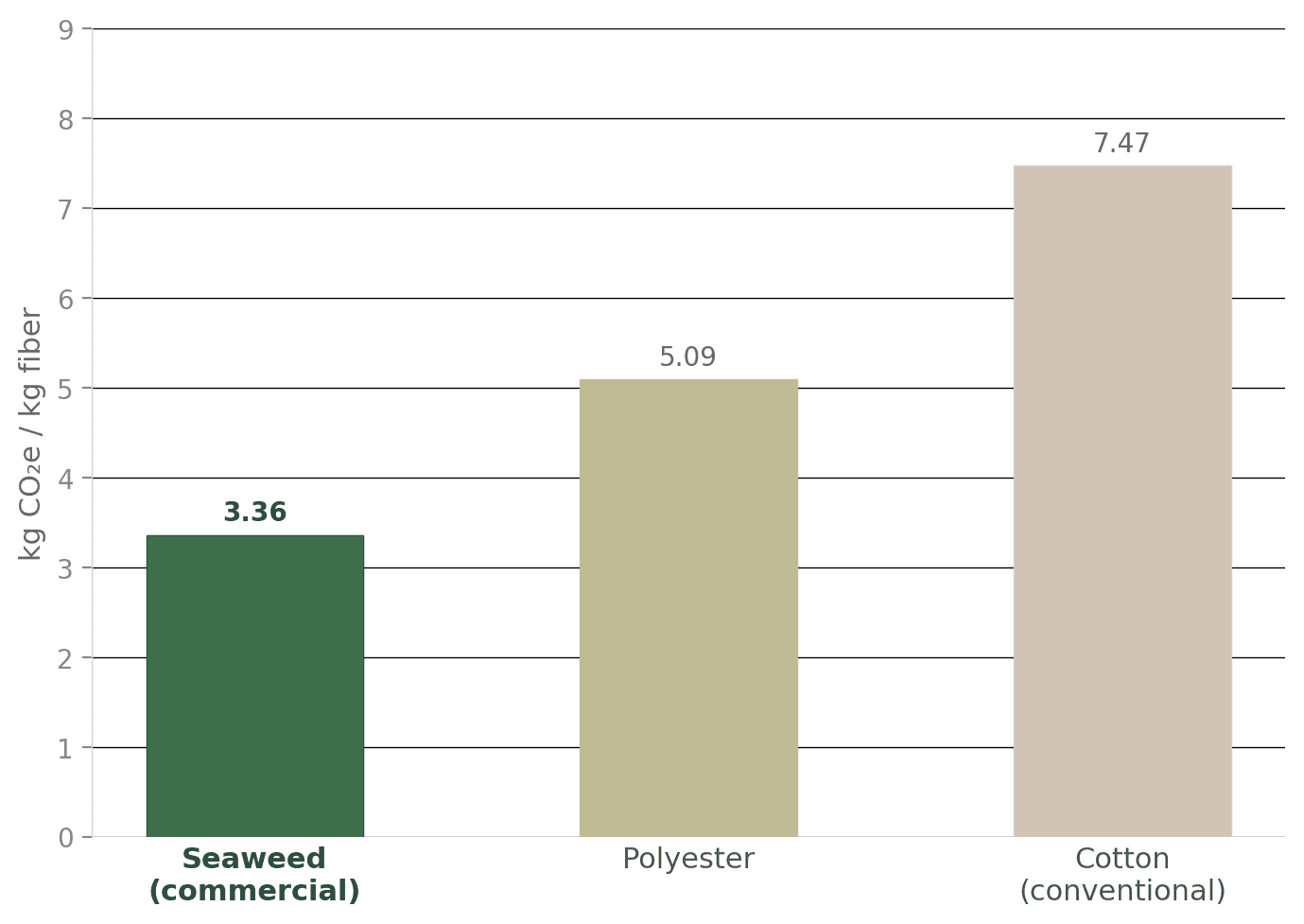
Calculation Chain
Step 1 — Displacement factor derivation
The functional unit is kg CO2e per kg of finished fiber (cradle-to-fiber-gate). This is the boundary used by the primary LCA sources. It excludes weaving, dyeing, garment manufacture, consumer use, and end-of-life — meaning all estimates are upper bounds on the full lifecycle benefit.
| Parameter | Value | Note |
| Seaweed fiber GWP | 3.36 kg CO2e/kg fiber | Combines Gonzalez et al. (2023) seaweed fiber LCA with Ayala et al. (2024) alginate processing; cradle-to-fiber-gate; commercial-scale assumption |
| Polyester fiber GWP | 5.09 kg CO2e/kg fiber | Virgin polyester (PET); cradle-to-fiber-gate; consistent boundary with seaweed figure; independently supported by Gonzalez et al. (2023) (~4.5 kg CO2e/kg) |
| Cotton fiber GWP | 7.47 kg CO2e/kg fiber | Conventional cotton; cradle-to-fiber-gate; includes agricultural stage (irrigation, fertilizer, N₂O) + ginning/spinning |
| Displacement factor vs polyester | 5.09 − 3.36 = 1.73 kg CO2e/kg fiber substituted | Per kg of seaweed fiber replacing polyester |
| Displacement factor vs cotton | 7.47 − 3.36 = 4.11 kg CO2e/kg fiber substituted | Per kg of seaweed fiber replacing cotton; 2.4× larger than polyester displacement |
Step 2 — WB 2030 central market scenario
| Parameter | Value | Note |
| WB 2030 biosynthetic textile market | $860M | World Bank (2023); seaweed fiber component of broader biosynthetic textile market |
| Assumed product price | $12/kg | Consistent with roadmap WB market assumptions; premium fiber market (comparable to specialty cellulose fibers) |
| Product volume | $860M ÷ $12/kg = ~71,667 t fiber/yr | WB market ÷ assumed price = product volume |
| Gross mitigation vs polyester | 71,667 t × 1.73 kg CO2e/kg = ~123,983 t CO2e/yr = 0.124 Mt CO2e/yr | At 100% seaweed fiber; vs polyester incumbent |
| Gross mitigation vs cotton | 71,667 t × 4.11 kg CO2e/kg = ~294,553 t CO2e/yr = 0.295 Mt CO2e/yr | At 100% seaweed fiber; vs cotton incumbent |
| Adjusted for actual seaweed inclusion (~10% average; real market composition) | Polyester: 0.12 × 0.10 = ~0.012 Mt CO2e/yr Cotton: 0.3 × 0.10 = ~0.03 Mt CO₂e/yr | At 10% seaweed inclusion in commercial products; most commercially active products are 4–10% seaweed |
Step 3- 2050 Scenario
| Parameter | Value | Note |
| Annual Growth Rate from 2030 to 2050 | 13% | Assumption: Growth rate similar to that for biostimulants |
| 2050 seaweed biosynthetic textile market | $9.9B | |
| Product volume | $9.9B ÷ $12/kg = ~825000 t fiber/yr | WB market ÷ assumed price = product volume |
| Gross mitigation vs polyester | 825000t × 1.73 kg CO2e/kg = ~1470000 t CO2e/yr = 1.47 Mt CO2e/yr | At 100% seaweed fiber; vs polyester incumbent |
| Gross mitigation vs cotton | 825000 t × 4.11 kg CO2e/kg = ~3390750 t CO2e/yr = 3.39 Mt CO2e/yr | At 100% seaweed fiber; vs cotton incumbent |
| Adjusted for actual seaweed inclusion (~10% average; real market composition) | Polyester: 1.47 × 0.10 = ~0.147 Mt CO2e/yr Cotton: 3.39 × 0.10 = ~0.339 Mt CO₂e/yr | At 10% seaweed inclusion in commercial products; most commercially active products are 4–10% seaweed |
Context
According to the Apparel Impact Institute (2025), more than a quarter of global greenhouse gas (GHG) emissions from the apparel sector is generated from raw material extraction (22%, 209 million tons CO2e) and processing (15%, 139 million tons CO2e). In 2023, the apparel sector produced 944 million tons of GHG emissions, representing approximately 1.8% of the global carbon footprint (Apparel Impact Institute, 2025). More than 720 million tons stem from fossil-fuel-based (polyester) and cotton fiber production (see Figure 3). [caption id="attachment_12451" align="aligncenter" width="640"] Figure 3. 2023 global apparel greenhouse gas (GHG) emissions (million tons CO2e, Mt), grouped by polyester, cotton, and other fibers. Source: Apparel Impact Institute (2025)[/caption]
Emissions Reduction Potential
| Scenario | Basis | Mitigation Potential | Key condition |
| WB 2030 central market — vs polyester (primary scenario) | Gonzalez et al. (2023) + Agarwal and Sethi (2026) + WB (2023) | ~0.012 Mt CO2e/yr | LCA stops at fiber gate; seaweed inclusion ~10% in most products |
| WB 2030 central market — vs cotton | Gonzalez et al. (2023) + Agarwal and Sethi (2026) + WB (2023) | ~0.03 Mt CO2e/yr | Cotton higher GWP than polyester; same LCA caveat; seaweed inclusion ~10% in most products |
| 2050 Scenario-10 X 2030 sce | WB 2030 central market — vs cotton Gonzalez et al. (2023) + Agarwal and Sethi (2026) | ~0.15-0.34 Mt CO2e/yr | 13% growth rate in market for seaweed products from 2030. Seaweed inclusion ~10% |
Evidence Base
We use LCA data from raw material extraction and the Lyocell fiber production method to estimate what the global warming potential of seaweed-based fibers would be. Combining the global warming potential of refined sodium alginate extraction with commercial scale lyocell production yields an estimated climate impact of 3.36 kg CO2e/kg fiber, in contrast to 5.09 kg CO2e/kg fiber and 7.47 kg CO2e/kg fiber produced by polyester and cotton methods, respectively (Gonzalez et al., 2023; Ayala et al., 2024; Agarwal and Sethi, 2026). [caption id="attachment_12453" align="aligncenter" width="1379"] Figure 4. GHG emissions intensity (kg CO₂e / kg fiber) for conventional cotton, polyester, and seaweed-based fiber at pilot and commercial scale. Dashed line marks the commercial-scale seaweed target. Sources: Ayala et al. (2024), Gonzalez et al. (2023), Agarwal and Sethi (2026)[/caption]
Calculation Chain
Step 1 — Displacement factor derivation
The functional unit is kg CO2e per kg of finished fiber (cradle-to-fiber-gate). This is the boundary used by the primary LCA sources. It excludes weaving, dyeing, garment manufacture, consumer use, and end-of-life — meaning all estimates are upper bounds on the full lifecycle benefit.| Parameter | Value | Note |
| Seaweed fiber GWP | 3.36 kg CO2e/kg fiber | Combines Gonzalez et al. (2023) seaweed fiber LCA with Ayala et al. (2024) alginate processing; cradle-to-fiber-gate; commercial-scale assumption |
| Polyester fiber GWP | 5.09 kg CO2e/kg fiber | Virgin polyester (PET); cradle-to-fiber-gate; consistent boundary with seaweed figure; independently supported by Gonzalez et al. (2023) (~4.5 kg CO2e/kg) |
| Cotton fiber GWP | 7.47 kg CO2e/kg fiber | Conventional cotton; cradle-to-fiber-gate; includes agricultural stage (irrigation, fertilizer, N₂O) + ginning/spinning |
| Displacement factor vs polyester | 5.09 − 3.36 = 1.73 kg CO2e/kg fiber substituted | Per kg of seaweed fiber replacing polyester |
| Displacement factor vs cotton | 7.47 − 3.36 = 4.11 kg CO2e/kg fiber substituted | Per kg of seaweed fiber replacing cotton; 2.4× larger than polyester displacement |
Step 2 — WB 2030 central market scenario
| Parameter | Value | Note |
| WB 2030 biosynthetic textile market | $860M | World Bank (2023); seaweed fiber component of broader biosynthetic textile market |
| Assumed product price | $12/kg | Consistent with roadmap WB market assumptions; premium fiber market (comparable to specialty cellulose fibers) |
| Product volume | $860M ÷ $12/kg = ~71,667 t fiber/yr | WB market ÷ assumed price = product volume |
| Gross mitigation vs polyester | 71,667 t × 1.73 kg CO2e/kg = ~123,983 t CO2e/yr = 0.124 Mt CO2e/yr | At 100% seaweed fiber; vs polyester incumbent |
| Gross mitigation vs cotton | 71,667 t × 4.11 kg CO2e/kg = ~294,553 t CO2e/yr = 0.295 Mt CO2e/yr | At 100% seaweed fiber; vs cotton incumbent |
| Adjusted for actual seaweed inclusion (~10% average; real market composition) | Polyester: 0.12 × 0.10 = ~0.012 Mt CO2e/yr Cotton: 0.3 × 0.10 = ~0.03 Mt CO₂e/yr | At 10% seaweed inclusion in commercial products; most commercially active products are 4–10% seaweed |
Step 3- 2050 Scenario
| Parameter | Value | Note |
| Annual Growth Rate from 2030 to 2050 | 13% | Assumption: Growth rate similar to that for biostimulants |
| 2050 seaweed biosynthetic textile market | $9.9B | |
| Product volume | $9.9B ÷ $12/kg = ~825000 t fiber/yr | WB market ÷ assumed price = product volume |
| Gross mitigation vs polyester | 825000t × 1.73 kg CO2e/kg = ~1470000 t CO2e/yr = 1.47 Mt CO2e/yr | At 100% seaweed fiber; vs polyester incumbent |
| Gross mitigation vs cotton | 825000 t × 4.11 kg CO2e/kg = ~3390750 t CO2e/yr = 3.39 Mt CO2e/yr | At 100% seaweed fiber; vs cotton incumbent |
| Adjusted for actual seaweed inclusion (~10% average; real market composition) | Polyester: 1.47 × 0.10 = ~0.147 Mt CO2e/yr Cotton: 3.39 × 0.10 = ~0.339 Mt CO₂e/yr | At 10% seaweed inclusion in commercial products; most commercially active products are 4–10% seaweed |
Context
According to the Apparel Impact Institute (2025), more than a quarter of global greenhouse gas (GHG) emissions from the apparel sector is generated from raw material extraction (22%, 209 million tons CO2e) and processing (15%, 139 million tons CO2e). In 2023, the apparel sector produced 944 million tons of GHG emissions, representing approximately 1.8% of the global carbon footprint (Apparel Impact Institute, 2025). More than 720 million tons stem from fossil-fuel-based (polyester) and cotton fiber production (see Figure 3). [caption id="attachment_12451" align="aligncenter" width="640"] Figure 3. 2023 global apparel greenhouse gas (GHG) emissions (million tons CO2e, Mt), grouped by polyester, cotton, and other fibers. Source: Apparel Impact Institute (2025)[/caption]
Emissions Reduction Potential
| Scenario | Basis | Mitigation Potential | Key condition |
| WB 2030 central market — vs polyester (primary scenario) | Gonzalez et al. (2023) + Agarwal and Sethi (2026) + WB (2023) | ~0.012 Mt CO2e/yr | LCA stops at fiber gate; seaweed inclusion ~10% in most products |
| WB 2030 central market — vs cotton | Gonzalez et al. (2023) + Agarwal and Sethi (2026) + WB (2023) | ~0.03 Mt CO2e/yr | Cotton higher GWP than polyester; same LCA caveat; seaweed inclusion ~10% in most products |
| 2050 Scenario-10 X 2030 sce | WB 2030 central market — vs cotton Gonzalez et al. (2023) + Agarwal and Sethi (2026) | ~0.15-0.34 Mt CO2e/yr | 13% growth rate in market for seaweed products from 2030. Seaweed inclusion ~10% |
Evidence Base
We use LCA data from raw material extraction and the Lyocell fiber production method to estimate what the global warming potential of seaweed-based fibers would be. Combining the global warming potential of refined sodium alginate extraction with commercial scale lyocell production yields an estimated climate impact of 3.36 kg CO2e/kg fiber, in contrast to 5.09 kg CO2e/kg fiber and 7.47 kg CO2e/kg fiber produced by polyester and cotton methods, respectively (Gonzalez et al., 2023; Ayala et al., 2024; Agarwal and Sethi, 2026). [caption id="attachment_12453" align="aligncenter" width="1379"] Figure 4. GHG emissions intensity (kg CO₂e / kg fiber) for conventional cotton, polyester, and seaweed-based fiber at pilot and commercial scale. Dashed line marks the commercial-scale seaweed target. Sources: Ayala et al. (2024), Gonzalez et al. (2023), Agarwal and Sethi (2026)[/caption]
Calculation Chain
Step 1 — Displacement factor derivation
The functional unit is kg CO2e per kg of finished fiber (cradle-to-fiber-gate). This is the boundary used by the primary LCA sources. It excludes weaving, dyeing, garment manufacture, consumer use, and end-of-life — meaning all estimates are upper bounds on the full lifecycle benefit.| Parameter | Value | Note |
| Seaweed fiber GWP | 3.36 kg CO2e/kg fiber | Combines Gonzalez et al. (2023) seaweed fiber LCA with Ayala et al. (2024) alginate processing; cradle-to-fiber-gate; commercial-scale assumption |
| Polyester fiber GWP | 5.09 kg CO2e/kg fiber | Virgin polyester (PET); cradle-to-fiber-gate; consistent boundary with seaweed figure; independently supported by Gonzalez et al. (2023) (~4.5 kg CO2e/kg) |
| Cotton fiber GWP | 7.47 kg CO2e/kg fiber | Conventional cotton; cradle-to-fiber-gate; includes agricultural stage (irrigation, fertilizer, N₂O) + ginning/spinning |
| Displacement factor vs polyester | 5.09 − 3.36 = 1.73 kg CO2e/kg fiber substituted | Per kg of seaweed fiber replacing polyester |
| Displacement factor vs cotton | 7.47 − 3.36 = 4.11 kg CO2e/kg fiber substituted | Per kg of seaweed fiber replacing cotton; 2.4× larger than polyester displacement |
Step 2 — WB 2030 central market scenario
| Parameter | Value | Note |
| WB 2030 biosynthetic textile market | $860M | World Bank (2023); seaweed fiber component of broader biosynthetic textile market |
| Assumed product price | $12/kg | Consistent with roadmap WB market assumptions; premium fiber market (comparable to specialty cellulose fibers) |
| Product volume | $860M ÷ $12/kg = ~71,667 t fiber/yr | WB market ÷ assumed price = product volume |
| Gross mitigation vs polyester | 71,667 t × 1.73 kg CO2e/kg = ~123,983 t CO2e/yr = 0.124 Mt CO2e/yr | At 100% seaweed fiber; vs polyester incumbent |
| Gross mitigation vs cotton | 71,667 t × 4.11 kg CO2e/kg = ~294,553 t CO2e/yr = 0.295 Mt CO2e/yr | At 100% seaweed fiber; vs cotton incumbent |
| Adjusted for actual seaweed inclusion (~10% average; real market composition) | Polyester: 0.12 × 0.10 = ~0.012 Mt CO2e/yr Cotton: 0.3 × 0.10 = ~0.03 Mt CO₂e/yr | At 10% seaweed inclusion in commercial products; most commercially active products are 4–10% seaweed |
Step 3- 2050 Scenario
| Parameter | Value | Note |
| Annual Growth Rate from 2030 to 2050 | 13% | Assumption: Growth rate similar to that for biostimulants |
| 2050 seaweed biosynthetic textile market | $9.9B | |
| Product volume | $9.9B ÷ $12/kg = ~825000 t fiber/yr | WB market ÷ assumed price = product volume |
| Gross mitigation vs polyester | 825000t × 1.73 kg CO2e/kg = ~1470000 t CO2e/yr = 1.47 Mt CO2e/yr | At 100% seaweed fiber; vs polyester incumbent |
| Gross mitigation vs cotton | 825000 t × 4.11 kg CO2e/kg = ~3390750 t CO2e/yr = 3.39 Mt CO2e/yr | At 100% seaweed fiber; vs cotton incumbent |
| Adjusted for actual seaweed inclusion (~10% average; real market composition) | Polyester: 1.47 × 0.10 = ~0.147 Mt CO2e/yr Cotton: 3.39 × 0.10 = ~0.339 Mt CO₂e/yr | At 10% seaweed inclusion in commercial products; most commercially active products are 4–10% seaweed |
Context
According to the Apparel Impact Institute (2025), more than a quarter of global greenhouse gas (GHG) emissions from the apparel sector is generated from raw material extraction (22%, 209 million tons CO2e) and processing (15%, 139 million tons CO2e). In 2023, the apparel sector produced 944 million tons of GHG emissions, representing approximately 1.8% of the global carbon footprint (Apparel Impact Institute, 2025). More than 720 million tons stem from fossil-fuel-based (polyester) and cotton fiber production (see Figure 3). [caption id="attachment_12451" align="aligncenter" width="640"] Figure 3. 2023 global apparel greenhouse gas (GHG) emissions (million tons CO2e, Mt), grouped by polyester, cotton, and other fibers. Source: Apparel Impact Institute (2025)[/caption]
Emissions Reduction Potential
| Scenario | Basis | Mitigation Potential | Key condition |
| WB 2030 central market — vs polyester (primary scenario) | Gonzalez et al. (2023) + Agarwal and Sethi (2026) + WB (2023) | ~0.012 Mt CO2e/yr | LCA stops at fiber gate; seaweed inclusion ~10% in most products |
| WB 2030 central market — vs cotton | Gonzalez et al. (2023) + Agarwal and Sethi (2026) + WB (2023) | ~0.03 Mt CO2e/yr | Cotton higher GWP than polyester; same LCA caveat; seaweed inclusion ~10% in most products |
| 2050 Scenario-10 X 2030 sce | WB 2030 central market — vs cotton Gonzalez et al. (2023) + Agarwal and Sethi (2026) | ~0.15-0.34 Mt CO2e/yr | 13% growth rate in market for seaweed products from 2030. Seaweed inclusion ~10% |
Evidence Base
We use LCA data from raw material extraction and the Lyocell fiber production method to estimate what the global warming potential of seaweed-based fibers would be. Combining the global warming potential of refined sodium alginate extraction with commercial scale lyocell production yields an estimated climate impact of 3.36 kg CO2e/kg fiber, in contrast to 5.09 kg CO2e/kg fiber and 7.47 kg CO2e/kg fiber produced by polyester and cotton methods, respectively (Gonzalez et al., 2023; Ayala et al., 2024; Agarwal and Sethi, 2026). [caption id="attachment_12453" align="aligncenter" width="1379"] Figure 4. GHG emissions intensity (kg CO₂e / kg fiber) for conventional cotton, polyester, and seaweed-based fiber at pilot and commercial scale. Dashed line marks the commercial-scale seaweed target. Sources: Ayala et al. (2024), Gonzalez et al. (2023), Agarwal and Sethi (2026)[/caption]
Calculation Chain
Step 1 — Displacement factor derivation
The functional unit is kg CO2e per kg of finished fiber (cradle-to-fiber-gate). This is the boundary used by the primary LCA sources. It excludes weaving, dyeing, garment manufacture, consumer use, and end-of-life — meaning all estimates are upper bounds on the full lifecycle benefit.| Parameter | Value | Note |
| Seaweed fiber GWP | 3.36 kg CO2e/kg fiber | Combines Gonzalez et al. (2023) seaweed fiber LCA with Ayala et al. (2024) alginate processing; cradle-to-fiber-gate; commercial-scale assumption |
| Polyester fiber GWP | 5.09 kg CO2e/kg fiber | Virgin polyester (PET); cradle-to-fiber-gate; consistent boundary with seaweed figure; independently supported by Gonzalez et al. (2023) (~4.5 kg CO2e/kg) |
| Cotton fiber GWP | 7.47 kg CO2e/kg fiber | Conventional cotton; cradle-to-fiber-gate; includes agricultural stage (irrigation, fertilizer, N₂O) + ginning/spinning |
| Displacement factor vs polyester | 5.09 − 3.36 = 1.73 kg CO2e/kg fiber substituted | Per kg of seaweed fiber replacing polyester |
| Displacement factor vs cotton | 7.47 − 3.36 = 4.11 kg CO2e/kg fiber substituted | Per kg of seaweed fiber replacing cotton; 2.4× larger than polyester displacement |
Step 2 — WB 2030 central market scenario
| Parameter | Value | Note |
| WB 2030 biosynthetic textile market | $860M | World Bank (2023); seaweed fiber component of broader biosynthetic textile market |
| Assumed product price | $12/kg | Consistent with roadmap WB market assumptions; premium fiber market (comparable to specialty cellulose fibers) |
| Product volume | $860M ÷ $12/kg = ~71,667 t fiber/yr | WB market ÷ assumed price = product volume |
| Gross mitigation vs polyester | 71,667 t × 1.73 kg CO2e/kg = ~123,983 t CO2e/yr = 0.124 Mt CO2e/yr | At 100% seaweed fiber; vs polyester incumbent |
| Gross mitigation vs cotton | 71,667 t × 4.11 kg CO2e/kg = ~294,553 t CO2e/yr = 0.295 Mt CO2e/yr | At 100% seaweed fiber; vs cotton incumbent |
| Adjusted for actual seaweed inclusion (~10% average; real market composition) | Polyester: 0.12 × 0.10 = ~0.012 Mt CO2e/yr Cotton: 0.3 × 0.10 = ~0.03 Mt CO₂e/yr | At 10% seaweed inclusion in commercial products; most commercially active products are 4–10% seaweed |
| Parameter | Value | Note |
| Annual Growth Rate from 2030 to 2050 | 13% | Assumption: Growth rate similar to that for biostimulants |
| 2050 seaweed biosynthetic textile market | $9.9B | |
| Product volume | $9.9B ÷ $12/kg = ~825000 t fiber/yr | WB market ÷ assumed price = product volume |
| Gross mitigation vs polyester | 825000t × 1.73 kg CO2e/kg = ~1470000 t CO2e/yr = 1.47 Mt CO2e/yr | At 100% seaweed fiber; vs polyester incumbent |
| Gross mitigation vs cotton | 825000 t × 4.11 kg CO2e/kg = ~3390750 t CO2e/yr = 3.39 Mt CO2e/yr | At 100% seaweed fiber; vs cotton incumbent |
| Adjusted for actual seaweed inclusion (~10% average; real market composition) | Polyester: 1.47 × 0.10 = ~0.147 Mt CO2e/yr Cotton: 3.39 × 0.10 = ~0.339 Mt CO₂e/yr | At 10% seaweed inclusion in commercial products; most commercially active products are 4–10% seaweed |
Context
According to the Apparel Impact Institute (2025), more than a quarter of global greenhouse gas (GHG) emissions from the apparel sector is generated from raw material extraction (22%, 209 million tons CO2e) and processing (15%, 139 million tons CO2e). In 2023, the apparel sector produced 944 million tons of GHG emissions, representing approximately 1.8% of the global carbon footprint (Apparel Impact Institute, 2025). More than 720 million tons stem from fossil-fuel-based (polyester) and cotton fiber production (see Figure 3). [caption id="attachment_12451" align="aligncenter" width="640"] Figure 3. 2023 global apparel greenhouse gas (GHG) emissions (million tons CO2e, Mt), grouped by polyester, cotton, and other fibers. Source: Apparel Impact Institute (2025)[/caption]
Emissions Reduction Potential
| Scenario | Basis | Mitigation Potential | Key condition |
| WB 2030 central market — vs polyester (primary scenario) | Gonzalez et al. (2023) + Agarwal and Sethi (2026) + WB (2023) | ~0.012 Mt CO2e/yr | LCA stops at fiber gate; seaweed inclusion ~10% in most products |
| WB 2030 central market — vs cotton | Gonzalez et al. (2023) + Agarwal and Sethi (2026) + WB (2023) | ~0.03 Mt CO2e/yr | Cotton higher GWP than polyester; same LCA caveat; seaweed inclusion ~10% in most products |
| 2050 Scenario-10 X 2030 sce |
Evidence Base
We use LCA data from raw material extraction and the Lyocell fiber production method to estimate what the global warming potential of seaweed-based fibers would be. Combining the global warming potential of refined sodium alginate extraction with commercial scale lyocell production yields an estimated climate impact of 3.36 kg CO2e/kg fiber, in contrast to 5.09 kg CO2e/kg fiber and 7.47 kg CO2e/kg fiber produced by polyester and cotton methods, respectively (Gonzalez et al., 2023; Ayala et al., 2024; Agarwal and Sethi, 2026). [caption id="attachment_12453" align="aligncenter" width="1379"] Figure 4. GHG emissions intensity (kg CO₂e / kg fiber) for conventional cotton, polyester, and seaweed-based fiber at pilot and commercial scale. Dashed line marks the commercial-scale seaweed target. Sources: Ayala et al. (2024), Gonzalez et al. (2023), Agarwal and Sethi (2026)[/caption]
Calculation Chain
Step 1 — Displacement factor derivation
The functional unit is kg CO2e per kg of finished fiber (cradle-to-fiber-gate). This is the boundary used by the primary LCA sources. It excludes weaving, dyeing, garment manufacture, consumer use, and end-of-life — meaning all estimates are upper bounds on the full lifecycle benefit.| Parameter | Value | Note |
| Seaweed fiber GWP | 3.36 kg CO2e/kg fiber | Combines Gonzalez et al. (2023) seaweed fiber LCA with Ayala et al. (2024) alginate processing; cradle-to-fiber-gate; commercial-scale assumption |
| Polyester fiber GWP | 5.09 kg CO2e/kg fiber | Virgin polyester (PET); cradle-to-fiber-gate; consistent boundary with seaweed figure; independently supported by Gonzalez et al. (2023) (~4.5 kg CO2e/kg) |
| Cotton fiber GWP | 7.47 kg CO2e/kg fiber | Conventional cotton; cradle-to-fiber-gate; includes agricultural stage (irrigation, fertilizer, N₂O) + ginning/spinning |
| Displacement factor vs polyester | 5.09 − 3.36 = 1.73 kg CO2e/kg fiber substituted | Per kg of seaweed fiber replacing polyester |
| Displacement factor vs cotton | 7.47 − 3.36 = 4.11 kg CO2e/kg fiber substituted | Per kg of seaweed fiber replacing cotton; 2.4× larger than polyester displacement |
Step 2 — WB 2030 central market scenario
| Parameter | Value | Note |
| WB 2030 biosynthetic textile market | $860M | World Bank (2023); seaweed fiber component of broader biosynthetic textile market |
| Assumed product price | $12/kg | Consistent with roadmap WB market assumptions; premium fiber market (comparable to specialty cellulose fibers) |
| Product volume | $860M ÷ $12/kg = ~71,667 t fiber/yr | WB market ÷ assumed price = product volume |
| Gross mitigation vs polyester | 71,667 t × 1,000 kg/t × 1.73 kg CO2e/kg = ~123,983 t CO2e/yr = 0.124 Mt CO2e/yr | At 100% seaweed fiber; vs polyester incumbent |
| Gross mitigation vs cotton | 71,667 t × 4.11 kg CO2e/kg = ~294,553 t CO2e/yr = 0.295 Mt CO2e/yr | At 100% seaweed fiber; vs cotton incumbent |
| Adjusted for actual seaweed inclusion (~10% average; real market composition) | Polyester: 0.12 × 0.10 = ~0.012 Mt CO2e/yr Cotton: 0.3 × 0.10 = ~0.03 Mt CO₂e/yr | At 10% seaweed inclusion in commercial products; most commercially active products are 4–10% seaweed |
| Parameter | Value | Note |
| Annual Growth Rate from 2030 to 2050 | 13% | Assumption: Growth rate |
| Assumed product price | $12/kg | Consistent with roadmap WB market assumptions; premium fiber market (comparable to specialty cellulose fibers) |
| Product volume | $860M ÷ $12/kg = ~71,667 t fiber/yr | WB market ÷ assumed price = product volume |
| Gross mitigation vs polyester | 71,667 t × 1,000 kg/t × 1.73 kg CO2e/kg = ~123,983 t CO2e/yr = 0.124 Mt CO2e/yr | At 100% seaweed fiber; vs polyester incumbent |
| Gross mitigation vs cotton | 71,667 t × 4.11 kg CO2e/kg = ~294,553 t CO2e/yr = 0.295 Mt CO2e/yr | At 100% seaweed fiber; vs cotton incumbent |
| Adjusted for actual seaweed inclusion (~10% average; real market composition) | Polyester: 0.12 × 0.10 = ~0.012 Mt CO2e/yr Cotton: 0.3 × 0.10 = ~0.03 Mt CO₂e/yr | At 10% seaweed inclusion in commercial products; most commercially active products are 4–10% seaweed |
Context
According to the Apparel Impact Institute (2025), more than a quarter of global greenhouse gas (GHG) emissions from the apparel sector is generated from raw material extraction (22%, 209 million tons CO2e) and processing (15%, 139 million tons CO2e). In 2023, the apparel sector produced 944 million tons of GHG emissions, representing approximately 1.8% of the global carbon footprint (Apparel Impact Institute, 2025). More than 720 million tons stem from fossil-fuel-based (polyester) and cotton fiber production (see Figure 3). [caption id="attachment_12451" align="aligncenter" width="640"] Figure 3. 2023 global apparel greenhouse gas (GHG) emissions (million tons CO2e, Mt), grouped by polyester, cotton, and other fibers. Source: Apparel Impact Institute (2025)[/caption]
Emissions Reduction Potential
| Scenario | Basis | Mitigation Potential | Key condition |
| WB 2030 central market — vs polyester (primary scenario) | Gonzalez et al. (2023) + Agarwal and Sethi (2026) + WB (2023) | ~0.012 Mt CO2e/yr | LCA stops at fiber gate; seaweed inclusion ~10% in most products |
| WB 2030 central market — vs cotton | Gonzalez et al. (2023) + Agarwal and Sethi (2026) + WB (2023) | ~0.03 Mt CO2e/yr | Cotton higher GWP than polyester; same LCA caveat; seaweed inclusion ~10% in most products |
Evidence Base
We use LCA data from raw material extraction and the Lyocell fiber production method to estimate what the global warming potential of seaweed-based fibers would be. Combining the global warming potential of refined sodium alginate extraction with commercial scale lyocell production yields an estimated climate impact of 3.36 kg CO2e/kg fiber, in contrast to 5.09 kg CO2e/kg fiber and 7.47 kg CO2e/kg fiber produced by polyester and cotton methods, respectively (Gonzalez et al., 2023; Ayala et al., 2024; Agarwal and Sethi, 2026). [caption id="attachment_12453" align="aligncenter" width="1379"] Figure 4. GHG emissions intensity (kg CO₂e / kg fiber) for conventional cotton, polyester, and seaweed-based fiber at pilot and commercial scale. Dashed line marks the commercial-scale seaweed target. Sources: Ayala et al. (2024), Gonzalez et al. (2023), Agarwal and Sethi (2026)[/caption]
Calculation Chain
Step 1 — Displacement factor derivation
The functional unit is kg CO2e per kg of finished fiber (cradle-to-fiber-gate). This is the boundary used by the primary LCA sources. It excludes weaving, dyeing, garment manufacture, consumer use, and end-of-life — meaning all estimates are upper bounds on the full lifecycle benefit.| Parameter | Value | Note |
| Seaweed fiber GWP | 3.36 kg CO2e/kg fiber | Combines Gonzalez et al. (2023) seaweed fiber LCA with Ayala et al. (2024) alginate processing; cradle-to-fiber-gate; commercial-scale assumption |
| Polyester fiber GWP | 5.09 kg CO2e/kg fiber | Virgin polyester (PET); cradle-to-fiber-gate; consistent boundary with seaweed figure; independently supported by Gonzalez et al. (2023) (~4.5 kg CO2e/kg) |
| Cotton fiber GWP | 7.47 kg CO2e/kg fiber | Conventional cotton; cradle-to-fiber-gate; includes agricultural stage (irrigation, fertilizer, N₂O) + ginning/spinning |
| Displacement factor vs polyester | 5.09 − 3.36 = 1.73 kg CO2e/kg fiber substituted | Per kg of seaweed fiber replacing polyester |
| Displacement factor vs cotton | 7.47 − 3.36 = 4.11 kg CO2e/kg fiber substituted | Per kg of seaweed fiber replacing cotton; 2.4× larger than polyester displacement |
Step 2 — WB 2030 central market scenario
| Parameter | Value | Note |
| WB 2030 biosynthetic textile market | $860M | World Bank (2023); seaweed fiber component of broader biosynthetic textile market |
| Assumed product price | $12/kg | Consistent with roadmap WB market assumptions; premium fiber market (comparable to specialty cellulose fibers) |
| Product volume | $860M ÷ $12/kg = ~71,667 t fiber/yr | WB market ÷ assumed price = product volume |
| Gross mitigation vs polyester | 71,667 t × 1,000 kg/t × 1.73 kg CO2e/kg = ~123,983 t CO2e/yr = 0.124 Mt CO2e/yr | At 100% seaweed fiber; vs polyester incumbent |
| Gross mitigation vs cotton | 71,667 t × 4.11 kg CO2e/kg = ~294,553 t CO2e/yr = 0.295 Mt CO2e/yr | At 100% seaweed fiber; vs cotton incumbent |
| Adjusted for actual seaweed inclusion (~10% average; real market composition) | Polyester: 0.12 × 0.10 = ~0.012 Mt CO2e/yr Cotton: 0.3 × 0.10 = ~0.03 Mt CO₂e/yr | At 10% seaweed inclusion in commercial products; most commercially active products are 4–10% seaweed |
Context
According to the Apparel Impact Institute (2025), more than a quarter of global greenhouse gas (GHG) emissions from the apparel sector is generated from raw material extraction (22%, 209 million tons CO2e) and processing (15%, 139 million tons CO2e). In 2023, the apparel sector produced 944 million tons of GHG emissions, representing approximately 1.8% of the global carbon footprint (Apparel Impact Institute, 2025). More than 720 million tons stem from fossil-fuel-based (polyester) and cotton fiber production (see Figure 3). [caption id="attachment_12451" align="aligncenter" width="640"] Figure 3. 2023 global apparel greenhouse gas (GHG) emissions (million tons CO2e, Mt), grouped by polyester, cotton, and other fibers. Source: Apparel Impact Institute (2025)[/caption]
Emissions Reduction Potential
| Scenario | Basis | Mitigation Potential | Key condition |
| WB 2030 central market — vs polyester (primary scenario) | Gonzalez et al. (2023) + Agarwal and Sethi (2026) + WB (2023) | ~0.012 Mt CO2e/yr | LCA stops at fiber gate; seaweed inclusion ~10% in most products |
| WB 2030 central market — vs cotton | Gonzalez et al. (2023) + Agarwal and Sethi (2026) + WB (2023) | ~0.03 Mt CO2e/yr | Cotton higher GWP than polyester; same LCA caveat; seaweed inclusion ~10% in most products |
Evidence Base
We use LCA data from raw material extraction and the Lyocell fiber production method to estimate what the global warming potential of seaweed-based fibers would be. Combining the global warming potential of refined sodium alginate extraction with commercial-scale lyocell production yields an estimated climate impact of 3.36 kg CO2e/kg fiber, in contrast to 5.09 kg CO2e/kg fiber and 7.47 kg CO2e/kg fiber produced by polyester and cotton methods, respectively (Gonzalez et al., 2023; Ayala et al., 2024; Agarwal and Sethi, 2026). [caption id="attachment_12453" align="aligncenter" width="1379"] Figure 4. GHG emissions intensity (kg CO₂e / kg fiber) for conventional cotton, polyester, and seaweed-based fiber at pilot and commercial scale. Dashed line marks the commercial-scale seaweed target. Sources: Ayala et al. (2024), Gonzalez et al. (2023), Agarwal and Sethi (2026)[/caption]
Calculation Chain
Step 1 — Displacement factor derivation
The functional unit is kg CO2e per kg of finished fiber (cradle-to-fiber-gate). This is the boundary used by the primary LCA sources. It excludes weaving, dyeing, garment manufacture, consumer use, and end-of-life — meaning all estimates are upper bounds on the full lifecycle benefit.| Parameter | Value | Note |
| Seaweed fiber GWP | 3.36 kg CO2e/kg fiber | Combines Gonzalez et al. (2023) seaweed fiber LCA with Ayala et al. (2024) alginate processing; cradle-to-fiber-gate; commercial-scale assumption |
| Polyester fiber GWP | 5.09 kg CO2e/kg fiber | Virgin polyester (PET); cradle-to-fiber-gate; consistent boundary with seaweed figure; independently supported by Gonzalez et al. (2023) (~4.5 kg CO2e/kg) |
| Cotton fiber GWP | 7.47 kg CO2e/kg fiber | Conventional cotton; cradle-to-fiber-gate; includes agricultural stage (irrigation, fertilizer, N₂O) + ginning/spinning |
| Displacement factor vs polyester | 5.09 − 3.36 = 1.73 kg CO2e/kg fiber substituted | Per kg of seaweed fiber replacing polyester |
| Displacement factor vs cotton | 7.47 − 3.36 = 4.11 kg CO2e/kg fiber substituted | Per kg of seaweed fiber replacing cotton; 2.4× larger than polyester displacement |
Step 2 — WB 2030 central market scenario
| Parameter | Value | Note |
| WB 2030 biosynthetic textile market | $860M | World Bank (2023); seaweed fiber component of broader biosynthetic textile market |
| Assumed product price | $12/kg | Consistent with roadmap WB market assumptions; premium fiber market (comparable to specialty cellulose fibers) |
| Product volume | $860M ÷ $12/kg = ~71,667 t fiber/yr | WB market ÷ assumed price = product volume |
| Gross mitigation vs polyester | 71,667 t × 1,000 kg/t × 1.73 kg CO2e/kg = ~123,983 t CO2e/yr = 0.124 Mt CO2e/yr | At 100% seaweed fiber; vs polyester incumbent |
| Gross mitigation vs cotton | 71,667 t × 4.11 kg CO2e/kg = ~294,553 t CO2e/yr = 0.295 Mt CO2e/yr | At 100% seaweed fiber; vs cotton incumbent |
| Adjusted for actual seaweed inclusion (~10% average; real market composition) | Polyester: 0.12 × 0.10 = ~0.012 Mt CO2e/yr Cotton: 0.3 × 0.10 = ~0.03 Mt CO₂e/yr | At 10% seaweed inclusion in commercial products; most commercially active products are 4–10% seaweed |
Context
According to the Apparel Impact Institute (2025), more than a quarter of global greenhouse gas (GHG) emissions from the apparel sector is generated from raw material extraction (22%, 209 million tons CO2e) and processing (15%, 139 million tons CO2e). In 2023, the apparel sector produced 944 million tons of GHG emissions, representing approximately 1.8% of the global carbon footprint (Apparel Impact Institute, 2025). More than 720 million tons stem from fossil-fuel-based (polyester) and cotton fiber production (see Figure 3). [caption id="attachment_12451" align="aligncenter" width="640"] Figure 3. 2023 global apparel greenhouse gas (GHG) emissions (million tons CO2e, Mt), grouped by polyester, cotton, and other fibers. Source: Apparel Impact Institute (2025)[/caption]
Emissions Reduction Potential
| Scenario | Basis | Mitigation Potential | Key condition |
| WB 2030 central market — vs polyester (primary scenario) | Gonzalez et al. (2023) + Agarwal & Sethi (2026) + WB (2023) | ~0.012 Mt CO2e/yr | LCA stops at fiber gate; seaweed inclusion ~10% in most products |
| WB 2030 central market — vs cotton | Gonzalez et al. (2023) + Agarwal & Sethi (2026) + WB (2023) | ~0.03 Mt CO2e/yr | Cotton higher GWP than polyester; same LCA caveat; seaweed inclusion ~10% in most products |
Evidence Base
We use LCA data from raw material extraction and the Lyocell fiber production method to estimate what the global warming potential of seaweed-based fibers would be. Combining the global warming potential of refined sodium alginate extraction with commercial-scale lyocell production yields an estimated climate impact of 3.36 kg CO2e/kg fiber, in contrast to 5.09 kg CO2e/kg fiber and 7.47 kg CO2e/kg fiber produced by polyester and cotton methods, respectively (Gonzalez et al., 2023; Ayala et al., 2024; Agarwal and Sethi, 2026). Gonzalez et al. (2023). [caption id="attachment_12453" align="aligncenter" width="1379"] Figure 4. GHG emissions intensity (kg CO₂e / kg fiber) for conventional cotton, polyester, and seaweed-based fiber at pilot and commercial scale. Dashed line marks the commercial-scale seaweed target. Sources: Ayala et al. (2024), Gonzalez et al. (2023), Agarwal and Sethi (2026)[/caption]
Calculation Chain
Step 1 — Displacement factor derivation
The functional unit is kg CO2e per kg of finished fiber (cradle-to-fiber-gate). This is the boundary used by the primary LCA sources. It excludes weaving, dyeing, garment manufacture, consumer use, and end-of-life — meaning all estimates are upper bounds on the full lifecycle benefit.| Parameter | Value | Note |
| Seaweed fiber GWP | 3.36 kg CO2e/kg fiber | Combines Gonzalez et al. (2023) seaweed fiber LCA with Ayala et al. (2024) alginate processing; cradle-to-fiber-gate; commercial-scale assumption |
| Polyester fiber GWP | 5.09 kg CO2e/kg fiber | Virgin polyester (PET); cradle-to-fiber-gate; consistent boundary with seaweed figure; independently supported by Gonzalez et al. (2023) (~4.5 kg CO2e/kg) |
| Cotton fiber GWP | 7.47 kg CO2e/kg fiber | Conventional cotton; cradle-to-fiber-gate; includes agricultural stage (irrigation, fertiliser, N₂O) + ginning/spinning |
| Displacement factor vs polyester | 5.09 − 3.36 = 1.73 kg CO2e/kg fiber substituted | Per kg of seaweed fiber replacing polyester |
| Displacement factor vs cotton | 7.47 − 3.36 = 4.11 kg CO2e/kg fiber substituted | Per kg of seaweed fiber replacing cotton; 2.4× larger than polyester displacement |
Step 2 — WB 2030 central market scenario
| Parameter | Value | Note |
| WB 2030 biosynthetic textile market | $860M | World Bank (2023); seaweed fiber component of broader biosynthetic textile market |
| Assumed product price | $12/kg | Consistent with roadmap WB market assumptions; premium fiber market (comparable to specialty cellulose fibers) |
| Product volume | $860M ÷ $12/kg = ~71,667 t fiber/yr | WB market ÷ assumed price = product volume |
| Gross mitigation vs polyester | 71,667 t × 1,000 kg/t × 1.73 kg CO2e/kg = ~123,983 t CO2e/yr = 0.124 Mt CO2e/yr | At 100% seaweed fiber; vs polyester incumbent |
| Gross mitigation vs cotton | 71,667 t × 4.11 kg CO2e/kg = ~294,553 t CO2e/yr = 0.295 Mt CO2e/yr | At 100% seaweed fiber; vs cotton incumbent |
| Adjusted for actual seaweed inclusion (~10% average; real market composition) | Polyester: 0.12 × 0.10 = ~0.012 Mt CO2e/yr Cotton: 0.3 × 0.10 = ~0.03 Mt CO₂e/yr | At 10% seaweed inclusion in commercial products; most commercially active products are 4–10% seaweed |
Context
According to the Apparel Impact Institute (2025), more than a quarter of global greenhouse gas (GHG) emissions from the apparel sector is generated from raw material extraction (22%, 209 million tons CO2e) and processing (15%, 139 million tons CO2e). In 2023, the apparel sector produced 944 million tons of GHG emissions, representing approximately 1.8% of the global carbon footprint (Apparel Impact Institute, 2025). More than 720 million tons stem from fossil-fuel-based (polyester) and cotton fiber production (see Figure 3). [caption id="attachment_12451" align="aligncenter" width="640"] Figure 3. 2023 global apparel greenhouse gas (GHG) emissions (million tons CO2e, Mt), grouped by polyester, cotton, and other fibers. Source: Apparel Impact Institute (2025)[/caption]
Emissions Reduction Potential
| Scenario | Basis / Source | Emissions Reduction Potential Mt CO₂e/yr | Key condition |
| WB 2030 central market — vs polyester (primary scenario) | Gonzalez et al. (2023) + Agarwal & Sethi (2026) + WB (2023) | ~0.012 Mt CO₂e/yr | LCA stops at fiber gate; seaweed inclusion ~10% in most products |
| WB 2030 central market — vs cotton | Gonzalez et al. (2023) + Agarwal & Sethi (2026) + WB (2023) | ~0.03 Mt CO₂e/yr | Cotton higher GWP than polyester; same LCA caveat; seaweed inclusion ~10% in most products |
Evidence Base
We use LCA data from raw material extraction and the Lyocell fiber production method to estimate what the global warming potential of seaweed-based fibers would be. Combining the global warming potential of refined sodium alginate extraction with commercial-scale lyocell production yields an estimated climate impact of 3.36 kg CO2e/kg fiber, in contrast to 5.09 kg CO2e/kg fiber and 7.47 kg CO2e/kg fiber produced by polyester and cotton methods, respectively (Gonzalez et al., 2023; Ayala et al., 2024; Agarwal and Sethi, 2026). Gonzalez et al. (2023). [caption id="attachment_12453" align="aligncenter" width="1379"] Figure 4. GHG emissions intensity (kg CO₂e / kg fiber) for conventional cotton, polyester, and seaweed-based fiber at pilot and commercial scale. Dashed line marks the commercial-scale seaweed target. Sources: Ayala et al. (2024), Gonzalez et al. (2023), Agarwal and Sethi (2026)[/caption]
Calculation Chain
Step 1 — Displacement factor derivation
The functional unit is kg CO₂e per kg of finished fiber (cradle-to-fiber-gate). This is the boundary used by the primary LCA sources. It excludes weaving, dyeing, garment manufacture, consumer use, and end-of-life — meaning all estimates are upper bounds on the full lifecycle benefit.| Parameter | Value | Note |
| Seaweed fiber GWP | 3.36 kg CO₂e/kg fiber | Combines Gonzalez et al. (2023) seaweed fiber LCA with Ayala et al. (2024) alginate processing; cradle-to-fiber-gate; commercial-scale assumption |
| Polyester fiber GWP | 5.09 kg CO₂e/kg fiber | Virgin polyester (PET); cradle-to-fiber-gate; consistent boundary with seaweed figure; independently supported by Gonzalez et al. (~4.5 kg CO₂e/kg) |
| Cotton fiber GWP | 7.47 kg CO₂e/kg fiber | Conventional cotton; cradle-to-fiber-gate; includes agricultural stage (irrigation, fertiliser, N₂O) + ginning/spinning |
| Displacement factor vs polyester | 5.09 − 3.36 = 1.73 kg CO₂e/kg fiber substituted | Per kg of seaweed fiber replacing polyester |
| Displacement factor vs cotton | 7.47 − 3.36 = 4.11 kg CO₂e/kg fiber substituted | Per kg of seaweed fiber replacing cotton; 2.4× larger than polyester displacement |
Step 2 — WB 2030 central market scenario
| Parameter | Value | Note |
| WB 2030 biosynthetic textile market | $860M | World Bank (2023); seaweed fiber component of broader biosynthetic textile market |
| Assumed product price | $12/kg | Consistent with roadmap WB market assumptions; premium fiber market (comparable to specialty cellulose fibers) |
| Product volume | $860M ÷ $12/kg = ~71,667 t fiber/yr | WB market ÷ assumed price = product volume |
| Gross mitigation vs polyester | 71,667 t × 1,000 kg/t × 1.73 kg CO₂e/kg = ~123,983 t CO₂e/yr = 0.124 Mt CO₂e/yr | At 100% seaweed fiber; vs polyester incumbent |
| Gross mitigation vs cotton | 71,667 t × 4.11 kg CO₂e/kg = ~294,553 t CO₂e/yr = 0.295 Mt CO₂e/yr | At 100% seaweed fiber; vs cotton incumbent |
| Adjusted for actual seaweed inclusion (~10% average; real market composition) | Polyester: 0.12 × 0.10 = ~0.012 Mt CO₂e/yr Cotton: 0.3 × 0.10 = ~0.03 Mt CO₂e/yr | At 10% seaweed inclusion in commercial products; most commercially active products are 4–10% seaweed |
Context
According to the Apparel Impact Institute (2025), more than a quarter of global greenhouse gas (GHG) emissions from the apparel sector is generated from raw material extraction (22%, 209 million tons CO2e) and processing (15%, 139 million tons CO2e). In 2023, the apparel sector produced 944 million tons of GHG emissions, representing approximately 1.8% of the global carbon footprint (Apparel Impact Institute, 2025). More than 720 million tons stem from fossil-fuel-based (polyester) and cotton fiber production (see Figure 3). [caption id="attachment_12451" align="aligncenter" width="640"] Figure 3. 2023 global apparel greenhouse gas (GHG) emissions (million tons CO2e, Mt), grouped by polyester, cotton, and other fibers. Source: Apparel Impact Institute (2025)[/caption]
Emissions Reduction Potential
| Scenario | Basis / Source | Emissions Reduction Potential Mt CO₂e/yr | Key condition |
| WB 2030 central market — vs polyester (primary scenario) | Gonzalez et al. (2023) + Agarwal & Sethi (2026) + WB (2023) | ~0.012 Mt CO₂e/yr | LCA stops at fiber gate; seaweed inclusion ~10% in most products |
| WB 2030 central market — vs cotton | Gonzalez et al. (2023) + Agarwal & Sethi (2026) + WB (2023) | ~0.03 Mt CO₂e/yr | Cotton higher GWP than polyester; same LCA caveat; seaweed inclusion ~10% in most products |
Evidence Base
We use LCA data from raw material extraction and the Lyocell fiber production method to estimate what the global warming potential of seaweed-based fibers would be. Combining the global warming potential of refined sodium alginate extraction with commercial-scale lyocell production yields an estimated climate impact of 3.36 kg CO2e/kg fiber, in contrast to 5.09 kg CO2e/kg fiber and 7.47 kg CO2e/kg fiber produced by polyester and cotton methods, respectively (Gonzalez et al., 2023; Ayala et al., 2024; Agarwal and Sethi, 2026). Gonzalez et al. (2023). [caption id="attachment_12453" align="aligncenter" width="1379"] Figure 4. GHG emissions intensity (kg CO₂e / kg fiber) for conventional cotton, polyester, and seaweed-based fiber at pilot and commercial scale. Dashed line marks the commercial-scale seaweed target. Sources: Ayala et al. (2024), Gonzalez et al. (2023), Agarwal and Sethi (2026)[/caption]
Calculation Chain
Step 1 — Displacement factor derivation
The functional unit is kg CO₂e per kg of finished fiber (cradle-to-fiber-gate). This is the boundary used by the primary LCA sources. It excludes weaving, dyeing, garment manufacture, consumer use, and end-of-life — meaning all estimates are upper bounds on the full lifecycle benefit.| Parameter | Value | Note |
| Seaweed fiber GWP | 3.36 kg CO₂e/kg fiber | Combines Gonzalez et al. (2023) seaweed fiber LCA with Ayala et al. (2024) alginate processing; cradle-to-fiber-gate; commercial-scale assumption |
| Polyester fiber GWP | 5.09 kg CO₂e/kg fiber | Virgin polyester (PET); cradle-to-fiber-gate; consistent boundary with seaweed figure; independently supported by Gonzalez et al. (~4.5 kg CO₂e/kg) |
| Cotton fiber GWP | 7.47 kg CO₂e/kg fiber | Conventional cotton; cradle-to-fiber-gate; includes agricultural stage (irrigation, fertiliser, N₂O) + ginning/spinning |
| Displacement factor vs polyester | 5.09 − 3.36 = 1.73 kg CO₂e/kg fiber substituted | Per kg of seaweed fiber replacing polyester |
| Displacement factor vs cotton | 7.47 − 3.36 = 4.11 kg CO₂e/kg fiber substituted | Per kg of seaweed fiber replacing cotton; 2.4× larger than polyester displacement |
Step 2 — WB 2030 central market scenario
| Parameter | Value | Note |
| WB 2030 biosynthetic textile market | $860M | World Bank (2023); seaweed fiber component of broader biosynthetic textile market |
| Assumed product price | $12/kg | Consistent with roadmap WB market assumptions; premium fiber market (comparable to specialty cellulose fibers) |
| Product volume | $860M ÷ $12/kg = ~71,667 t fiber/yr | WB market ÷ assumed price = product volume |
| Gross mitigation vs polyester | 71,667 t × 1,000 kg/t × 1.73 kg CO₂e/kg = ~123,983 t CO₂e/yr = 0.124 Mt CO₂e/yr | At 100% seaweed fiber; vs polyester incumbent |
| Gross mitigation vs cotton | 71,667 t × 4.11 kg CO₂e/kg = ~294,553 t CO₂e/yr = 0.295 Mt CO₂e/yr | At 100% seaweed fiber; vs cotton incumbent |
| Adjusted for actual seaweed inclusion (~10% average; real market composition) | Polyester: 0.12 × 0.10 = ~0.012 Mt CO₂e/yr Cotton: 0.3 × 0.10 = ~0.03 Mt CO₂e/yr | At 10% seaweed inclusion in commercial products; most commercially active products are 4–10% seaweed |
Context
According to the Apparel Impact Institute (2025), more than a quarter of global greenhouse gas (GHG) emissions from the apparel sector is generated from raw material extraction (22%, 209 million tons CO2e) and processing (15%, 139 million tons CO2e). In 2023, the apparel sector produced 944 million tons of GHG emissions, representing approximately 1.8% of the global carbon footprint (Apparel Impact Institute, 2025). More than 720 million tons stem from fossil-fuel-based (polyester) and cotton fiber production (see Figure 3). [caption id="attachment_12451" align="aligncenter" width="640"] Figure 3. 2023 global apparel greenhouse gas (GHG) emissions (million tons CO2e, Mt), grouped by polyester, cotton, and other fibers. Source: Apparel Impact Institute (2025)[/caption]
Emissions Reduction Potential
| Scenario | Basis / Source | Emissions Reduction Potential Mt CO₂e/yr | Key condition |
| WB 2030 central market — vs polyester (primary scenario) | Gonzalez et al. (2023) + Agarwal & Sethi (2026) + WB (2023) | ~0.012 Mt CO₂e/yr | LCA stops at fiber gate; seaweed inclusion ~10% in most products |
| WB 2030 central market — vs cotton | Gonzalez et al. (2023) + Agarwal & Sethi (2026) + WB (2023) | ~0.03 Mt CO₂e/yr | Cotton higher GWP than polyester; same LCA caveat; seaweed inclusion ~10% in most products |
Evidence Base
We use LCA data from raw material extraction and the Lyocell fiber production method to estimate what the global warming potential of seaweed-based fibers would be. Combining the global warming potential of refined sodium alginate extraction with commercial-scale lyocell production yields an estimated climate impact of 3.36 kg CO2e/kg fiber, in contrast to 5.09 kg CO2e/kg fiber and 7.47 kg CO2e/kg fiber produced by polyester and cotton methods, respectively (Gonzalez et al., 2023; Ayala et al., 2024; Agarwal and Sethi, 2026). Gonzalez et al. (2023). [caption id="attachment_12453" align="aligncenter" width="1379"] Figure 4. GHG emissions intensity (kg CO₂e / kg fiber) for conventional cotton, polyester, and seaweed-based fiber at pilot and commercial scale. Dashed line marks the commercial-scale seaweed target. Sources: Ayala et al. (2024), Gonzalez et al. (2023), Agarwal and Sethi (2026)[/caption]
Calculation Chain
Step 1 — Displacement factor derivation
The functional unit is kg CO₂e per kg of finished fiber (cradle-to-fiber-gate). This is the boundary used by the primary LCA sources. It excludes weaving, dyeing, garment manufacture, consumer use, and end-of-life — meaning all estimates are upper bounds on the full lifecycle benefit.| Parameter | Value | Note |
| Seaweed fiber GWP | 3.36 kg CO₂e/kg fiber | Combines Gonzalez et al. (2023) seaweed fiber LCA with Ayala et al. (2024) alginate processing; cradle-to-fiber-gate; commercial-scale assumption |
| Polyester fiber GWP | 5.09 kg CO₂e/kg fiber | Virgin polyester (PET); cradle-to-fiber-gate; consistent boundary with seaweed figure; independently supported by Gonzalez et al. (~4.5 kg CO₂e/kg) |
| Cotton fiber GWP | 7.47 kg CO₂e/kg fiber | Conventional cotton; cradle-to-fiber-gate; includes agricultural stage (irrigation, fertiliser, N₂O) + ginning/spinning |
| Displacement factor vs polyester | 5.09 − 3.36 = 1.73 kg CO₂e/kg fiber substituted | Per kg of seaweed fiber replacing polyester |
| Displacement factor vs cotton | 7.47 − 3.36 = 4.11 kg CO₂e/kg fiber substituted | Per kg of seaweed fiber replacing cotton; 2.4× larger than polyester displacement |
Step 2 — WB 2030 central market scenario
| Parameter | Value | Note |
| WB 2030 biosynthetic textile market | $860M | World Bank (2023); seaweed fiber component of broader biosynthetic textile market |
| Assumed product price | $12/kg | Consistent with roadmap WB market assumptions; premium fiber market (comparable to specialty cellulose fibers) |
| Product volume | $860M ÷ $12/kg = ~71,667 t fiber/yr | WB market ÷ assumed price = product volume |
| Gross mitigation vs polyester | 71,667 t × 1,000 kg/t × 1.73 kg CO₂e/kg = ~123,983 t CO₂e/yr = 0.124 Mt CO₂e/yr | At 100% seaweed fiber; vs polyester incumbent |
| Gross mitigation vs cotton | 71,667 t × 4.11 kg CO₂e/kg = ~294,553 t CO₂e/yr = 0.295 Mt CO₂e/yr | At 100% seaweed fiber; vs cotton incumbent |
| Adjusted for actual seaweed inclusion (~10% average; real market composition) | Polyester: 0.12 × 0.10 = ~0.012 Mt CO₂e/yr Cotton: 0.3 × 0.10 = ~0.03 Mt CO₂e/yr | At 10% seaweed inclusion in commercial products; most commercially active products are 4–10% seaweed |
Context
According to the Apparel Impact Institute (2025), more than a quarter of global greenhouse gas (GHG) emissions from the apparel sector is generated from raw material extraction (22%, 209 million tons CO2e) and processing (15%, 139 million tons CO2e). In 2023, the apparel sector produced 944 million tons of GHG emissions, representing approximately 1.8% of the global carbon footprint (Apparel Impact Institute, 2025). More than 720 million tons stem from fossil-fuel-based (polyester) and cotton fiber production (see Figure 3). [caption id="attachment_12451" align="aligncenter" width="640"] Figure 3. 2023 global apparel greenhouse gas (GHG) emissions (million tons CO2e, Mt), grouped by polyester, cotton, and other fibers. Source: Apparel Impact Institute (2025)[/caption]
Emissions Reduction Potential
| Scenario | Basis / Source | Feasibility-adjusted (×0.75) Mt CO₂e/yr | Key condition |
| WB 2030 central market — vs polyester (primary scenario) | Gonzalez et al. (2023) + Agarwal & Sethi (2026) + WB (2023) | ~0.028 Mt CO₂e/yr | LCA stops at fiber gate; seaweed inclusion ~10% in most products |
| WB 2030 central market — vs cotton | Gonzalez et al. (2023) + Agarwal & Sethi (2026) + WB (2023) | ~0.043 Mt CO₂e/yr | Cotton higher GWP than polyester; same LCA caveat; seaweed inclusion ~10% in most products |
Evidence Base
We use LCA data from raw material extraction and the Lyocell fiber production method to estimate what the global warming potential of seaweed-based fibers would be. Combining the global warming potential of refined sodium alginate extraction with commercial-scale lyocell production yields an estimated climate impact of 3.36 kg CO2e/kg fiber, in contrast to 5.09 kg CO2e/kg fiber and 7.47 kg CO2e/kg fiber produced by polyester and cotton methods, respectively (Gonzalez et al., 2023; Ayala et al., 2024; Agarwal and Sethi, 2026). Gonzalez et al. (2023). [caption id="attachment_12453" align="aligncenter" width="1379"] Figure 4. GHG emissions intensity (kg CO₂e / kg fiber) for conventional cotton, polyester, and seaweed-based fiber at pilot and commercial scale. Dashed line marks the commercial-scale seaweed target. Sources: Ayala et al. (2024), Gonzalez et al. (2023), Agarwal and Sethi (2026)[/caption]
Calculation Chain
Step 1 — Displacement factor derivation
The functional unit is kg CO₂e per kg of finished fiber (cradle-to-fiber-gate). This is the boundary used by the primary LCA sources. It excludes weaving, dyeing, garment manufacture, consumer use, and end-of-life — meaning all estimates are upper bounds on the full lifecycle benefit.| Parameter | Value | Note |
| Seaweed fiber GWP | 3.36 kg CO₂e/kg fiber | Combines Gonzalez et al. (2023) seaweed fiber LCA with Ayala et al. (2024) alginate processing; cradle-to-fiber-gate; commercial-scale assumption |
| Polyester fiber GWP | 5.09 kg CO₂e/kg fiber | Virgin polyester (PET); cradle-to-fiber-gate; consistent boundary with seaweed figure; independently supported by Gonzalez et al. (~4.5 kg CO₂e/kg) |
| Cotton fiber GWP | 7.47 kg CO₂e/kg fiber | Conventional cotton; cradle-to-fiber-gate; includes agricultural stage (irrigation, fertiliser, N₂O) + ginning/spinning |
| Displacement factor vs polyester | 5.09 − 3.36 = 1.73 kg CO₂e/kg fiber substituted | Per kg of seaweed fiber replacing polyester |
| Displacement factor vs cotton | 7.47 − 3.36 = 4.11 kg CO₂e/kg fiber substituted | Per kg of seaweed fiber replacing cotton; 2.4× larger than polyester displacement |
Step 2 — WB 2030 central market scenario
| Parameter | Value | Note |
| WB 2030 biosynthetic textile market | $860M | World Bank (2023); seaweed fiber component of broader biosynthetic textile market |
| Assumed product price | $12/kg | Consistent with roadmap WB market assumptions; premium fiber market (comparable to specialty cellulose fibers) |
| Product volume | $860M ÷ $12/kg = ~71,667 t fiber/yr | WB market ÷ assumed price = product volume |
| Gross mitigation vs polyester | 71,667 t × 1,000 kg/t × 1.73 kg CO₂e/kg = ~123,983 t CO₂e/yr = 0.124 Mt CO₂e/yr | At 100% seaweed fiber; vs polyester incumbent |
| Gross mitigation vs cotton | 71,667 t × 4.11 kg CO₂e/kg = ~294,553 t CO₂e/yr = 0.295 Mt CO₂e/yr | At 100% seaweed fiber; vs cotton incumbent |
| Adjusted for actual seaweed inclusion (~10% average; real market composition) | Polyester: 0.12 × 0.10 = ~0.012 Mt CO₂e/yr Cotton: 0.3 × 0.10 = ~0.03 Mt CO₂e/yr | At 10% seaweed inclusion in commercial products; most commercially active products are 4–10% seaweed |
| VERIFICATION (check 2) | 71,667 t × 4.11 = 294,656 t CO₂e ÷ 1,000,000 = 0.295 Mt ✓ | Cotton gross mitigation — confirmed |
| VERIFICATION (check 3) | $860M ÷ $12 = 71,667 t ✓ 71,667 × 0.75 feasibility adj. Polyester: 71,667 × 1.73 × 0.75 = 93,000 t CO₂e ÷ 10⁶ = 0.093 ≈ 0.09 Mt ✓ | All steps check independently |
Figure 3. 2023 global apparel greenhouse gas (GHG) emissions (million tons CO2e, Mt), grouped by polyester, cotton, and other fibers. Source: Apparel Impact Institute (2025)[/caption]
In this section we use life cycle analyses (LCAs) to compare the global mitigation potential of substituting conventional fibers used in fabric production with seaweed-based fibers. LCAs for seaweed-based fibers stop short at fiber production; end-to-end LCAs need to be developed to better understand seaweed’s potential for producing alternative low-carbon fabrics that can mitigate global GHG emissions. Figure 4 summarizes the calculations below.
We use LCA data from raw material extraction and the Lyocell fiber production method to estimate what the global warming potential of seaweed-based fibers would be. Combining the global warming potential of refined sodium alginate extraction with commercial-scale lyocell production yields an estimated climate impact of 3.36 kg CO2e/kg fiber, in contrast to 5.09 kg CO2e/kg fiber and 7.47 kg CO2e/kg fiber produced by polyester and cotton methods, respectively (Gonzalez et al., 2023; Ayala et al., 2024; Agarwal and Sethi, 2026). Gonzalez et al. (2023).
[caption id="attachment_12453" align="aligncenter" width="1379"] Figure 4. GHG emissions intensity (kg CO₂e / kg fiber) for conventional cotton, polyester, and seaweed-based fiber at pilot and commercial scale. Dashed line marks the commercial-scale seaweed target. Sources: Ayala et al. (2024), Gonzalez et al. (2023), Agarwal and Sethi (2026)[/caption]
If seaweed-based fiber production matched the climate impact of seaweed-based bioplastics at commercial scale, then substituting seaweed-based fibers for polyester and cotton in 2023 could have reduced emissions. Assuming the total global seaweed production in 2023 (36 million tons fresh weight) was available for substitution in each case, the potential mitigation would have approximated 1.2–1.4 million tons CO2e for polyester and about 2.9–3.3 million tons CO2e for cotton. Figure 3. 2023 global apparel greenhouse gas (GHG) emissions (million tons CO2e, Mt), grouped by polyester, cotton, and other fibers. Source: Apparel Impact Institute (2025)[/caption]
In this section we use life cycle analyses (LCAs) to compare the global mitigation potential of substituting conventional fibers used in fabric production with seaweed-based fibers. LCAs for seaweed-based fibers stop short at fiber production; end-to-end LCAs need to be developed to better understand seaweed’s potential for producing alternative low-carbon fabrics that can mitigate global GHG emissions. Figure 4 summarizes the calculations below.
We use LCA data from raw material extraction and the Lyocell fiber production method to estimate what the global warming potential of seaweed-based fibers would be. Combining the global warming potential of refined sodium alginate extraction with commercial-scale lyocell production yields an estimated climate impact of 3.36 kg CO2e/kg fiber, in contrast to 5.09 kg CO2e/kg fiber and 7.47 kg CO2e/kg fiber produced by polyester and cotton methods, respectively (Gonzalez et al., 2023; Ayala et al., 2024; Agarwal and Sethi, 2026). Gonzalez et al. (2023).
[caption id="attachment_12453" align="aligncenter" width="1379"] Figure 4. GHG emissions intensity (kg CO₂e / kg fiber) for conventional cotton, polyester, and seaweed-based fiber at pilot and commercial scale. Dashed line marks the commercial-scale seaweed target. Sources: Ayala et al. (2024), Gonzalez et al. (2023), Agarwal and Sethi (2026)[/caption]
If seaweed-based fiber production matched the climate impact of seaweed-based bioplastics at commercial scale, then substituting seaweed-based fibers for polyester and cotton in 2023 could have reduced emissions. Assuming the total global seaweed production in 2023 (36 million tons fresh weight) was available for substitution in each case, the potential mitigation would have approximated 1.2–1.4 million tons CO2e for polyester and about 2.9–3.3 million tons CO2e for cotton. Figure 3. 2023 global apparel greenhouse gas (GHG) emissions (million tons CO2e, Mt), grouped by polyester, cotton, and other fibers. Source: Apparel Impact Institute (2025)[/caption]
In this section we use life cycle analyses (LCAs) to compare the global mitigation potential of substituting conventional fibers used in fabric production with seaweed-based fibers. LCAs for seaweed-based fibers stop short at fiber production; end-to-end LCAs need to be developed to better understand seaweed’s potential for producing alternative low-carbon fabrics that can mitigate global GHG emissions. Figure 4 summarizes the calculations below.
We use LCA data from raw material extraction and the Lyocell fiber production method to estimate what the global warming potential of seaweed-based fibers would be. Combining the global warming potential of refined sodium alginate extraction with commercial-scale lyocell production yields an estimated climate impact of 3.36 kg CO2e/kg fiber, in contrast to 5.09 kg CO2e/kg fiber and 7.47 kg CO2e/kg fiber produced by polyester and cotton methods, respectively (Gonzalez et al., 2023; Ayala et al., 2024; Agarwal and Sethi, 2026). Gonzalez et al. (2023).
[caption id="attachment_12453" align="aligncenter" width="1379"] Figure 4. GHG emissions intensity (kg CO₂e / kg fiber) for conventional cotton, polyester, and seaweed-based fiber at pilot and commercial scale. Dashed line marks the commercial-scale seaweed target. Sources: Ayala et al. (2024), Gonzalez et al. (2023), Agarwal and Sethi (2026)[/caption]
If seaweed-based fiber production matched the climate impact of seaweed-based bioplastics at commercial scale, then substituting seaweed-based fibers for polyester and cotton in 2023 could have reduced emissions. Assuming the total global seaweed production in 2023 (36 million tons fresh weight) was available for substitution in each case, the potential mitigation would have approximated 1.2–1.4 million tons CO2e for polyester and about 2.9–3.3 million tons CO2e for cotton. Figure 3. 2023 global apparel greenhouse gas (GHG) emissions (million tons CO2e, Mt), grouped by polyester, cotton, and other fibers. Source: Apparel Impact Institute (2025)[/caption]
In this section we use life cycle analyses (LCAs) to compare the global mitigation potential of substituting conventional fibers used in fabric production with seaweed-based fibers. LCAs for seaweed-based fibers stop short at fiber production; end-to-end LCAs need to be developed to better understand seaweed’s potential for producing alternative low-carbon fabrics that can mitigate global GHG emissions. Figure 4 summarizes the calculations below.
We use LCA data from raw material extraction and the Lyocell fiber production method to estimate what the global warming potential of seaweed-based fibers would be. Combining the global warming potential of refined sodium alginate extraction with commercial-scale lyocell production yields an estimated climate impact of 3.36 kg CO2e/kg fiber, in contrast to 5.09 kg CO2e/kg fiber and 7.47 kg CO2e/kg fiber produced by polyester and cotton methods, respectively (Gonzalez et al., 2023; Ayala et al., 2024; Agarwal and Sethi, 2026). Gonzalez et al. (2023).
[caption id="attachment_12453" align="aligncenter" width="1379"] Figure 4. GHG emissions intensity (kg CO₂e / kg fiber) for conventional cotton, polyester, and seaweed-based fiber at pilot and commercial scale. Dashed line marks the commercial-scale seaweed target. Sources: Ayala et al. (2024), Gonzalez et al. (2023), Agarwal and Sethi (2026)[/caption]
If seaweed-based fiber production matched the climate impact of seaweed-based bioplastics at commercial scale, then substituting seaweed-based fibers for polyester and cotton in 2023 could have reduced emissions. Assuming the total global seaweed production in 2023 (36 million tons fresh weight) was available for substitution in each case, the potential mitigation would have approximated 1.2–1.4 million tons CO2e for polyester and about 2.9–3.3 million tons CO2e for cotton. | Product type | Manufacturing process | Commercial examples | TRL | Seaweed in final product | Trade-offs |
| Cellulosic fiber with seaweed additive Lyocell; SeaCell; Vitadylan | Seaweed extract blended with wood pulp or cotton before standard viscose / Lyocell spinning | SeaCell Vitadylan | 7–9 | Up to 10% | Technically feasible and commercially proven. Low seaweed content limits ecological co-benefits. Supply chain well established. |
| Alginate fiber or leather | Conversion to sodium alginate → liquid fraction separation → wet-spinning (fiber) or molding (leather) | Smith and Nephew AQUACEL Mölnlycke Health Care Kelsun – Keel Labs MOICvegan Uncommon Alchemy | 4–6 | Partial inclusion | Prototyping with limited commercial availability. Medical-grade wound-care products established; apparel applications remain pre-commercial. Scale-up expected within approx. 10–12 years. |
| Fiber blend using seaweed-based fiber | Seaweed-derived fiber (e.g., SeaCell) blended with plant-based fiber prior to yarn spinning | Pangaia: C-Fiber Terratela: SeaFibe PYRATEX x Seacell Ecosphere FTC Cashmere Supercarb | 5–7 | 0.05–0.1% | Small commercial availability. Very low seaweed content raises questions about meaningful ecological or health co-benefits. Blend approach reduces manufacturing risk. |
| Seaweed as main component | To be determined — multiple experimental processing routes under active R&D | Keel Labs (formerly AlgiKnit) AlgaLife | 2–4 | Close to 100% | Significant R&D still required. Substantial seaweed feedstock volumes needed at scale. Potential human health co-benefits claimed but not yet confirmed through clinical trials. Highest ecological co-benefit potential if proven. |
Environmental Co-benefits and Risks
Co-Benefits
- Seaweed-based fiber production will require less arable/forest land, freshwater, fertilizers, and/or pesticides to grow compared to conventional fibers such as cotton and wood-based cellulose. It can also help in bioremediation efforts like ocean acidification mitigation, depending on the site of production (World Bank, 2023; Baghel et al., 2021)
Risks
- Chemical reagents used to process seaweed-based fibers using conventional approaches can pollute adjacent ecosystems, if not properly managed and disposed of (Baghel et al., 2021; Bojorges et al., 2023; Guo et al., 2021; Quaratesi et al., 2024)
- Conventional alginate extractions have a high water footprint (Saji et al., 2022)
Co-Benefits
- Seaweed-based fiber production will require less arable/forest land, freshwater, fertilizers, and/or pesticides to grow compared to conventional fibers such as cotton and wood-based cellulose. It can also help in bioremediation efforts like ocean acidification mitigation, depending on the site of production (World Bank, 2023; Baghel et al., 2021)
Risks
- Chemical reagents used to process seaweed-based fibers using conventional approaches can pollute adjacent ecosystems, if not properly managed and disposed of (Baghel et al., 2021; Bojorges et al., 2023; Guo et al., 2021; Quaratesi et al., 2024)
- Conventional alginate extractions have a high water footprint (Saji et al., 2022)
Co-Benefits
- Seaweed-based fiber production will require less arable/forest land, freshwater, fertilizers, and/or pesticides to grow compared to conventional fibers such as cotton and wood-based cellulose. It can also help in bioremediation efforts like ocean acidification mitigation (World Bank, 2023; Baghel et al., 2021)
Risks
- Chemical reagents used to process seaweed-based fibers using conventional approaches can pollute adjacent ecosystems, if not properly managed and disposed of (Baghel et al., 2021; Bojorges et al., 2023; Guo et al., 2021; Quaratesi et al., 2024)
- Conventional alginate extractions have a high water footprint (Saji et al., 2022)
Co-Benefits
- Seaweed-based fiber production will require less arable/forest land, freshwater, fertilizers, and/or pesticides to grow compared to conventional fibers such as cotton and wood-based cellulose. It can also help in bioremediation efforts like ocean acidification mitigation (World Bank, 2023), (Baghel et al., 2021)
Risks
- Chemical reagents used to process seaweed-based fibers using conventional approaches can pollute adjacent ecosystems, if not properly managed and disposed of (Baghel et al., 2021; Bojorges et al., 2023; Guo et al., 2021; Quaratesi et al., 2024)
- Conventional alginate extractions have a high water footprint (Saji et al., 2022)
Co-Benefits
- Seaweed-based fiber production will require less arable/forest land, freshwater, fertilizers, and/or pesticides to grow compared to conventional fibers such as cotton and wood-based cellulose. It can also help in bioremediation efforts like ocean acidification mitigation (World Bank, 2023), (Baghel et al., 2021)
Risks
- Chemical reagents used to process seaweed-based fibers using conventional approaches can pollute adjacent ecosystems, if not properly managed and disposed of (Baghel et al., 2021; Bojorges et al., 2023; Guo et al., 2021; Quaratesi et al., 2024)
- Conventional alginate extractions has a high water footprint (Saji et al., 2022)
Community Perception
The seaweed fabric industry is nascent, with most activity at the pilot and experimental stage. Although early adopters describe seaweed as a vibrant, living material, the sector must cross the “valley of death” between lab innovation and commercial scale to establish long-term credibility (World Bank, 2023; Franzo et al., 2024). Seaweed’s environmental advantages in reduced land, freshwater, and pesticide use can strengthen its social license within coastal communities (Ayala et al., 2024). That trust is further supported by the potential for restorative ecosystem services and inclusive value chains that benefit marginalized groups. Sustaining this positive perception, however, will require closing consumer awareness gaps and skepticism, and meaningfully addressing human rights concerns with textile/fabric industry structures (Thakker and Sun, 2023; World Bank, 2023).
Policy and Regulation
There is currently limited inclusion of seaweed-based fibers in governance and policy frameworks. To promote the scaling of seaweed-based fibers in the fabric industry, certain policies and regulations could provide market support and incentives for scaling the industry. However, some of the certifications that could promote more market support exclude parts of the workstream that are in certain regions (e.g., Fairtrade certification only applies to textiles produced in developing countries). Table 5 summarizes current policies and regulations that would apply to seaweed-based fibers.
| Region | Policies and regulations | Applicability |
| Global | OEKO-TEX Standard 100, STeP | This regulation ensures that textiles are free from harmful substances, promoting safety for consumers and the environment |
| Global | Vinconcette | This regulation establishes a framework for responsible practices to limit negative environmental and social impacts. |
| Global | Fairtrade International | Can help market products to sustainably-inclined consumers |
| Global | Global Organic Textile Standard (GOTS) | Can help market products to sustainably-inclined consumers, especially in competition with cotton products which have high-carbon footprints associated with fertilizer and pesticide usage |
| Global | Cradle to Cradle (C2C) Certified | Products are evaluated based on their sustainability performance across material health, material reutilization, renewable energy and carbon management, water stewardship, and social fairness |
| Global | ISO 14040 / ISO 14044 (LCA standards) | Provide methodology and reporting requirements for life cycle assessment — critical for comparing environmental impacts of fibres. Use these to define goal & scope, functional unit, system boundaries, and data quality. |
| Global | ASTM and ISO biodegradability tests | Define compostability and test methods for industrial versus home composting |
| European Union | REACH regulation | Chemical registration and restrictions that affect processing chemicals and additives used in fiber manufacture |
| United States | Biopreferred | Guidelines and rules that govern the production, labeling, and marketing of textiles made from biological sources |
Table 5. Example policies and regulations relevant to seaweed-based fibers.
| Region | Policies and regulations | Applicability |
| Global | OEKO-TEX Standard 100, STeP | This regulation ensures that textiles are free from harmful substances, promoting safety for consumers and the environment |
| Global | Vinconcette | This regulation establishes a framework for responsible practices to limit negative environmental and social impacts. |
| Global | Fairtrade International | Can help market products to sustainably-inclined consumers |
| Global | Global Organic Textile Standard (GOTS) | Can help market products to sustainably-inclined consumers, especially in competition with cotton products which have high-carbon footprints associated with fertilizer and pesticide usage |
| Global | Cradle to Cradle (C2C) Certified | Products are evaluated based on their sustainability performance across material health, material reutilization, renewable energy and carbon management, water stewardship, and social fairness |
| Global | ISO 14040 / ISO 14044 (LCA standards) | Provide methodology and reporting requirements for life cycle assessment — critical for comparing environmental impacts of fibres. Use these to define goal & scope, functional unit, system boundaries, and data quality. |
| Global | ASTM and ISO biodegradability tests | Define compostability and test methods for industrial versus home composting |
| European Union | REACH regulation | Chemical registration and restrictions that affect processing chemicals and additives used in fiber manufacture |
| United States | Biopreferred | Guidelines and rules that govern the production, labeling, and marketing of textiles made from biological sources |
How to submit comments:
Thanks for helping to advance these roadmaps. Here is how it works!
Or, send general feedback to info@oceanvisions.org
All submitted comments will be reviewed by the Ocean Visions team to ensure that they are true, verifiable, and additive before being added to the road maps. You can increase the likelihood that your comments will be incorporated into the road maps by providing references (where appropriate).